Introduction to Clinical Skills  Thorax, Lungs and CVC system Universidad Iberoamericana UNIBE
Introduction to Clinical Skills Teaching Staff  Dra Elizabeth Peralta Dr Marcos Núñez  Dra Cristina Páez C Dr Juan Carlos Mariñez Dra Wayna Greo Dra Yun Pey Lee
Introduction to Clinical Skills Chest Exam: anterior and posterior Landmarks Muscle skeletal Mediastinum Lungs Heart
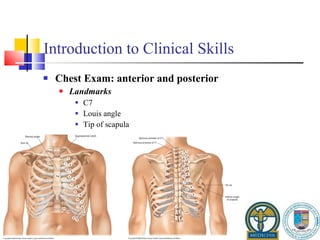
Introduction to Clinical Skills Chest Exam: anterior and posterior Landmarks C7 Louis angle Tip of scapula
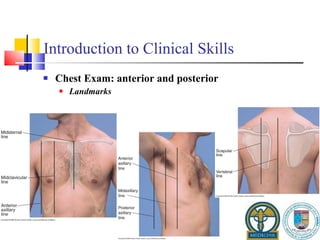
Introduction to Clinical Skills Chest Exam: anterior and posterior Landmarks
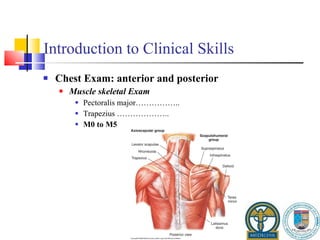
Introduction to Clinical Skills Chest Exam: anterior and posterior Muscle skeletal Exam Pectoralis major…………….. Trapezius ……………….. M0 to M5
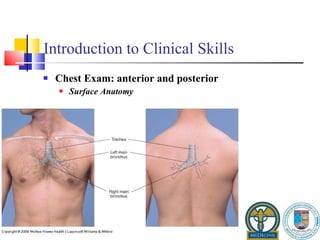
Introduction to Clinical Skills Chest Exam: anterior and posterior Surface Anatomy
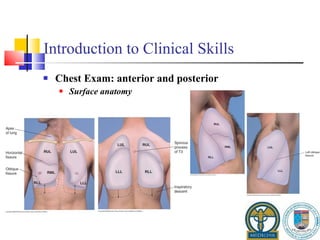
Introduction to Clinical Skills Chest Exam: anterior and posterior Surface anatomy
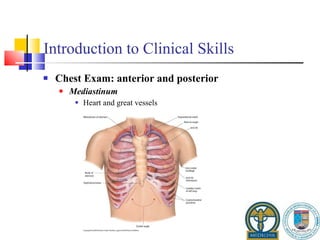
Introduction to Clinical Skills Chest Exam: anterior and posterior Mediastinum Heart and great vessels
Introduction to Clinical Skills Chest Exam: anterior and posterior The Lungs The Trachea and major bronchi The Pleurae Lungs , Fissures and Lobes Breathing
Introduction to Clinical Skills Chest Exam: anterior and posterior The Health History Chest pain Myocardium, Pericardium, Aorta Trachea and large bronchi, Pleura  (parietal) Chest wall Esophagus Extrathoracic :  Gallbladder, Stomach Shortness of breath (dyspnea) Wheezing Cough Blood-streaked sputum (hemoptysis)
Introduction to Clinical Skills Chest Exam: anterior and posterior Health Promotion and Counseling Tobacco cessation CAD, Stroke, PVD COPD Cancer Immunizations Influenza Neumococcus
Introduction to Clinical Skills Chest Exam: anterior  and posterior Techniques of Examination Assess patient Color Observe and Listen patient´s breathing Rate, Rythm, Depth and Effort of breathing Inspect the neck Observe shape of the Chest
Introduction to Clinical Skills Chest Exam: anterior and posterior Techniques of Examination Inspection Palpation Percussion Auscultation
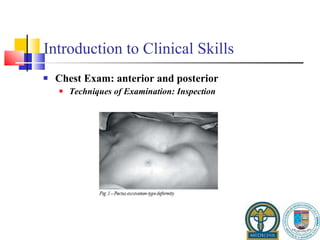
Introduction to Clinical Skills Chest Exam: anterior and posterior Techniques of Examination: Inspection
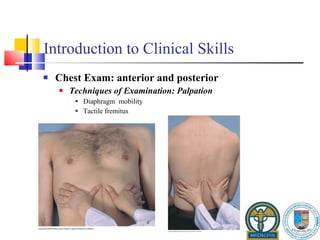
Introduction to Clinical Skills Chest Exam: anterior and posterior Techniques of Examination: Palpation Diaphragm  mobility Tactile fremitus
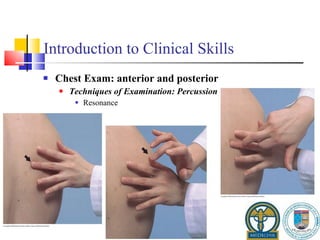
Introduction to Clinical Skills Chest Exam: anterior and posterior Techniques of Examination: Percussion Resonance
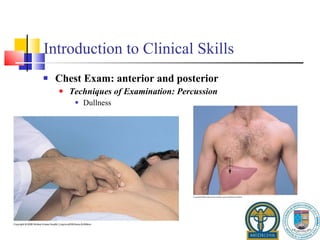
Introduction to Clinical Skills Chest Exam: anterior and posterior Techniques of Examination: Percussion Dullness
Introduction to Clinical Skills Chest Exam: anterior and posterior Techniques of Examination: Percussion
Introduction to Clinical Skills Chest Exam: anterior and posterior Techniques of Examination: Auscultation
Introduction to Clinical Skills Chest Exam: anterior and posterior The Thorax and Lungs. Recording findings “ Thorax is symmetric with good expansion. Lungs resonant. Breath sounds vesicular, no rales, wheezes, or rhonchi. Diaphragms descend 4 cm bilaterally”.
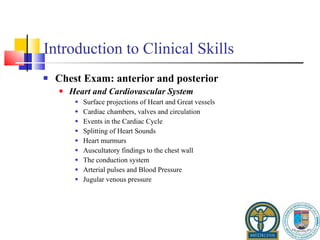
Introduction to Clinical Skills Chest Exam: anterior and posterior Heart and Cardiovascular System Surface projections of Heart and Great vessels Cardiac chambers, valves and circulation Events in the Cardiac Cycle Splitting of Heart Sounds Heart murmurs Auscultatory findings to the chest wall The conduction system Arterial pulses and Blood Pressure Jugular venous pressure
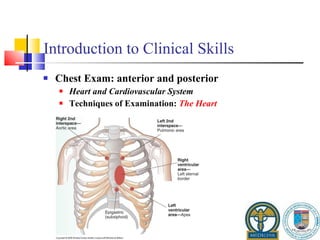
Introduction to Clinical Skills Chest Exam: anterior and posterior Heart and Cardiovascular System Surface projections of Heart and Great vessels
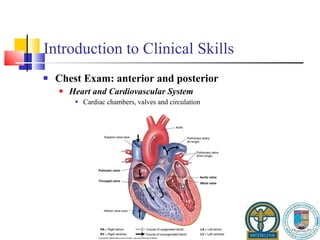
Introduction to Clinical Skills Chest Exam: anterior and posterior Heart and Cardiovascular System Cardiac chambers, valves and circulation
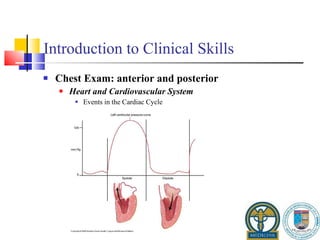
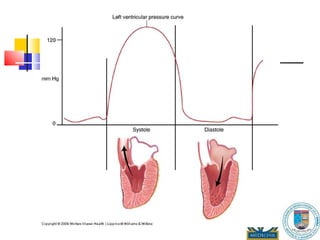
Introduction to Clinical Skills Chest Exam: anterior and posterior Heart and Cardiovascular System Events in the Cardiac Cycle
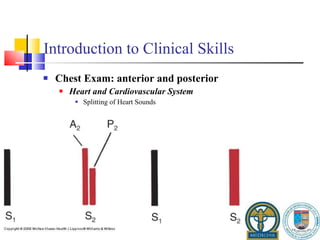
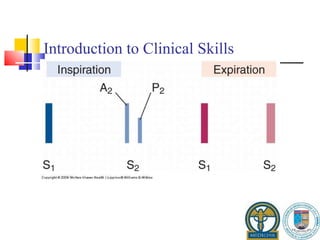
Introduction to Clinical Skills Chest Exam: anterior and posterior Heart and Cardiovascular System Splitting of Heart Sounds
Introduction to Clinical Skills Chest Exam: anterior and posterior Heart and Cardiovascular System Turbulence = Heart murmurs (physiologic) http://www.wilkes.med.ucla.edu/intro.html
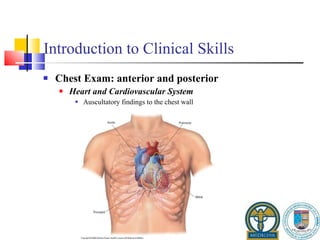
Introduction to Clinical Skills Chest Exam: anterior and posterior Heart and Cardiovascular System Auscultatory findings to the chest wall
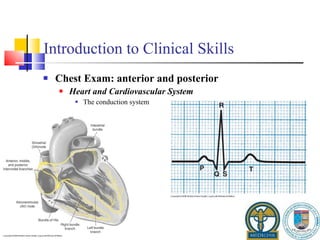
Introduction to Clinical Skills Chest Exam: anterior and posterior Heart and Cardiovascular System The conduction system
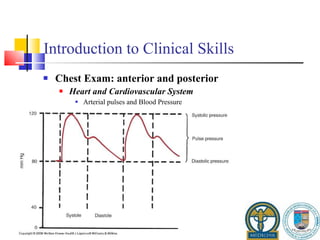
Introduction to Clinical Skills Chest Exam: anterior and posterior Heart and Cardiovascular System Arterial pulses and Blood Pressure
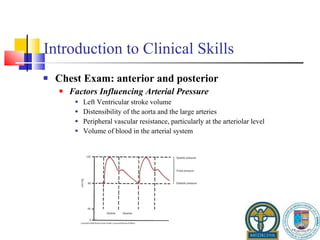
Introduction to Clinical Skills Chest Exam: anterior and posterior Factors Influencing Arterial Pressure Left Ventricular stroke volume Distensibility of the aorta and the large arteries Peripheral vascular resistance, particularly at the arteriolar level Volume of blood in the arterial system
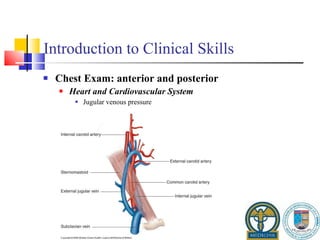
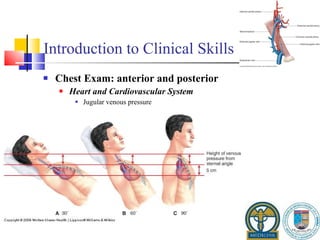
Introduction to Clinical Skills Chest Exam: anterior and posterior Heart and Cardiovascular System Jugular venous pressure
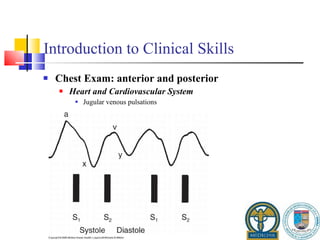
Introduction to Clinical Skills Chest Exam: anterior and posterior Heart and Cardiovascular System Jugular venous pulsations
Introduction to Clinical Skills Chest Exam: anterior and posterior Heart and Cardiovascular System The Health History Chest pain Palpitations Shortness of breath Dyspnea Orthopnea Paroxysmal dyspnea Swelling or edema
Introduction to Clinical Skills Chest Exam: anterior and posterior Heart and Cardiovascular System Health Promotion and Counseling Screening for hypertension Screening for coronary heart disease and stroke Screening for dyslipidemias Promoting lifestyle modification and risk - factor reduction
Introduction to Clinical Skills Chest Exam: anterior and posterior Heart and Cardiovascular System Techniques of Examination Jugular Venous Pressure and Pulsations The Carotid Pulse The Heart Functional Murmurs
Introduction to Clinical Skills Chest Exam: anterior and posterior Heart and Cardiovascular System Techniques of Examination:  JVP and pulsations
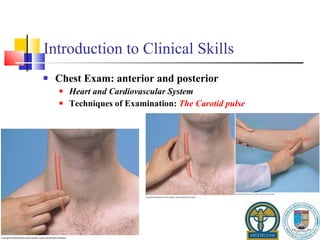
Introduction to Clinical Skills Chest Exam: anterior and posterior Heart and Cardiovascular System Techniques of Examination:  The Carotid pulse
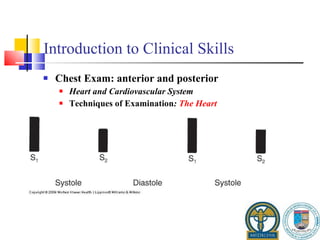
Introduction to Clinical Skills Chest Exam: anterior and posterior Heart and Cardiovascular System Techniques of Examination :  The Heart
Introduction to Clinical Skills Chest Exam: anterior and posterior
Introduction to Clinical Skills Chest Exam: anterior and posterior Heart and Cardiovascular System Techniques of Examination:  The Heart
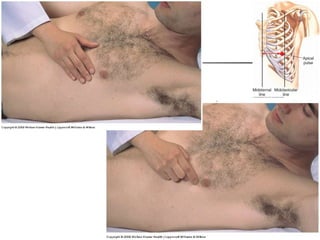
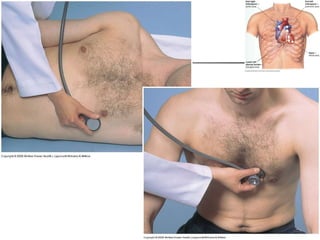
Heart and Cardiovascular System Techniques of Examination: The Heart
 
Introduction to Clinical Skills Chest Exam: anterior and posterior Heart and Cardiovascular System Techniques of Examination Functional Murmurs
Introduction to Clinical Skills Chest Exam: anterior and posterior Heart and Cardiovascular System Recording your Findings “  The Jugular venous pulse is 3 cm above the sternal angle with the head of the bed elevated to 30°. Carotid upstrokes are brisk, without bruits. The point of maximal impulse is tapping, 7 cms lateral to the midsternal line in the 5th intercostal space. Crisp S1 and S2. At the base S2 is greater than S1 and physiologically split, with A2 > P2. At the apex S1 is greater than S2 and constant. No murmurs or extrasounds.”
 

Thorax, lungs and cvc system

  • 1.
    Introduction to ClinicalSkills Thorax, Lungs and CVC system Universidad Iberoamericana UNIBE
  • 2.
    Introduction to ClinicalSkills Teaching Staff Dra Elizabeth Peralta Dr Marcos Núñez Dra Cristina Páez C Dr Juan Carlos Mariñez Dra Wayna Greo Dra Yun Pey Lee
  • 3.
    Introduction to ClinicalSkills Chest Exam: anterior and posterior Landmarks Muscle skeletal Mediastinum Lungs Heart
  • 4.
    Introduction to ClinicalSkills Chest Exam: anterior and posterior Landmarks C7 Louis angle Tip of scapula
  • 5.
    Introduction to ClinicalSkills Chest Exam: anterior and posterior Landmarks
  • 6.
    Introduction to ClinicalSkills Chest Exam: anterior and posterior Muscle skeletal Exam Pectoralis major…………….. Trapezius ……………….. M0 to M5
  • 7.
    Introduction to ClinicalSkills Chest Exam: anterior and posterior Surface Anatomy
  • 8.
    Introduction to ClinicalSkills Chest Exam: anterior and posterior Surface anatomy
  • 9.
    Introduction to ClinicalSkills Chest Exam: anterior and posterior Mediastinum Heart and great vessels
  • 10.
    Introduction to ClinicalSkills Chest Exam: anterior and posterior The Lungs The Trachea and major bronchi The Pleurae Lungs , Fissures and Lobes Breathing
  • 11.
    Introduction to ClinicalSkills Chest Exam: anterior and posterior The Health History Chest pain Myocardium, Pericardium, Aorta Trachea and large bronchi, Pleura (parietal) Chest wall Esophagus Extrathoracic : Gallbladder, Stomach Shortness of breath (dyspnea) Wheezing Cough Blood-streaked sputum (hemoptysis)
  • 12.
    Introduction to ClinicalSkills Chest Exam: anterior and posterior Health Promotion and Counseling Tobacco cessation CAD, Stroke, PVD COPD Cancer Immunizations Influenza Neumococcus
  • 13.
    Introduction to ClinicalSkills Chest Exam: anterior and posterior Techniques of Examination Assess patient Color Observe and Listen patient´s breathing Rate, Rythm, Depth and Effort of breathing Inspect the neck Observe shape of the Chest
  • 14.
    Introduction to ClinicalSkills Chest Exam: anterior and posterior Techniques of Examination Inspection Palpation Percussion Auscultation
  • 15.
    Introduction to ClinicalSkills Chest Exam: anterior and posterior Techniques of Examination: Inspection
  • 16.
    Introduction to ClinicalSkills Chest Exam: anterior and posterior Techniques of Examination: Palpation Diaphragm mobility Tactile fremitus
  • 17.
    Introduction to ClinicalSkills Chest Exam: anterior and posterior Techniques of Examination: Percussion Resonance
  • 18.
    Introduction to ClinicalSkills Chest Exam: anterior and posterior Techniques of Examination: Percussion Dullness
  • 19.
    Introduction to ClinicalSkills Chest Exam: anterior and posterior Techniques of Examination: Percussion
  • 20.
    Introduction to ClinicalSkills Chest Exam: anterior and posterior Techniques of Examination: Auscultation
  • 21.
    Introduction to ClinicalSkills Chest Exam: anterior and posterior The Thorax and Lungs. Recording findings “ Thorax is symmetric with good expansion. Lungs resonant. Breath sounds vesicular, no rales, wheezes, or rhonchi. Diaphragms descend 4 cm bilaterally”.
  • 22.
    Introduction to ClinicalSkills Chest Exam: anterior and posterior Heart and Cardiovascular System Surface projections of Heart and Great vessels Cardiac chambers, valves and circulation Events in the Cardiac Cycle Splitting of Heart Sounds Heart murmurs Auscultatory findings to the chest wall The conduction system Arterial pulses and Blood Pressure Jugular venous pressure
  • 23.
    Introduction to ClinicalSkills Chest Exam: anterior and posterior Heart and Cardiovascular System Surface projections of Heart and Great vessels
  • 24.
    Introduction to ClinicalSkills Chest Exam: anterior and posterior Heart and Cardiovascular System Cardiac chambers, valves and circulation
  • 25.
    Introduction to ClinicalSkills Chest Exam: anterior and posterior Heart and Cardiovascular System Events in the Cardiac Cycle
  • 26.
    Introduction to ClinicalSkills Chest Exam: anterior and posterior Heart and Cardiovascular System Events in the Cardiac Cycle
  • 27.
    Introduction to ClinicalSkills Chest Exam: anterior and posterior Heart and Cardiovascular System Splitting of Heart Sounds
  • 28.
    Introduction to ClinicalSkills Chest Exam: anterior and posterior Heart and Cardiovascular System Turbulence = Heart murmurs (physiologic) http://www.wilkes.med.ucla.edu/intro.html
  • 29.
    Introduction to ClinicalSkills Chest Exam: anterior and posterior Heart and Cardiovascular System Auscultatory findings to the chest wall
  • 30.
    Introduction to ClinicalSkills Chest Exam: anterior and posterior Heart and Cardiovascular System The conduction system
  • 31.
    Introduction to ClinicalSkills Chest Exam: anterior and posterior Heart and Cardiovascular System Arterial pulses and Blood Pressure
  • 32.
    Introduction to ClinicalSkills Chest Exam: anterior and posterior Factors Influencing Arterial Pressure Left Ventricular stroke volume Distensibility of the aorta and the large arteries Peripheral vascular resistance, particularly at the arteriolar level Volume of blood in the arterial system
  • 33.
    Introduction to ClinicalSkills Chest Exam: anterior and posterior Heart and Cardiovascular System Jugular venous pressure
  • 34.
    Introduction to ClinicalSkills Chest Exam: anterior and posterior Heart and Cardiovascular System Jugular venous pressure
  • 35.
    Introduction to ClinicalSkills Chest Exam: anterior and posterior Heart and Cardiovascular System Jugular venous pulsations
  • 36.
    Introduction to ClinicalSkills Chest Exam: anterior and posterior Heart and Cardiovascular System The Health History Chest pain Palpitations Shortness of breath Dyspnea Orthopnea Paroxysmal dyspnea Swelling or edema
  • 37.
    Introduction to ClinicalSkills Chest Exam: anterior and posterior Heart and Cardiovascular System Health Promotion and Counseling Screening for hypertension Screening for coronary heart disease and stroke Screening for dyslipidemias Promoting lifestyle modification and risk - factor reduction
  • 38.
    Introduction to ClinicalSkills Chest Exam: anterior and posterior Heart and Cardiovascular System Techniques of Examination Jugular Venous Pressure and Pulsations The Carotid Pulse The Heart Functional Murmurs
  • 39.
    Introduction to ClinicalSkills Chest Exam: anterior and posterior Heart and Cardiovascular System Techniques of Examination: JVP and pulsations
  • 40.
    Introduction to ClinicalSkills Chest Exam: anterior and posterior Heart and Cardiovascular System Techniques of Examination: The Carotid pulse
  • 41.
    Introduction to ClinicalSkills Chest Exam: anterior and posterior Heart and Cardiovascular System Techniques of Examination : The Heart
  • 42.
    Introduction to ClinicalSkills Chest Exam: anterior and posterior
  • 43.
    Introduction to ClinicalSkills Chest Exam: anterior and posterior Heart and Cardiovascular System Techniques of Examination: The Heart
  • 44.
    Heart and CardiovascularSystem Techniques of Examination: The Heart
  • 45.
  • 46.
    Introduction to ClinicalSkills Chest Exam: anterior and posterior Heart and Cardiovascular System Techniques of Examination Functional Murmurs
  • 47.
    Introduction to ClinicalSkills Chest Exam: anterior and posterior Heart and Cardiovascular System Recording your Findings “ The Jugular venous pulse is 3 cm above the sternal angle with the head of the bed elevated to 30°. Carotid upstrokes are brisk, without bruits. The point of maximal impulse is tapping, 7 cms lateral to the midsternal line in the 5th intercostal space. Crisp S1 and S2. At the base S2 is greater than S1 and physiologically split, with A2 > P2. At the apex S1 is greater than S2 and constant. No murmurs or extrasounds.”
  • 48.