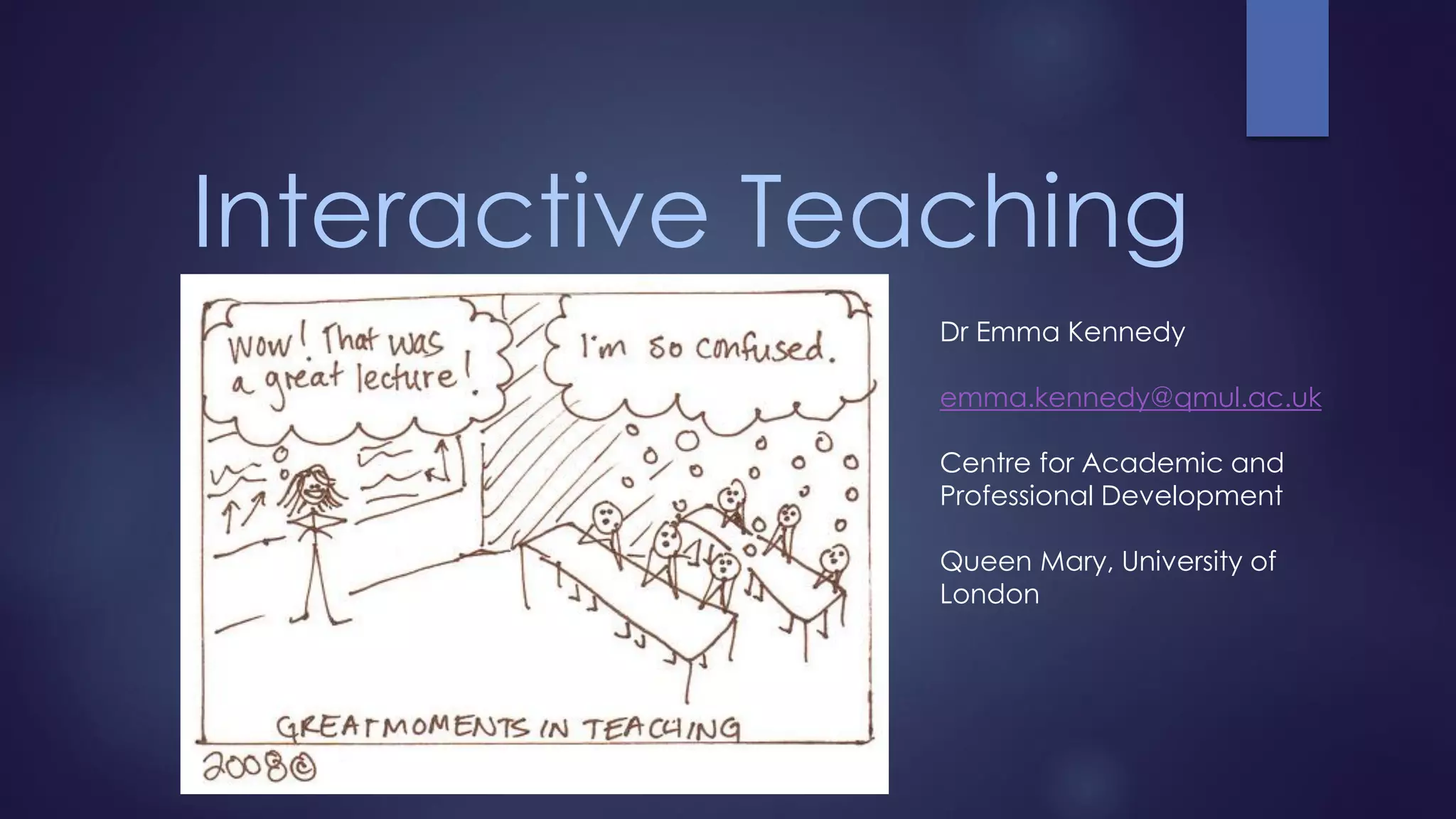
Interactive Teaching
Dr Emma Kennedy
emma.kennedy@qmul.ac.uk
Centre for Academic and
Professional Development
Queen Mary, University of
London
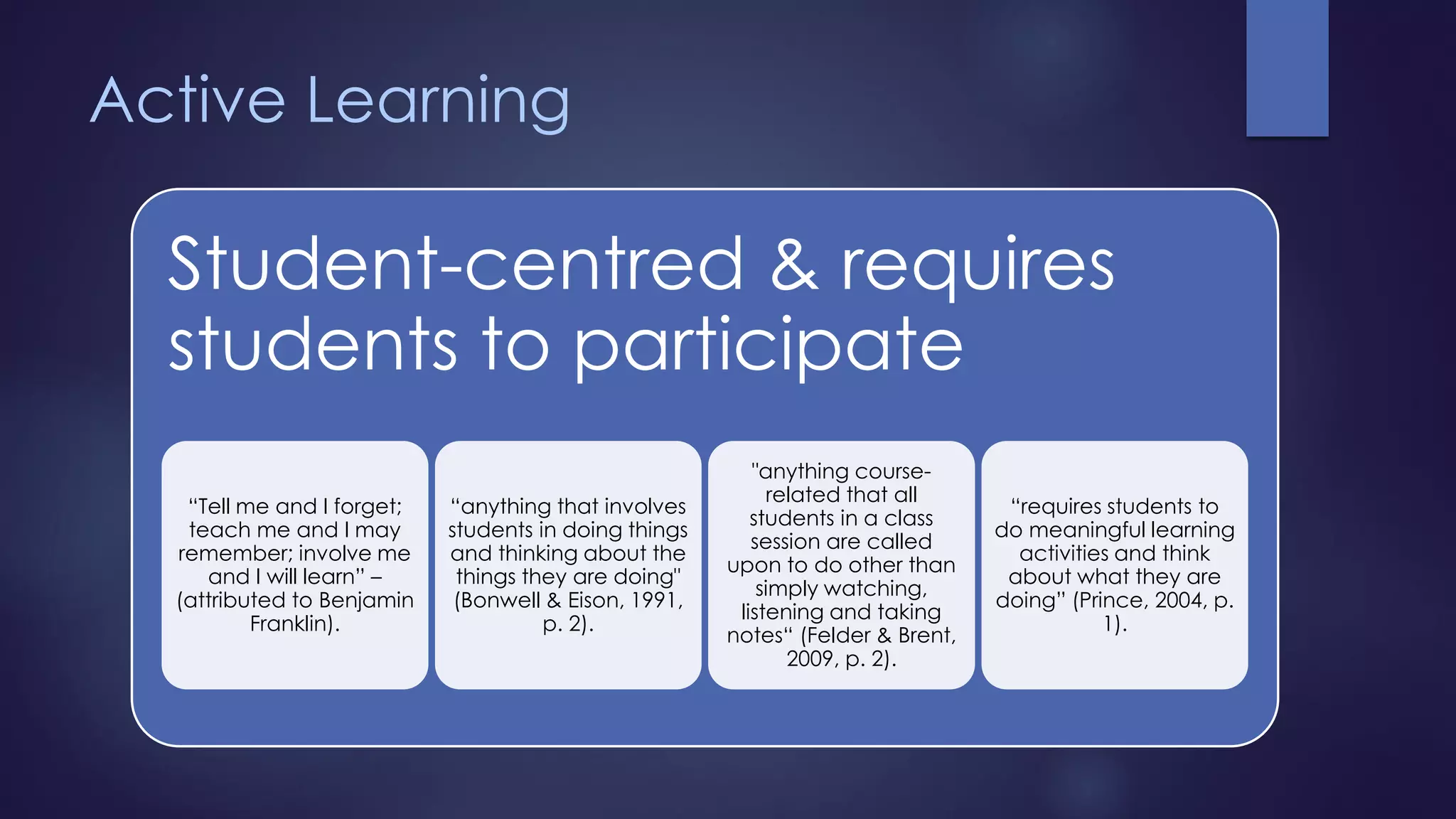
Active Learning
Student-centred & requires
students to participate
“Tell me and I forget;
teach me and I may
remember; involve me
and I will learn” –
(attributed to Benjamin
Franklin).
“anything that involves
students in doing things
and thinking about the
things they are doing"
(Bonwell & Eison, 1991,
p. 2).
"anything course-
related that all
students in a class
session are called
upon to do other than
simply watching,
listening and taking
notes“ (Felder & Brent,
2009, p. 2).
“requires students to
do meaningful learning
activities and think
about what they are
doing” (Prince, 2004, p.
1).
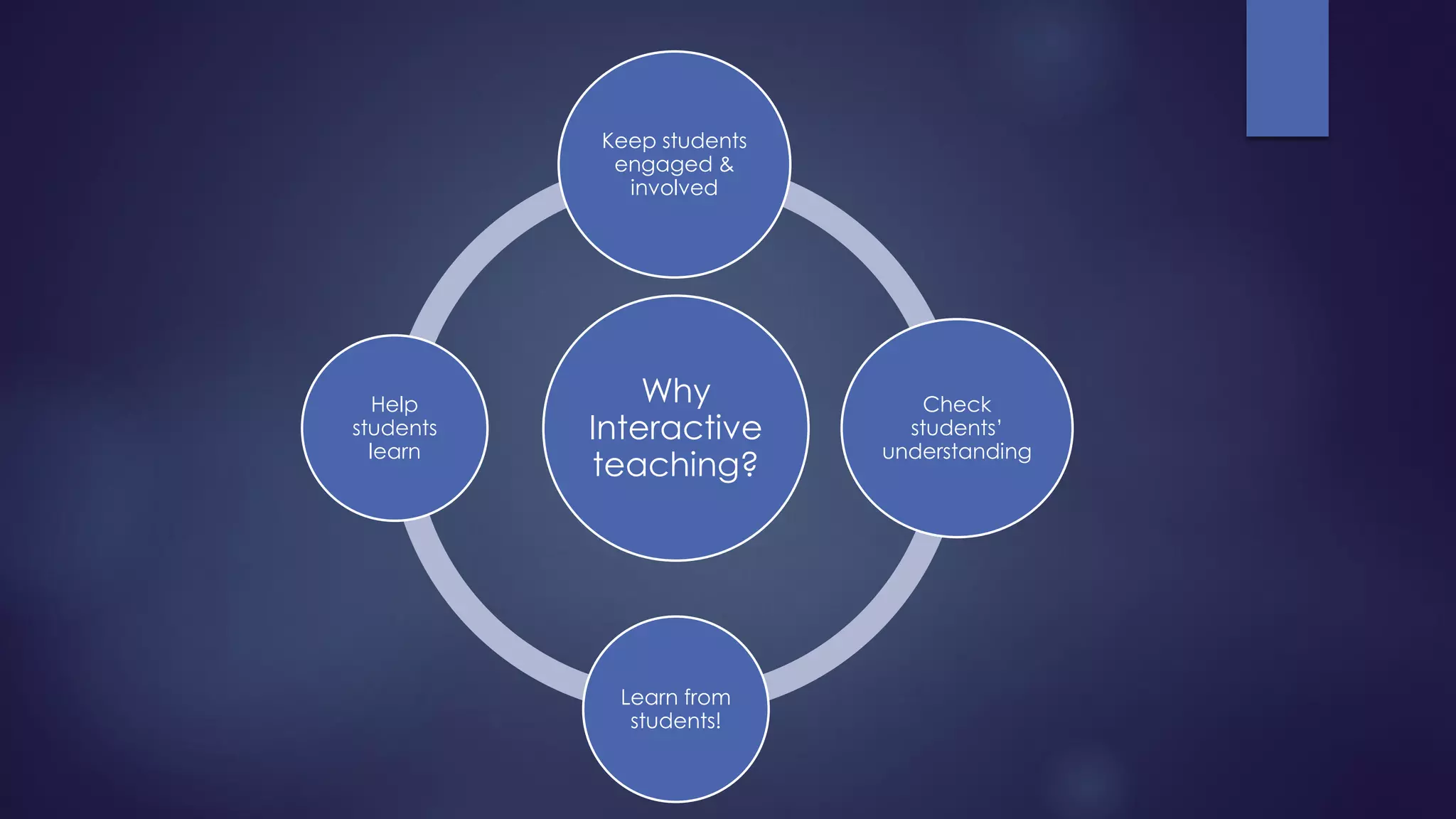
Why
Interactive
teaching?
Keep students
engaged &
involved
Check
students’
understanding
Learn from
students!
Help
students
learn
What does active learning look
and feel like?
 In tables– draw on the whiteboard if you like, and/or describe
a) Words/images to describe active learning.
b) Words/images to describe passive learning
What are they doing in class?
What do they do before and after class?
How do they interact with their peers? 10 minutes in groups
(then feed back)
Keeping students motivated &
involved
Benefits
to attending
(What’s in it for me?)
“Students in […]co-operative
learning classes not only performed at
a level above their peers [who had
lectures] but they also were more
positive about their learning
experience.” (Anderson et al, 2005).
Thaman et al (2013) positive feedback from students:
“Analysis of […] student feedback revealed that most
of the students agreed that active learning strategies
helped them to create interest (89.4%) and better
understanding (94.1%) about the subject.”
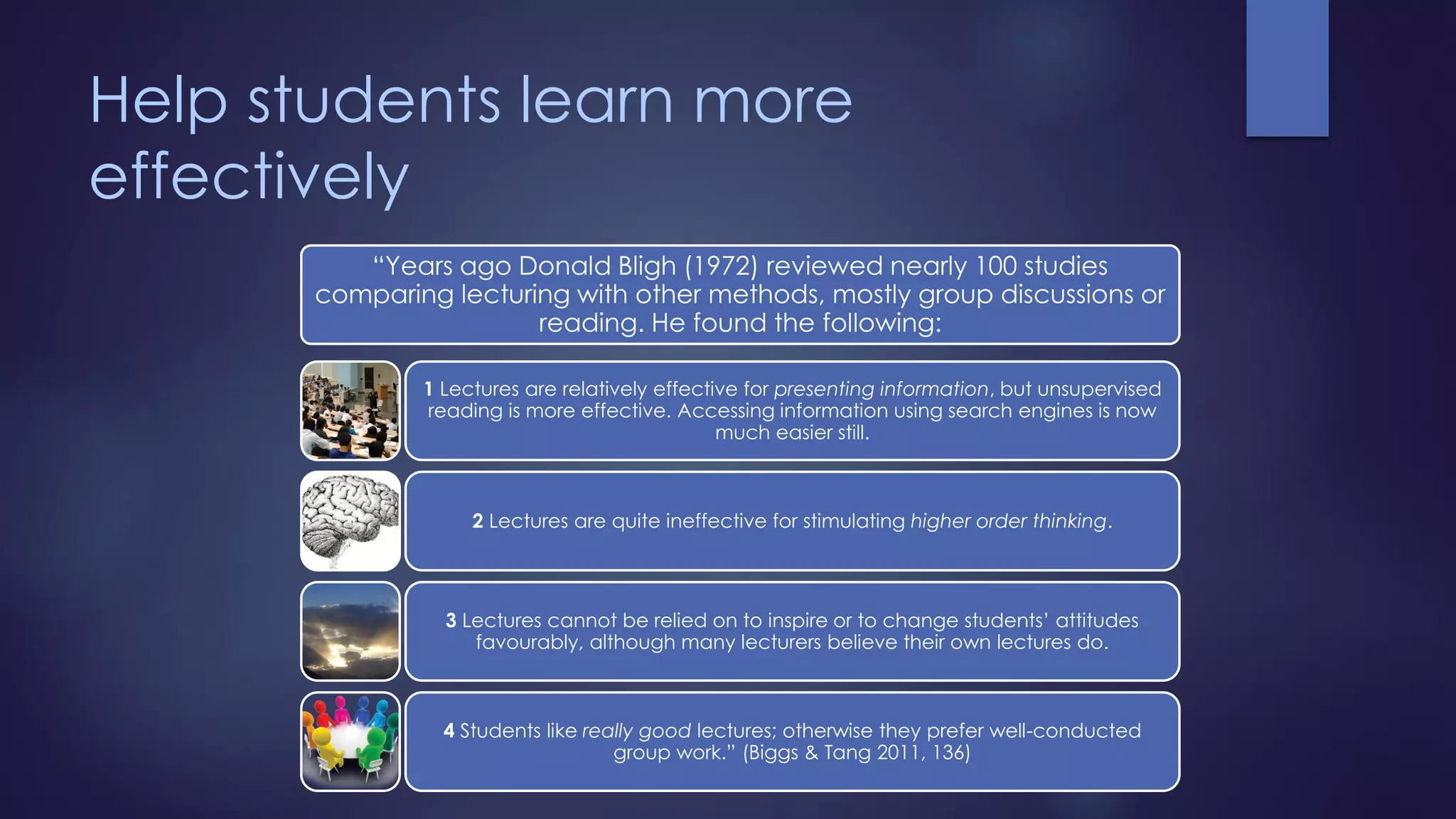
Help students learn more
effectively
“Years ago Donald Bligh (1972) reviewed nearly 100 studies
comparing lecturing with other methods, mostly group discussions or
reading. He found the following:
1 Lectures are relatively effective for presenting information, but unsupervised
reading is more effective. Accessing information using search engines is now
much easier still.
2 Lectures are quite ineffective for stimulating higher order thinking.
3 Lectures cannot be relied on to inspire or to change students’ attitudes
favourably, although many lecturers believe their own lectures do.
4 Students like really good lectures; otherwise they prefer well-conducted
group work.” (Biggs & Tang 2011, 136)
Check students’ understanding
Asking for student responses allows you to correct any
misconceptions – either immediately or at the start of the next
session.
“Students […] have a twofold problem: of following what they are hearing and of writing notes
for later reference. They can’t do both simultaneously so they alternate between listening and
writing. But while they are writing the gist down, the lecturer is sentences ahead. Their notes
are therefore a random sample of a fraction of what the teacher was saying. And with only a
fraction of the trees, they have to reconstruct the whole wood” (Biggs & Tang, 2011, 143)
As experts in our subject, we forget the sheer number of ways in
which students may misunderstand our subject, the number of
“silly” mistakes they might make in their thinking.
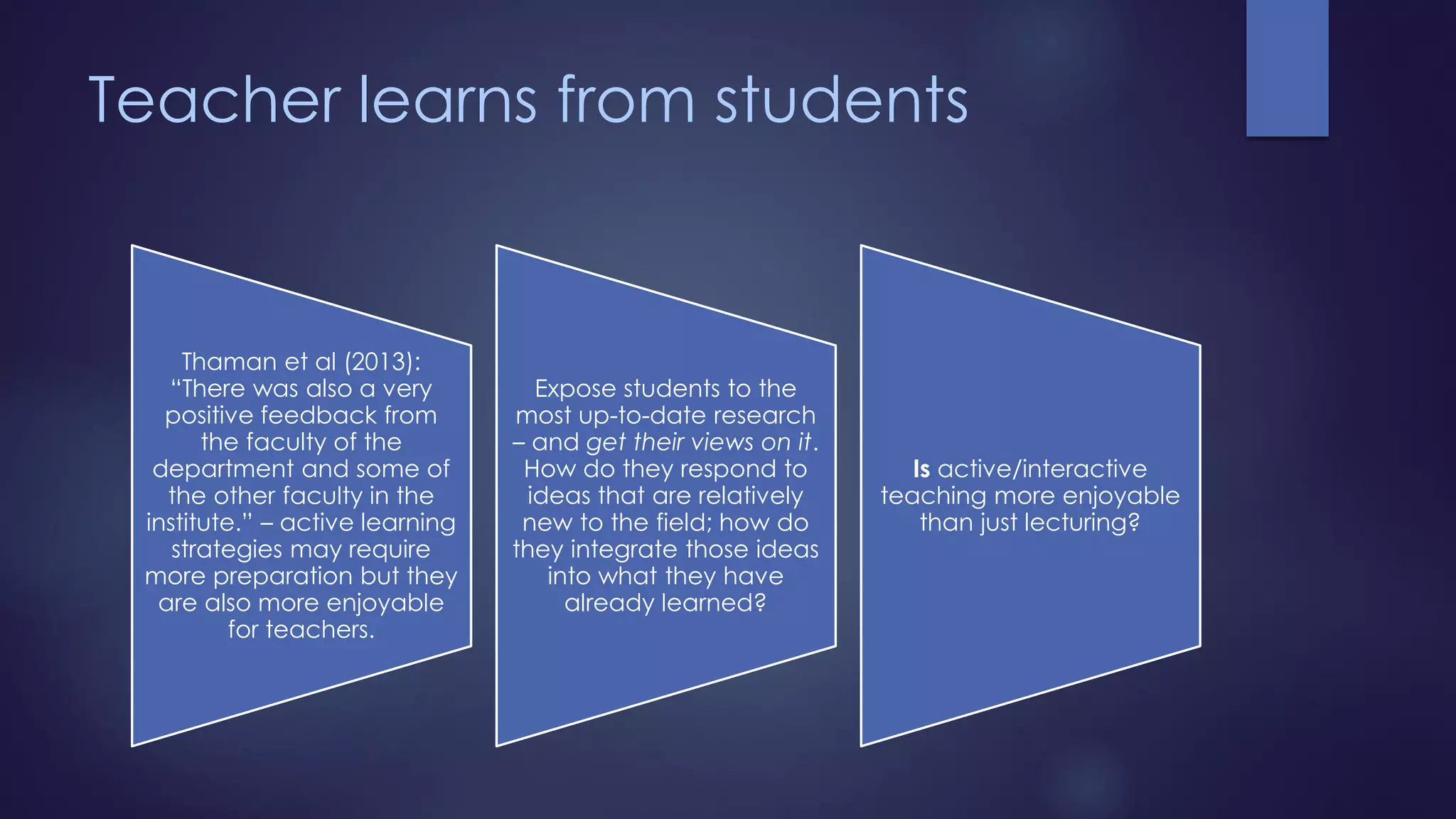
Teacher learns from students
Thaman et al (2013):
“There was also a very
positive feedback from
the faculty of the
department and some of
the other faculty in the
institute.” – active learning
strategies may require
more preparation but they
are also more enjoyable
for teachers.
Expose students to the
most up-to-date research
– and get their views on it.
How do they respond to
ideas that are relatively
new to the field; how do
they integrate those ideas
into what they have
already learned?
Is active/interactive
teaching more enjoyable
than just lecturing?
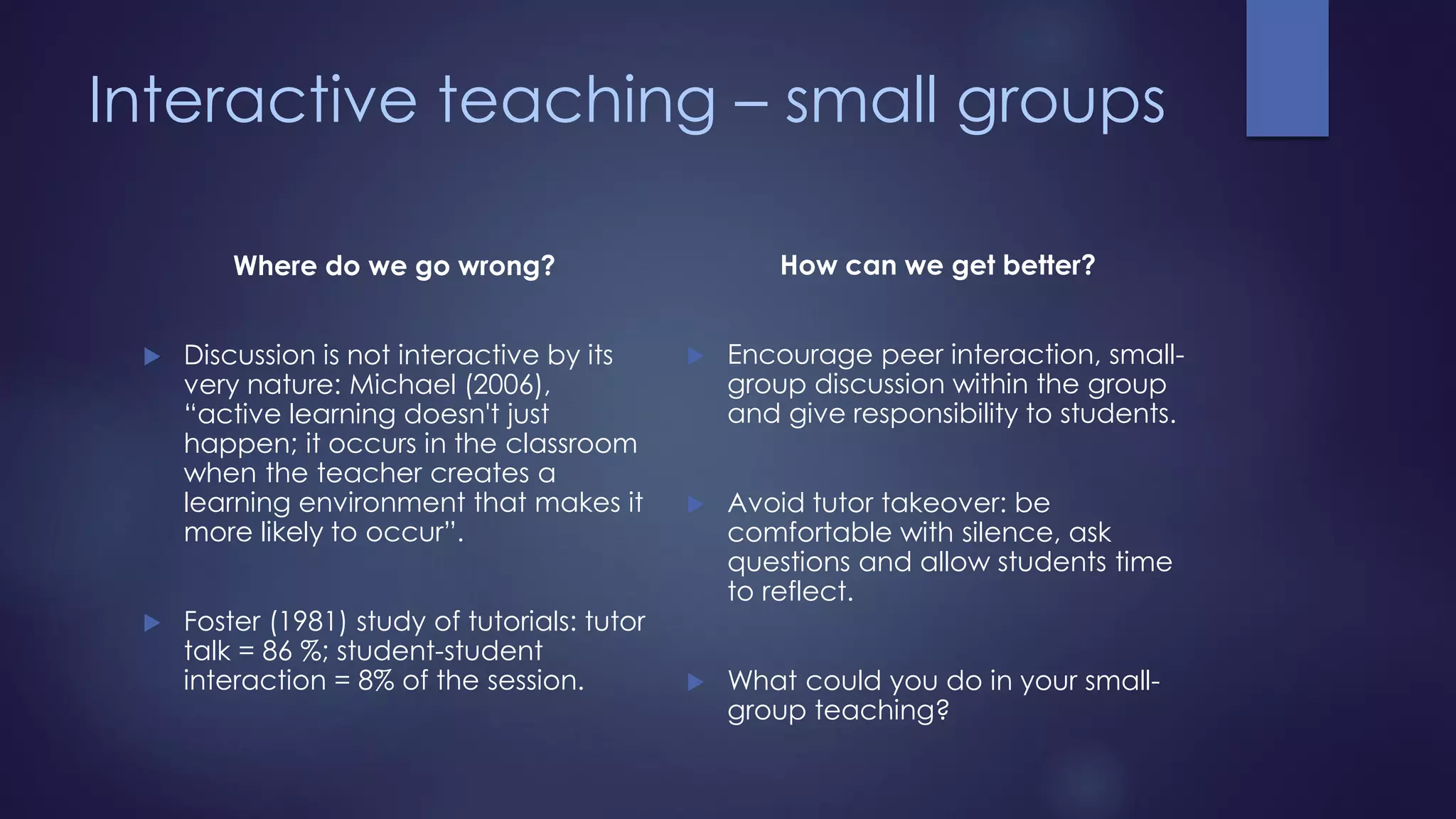
Interactive teaching – small groups
Where do we go wrong?
 Discussion is not interactive by its
very nature: Michael (2006),
“active learning doesn't just
happen; it occurs in the classroom
when the teacher creates a
learning environment that makes it
more likely to occur”.
 Foster (1981) study of tutorials: tutor
talk = 86 %; student-student
interaction = 8% of the session.
How can we get better?
 Encourage peer interaction, small-
group discussion within the group
and give responsibility to students.
 Avoid tutor takeover: be
comfortable with silence, ask
questions and allow students time
to reflect.
 What could you do in your small-
group teaching?
Interactive teaching – large groups
Where do we go wrong?
 “Sustained and unchanging low-level activity
requires concentration. Sitting listening to a
lecture is such an activity. Yet it requires
concentrated effort to follow lecture content. […]
The low-level outcomes usually gained from the
lecture are in large part due to the unbroken
activities of listening and note-taking”(Biggs, 2011,
137)
How can we get better?
 Prince (2004) pp. 3-4: introducing even small amounts of
activity to the standard lecture improves retention of
information & engagement.
 Stop the ‘unbroken’ note-taking activity and give students
a chance to reflect and understand what they have just
written down, & to check their understanding
These two graphs show the
changing performance of
students during a 90 minute
lecture: without
questions/breaks (L) & with
questions every 15 min (R).
(Biggs & Tang 2011, 137)
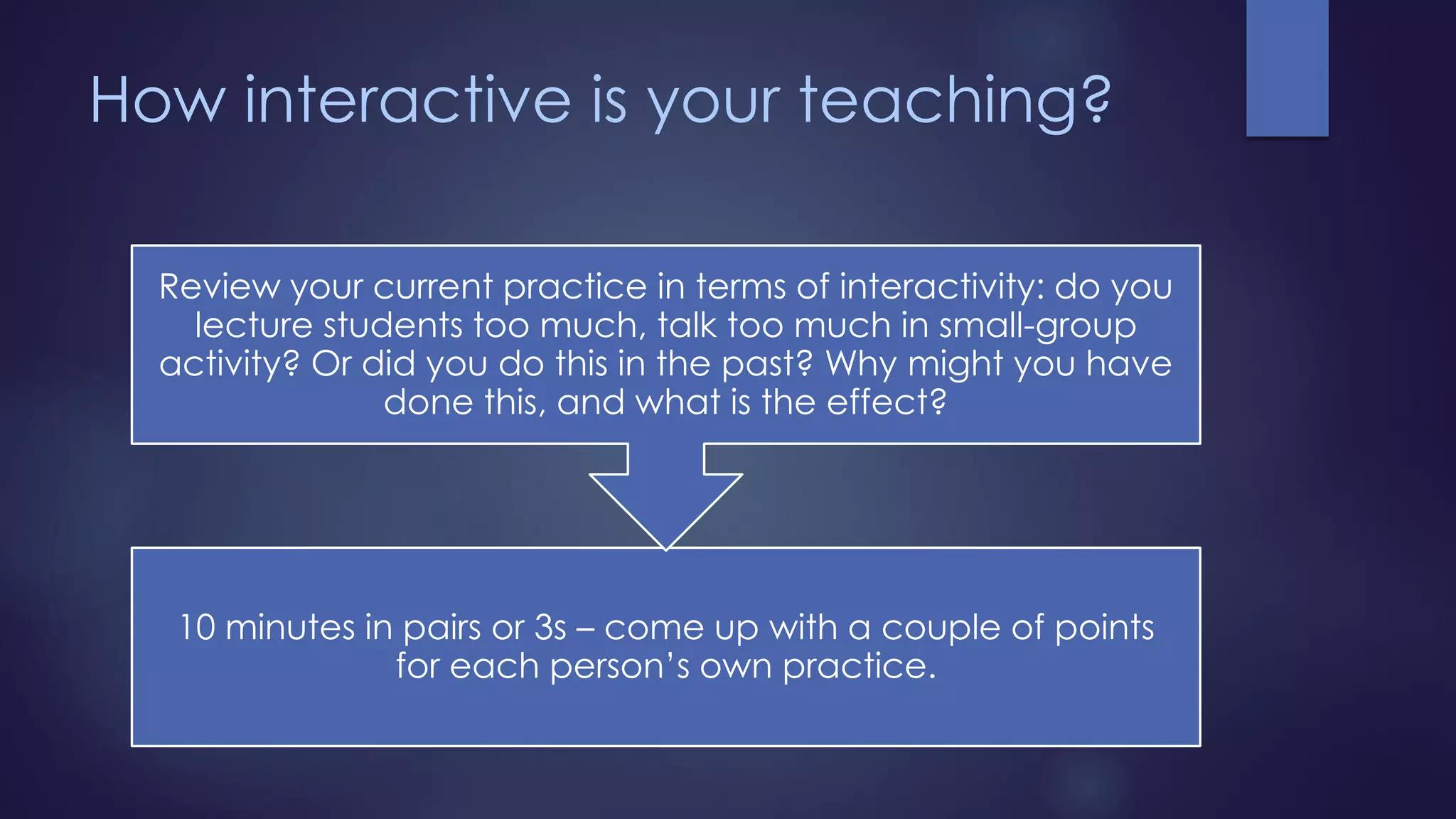
How interactive is your teaching?
10 minutes in pairs or 3s – come up with a couple of points
for each person’s own practice.
Review your current practice in terms of interactivity: do you
lecture students too much, talk too much in small-group
activity? Or did you do this in the past? Why might you have
done this, and what is the effect?
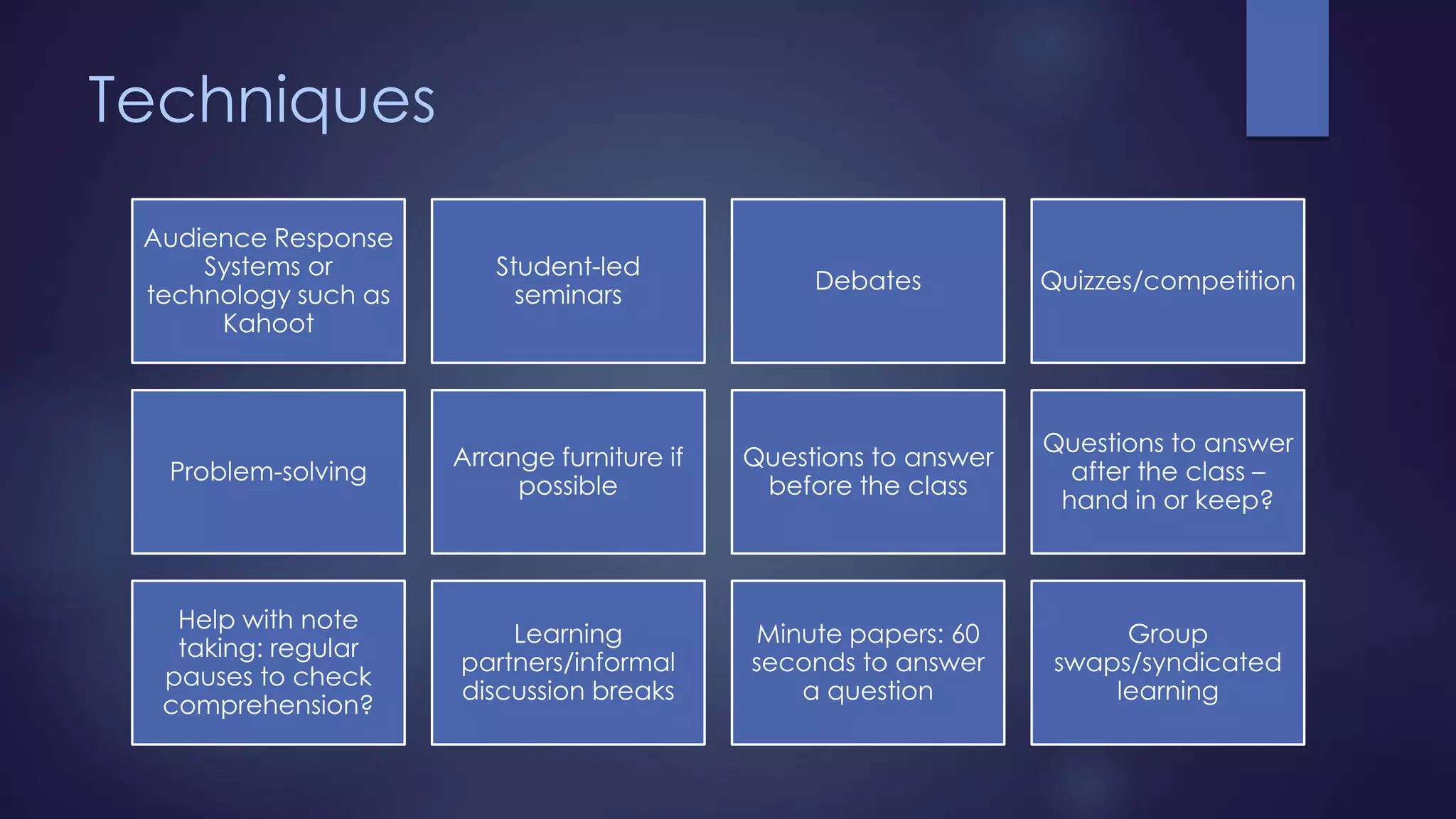
Techniques
Audience Response
Systems or
technology such as
Kahoot
Student-led
seminars
Debates Quizzes/competition
Problem-solving
Arrange furniture if
possible
Questions to answer
before the class
Questions to answer
after the class –
hand in or keep?
Help with note
taking: regular
pauses to check
comprehension?
Learning
partners/informal
discussion breaks
Minute papers: 60
seconds to answer
a question
Group
swaps/syndicated
learning
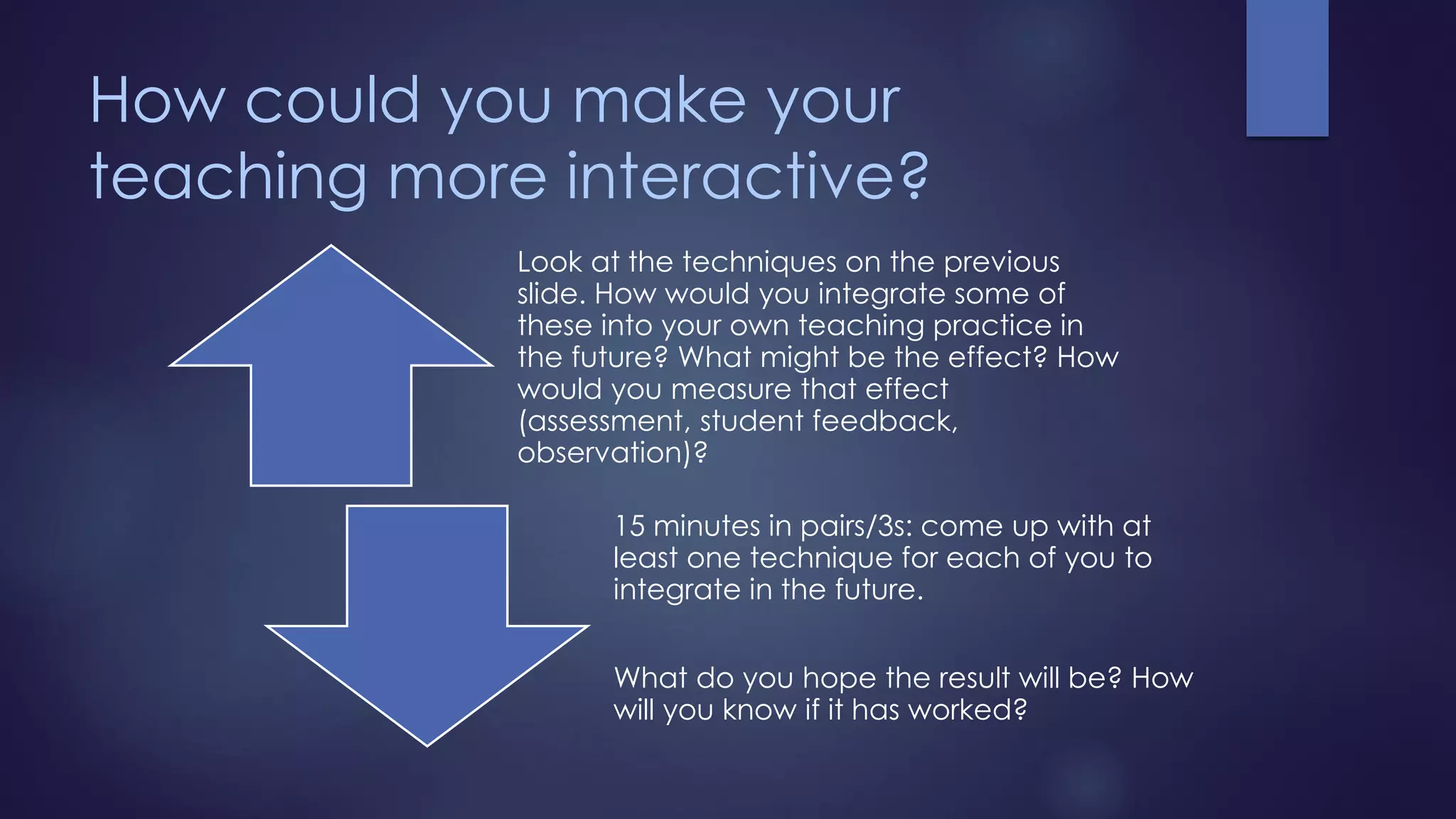
How could you make your
teaching more interactive?
Look at the techniques on the previous
slide. How would you integrate some of
these into your own teaching practice in
the future? What might be the effect? How
would you measure that effect
(assessment, student feedback,
observation)?
15 minutes in pairs/3s: come up with at
least one technique for each of you to
integrate in the future.
What do you hope the result will be? How
will you know if it has worked?
References
 Anderson et al (2005). Comparison of student performance in cooperative learning
and traditional lecture-based biochemistry classes. Biochemistry and Molecular
Biology Education, 33: 6, pp. 387-393.
 Biggs, J & Tang, C. (1999, 2011) Teaching for Quality Learning at University. Open
University Press.
 Bonwell, C. C., & Eison, J. A. (1991). Active learning: Creating excitement in the
classroom (ASHE–ERIC Higher Education Rep. No. 1). Washington, DC: The George
Washington University, School of Education and Human Development.
 Freeman et al (2014). ‘Active learning increases student performance in science,
engineering, and mathematics’. Proceedings of the National Academy of Sciences
of the USA, 111:23, 8410-8415.
 Michael, J. (2006). ‘Where’s the evidence that active learning works?’ Advances in
Physiology Education 30:4, 159-167.
 Prince (2004). ‘Does active learning work? A Review of the Research’ Journal of
Engineering Education 93: 3, 223-231.
 Thaman et al (2013). ‘Promoting Active Learning in Respiratory Physiology’ National
Journal of Physiology, Pharmacy & Pharmacology 3: 1, 27 – 34.
 https://www.amacad.org/content/publications/pubContent.aspx?d=1111

Interactive Teaching: an ADEPT workshop by Emma Kennedy, QMUL

  • 1.
    Interactive Teaching Dr EmmaKennedy emma.kennedy@qmul.ac.uk Centre for Academic and Professional Development Queen Mary, University of London
  • 2.
    Active Learning Student-centred &requires students to participate “Tell me and I forget; teach me and I may remember; involve me and I will learn” – (attributed to Benjamin Franklin). “anything that involves students in doing things and thinking about the things they are doing" (Bonwell & Eison, 1991, p. 2). "anything course- related that all students in a class session are called upon to do other than simply watching, listening and taking notes“ (Felder & Brent, 2009, p. 2). “requires students to do meaningful learning activities and think about what they are doing” (Prince, 2004, p. 1).
  • 3.
  • 4.
    What does activelearning look and feel like?  In tables– draw on the whiteboard if you like, and/or describe a) Words/images to describe active learning. b) Words/images to describe passive learning What are they doing in class? What do they do before and after class? How do they interact with their peers? 10 minutes in groups (then feed back)
  • 5.
    Keeping students motivated& involved Benefits to attending (What’s in it for me?) “Students in […]co-operative learning classes not only performed at a level above their peers [who had lectures] but they also were more positive about their learning experience.” (Anderson et al, 2005). Thaman et al (2013) positive feedback from students: “Analysis of […] student feedback revealed that most of the students agreed that active learning strategies helped them to create interest (89.4%) and better understanding (94.1%) about the subject.”
  • 6.
    Help students learnmore effectively “Years ago Donald Bligh (1972) reviewed nearly 100 studies comparing lecturing with other methods, mostly group discussions or reading. He found the following: 1 Lectures are relatively effective for presenting information, but unsupervised reading is more effective. Accessing information using search engines is now much easier still. 2 Lectures are quite ineffective for stimulating higher order thinking. 3 Lectures cannot be relied on to inspire or to change students’ attitudes favourably, although many lecturers believe their own lectures do. 4 Students like really good lectures; otherwise they prefer well-conducted group work.” (Biggs & Tang 2011, 136)
  • 7.
    Check students’ understanding Askingfor student responses allows you to correct any misconceptions – either immediately or at the start of the next session. “Students […] have a twofold problem: of following what they are hearing and of writing notes for later reference. They can’t do both simultaneously so they alternate between listening and writing. But while they are writing the gist down, the lecturer is sentences ahead. Their notes are therefore a random sample of a fraction of what the teacher was saying. And with only a fraction of the trees, they have to reconstruct the whole wood” (Biggs & Tang, 2011, 143) As experts in our subject, we forget the sheer number of ways in which students may misunderstand our subject, the number of “silly” mistakes they might make in their thinking.
  • 8.
    Teacher learns fromstudents Thaman et al (2013): “There was also a very positive feedback from the faculty of the department and some of the other faculty in the institute.” – active learning strategies may require more preparation but they are also more enjoyable for teachers. Expose students to the most up-to-date research – and get their views on it. How do they respond to ideas that are relatively new to the field; how do they integrate those ideas into what they have already learned? Is active/interactive teaching more enjoyable than just lecturing?
  • 9.
    Interactive teaching –small groups Where do we go wrong?  Discussion is not interactive by its very nature: Michael (2006), “active learning doesn't just happen; it occurs in the classroom when the teacher creates a learning environment that makes it more likely to occur”.  Foster (1981) study of tutorials: tutor talk = 86 %; student-student interaction = 8% of the session. How can we get better?  Encourage peer interaction, small- group discussion within the group and give responsibility to students.  Avoid tutor takeover: be comfortable with silence, ask questions and allow students time to reflect.  What could you do in your small- group teaching?
  • 10.
    Interactive teaching –large groups Where do we go wrong?  “Sustained and unchanging low-level activity requires concentration. Sitting listening to a lecture is such an activity. Yet it requires concentrated effort to follow lecture content. […] The low-level outcomes usually gained from the lecture are in large part due to the unbroken activities of listening and note-taking”(Biggs, 2011, 137) How can we get better?  Prince (2004) pp. 3-4: introducing even small amounts of activity to the standard lecture improves retention of information & engagement.  Stop the ‘unbroken’ note-taking activity and give students a chance to reflect and understand what they have just written down, & to check their understanding These two graphs show the changing performance of students during a 90 minute lecture: without questions/breaks (L) & with questions every 15 min (R). (Biggs & Tang 2011, 137)
  • 11.
    How interactive isyour teaching? 10 minutes in pairs or 3s – come up with a couple of points for each person’s own practice. Review your current practice in terms of interactivity: do you lecture students too much, talk too much in small-group activity? Or did you do this in the past? Why might you have done this, and what is the effect?
  • 12.
    Techniques Audience Response Systems or technologysuch as Kahoot Student-led seminars Debates Quizzes/competition Problem-solving Arrange furniture if possible Questions to answer before the class Questions to answer after the class – hand in or keep? Help with note taking: regular pauses to check comprehension? Learning partners/informal discussion breaks Minute papers: 60 seconds to answer a question Group swaps/syndicated learning
  • 13.
    How could youmake your teaching more interactive? Look at the techniques on the previous slide. How would you integrate some of these into your own teaching practice in the future? What might be the effect? How would you measure that effect (assessment, student feedback, observation)? 15 minutes in pairs/3s: come up with at least one technique for each of you to integrate in the future. What do you hope the result will be? How will you know if it has worked?
  • 14.
    References  Anderson etal (2005). Comparison of student performance in cooperative learning and traditional lecture-based biochemistry classes. Biochemistry and Molecular Biology Education, 33: 6, pp. 387-393.  Biggs, J & Tang, C. (1999, 2011) Teaching for Quality Learning at University. Open University Press.  Bonwell, C. C., & Eison, J. A. (1991). Active learning: Creating excitement in the classroom (ASHE–ERIC Higher Education Rep. No. 1). Washington, DC: The George Washington University, School of Education and Human Development.  Freeman et al (2014). ‘Active learning increases student performance in science, engineering, and mathematics’. Proceedings of the National Academy of Sciences of the USA, 111:23, 8410-8415.  Michael, J. (2006). ‘Where’s the evidence that active learning works?’ Advances in Physiology Education 30:4, 159-167.  Prince (2004). ‘Does active learning work? A Review of the Research’ Journal of Engineering Education 93: 3, 223-231.  Thaman et al (2013). ‘Promoting Active Learning in Respiratory Physiology’ National Journal of Physiology, Pharmacy & Pharmacology 3: 1, 27 – 34.  https://www.amacad.org/content/publications/pubContent.aspx?d=1111