Opportunity to teach Learners Clinical Medicine & Clinical Reasoning =>
* Direct Patient Care Observation
*Evaluation of Admission Notes & Discharge Summaries
*Oral Case Presentations on Rounds
Clinical Reasoning Skills For The Learners =>
*Develop through Multiple Phases
*From focusing on Symptoms only, thru the Analytical and
Non-Analytical approaches towards Diagnosis &Treatment
“Expert Clinicians” Use =>
*Intuitive Reasoning
*Pattern Recognition
*Non-Analytical Reasoning
*Analytical Reasoning
“Intuitive Clinical Reasoning” for the Novice Physician =>
*Leads to a High Potential for Errors
*”Common Heuristics” or Diagnostic Biases also High Potential for Errors
Principles of Clinical Epidemiology =>
*Instrumental for the Development of a Proper Differential Diagnosis
*Understanding Thresholds for Treatment
Bayesian Theory =>
*Teaches Analytical Clinical Reasoning in an Orderly, Concrete Fashion
Use Analytical Reasoning & Non-Analytical, Pattern Recognition
Simultaneously
Use Analytical Reasoning when no clear clinical diagnosis emerges
from the clinical data
Use Analytical Reasoning & Non-Analytical, Pattern Recognition
when appropriate to double-check that the reasoning applied in a
specific case makes sense
Highlight “Illness Scripts” =>
key aspects of disease presentations
easily acquired knowledge
**Non-Analytic Component to Teaching
Use Clinical Knowledge
Focused Diagnostic Testing
Bayesian Reasoning =>
**Analytic Component to Teaching
**Best to stress Analytic Component
**Analytical Reasoning is NOT Intuitive
**ONLY develops with Active Teaching
http://www.youtube.com/watch?v=dMAS2S51b
M8&feature=player_detailpage
Students focus on one symptom
**have difficulty seeing any unifying patterns of a specific
disease amidst a myriad of signs and symptoms
Students do not link signs and symptoms together
**focus on each sign or symptom individually
Gaining Clinical Experience => “Encapsulating Knowledge”
**Learner’s Merge Disease Details into “Syndromes”
**Works for Common, Uncomplicated Clinical Presentations
only!
**Learner’s will Regress to “Pathophysiologic, Biomedical
Knowledge” if they do not recognize an obvious
clinical syndrome
The Learner’s Knowledge is further Encapsulated into “Illness Scripts”
**Included in these “Illness Scripts” is the knowledge of
predisposing conditions
**Allows the Learner to rapidly exclude categories of diseases
**Pattern recognition is becoming a more prominent aspect of
clinical reasoning
Learners start to use Analytical Deduction
**The First Step is developing a Hypothesis {DDx}, with
focused gathering of additional data to confirm or
eliminate the Hypothesis {DDx}
**Diagnostic Testing becomes more focused
**Diagnostic Verification occurs -- Physicians assess the
Adequacy and Coherency of their Diagnoses
=>An Adequate Diagnosis explains all the clinical findings
=>A Coherent Diagnosis explains the Pathophysiology
**After completing these steps, Physicians choose a working diagnosis
**Despite remaining uncertain to some degree, they begin to manage the
patient’s illness
**Without clinical instruction, these Analytical and Diagnostic Reasoning
Skills WILL remain rudimentary
**Experienced Physicians use the Non-Analytic Method of
Diagnosis very commonly; but also Analytic
Reasoning as commonly
**Teaching Physicians must encourage Learners to use Analytic
Reasoning
**Teaching Physicians must role-model Analytic Reasoning =>
make Learners use Deductive Reasoning {which of the
top three differential diagnoses is most correct relative
to the others}
The Intuitive Non-Analytical mental short-cuts used to recognize and
categorize certain illnesses
“Heuristics” are really “Biases”
**can lead to inaccurate diagnoses
**Learner’s need to verify these diagnoses with Analytical
Reasoning {“The Bayesian Theorem”}
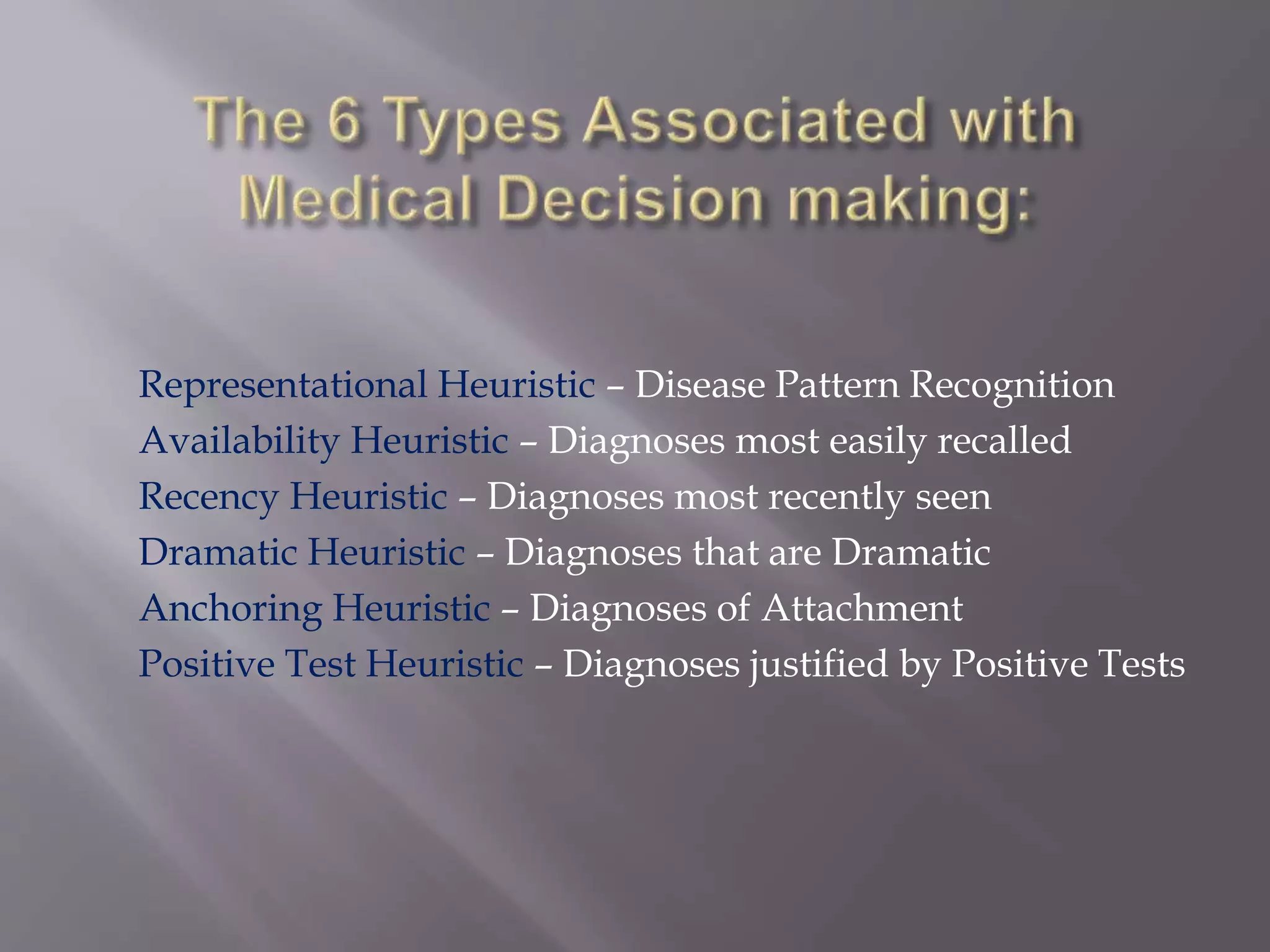
Representational Heuristic – Disease Pattern Recognition
Availability Heuristic – Diagnoses most easily recalled
Recency Heuristic – Diagnoses most recently seen
Dramatic Heuristic – Diagnoses that are Dramatic
Anchoring Heuristic – Diagnoses of Attachment
Positive Test Heuristic – Diagnoses justified by Positive Tests
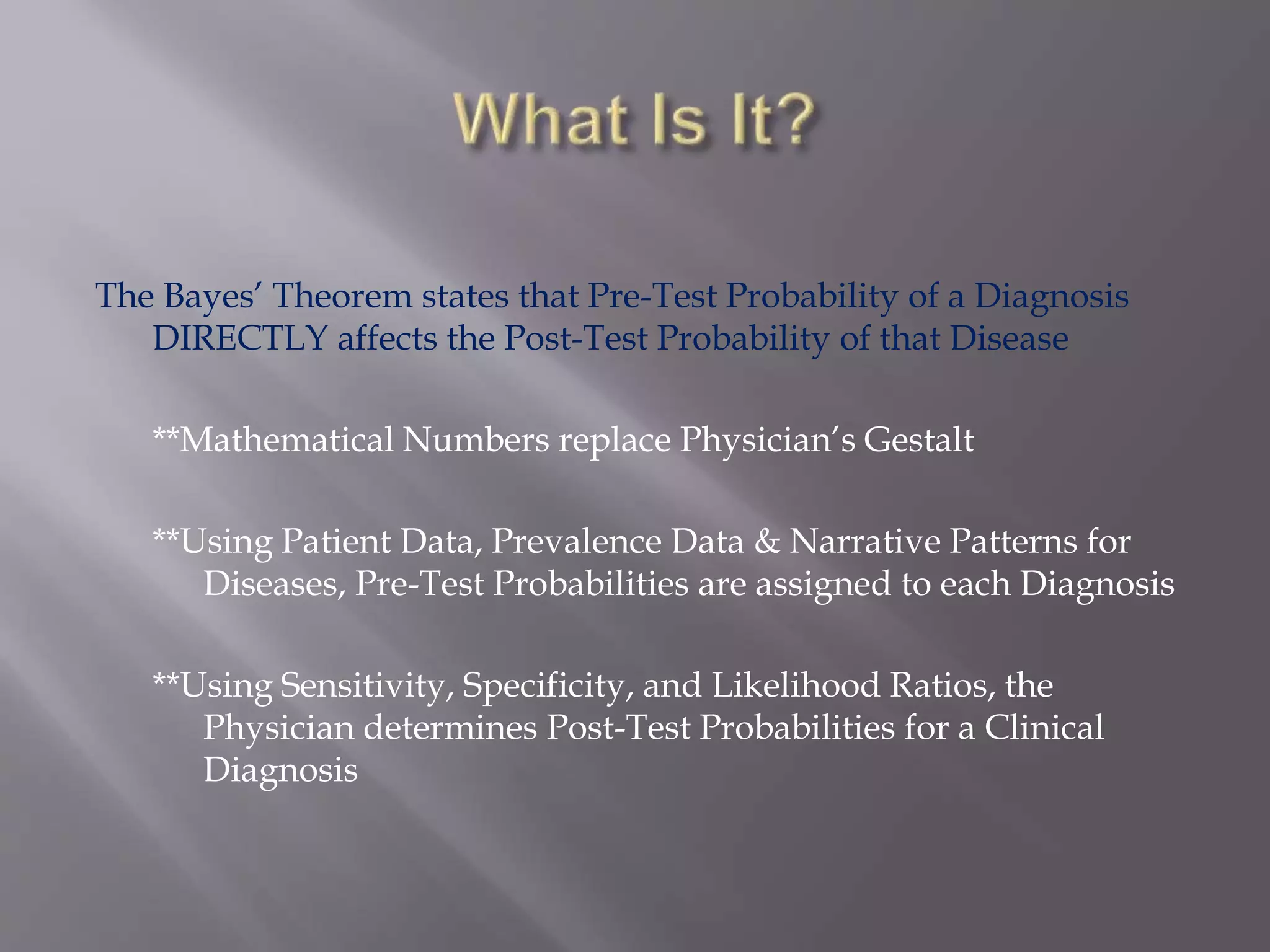
The Bayes’ Theorem states that Pre-Test Probability of a Diagnosis
DIRECTLY affects the Post-Test Probability of that Disease
**Mathematical Numbers replace Physician’s Gestalt
**Using Patient Data, Prevalence Data & Narrative Patterns for
Diseases, Pre-Test Probabilities are assigned to each Diagnosis
**Using Sensitivity, Specificity, and Likelihood Ratios, the
Physician determines Post-Test Probabilities for a Clinical
Diagnosis
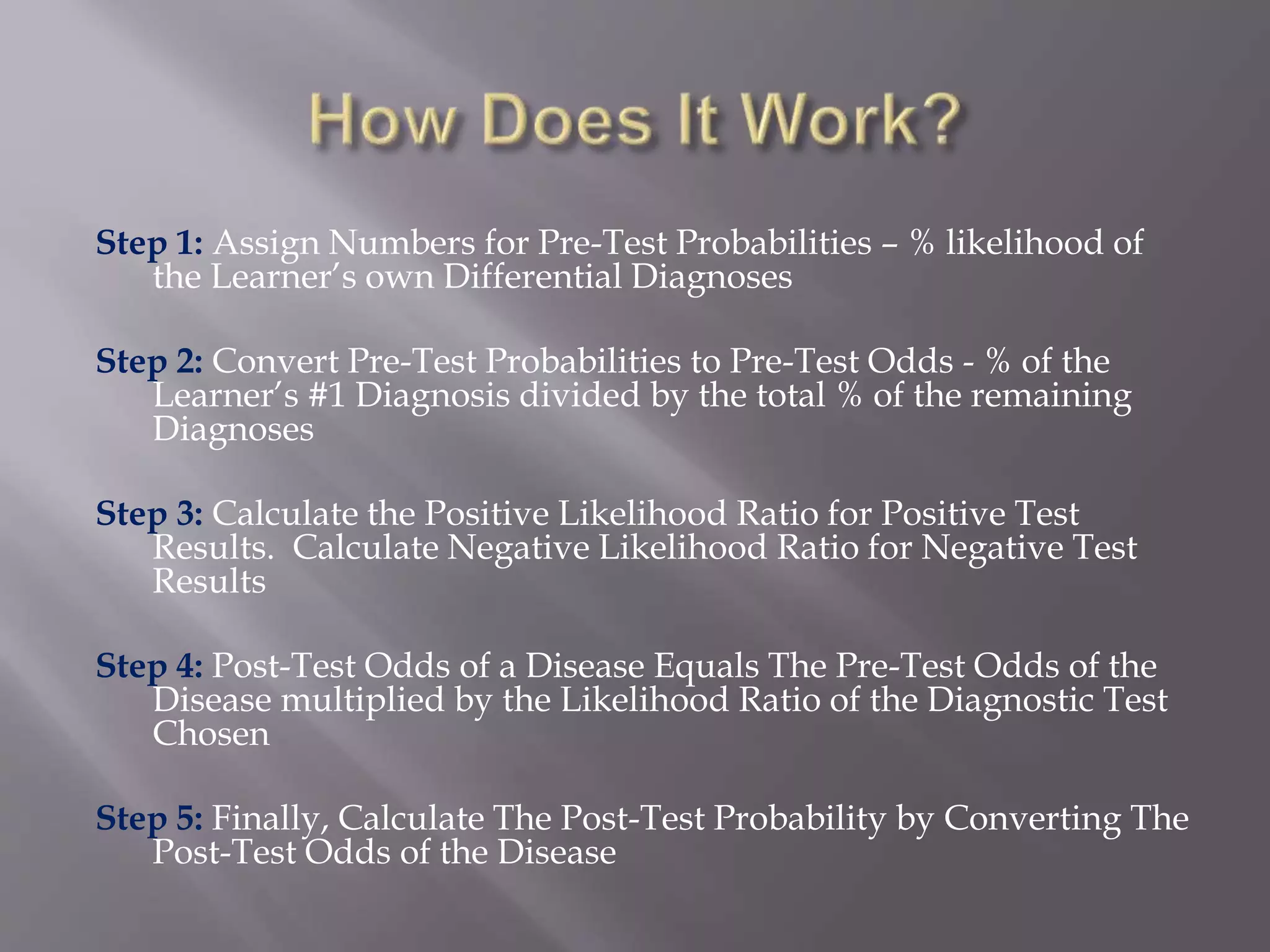
Step 1: Assign Numbers for Pre-Test Probabilities – % likelihood of
the Learner’s own Differential Diagnoses
Step 2: Convert Pre-Test Probabilities to Pre-Test Odds - % of the
Learner’s #1 Diagnosis divided by the total % of the remaining
Diagnoses
Step 3: Calculate the Positive Likelihood Ratio for Positive Test
Results. Calculate Negative Likelihood Ratio for Negative Test
Results
Step 4: Post-Test Odds of a Disease Equals The Pre-Test Odds of the
Disease multiplied by the Likelihood Ratio of the Diagnostic Test
Chosen
Step 5: Finally, Calculate The Post-Test Probability by Converting The
Post-Test Odds of the Disease
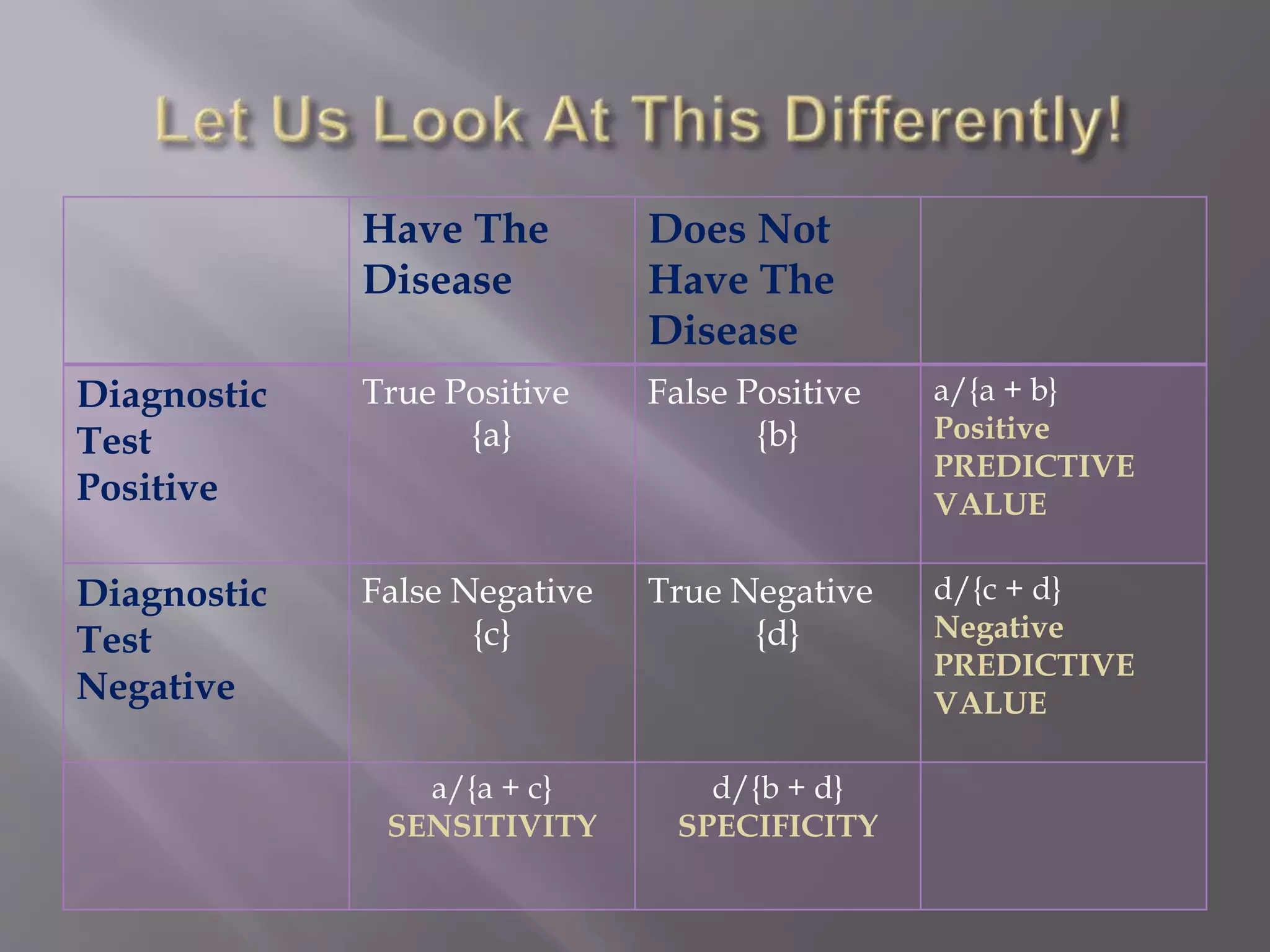
Have The
Disease
Does Not
Have The
Disease
Diagnostic
Test
Positive
True Positive
{a}
False Positive
{b}
a/{a + b}
Positive
PREDICTIVE
VALUE
Diagnostic
Test
Negative
False Negative
{c}
True Negative
{d}
d/{c + d}
Negative
PREDICTIVE
VALUE
a/{a + c}
SENSITIVITY
d/{b + d}
SPECIFICITY
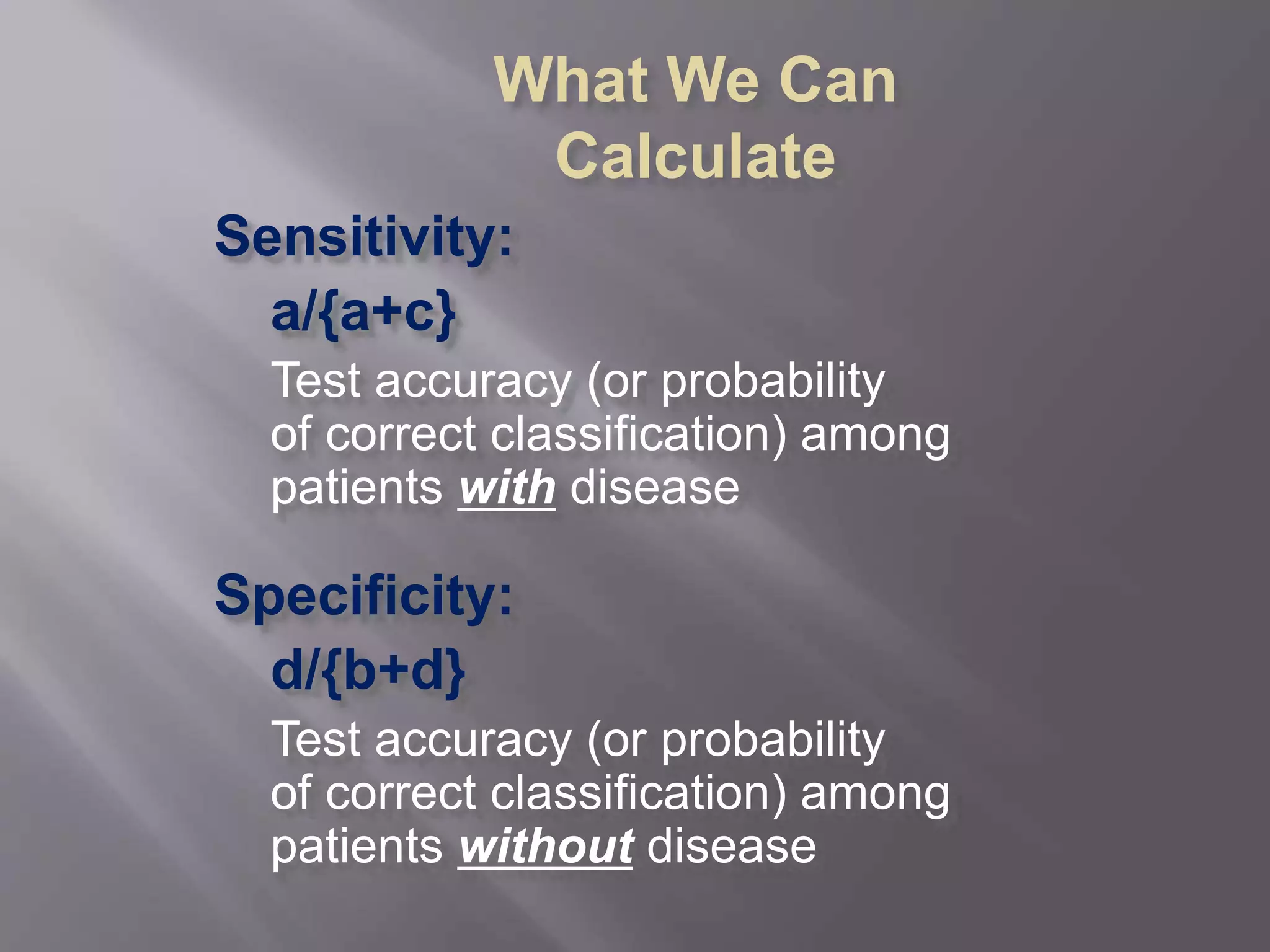
Sensitivity:
a/{a+c}
Test accuracy (or probability
of correct classification) among
patients with disease
Specificity:
d/{b+d}
Test accuracy (or probability
of correct classification) among
patients without disease
What We Can
Calculate
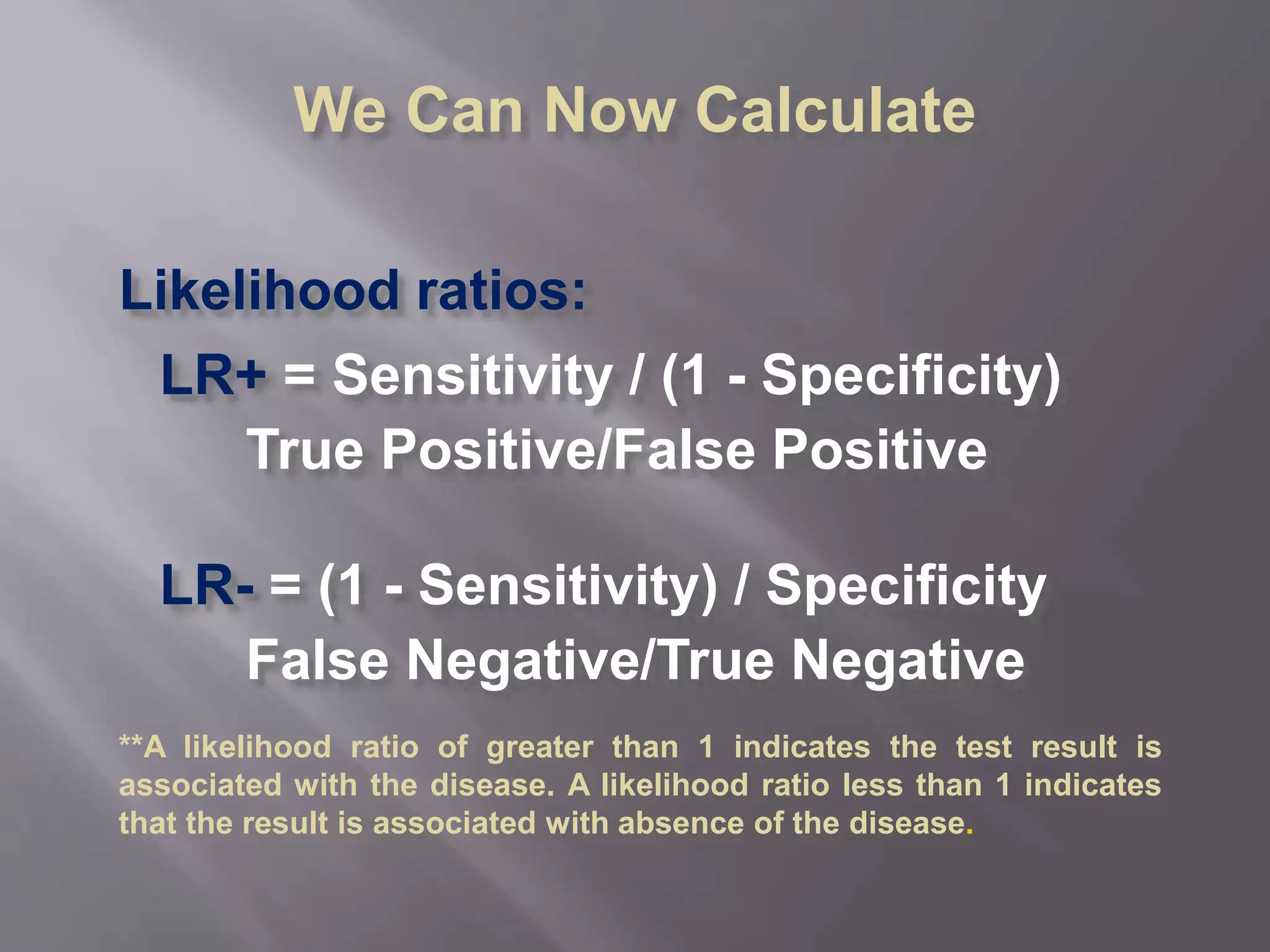
We Can Now Calculate
Likelihood ratios:
LR+ = Sensitivity / (1 - Specificity)
True Positive/False Positive
LR- = (1 - Sensitivity) / Specificity
False Negative/True Negative
**A likelihood ratio of greater than 1 indicates the test result is
associated with the disease. A likelihood ratio less than 1 indicates
that the result is associated with absence of the disease.
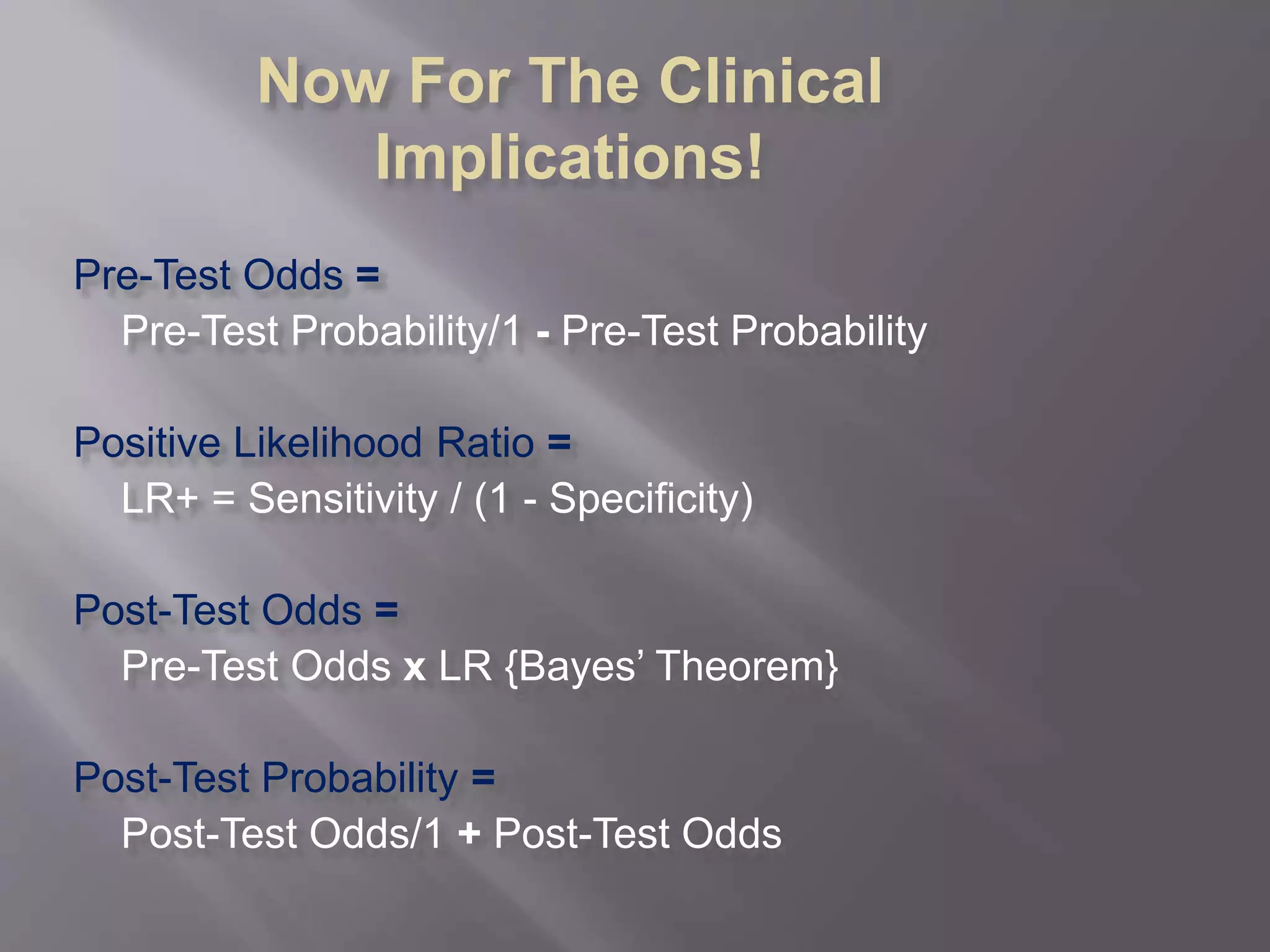
Now For The Clinical
Implications!
Pre-Test Odds =
Pre-Test Probability/1 - Pre-Test Probability
Positive Likelihood Ratio =
LR+ = Sensitivity / (1 - Specificity)
Post-Test Odds =
Pre-Test Odds x LR {Bayes’ Theorem}
Post-Test Probability =
Post-Test Odds/1 + Post-Test Odds
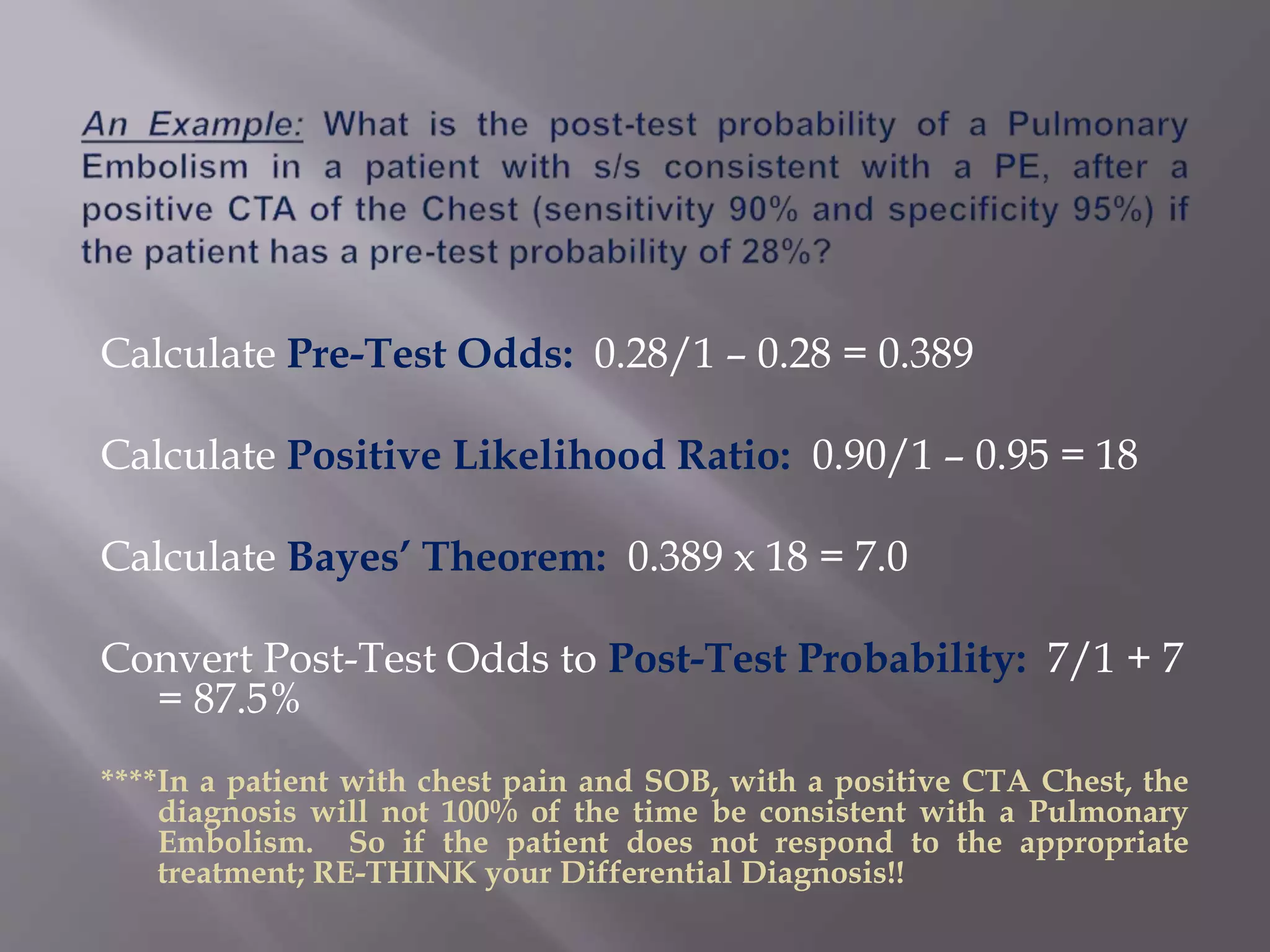
Calculate Pre-Test Odds: 0.28/1 – 0.28 = 0.389
Calculate Positive Likelihood Ratio: 0.90/1 – 0.95 = 18
Calculate Bayes’ Theorem: 0.389 x 18 = 7.0
Convert Post-Test Odds to Post-Test Probability: 7/1 + 7
= 87.5%
****In a patient with chest pain and SOB, with a positive CTA Chest, the
diagnosis will not 100% of the time be consistent with a Pulmonary
Embolism. So if the patient does not respond to the appropriate
treatment; RE-THINK your Differential Diagnosis!!
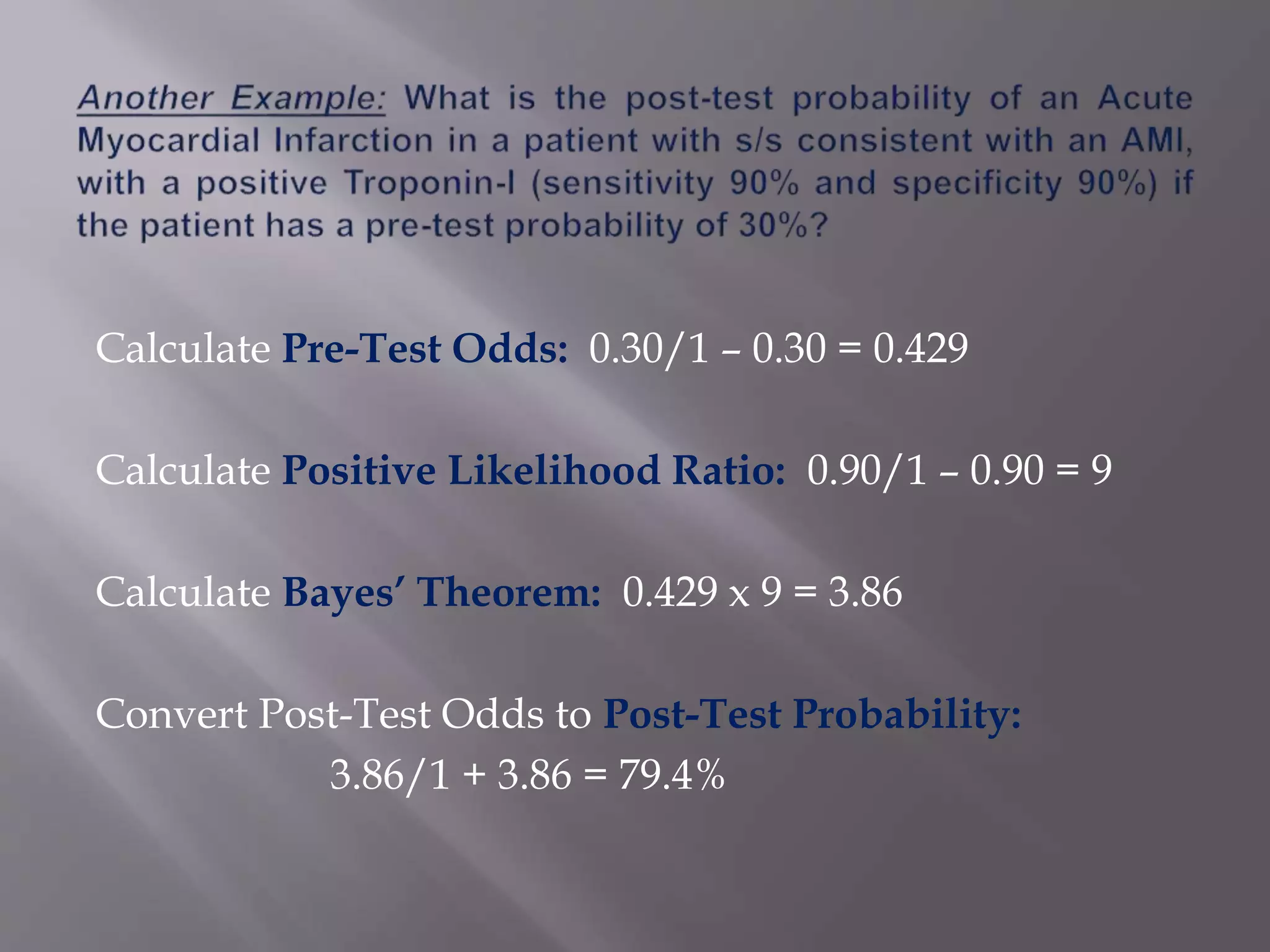
Calculate Pre-Test Odds: 0.30/1 – 0.30 = 0.429
Calculate Positive Likelihood Ratio: 0.90/1 – 0.90 = 9
Calculate Bayes’ Theorem: 0.429 x 9 = 3.86
Convert Post-Test Odds to Post-Test Probability:
3.86/1 + 3.86 = 79.4%
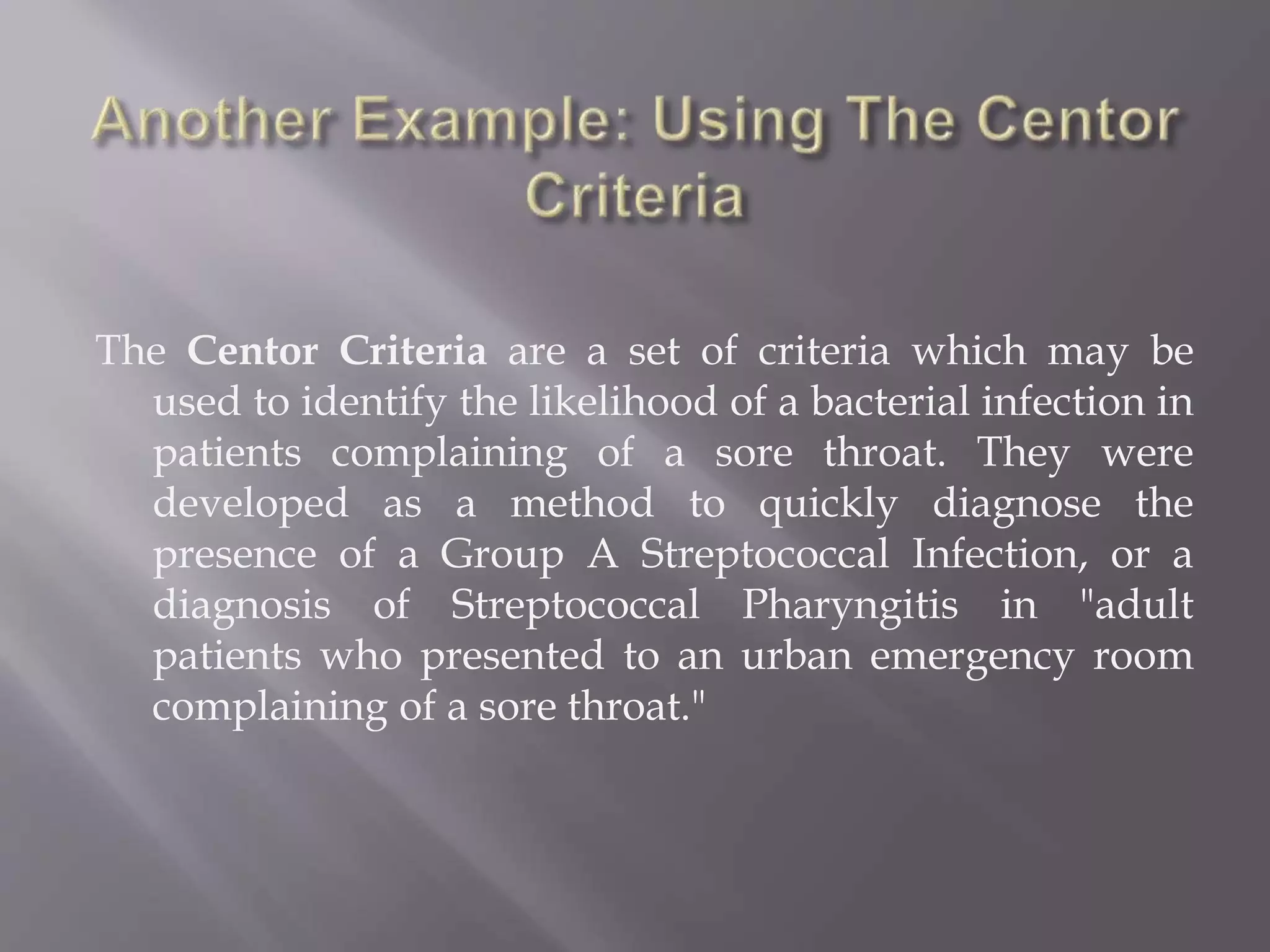
The Centor Criteria are a set of criteria which may be
used to identify the likelihood of a bacterial infection in
patients complaining of a sore throat. They were
developed as a method to quickly diagnose the
presence of a Group A Streptococcal Infection, or a
diagnosis of Streptococcal Pharyngitis in "adult
patients who presented to an urban emergency room
complaining of a sore throat."
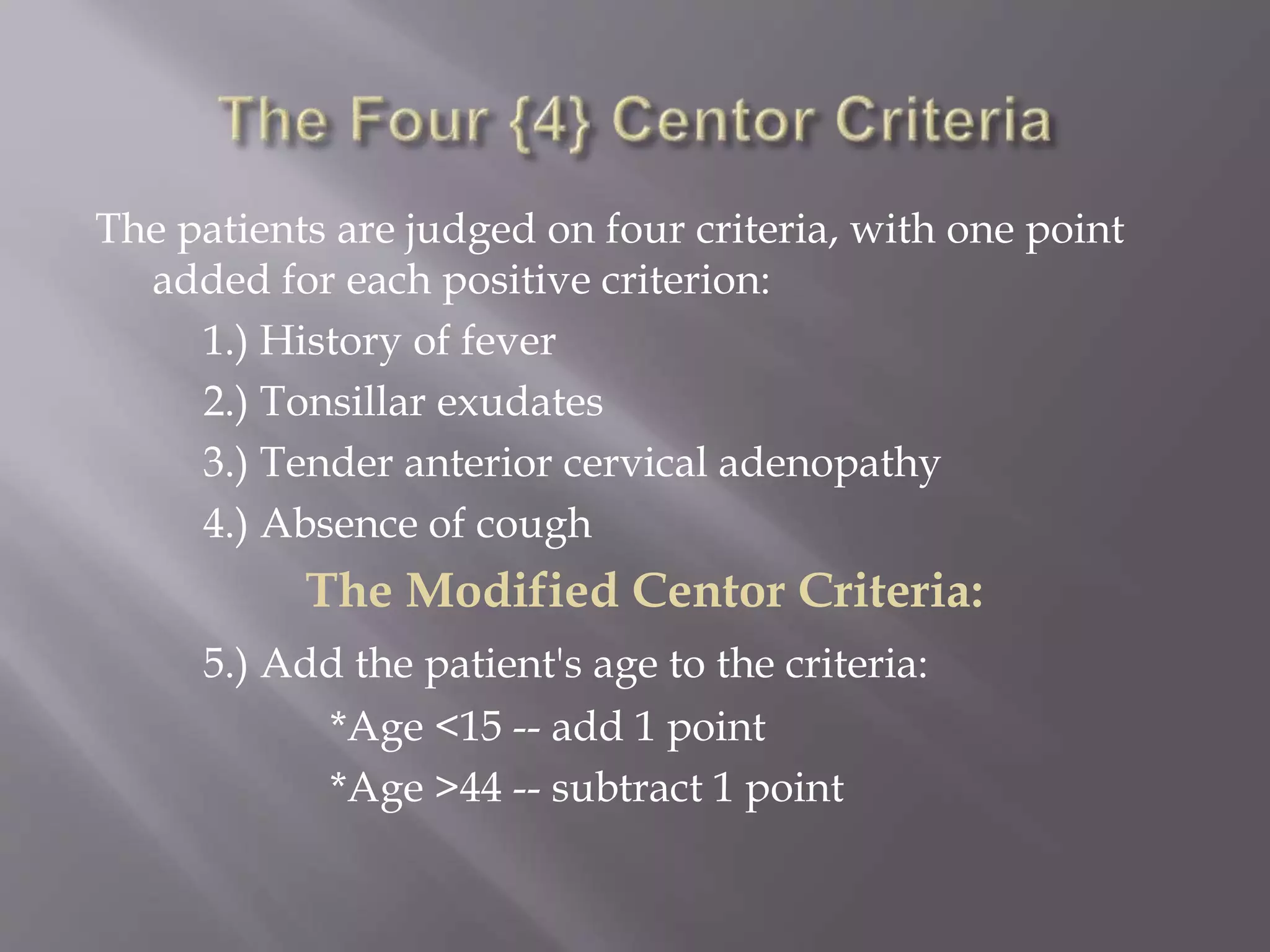
The patients are judged on four criteria, with one point
added for each positive criterion:
1.) History of fever
2.) Tonsillar exudates
3.) Tender anterior cervical adenopathy
4.) Absence of cough
The Modified Centor Criteria:
5.) Add the patient's age to the criteria:
*Age <15 -- add 1 point
*Age >44 -- subtract 1 point
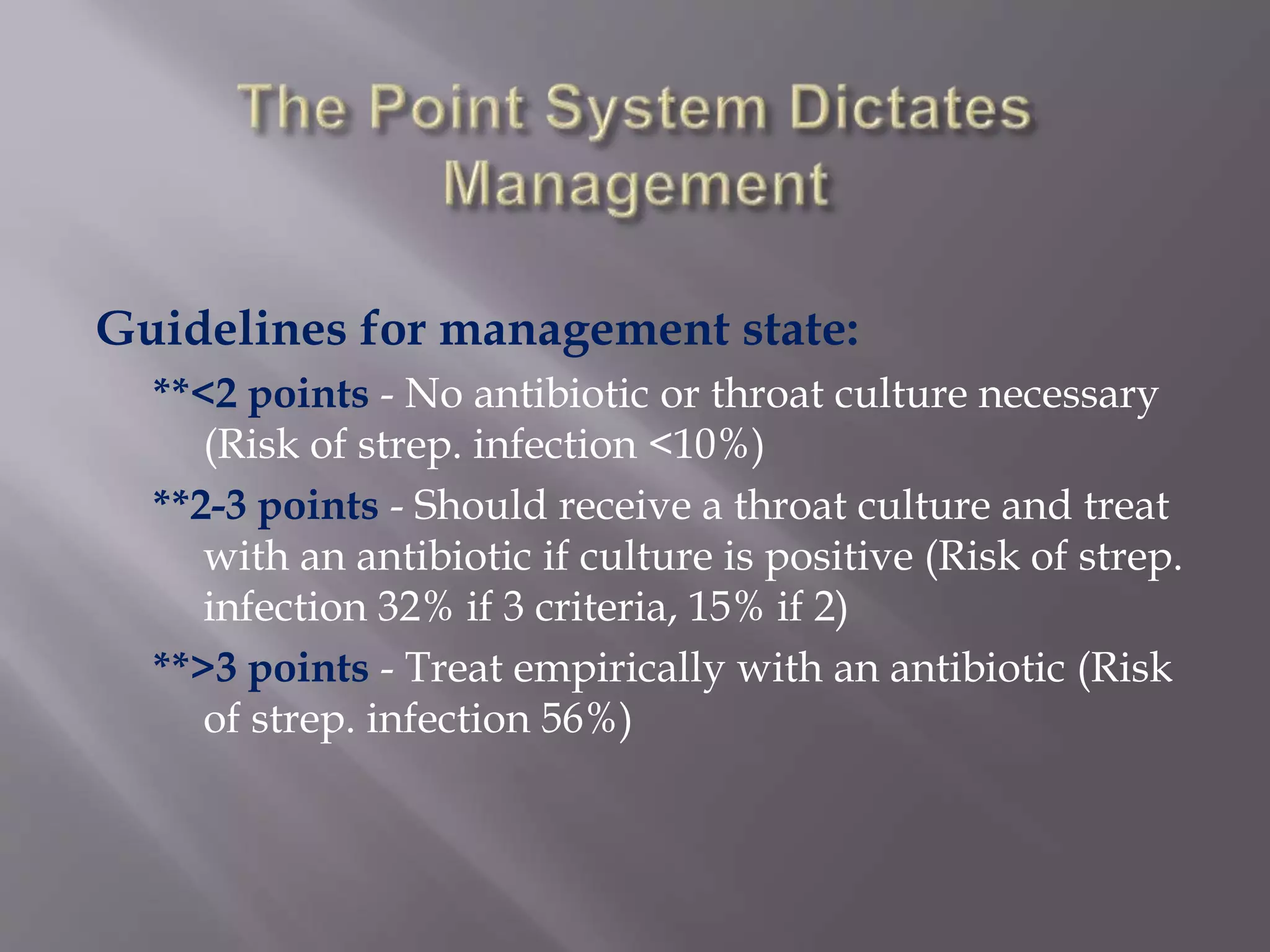
Guidelines for management state:
**<2 points - No antibiotic or throat culture necessary
(Risk of strep. infection <10%)
**2-3 points - Should receive a throat culture and treat
with an antibiotic if culture is positive (Risk of strep.
infection 32% if 3 criteria, 15% if 2)
**>3 points - Treat empirically with an antibiotic (Risk
of strep. infection 56%)
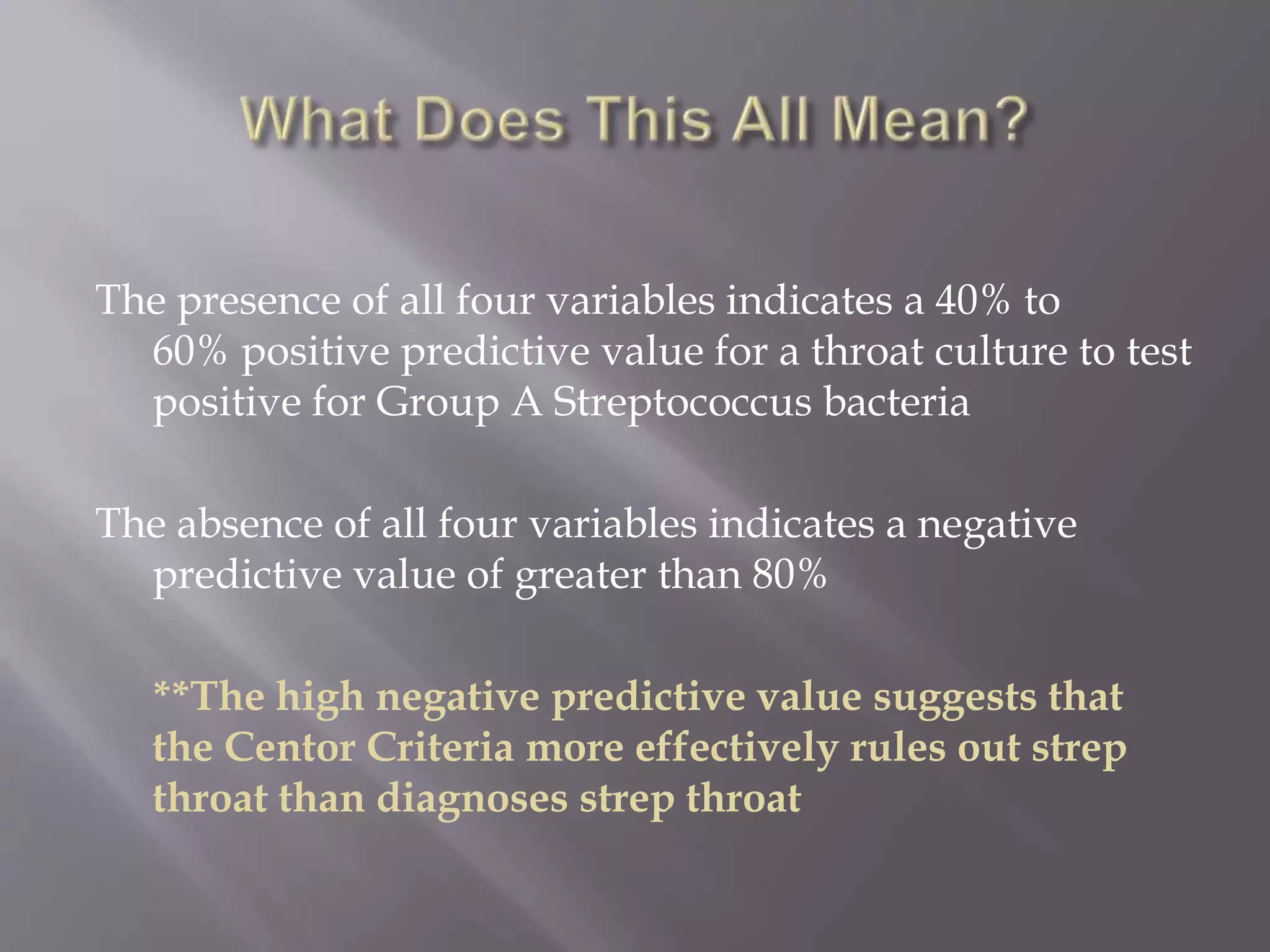
The presence of all four variables indicates a 40% to
60% positive predictive value for a throat culture to test
positive for Group A Streptococcus bacteria
The absence of all four variables indicates a negative
predictive value of greater than 80%
**The high negative predictive value suggests that
the Centor Criteria more effectively rules out strep
throat than diagnoses strep throat
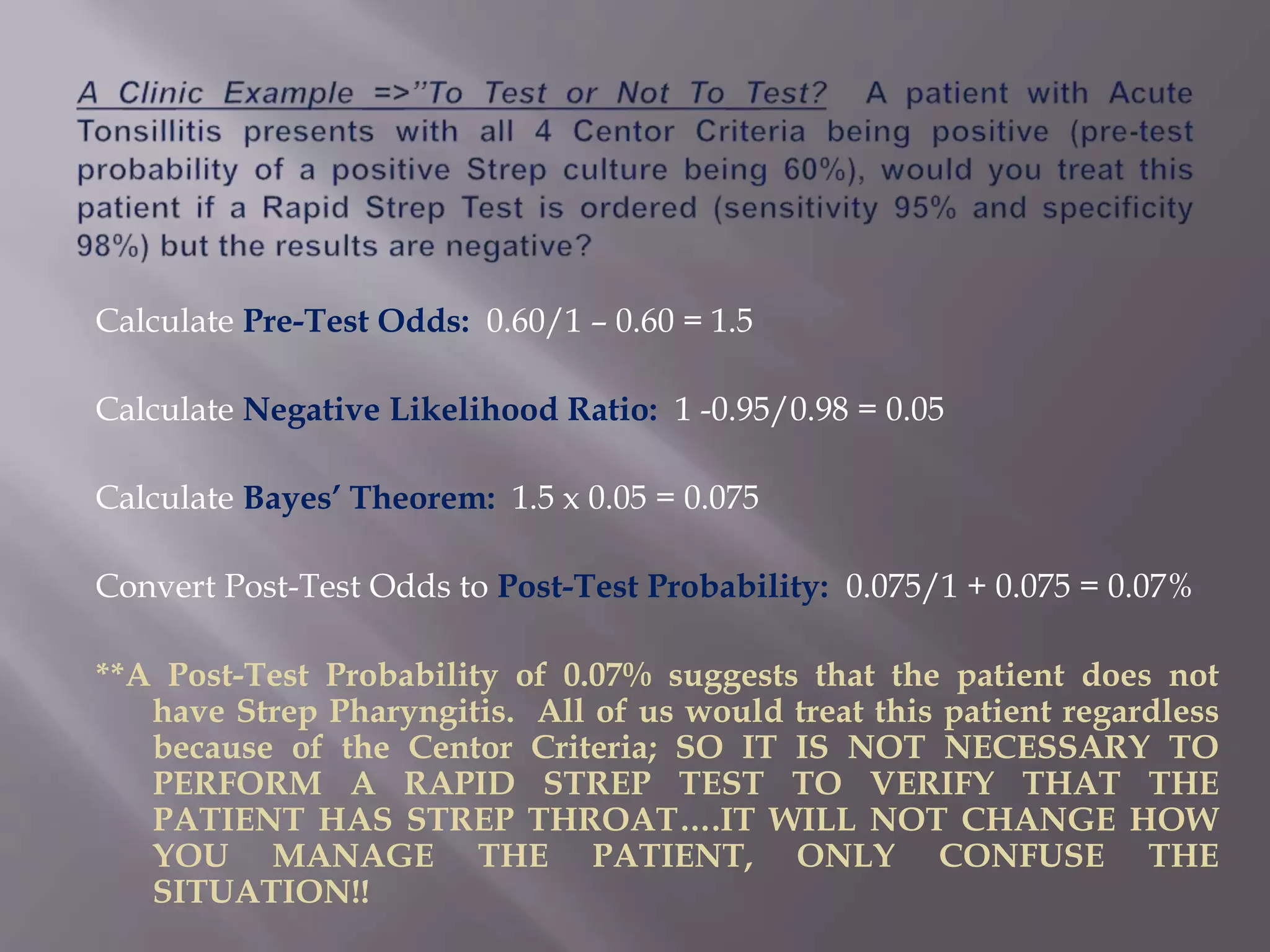
Calculate Pre-Test Odds: 0.60/1 – 0.60 = 1.5
Calculate Negative Likelihood Ratio: 1 -0.95/0.98 = 0.05
Calculate Bayes’ Theorem: 1.5 x 0.05 = 0.075
Convert Post-Test Odds to Post-Test Probability: 0.075/1 + 0.075 = 0.07%
**A Post-Test Probability of 0.07% suggests that the patient does not
have Strep Pharyngitis. All of us would treat this patient regardless
because of the Centor Criteria; SO IT IS NOT NECESSARY TO
PERFORM A RAPID STREP TEST TO VERIFY THAT THE
PATIENT HAS STREP THROAT….IT WILL NOT CHANGE HOW
YOU MANAGE THE PATIENT, ONLY CONFUSE THE
SITUATION!!
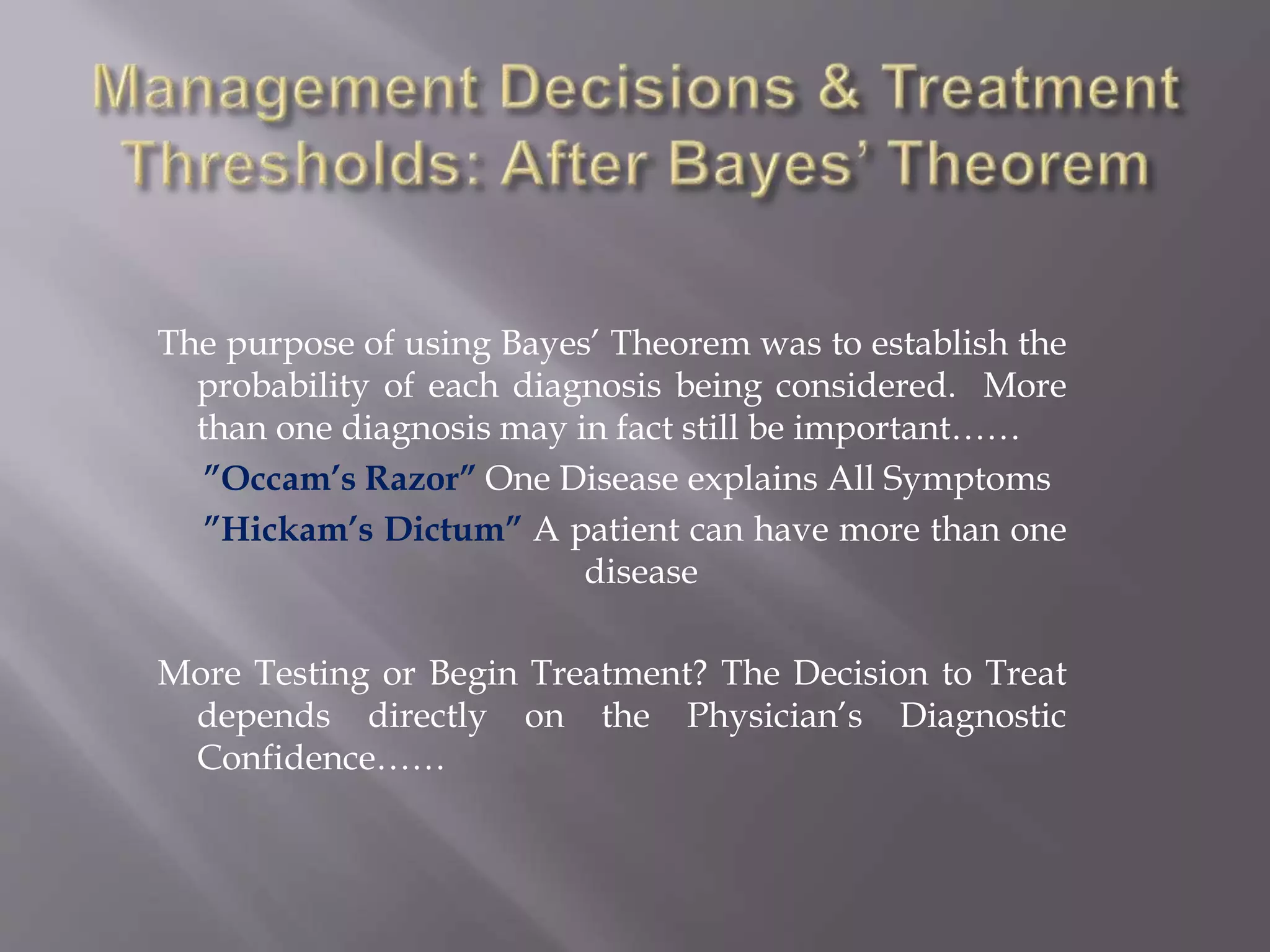
The purpose of using Bayes’ Theorem was to establish the
probability of each diagnosis being considered. More
than one diagnosis may in fact still be important……
”Occam’s Razor” One Disease explains All Symptoms
”Hickam’s Dictum” A patient can have more than one
disease
More Testing or Begin Treatment? The Decision to Treat
depends directly on the Physician’s Diagnostic
Confidence……
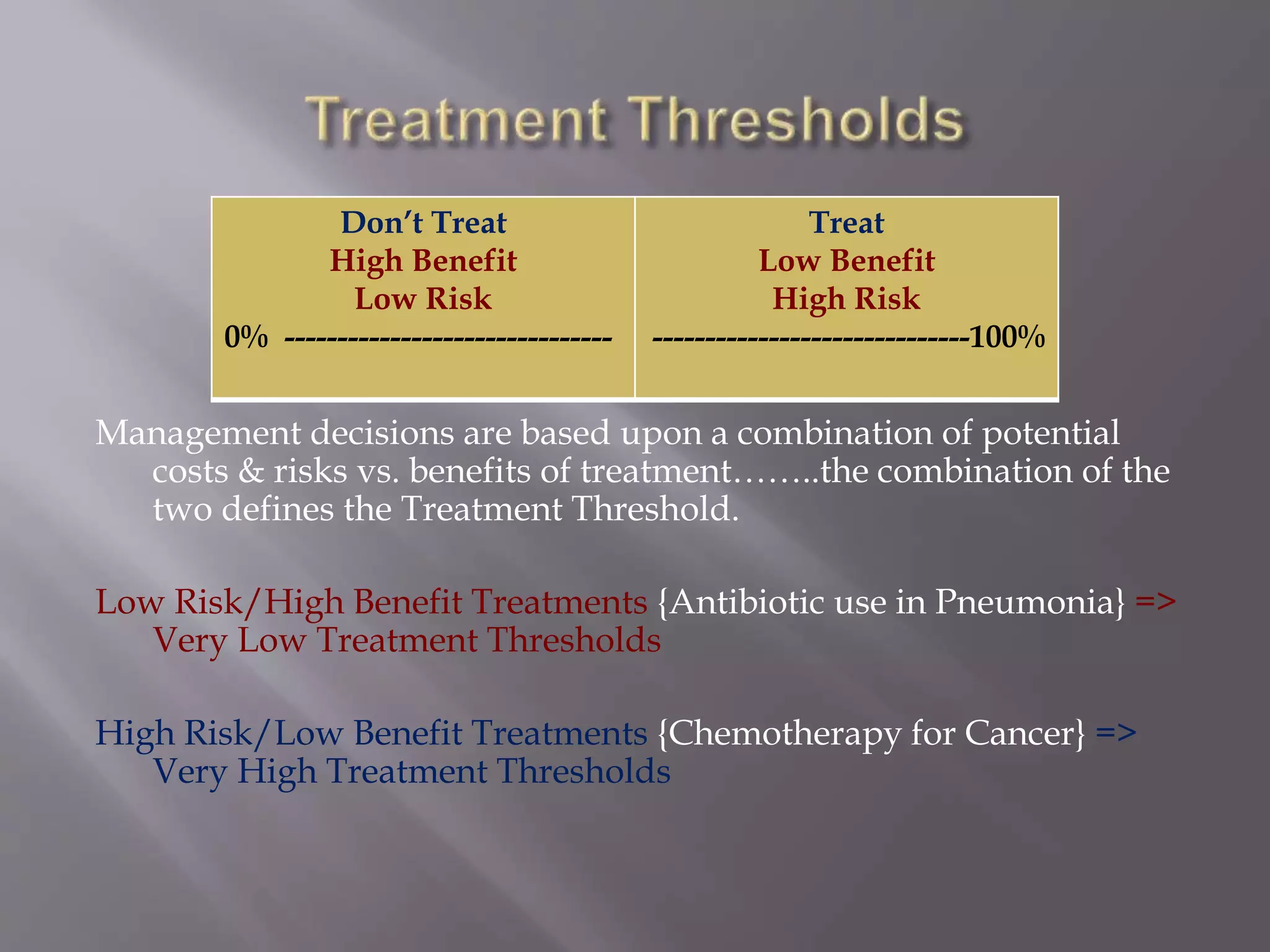
Management decisions are based upon a combination of potential
costs & risks vs. benefits of treatment……..the combination of the
two defines the Treatment Threshold.
Low Risk/High Benefit Treatments {Antibiotic use in Pneumonia} =>
Very Low Treatment Thresholds
High Risk/Low Benefit Treatments {Chemotherapy for Cancer} =>
Very High Treatment Thresholds
Don’t Treat
High Benefit
Low Risk
0% -------------------------------
Treat
Low Benefit
High Risk
------------------------------100%
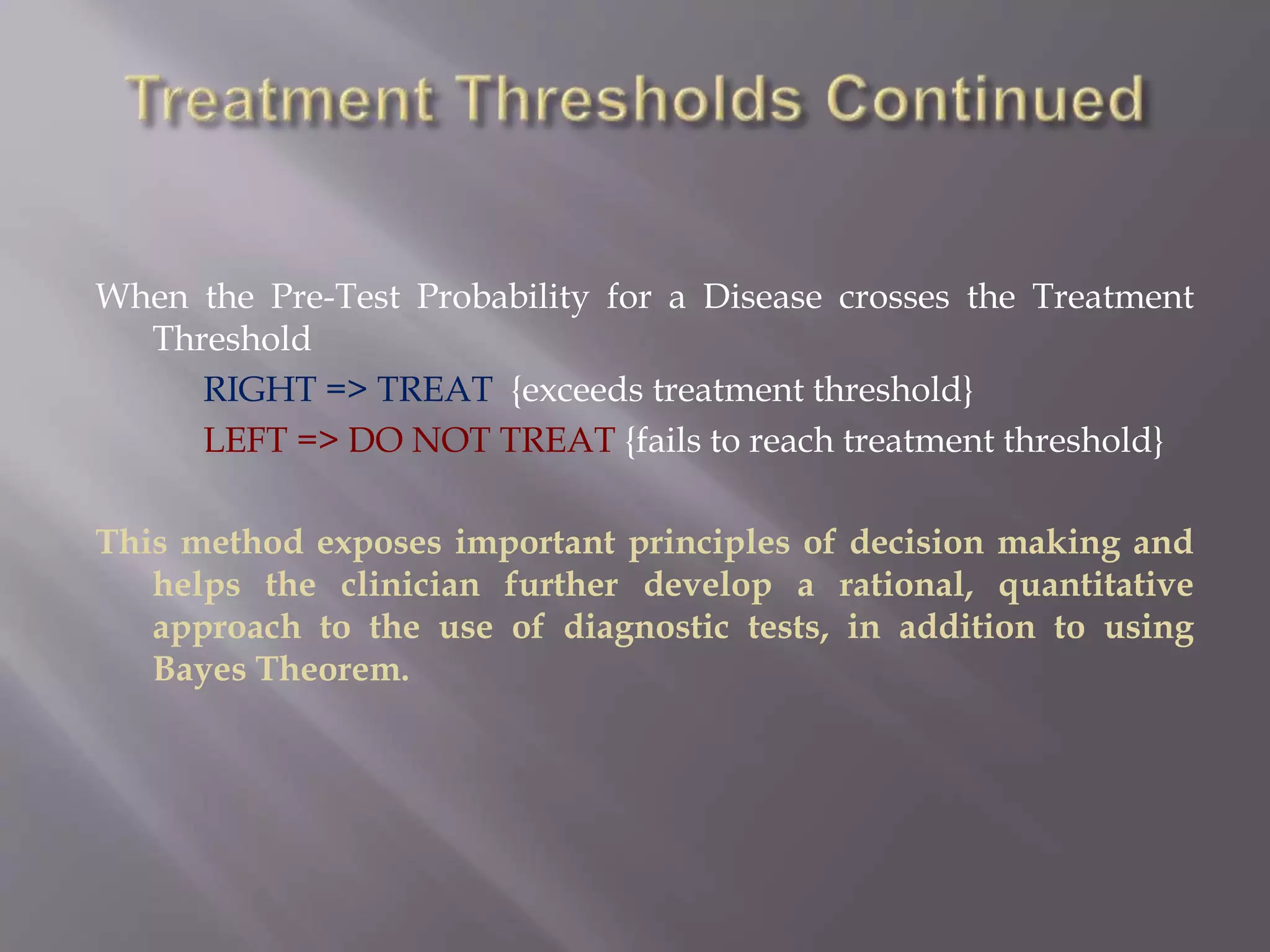
When the Pre-Test Probability for a Disease crosses the Treatment
Threshold
RIGHT => TREAT {exceeds treatment threshold}
LEFT => DO NOT TREAT {fails to reach treatment threshold}
This method exposes important principles of decision making and
helps the clinician further develop a rational, quantitative
approach to the use of diagnostic tests, in addition to using
Bayes Theorem.
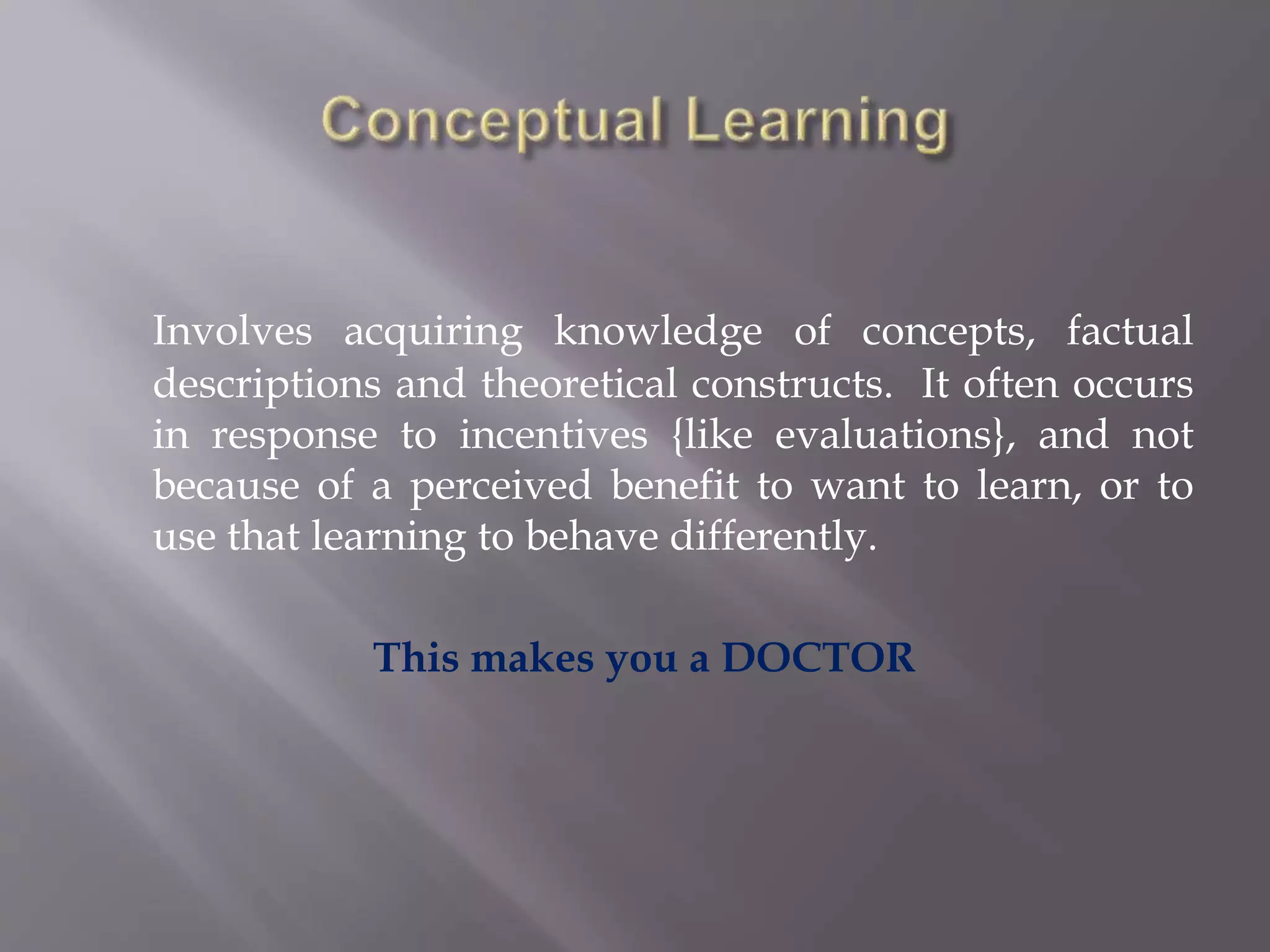
Involves acquiring knowledge of concepts, factual
descriptions and theoretical constructs. It often occurs
in response to incentives {like evaluations}, and not
because of a perceived benefit to want to learn, or to
use that learning to behave differently.
This makes you a DOCTOR
Involves the Learner engaging in activities/tasks,
thinking about what they are doing. The tasks may
range from those that are simple and less structured to
those that are complex and longer in duration. The
tasks are carefully planned and structured. The tasks
are linked to higher order thinking outcomes, and to
explanations about why you are learning and how you
learn.
This makes you a PHYSICIAN
Teaching Physicians are striving for “ACTIVE LEARNING.”
Learners need to strive for the same
The Learner must commit to a Diagnosis. Use Bayesian Numbers to
Solidify the Diagnosis
Challenge the Student and the Resident to defend their management
decisions by giving them a contradictory diagnostic opinion
Overestimation of a Pre-Test Probability for a Wrong Diagnosis
Underestimation of a Pre-Test Probability for a Correct Diagnosis
Overestimation of the Power of a Diagnostic Test whose results
were positive for the Correct Diagnosis
Underestimation of the Power of a Diagnostic Test whose results
were positive for the Correct Diagnosis
Overestimation of the Power of a Diagnostic Test whose results were
negative for the Wrong Diagnosis
Underestimation of the Power of a Diagnostic Test whose results were
negative for the Wrong Diagnosis
Treatment Threshold set too high as the Risk-Benefit ratio
miscalculated
Treating illness prematurely because you set the Treatment Threshold
too Low
Teaching Clinical Reasoning Friday Lecture Presentation 11022012

Teaching Clinical Reasoning Friday Lecture Presentation 11022012

  • 2.
    Opportunity to teachLearners Clinical Medicine & Clinical Reasoning => * Direct Patient Care Observation *Evaluation of Admission Notes & Discharge Summaries *Oral Case Presentations on Rounds Clinical Reasoning Skills For The Learners => *Develop through Multiple Phases *From focusing on Symptoms only, thru the Analytical and Non-Analytical approaches towards Diagnosis &Treatment “Expert Clinicians” Use => *Intuitive Reasoning *Pattern Recognition *Non-Analytical Reasoning *Analytical Reasoning
  • 3.
    “Intuitive Clinical Reasoning”for the Novice Physician => *Leads to a High Potential for Errors *”Common Heuristics” or Diagnostic Biases also High Potential for Errors Principles of Clinical Epidemiology => *Instrumental for the Development of a Proper Differential Diagnosis *Understanding Thresholds for Treatment Bayesian Theory => *Teaches Analytical Clinical Reasoning in an Orderly, Concrete Fashion
  • 5.
    Use Analytical Reasoning& Non-Analytical, Pattern Recognition Simultaneously Use Analytical Reasoning when no clear clinical diagnosis emerges from the clinical data Use Analytical Reasoning & Non-Analytical, Pattern Recognition when appropriate to double-check that the reasoning applied in a specific case makes sense
  • 6.
    Highlight “Illness Scripts”=> key aspects of disease presentations easily acquired knowledge **Non-Analytic Component to Teaching Use Clinical Knowledge Focused Diagnostic Testing Bayesian Reasoning => **Analytic Component to Teaching **Best to stress Analytic Component **Analytical Reasoning is NOT Intuitive **ONLY develops with Active Teaching
  • 8.
  • 9.
    Students focus onone symptom **have difficulty seeing any unifying patterns of a specific disease amidst a myriad of signs and symptoms Students do not link signs and symptoms together **focus on each sign or symptom individually
  • 10.
    Gaining Clinical Experience=> “Encapsulating Knowledge” **Learner’s Merge Disease Details into “Syndromes” **Works for Common, Uncomplicated Clinical Presentations only! **Learner’s will Regress to “Pathophysiologic, Biomedical Knowledge” if they do not recognize an obvious clinical syndrome
  • 11.
    The Learner’s Knowledgeis further Encapsulated into “Illness Scripts” **Included in these “Illness Scripts” is the knowledge of predisposing conditions **Allows the Learner to rapidly exclude categories of diseases **Pattern recognition is becoming a more prominent aspect of clinical reasoning
  • 12.
    Learners start touse Analytical Deduction **The First Step is developing a Hypothesis {DDx}, with focused gathering of additional data to confirm or eliminate the Hypothesis {DDx} **Diagnostic Testing becomes more focused **Diagnostic Verification occurs -- Physicians assess the Adequacy and Coherency of their Diagnoses =>An Adequate Diagnosis explains all the clinical findings =>A Coherent Diagnosis explains the Pathophysiology
  • 13.
    **After completing thesesteps, Physicians choose a working diagnosis **Despite remaining uncertain to some degree, they begin to manage the patient’s illness **Without clinical instruction, these Analytical and Diagnostic Reasoning Skills WILL remain rudimentary
  • 14.
    **Experienced Physicians usethe Non-Analytic Method of Diagnosis very commonly; but also Analytic Reasoning as commonly **Teaching Physicians must encourage Learners to use Analytic Reasoning **Teaching Physicians must role-model Analytic Reasoning => make Learners use Deductive Reasoning {which of the top three differential diagnoses is most correct relative to the others}
  • 16.
    The Intuitive Non-Analyticalmental short-cuts used to recognize and categorize certain illnesses “Heuristics” are really “Biases” **can lead to inaccurate diagnoses **Learner’s need to verify these diagnoses with Analytical Reasoning {“The Bayesian Theorem”}
  • 17.
    Representational Heuristic –Disease Pattern Recognition Availability Heuristic – Diagnoses most easily recalled Recency Heuristic – Diagnoses most recently seen Dramatic Heuristic – Diagnoses that are Dramatic Anchoring Heuristic – Diagnoses of Attachment Positive Test Heuristic – Diagnoses justified by Positive Tests
  • 19.
    The Bayes’ Theoremstates that Pre-Test Probability of a Diagnosis DIRECTLY affects the Post-Test Probability of that Disease **Mathematical Numbers replace Physician’s Gestalt **Using Patient Data, Prevalence Data & Narrative Patterns for Diseases, Pre-Test Probabilities are assigned to each Diagnosis **Using Sensitivity, Specificity, and Likelihood Ratios, the Physician determines Post-Test Probabilities for a Clinical Diagnosis
  • 20.
    Step 1: AssignNumbers for Pre-Test Probabilities – % likelihood of the Learner’s own Differential Diagnoses Step 2: Convert Pre-Test Probabilities to Pre-Test Odds - % of the Learner’s #1 Diagnosis divided by the total % of the remaining Diagnoses Step 3: Calculate the Positive Likelihood Ratio for Positive Test Results. Calculate Negative Likelihood Ratio for Negative Test Results Step 4: Post-Test Odds of a Disease Equals The Pre-Test Odds of the Disease multiplied by the Likelihood Ratio of the Diagnostic Test Chosen Step 5: Finally, Calculate The Post-Test Probability by Converting The Post-Test Odds of the Disease
  • 21.
    Have The Disease Does Not HaveThe Disease Diagnostic Test Positive True Positive {a} False Positive {b} a/{a + b} Positive PREDICTIVE VALUE Diagnostic Test Negative False Negative {c} True Negative {d} d/{c + d} Negative PREDICTIVE VALUE a/{a + c} SENSITIVITY d/{b + d} SPECIFICITY
  • 22.
    Sensitivity: a/{a+c} Test accuracy (orprobability of correct classification) among patients with disease Specificity: d/{b+d} Test accuracy (or probability of correct classification) among patients without disease What We Can Calculate
  • 23.
    We Can NowCalculate Likelihood ratios: LR+ = Sensitivity / (1 - Specificity) True Positive/False Positive LR- = (1 - Sensitivity) / Specificity False Negative/True Negative **A likelihood ratio of greater than 1 indicates the test result is associated with the disease. A likelihood ratio less than 1 indicates that the result is associated with absence of the disease.
  • 24.
    Now For TheClinical Implications! Pre-Test Odds = Pre-Test Probability/1 - Pre-Test Probability Positive Likelihood Ratio = LR+ = Sensitivity / (1 - Specificity) Post-Test Odds = Pre-Test Odds x LR {Bayes’ Theorem} Post-Test Probability = Post-Test Odds/1 + Post-Test Odds
  • 25.
    Calculate Pre-Test Odds:0.28/1 – 0.28 = 0.389 Calculate Positive Likelihood Ratio: 0.90/1 – 0.95 = 18 Calculate Bayes’ Theorem: 0.389 x 18 = 7.0 Convert Post-Test Odds to Post-Test Probability: 7/1 + 7 = 87.5% ****In a patient with chest pain and SOB, with a positive CTA Chest, the diagnosis will not 100% of the time be consistent with a Pulmonary Embolism. So if the patient does not respond to the appropriate treatment; RE-THINK your Differential Diagnosis!!
  • 26.
    Calculate Pre-Test Odds:0.30/1 – 0.30 = 0.429 Calculate Positive Likelihood Ratio: 0.90/1 – 0.90 = 9 Calculate Bayes’ Theorem: 0.429 x 9 = 3.86 Convert Post-Test Odds to Post-Test Probability: 3.86/1 + 3.86 = 79.4%
  • 27.
    The Centor Criteriaare a set of criteria which may be used to identify the likelihood of a bacterial infection in patients complaining of a sore throat. They were developed as a method to quickly diagnose the presence of a Group A Streptococcal Infection, or a diagnosis of Streptococcal Pharyngitis in "adult patients who presented to an urban emergency room complaining of a sore throat."
  • 28.
    The patients arejudged on four criteria, with one point added for each positive criterion: 1.) History of fever 2.) Tonsillar exudates 3.) Tender anterior cervical adenopathy 4.) Absence of cough The Modified Centor Criteria: 5.) Add the patient's age to the criteria: *Age <15 -- add 1 point *Age >44 -- subtract 1 point
  • 29.
    Guidelines for managementstate: **<2 points - No antibiotic or throat culture necessary (Risk of strep. infection <10%) **2-3 points - Should receive a throat culture and treat with an antibiotic if culture is positive (Risk of strep. infection 32% if 3 criteria, 15% if 2) **>3 points - Treat empirically with an antibiotic (Risk of strep. infection 56%)
  • 30.
    The presence ofall four variables indicates a 40% to 60% positive predictive value for a throat culture to test positive for Group A Streptococcus bacteria The absence of all four variables indicates a negative predictive value of greater than 80% **The high negative predictive value suggests that the Centor Criteria more effectively rules out strep throat than diagnoses strep throat
  • 31.
    Calculate Pre-Test Odds:0.60/1 – 0.60 = 1.5 Calculate Negative Likelihood Ratio: 1 -0.95/0.98 = 0.05 Calculate Bayes’ Theorem: 1.5 x 0.05 = 0.075 Convert Post-Test Odds to Post-Test Probability: 0.075/1 + 0.075 = 0.07% **A Post-Test Probability of 0.07% suggests that the patient does not have Strep Pharyngitis. All of us would treat this patient regardless because of the Centor Criteria; SO IT IS NOT NECESSARY TO PERFORM A RAPID STREP TEST TO VERIFY THAT THE PATIENT HAS STREP THROAT….IT WILL NOT CHANGE HOW YOU MANAGE THE PATIENT, ONLY CONFUSE THE SITUATION!!
  • 32.
    The purpose ofusing Bayes’ Theorem was to establish the probability of each diagnosis being considered. More than one diagnosis may in fact still be important…… ”Occam’s Razor” One Disease explains All Symptoms ”Hickam’s Dictum” A patient can have more than one disease More Testing or Begin Treatment? The Decision to Treat depends directly on the Physician’s Diagnostic Confidence……
  • 33.
    Management decisions arebased upon a combination of potential costs & risks vs. benefits of treatment……..the combination of the two defines the Treatment Threshold. Low Risk/High Benefit Treatments {Antibiotic use in Pneumonia} => Very Low Treatment Thresholds High Risk/Low Benefit Treatments {Chemotherapy for Cancer} => Very High Treatment Thresholds Don’t Treat High Benefit Low Risk 0% ------------------------------- Treat Low Benefit High Risk ------------------------------100%
  • 34.
    When the Pre-TestProbability for a Disease crosses the Treatment Threshold RIGHT => TREAT {exceeds treatment threshold} LEFT => DO NOT TREAT {fails to reach treatment threshold} This method exposes important principles of decision making and helps the clinician further develop a rational, quantitative approach to the use of diagnostic tests, in addition to using Bayes Theorem.
  • 36.
    Involves acquiring knowledgeof concepts, factual descriptions and theoretical constructs. It often occurs in response to incentives {like evaluations}, and not because of a perceived benefit to want to learn, or to use that learning to behave differently. This makes you a DOCTOR
  • 37.
    Involves the Learnerengaging in activities/tasks, thinking about what they are doing. The tasks may range from those that are simple and less structured to those that are complex and longer in duration. The tasks are carefully planned and structured. The tasks are linked to higher order thinking outcomes, and to explanations about why you are learning and how you learn. This makes you a PHYSICIAN
  • 38.
    Teaching Physicians arestriving for “ACTIVE LEARNING.” Learners need to strive for the same The Learner must commit to a Diagnosis. Use Bayesian Numbers to Solidify the Diagnosis Challenge the Student and the Resident to defend their management decisions by giving them a contradictory diagnostic opinion
  • 39.
    Overestimation of aPre-Test Probability for a Wrong Diagnosis Underestimation of a Pre-Test Probability for a Correct Diagnosis Overestimation of the Power of a Diagnostic Test whose results were positive for the Correct Diagnosis Underestimation of the Power of a Diagnostic Test whose results were positive for the Correct Diagnosis
  • 40.
    Overestimation of thePower of a Diagnostic Test whose results were negative for the Wrong Diagnosis Underestimation of the Power of a Diagnostic Test whose results were negative for the Wrong Diagnosis Treatment Threshold set too high as the Risk-Benefit ratio miscalculated Treating illness prematurely because you set the Treatment Threshold too Low