1
2
In-service training seminar
Bechar – 15/03/2016
What is lesson planning
3
The process of thinking through and
writing down a .......... for the teaching of,
and learning within, a lesson that I will be
teaching to a specific group of students in a
specific place at a specific ……….
(Jonathan Savage: 2015)
4
What is a lesson plan
5
A lesson plan is a ….…… that maps out the
teacher’s intentions about the lesson. It
reflects the teacher’s planning decisions and
…………………. of the principles of lesson
design.
6
Why a lesson plan
7
8
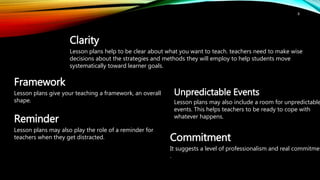
Clarity
Lesson plans help to be clear about what you want to teach. teachers need to make wise
decisions about the strategies and methods they will employ to help students move
systematically toward learner goals.
Unpredictable Events
Lesson plans may also include a room for unpredictable
events. This helps teachers to be ready to cope with
whatever happens.
Framework
Lesson plans give your teaching a framework, an overall
shape.
Reminder
Lesson plans may also play the role of a reminder for
teachers when they get distracted. Commitment
It suggests a level of professionalism and real commitmen
.
9
For the teacher
o They don’t have to think on their feet. They don’t lose face in front of their
learners.
o They are clear on the procedure to follow.
o They build on previous teaching and prepare for coming lessons
For the learner
o They realize that the teacher cares for their learning.
o They attend a structured lesson: easier to assimilate
o They appreciate their teacher’s work as a model of well-organized work to
imitate.
What are the components
of
a lesson plan
10
Objective & aims (specific)
Targeted competency
Procedure & Timing
Aids & activities
Comments
Penny Ur : 2015
11
Lesson plans must involve a unifying theme, an
overall general …………. to accomplish by the end of
the lesson period. They must include clear statements
of what learners will be able to do by the end of the
lesson. These derive from the ………… that gives a
general direction for planning our teaching.
12
Objectives are supposed to be
13
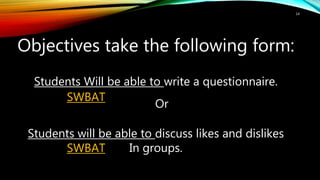
Objectives take the following form:
Students Will be able to write a questionnaire.
Or
Students will be able to discuss likes and dislikes
In groups.
SWBAT
SWBAT
14
15
Aims
16
Aims (stage aims): What is to be taught?
Decide on the main teaching point. This may be a new structure
(pattern). If so, isolate the use (or uses) to be focused on. list the forms that
are to be included.
Which stage of practice is to be attempted with the
patterns you isolated ?
Choose a suitable situation or situations for the activities you have in mind. If the
situation is already determined by your textbook, think of ways of setting or
introducing this situation.
17
Aims of stages may take
The following forms:
To present and provide practice of the use of 'for' and 'since' with the present
perfect.
To check that learners understand the concept and form of the new item.
Or
18
19
Let’s write s.m.a.r.t objectives
&
stage aims
Activities: What to do in the lesson?
Plan the stages to be followed in introducing and practicing the main
teaching point(s), bearing in mind what you have decided in 'Aims'.
Calculate the timing of these stages. Is there too much for
your lesson? Is there time left over?
Logical sequencing
20
Procedures & (interaction/focus) who does what?
T = teacher
S = an individual student
T – C = the teacher working with the whole class
S,S,S = students working on their own
S-S = students working in pairs
SS-SS = pairs of students in discussion with other pairs
GG = students working in groups
Worksheet N° 3
Jeremy Harmer, 2015
21
Aids: What aids are you going to use?
Which are likely to be most …………....?
Are they varied or ……………... enough?
Are you making full ……… of them?
Do not forget that the ……….. is an aid.
22
Comments
No need to comment on every single activity.
Mention things that went well or didn’t.
Write what to do or not (next time)
Changes
Self-evaluation
23
Competencies define the applied ……… and
knowledge that enable students to successfully perform
their work over a long period of time , while learning
objectives are specific to a certain course of instruction
and they are “time bound” – 45 /60 minutes.
24
Why a variety
Of
components
25
Prolong energy levels
Engaging & enjoyable
Avoid boredom & discipline problems
Penny Ur, 2015
26
How to vary
these
components
27
28
Planning paradoxes
Planning is good, but what if a zealous
conversation comes out of the blue ?
Problems we hadn’t anticipated. e.g: vocabulary input .
No lesson, even if prepared carefully, works exactly
As planned.
29
A proposal for action rather than a rigid procedure.
Jeremy Harmer, 2015
A lesson plan ,thus, becomes……
30
31
Do all lesson plans
look the same
32
PPU
33
PPU (Presentation, Practice, Use)
A framework for designing “speaking” lessons for
example. It helps create lessons that are organized,
coherent, and lead to a clear lesson objective.
34
The stages of a framework in this way are:
• Present - During this phase, Ss understand the context being
used, the form, meaning and use of the vocabulary, function(s),
pronunciation point or grammar, and/or the speaking skills
(stating an opinion, pausing while speaking, interrupting, etc.),
which are the focus of the lesson. (Awareness)
35
• Practice - Ss practice the speaking skills and/or the language
component of the lesson by doing tasks which
are designed to help Ss increase their accuracy or
correctness
move from Ss’ having no choice of what to say (repetition or
drills) to more, but still limited, choice of the form, meaning, or
use of the skill or language they use in the activity. (Accuracy)
36
Use - Students use the language or skill to
complete a communicative task similar to an
activity they will or may do outside the
classroom. (Fluency)
37
PDP
38
The PDP Framework
Delivers effective listening, video and reading lessons.
Motivates, engages and makes active before, while and
after listening to, watching or reading a text.
39
The stages of the framework are:
Pre Ss prepare to listen:
Ø they understand what they will listen or read for in the
text before they begin working with it
Ø they can make predictions about what the text will be
about.
40
During Ss focus their attention on the listening or
reading text and complete tasks which develop and
deepen their understanding of the text progressively (i.e.,
from simpler and more general to more complex and
more specific). They can also do tasks that help them
develop specific listening and reading skills.
41
Post Ss extend and integrate the
understanding and knowledge they gained
from working with the listening or reading text
into other skills areas or contexts.
42
43

Lesson planning

  • 1.
  • 2.
  • 3.
    What is lessonplanning 3
  • 4.
    The process ofthinking through and writing down a .......... for the teaching of, and learning within, a lesson that I will be teaching to a specific group of students in a specific place at a specific ………. (Jonathan Savage: 2015) 4
  • 5.
    What is alesson plan 5
  • 6.
    A lesson planis a ….…… that maps out the teacher’s intentions about the lesson. It reflects the teacher’s planning decisions and …………………. of the principles of lesson design. 6
  • 7.
  • 8.
    8 Clarity Lesson plans helpto be clear about what you want to teach. teachers need to make wise decisions about the strategies and methods they will employ to help students move systematically toward learner goals. Unpredictable Events Lesson plans may also include a room for unpredictable events. This helps teachers to be ready to cope with whatever happens. Framework Lesson plans give your teaching a framework, an overall shape. Reminder Lesson plans may also play the role of a reminder for teachers when they get distracted. Commitment It suggests a level of professionalism and real commitmen .
  • 9.
    9 For the teacher oThey don’t have to think on their feet. They don’t lose face in front of their learners. o They are clear on the procedure to follow. o They build on previous teaching and prepare for coming lessons For the learner o They realize that the teacher cares for their learning. o They attend a structured lesson: easier to assimilate o They appreciate their teacher’s work as a model of well-organized work to imitate.
  • 10.
    What are thecomponents of a lesson plan 10
  • 11.
    Objective & aims(specific) Targeted competency Procedure & Timing Aids & activities Comments Penny Ur : 2015 11
  • 12.
    Lesson plans mustinvolve a unifying theme, an overall general …………. to accomplish by the end of the lesson period. They must include clear statements of what learners will be able to do by the end of the lesson. These derive from the ………… that gives a general direction for planning our teaching. 12
  • 13.
  • 14.
    Objectives take thefollowing form: Students Will be able to write a questionnaire. Or Students will be able to discuss likes and dislikes In groups. SWBAT SWBAT 14
  • 15.
  • 16.
  • 17.
    Aims (stage aims):What is to be taught? Decide on the main teaching point. This may be a new structure (pattern). If so, isolate the use (or uses) to be focused on. list the forms that are to be included. Which stage of practice is to be attempted with the patterns you isolated ? Choose a suitable situation or situations for the activities you have in mind. If the situation is already determined by your textbook, think of ways of setting or introducing this situation. 17
  • 18.
    Aims of stagesmay take The following forms: To present and provide practice of the use of 'for' and 'since' with the present perfect. To check that learners understand the concept and form of the new item. Or 18
  • 19.
    19 Let’s write s.m.a.r.tobjectives & stage aims
  • 20.
    Activities: What todo in the lesson? Plan the stages to be followed in introducing and practicing the main teaching point(s), bearing in mind what you have decided in 'Aims'. Calculate the timing of these stages. Is there too much for your lesson? Is there time left over? Logical sequencing 20
  • 21.
    Procedures & (interaction/focus)who does what? T = teacher S = an individual student T – C = the teacher working with the whole class S,S,S = students working on their own S-S = students working in pairs SS-SS = pairs of students in discussion with other pairs GG = students working in groups Worksheet N° 3 Jeremy Harmer, 2015 21
  • 22.
    Aids: What aidsare you going to use? Which are likely to be most …………....? Are they varied or ……………... enough? Are you making full ……… of them? Do not forget that the ……….. is an aid. 22
  • 23.
    Comments No need tocomment on every single activity. Mention things that went well or didn’t. Write what to do or not (next time) Changes Self-evaluation 23
  • 24.
    Competencies define theapplied ……… and knowledge that enable students to successfully perform their work over a long period of time , while learning objectives are specific to a certain course of instruction and they are “time bound” – 45 /60 minutes. 24
  • 25.
  • 26.
    Prolong energy levels Engaging& enjoyable Avoid boredom & discipline problems Penny Ur, 2015 26
  • 27.
  • 28.
  • 29.
    Planning paradoxes Planning isgood, but what if a zealous conversation comes out of the blue ? Problems we hadn’t anticipated. e.g: vocabulary input . No lesson, even if prepared carefully, works exactly As planned. 29
  • 30.
    A proposal foraction rather than a rigid procedure. Jeremy Harmer, 2015 A lesson plan ,thus, becomes…… 30
  • 31.
  • 32.
    Do all lessonplans look the same 32
  • 33.
  • 34.
    PPU (Presentation, Practice,Use) A framework for designing “speaking” lessons for example. It helps create lessons that are organized, coherent, and lead to a clear lesson objective. 34
  • 35.
    The stages ofa framework in this way are: • Present - During this phase, Ss understand the context being used, the form, meaning and use of the vocabulary, function(s), pronunciation point or grammar, and/or the speaking skills (stating an opinion, pausing while speaking, interrupting, etc.), which are the focus of the lesson. (Awareness) 35
  • 36.
    • Practice -Ss practice the speaking skills and/or the language component of the lesson by doing tasks which are designed to help Ss increase their accuracy or correctness move from Ss’ having no choice of what to say (repetition or drills) to more, but still limited, choice of the form, meaning, or use of the skill or language they use in the activity. (Accuracy) 36
  • 37.
    Use - Studentsuse the language or skill to complete a communicative task similar to an activity they will or may do outside the classroom. (Fluency) 37
  • 38.
  • 39.
    The PDP Framework Deliverseffective listening, video and reading lessons. Motivates, engages and makes active before, while and after listening to, watching or reading a text. 39
  • 40.
    The stages ofthe framework are: Pre Ss prepare to listen: Ø they understand what they will listen or read for in the text before they begin working with it Ø they can make predictions about what the text will be about. 40
  • 41.
    During Ss focustheir attention on the listening or reading text and complete tasks which develop and deepen their understanding of the text progressively (i.e., from simpler and more general to more complex and more specific). They can also do tasks that help them develop specific listening and reading skills. 41
  • 42.
    Post Ss extendand integrate the understanding and knowledge they gained from working with the listening or reading text into other skills areas or contexts. 42
  • 43.