INTERACTIVE
TECHNOLOGIES
Zhaketova Kamila
Zhandildinov Arnur
303 group
Everything flows, and there is nothing more
permanent than a permanent change.
Confucius
Все течет,
и нет ничего более постоянного,
чем постоянные изменения.
Конфуций
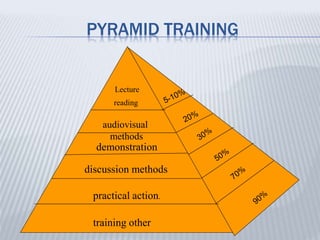
PYRAMID TRAINING
Lecture
reading
audiovisual
methods
demonstration
discussion methods
practical action.
training other
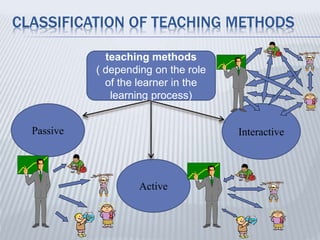
CLASSIFICATION OF TEACHING METHODS
teaching methods
( depending on the role
of the learner in the
learning process)
Passive Interactive
Active
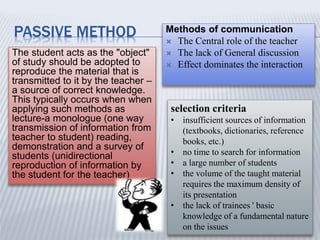
PASSIVE METHOD
The student acts as the "object"
of study should be adopted to
reproduce the material that is
transmitted to it by the teacher –
a source of correct knowledge.
This typically occurs when when
applying such methods as
lecture-a monologue (one way
transmission of information from
teacher to student) reading,
demonstration and a survey of
students (unidirectional
reproduction of information by
the student for the teacher)
Methods of communication
 The Central role of the teacher
 The lack of General discussion
 Effect dominates the interaction
selection criteria
• insufficient sources of information
(textbooks, dictionaries, reference
books, etc.)
• no time to search for information
• а large number of students
• the volume of the taught material
requires the maximum density of
its presentation
• the lack of trainees ' basic
knowledge of a fundamental nature
on the issues
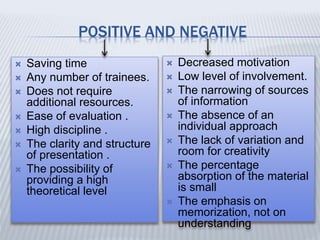
POSITIVE AND NEGATIVE
 Saving time
 Any number of trainees.
 Does not require
additional resources.
 Ease of evaluation .
 High discipline .
 The clarity and structure
of presentation .
 The possibility of
providing a high
theoretical level
 Decreased motivation
 Low level of involvement.
 The narrowing of sources
of information
 The absence of an
individual approach
 The lack of variation and
room for creativity
 The percentage
absorption of the material
is small
 The emphasis on
memorization, not on
understanding
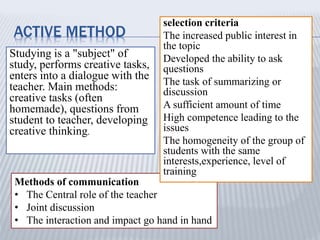
ACTIVE METHOD
Studying is a "subject" of
study, performs creative tasks,
enters into a dialogue with the
teacher. Main methods:
creative tasks (often
homemade), questions from
student to teacher, developing
creative thinking.
Methods of communication
• The Central role of the teacher
• Joint discussion
• The interaction and impact go hand in hand
selection criteria
The increased public interest in
the topic
Developed the ability to ask
questions
The task of summarizing or
discussion
A sufficient amount of time
High competence leading to the
issues
The homogeneity of the group of
students with the same
interests,experience, level of
training
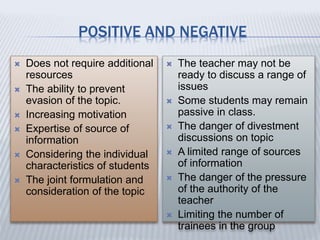
POSITIVE AND NEGATIVE
 Does not require additional
resources
 The ability to prevent
evasion of the topic.
 Increasing motivation
 Expertise of source of
information
 Considering the individual
characteristics of students
 The joint formulation and
consideration of the topic
 The teacher may not be
ready to discuss a range of
issues
 Some students may remain
passive in class.
 The danger of divestment
discussions on topic
 A limited range of sources
of information
 The danger of the pressure
of the authority of the
teacher
 Limiting the number of
trainees in the group
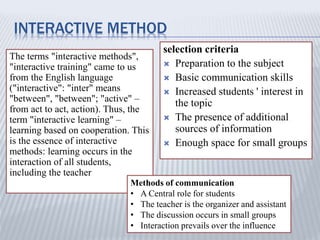
INTERACTIVE METHOD
The terms "interactive methods",
"interactive training" came to us
from the English language
("interactive": "inter" means
"between", "between"; "active" –
from act to act, action). Thus, the
term "interactive learning" –
learning based on cooperation. This
is the essence of interactive
methods: learning occurs in the
interaction of all students,
including the teacher
selection criteria
 Preparation to the subject
 Basic communication skills
 Increased students ' interest in
the topic
 The presence of additional
sources of information
 Enough space for small groups
Methods of communication
• A Central role for students
• The teacher is the organizer and assistant
• The discussion occurs in small groups
• Interaction prevails over the influence
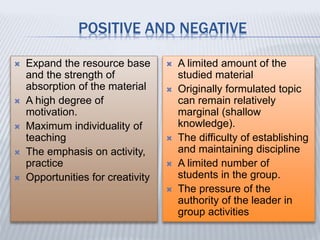
POSITIVE AND NEGATIVE
 Expand the resource base
and the strength of
absorption of the material
 A high degree of
motivation.
 Maximum individuality of
teaching
 The emphasis on activity,
practice
 Opportunities for creativity
 A limited amount of the
studied material
 Originally formulated topic
can remain relatively
marginal (shallow
knowledge).
 The difficulty of establishing
and maintaining discipline
 A limited number of
students in the group.
 The pressure of the
authority of the leader in
group activities
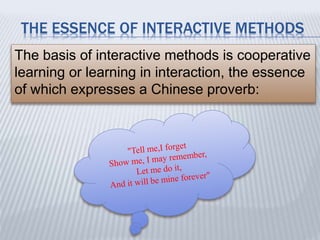
THE ESSENCE OF INTERACTIVE METHODS
The basis of interactive methods is cooperative
learning or learning in interaction, the essence
of which expresses a Chinese proverb:
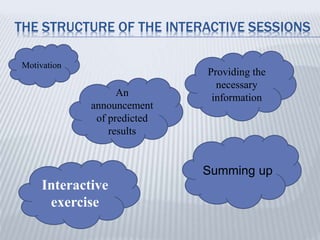
THE STRUCTURE OF THE INTERACTIVE SESSIONS
Motivation
An
announcement
of predicted
results
Interactive
exercise
Summing up
Providing the
necessary
information
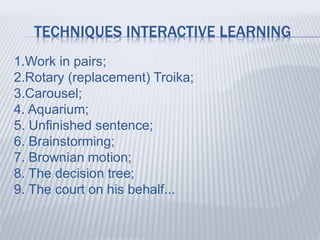
TECHNIQUES INTERACTIVE LEARNING
1.Work in pairs;
2.Rotary (replacement) Troika;
3.Carousel;
4. Aquarium;
5. Unfinished sentence;
6. Brainstorming;
7. Brownian motion;
8. The decision tree;
9. The court on his behalf...
interactive technology

interactive technology

  • 1.
  • 2.
    Everything flows, andthere is nothing more permanent than a permanent change. Confucius Все течет, и нет ничего более постоянного, чем постоянные изменения. Конфуций
  • 3.
  • 4.
    CLASSIFICATION OF TEACHINGMETHODS teaching methods ( depending on the role of the learner in the learning process) Passive Interactive Active
  • 5.
    PASSIVE METHOD The studentacts as the "object" of study should be adopted to reproduce the material that is transmitted to it by the teacher – a source of correct knowledge. This typically occurs when when applying such methods as lecture-a monologue (one way transmission of information from teacher to student) reading, demonstration and a survey of students (unidirectional reproduction of information by the student for the teacher) Methods of communication  The Central role of the teacher  The lack of General discussion  Effect dominates the interaction selection criteria • insufficient sources of information (textbooks, dictionaries, reference books, etc.) • no time to search for information • а large number of students • the volume of the taught material requires the maximum density of its presentation • the lack of trainees ' basic knowledge of a fundamental nature on the issues
  • 6.
    POSITIVE AND NEGATIVE Saving time  Any number of trainees.  Does not require additional resources.  Ease of evaluation .  High discipline .  The clarity and structure of presentation .  The possibility of providing a high theoretical level  Decreased motivation  Low level of involvement.  The narrowing of sources of information  The absence of an individual approach  The lack of variation and room for creativity  The percentage absorption of the material is small  The emphasis on memorization, not on understanding
  • 7.
    ACTIVE METHOD Studying isa "subject" of study, performs creative tasks, enters into a dialogue with the teacher. Main methods: creative tasks (often homemade), questions from student to teacher, developing creative thinking. Methods of communication • The Central role of the teacher • Joint discussion • The interaction and impact go hand in hand selection criteria The increased public interest in the topic Developed the ability to ask questions The task of summarizing or discussion A sufficient amount of time High competence leading to the issues The homogeneity of the group of students with the same interests,experience, level of training
  • 8.
    POSITIVE AND NEGATIVE Does not require additional resources  The ability to prevent evasion of the topic.  Increasing motivation  Expertise of source of information  Considering the individual characteristics of students  The joint formulation and consideration of the topic  The teacher may not be ready to discuss a range of issues  Some students may remain passive in class.  The danger of divestment discussions on topic  A limited range of sources of information  The danger of the pressure of the authority of the teacher  Limiting the number of trainees in the group
  • 9.
    INTERACTIVE METHOD The terms"interactive methods", "interactive training" came to us from the English language ("interactive": "inter" means "between", "between"; "active" – from act to act, action). Thus, the term "interactive learning" – learning based on cooperation. This is the essence of interactive methods: learning occurs in the interaction of all students, including the teacher selection criteria  Preparation to the subject  Basic communication skills  Increased students ' interest in the topic  The presence of additional sources of information  Enough space for small groups Methods of communication • A Central role for students • The teacher is the organizer and assistant • The discussion occurs in small groups • Interaction prevails over the influence
  • 10.
    POSITIVE AND NEGATIVE Expand the resource base and the strength of absorption of the material  A high degree of motivation.  Maximum individuality of teaching  The emphasis on activity, practice  Opportunities for creativity  A limited amount of the studied material  Originally formulated topic can remain relatively marginal (shallow knowledge).  The difficulty of establishing and maintaining discipline  A limited number of students in the group.  The pressure of the authority of the leader in group activities
  • 11.
    THE ESSENCE OFINTERACTIVE METHODS The basis of interactive methods is cooperative learning or learning in interaction, the essence of which expresses a Chinese proverb:
  • 12.
    THE STRUCTURE OFTHE INTERACTIVE SESSIONS Motivation An announcement of predicted results Interactive exercise Summing up Providing the necessary information
  • 13.
    TECHNIQUES INTERACTIVE LEARNING 1.Workin pairs; 2.Rotary (replacement) Troika; 3.Carousel; 4. Aquarium; 5. Unfinished sentence; 6. Brainstorming; 7. Brownian motion; 8. The decision tree; 9. The court on his behalf...