Introduction and Theoretical Foundations of New MediaInteractive Media
ContentsEtymologyEssential characteristicsThe environmental thesis and the anti-deterministic viewTechnology acceptance modelsDigital natives and digital immigrantsThe MillennialsInnovation adoption stagesA look into the futureRelated careersDavid Lamas, TLU, 20112
Computing in the humanities1978Computing in the humanities is a field dominated by amateurs, in the best sense of this word. Nothing forces a critic to put texts on a computer; no composer is compelled to seek the aid of a machine; even the programmers employed on this kind of project are likely to be there by inclination rather than  by accident. Economic motives are also largely absent: in general, nobody makes or saves money by using computers for such applications, and only occasionally can the machine save time.David Lamas, TLU, 20113
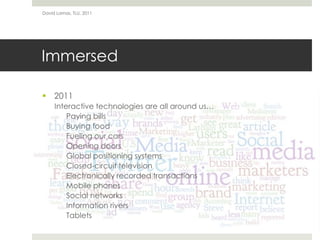
Immersed2011Interactive technologies are all around us…	Paying billsBuying foodFueling our carsOpening doorsGlobal positioning systemsClosed-circuit televisionElectronically recorded transactionsMobile phonesSocial networksInformation riversTabletsDavid Lamas, TLU, 2011
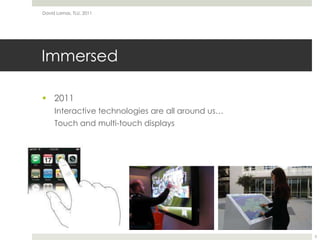
Immersed2011Interactive technologies are all around us…Touch and multi-touch displaysDavid Lamas, TLU, 20115
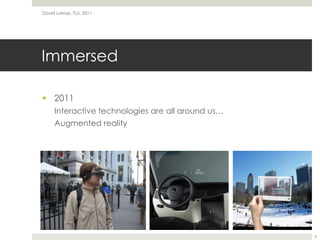
Immersed2011Interactive technologies are all around us…Augmented realityDavid Lamas, TLU, 20116
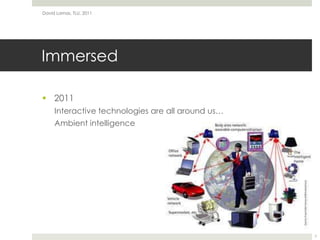
Immersed2011Interactive technologies are all around us…Ambient intelligenceDavid Lamas, TLU, 20117
Interactive mediaInterAmong, betweenActionThe fact or process of doing something, typically to achieve an aim MediaThe plural form of medium, an agency or means of doing something, something we use to communicate withDavid Lamas, TLU, 20118
Interactive mediaInteractive media is…The integration of digital media including combinations of electronic text, graphics, moving images, and sound, into a structured digital computerized environment that allows people to interact with the data for appropriate purposesRelated to products and services on digital computer-based systems which respond to the user’s actions by presenting content such as text, graphics, animation, video, audio, etc…Interactive media…allows users to participate and edit the contentDavid Lamas, TLU, 20119
Interactive mediaBut some argue that interactive media is not…limited to electronic media or digital media	They include board games, pop-up books and flip might be also considered examples of printed interactive media	Some will even argue that books with a simple table of contents or index may be considered interactive due to the non-linear control mechanism in the medium…David Lamas, TLU, 201110
Interactive mediaAnd interactive media is not…New mediaOn one hand, interactive media enables the dynamic life of the new media content and its interactive relationship with the prosumersOn the other, interactive media might just be used to “update” older mediaDavid Lamas, TLU, 201111
Essential characteristicsOn one hand, interactive media retains some of the qualities of both artistic media and mass mediaBut in the other hand, the very nature of these older media forms has been subjected to change by the qualities of computing devicesAs such and with the relationship between old and new interactive media in mindIt is important to establish what is new about interactive media. In other words, what makes interactive media be interactive media.David Lamas, TLU, 201112
Essential characteristicsThe technological convergence of multiple mediaIntermediaMultimediaHypermediaGenerative content creationThe digitization, abstraction and simulation of old mediaIncreased fidelityQuality of representationNon-linearityImmediacyThe interactive authoring and interpretation of meaningInteraction with and through the enabling technologyRelating production and interpretationDavid Lamas, TLU, 201113
Essential characteristicsThe fact is that…Interactive media is changing the way in which we relate to our surroundings by changing the nature of the media that we are already familiar withOne should ask…How do we establish what these changes and the resulting characteristics ofinteractive media are?Today, we will address this question peeking at some theoretical landmarks…The environmental thesisThe anti-deterministic viewThe technology acceptance modelsThe notions of digital native and digital immigrantsThe MillennialsInnovation adoption stagesDavid Lamas, TLU, 201114
The environmental thesisFor McLuhan (1967) we are metaphorically fish that are unaware of the mediating water that surrounds usFish of course, having evolved to be perfectly adapted to the life in the medium of water, are not aware of its existenceWater is the ecological niche into which they were born intoDavid Lamas, TLU, 201115
The anti-deterministic viewFor Williams (1974) it is human agency and the activities of societies and cultures that affect the nature of technology, not the other way aroundIn this case…Technology is always developed with some human need or intention in mindIt is aimed at solving some problem or improving some pre-existing social situationPeople are always in control of its development David Lamas, TLU, 201116
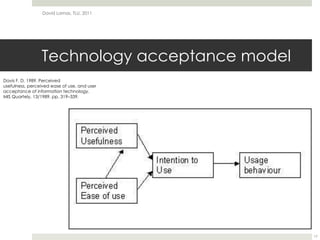
Technology acceptance modelDavid Lamas, TLU, 201117Davis F. D. 1989. Perceived usefulness, perceived ease of use, and user acceptance of information technology. MIS Quartely, 13/1989, pp. 319–339.
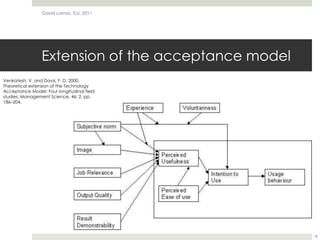
Extension of the acceptance modelDavid Lamas, TLU, 201118Venkatesh, V. and Davis, F. D. 2000. Theoretical extension of the Technology Acceptance Model: Four longitudinal field studies. Management Science, 46: 2, pp. 186–204.
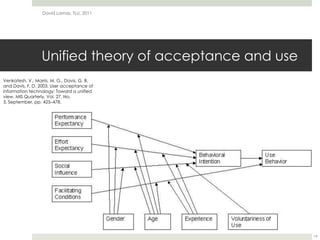
Unified theory of acceptance and useDavid Lamas, TLU, 201119Venkatesh, V., Morris, M. G., Davis, G. B. and Davis, F. D. 2003. User acceptance of information technology: Toward a unified view. MIS Quarterly, Vol. 27. No. 3, September, pp. 425–478.
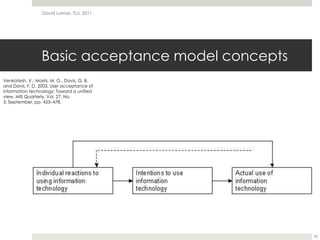
Basic acceptance model conceptsDavid Lamas, TLU, 201120Venkatesh, V., Morris, M. G., Davis, G. B. and Davis, F. D. 2003. User acceptance of information technology: Toward a unified view. MIS Quarterly, Vol. 27. No. 3, September, pp. 425–478.
Digital nativesDigital natives grew up using digital technology, and they’re often acting as guides for digital immigrantsThey are typically Millennials(There are no precise dates for when the Millennial generation starts and ends, and commentators have used birth dates ranging somewhere from the mid-1970s[6] to the mid 1990s, with some sources including as late as the early 2000’s)David Lamas, TLU, 201121http://abm.typepad.com/mediapace/2008/07/index.html
Millennials?Also named…Generation Nowhas been used as well to reflect the urge for instant-gratification that technology has impartedComputer GenerationGeneration Dfor DigitalGeneration Mfor Millennium or Multi-TaskNet Gen	a shortened form of Net GenerationDavid Lamas, TLU, 201122
Millennials?Some interesting facts…97% own a computer94% own a cell phone76% use Instant Messaging15% of IM users are logged on 24/734% use Web sites as their primary source of news28% own a blog and 44% read blogs49% download music using peer-to-peer file sharing75% of college students have a Facebook account60% own some type of portable music or video device such as an iPodDavid Lamas, TLU, 201123
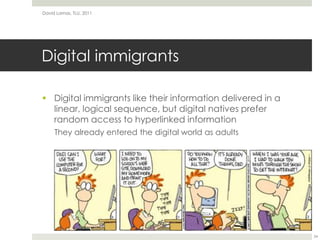
Digital immigrantsDigital immigrants like their information delivered in a linear, logical sequence, but digital natives prefer random access to hyperlinked informationThey already entered the digital world as adultsDavid Lamas, TLU, 201124
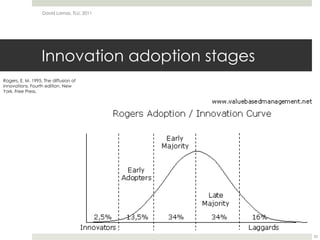
Innovation adoption stagesDavid Lamas, TLU, 201125Rogers, E. M. 1995. The diffusion of innovations. Fourth edition. New York. Free Press.
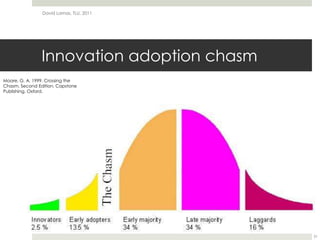
Innovation adoption stagesInnovatorsInnovators are the first individuals to adopt an innovation. Innovators are willing to take risks, youngest in age, have the highest social class, have great financial lucidity, very social and have closest contact to scientific sources and interaction with other innovators. Risk tolerance has them adopting technologies which may ultimately fail. Financial resources help absorb these failures.David Lamas, TLU, 201126Rogers, E. M. 1962. Diffusion of Innovations. Glencoe: Free Press.
Innovation adoption stagesEarly AdoptersThis is the second fastest category of individuals who adopt an innovation. These individuals have the highest degree of opinion leadership among the other adopter categories. Early adopters are typically younger in age, have a higher social status, have more financial lucidity, advanced education, and are more socially forward than late adopters. More discrete in adoption choices than innovators. Realize judicious choice of adoption will help them maintain central communication position.David Lamas, TLU, 201127Rogers, E. M. 1962. Diffusion of Innovations. Glencoe: Free Press.
Innovation adoption stagesEarly MajorityIndividuals in this category adopt an innovation after a varying degree of time. This time of adoption is significantly longer than the innovators and early adopters. Early Majority tend to be slower in the adoption process, have above average social status, contact with early adopters, and seldom hold positions of opinion leadership in a system.David Lamas, TLU, 201128Rogers, E. M. 1962. Diffusion of Innovations. Glencoe: Free Press.
Innovation adoption stagesLate MajorityIndividuals in this category will adopt an innovation after the average member of the society. These individuals approach an innovation with a high degree of skepticism and after the majority of society has adopted the innovation. Late Majority are typically skeptical about an innovation, have below average social status, very little financial lucidity, in contact with others in late majority and early majority, very little opinion leadership.David Lamas, TLU, 201129Rogers, E. M. 1962. Diffusion of Innovations. Glencoe: Free Press.
Innovation adoption stagesLaggardsIndividuals in this category are the last to adopt an innovation. Unlike some of the previous categories, individuals in this category show little to no opinion leadership. These individuals typically have an aversion to change-agents and tend to be advanced in age. Laggards typically tend to be focused on “traditions”, have lowest social status, lowest financial fluidity, oldest of all other adopters, in contact with only family and close friends, very little to no opinion leadership.David Lamas, TLU, 201130Rogers, E. M. 1962. Diffusion of Innovations. Glencoe: Free Press.
Innovation adoption chasmDavid Lamas, TLU, 201131Moore, G. A. 1999. Crossing the Chasm. Second Edition. Capstone Publishing, Oxford.
A look into the futureFive powerful trendsMost growth in the interactive media market will occur outside of today’s high income, or “advanced,” economiesGlobal governance of the Internet will remain substantially unchangedDigital natives will relate to the Internet in markedly different ways than earlier generationsThe QWERTY keyboard will not be the primary interface with the InternetConsumers will pay for Internet connectivity in a much wider range of ways(with flat pricing a rarity)David Lamas, TLU, 201132Monitor Global Business Network and Cisco. 2010. A Look Ahead to 2025 by Cisco and Monitor's Global Business Network.
A look into the futureThree areas of uncertaintyWill broadband network build-out be extensive as a result of the combined effect of private and public investment, or more limited?Will technological progress be characterized more by breakthroughs or mostly represent incremental advances?Will user behavior, including the appetite for ever-richer interactive media applications, lead to demand growth being unbridled or more constrained?David Lamas, TLU, 201133Monitor Global Business Network and Cisco. 2010. A Look Ahead to 2025 by Cisco and Monitor's Global Business Network.
A look into the futureFour possible scenariosFluid frontiers	A world in which the Internet becomes pervasive and centrifugalTechnology continues to make connectivity and devices more and more affordable, in spite of limited investment in network build-out, while global entrepreneurship and fierce competition ensure that the wide range of needs and demands from across the world are met quickly and from equally diverse setups and locationsDavid Lamas, TLU, 201134Monitor Global Business Network and Cisco. 2010. A Look Ahead to 2025 by Cisco and Monitor's Global Business Network.
A look into the futureFour possible scenariosInsecure growth	A world in which users, individuals and business alike, are inhibited from intensive reliance on the InternetRelentless cyber attacks driven by wide-ranging motivations defy the preventive capabilities of governments and international bodiesSecure alternatives emerge, but they are expensiveDavid Lamas, TLU, 201135Monitor Global Business Network and Cisco. 2010. A Look Ahead to 2025 by Cisco and Monitor's Global Business Network.
A look into the futureFour possible scenariosShort of the promise	A frugal world in which prolonged economic stagnation in many countries takes its toll on the spread of the Internet	Technology offers no compensating breakthroughs, and protectionist policy responses to economic weakness make matters worse both in economic terms and with regard to network technology adoptionDavid Lamas, TLU, 201136Monitor Global Business Network and Cisco. 2010. A Look Ahead to 2025 by Cisco and Monitor's Global Business Network.
A look into the futureFour possible scenariosBursting at the seams	A world in which the Internet becomes a victim of its own successDemand for IP-based services is boundless, but capacity constraints and occasional bottlenecks create a gap between the expectations and reality of Internet useMeanwhile, international technology standards don’t come to pass, in part because of a global backlash against decades of U.S. technology dominanceDavid Lamas, TLU, 201137Monitor Global Business Network and Cisco. 2010. A Look Ahead to 2025 by Cisco and Monitor's Global Business Network.
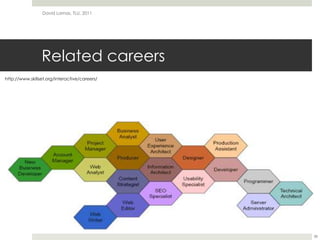
Related careersDavid Lamas, TLU, 201138http://www.skillset.org/interactive/careers/
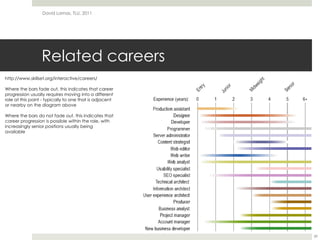
Related careersDavid Lamas, TLU, 201139http://www.skillset.org/interactive/careers/Where the bars fade out, this indicates that career progression usually requires moving into a different role at this point - typically to one that is adjacent or nearby on the diagram aboveWhere the bars do not fade out, this indicates that career progression is possible within the role, with increasingly senior positions usually being available
Interactive media recapEtymologyEssential characteristicsThe environmental thesis and the anti-deterministic viewTechnology acceptance modelsDigital natives and digital immigrantsThe MillennialsInnovation adoption stagesA look into the futureRelated careersDavid Lamas, TLU, 201140
One final questionSo… do we drive or are we driven by the development of interactive media?Does any of the initially presented models prevail?Does the answer depend on our digital citizenship status?David Lamas, TLU, 201141

Interactive Media

  • 1.
    Introduction and TheoreticalFoundations of New MediaInteractive Media
  • 2.
    ContentsEtymologyEssential characteristicsThe environmentalthesis and the anti-deterministic viewTechnology acceptance modelsDigital natives and digital immigrantsThe MillennialsInnovation adoption stagesA look into the futureRelated careersDavid Lamas, TLU, 20112
  • 3.
    Computing in thehumanities1978Computing in the humanities is a field dominated by amateurs, in the best sense of this word. Nothing forces a critic to put texts on a computer; no composer is compelled to seek the aid of a machine; even the programmers employed on this kind of project are likely to be there by inclination rather than by accident. Economic motives are also largely absent: in general, nobody makes or saves money by using computers for such applications, and only occasionally can the machine save time.David Lamas, TLU, 20113
  • 4.
    Immersed2011Interactive technologies areall around us… Paying billsBuying foodFueling our carsOpening doorsGlobal positioning systemsClosed-circuit televisionElectronically recorded transactionsMobile phonesSocial networksInformation riversTabletsDavid Lamas, TLU, 2011
  • 5.
    Immersed2011Interactive technologies areall around us…Touch and multi-touch displaysDavid Lamas, TLU, 20115
  • 6.
    Immersed2011Interactive technologies areall around us…Augmented realityDavid Lamas, TLU, 20116
  • 7.
    Immersed2011Interactive technologies areall around us…Ambient intelligenceDavid Lamas, TLU, 20117
  • 8.
    Interactive mediaInterAmong, betweenActionThefact or process of doing something, typically to achieve an aim MediaThe plural form of medium, an agency or means of doing something, something we use to communicate withDavid Lamas, TLU, 20118
  • 9.
    Interactive mediaInteractive mediais…The integration of digital media including combinations of electronic text, graphics, moving images, and sound, into a structured digital computerized environment that allows people to interact with the data for appropriate purposesRelated to products and services on digital computer-based systems which respond to the user’s actions by presenting content such as text, graphics, animation, video, audio, etc…Interactive media…allows users to participate and edit the contentDavid Lamas, TLU, 20119
  • 10.
    Interactive mediaBut someargue that interactive media is not…limited to electronic media or digital media They include board games, pop-up books and flip might be also considered examples of printed interactive media Some will even argue that books with a simple table of contents or index may be considered interactive due to the non-linear control mechanism in the medium…David Lamas, TLU, 201110
  • 11.
    Interactive mediaAnd interactivemedia is not…New mediaOn one hand, interactive media enables the dynamic life of the new media content and its interactive relationship with the prosumersOn the other, interactive media might just be used to “update” older mediaDavid Lamas, TLU, 201111
  • 12.
    Essential characteristicsOn onehand, interactive media retains some of the qualities of both artistic media and mass mediaBut in the other hand, the very nature of these older media forms has been subjected to change by the qualities of computing devicesAs such and with the relationship between old and new interactive media in mindIt is important to establish what is new about interactive media. In other words, what makes interactive media be interactive media.David Lamas, TLU, 201112
  • 13.
    Essential characteristicsThe technologicalconvergence of multiple mediaIntermediaMultimediaHypermediaGenerative content creationThe digitization, abstraction and simulation of old mediaIncreased fidelityQuality of representationNon-linearityImmediacyThe interactive authoring and interpretation of meaningInteraction with and through the enabling technologyRelating production and interpretationDavid Lamas, TLU, 201113
  • 14.
    Essential characteristicsThe factis that…Interactive media is changing the way in which we relate to our surroundings by changing the nature of the media that we are already familiar withOne should ask…How do we establish what these changes and the resulting characteristics ofinteractive media are?Today, we will address this question peeking at some theoretical landmarks…The environmental thesisThe anti-deterministic viewThe technology acceptance modelsThe notions of digital native and digital immigrantsThe MillennialsInnovation adoption stagesDavid Lamas, TLU, 201114
  • 15.
    The environmental thesisForMcLuhan (1967) we are metaphorically fish that are unaware of the mediating water that surrounds usFish of course, having evolved to be perfectly adapted to the life in the medium of water, are not aware of its existenceWater is the ecological niche into which they were born intoDavid Lamas, TLU, 201115
  • 16.
    The anti-deterministic viewForWilliams (1974) it is human agency and the activities of societies and cultures that affect the nature of technology, not the other way aroundIn this case…Technology is always developed with some human need or intention in mindIt is aimed at solving some problem or improving some pre-existing social situationPeople are always in control of its development David Lamas, TLU, 201116
  • 17.
    Technology acceptance modelDavidLamas, TLU, 201117Davis F. D. 1989. Perceived usefulness, perceived ease of use, and user acceptance of information technology. MIS Quartely, 13/1989, pp. 319–339.
  • 18.
    Extension of theacceptance modelDavid Lamas, TLU, 201118Venkatesh, V. and Davis, F. D. 2000. Theoretical extension of the Technology Acceptance Model: Four longitudinal field studies. Management Science, 46: 2, pp. 186–204.
  • 19.
    Unified theory ofacceptance and useDavid Lamas, TLU, 201119Venkatesh, V., Morris, M. G., Davis, G. B. and Davis, F. D. 2003. User acceptance of information technology: Toward a unified view. MIS Quarterly, Vol. 27. No. 3, September, pp. 425–478.
  • 20.
    Basic acceptance modelconceptsDavid Lamas, TLU, 201120Venkatesh, V., Morris, M. G., Davis, G. B. and Davis, F. D. 2003. User acceptance of information technology: Toward a unified view. MIS Quarterly, Vol. 27. No. 3, September, pp. 425–478.
  • 21.
    Digital nativesDigital nativesgrew up using digital technology, and they’re often acting as guides for digital immigrantsThey are typically Millennials(There are no precise dates for when the Millennial generation starts and ends, and commentators have used birth dates ranging somewhere from the mid-1970s[6] to the mid 1990s, with some sources including as late as the early 2000’s)David Lamas, TLU, 201121http://abm.typepad.com/mediapace/2008/07/index.html
  • 22.
    Millennials?Also named…Generation Nowhasbeen used as well to reflect the urge for instant-gratification that technology has impartedComputer GenerationGeneration Dfor DigitalGeneration Mfor Millennium or Multi-TaskNet Gen a shortened form of Net GenerationDavid Lamas, TLU, 201122
  • 23.
    Millennials?Some interesting facts…97%own a computer94% own a cell phone76% use Instant Messaging15% of IM users are logged on 24/734% use Web sites as their primary source of news28% own a blog and 44% read blogs49% download music using peer-to-peer file sharing75% of college students have a Facebook account60% own some type of portable music or video device such as an iPodDavid Lamas, TLU, 201123
  • 24.
    Digital immigrantsDigital immigrantslike their information delivered in a linear, logical sequence, but digital natives prefer random access to hyperlinked informationThey already entered the digital world as adultsDavid Lamas, TLU, 201124
  • 25.
    Innovation adoption stagesDavidLamas, TLU, 201125Rogers, E. M. 1995. The diffusion of innovations. Fourth edition. New York. Free Press.
  • 26.
    Innovation adoption stagesInnovatorsInnovatorsare the first individuals to adopt an innovation. Innovators are willing to take risks, youngest in age, have the highest social class, have great financial lucidity, very social and have closest contact to scientific sources and interaction with other innovators. Risk tolerance has them adopting technologies which may ultimately fail. Financial resources help absorb these failures.David Lamas, TLU, 201126Rogers, E. M. 1962. Diffusion of Innovations. Glencoe: Free Press.
  • 27.
    Innovation adoption stagesEarlyAdoptersThis is the second fastest category of individuals who adopt an innovation. These individuals have the highest degree of opinion leadership among the other adopter categories. Early adopters are typically younger in age, have a higher social status, have more financial lucidity, advanced education, and are more socially forward than late adopters. More discrete in adoption choices than innovators. Realize judicious choice of adoption will help them maintain central communication position.David Lamas, TLU, 201127Rogers, E. M. 1962. Diffusion of Innovations. Glencoe: Free Press.
  • 28.
    Innovation adoption stagesEarlyMajorityIndividuals in this category adopt an innovation after a varying degree of time. This time of adoption is significantly longer than the innovators and early adopters. Early Majority tend to be slower in the adoption process, have above average social status, contact with early adopters, and seldom hold positions of opinion leadership in a system.David Lamas, TLU, 201128Rogers, E. M. 1962. Diffusion of Innovations. Glencoe: Free Press.
  • 29.
    Innovation adoption stagesLateMajorityIndividuals in this category will adopt an innovation after the average member of the society. These individuals approach an innovation with a high degree of skepticism and after the majority of society has adopted the innovation. Late Majority are typically skeptical about an innovation, have below average social status, very little financial lucidity, in contact with others in late majority and early majority, very little opinion leadership.David Lamas, TLU, 201129Rogers, E. M. 1962. Diffusion of Innovations. Glencoe: Free Press.
  • 30.
    Innovation adoption stagesLaggardsIndividualsin this category are the last to adopt an innovation. Unlike some of the previous categories, individuals in this category show little to no opinion leadership. These individuals typically have an aversion to change-agents and tend to be advanced in age. Laggards typically tend to be focused on “traditions”, have lowest social status, lowest financial fluidity, oldest of all other adopters, in contact with only family and close friends, very little to no opinion leadership.David Lamas, TLU, 201130Rogers, E. M. 1962. Diffusion of Innovations. Glencoe: Free Press.
  • 31.
    Innovation adoption chasmDavidLamas, TLU, 201131Moore, G. A. 1999. Crossing the Chasm. Second Edition. Capstone Publishing, Oxford.
  • 32.
    A look intothe futureFive powerful trendsMost growth in the interactive media market will occur outside of today’s high income, or “advanced,” economiesGlobal governance of the Internet will remain substantially unchangedDigital natives will relate to the Internet in markedly different ways than earlier generationsThe QWERTY keyboard will not be the primary interface with the InternetConsumers will pay for Internet connectivity in a much wider range of ways(with flat pricing a rarity)David Lamas, TLU, 201132Monitor Global Business Network and Cisco. 2010. A Look Ahead to 2025 by Cisco and Monitor's Global Business Network.
  • 33.
    A look intothe futureThree areas of uncertaintyWill broadband network build-out be extensive as a result of the combined effect of private and public investment, or more limited?Will technological progress be characterized more by breakthroughs or mostly represent incremental advances?Will user behavior, including the appetite for ever-richer interactive media applications, lead to demand growth being unbridled or more constrained?David Lamas, TLU, 201133Monitor Global Business Network and Cisco. 2010. A Look Ahead to 2025 by Cisco and Monitor's Global Business Network.
  • 34.
    A look intothe futureFour possible scenariosFluid frontiers A world in which the Internet becomes pervasive and centrifugalTechnology continues to make connectivity and devices more and more affordable, in spite of limited investment in network build-out, while global entrepreneurship and fierce competition ensure that the wide range of needs and demands from across the world are met quickly and from equally diverse setups and locationsDavid Lamas, TLU, 201134Monitor Global Business Network and Cisco. 2010. A Look Ahead to 2025 by Cisco and Monitor's Global Business Network.
  • 35.
    A look intothe futureFour possible scenariosInsecure growth A world in which users, individuals and business alike, are inhibited from intensive reliance on the InternetRelentless cyber attacks driven by wide-ranging motivations defy the preventive capabilities of governments and international bodiesSecure alternatives emerge, but they are expensiveDavid Lamas, TLU, 201135Monitor Global Business Network and Cisco. 2010. A Look Ahead to 2025 by Cisco and Monitor's Global Business Network.
  • 36.
    A look intothe futureFour possible scenariosShort of the promise A frugal world in which prolonged economic stagnation in many countries takes its toll on the spread of the Internet Technology offers no compensating breakthroughs, and protectionist policy responses to economic weakness make matters worse both in economic terms and with regard to network technology adoptionDavid Lamas, TLU, 201136Monitor Global Business Network and Cisco. 2010. A Look Ahead to 2025 by Cisco and Monitor's Global Business Network.
  • 37.
    A look intothe futureFour possible scenariosBursting at the seams A world in which the Internet becomes a victim of its own successDemand for IP-based services is boundless, but capacity constraints and occasional bottlenecks create a gap between the expectations and reality of Internet useMeanwhile, international technology standards don’t come to pass, in part because of a global backlash against decades of U.S. technology dominanceDavid Lamas, TLU, 201137Monitor Global Business Network and Cisco. 2010. A Look Ahead to 2025 by Cisco and Monitor's Global Business Network.
  • 38.
    Related careersDavid Lamas,TLU, 201138http://www.skillset.org/interactive/careers/
  • 39.
    Related careersDavid Lamas,TLU, 201139http://www.skillset.org/interactive/careers/Where the bars fade out, this indicates that career progression usually requires moving into a different role at this point - typically to one that is adjacent or nearby on the diagram aboveWhere the bars do not fade out, this indicates that career progression is possible within the role, with increasingly senior positions usually being available
  • 40.
    Interactive media recapEtymologyEssentialcharacteristicsThe environmental thesis and the anti-deterministic viewTechnology acceptance modelsDigital natives and digital immigrantsThe MillennialsInnovation adoption stagesA look into the futureRelated careersDavid Lamas, TLU, 201140
  • 41.
    One final questionSo…do we drive or are we driven by the development of interactive media?Does any of the initially presented models prevail?Does the answer depend on our digital citizenship status?David Lamas, TLU, 201141