[M1] 
contemporary trends
- workshop - 
Concept mapping 
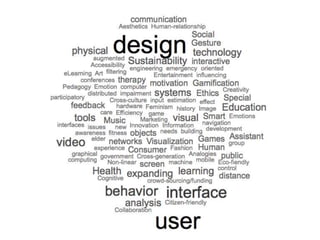
the contemporary trends
Concept mapping
A map is... 
A representation of a system intended to 
someone to help find their way
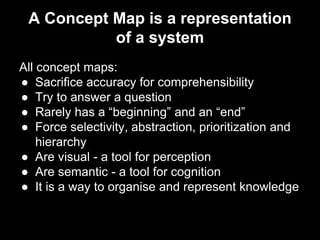
A Concept Map is a representation 
of a system 
All concept maps: 
● Sacrifice accuracy for comprehensibility 
● Try to answer a question 
● Rarely has a “beginning” and an “end” 
● Force selectivity, abstraction, prioritization and 
hierarchy 
● Are visual - a tool for perception 
● Are semantic - a tool for cognition 
● It is a way to organise and represent knowledge
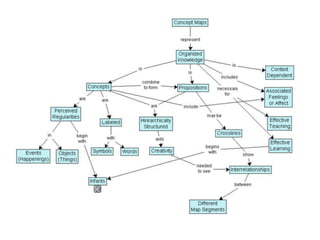
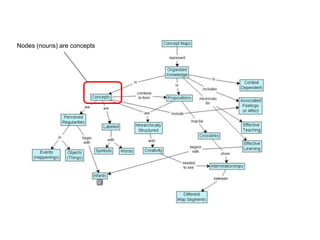
Nodes (nouns) are concepts
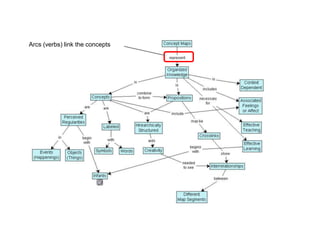
Arcs (verbs) link the concepts
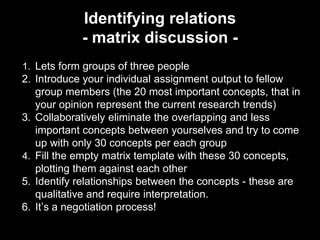
Identifying relations 
- matrix discussion - 
1. Lets form groups of three people 
2. Introduce your individual assignment output to fellow 
group members (the 20 most important concepts, that in 
your opinion represent the current research trends) 
3. Collaboratively eliminate the overlapping and less 
important concepts between yourselves and try to come 
up with only 30 concepts per each group 
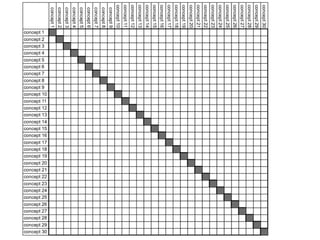
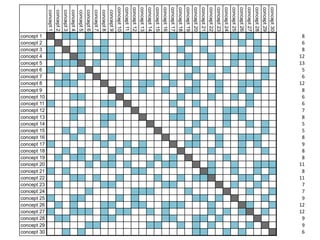
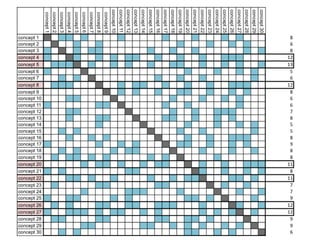
4. Fill the empty matrix template with these 30 concepts, 
plotting them against each other 
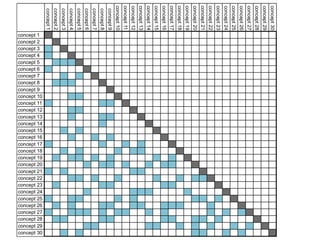
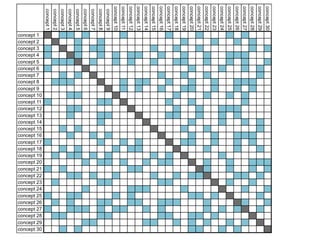
5. Identify relationships between the concepts - these are 
qualitative and require interpretation. 
6. It’s a negotiation process!
Creating the concept map 
1. Use CMapTools 
2. Decide on main concepts of the map based on 
frequency of connections as well as common sense. 
The most frequent concepts should build the skeleton of 
the map. 
3. Fill in the rest of the structure (with leftover concepts - 
let yourself be guided by the matrix), in order to 
represent all the elements in the system. 
4. As you add concepts to the map, connect them with 
arcs (usually verbs) to formulate meaningful sentences. 
5. Export your concept map as a picture to the shared 
folder and present the result by the end of this session 
(3-5 min).

IFI7159 M1

  • 1.
  • 3.
    - workshop - Concept mapping the contemporary trends
  • 4.
  • 5.
    A map is... A representation of a system intended to someone to help find their way
  • 7.
    A Concept Mapis a representation of a system All concept maps: ● Sacrifice accuracy for comprehensibility ● Try to answer a question ● Rarely has a “beginning” and an “end” ● Force selectivity, abstraction, prioritization and hierarchy ● Are visual - a tool for perception ● Are semantic - a tool for cognition ● It is a way to organise and represent knowledge
  • 8.
  • 9.
    Arcs (verbs) linkthe concepts
  • 10.
    Identifying relations -matrix discussion - 1. Lets form groups of three people 2. Introduce your individual assignment output to fellow group members (the 20 most important concepts, that in your opinion represent the current research trends) 3. Collaboratively eliminate the overlapping and less important concepts between yourselves and try to come up with only 30 concepts per each group 4. Fill the empty matrix template with these 30 concepts, plotting them against each other 5. Identify relationships between the concepts - these are qualitative and require interpretation. 6. It’s a negotiation process!
  • 16.
    Creating the conceptmap 1. Use CMapTools 2. Decide on main concepts of the map based on frequency of connections as well as common sense. The most frequent concepts should build the skeleton of the map. 3. Fill in the rest of the structure (with leftover concepts - let yourself be guided by the matrix), in order to represent all the elements in the system. 4. As you add concepts to the map, connect them with arcs (usually verbs) to formulate meaningful sentences. 5. Export your concept map as a picture to the shared folder and present the result by the end of this session (3-5 min).