Evolution of Digital Media Technologies:   Diffusion Theory Kathy E. Gill 23 October 2007
Overview More Theory   Group Discussion Group 1 Leads Reading Discussion Course Projects
Recap:  Linear innovation-diffusion theory The process by which an   innovation   is   communicated   through certain   channels   over  time  among the members of a   social system .  Rogers, 1995, page 5
Recap: Rogers: Five steps of adoption Knowledge Persuasion Decision (adopt or reject) Implementation Confirmation
Recap: Categories Innovators Early Adopters Early Majority Late Majority Laggards
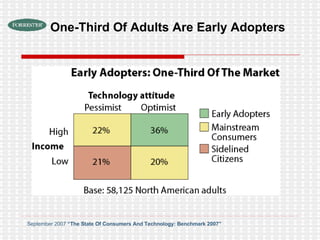
One-Third Of Adults Are Early Adopters September 2007  “The State Of Consumers And Technology: Benchmark 2007”
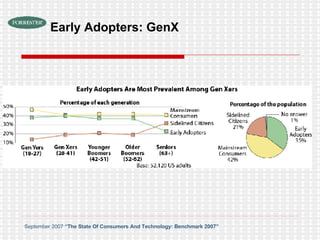
Early Adopters: GenX September 2007  “The State Of Consumers And Technology: Benchmark 2007”
 
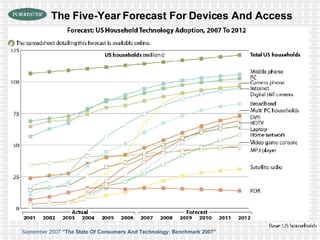
The Five-Year Forecast For Devices And Access September 2007  “The State Of Consumers And Technology: Benchmark 2007”
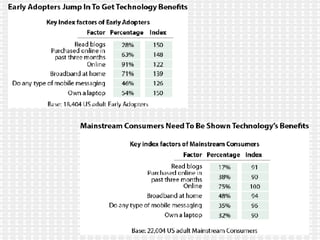
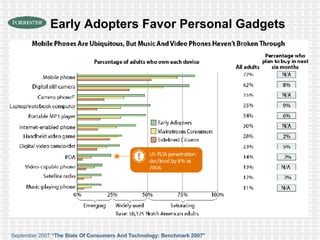
Early Adopters Favor Personal Gadgets September 2007  “The State Of Consumers And Technology: Benchmark 2007”
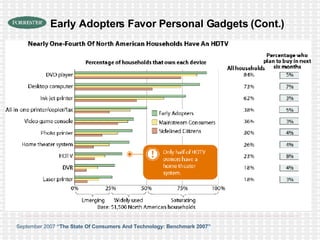
Early Adopters Favor Personal Gadgets (Cont.) September 2007  “The State Of Consumers And Technology: Benchmark 2007”
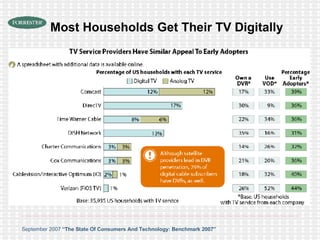
Most Households Get Their TV Digitally September 2007  “The State Of Consumers And Technology: Benchmark 2007”
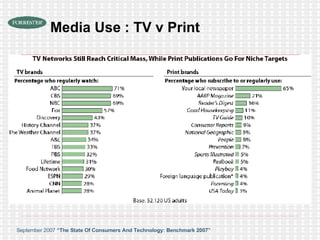
Media Use : TV v Print September 2007  “The State Of Consumers And Technology: Benchmark 2007”
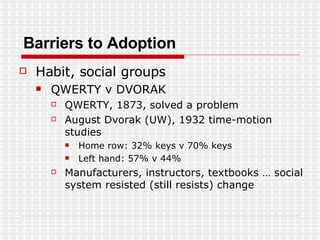
Barriers to Adoption Habit, social groups QWERTY v DVORAK QWERTY, 1873, solved a problem August Dvorak (UW), 1932 time-motion studies Home row: 32% keys v 70% keys Left hand: 57% v 44% Manufacturers, instructors, textbooks … social system resisted (still resists) change
Barriers To Innovation Narrow World View VCR, developed by Ampex Corp, 1950s TV stations $50K, size of refrigerator R&D employees said “miniaturize” Licensed to Sony By 1995,no US company made VCRs Rogers would also say poor  “technology transfer” from R&D
Barriers to Innovation Profit motive 1930, prototypes for two refrigerators: gas and electric Gas had no moving parts GE, GM, Westinghouse and Kelvinator invested heavily in R&D and promotion for electric because “larger profit” potential (Rogers) This is why your refrigerator “hums”
Technology and Society Technological determinism Tech is “autonomous” – out of human control – the “cause” of change Social construction of technology Society shapes technology Refrigerator example Greatest profit to manufacturers not greatest advantage to consumers Many technologies shaped by military
Remember Customer adaptation may change the nature of adoption as the time moves forward Disruptive technologies may change the patter or begin a competing s-curve Familiarity may prevent adoption of “better” technologies
Supervening Social Necessity  (1/2)   Reminder:  1943 - Alan Turing & COLOSSUS WWII machine designed to break German code Earliest working programmable electronic digital computer
Supervening Social Necessity (2/2) 1951 : 1st Computer Sold to U.S. Bureau of Census - UNIVAC  I 1954 : 1st Computer Sold to Private Corp., General Electric Company - UNIVAC  I
ARPANET (Rand, MIT, UCLA) 1969 : 1st node on the Internet 1971 : 15 nodes 1982 : TCP/IP Transmission Control Protocol/Internet Protocol, the de facto standard for transmitting data over networks
Picking Up Speed 1987 : Apple’s Hypertext 1991 : Tim Berners-Lee at European Particle Physics Laboratory in Geneva conceived/birthed the World Wide Web 1993 : National Center for Supercomputing Applications [NCSA] - University of Illinois created a WWW browser named Mosaic
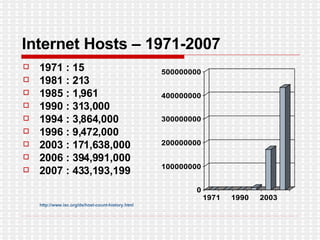
Faster... faster... faster April 94 : Mosaic Communications [Clark & Andreessen] Oct 94 : Netscape Beta Released Nov 94 : Mosaic Co ==> Netscape Aug 9, 1995 : Netscape IPO Initial Public Offering, to “go public” One measure of adoption: hosts
Internet Hosts – 1971-2007 1971 : 15 1981 : 213 1985 : 1,961 1990 : 313,000 1994 : 3,864,000 1996 : 9,472,000 2003 : 171,638,000  2006 : 394,991,000 2007 : 433,193,199 http://www.isc.org/ds/host-count-history.html
Today’s Internet Clearly an example of social construction (ie, not what inventors envisioned)
Reading Discussion Group 1 Leads Groups 2-5, review Group 1 blogposts before discussion Group 1 discussion leaders: remember to post a reflection on your experience tonight by the end of the week!
Project Proposals In a narrative form: State the research area you have selected. (1-2 sentences)  Explain why this is an important topic to research.  Explain how you visualize breaking your topic into three timelines (past-present-future).  Explain what theories you expect to use to support your claims.  Provide an  annotated  list of at least five  scholarly  resources related to your topic. Each resource should be from a unique source. Remember that the final project must have 12 scholarly citations as well as those from reputable media. Provide proper citation and include the type of information provided, including key arguments.

COM 546 - Week 4

  • 1.
    Evolution of DigitalMedia Technologies: Diffusion Theory Kathy E. Gill 23 October 2007
  • 2.
    Overview More Theory  Group Discussion Group 1 Leads Reading Discussion Course Projects
  • 3.
    Recap: Linearinnovation-diffusion theory The process by which an innovation is communicated through certain channels over time among the members of a social system . Rogers, 1995, page 5
  • 4.
    Recap: Rogers: Fivesteps of adoption Knowledge Persuasion Decision (adopt or reject) Implementation Confirmation
  • 5.
    Recap: Categories InnovatorsEarly Adopters Early Majority Late Majority Laggards
  • 6.
    One-Third Of AdultsAre Early Adopters September 2007 “The State Of Consumers And Technology: Benchmark 2007”
  • 7.
    Early Adopters: GenXSeptember 2007 “The State Of Consumers And Technology: Benchmark 2007”
  • 8.
  • 9.
    The Five-Year ForecastFor Devices And Access September 2007 “The State Of Consumers And Technology: Benchmark 2007”
  • 10.
    Early Adopters FavorPersonal Gadgets September 2007 “The State Of Consumers And Technology: Benchmark 2007”
  • 11.
    Early Adopters FavorPersonal Gadgets (Cont.) September 2007 “The State Of Consumers And Technology: Benchmark 2007”
  • 12.
    Most Households GetTheir TV Digitally September 2007 “The State Of Consumers And Technology: Benchmark 2007”
  • 13.
    Media Use :TV v Print September 2007 “The State Of Consumers And Technology: Benchmark 2007”
  • 14.
    Barriers to AdoptionHabit, social groups QWERTY v DVORAK QWERTY, 1873, solved a problem August Dvorak (UW), 1932 time-motion studies Home row: 32% keys v 70% keys Left hand: 57% v 44% Manufacturers, instructors, textbooks … social system resisted (still resists) change
  • 15.
    Barriers To InnovationNarrow World View VCR, developed by Ampex Corp, 1950s TV stations $50K, size of refrigerator R&D employees said “miniaturize” Licensed to Sony By 1995,no US company made VCRs Rogers would also say poor “technology transfer” from R&D
  • 16.
    Barriers to InnovationProfit motive 1930, prototypes for two refrigerators: gas and electric Gas had no moving parts GE, GM, Westinghouse and Kelvinator invested heavily in R&D and promotion for electric because “larger profit” potential (Rogers) This is why your refrigerator “hums”
  • 17.
    Technology and SocietyTechnological determinism Tech is “autonomous” – out of human control – the “cause” of change Social construction of technology Society shapes technology Refrigerator example Greatest profit to manufacturers not greatest advantage to consumers Many technologies shaped by military
  • 18.
    Remember Customer adaptationmay change the nature of adoption as the time moves forward Disruptive technologies may change the patter or begin a competing s-curve Familiarity may prevent adoption of “better” technologies
  • 19.
    Supervening Social Necessity (1/2) Reminder: 1943 - Alan Turing & COLOSSUS WWII machine designed to break German code Earliest working programmable electronic digital computer
  • 20.
    Supervening Social Necessity(2/2) 1951 : 1st Computer Sold to U.S. Bureau of Census - UNIVAC I 1954 : 1st Computer Sold to Private Corp., General Electric Company - UNIVAC I
  • 21.
    ARPANET (Rand, MIT,UCLA) 1969 : 1st node on the Internet 1971 : 15 nodes 1982 : TCP/IP Transmission Control Protocol/Internet Protocol, the de facto standard for transmitting data over networks
  • 22.
    Picking Up Speed1987 : Apple’s Hypertext 1991 : Tim Berners-Lee at European Particle Physics Laboratory in Geneva conceived/birthed the World Wide Web 1993 : National Center for Supercomputing Applications [NCSA] - University of Illinois created a WWW browser named Mosaic
  • 23.
    Faster... faster... fasterApril 94 : Mosaic Communications [Clark & Andreessen] Oct 94 : Netscape Beta Released Nov 94 : Mosaic Co ==> Netscape Aug 9, 1995 : Netscape IPO Initial Public Offering, to “go public” One measure of adoption: hosts
  • 24.
    Internet Hosts –1971-2007 1971 : 15 1981 : 213 1985 : 1,961 1990 : 313,000 1994 : 3,864,000 1996 : 9,472,000 2003 : 171,638,000 2006 : 394,991,000 2007 : 433,193,199 http://www.isc.org/ds/host-count-history.html
  • 25.
    Today’s Internet Clearlyan example of social construction (ie, not what inventors envisioned)
  • 26.
    Reading Discussion Group1 Leads Groups 2-5, review Group 1 blogposts before discussion Group 1 discussion leaders: remember to post a reflection on your experience tonight by the end of the week!
  • 27.
    Project Proposals Ina narrative form: State the research area you have selected. (1-2 sentences) Explain why this is an important topic to research. Explain how you visualize breaking your topic into three timelines (past-present-future). Explain what theories you expect to use to support your claims. Provide an annotated list of at least five scholarly resources related to your topic. Each resource should be from a unique source. Remember that the final project must have 12 scholarly citations as well as those from reputable media. Provide proper citation and include the type of information provided, including key arguments.