The Landscape of 2021 A.D.


Final Project, Selenia Detweiler, Com 303-50, December 5, 2011
   We‘ve come a long way since the very first
    instances of verbal and written communication.
    From the early stages of speech, along with the
    primitive use of symbols and pictures to
    convey messages to one another, we‘ve
    evolved into a communications powerhouse.
    Data has never been transferred faster and
    communication has thus never been more
    sophisticated than it is right now.
   When I think about technology and the use of the umbrella perspective I think about
    Facebook. Some of the enabling factors for me and the use of Facebook is
    personalize, communication, availability. When using Facebook you have the ability to
    adjust your profile to reflect only the things you are willing to let others know about
    you. These setting can be private, semi-private, or open. Along with setting you choose
    who you want your friends to be and what exactly they will be able to see when viewing
    your page. You can also choose which, if any, games to play with friends. Facebook
    gives you the ability to create groups, join groups, etc to promote ideas that are
    meaningful to you.
   Facebook was originally established as a means of communication. Set up for college
    students to stay connected to friends. Communication is a motivating factor. Now that
    it has gone public many people of all ages use Facebook as a means to stay updated with
    their family and friends.
   Another motivating and enabling factor is availability. Smart phones, lap tops, and desk
    tops allow people to connect with Facebook more often and much easier. I did not log
    on to Facebook a fraction of the number of times I do now because I am able to log on
    using my phone. Sitting on a bus or at a stop light allows me to check up on friends any
    time and any where. I am also able to update my ―status‖ whenever as well. Letting my
    friends and family know what I am doing.

   (http://ewheeler82.wordpress.com/2011/01/18/umbrella-perspective-of-
    communication-technologies/)
http://www.huffingtonpost.com/news/social-
networking
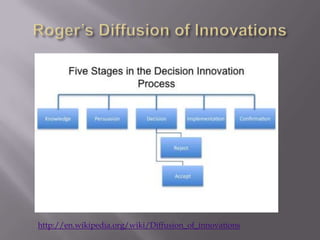
http://en.wikipedia.org/wiki/Diffusion_of_innovations
   The networked classroom
    Tiny Branson, Colo., is proof that the information highway
    can take you anywhere. Faced with declining enrollment at
    its traditional schoolhouse, Branson started offering an
    online public school education to students in far-flung areas
    of the state.
   Branson‘s population may be just 100, but via the
    Internet, 850 children go to school there. One of them is
    Riley South, an eighth-grader who ―attends‖ class from his
    family‘s ranch 165 miles away in Penrose.
   Riley gets up on his own and is on the computer between
    6:30 and 7 a.m. everyday. ―The best part is I can get my
    school work done earlier and I can get my horse exercised
    and rode every day,‖ he told NBC‘s Kevin Tibbles.
   (http://www.msnbc.msn.com/id/18664322/ns/nightly_ne
    ws/t/what-will-world-look/#.Tt1U27JCqU8)
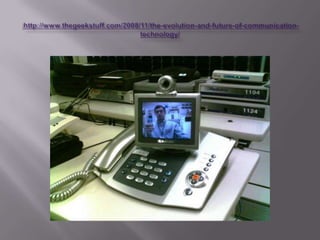
   The Integration of VoIP
   VoIP allows you to make phone calls in three different ways.
    You‘ll need a high-speed broadband internet connection for all
    three options. First, you can still make that phone call through
    your computer using a microphone and headphones/speakers, or
    a headset that does both. Second, you can actually still use an old
    phone you have lying around your house to make an internet
    phone call with the help of a VoIP adapter that hooks up to a
    broadband connection. A third option, (mainly for businesses that
    have multiple incoming/outgoing calls) is to buy a special VoIP
    phone that is just like many other businesses phones but it plugs
    directly into a broadband connection. It has all sorts of special
    features right on the user interface so that you can easily answer
    and transfer calls multiple phone calls. Picking the option that best
    suits you depends on what your intended use is.
   (http://www.thegeekstuff.com/2008/11/the-evolution-and-
    future-of-communication-technology/)
   According to Moore, the marketer should focus on one group of
    customers at a time, using each group as a base for marketing to
    the next group. The most difficult step is making the transition
    between visionaries (early adopters) and pragmatists (early
    majority). This is the chasm that he refers to. If a successful firm
    can create a bandwagon effect in which enough momentum
    builds, then the product becomes a de facto standard.
    However, Moore's theories are only applicable for disruptive or
    discontinuous innovations. Adoption of continuous innovations
    (that do not force a significant change of behavior by the
    customer) are still best described by the original technology
    adoption lifecycle. Confusion between continuous and
    discontinuous innovation is a leading cause of failure for high tech
    prod
   ucts.
    (http://en.wikipedia.org/wiki/Crossing_the_Chasm_(book))
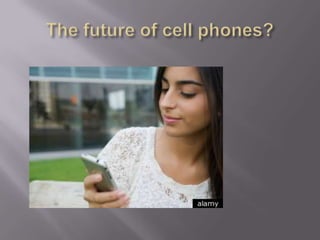
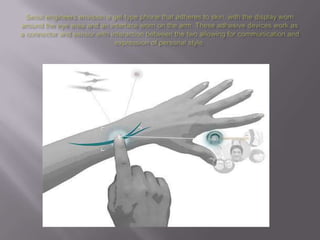
   In the future, the ―cell phone‖ could be an
    extension of our bodies and senses, where
    information could be exchanged and
    communication could be achieved through
    universal gestures. Moreover, embedded
    technology could become more
    accepted, designs could be more varied and
    shape-shifting technologies could enable
    people to adapt devices for different needs.
   While critical mass can be applied to many different aspects of
    sociodynamics, it becomes increasingly applicable to innovations
    in interactive media such as the telephone, fax, or email. With
    other non-interactive innovations, the dependence on other users
    was generally sequential, meaning that the early adopters
    influenced the later adopters to use the innovation. However, with
    interactive media, the interdependence was reciprocal, meaning
    both users influenced each other. This is due to the fact that
    interactive media have high network externality[1], where in the
    value and utility of a good or service increases the more users it
    has. Thus, he increase of adopters and quickness to reach critical
    mass can therefore be faster and more intense with interactive
    media, as can the rate at which previous users discontinue their
    use. The more people that use it, the more beneficial it will be,
    thus creating a type of snowball effect and conversely, if users
    begin to stop using the innovation, the innovation loses utility,
    thus pushing more users to discontinue their use.
   (http://en.wikipedia.org/wiki/Critical_mass_(sociodynamics))
   Blumler and Katz‘s uses and gratification theory
    suggests that media users play an active role in
    choosing and using the media. Users take an
    active part in the communication process and are
    goal oriented in their media use. The theorist say
    that a media user seeks out a media source that
    best fulfills the needs of the user. Uses and
    gratifications assume that the user has alternate
    choices to satisfy their need.
   (http://www.uky.edu/~drlane/capstone/mass/u
    ses.htm)
   Media Systems Dependency Theory (MSD) was first
    proposed by Sandra Ball-Rokeach and Melvin DeFleur in
    1976, and consists of a complex system in which the
    media, individuals, their interpersonal environment, and the
    social environment have dependency relationships with
    each other; Each component depends on the other
    components in a system by drawing on resources in order to
    satisfy goals. Particular attention is given to the resources of
    media systems in modern society and the consideration of
    conditions which will increase or decrease individuals'
    reliance on media systems.The more complex (specialized)
    the society and differentiated its culture, the broader the
    scope of personal and social goals that require access to
    media information resources
   (http://en.wikipedia.org/wiki/Media_systems_dependenc
    y_theory)
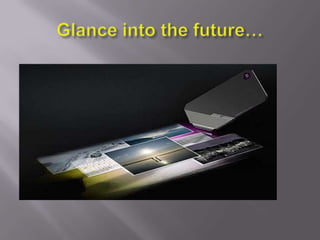
   — Communication could be ambient, always
    on, and people could live online
    — Computers and mobile devices could be
    embedded in the ordinary
    — ―Using Software‖ could vanish; only interface
    and human interaction would remain
    — Device interaction could become
    natural, predictive, and fluid
    — Mollecular manufacturing could revolutionize
    production
    — Objects could access ‗The Cloud‘ at will
   (http://www.designworldonline.com/articles/43
    31/What-will-communication-devices-look-like-
    in-2033.aspx)
   Social cognitive theory, used in
    psychology, education, and
    communication, posits that portions of an
    individual's knowledge acquisition can be
    directly related to observing others within the
    context of social interactions, experiences, and
    outside media influences.
   (http://en.wikipedia.org/wiki/Social_cognitiv
    e_theory)
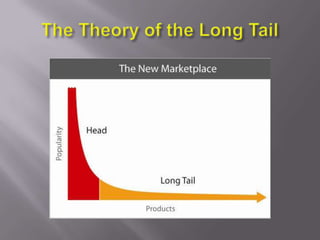
The theory of the Long Tail is that our culture and
   economy is increasingly shifting away from a focus
   on a relatively small number of "hits" (mainstream
   products and markets) at the head of the demand
   curve and toward a huge number of niches in the
   tail. As the costs of production and distribution
   fall, especially online, there is now less need to
   lump products and consumers into one-size-fits-all
   containers. In an era without the constraints of
   physical shelf space and other bottlenecks of
   distribution, narrowly-targeted goods and services
   can be as economically attractive as mainstream
   fare.
(http://thelongtail.com/about.html)
   The Principle of Relative Constancy is a complex
    idea with very simple implications. What at first
    seems like a curio – that advertising is a fairly
    constant proportion of Gross Domestic Product –
    turns into something that might define an
    industry: media are playing a zero-sum game and
    have no choice but to eat their competitors‘
    revenues. Or see theirs eaten.
   The precise mathematical process of determining
    constancy is less interesting than it general use as a
    benchmarking tool. We can use it to figure out just
    how much advertising exists.
   (http://economicsofadvertising.com/?page_id=42
   Tension free needs:
   People sometimes use the media as a means of escapism and to relieve from
    tension
   For e.g. People tend to relax watching TV, listening to radio and for satisfying their
    need for entertainment there by relaxing from all the tension, people watch
    films, films on TV etc
   Note: The needs are individual in nature, and how u satisfies the need is
    individualistic.
   E.g.: That‘s why some watch news to relax and some get more tension by watching
    news, Program is same but people use it for different needs.
   Taking TV today, most people watch reality shows because
   It is more realistic
   For entertainment
   Interesting
   New concepts (different from other programs)
   In a way you can participate
   Controversy, people crying
   Sensationalism
   (http://communicationtheory.org/uses-and-gratification-theory/)
   Social Integrative needs:
   It encompasses the need to socialize with family,
    friends and relations in the society. For social
    interaction now a days people do not seems to have
    social gathering in weekend, instead they do such
    social interaction using media like the social
    networking sites like my space, facebook, orkut etc to
    satisfy their need.
   Another example is you may not watch the particular
    serial regularly but because your friend watching, you
    also start watching so that you have common topics for
    discussion.
   (http://communicationtheory.org/uses-and-
    gratification-theory/)
   TECHNOLOGY MOVES FAST
   The pace of technological development is
    moving fast — really fast. New tools are being
    developed at an astounding pace, the cost of
    hardware and software continues to
    decline, over 90% of the world is now covered
    by a cellular network and 25% of the world has
    access to the internet.
   http://ewheeler82.wordpress.com/2011/01/1
    8/umbrella-perspective-of-communication-
    technologies/)

   http://www.huffingtonpost.com/news/social
    -networking
   http://en.wikipedia.org/wiki/Diffusion_of_in
    novations
   (http://www.msnbc.msn.com/id/18664322/n
    s/nightly_news/t/what-will-world-
    look/#.Tt1U27JCqU8)
   (http://www.thegeekstuff.com/2008/11/the-
    evolution-and-future-of-communication-
    technology/)
   (http://www.thegeekstuff.com/2008/11/the-
    evolution-and-future-of-communication-
    technology/
   (http://en.wikipedia.org/wiki/Crossing_the_
    Chasm_(book))
   (http://en.wikipedia.org/wiki/Critical_mass_
    (sociodynamics))
   (http://www.uky.edu/~drlane/capstone/mas
    s/uses.htm)
   (http://en.wikipedia.org/wiki/Media_system
    s_dependency_theory)
   (http://www.designworldonline.com/articles
    /4331/What-will-communication-devices-
    look-like-in-2033.aspx)
   (http://en.wikipedia.org/wiki/Social_cognitiv
    e_theory)
   (http://thelongtail.com/about.html)
 Final Project
   Selenia Detweiler
     COM 303-50

   December 5, 2011

Detweiler,com303 50,final project

  • 1.
    The Landscape of2021 A.D. Final Project, Selenia Detweiler, Com 303-50, December 5, 2011
  • 2.
    We‘ve come a long way since the very first instances of verbal and written communication. From the early stages of speech, along with the primitive use of symbols and pictures to convey messages to one another, we‘ve evolved into a communications powerhouse. Data has never been transferred faster and communication has thus never been more sophisticated than it is right now.
  • 4.
    When I think about technology and the use of the umbrella perspective I think about Facebook. Some of the enabling factors for me and the use of Facebook is personalize, communication, availability. When using Facebook you have the ability to adjust your profile to reflect only the things you are willing to let others know about you. These setting can be private, semi-private, or open. Along with setting you choose who you want your friends to be and what exactly they will be able to see when viewing your page. You can also choose which, if any, games to play with friends. Facebook gives you the ability to create groups, join groups, etc to promote ideas that are meaningful to you.  Facebook was originally established as a means of communication. Set up for college students to stay connected to friends. Communication is a motivating factor. Now that it has gone public many people of all ages use Facebook as a means to stay updated with their family and friends.  Another motivating and enabling factor is availability. Smart phones, lap tops, and desk tops allow people to connect with Facebook more often and much easier. I did not log on to Facebook a fraction of the number of times I do now because I am able to log on using my phone. Sitting on a bus or at a stop light allows me to check up on friends any time and any where. I am also able to update my ―status‖ whenever as well. Letting my friends and family know what I am doing.  (http://ewheeler82.wordpress.com/2011/01/18/umbrella-perspective-of- communication-technologies/)
  • 5.
  • 7.
  • 9.
    The networked classroom Tiny Branson, Colo., is proof that the information highway can take you anywhere. Faced with declining enrollment at its traditional schoolhouse, Branson started offering an online public school education to students in far-flung areas of the state.  Branson‘s population may be just 100, but via the Internet, 850 children go to school there. One of them is Riley South, an eighth-grader who ―attends‖ class from his family‘s ranch 165 miles away in Penrose.  Riley gets up on his own and is on the computer between 6:30 and 7 a.m. everyday. ―The best part is I can get my school work done earlier and I can get my horse exercised and rode every day,‖ he told NBC‘s Kevin Tibbles.  (http://www.msnbc.msn.com/id/18664322/ns/nightly_ne ws/t/what-will-world-look/#.Tt1U27JCqU8)
  • 10.
    The Integration of VoIP  VoIP allows you to make phone calls in three different ways. You‘ll need a high-speed broadband internet connection for all three options. First, you can still make that phone call through your computer using a microphone and headphones/speakers, or a headset that does both. Second, you can actually still use an old phone you have lying around your house to make an internet phone call with the help of a VoIP adapter that hooks up to a broadband connection. A third option, (mainly for businesses that have multiple incoming/outgoing calls) is to buy a special VoIP phone that is just like many other businesses phones but it plugs directly into a broadband connection. It has all sorts of special features right on the user interface so that you can easily answer and transfer calls multiple phone calls. Picking the option that best suits you depends on what your intended use is.  (http://www.thegeekstuff.com/2008/11/the-evolution-and- future-of-communication-technology/)
  • 12.
    According to Moore, the marketer should focus on one group of customers at a time, using each group as a base for marketing to the next group. The most difficult step is making the transition between visionaries (early adopters) and pragmatists (early majority). This is the chasm that he refers to. If a successful firm can create a bandwagon effect in which enough momentum builds, then the product becomes a de facto standard. However, Moore's theories are only applicable for disruptive or discontinuous innovations. Adoption of continuous innovations (that do not force a significant change of behavior by the customer) are still best described by the original technology adoption lifecycle. Confusion between continuous and discontinuous innovation is a leading cause of failure for high tech prod  ucts. (http://en.wikipedia.org/wiki/Crossing_the_Chasm_(book))
  • 15.
    In the future, the ―cell phone‖ could be an extension of our bodies and senses, where information could be exchanged and communication could be achieved through universal gestures. Moreover, embedded technology could become more accepted, designs could be more varied and shape-shifting technologies could enable people to adapt devices for different needs.
  • 16.
    While critical mass can be applied to many different aspects of sociodynamics, it becomes increasingly applicable to innovations in interactive media such as the telephone, fax, or email. With other non-interactive innovations, the dependence on other users was generally sequential, meaning that the early adopters influenced the later adopters to use the innovation. However, with interactive media, the interdependence was reciprocal, meaning both users influenced each other. This is due to the fact that interactive media have high network externality[1], where in the value and utility of a good or service increases the more users it has. Thus, he increase of adopters and quickness to reach critical mass can therefore be faster and more intense with interactive media, as can the rate at which previous users discontinue their use. The more people that use it, the more beneficial it will be, thus creating a type of snowball effect and conversely, if users begin to stop using the innovation, the innovation loses utility, thus pushing more users to discontinue their use.  (http://en.wikipedia.org/wiki/Critical_mass_(sociodynamics))
  • 17.
    Blumler and Katz‘s uses and gratification theory suggests that media users play an active role in choosing and using the media. Users take an active part in the communication process and are goal oriented in their media use. The theorist say that a media user seeks out a media source that best fulfills the needs of the user. Uses and gratifications assume that the user has alternate choices to satisfy their need.  (http://www.uky.edu/~drlane/capstone/mass/u ses.htm)
  • 18.
    Media Systems Dependency Theory (MSD) was first proposed by Sandra Ball-Rokeach and Melvin DeFleur in 1976, and consists of a complex system in which the media, individuals, their interpersonal environment, and the social environment have dependency relationships with each other; Each component depends on the other components in a system by drawing on resources in order to satisfy goals. Particular attention is given to the resources of media systems in modern society and the consideration of conditions which will increase or decrease individuals' reliance on media systems.The more complex (specialized) the society and differentiated its culture, the broader the scope of personal and social goals that require access to media information resources  (http://en.wikipedia.org/wiki/Media_systems_dependenc y_theory)
  • 20.
    — Communication could be ambient, always on, and people could live online — Computers and mobile devices could be embedded in the ordinary — ―Using Software‖ could vanish; only interface and human interaction would remain — Device interaction could become natural, predictive, and fluid — Mollecular manufacturing could revolutionize production — Objects could access ‗The Cloud‘ at will  (http://www.designworldonline.com/articles/43 31/What-will-communication-devices-look-like- in-2033.aspx)
  • 21.
    Social cognitive theory, used in psychology, education, and communication, posits that portions of an individual's knowledge acquisition can be directly related to observing others within the context of social interactions, experiences, and outside media influences.  (http://en.wikipedia.org/wiki/Social_cognitiv e_theory)
  • 23.
    The theory ofthe Long Tail is that our culture and economy is increasingly shifting away from a focus on a relatively small number of "hits" (mainstream products and markets) at the head of the demand curve and toward a huge number of niches in the tail. As the costs of production and distribution fall, especially online, there is now less need to lump products and consumers into one-size-fits-all containers. In an era without the constraints of physical shelf space and other bottlenecks of distribution, narrowly-targeted goods and services can be as economically attractive as mainstream fare. (http://thelongtail.com/about.html)
  • 24.
    The Principle of Relative Constancy is a complex idea with very simple implications. What at first seems like a curio – that advertising is a fairly constant proportion of Gross Domestic Product – turns into something that might define an industry: media are playing a zero-sum game and have no choice but to eat their competitors‘ revenues. Or see theirs eaten.  The precise mathematical process of determining constancy is less interesting than it general use as a benchmarking tool. We can use it to figure out just how much advertising exists.  (http://economicsofadvertising.com/?page_id=42
  • 25.
    Tension free needs:  People sometimes use the media as a means of escapism and to relieve from tension  For e.g. People tend to relax watching TV, listening to radio and for satisfying their need for entertainment there by relaxing from all the tension, people watch films, films on TV etc  Note: The needs are individual in nature, and how u satisfies the need is individualistic.  E.g.: That‘s why some watch news to relax and some get more tension by watching news, Program is same but people use it for different needs.  Taking TV today, most people watch reality shows because  It is more realistic  For entertainment  Interesting  New concepts (different from other programs)  In a way you can participate  Controversy, people crying  Sensationalism  (http://communicationtheory.org/uses-and-gratification-theory/)
  • 26.
    Social Integrative needs:  It encompasses the need to socialize with family, friends and relations in the society. For social interaction now a days people do not seems to have social gathering in weekend, instead they do such social interaction using media like the social networking sites like my space, facebook, orkut etc to satisfy their need.  Another example is you may not watch the particular serial regularly but because your friend watching, you also start watching so that you have common topics for discussion.  (http://communicationtheory.org/uses-and- gratification-theory/)
  • 27.
    TECHNOLOGY MOVES FAST  The pace of technological development is moving fast — really fast. New tools are being developed at an astounding pace, the cost of hardware and software continues to decline, over 90% of the world is now covered by a cellular network and 25% of the world has access to the internet.
  • 29.
    http://ewheeler82.wordpress.com/2011/01/1 8/umbrella-perspective-of-communication- technologies/)  http://www.huffingtonpost.com/news/social -networking  http://en.wikipedia.org/wiki/Diffusion_of_in novations  (http://www.msnbc.msn.com/id/18664322/n s/nightly_news/t/what-will-world- look/#.Tt1U27JCqU8)
  • 30.
    (http://www.thegeekstuff.com/2008/11/the- evolution-and-future-of-communication- technology/)  (http://www.thegeekstuff.com/2008/11/the- evolution-and-future-of-communication- technology/  (http://en.wikipedia.org/wiki/Crossing_the_ Chasm_(book))  (http://en.wikipedia.org/wiki/Critical_mass_ (sociodynamics))
  • 31.
    (http://www.uky.edu/~drlane/capstone/mas s/uses.htm)  (http://en.wikipedia.org/wiki/Media_system s_dependency_theory)  (http://www.designworldonline.com/articles /4331/What-will-communication-devices- look-like-in-2033.aspx)  (http://en.wikipedia.org/wiki/Social_cognitiv e_theory)  (http://thelongtail.com/about.html)
  • 32.
     Final Project  Selenia Detweiler  COM 303-50  December 5, 2011