Introduction and Theoretical Foundations of New MediaMetadata and Ontologies..
ContentsMetadataOntologiesFolksonomiesThe sematic webThe internet of thingsDavid Lamas, TLU, 20112
MetadataDavid Lamas, TLU, 20113
MetadataSo, why is metadata relevant?Or… why should we care about metadata?David Lamas, TLU, 20114
MetadataAs a concept, is not newMetadata has long been for managing document collections such as the ones kept by librariesBut the term itself, was only coined in 1968By Philip Bagley, a pioneer of computerized document retrievalDavid Lamas, TLU, 20115
MetadataLiterally, a set of data that describes and gives information about other data, metadata in our context is:Machine readableDescriptiveFor the purposes of resource…	Discovery	ManagementDeliveryAccess controlUse	Re-useLong term preservationDavid Lamas, TLU, 20116
MetadataOr in other words, metadata allows for the description of the…DefinitionStructure; andAdministrationof selected resources with all contents in context to ease the further use of the resourceDavid Lamas, TLU, 20117
MARCOr… Machine Readable CatalogueIs still the main metadata standard in the library world although it is not a full cataloguing scheme being David Lamas, TLU, 20118
UDC, AARC2 and RDAUniversal Decimal ClassificationA multilingual classification scheme for all fields of knowledge	Available at… http://www.udcc.org/udcsummary/php/index.phpAnglo-American Cataloguing RulesFor use in the construction of cataloguesAvailable at…http://www.aacr2.org/Resource description and accessAvailable at…http://www.rda-jsc.org/rda.htmlDavid Lamas, TLU, 20119
Z39.50, SRW and SRUZ39.50is a client–server protocol for searching and retrieving information widely used in library environmentsSearch & Retrieve Web ServiceA intended standard web-based text-searching interfaceSearch/Retrieval via URLAstandard XML-focused search protocol for Internet search queries, which uses the Contextual Query LanguageDavid Lamas, TLU, 201110
But…This should not bother you other than to note that…Metadata tends to get more complicated the longer you think about itDavid Lamas, TLU, 201111
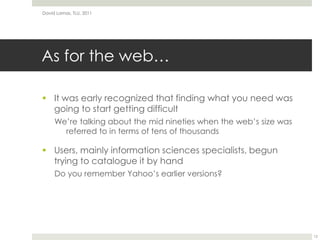
As for the web…It was early recognized that finding what you need was going to start getting difficultWe’re talking about the mid nineties when the web’s size was referred to in terms of tens of thousandsUsers, mainly information sciences specialists, begun trying to catalogue it by handDo you remember Yahoo’s earlier versions?David Lamas, TLU, 201112
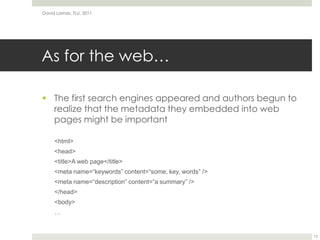
As for the web…The first search engines appeared and authors begun to realize that the metadata they embedded into web pages might be important<html><head><title>A web page</title><meta name=“keywords” content=“some, key, words” /><meta name=“description” content=“a summary” /></head><body>…David Lamas, TLU, 201113
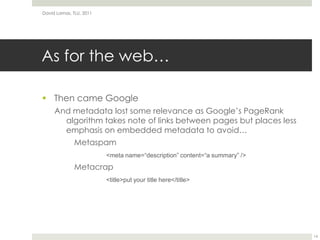
As for the web…Then came GoogleAnd metadata lost some relevance as Google’s PageRank algorithm takes note of links between pages but places less emphasis on embedded metadata to avoid…Metaspam<meta name=“description” content=“a summary” />Metacrap<title>put your title here</title>David Lamas, TLU, 201114
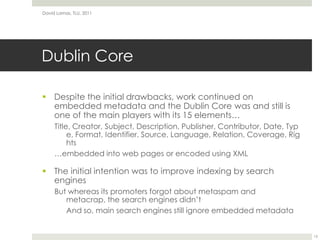
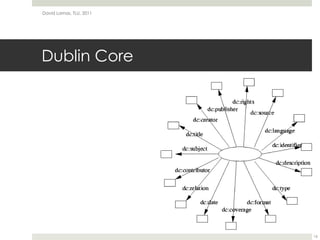
Dublin CoreDespite the initial drawbacks, work continued on embedded metadata and the Dublin Core was and still is one of the main players with its 15 elements…Title, Creator, Subject, Description, Publisher, Contributor, Date, Type, Format, Identifier, Source, Language, Relation, Coverage, Rights…embedded into web pages or encoded using XMLThe initial intention was to improve indexing by search enginesBut whereas its promoters forgot about metaspam and metacrap, the search engines didn’tAnd so, main search engines still ignore embedded metadataDavid Lamas, TLU, 201115
Dublin CoreDavid Lamas, TLU, 201116
MetadataRemarkably, there has been fairly widespread adoption of metadata principles, specially in policy terms, namely in government(look into http://www.esd.org.uk/standards/egms/viewer/viewer.aspxfor and interesting example)And in:EducationHealthCultural heritageEnvironmental agencies, and…Libraries, of courseDavid Lamas, TLU, 201117
MetadataThis resulted in the… Growth of metadata cataloguing rules(although every community has its own rules)Growth in use of additional elements for particular communities(and again, every community’s additions are different)Adoption of application profiles to document the distinct cataloguing rules and additionsInstitution of the Dublin Core Metadata Initiative asan organization engaged in the development of interoperable metadata standards that support a broad range of purposes and business modelsDavid Lamas, TLU, 201118
MetadataBut the Dublin Core isn’t alone, far from itMany other standards were and are being developed such as these, just to name two:RDF (Resource Description Framework)LOM (Learning Object Metadata)David Lamas, TLU, 201119
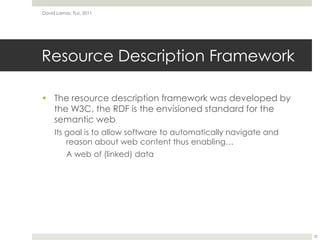
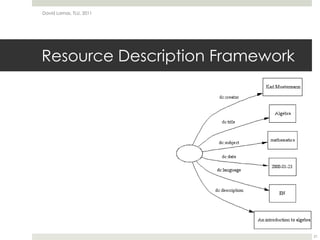
Resource Description FrameworkThe resource description framework was developed by the W3C, the RDF is the envisioned standard for the semantic webIts goal is to allow software to automatically navigate and reason about web content thus enabling…	A web of (linked) dataDavid Lamas, TLU, 201120
Resource Description FrameworkDavid Lamas, TLU, 201121
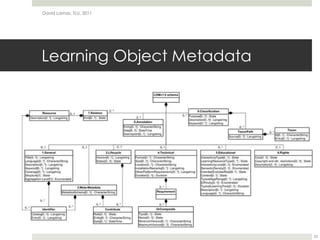
Learning Object MetadataLearning Object Metadata is a data modelUsually encoded in XML, it is used to describe learning objects and similar digital resources used to support learning.David Lamas, TLU, 201122
Learning Object MetadataDavid Lamas, TLU, 201123
MetadataAs said in the beginning…Metadata tends to get more complicated the longer we think about itThe current metadata efforts lack of within standards and within communities coherence and cohesion are a good example	And that is why we will next look into OntologiesSo… do we care about metadata?Why are we interested?David Lamas, TLU, 201124
MetadataI guess the answer is yes, we care.And yes, we are interested, because metadata is everywhere	Sometimes it is explicitly available,Other times it is hidden or not so readily available, butanyway…It would be foolish not to make use of itDavid Lamas, TLU, 201125
MetadataFurther, there is increasing pressure to expose metadata on the web for other to mash up and this is specially true today in settingssuch as…Education;Research; andGovernmentAnd finally, metadata becomes paramount in scenarios wherecontent is data; orthe required information can not easily derived from contentDavid Lamas, TLU, 201126
OntologiesDavid Lamas, TLU, 201127
OntologiesOne way of dealing with the lack of within standards and within communities coherence and cohesion of current metadata efforts is to evolve to an ontology-base metadata approachBut what does this means?David Lamas, TLU, 201128
OntologiesAn ontology is a logical theory which gives an explicit partial account of a conceptualizationAn intentional semantic structure which encodes the implicit rules constraining the structure of a piece of realityIn this light, the aim of an ontology is to define which primitives, provided with their associated semantics, are necessary for knowledge representation in a given contextDavid Lamas, TLU, 2011Thomas R. Gruber (1993). Toward principles for the design of ontologies used for knowledge sharing. Originally in N. Guarino and R. Poli, (Eds.), International Workshop on Formal Ontology, Padova, Italy. Revised August 1993. Published in International Journal of Human-Computer Studies, Volume 43 , Issue 5-6 Nov./Dec. 1995, Pages: 907-928, special issue on the role of formal ontology in the information technology.
OntologiesOntologies are usually characterized by their…CoverageThe extent to which the primitives mobilized by the perceived usage scenarios are covered by the ontologySpecificityThe extent to which ontological primitives are precisely identifiedGranularityThe extent to which primitives are precisely and formally definedFormalityThe extent to which primitives are described in a formal languageDavid Lamas, TLU, 201130
OntologiesAnd ontologies are not… taxonomiesBut  taxonomy might be perceived as a  specific case of an ontologyA taxonomy is a particular classification arranged in a hierarchical structureTypically it is organized by supertype/subtype relationships also called generalization/specialization relationshipsDavid Lamas, TLU, 201131
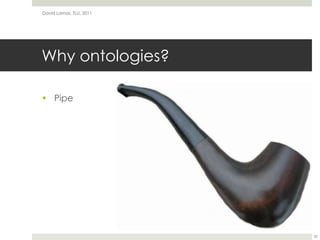
Why ontologies?David Lamas, TLU, 201132Pipe
Why ontologies?David Lamas, TLU, 201133Pipe
Why ontologies?David Lamas, TLU, 201134Pipe
Why ontologies?In short, we interpret, machines don’tAs such, an effort must be undertaken in order to support adequate usage of digital resourcesSo, what’s missing?Among other…	The possibility to share a common understanding of the structure of information within a specific domain	The possibility to reuse domain knowledge	The possibility to make domain assumptions explicitThe possibility to analyze domain knowledgeDavid Lamas, TLU, 201135
Ontologies and the webIt is estimated that by 2010…70% of public web pages will have some level of metadata, but only20% will use more extensive semantic web approaches such as ontology-based metadataBut why should we care?David Lamas, TLU, 201136http://www.afsg.nl/InformationManagement/images/nieuws/finding%20and%20exploiting%20value%20of%20semantic%20tech%20on%20web.pdf
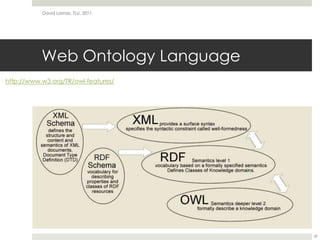
Ontologies and the webAn emerging ontological approach is OWL or…Web Ontology LanguageA vocabulary extension of the Resource Description Framework, which adds more vocabulary for describing characteristics of properties and classes or relations between classesDavid Lamas, TLU, 201137
Web Ontology LanguageOWL enables ontology-based information sharing and manipulation together with RDF and XMLIn reverse order…XML allows users to add arbitrary structure to their docuemnts but says nothing about what such structures meanRDF enables expression of meaning over XML (and other) structuresUsing subject, verb and object triplesOWL enables machines to comprehend semantic documents and dataDavid Lamas, TLU, 201138
Web Ontology LanguageDavid Lamas, TLU, 201139http://www.w3.org/TR/owl-features/
OntologiesThis said and while addressing some of the current metadata efforts weaknesses, present-day ontologies still largely depend on explicit human intervention to be usefulAnd that is why we will next look into folksonomiesDavid Lamas, TLU, 201140
FolksonomiesDavid Lamas, TLU, 2011
FolksonomiesAre mainly a bottom-up social classification systemA way to organize and share contents by tagging resourcesSynonyms are…Ethno-classification; andCollaborative taggingDavid Lamas, TLU, 2011
FolksonomiesFolksonomies are created by users and have…No structureNo fixed vocabularyNo explicit relationships between terms, andNo authorityDavid Lamas, TLU, 201143
FolksonomiesFolksonomies also are…Distributed, andCollaboratively built and maintainedYou can tag items owned by othersYou can get instant feedback	All items for the same tag	All tags for the same itemYou can a adapt your tags to the group norm	But you are never forcedDavid Lamas, TLU, 201144
FolksonomiesSome of their apparent benefits are…Being cheap and easy to build and useBeing capable to adapt very quickly to changes and users needsThey scale wellFoster serendipitySemantic browsing instead of searchingLower the cooperation barriersDavid Lamas, TLU, 201145
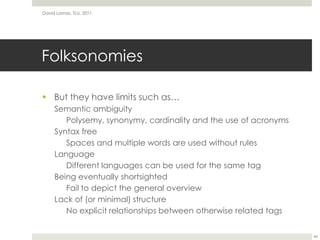
FolksonomiesBut they have limits such as…Semantic ambiguityPolysemy, synonymy, cardinality and the use of acronymsSyntax freeSpaces and multiple words are used without rulesLanguageDifferent languages can be used for the same tagBeing eventually shortsightedFail to depict the general overviewLack of (or minimal) structureNo explicit relationships between otherwise related tagsDavid Lamas, TLU, 201146
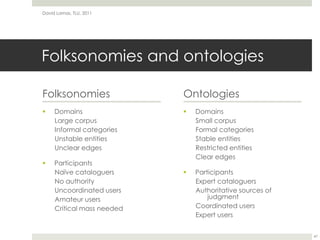
Folksonomies and ontologiesFolksonomiesDomainsLarge corpusInformal categoriesUnstable entitiesUnclear edgesParticipantsNaïve cataloguersNo authorityUncoordinated usersAmateur usersCritical mass neededOntologiesDomainsSmall corpusFormal categoriesStable entitiesRestricted entitiesClear edgesParticipantsExpert cataloguersAuthoritative sources of judgmentCoordinated usersExpert usersDavid Lamas, TLU, 201147
Folksonomies and ontologiesHow do we choose?Folksonomies are useful when all that is needed is the ability to link items to topicsOntologies are useful when what is needed is to formally define meaningBut… do we need to choose?Not really, at least that what current research is exploringDavid Lamas, TLU, 201148
Folksonomies and ontologiesResearch directions includeThe combination of the folksonomy and ontology approaches into an hybrid system where the most consensual constructs would long last while others would be forgotten or redefinedAn approach that combines the ease and adaptability of folksonomy with the formality and semantic richness of an ontologyQuantitative tag analysis and qualitative use analysis in current online social networking servicesTo understand if tag usage converge or notTo understand how a folksonomy is formedTo… any ideas?David Lamas, TLU, 201149
Semantic webDavid Lamas, TLU, 2011
Semantic WebThe Web was designed as an information space, with the goal that it should be useful not only for human-human communication, but also that machines would be able to participate and helpOne of the major obstacles to this has been the fact that most information on the Web is designed for human consumption, and even if it was derived from a database with well defined meanings (in at least some terms) for its columns, that the structure of the data is not evident to a robot browsing the webLeaving aside the artificial intelligence problem of training machines to behave like people, the Semantic Web approach instead develops languages for expressing information in a machine processable form.David Lamas, TLU, 2011
Internet of thingsDavid Lamas, TLU, 2011
The internet of thingsThe internet of things might be described as a self-configuring wireless network of sensors whose purpose would be to interconnect all thingsAnd the concept is attributed to the former Auto-ID Center, founded in 1999, based at the time at the MITAn alternative viewfocuses instead on making all things addressable by the existing naming protocolsIn the current vision, objects themselves do not interact, but they may now be referred to by other agents, such as centralized servers acting for their human usersDavid Lamas, TLU, 2011
Metadata and Ontologies recapMetadataOntologiesFolksonomiesThe sematic webThe internet of thingsDavid Lamas, TLU, 201154

Metadata and ontologies

  • 1.
    Introduction and TheoreticalFoundations of New MediaMetadata and Ontologies..
  • 2.
    ContentsMetadataOntologiesFolksonomiesThe sematic webTheinternet of thingsDavid Lamas, TLU, 20112
  • 3.
  • 4.
    MetadataSo, why ismetadata relevant?Or… why should we care about metadata?David Lamas, TLU, 20114
  • 5.
    MetadataAs a concept,is not newMetadata has long been for managing document collections such as the ones kept by librariesBut the term itself, was only coined in 1968By Philip Bagley, a pioneer of computerized document retrievalDavid Lamas, TLU, 20115
  • 6.
    MetadataLiterally, a setof data that describes and gives information about other data, metadata in our context is:Machine readableDescriptiveFor the purposes of resource… Discovery ManagementDeliveryAccess controlUse Re-useLong term preservationDavid Lamas, TLU, 20116
  • 7.
    MetadataOr in otherwords, metadata allows for the description of the…DefinitionStructure; andAdministrationof selected resources with all contents in context to ease the further use of the resourceDavid Lamas, TLU, 20117
  • 8.
    MARCOr… Machine ReadableCatalogueIs still the main metadata standard in the library world although it is not a full cataloguing scheme being David Lamas, TLU, 20118
  • 9.
    UDC, AARC2 andRDAUniversal Decimal ClassificationA multilingual classification scheme for all fields of knowledge Available at… http://www.udcc.org/udcsummary/php/index.phpAnglo-American Cataloguing RulesFor use in the construction of cataloguesAvailable at…http://www.aacr2.org/Resource description and accessAvailable at…http://www.rda-jsc.org/rda.htmlDavid Lamas, TLU, 20119
  • 10.
    Z39.50, SRW andSRUZ39.50is a client–server protocol for searching and retrieving information widely used in library environmentsSearch & Retrieve Web ServiceA intended standard web-based text-searching interfaceSearch/Retrieval via URLAstandard XML-focused search protocol for Internet search queries, which uses the Contextual Query LanguageDavid Lamas, TLU, 201110
  • 11.
    But…This should notbother you other than to note that…Metadata tends to get more complicated the longer you think about itDavid Lamas, TLU, 201111
  • 12.
    As for theweb…It was early recognized that finding what you need was going to start getting difficultWe’re talking about the mid nineties when the web’s size was referred to in terms of tens of thousandsUsers, mainly information sciences specialists, begun trying to catalogue it by handDo you remember Yahoo’s earlier versions?David Lamas, TLU, 201112
  • 13.
    As for theweb…The first search engines appeared and authors begun to realize that the metadata they embedded into web pages might be important<html><head><title>A web page</title><meta name=“keywords” content=“some, key, words” /><meta name=“description” content=“a summary” /></head><body>…David Lamas, TLU, 201113
  • 14.
    As for theweb…Then came GoogleAnd metadata lost some relevance as Google’s PageRank algorithm takes note of links between pages but places less emphasis on embedded metadata to avoid…Metaspam<meta name=“description” content=“a summary” />Metacrap<title>put your title here</title>David Lamas, TLU, 201114
  • 15.
    Dublin CoreDespite theinitial drawbacks, work continued on embedded metadata and the Dublin Core was and still is one of the main players with its 15 elements…Title, Creator, Subject, Description, Publisher, Contributor, Date, Type, Format, Identifier, Source, Language, Relation, Coverage, Rights…embedded into web pages or encoded using XMLThe initial intention was to improve indexing by search enginesBut whereas its promoters forgot about metaspam and metacrap, the search engines didn’tAnd so, main search engines still ignore embedded metadataDavid Lamas, TLU, 201115
  • 16.
  • 17.
    MetadataRemarkably, there hasbeen fairly widespread adoption of metadata principles, specially in policy terms, namely in government(look into http://www.esd.org.uk/standards/egms/viewer/viewer.aspxfor and interesting example)And in:EducationHealthCultural heritageEnvironmental agencies, and…Libraries, of courseDavid Lamas, TLU, 201117
  • 18.
    MetadataThis resulted inthe… Growth of metadata cataloguing rules(although every community has its own rules)Growth in use of additional elements for particular communities(and again, every community’s additions are different)Adoption of application profiles to document the distinct cataloguing rules and additionsInstitution of the Dublin Core Metadata Initiative asan organization engaged in the development of interoperable metadata standards that support a broad range of purposes and business modelsDavid Lamas, TLU, 201118
  • 19.
    MetadataBut the DublinCore isn’t alone, far from itMany other standards were and are being developed such as these, just to name two:RDF (Resource Description Framework)LOM (Learning Object Metadata)David Lamas, TLU, 201119
  • 20.
    Resource Description FrameworkTheresource description framework was developed by the W3C, the RDF is the envisioned standard for the semantic webIts goal is to allow software to automatically navigate and reason about web content thus enabling… A web of (linked) dataDavid Lamas, TLU, 201120
  • 21.
  • 22.
    Learning Object MetadataLearningObject Metadata is a data modelUsually encoded in XML, it is used to describe learning objects and similar digital resources used to support learning.David Lamas, TLU, 201122
  • 23.
  • 24.
    MetadataAs said inthe beginning…Metadata tends to get more complicated the longer we think about itThe current metadata efforts lack of within standards and within communities coherence and cohesion are a good example And that is why we will next look into OntologiesSo… do we care about metadata?Why are we interested?David Lamas, TLU, 201124
  • 25.
    MetadataI guess theanswer is yes, we care.And yes, we are interested, because metadata is everywhere Sometimes it is explicitly available,Other times it is hidden or not so readily available, butanyway…It would be foolish not to make use of itDavid Lamas, TLU, 201125
  • 26.
    MetadataFurther, there isincreasing pressure to expose metadata on the web for other to mash up and this is specially true today in settingssuch as…Education;Research; andGovernmentAnd finally, metadata becomes paramount in scenarios wherecontent is data; orthe required information can not easily derived from contentDavid Lamas, TLU, 201126
  • 27.
  • 28.
    OntologiesOne way ofdealing with the lack of within standards and within communities coherence and cohesion of current metadata efforts is to evolve to an ontology-base metadata approachBut what does this means?David Lamas, TLU, 201128
  • 29.
    OntologiesAn ontology isa logical theory which gives an explicit partial account of a conceptualizationAn intentional semantic structure which encodes the implicit rules constraining the structure of a piece of realityIn this light, the aim of an ontology is to define which primitives, provided with their associated semantics, are necessary for knowledge representation in a given contextDavid Lamas, TLU, 2011Thomas R. Gruber (1993). Toward principles for the design of ontologies used for knowledge sharing. Originally in N. Guarino and R. Poli, (Eds.), International Workshop on Formal Ontology, Padova, Italy. Revised August 1993. Published in International Journal of Human-Computer Studies, Volume 43 , Issue 5-6 Nov./Dec. 1995, Pages: 907-928, special issue on the role of formal ontology in the information technology.
  • 30.
    OntologiesOntologies are usuallycharacterized by their…CoverageThe extent to which the primitives mobilized by the perceived usage scenarios are covered by the ontologySpecificityThe extent to which ontological primitives are precisely identifiedGranularityThe extent to which primitives are precisely and formally definedFormalityThe extent to which primitives are described in a formal languageDavid Lamas, TLU, 201130
  • 31.
    OntologiesAnd ontologies arenot… taxonomiesBut taxonomy might be perceived as a specific case of an ontologyA taxonomy is a particular classification arranged in a hierarchical structureTypically it is organized by supertype/subtype relationships also called generalization/specialization relationshipsDavid Lamas, TLU, 201131
  • 32.
  • 33.
  • 34.
  • 35.
    Why ontologies?In short,we interpret, machines don’tAs such, an effort must be undertaken in order to support adequate usage of digital resourcesSo, what’s missing?Among other… The possibility to share a common understanding of the structure of information within a specific domain The possibility to reuse domain knowledge The possibility to make domain assumptions explicitThe possibility to analyze domain knowledgeDavid Lamas, TLU, 201135
  • 36.
    Ontologies and thewebIt is estimated that by 2010…70% of public web pages will have some level of metadata, but only20% will use more extensive semantic web approaches such as ontology-based metadataBut why should we care?David Lamas, TLU, 201136http://www.afsg.nl/InformationManagement/images/nieuws/finding%20and%20exploiting%20value%20of%20semantic%20tech%20on%20web.pdf
  • 37.
    Ontologies and thewebAn emerging ontological approach is OWL or…Web Ontology LanguageA vocabulary extension of the Resource Description Framework, which adds more vocabulary for describing characteristics of properties and classes or relations between classesDavid Lamas, TLU, 201137
  • 38.
    Web Ontology LanguageOWLenables ontology-based information sharing and manipulation together with RDF and XMLIn reverse order…XML allows users to add arbitrary structure to their docuemnts but says nothing about what such structures meanRDF enables expression of meaning over XML (and other) structuresUsing subject, verb and object triplesOWL enables machines to comprehend semantic documents and dataDavid Lamas, TLU, 201138
  • 39.
    Web Ontology LanguageDavidLamas, TLU, 201139http://www.w3.org/TR/owl-features/
  • 40.
    OntologiesThis said andwhile addressing some of the current metadata efforts weaknesses, present-day ontologies still largely depend on explicit human intervention to be usefulAnd that is why we will next look into folksonomiesDavid Lamas, TLU, 201140
  • 41.
  • 42.
    FolksonomiesAre mainly abottom-up social classification systemA way to organize and share contents by tagging resourcesSynonyms are…Ethno-classification; andCollaborative taggingDavid Lamas, TLU, 2011
  • 43.
    FolksonomiesFolksonomies are createdby users and have…No structureNo fixed vocabularyNo explicit relationships between terms, andNo authorityDavid Lamas, TLU, 201143
  • 44.
    FolksonomiesFolksonomies also are…Distributed,andCollaboratively built and maintainedYou can tag items owned by othersYou can get instant feedback All items for the same tag All tags for the same itemYou can a adapt your tags to the group norm But you are never forcedDavid Lamas, TLU, 201144
  • 45.
    FolksonomiesSome of theirapparent benefits are…Being cheap and easy to build and useBeing capable to adapt very quickly to changes and users needsThey scale wellFoster serendipitySemantic browsing instead of searchingLower the cooperation barriersDavid Lamas, TLU, 201145
  • 46.
    FolksonomiesBut they havelimits such as…Semantic ambiguityPolysemy, synonymy, cardinality and the use of acronymsSyntax freeSpaces and multiple words are used without rulesLanguageDifferent languages can be used for the same tagBeing eventually shortsightedFail to depict the general overviewLack of (or minimal) structureNo explicit relationships between otherwise related tagsDavid Lamas, TLU, 201146
  • 47.
    Folksonomies and ontologiesFolksonomiesDomainsLargecorpusInformal categoriesUnstable entitiesUnclear edgesParticipantsNaïve cataloguersNo authorityUncoordinated usersAmateur usersCritical mass neededOntologiesDomainsSmall corpusFormal categoriesStable entitiesRestricted entitiesClear edgesParticipantsExpert cataloguersAuthoritative sources of judgmentCoordinated usersExpert usersDavid Lamas, TLU, 201147
  • 48.
    Folksonomies and ontologiesHowdo we choose?Folksonomies are useful when all that is needed is the ability to link items to topicsOntologies are useful when what is needed is to formally define meaningBut… do we need to choose?Not really, at least that what current research is exploringDavid Lamas, TLU, 201148
  • 49.
    Folksonomies and ontologiesResearchdirections includeThe combination of the folksonomy and ontology approaches into an hybrid system where the most consensual constructs would long last while others would be forgotten or redefinedAn approach that combines the ease and adaptability of folksonomy with the formality and semantic richness of an ontologyQuantitative tag analysis and qualitative use analysis in current online social networking servicesTo understand if tag usage converge or notTo understand how a folksonomy is formedTo… any ideas?David Lamas, TLU, 201149
  • 50.
  • 51.
    Semantic WebThe Webwas designed as an information space, with the goal that it should be useful not only for human-human communication, but also that machines would be able to participate and helpOne of the major obstacles to this has been the fact that most information on the Web is designed for human consumption, and even if it was derived from a database with well defined meanings (in at least some terms) for its columns, that the structure of the data is not evident to a robot browsing the webLeaving aside the artificial intelligence problem of training machines to behave like people, the Semantic Web approach instead develops languages for expressing information in a machine processable form.David Lamas, TLU, 2011
  • 52.
    Internet of thingsDavidLamas, TLU, 2011
  • 53.
    The internet ofthingsThe internet of things might be described as a self-configuring wireless network of sensors whose purpose would be to interconnect all thingsAnd the concept is attributed to the former Auto-ID Center, founded in 1999, based at the time at the MITAn alternative viewfocuses instead on making all things addressable by the existing naming protocolsIn the current vision, objects themselves do not interact, but they may now be referred to by other agents, such as centralized servers acting for their human usersDavid Lamas, TLU, 2011
  • 54.
    Metadata and OntologiesrecapMetadataOntologiesFolksonomiesThe sematic webThe internet of thingsDavid Lamas, TLU, 201154