Introduction and Theoretical Foundations of New MediaInteraction Styles
ContentsEtymologyThe relation between the evolution of computing and the main interaction stylesThe technological hype cycle and adoption timingsRelated knowledge domainsBeyond interacting with digital mediaDavid Lamas, TLU, 20112
Personal computing1978It is generally thought that a computer must cost under USD 1000.00 to have mass-market appeal. A machine at that price today is a minimal computer system. It has as little as 8KB of user memory, uses audio cassettes for mass storage, and has a CRT display for output. Today’s computer is programmed in BASC. Small amounts of application software are available on cassettes.David Lamas, TLU, 20113
Data storage1978A new approach to storing data in computers, using a tunable dye laser, is described in US Patent 4,101,976 awarded to scientists at IBM’s San Jose Research Laboratory. Based on a photochemical process called ‘hole burning’, the new system provides a unique method for increasing the amount of information that can be packed into a given space.David Lamas, TLU, 20114
Mobile computing1994Recent advances in technology have provided portable computers with wireless interfaces that allow networked communication even while a user is mobile. Whereas today’s first-generation notebook computers and personal digital assistants are self-contained, networked mobile computers are part of a greater infrastructure. Mobile computing will very likely revolutionize the way we use computers.David Lamas, TLU, 20115
Interaction stylesInterAmong, betweenActionthe fact or process of doing something, typically to achieve an aim InteractionReciprocal action or influenceInteraction is a kind of action that occurs as two or more objects have an effect upon one another	The idea of a two-way effect is essential in the concept of interaction, as opposed to a one-way causal effectStyleA manner of doing somethingA way of painting, a way of writing…	A way of interactingDavid Lamas, TLU, 2011
Interaction stylesIn our case…Ways of interacting with and through interactive mediaWays of communicating with and by means of computerized environments David Lamas, TLU, 20117
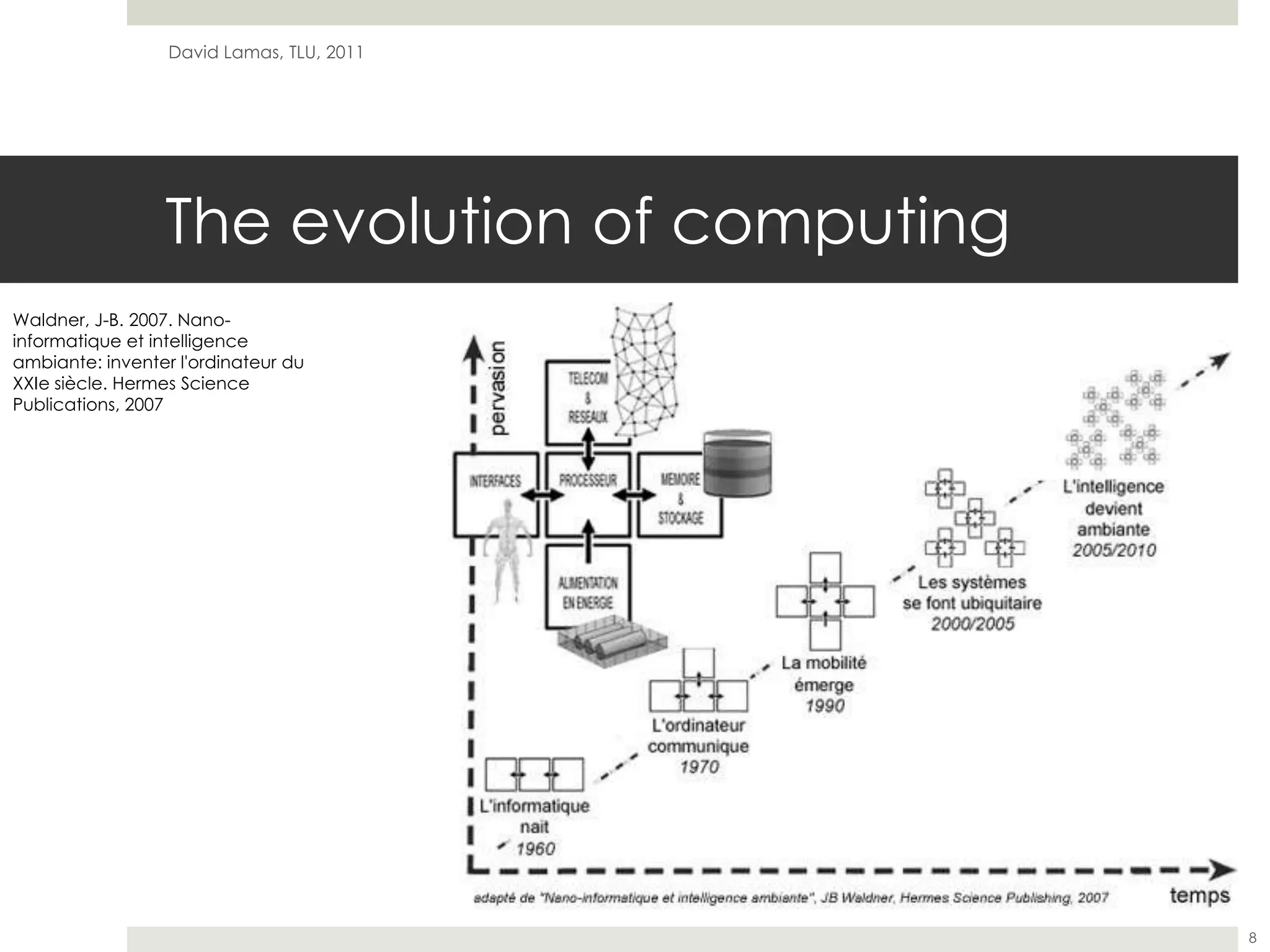
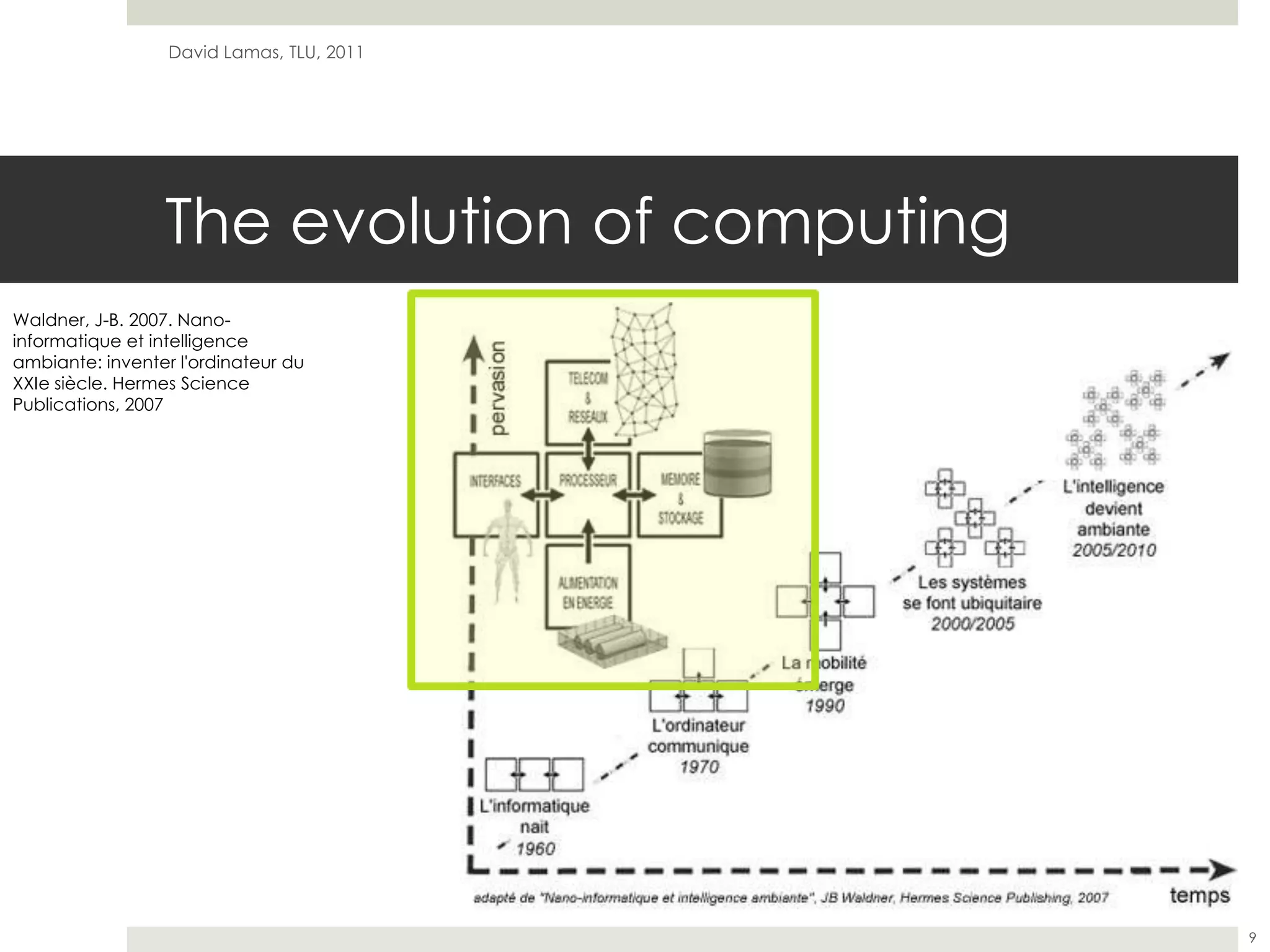
The evolution of computingDavid Lamas, TLU, 20118Waldner, J-B. 2007. Nano-informatiqueet intelligence ambiante: inventerl'ordinateurdu XXIe siècle. Hermes Science Publications, 2007
The evolution of computingDavid Lamas, TLU, 20119Waldner, J-B. 2007. Nano-informatiqueet intelligence ambiante: inventerl'ordinateurdu XXIe siècle. Hermes Science Publications, 2007
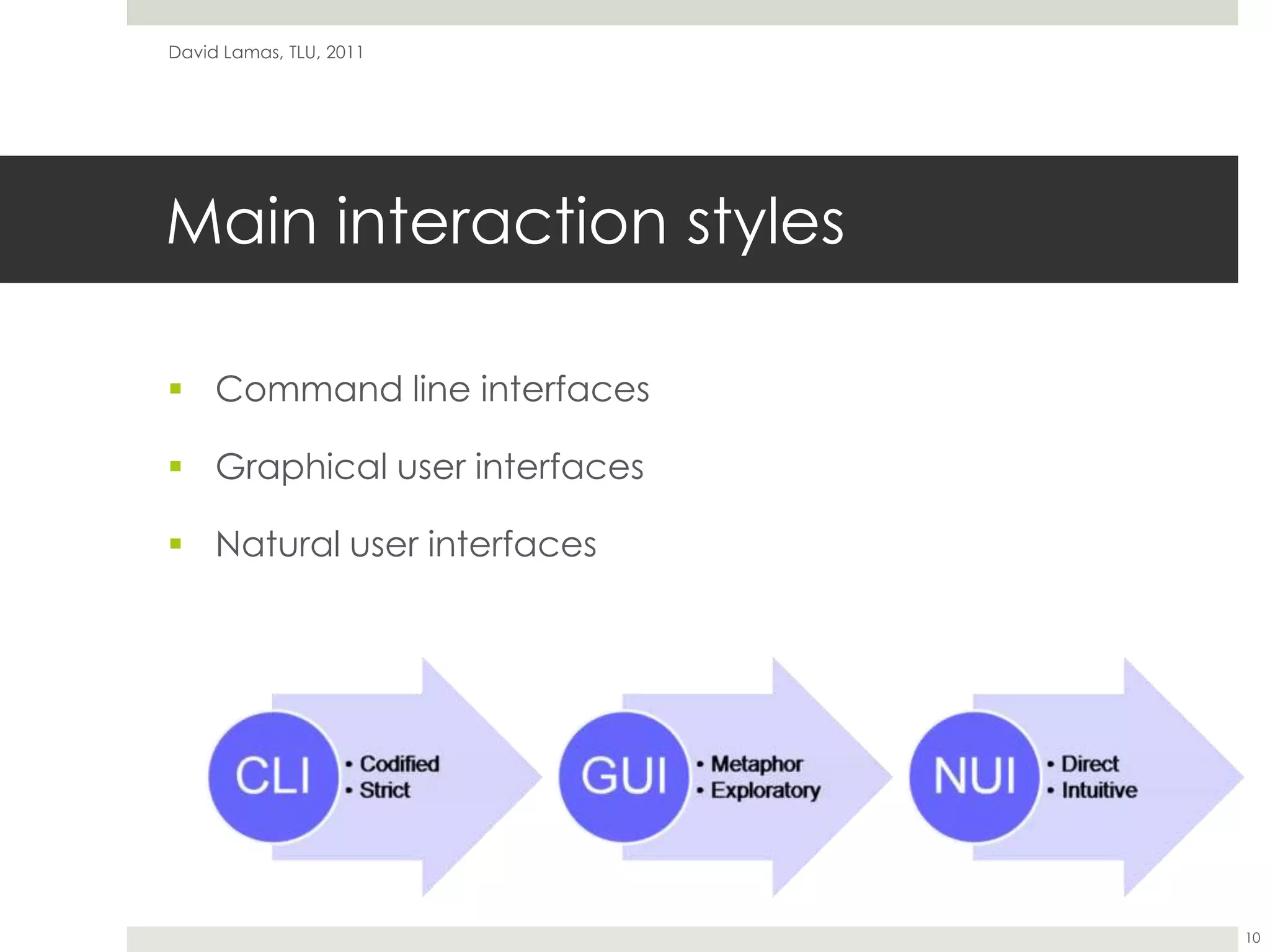
Main interaction stylesCommand line interfacesGraphical user interfacesNatural user interfacesDavid Lamas, TLU, 201110
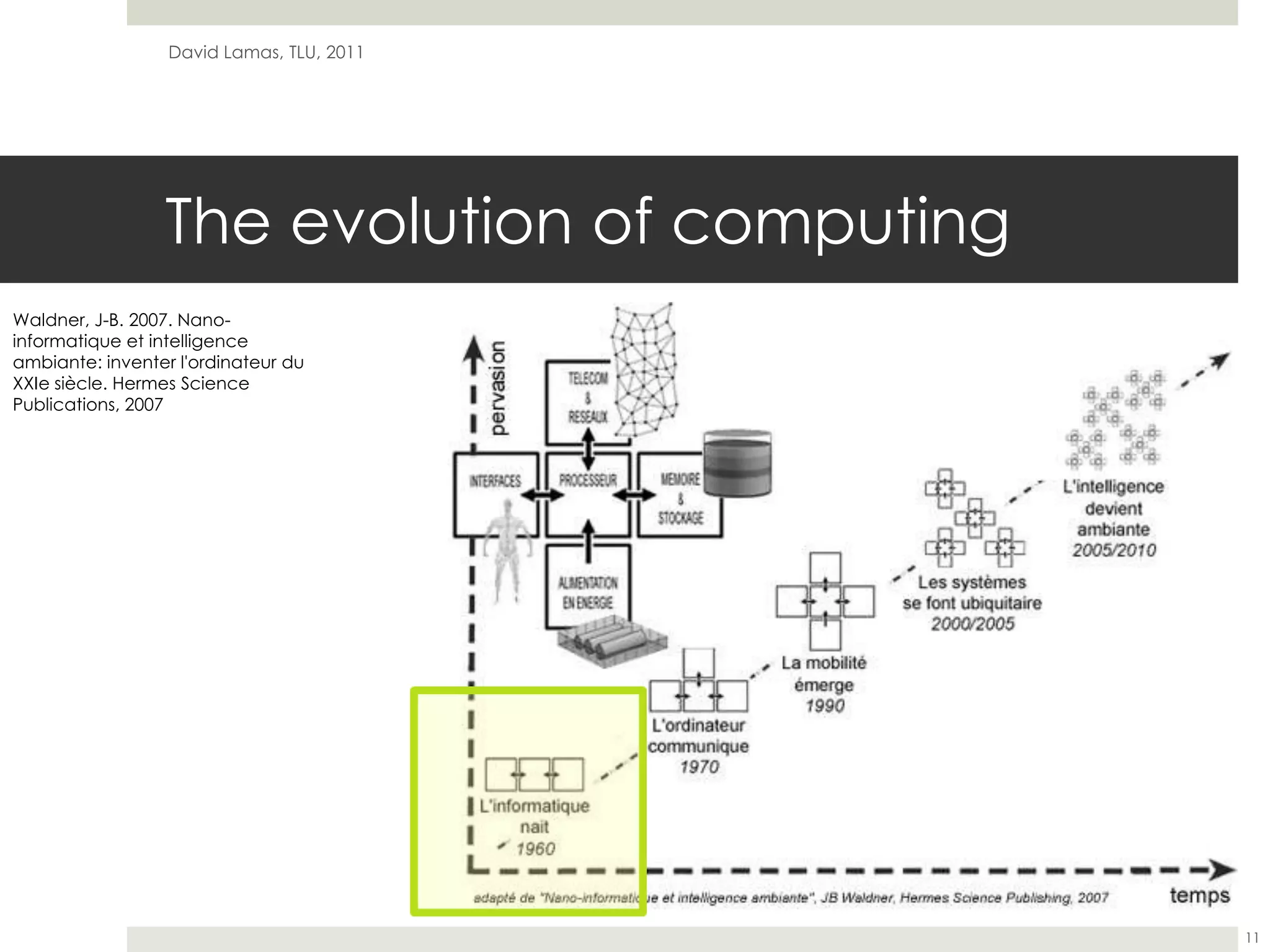
The evolution of computingDavid Lamas, TLU, 201111Waldner, J-B. 2007. Nano-informatiqueet intelligence ambiante: inventerl'ordinateurdu XXIe siècle. Hermes Science Publications, 2007
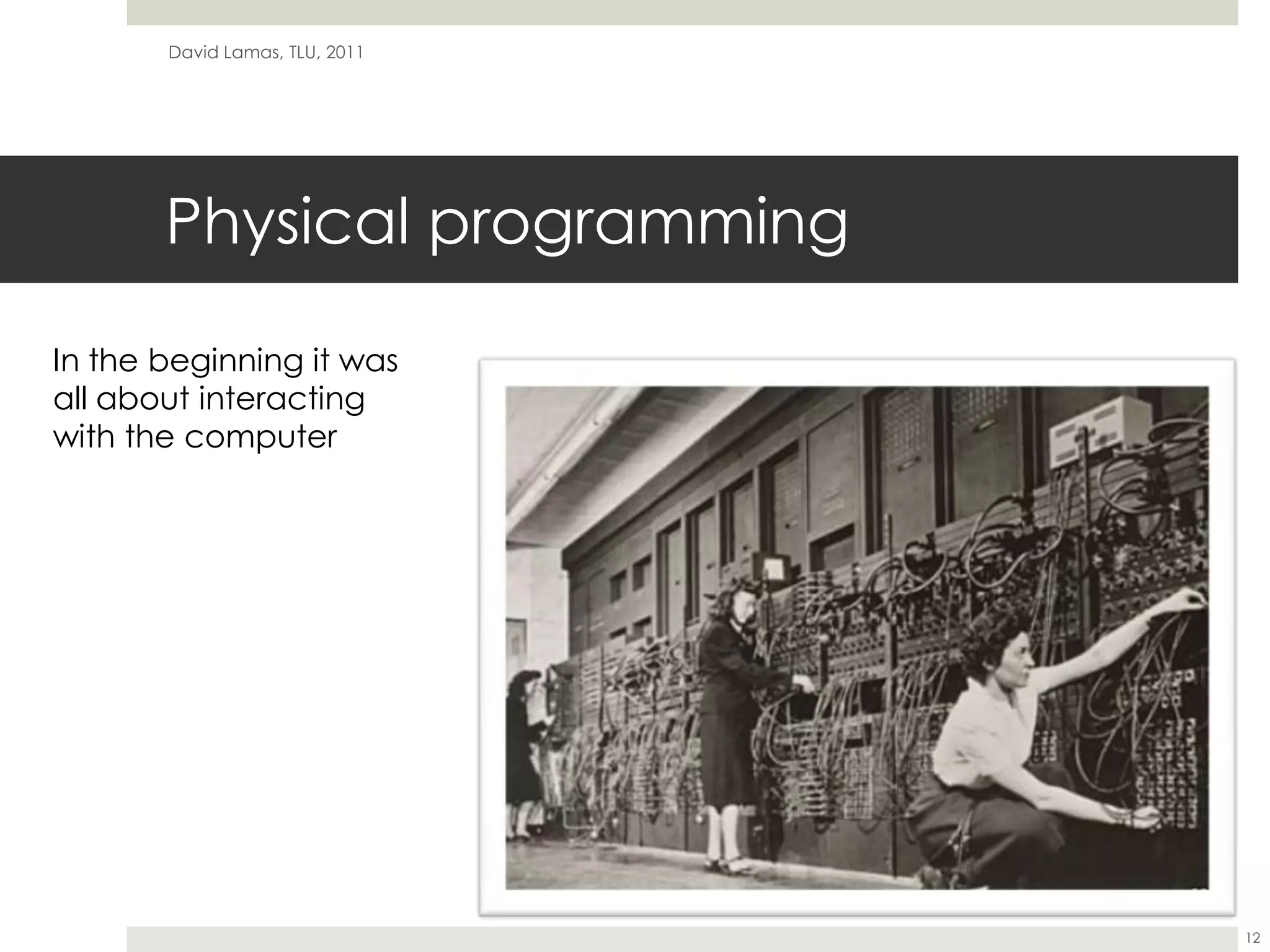
Physical programmingDavid Lamas, TLU, 201112In the beginning it wasall about interacting with the computer
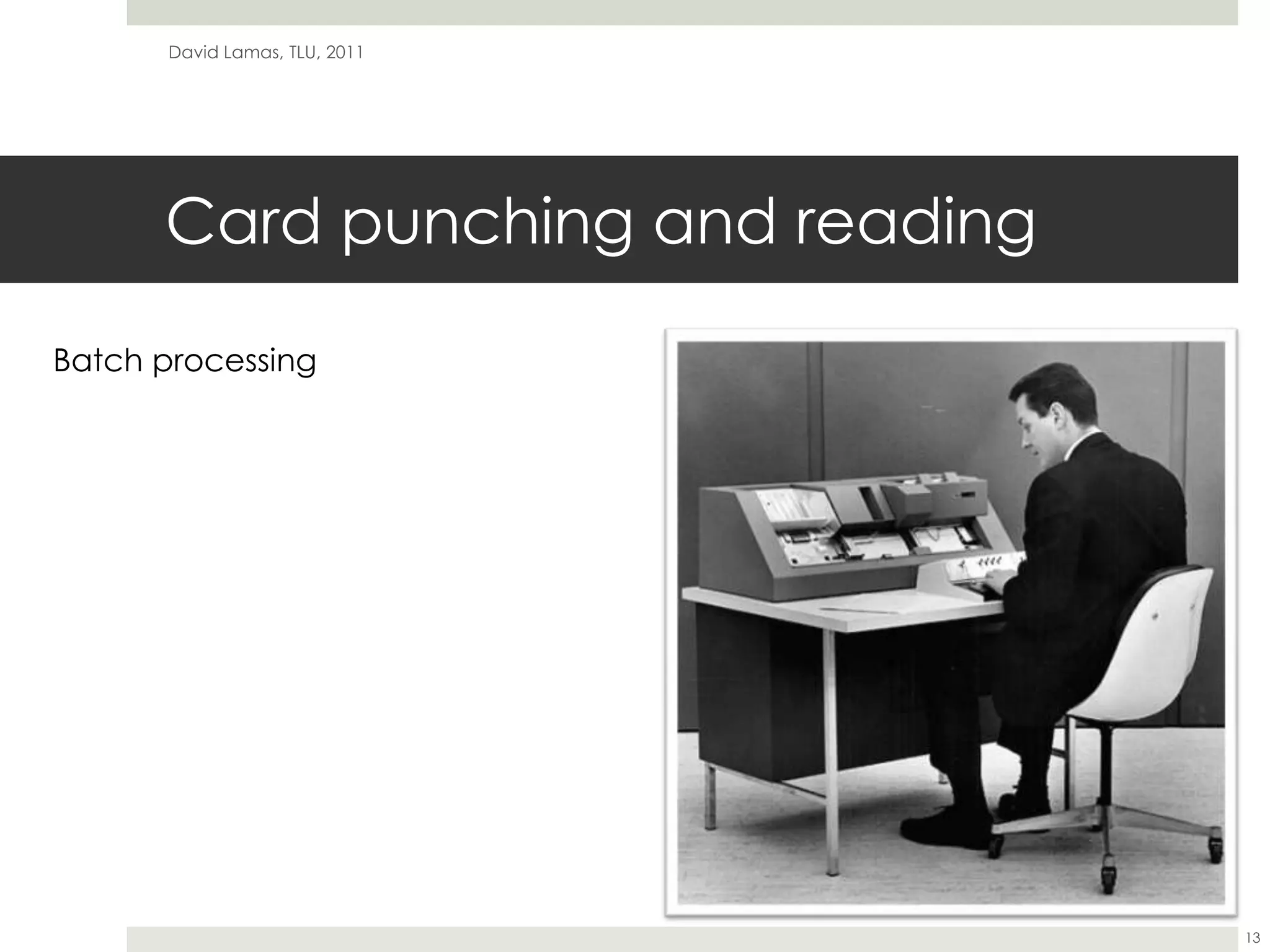
Card punching and readingDavid Lamas, TLU, 201113Batch processing
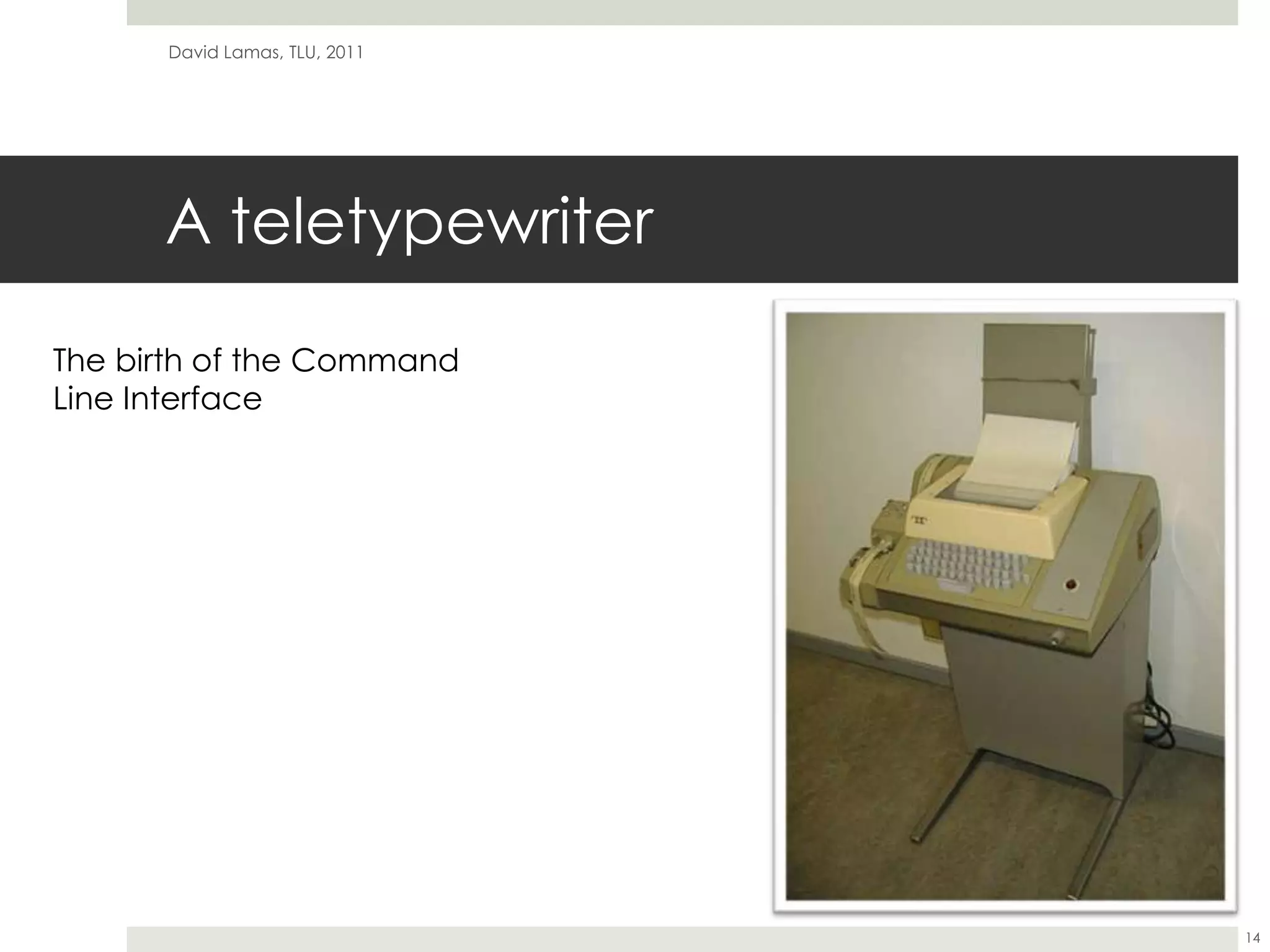
A teletypewriter David Lamas, TLU, 201114The birth of the CommandLine Interface
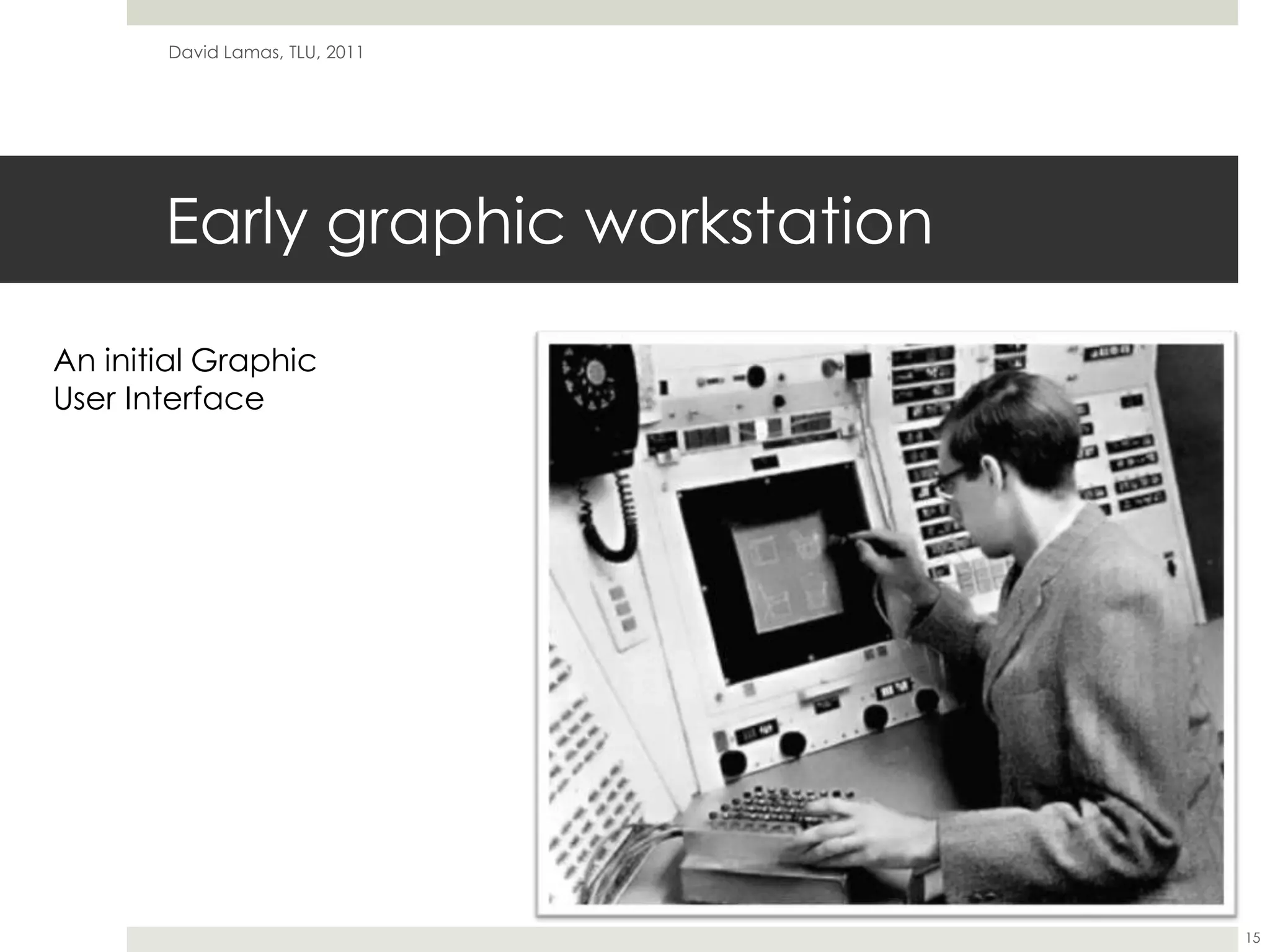
Early graphic workstationDavid Lamas, TLU, 201115An initial GraphicUser Interface
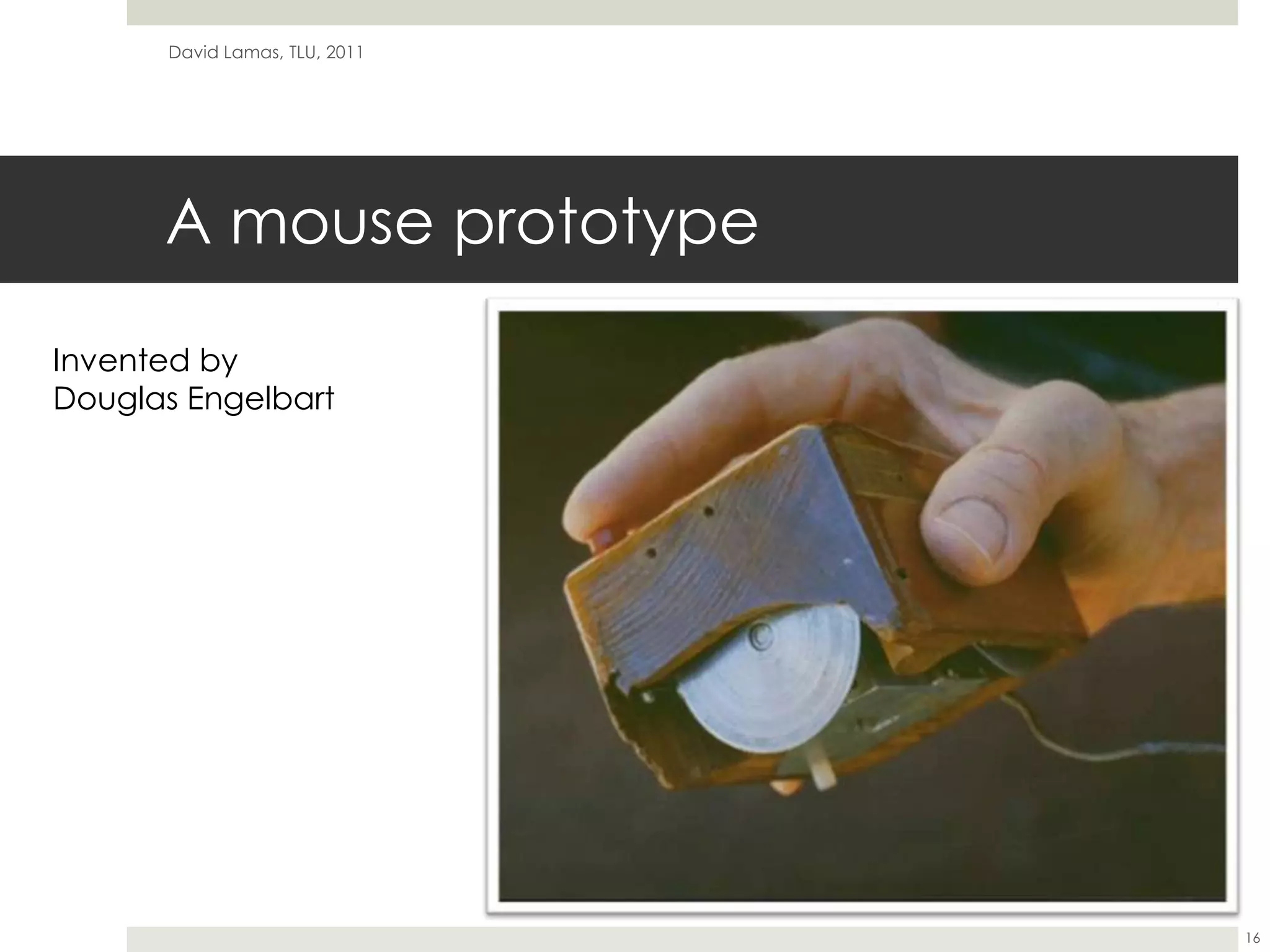
A mouse prototypeDavid Lamas, TLU, 201116Invented byDouglas Engelbart
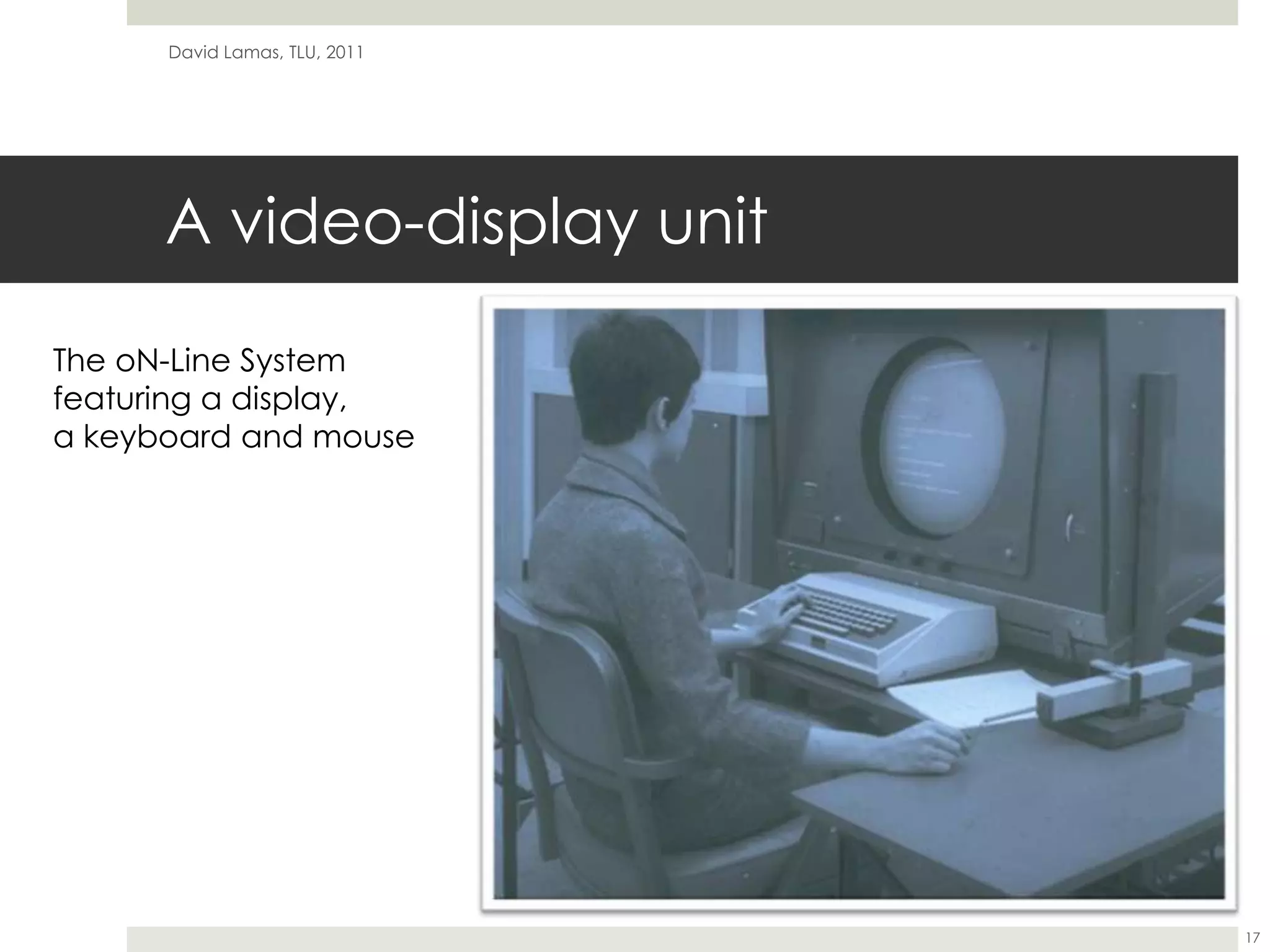
A video-display unitDavid Lamas, TLU, 201117The oN-Line System featuring a display, a keyboard and mouse
The oN-Line System…or the Augmentation of Human IntellectA system envisioned by Douglas Engelbart, to help Increasing the capability of a man to approach a complex problem situation, to gain comprehension to suit his particular needs, and to derive solutions to problemsIncreased capability in this respect is taken to mean a mixture of the following: more-rapid comprehension, better comprehension, the possibility of gaining a useful degree of comprehension in a situation that previously was too complex, speedier solutions, better solutions, and the possibility of finding solutions to problems that before seemed insolvable Complex situations we include the professional problems of diplomats, executives, social scientists, life scientists, physical scientists, attorneys, designers--whether the problem situation exists for twenty minutes or twenty years…David Lamas, TLU, 201118http://www.dougengelbart.org/pubs/augment-3906.html
The oN-Line SystemThe system was called oN-Line System, because it was also networked between multiple computersComputers were no longer isolatedThe display system was based on vector graphics technology and could display both text and solid lines on the same screenBecause of limited memory space in the mainframe computer, it could only display upper-case characters, although true upper-case was displayed by the use of a short horizontal line directly above any capitalized lettersDavid Lamas, TLU, 201119
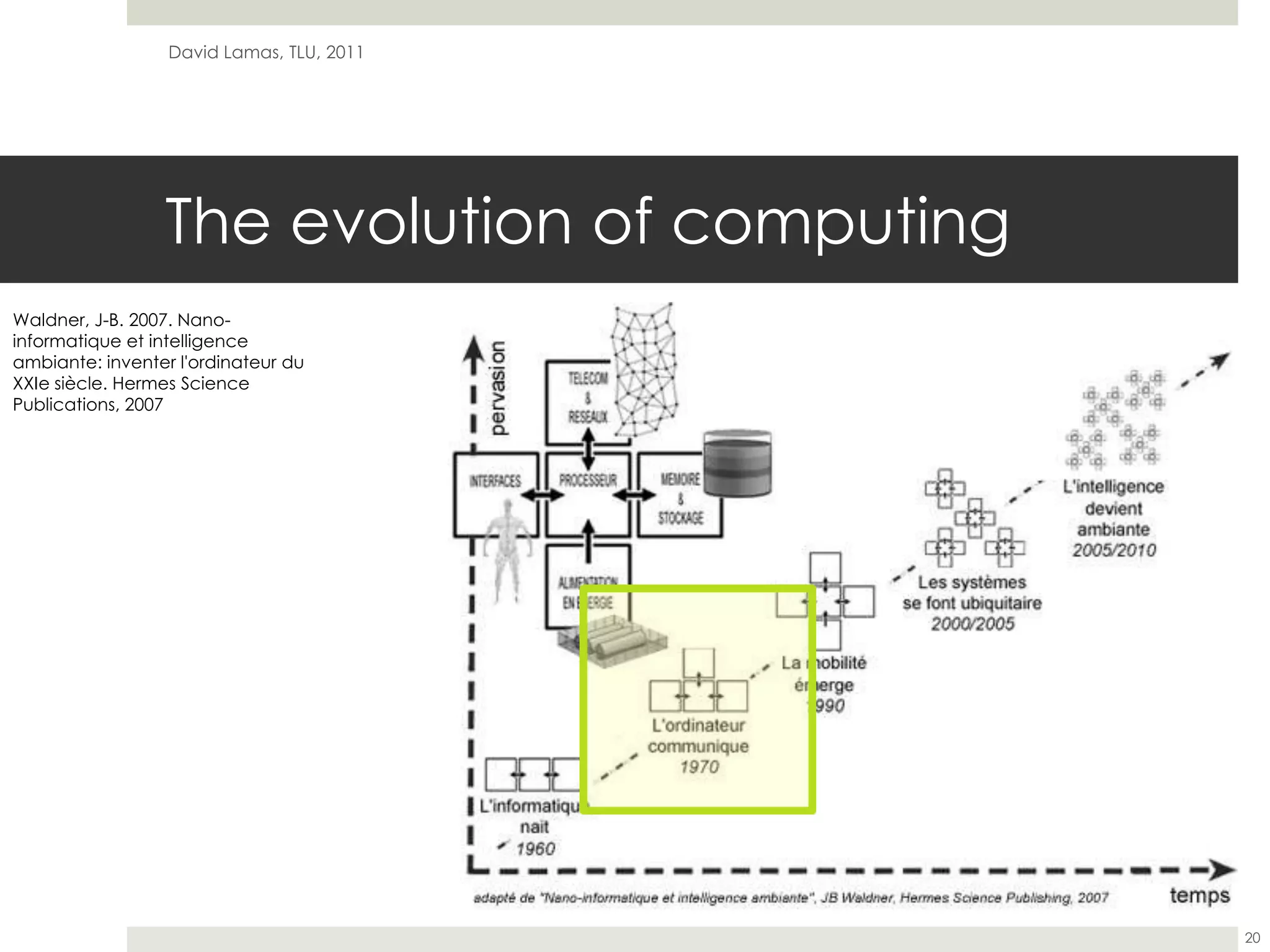
The evolution of computingDavid Lamas, TLU, 201120Waldner, J-B. 2007. Nano-informatiqueet intelligence ambiante: inventerl'ordinateurdu XXIe siècle. Hermes Science Publications, 2007
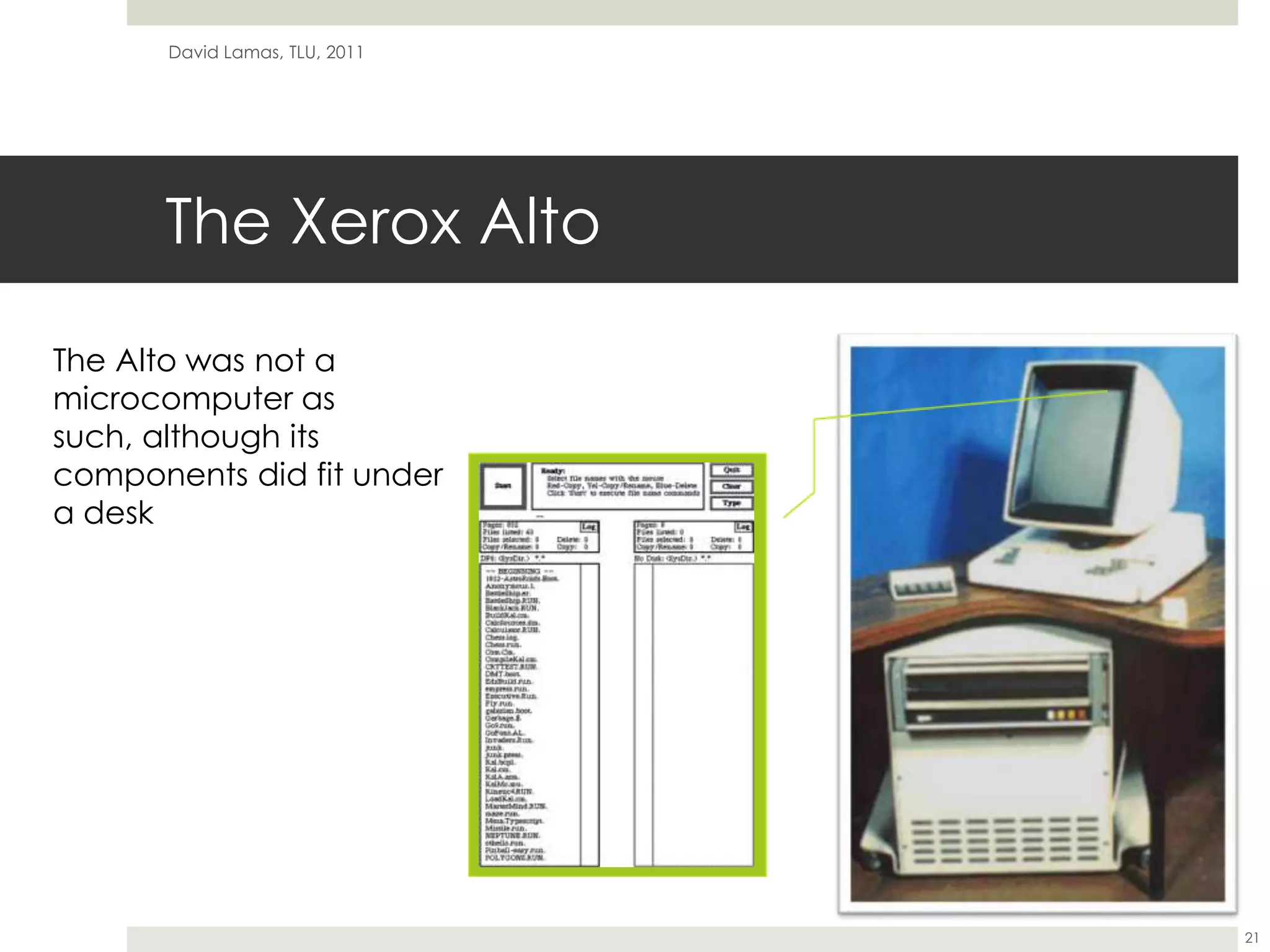
The Xerox AltoDavid Lamas, TLU, 201121The Alto was not a microcomputer as such, although its components did fit under a desk
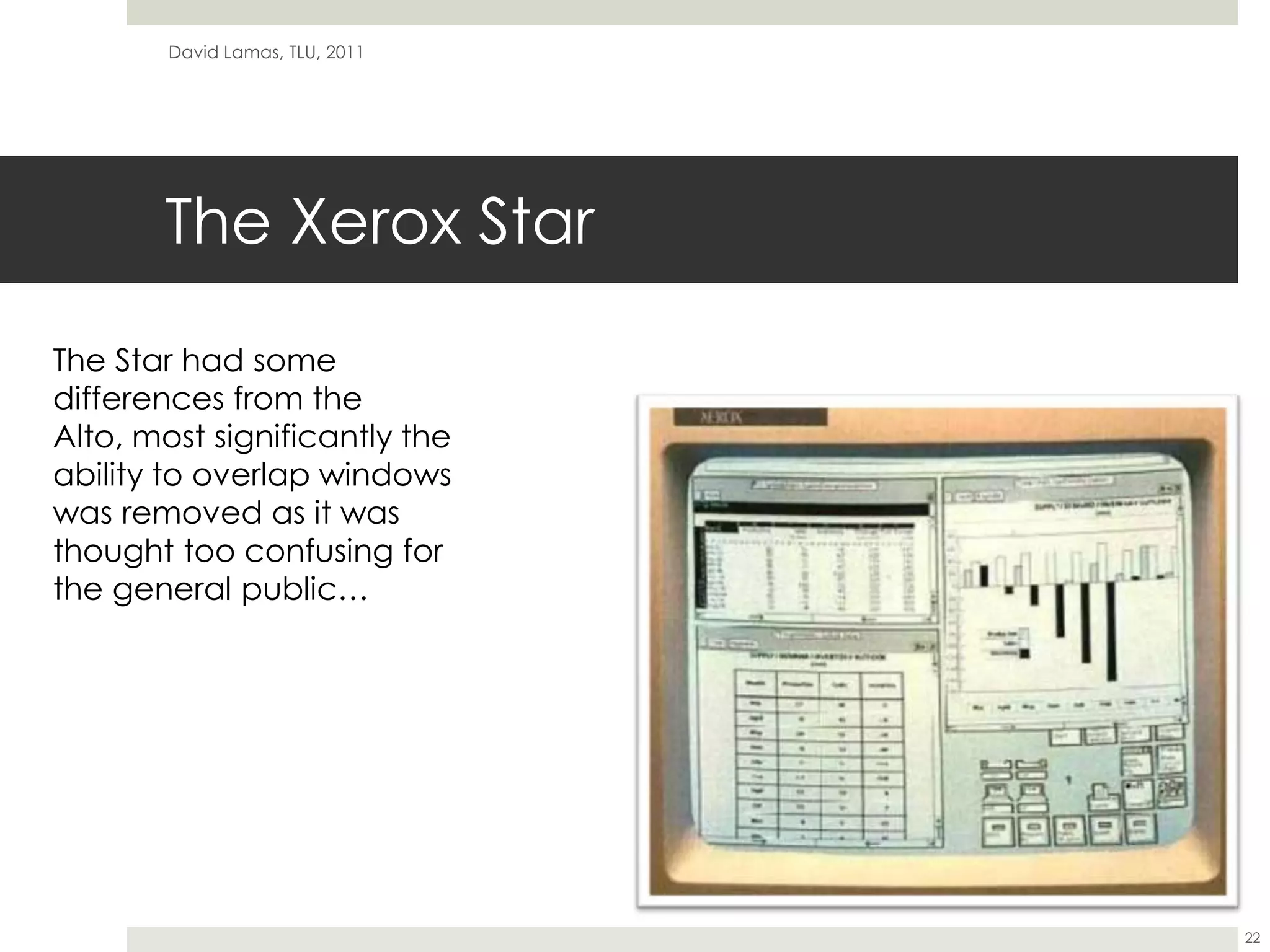
The Xerox StarDavid Lamas, TLU, 201122The Star had some differences from the Alto, most significantly the ability to overlap windows was removed as it was thought too confusing for the general public…
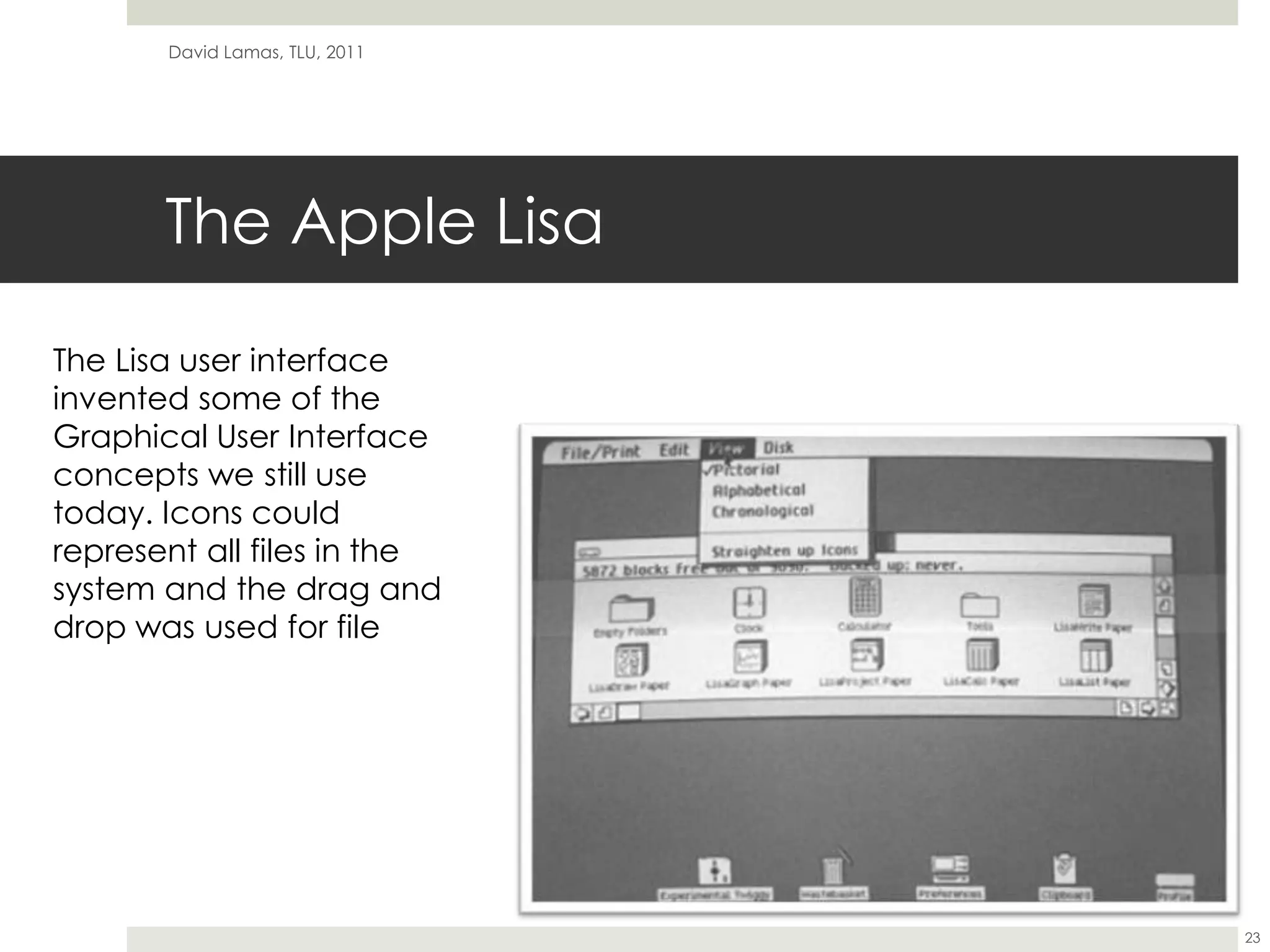
The Apple LisaDavid Lamas, TLU, 201123The Lisa user interface invented some of the Graphical User Interface concepts we still use today. Icons could represent all files in the system and the drag and drop was used for file
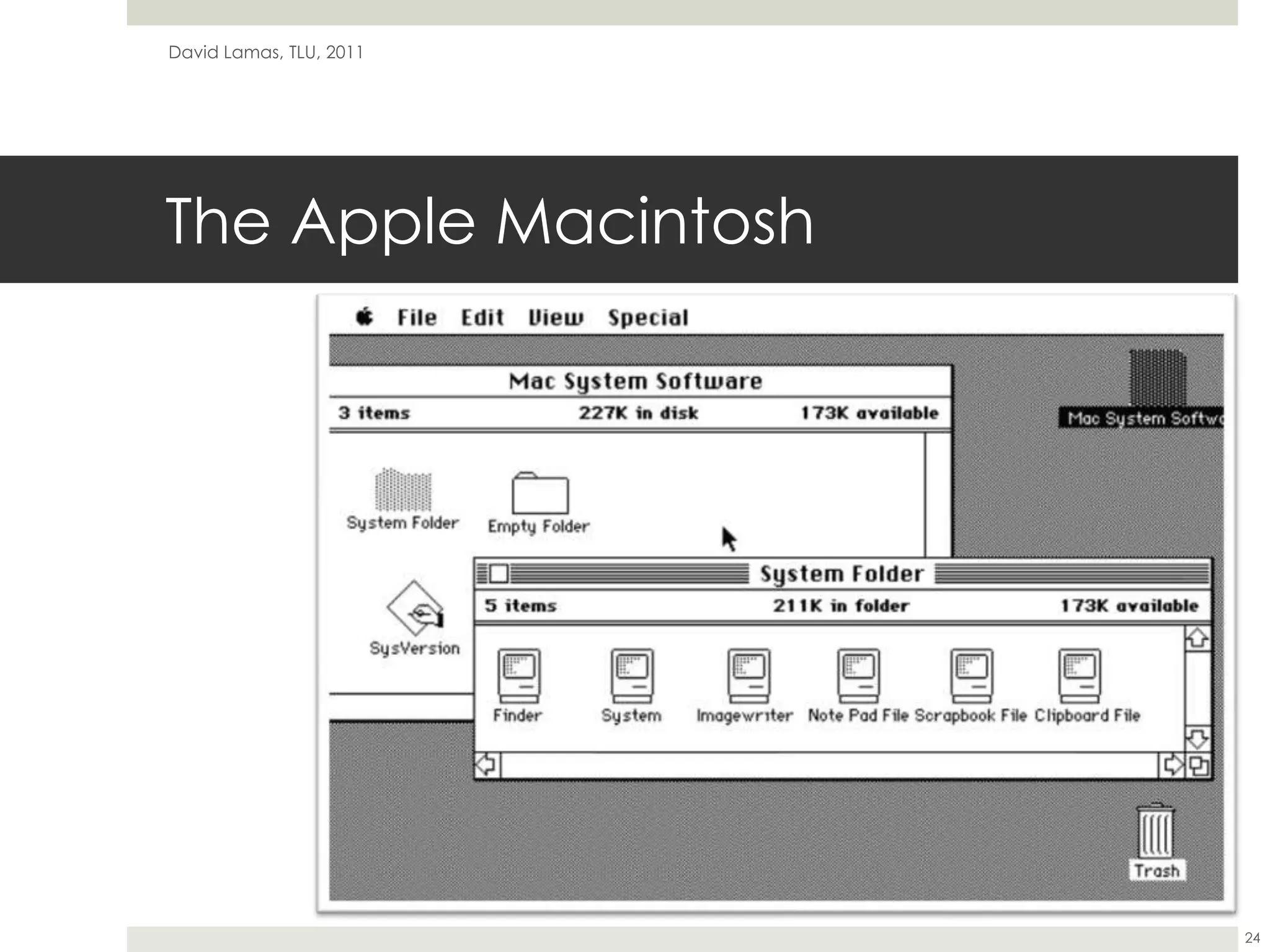
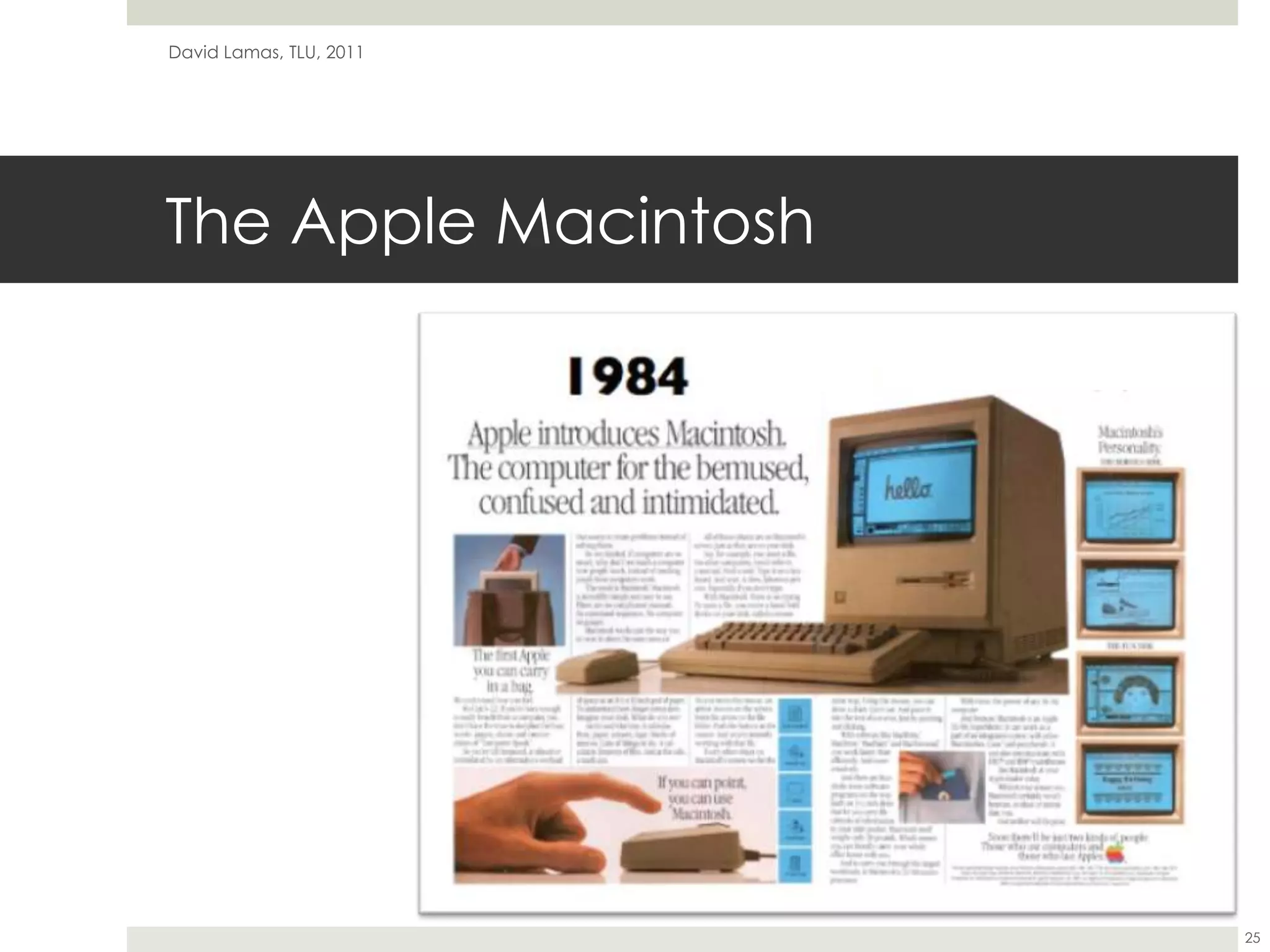
The Apple MacintoshDavid Lamas, TLU, 201124
The Apple MacintoshDavid Lamas, TLU, 201125
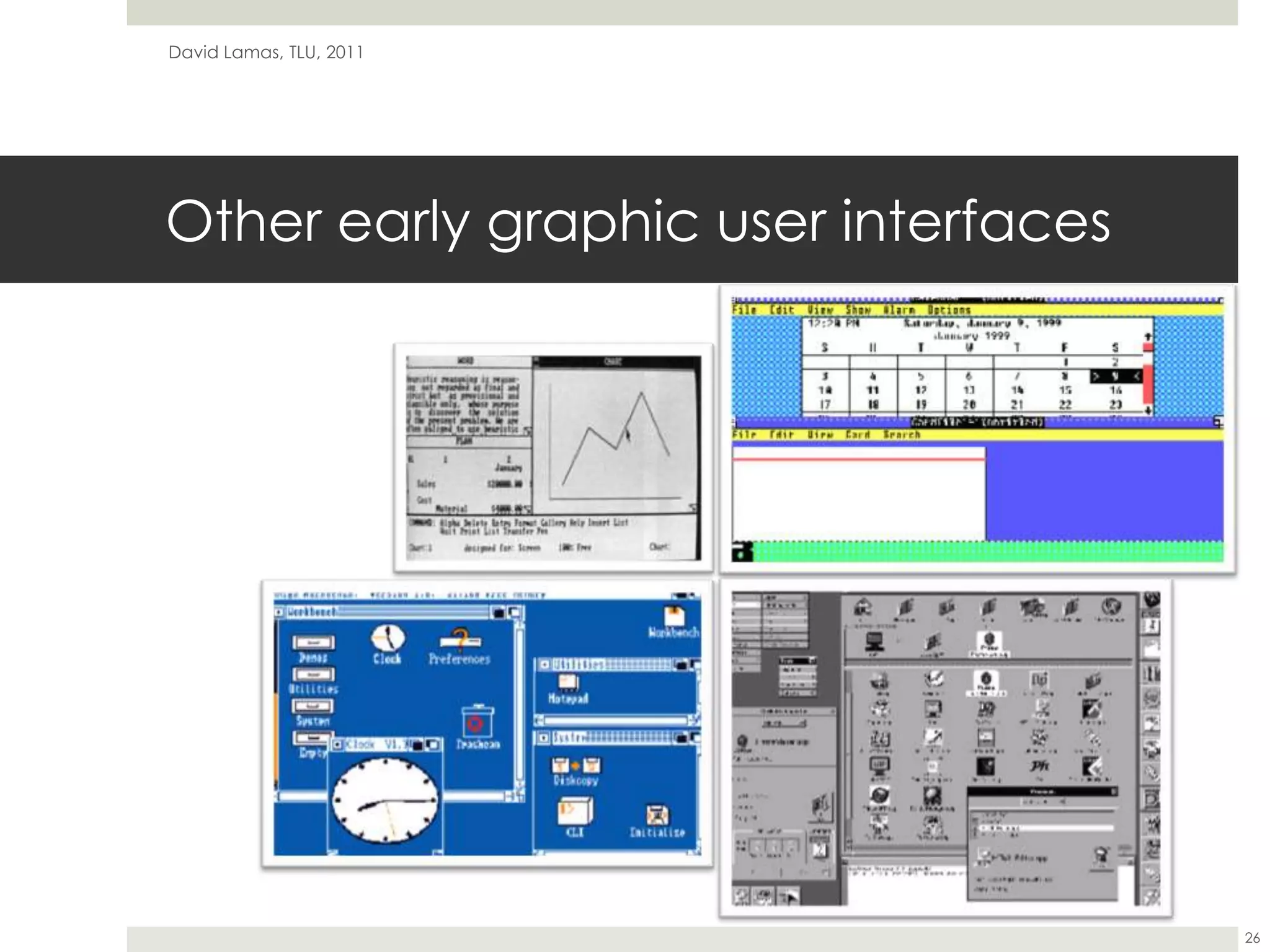
Other early graphic user interfacesDavid Lamas, TLU, 201126
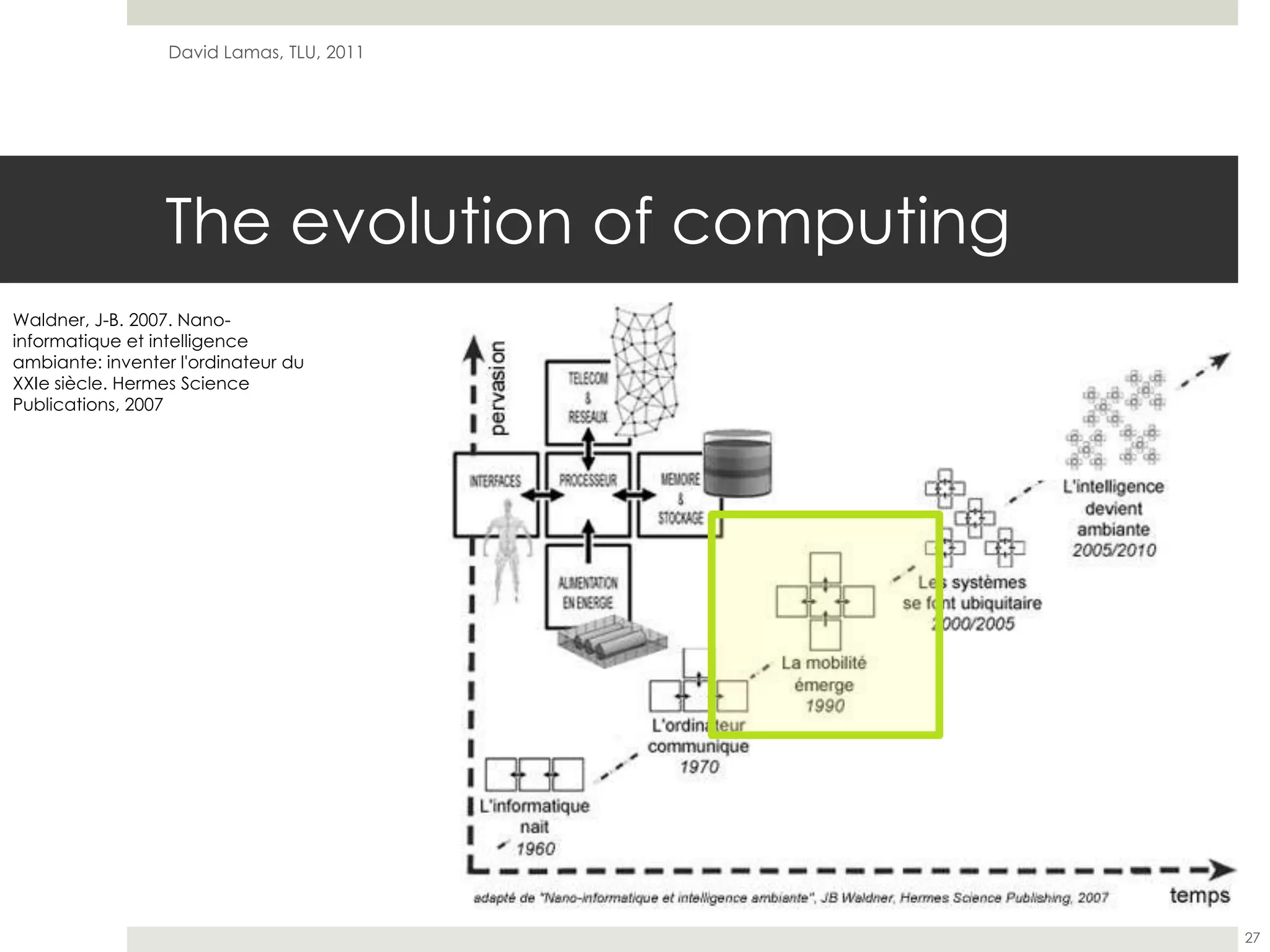
The evolution of computingDavid Lamas, TLU, 201127Waldner, J-B. 2007. Nano-informatiqueet intelligence ambiante: inventerl'ordinateurdu XXIe siècle. Hermes Science Publications, 2007
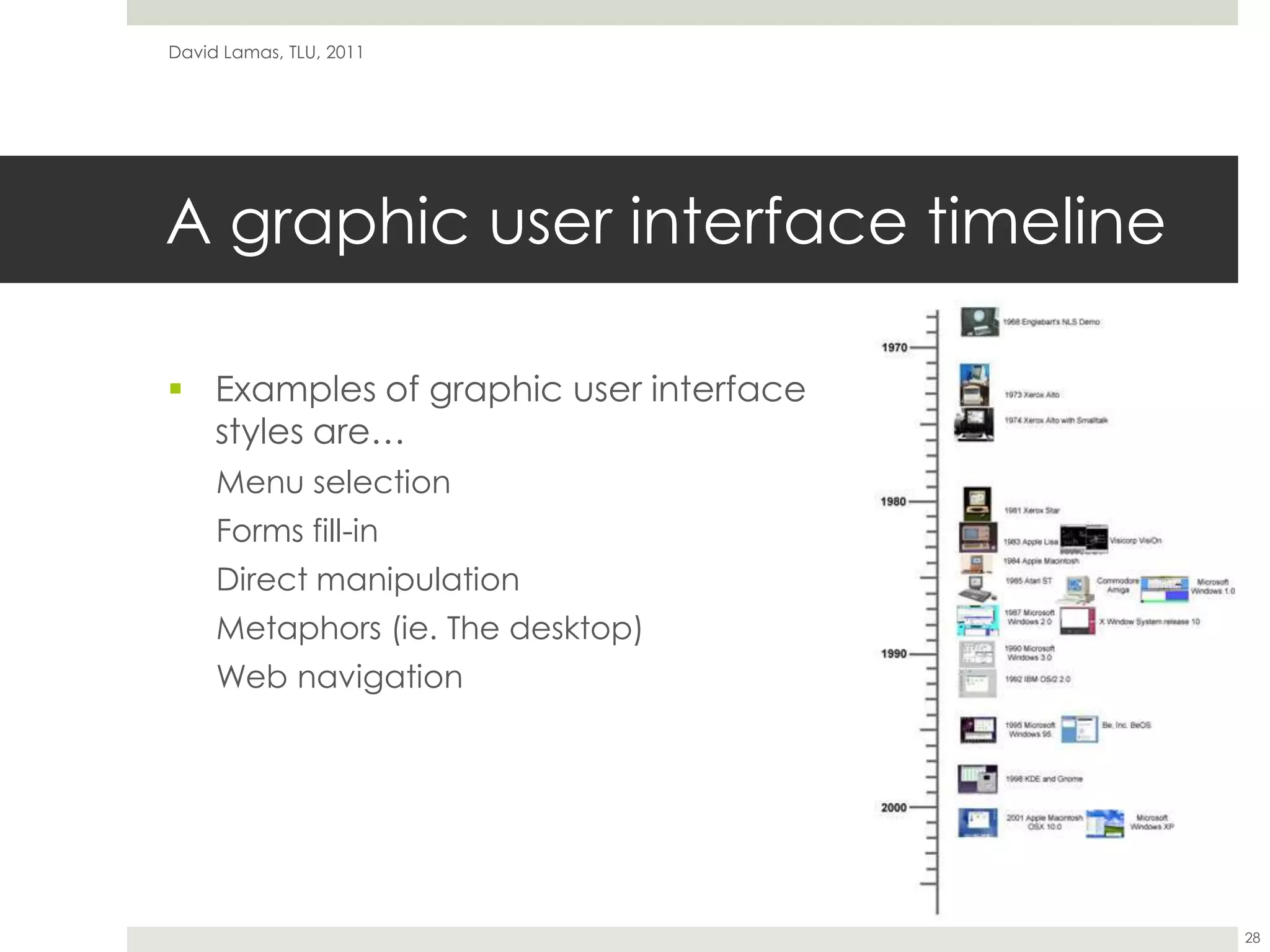
A graphic user interface timelineExamples of graphic user interface styles are…Menu selectionForms fill-inDirect manipulationMetaphors (ie. The desktop)Web navigationDavid Lamas, TLU, 201128
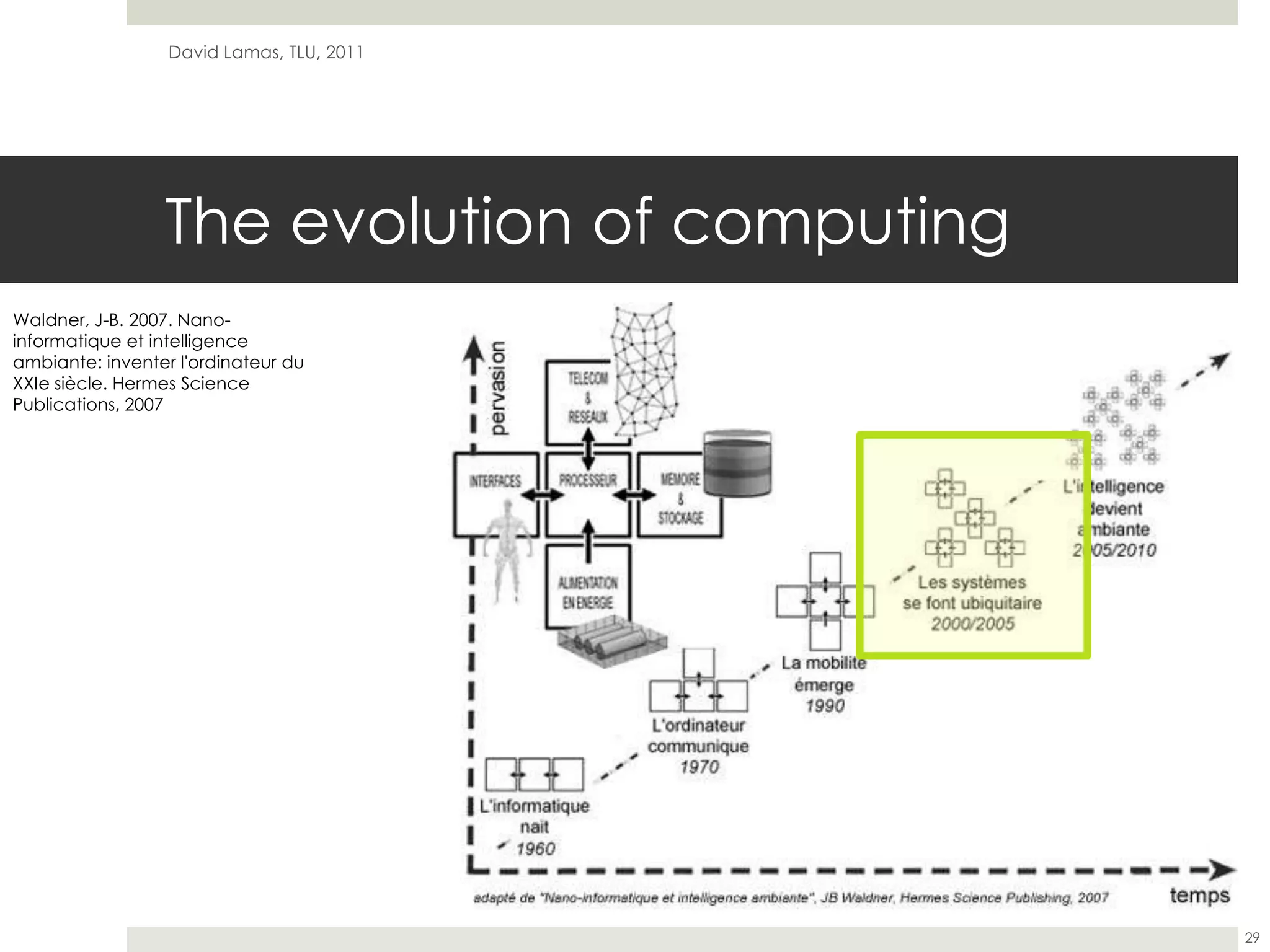
The evolution of computingDavid Lamas, TLU, 201129Waldner, J-B. 2007. Nano-informatiqueet intelligence ambiante: inventerl'ordinateurdu XXIe siècle. Hermes Science Publications, 2007
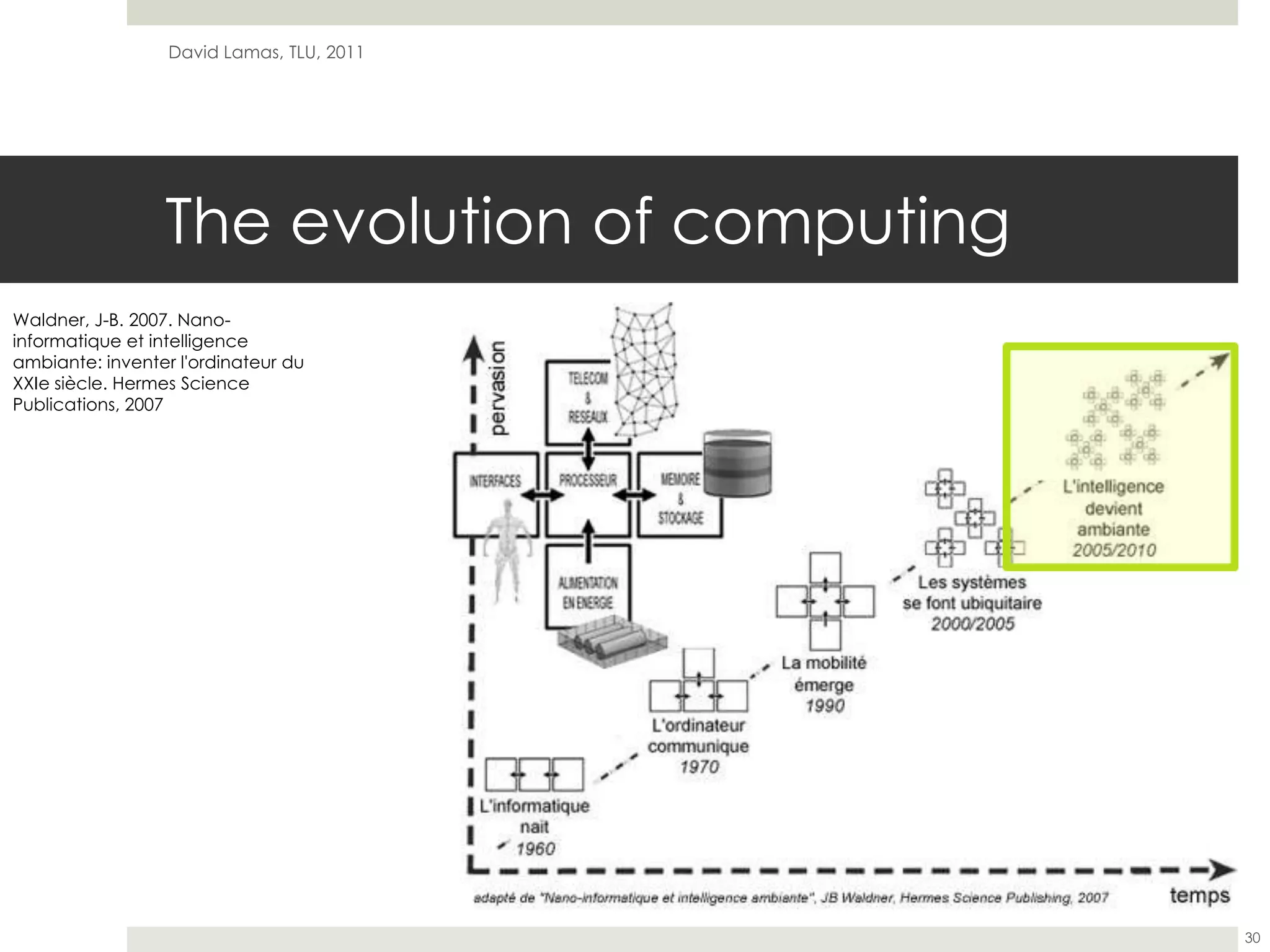
The evolution of computingDavid Lamas, TLU, 201130Waldner, J-B. 2007. Nano-informatiqueet intelligence ambiante: inventerl'ordinateurdu XXIe siècle. Hermes Science Publications, 2007
Natural user interfaces…is the common designation used by designers and developers of computer interfaces to refer to a user interface that is effectively invisible, or becomes invisible with successive learned interactions, to its usersThe word natural is used because most computer interfaces use artificial control devices whose operation has to be learnedSuch an interface relies on a user being able to carry out relatively natural motions, movements or gestures that they quickly discover control the computer application or manipulate the on-screen contentDavid Lamas, TLU, 201131
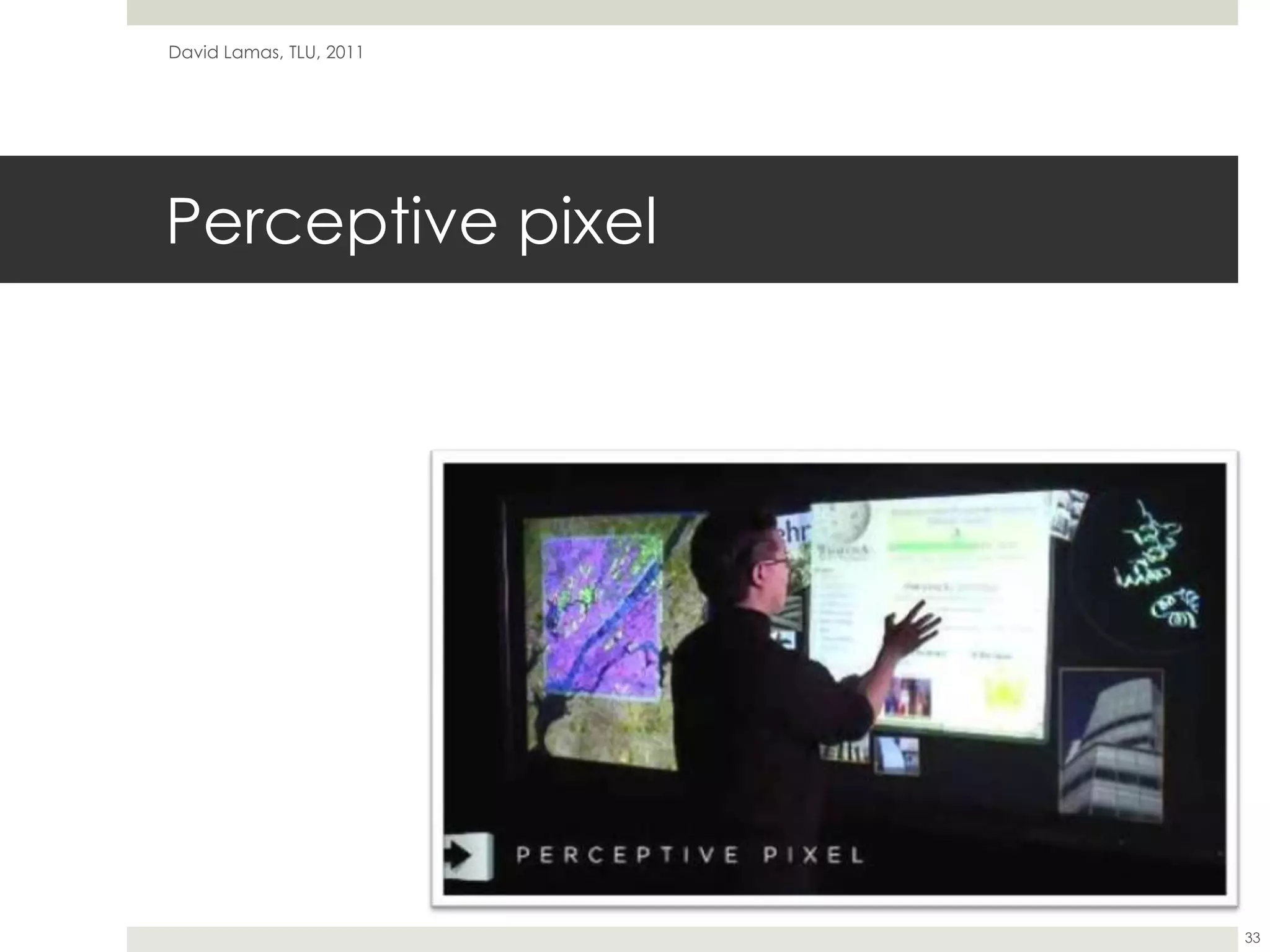
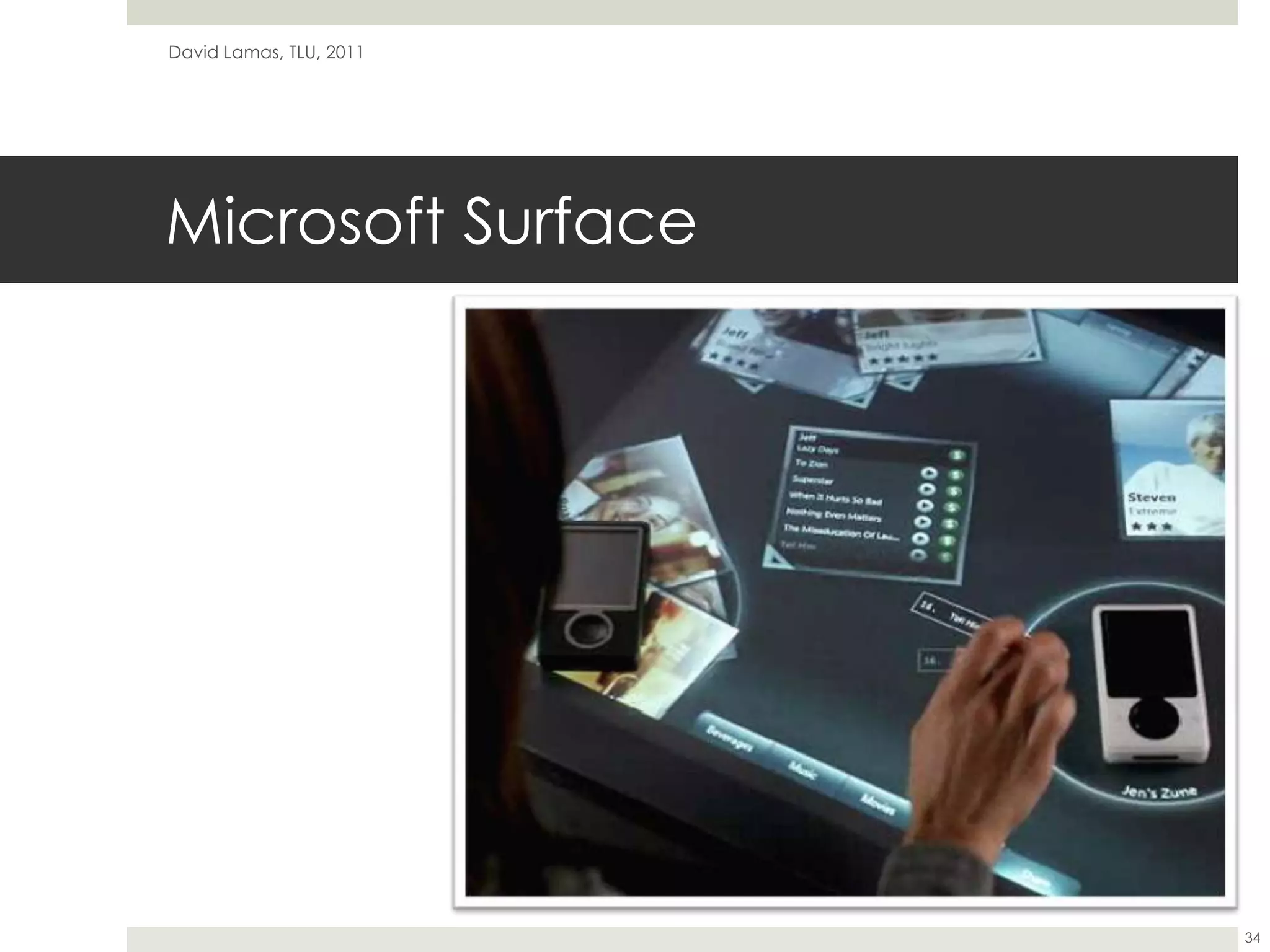
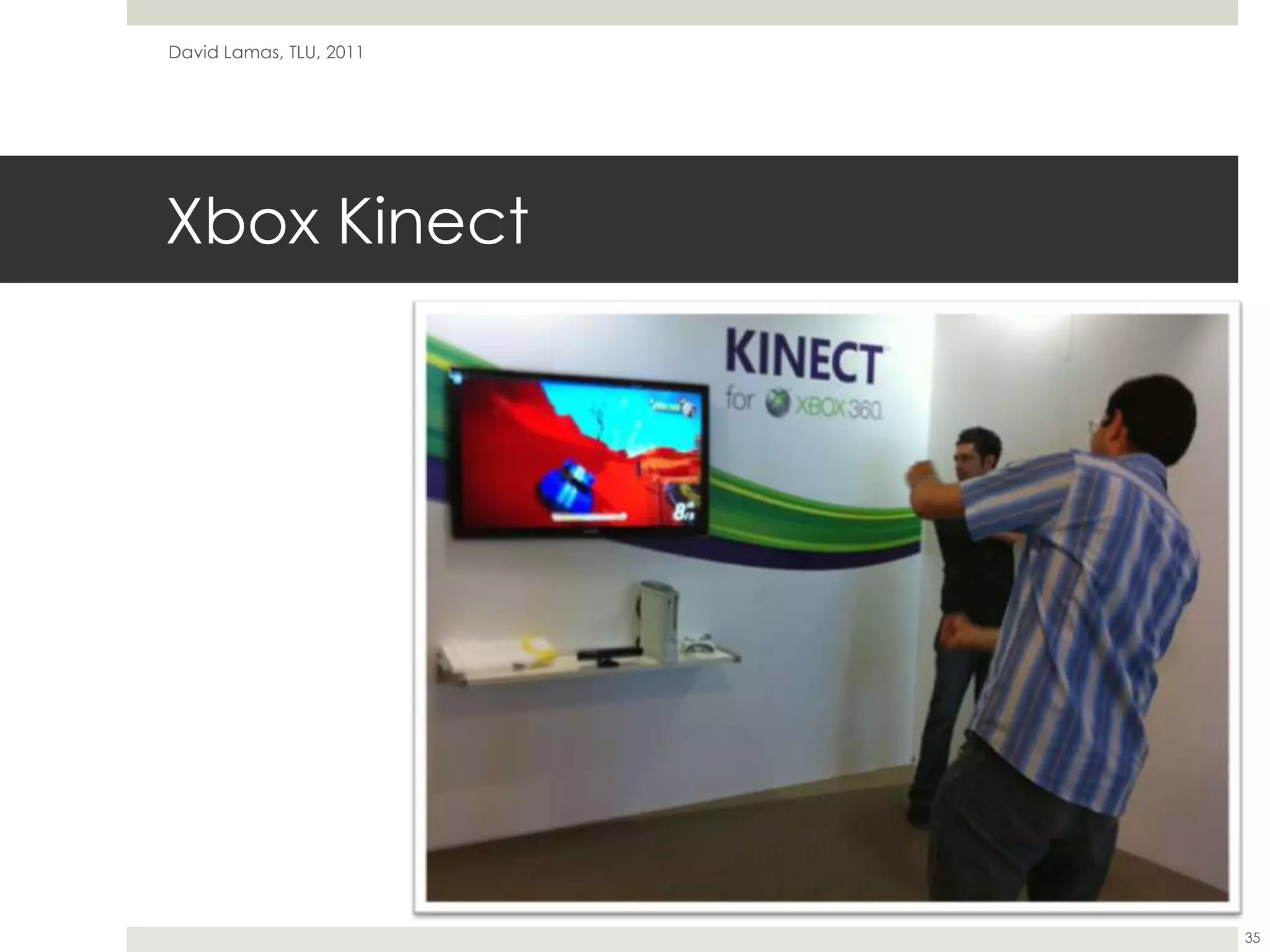
Natural user interfacesThe most distinct identifier of a natural user interface is the lack of a physical keyboard and or mouseHence, the most common examples are…(multi-)touch interfaces; andvoice-operated interfacesThe natural user interface removes the metaphors, and many of the artificially learned devices, to allow users to more directly manipulate content using more natural movements, motions and gesturesEnthusiast defend that these interfaces are fast to learn and, as such, freely apply the adjective 'intuitive’ to describe how users interact with themDavid Lamas, TLU, 201132
Perceptive pixelDavid Lamas, TLU, 201133
Microsoft SurfaceDavid Lamas, TLU, 201134
Xbox KinectDavid Lamas, TLU, 201135
Natural user interfaces are… not naturalAccording to Don NormanFundamental principles of knowledge of results, feedback, and a good conceptual model still ruleThe strength of the graphical user interface has little to do with its use of graphicsIt has to do with the ease of remembering actions, both in what actions are possible and how to invoke themVisible icons and visible menus are the mechanisms, and despite the well-known problems of scaling up to the demands of modern complex systems, they still allow one to explore and learnThe important design rule of a GUI is visibility: through the menus, all possible actions can be made visible and, therefore, easily discoverable. The system can often be learned through explorationSystems that avoid these well-known methods suffer.Are natural user interfaces natural? No, he says, but they will be useful.David Lamas, TLU, 201136
Other user interfacesDavid Lamas, TLU, 201137
Other user interfacesDavid Lamas, TLU, 201138
Other user interfacesDavid Lamas, TLU, 201139
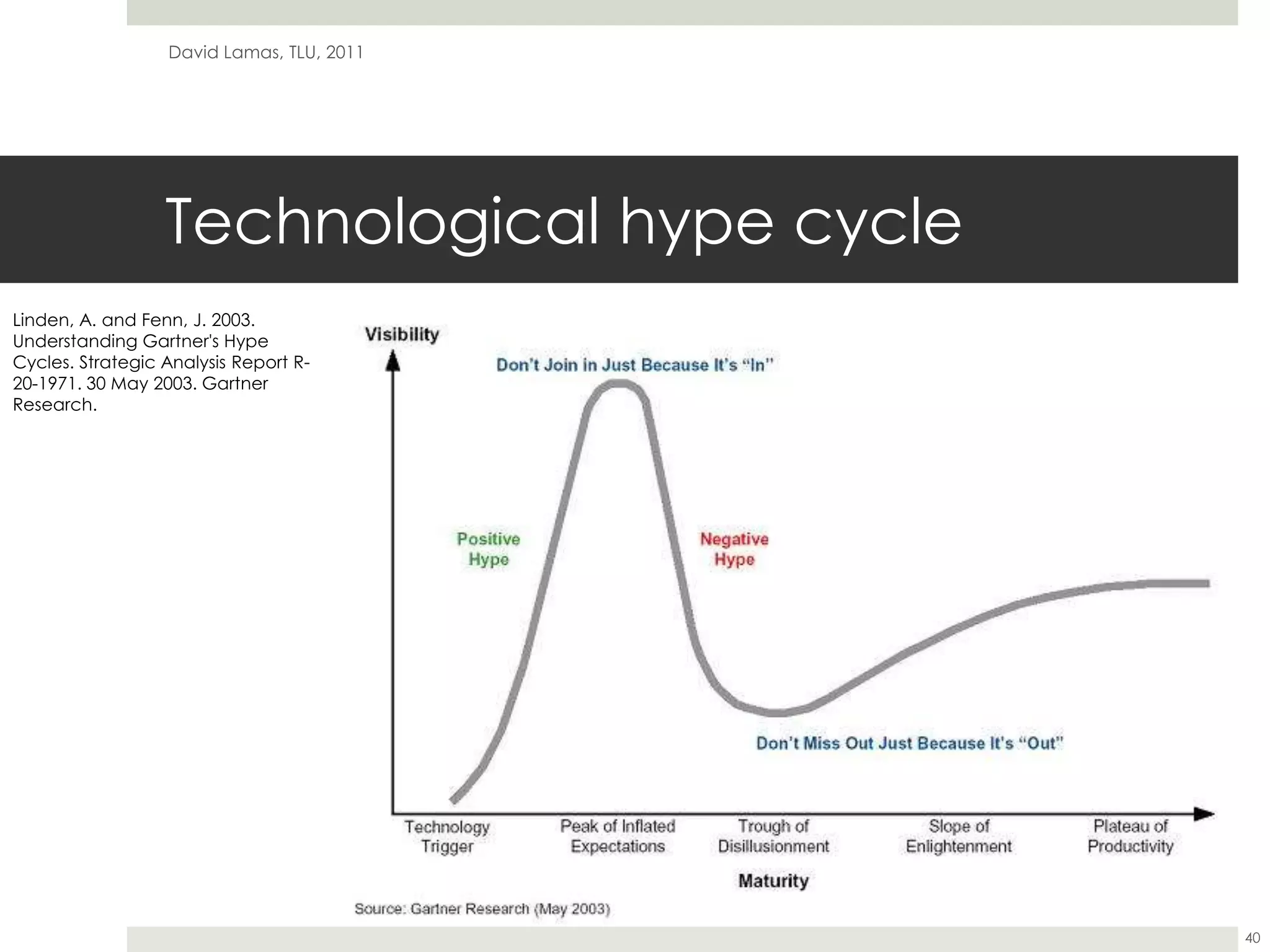
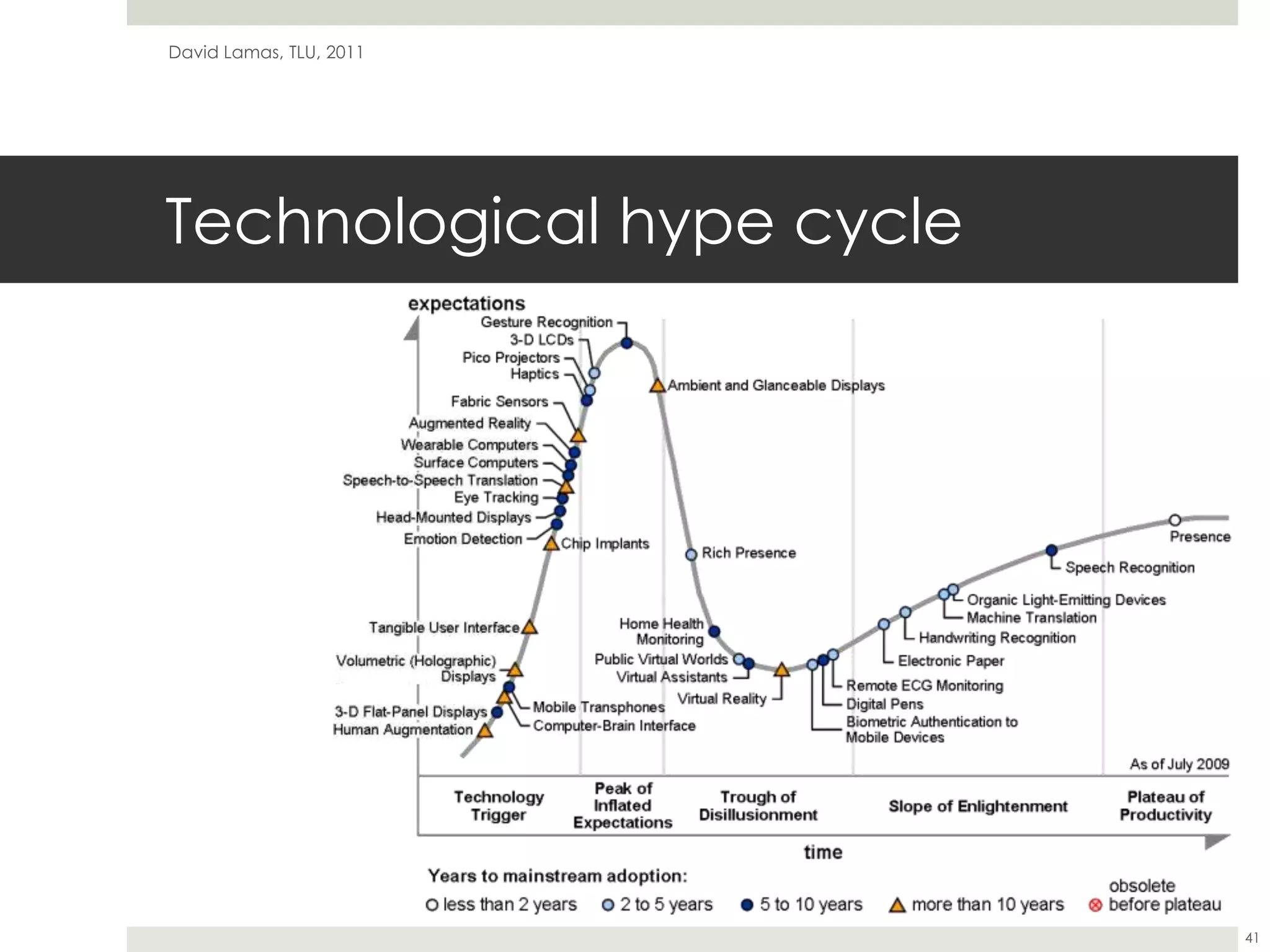
Technological hype cycleDavid Lamas, TLU, 201140Linden, A. and Fenn, J. 2003. Understanding Gartner's Hype Cycles. Strategic Analysis Report R-20-1971. 30 May 2003. Gartner Research.
Technological hype cycleDavid Lamas, TLU, 201141
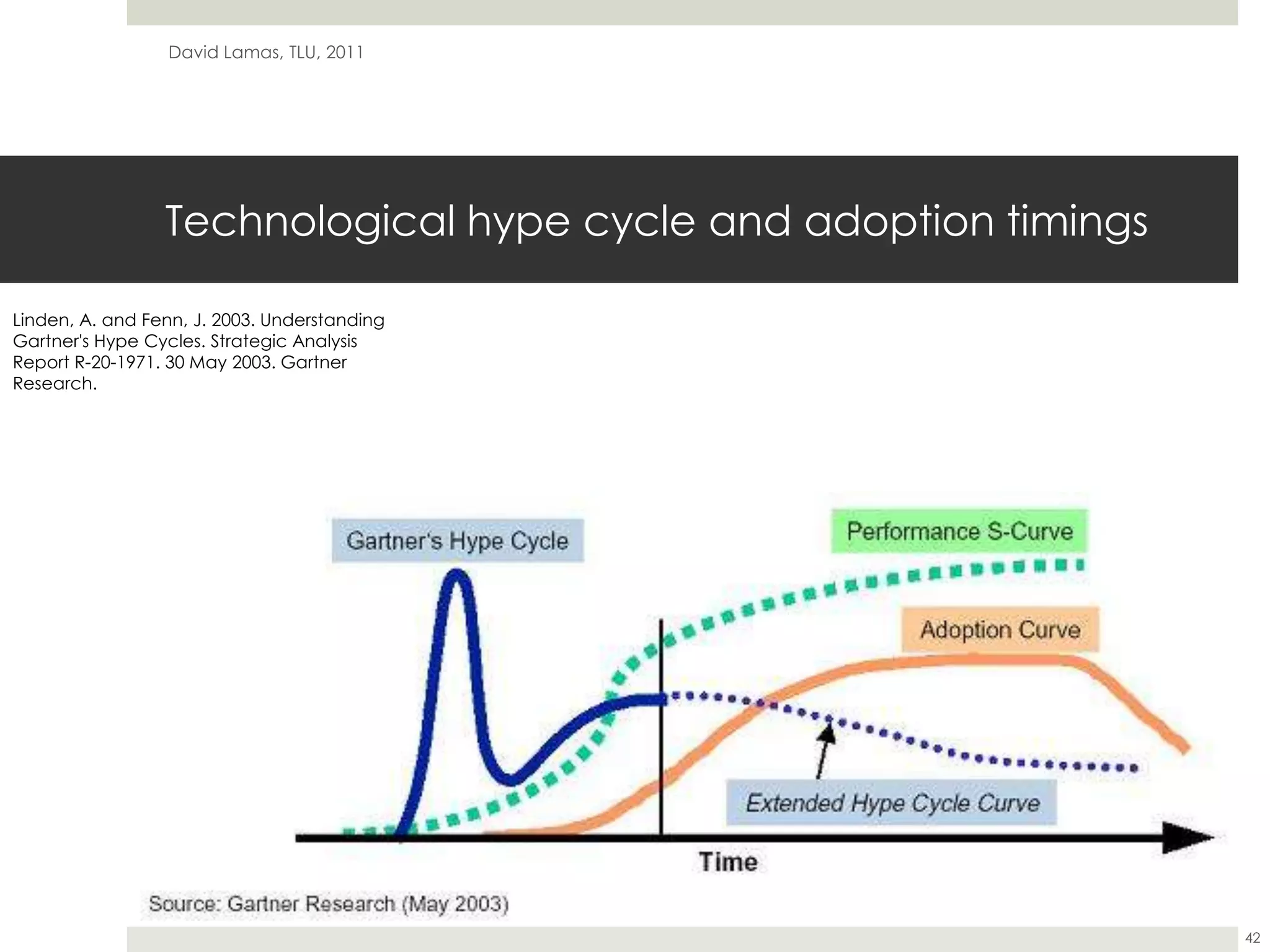
Technological hype cycle and adoption timingsDavid Lamas, TLU, 201142Linden, A. and Fenn, J. 2003. Understanding Gartner's Hype Cycles. Strategic Analysis Report R-20-1971. 30 May 2003. Gartner Research.
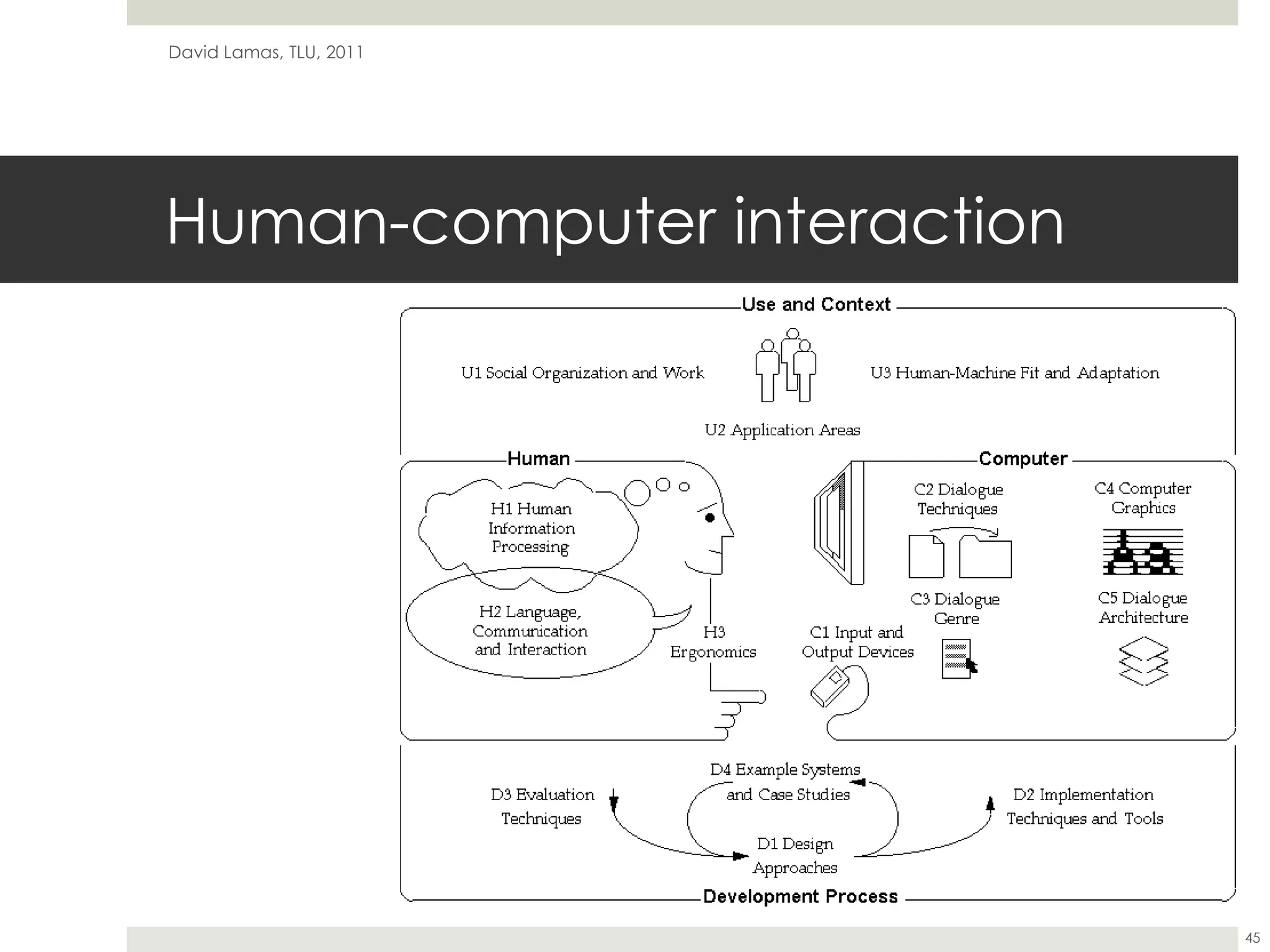
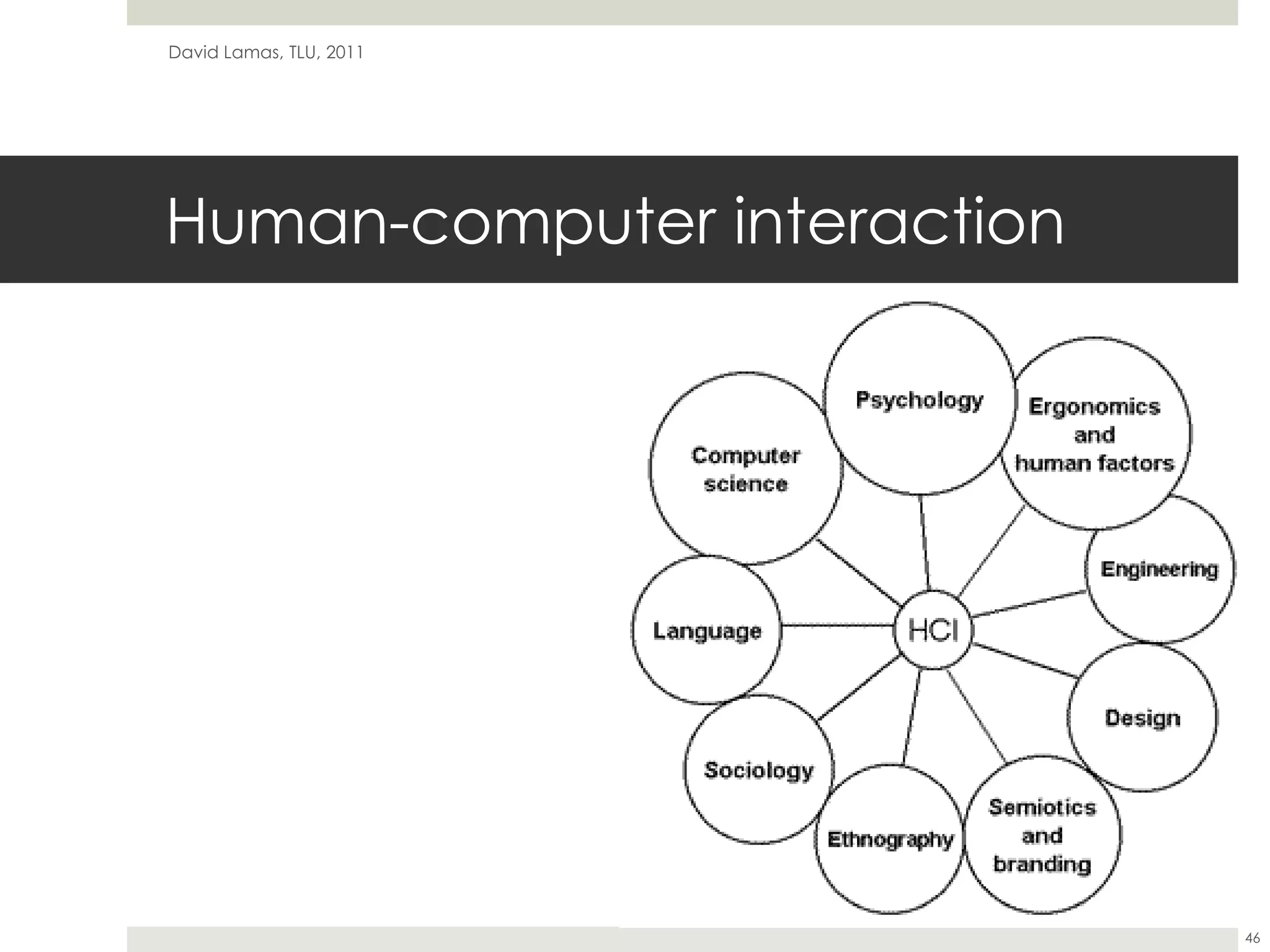
Related knowledge domainsHuman-computer interactionThe study of how people interact with computers and to what extent computers are or are not developed for successful interaction with human beings	Recent advances in mobile, ubiquitous, social, and tangible computing technologies have moved human-computer interaction into practically all areas of human activityThis has led to a shift away from the usual stress on usability to a much richer scope of user experience, where user's feelings, motivations, and values are given as much, if not more, attention than efficiency, effectiveness and basic subjective satisfactionDavid Lamas, TLU, 201143
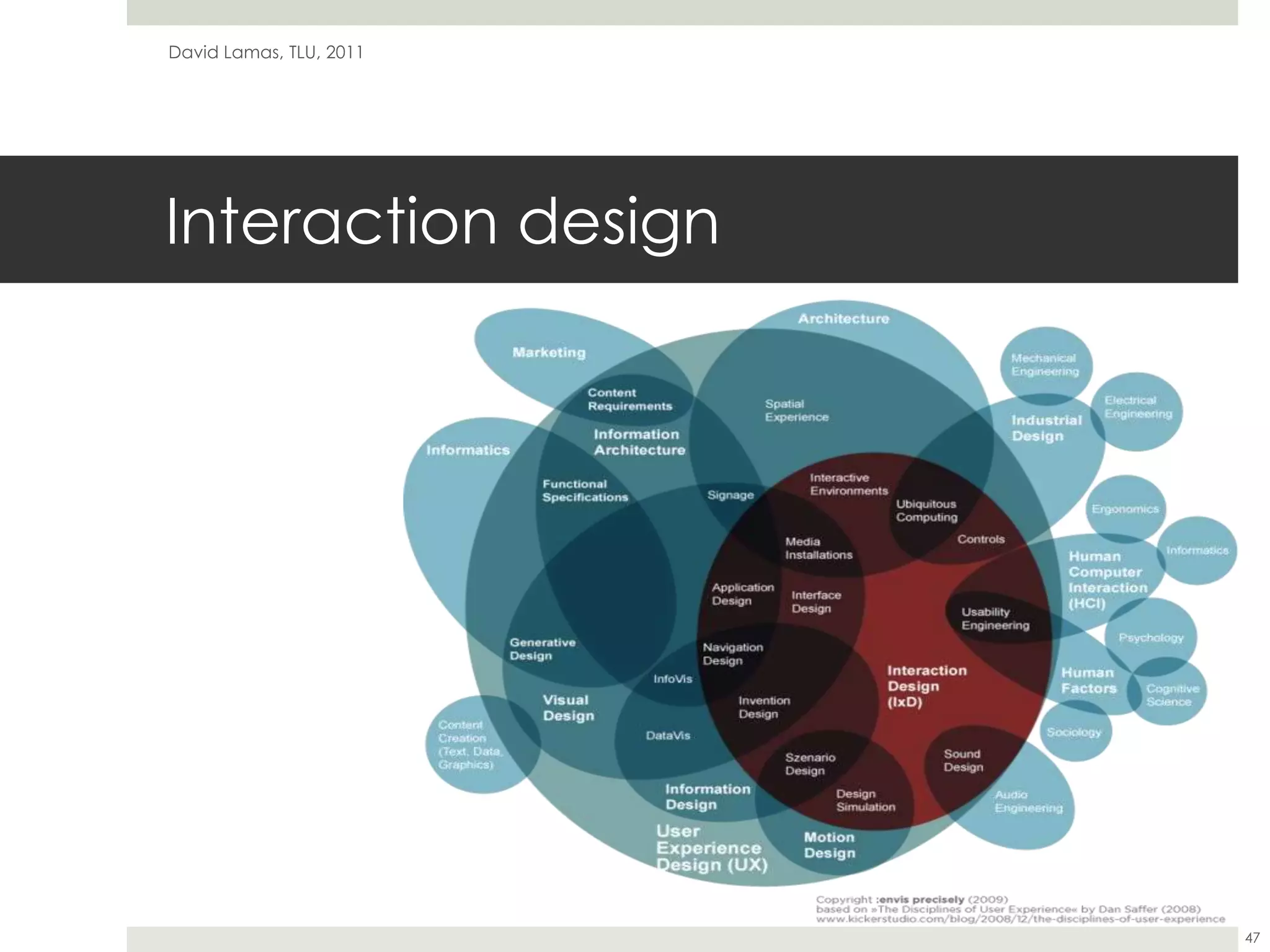
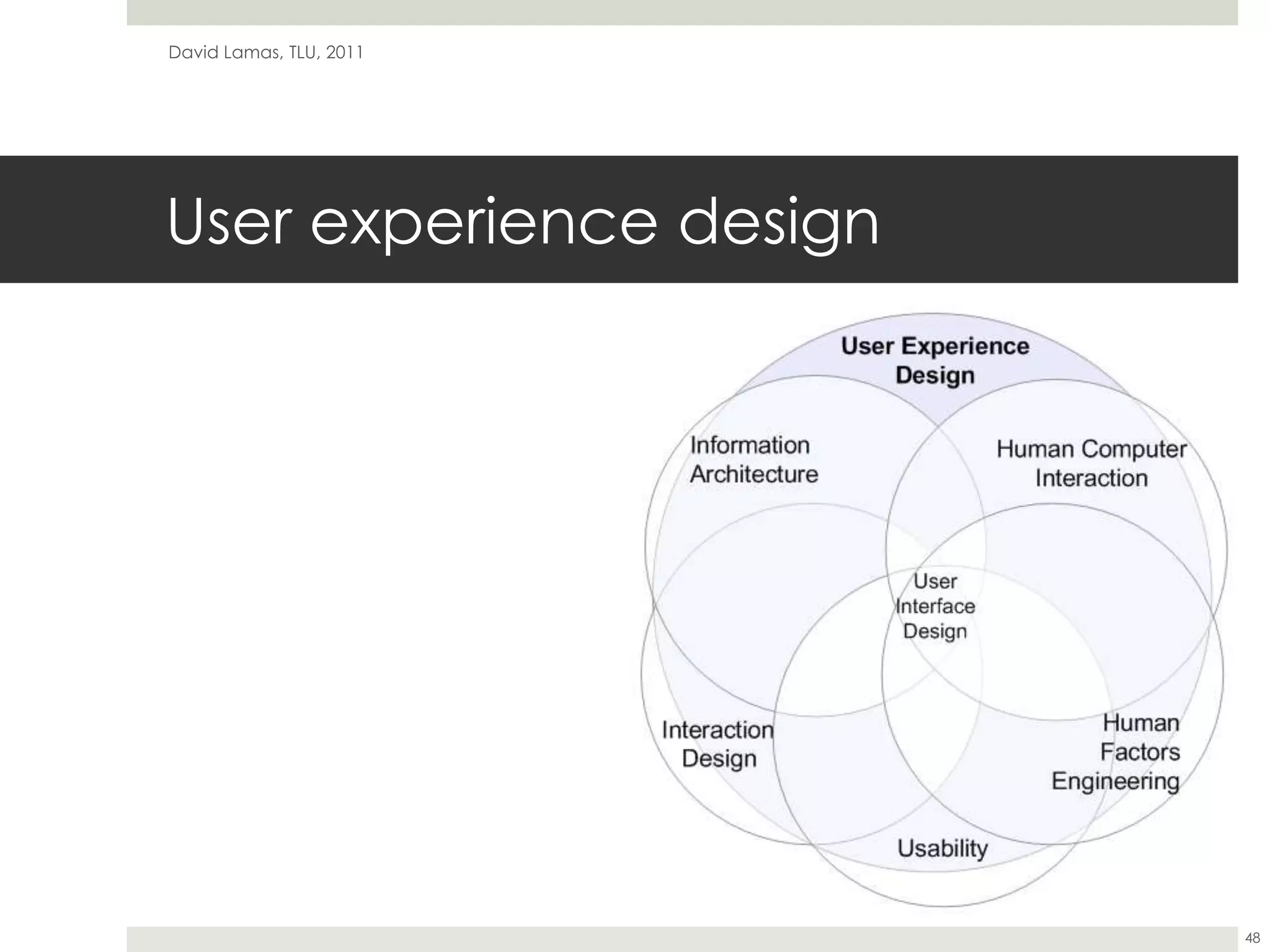
Related knowledge domainsInteraction designA design discipline dedicated to defining the behavior of artifacts, environments and systemsUser experience designThe field of user experience was established to cover the holistic perspective to how a person feels about using a system	The focus is on pleasure and value rather than on performanceDavid Lamas, TLU, 201144
Human-computer interactionDavid Lamas, TLU, 201145
Human-computer interactionDavid Lamas, TLU, 201146
Interaction designDavid Lamas, TLU, 201147
User experience designDavid Lamas, TLU, 201148
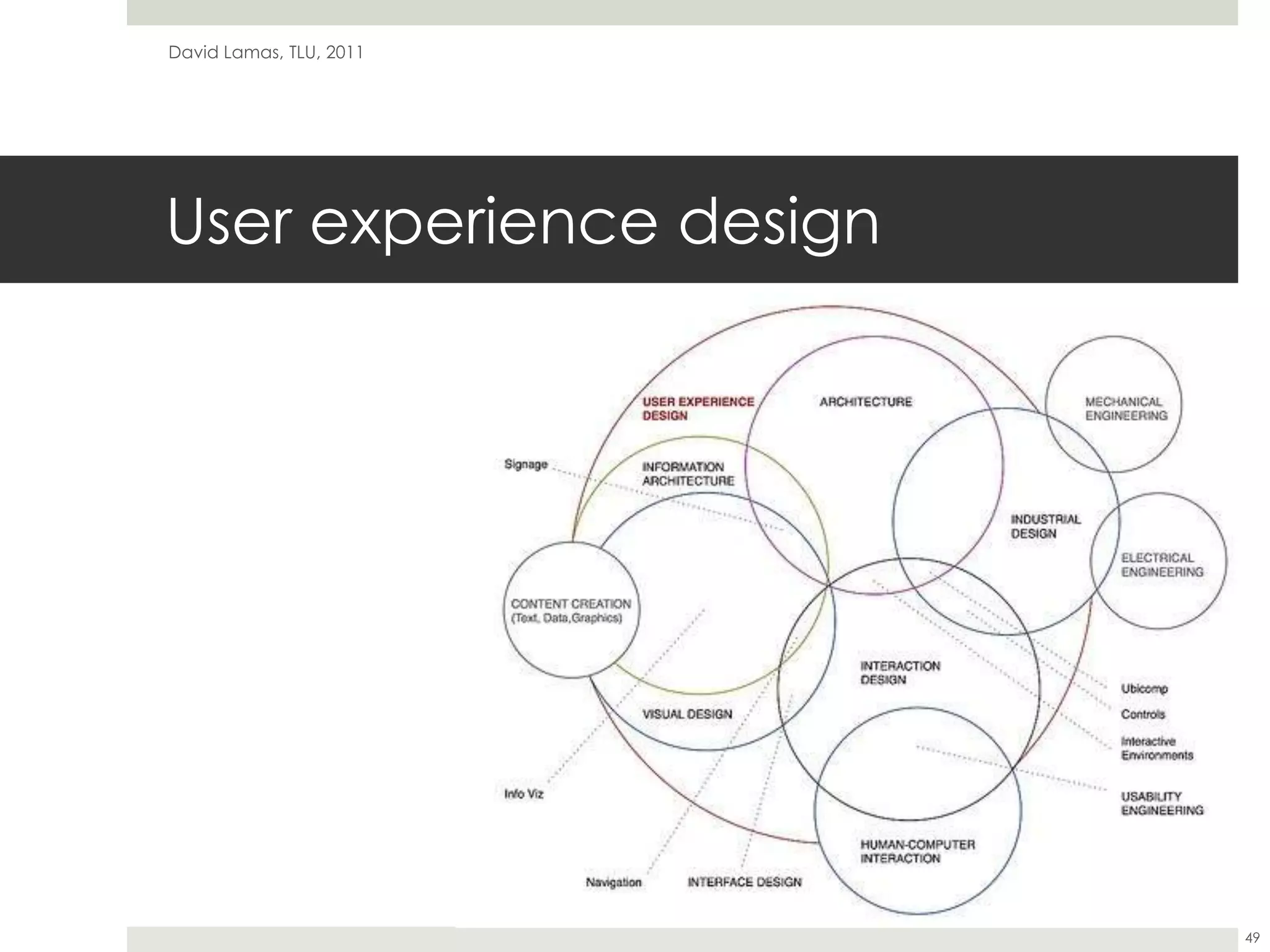
User experience designDavid Lamas, TLU, 201149
But…Interactivityis not limited to technological systemsPeople have been interacting with each other as long as humans have been a speciesFrom this broader viewpoint, reasoning about interaction styles should also address the interaction between human beings by means of a interactive mediaDavid Lamas, TLU, 201150
Interaction styles recapEtymologyThe relation between the evolution of computing and the main interaction stylesThe technological hype cycle and adoption timingsRelated knowledge domainsBeyond interacting with digital mediaDavid Lamas, TLU, 201151
Two final questionsHow do you see the evolution of interacting with and through interactive media?Are natural user interfaces the future or part of the future?Are the previous interaction styles dead or condemned?Should mobile user interfaces be regarded as a completely new interaction style?If so, what would their distinctive characteristics be?David Lamas, TLU, 201152

Interaction styles

  • 1.
    Introduction and TheoreticalFoundations of New MediaInteraction Styles
  • 2.
    ContentsEtymologyThe relation betweenthe evolution of computing and the main interaction stylesThe technological hype cycle and adoption timingsRelated knowledge domainsBeyond interacting with digital mediaDavid Lamas, TLU, 20112
  • 3.
    Personal computing1978It isgenerally thought that a computer must cost under USD 1000.00 to have mass-market appeal. A machine at that price today is a minimal computer system. It has as little as 8KB of user memory, uses audio cassettes for mass storage, and has a CRT display for output. Today’s computer is programmed in BASC. Small amounts of application software are available on cassettes.David Lamas, TLU, 20113
  • 4.
    Data storage1978A newapproach to storing data in computers, using a tunable dye laser, is described in US Patent 4,101,976 awarded to scientists at IBM’s San Jose Research Laboratory. Based on a photochemical process called ‘hole burning’, the new system provides a unique method for increasing the amount of information that can be packed into a given space.David Lamas, TLU, 20114
  • 5.
    Mobile computing1994Recent advancesin technology have provided portable computers with wireless interfaces that allow networked communication even while a user is mobile. Whereas today’s first-generation notebook computers and personal digital assistants are self-contained, networked mobile computers are part of a greater infrastructure. Mobile computing will very likely revolutionize the way we use computers.David Lamas, TLU, 20115
  • 6.
    Interaction stylesInterAmong, betweenActionthefact or process of doing something, typically to achieve an aim InteractionReciprocal action or influenceInteraction is a kind of action that occurs as two or more objects have an effect upon one another The idea of a two-way effect is essential in the concept of interaction, as opposed to a one-way causal effectStyleA manner of doing somethingA way of painting, a way of writing… A way of interactingDavid Lamas, TLU, 2011
  • 7.
    Interaction stylesIn ourcase…Ways of interacting with and through interactive mediaWays of communicating with and by means of computerized environments David Lamas, TLU, 20117
  • 8.
    The evolution ofcomputingDavid Lamas, TLU, 20118Waldner, J-B. 2007. Nano-informatiqueet intelligence ambiante: inventerl'ordinateurdu XXIe siècle. Hermes Science Publications, 2007
  • 9.
    The evolution ofcomputingDavid Lamas, TLU, 20119Waldner, J-B. 2007. Nano-informatiqueet intelligence ambiante: inventerl'ordinateurdu XXIe siècle. Hermes Science Publications, 2007
  • 10.
    Main interaction stylesCommandline interfacesGraphical user interfacesNatural user interfacesDavid Lamas, TLU, 201110
  • 11.
    The evolution ofcomputingDavid Lamas, TLU, 201111Waldner, J-B. 2007. Nano-informatiqueet intelligence ambiante: inventerl'ordinateurdu XXIe siècle. Hermes Science Publications, 2007
  • 12.
    Physical programmingDavid Lamas,TLU, 201112In the beginning it wasall about interacting with the computer
  • 13.
    Card punching andreadingDavid Lamas, TLU, 201113Batch processing
  • 14.
    A teletypewriter DavidLamas, TLU, 201114The birth of the CommandLine Interface
  • 15.
    Early graphic workstationDavidLamas, TLU, 201115An initial GraphicUser Interface
  • 16.
    A mouse prototypeDavidLamas, TLU, 201116Invented byDouglas Engelbart
  • 17.
    A video-display unitDavidLamas, TLU, 201117The oN-Line System featuring a display, a keyboard and mouse
  • 18.
    The oN-Line System…orthe Augmentation of Human IntellectA system envisioned by Douglas Engelbart, to help Increasing the capability of a man to approach a complex problem situation, to gain comprehension to suit his particular needs, and to derive solutions to problemsIncreased capability in this respect is taken to mean a mixture of the following: more-rapid comprehension, better comprehension, the possibility of gaining a useful degree of comprehension in a situation that previously was too complex, speedier solutions, better solutions, and the possibility of finding solutions to problems that before seemed insolvable Complex situations we include the professional problems of diplomats, executives, social scientists, life scientists, physical scientists, attorneys, designers--whether the problem situation exists for twenty minutes or twenty years…David Lamas, TLU, 201118http://www.dougengelbart.org/pubs/augment-3906.html
  • 19.
    The oN-Line SystemThesystem was called oN-Line System, because it was also networked between multiple computersComputers were no longer isolatedThe display system was based on vector graphics technology and could display both text and solid lines on the same screenBecause of limited memory space in the mainframe computer, it could only display upper-case characters, although true upper-case was displayed by the use of a short horizontal line directly above any capitalized lettersDavid Lamas, TLU, 201119
  • 20.
    The evolution ofcomputingDavid Lamas, TLU, 201120Waldner, J-B. 2007. Nano-informatiqueet intelligence ambiante: inventerl'ordinateurdu XXIe siècle. Hermes Science Publications, 2007
  • 21.
    The Xerox AltoDavidLamas, TLU, 201121The Alto was not a microcomputer as such, although its components did fit under a desk
  • 22.
    The Xerox StarDavidLamas, TLU, 201122The Star had some differences from the Alto, most significantly the ability to overlap windows was removed as it was thought too confusing for the general public…
  • 23.
    The Apple LisaDavidLamas, TLU, 201123The Lisa user interface invented some of the Graphical User Interface concepts we still use today. Icons could represent all files in the system and the drag and drop was used for file
  • 24.
    The Apple MacintoshDavidLamas, TLU, 201124
  • 25.
    The Apple MacintoshDavidLamas, TLU, 201125
  • 26.
    Other early graphicuser interfacesDavid Lamas, TLU, 201126
  • 27.
    The evolution ofcomputingDavid Lamas, TLU, 201127Waldner, J-B. 2007. Nano-informatiqueet intelligence ambiante: inventerl'ordinateurdu XXIe siècle. Hermes Science Publications, 2007
  • 28.
    A graphic userinterface timelineExamples of graphic user interface styles are…Menu selectionForms fill-inDirect manipulationMetaphors (ie. The desktop)Web navigationDavid Lamas, TLU, 201128
  • 29.
    The evolution ofcomputingDavid Lamas, TLU, 201129Waldner, J-B. 2007. Nano-informatiqueet intelligence ambiante: inventerl'ordinateurdu XXIe siècle. Hermes Science Publications, 2007
  • 30.
    The evolution ofcomputingDavid Lamas, TLU, 201130Waldner, J-B. 2007. Nano-informatiqueet intelligence ambiante: inventerl'ordinateurdu XXIe siècle. Hermes Science Publications, 2007
  • 31.
    Natural user interfaces…isthe common designation used by designers and developers of computer interfaces to refer to a user interface that is effectively invisible, or becomes invisible with successive learned interactions, to its usersThe word natural is used because most computer interfaces use artificial control devices whose operation has to be learnedSuch an interface relies on a user being able to carry out relatively natural motions, movements or gestures that they quickly discover control the computer application or manipulate the on-screen contentDavid Lamas, TLU, 201131
  • 32.
    Natural user interfacesThemost distinct identifier of a natural user interface is the lack of a physical keyboard and or mouseHence, the most common examples are…(multi-)touch interfaces; andvoice-operated interfacesThe natural user interface removes the metaphors, and many of the artificially learned devices, to allow users to more directly manipulate content using more natural movements, motions and gesturesEnthusiast defend that these interfaces are fast to learn and, as such, freely apply the adjective 'intuitive’ to describe how users interact with themDavid Lamas, TLU, 201132
  • 33.
  • 34.
  • 35.
  • 36.
    Natural user interfacesare… not naturalAccording to Don NormanFundamental principles of knowledge of results, feedback, and a good conceptual model still ruleThe strength of the graphical user interface has little to do with its use of graphicsIt has to do with the ease of remembering actions, both in what actions are possible and how to invoke themVisible icons and visible menus are the mechanisms, and despite the well-known problems of scaling up to the demands of modern complex systems, they still allow one to explore and learnThe important design rule of a GUI is visibility: through the menus, all possible actions can be made visible and, therefore, easily discoverable. The system can often be learned through explorationSystems that avoid these well-known methods suffer.Are natural user interfaces natural? No, he says, but they will be useful.David Lamas, TLU, 201136
  • 37.
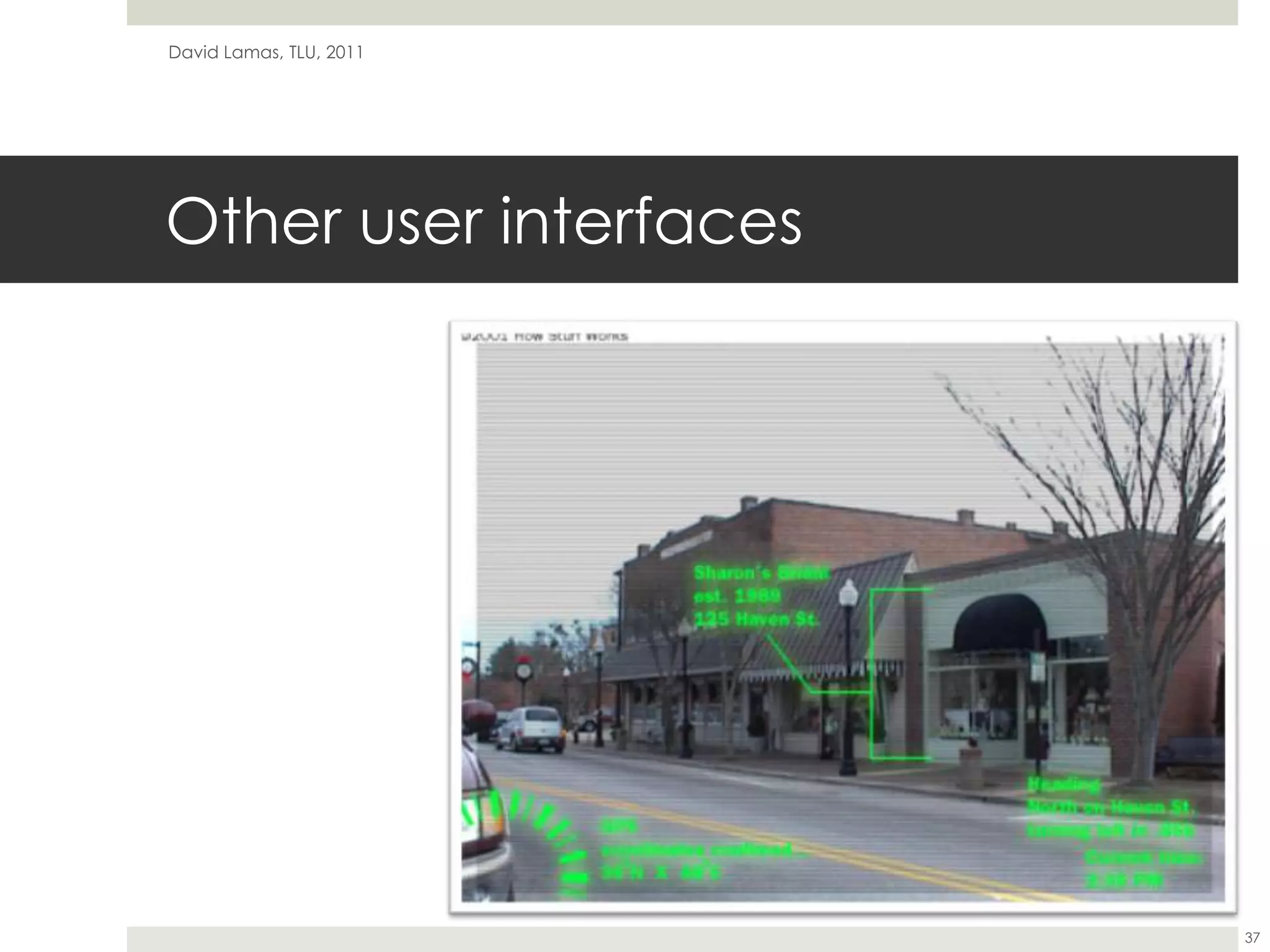
    Other user interfacesDavidLamas, TLU, 201137
  • 38.
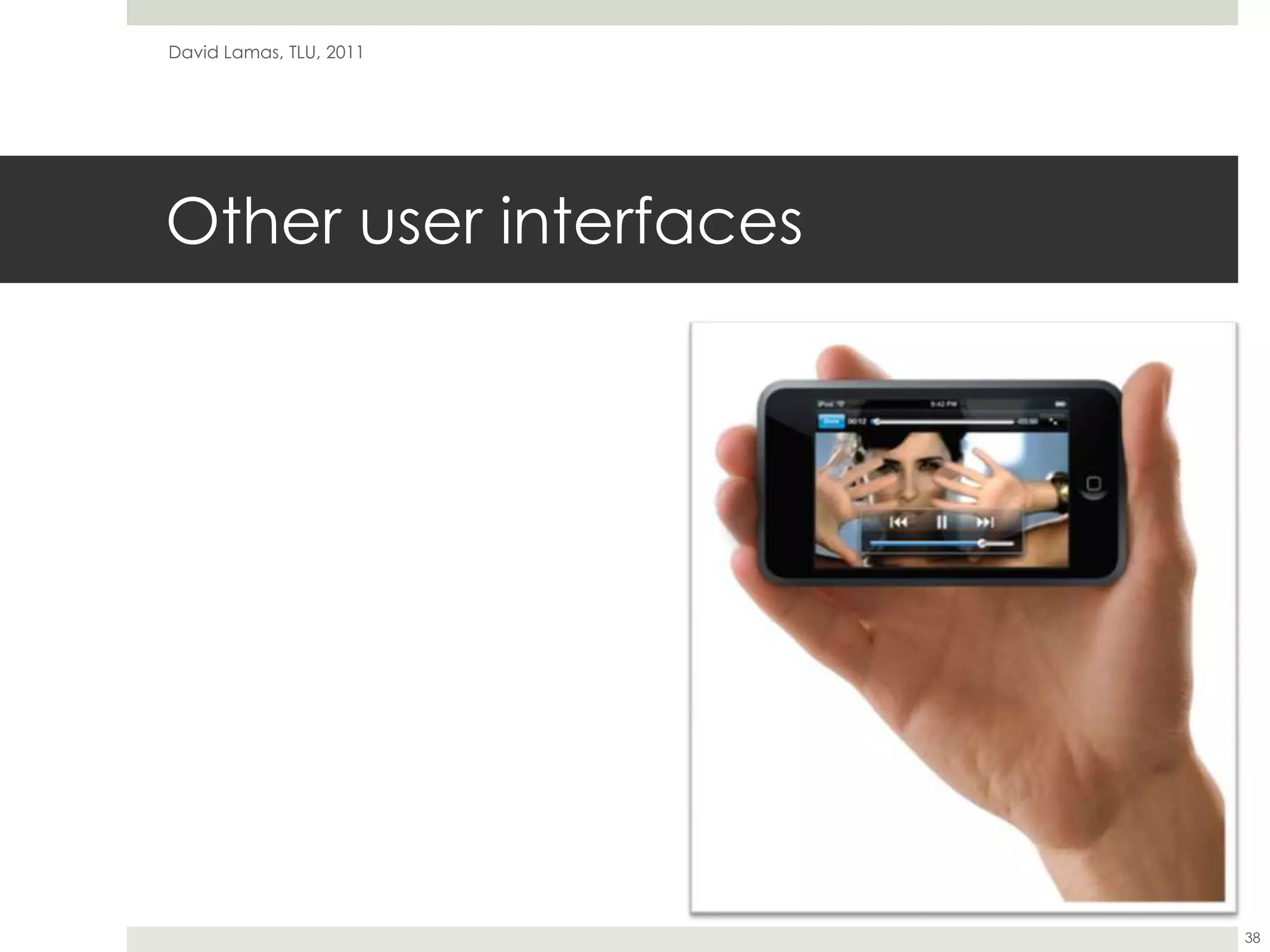
    Other user interfacesDavidLamas, TLU, 201138
  • 39.
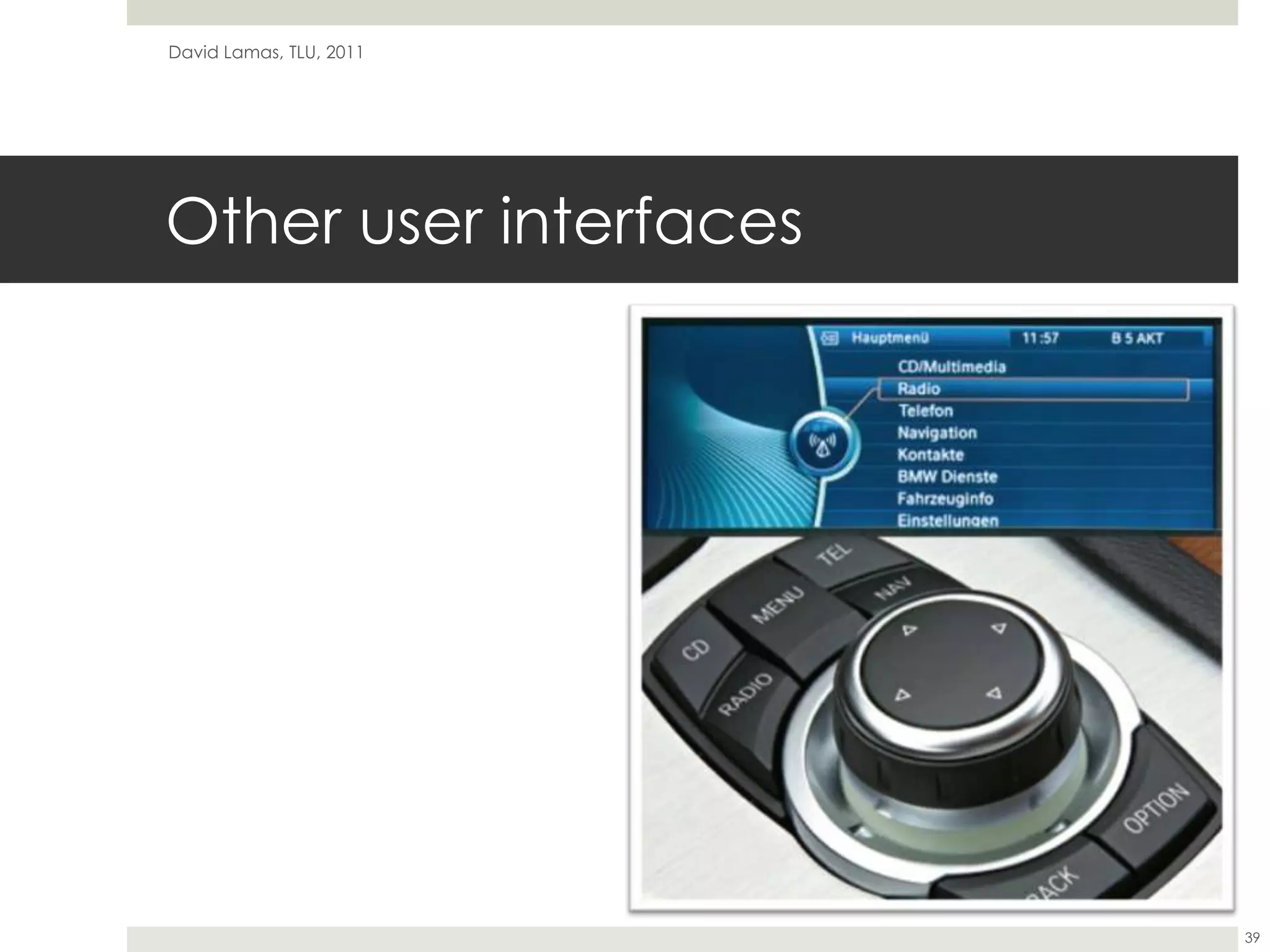
    Other user interfacesDavidLamas, TLU, 201139
  • 40.
    Technological hype cycleDavidLamas, TLU, 201140Linden, A. and Fenn, J. 2003. Understanding Gartner's Hype Cycles. Strategic Analysis Report R-20-1971. 30 May 2003. Gartner Research.
  • 41.
  • 42.
    Technological hype cycleand adoption timingsDavid Lamas, TLU, 201142Linden, A. and Fenn, J. 2003. Understanding Gartner's Hype Cycles. Strategic Analysis Report R-20-1971. 30 May 2003. Gartner Research.
  • 43.
    Related knowledge domainsHuman-computerinteractionThe study of how people interact with computers and to what extent computers are or are not developed for successful interaction with human beings Recent advances in mobile, ubiquitous, social, and tangible computing technologies have moved human-computer interaction into practically all areas of human activityThis has led to a shift away from the usual stress on usability to a much richer scope of user experience, where user's feelings, motivations, and values are given as much, if not more, attention than efficiency, effectiveness and basic subjective satisfactionDavid Lamas, TLU, 201143
  • 44.
    Related knowledge domainsInteractiondesignA design discipline dedicated to defining the behavior of artifacts, environments and systemsUser experience designThe field of user experience was established to cover the holistic perspective to how a person feels about using a system The focus is on pleasure and value rather than on performanceDavid Lamas, TLU, 201144
  • 45.
  • 46.
  • 47.
  • 48.
    User experience designDavidLamas, TLU, 201148
  • 49.
    User experience designDavidLamas, TLU, 201149
  • 50.
    But…Interactivityis not limitedto technological systemsPeople have been interacting with each other as long as humans have been a speciesFrom this broader viewpoint, reasoning about interaction styles should also address the interaction between human beings by means of a interactive mediaDavid Lamas, TLU, 201150
  • 51.
    Interaction styles recapEtymologyTherelation between the evolution of computing and the main interaction stylesThe technological hype cycle and adoption timingsRelated knowledge domainsBeyond interacting with digital mediaDavid Lamas, TLU, 201151
  • 52.
    Two final questionsHowdo you see the evolution of interacting with and through interactive media?Are natural user interfaces the future or part of the future?Are the previous interaction styles dead or condemned?Should mobile user interfaces be regarded as a completely new interaction style?If so, what would their distinctive characteristics be?David Lamas, TLU, 201152