Introduction and Theoretical Foundations of New MediaDesign issues and processes
ContentsDesignInteraction design Experience designDesign strategyDevelopment lifecyclesSystems development lifecycleAgile lifecycleMethods and techniquesDavid Lamas, TLU, 20112
DesignDavid Lamas, TLU, 20113
Design	From googleNounA plan or drawing produced to show the look and function or workings of a building, garment, or other object before it is built or madeVerbDecide upon the look and functioning of (a building, garment, or other object), typically by making a detailed drawing of itDavid Lamas, TLU, 2011
DesignDesign is a creative activity whose aim is to establish the mufti-faceted qualities ofObjectsProcessesServices, and theirSystems in whole life cyclesDesign is also…the central factor of innovative humanization of technologies; andthe crucial factor of cultural and economic exchangeDavid Lamas, TLU, 20115
DesignThe rational model states thatDesigners attempt to optimize a design candidate for known constraints and objectivesThe design process is plan-drivenThe design process is understood in terms of a discrete sequence of stagesDavid Lamas, TLU, 20116
DesignThe action-centered modelDesigners use creativity and emotion to generate design candidatesThe design process is improvisedNo universal sequence of stages is apparentAnalysis, design and implementation are contemporary and inextricably linkedDavid Lamas, TLU, 20117
Interaction designDavid Lamas, TLU, 20118
Interaction designAccording to Allan Cooper…Interaction design is the practice of designing interactive digital products, environments, systems, and servicesFurther, interaction design is heavily focused on satisfying the needs and desires of the people who will use the productIt is, however, about behavior and not so much focused on form or appearanceAnd behavior is much harder to observe and understand than appearanceDavid Lamas, TLU, 20119
Interaction designDan Saffer identifies three ways of looking at interaction designThese are views centered inTechnologyBehaviorSocietyDavid Lamas, TLU, 201110
The technology centered view Interaction designers make technology, particularly digital technology, useful and pleasurable to useThis is why the rise of software and the Internet was also de rise of the field if interaction designInteraction designers take the raw stuff produced by engineers and programmers and mold it into products that people enjoy usingDavid Lamas, TLU, 201111
The behaviorist viewAccording to Jodi Forlizzi and Robert Reimann…Interaction design is about defining the behavior of artifacts, environments and systemsThis view obviously focus on functionality and feedback being concerned on how products behave and provide feedback based on what the people engaged with them are doing David Lamas, TLU, 201112
The social interaction viewInteraction design is inherently social, revolving around facilitating communication between humans through productsTechnology is nearly irrelevant in this viewAny kind of object or device can make a connection between people and these connections can take many formsThey can be one-to-one, as with a telephone callThey can be one-to many, as with a blogThey can be many-to-many, as in the stock marketDavid Lamas, TLU, 201113
Interaction designAlthough these are distinct conceptualizations of what interaction design is, the common ground is that……they all perceive interaction design as an applied art that solves specific problems, under a particular set of circumstances, using the available materialsHowever, generalizations have been made and true rules have emerged that defy the applied art claimDavid Lamas, TLU, 201114
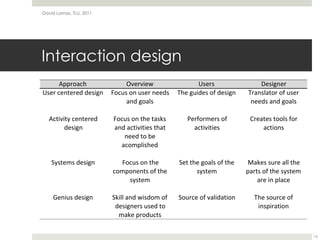
Interaction designCommon to all conceptualizations of interaction design are the four approaches to address itUser centered designActivity centered designSystems designGenius designAll have been used to create successful productsAnd it is typically up designers to select the approach that better addresses the problem at handDavid Lamas, TLU, 201115
Interaction designDavid Lamas, TLU, 201116
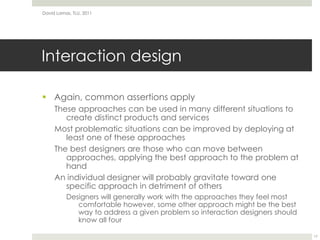
Interaction designAgain, common assertions applyThese approaches can be used in many different situations to create distinct products and servicesMost problematic situations can be improved by deploying at least one of these approachesThe best designers are those who can move between approaches, applying the best approach to the problem at handAn individual designer will probably gravitate toward one specific approach in detriment of othersDesigners will generally work with the approaches they feel most comfortable however, some other approach might be the best way to address a given problem so interaction designers should know all four  David Lamas, TLU, 201117
Experience designDavid Lamas, TLU, 2011
Experience designBut what is this experience or user experience?Different people understand it in very different waysA group of user experience experts has been working on a white paper, which is an important step towards a common understanding of the concept of user experience however, a number a distinct definitions still coexist, which indicate that this is not yet a mature conceptDavid Lamas, TLU, 201119Available in our shared dropbox
But what is this experience or user experience?The term user experience is often used as a synonym for…usabilityuser interfaceinteraction experienceinteraction designcustomer experienceweb site appealemotionwow effectgeneral experience…or as an umbrella term incorporating all or many of these conceptsDavid Lamas, TLU, 201120
Experience designSome definitions…All the aspects of how people use an interactive product: the way it feels in their hands, how well they understand how it works, how they feel about it while they’re using it, how well it serves their purposes, and how well it fits into the entire context in which they are using it.http://delivery.acm.org/10.1145/240000/235010/p11-alben.pdf?key1=235010&key2=2405233021&coll=GUIDE&dl=GUIDE&CFID=16757653&CFTOKEN=13134697David Lamas, TLU, 201121
Experience designSome definitions…All aspects of the end-user’s interaction with the company, its services, and its products. The first requirement for an exemplary user experience is to meet the exact needs of the customer, without fuss or bother. Next comes simplicity and elegance that produce products that are a joy to own, a joy to use. True user experience goes far beyond giving customers what they say they want, or providing checklist features. In order to achieve high-quality user experience in a company’s offerings there must be a seamless merging of the services of multiple disciplines, including engineering, marketing, graphical and industrial design, and interface design.http://www.nngroup.com/about/userexperience.htmlDavid Lamas, TLU, 201122
Experience designSome definitions…A consequence of a user’s internal state (predispositions, expectations, needs, motivation, mood, etc.), the characteristics of the designed system (e.g. complexity, purpose, usability, functionality, etc.) and the context (or the environment) within which the interaction occurs (e.g. organisational/social setting, meaningfulness of the activity, voluntariness of use, etc.)http://www.uni-landau.de/hassenzahl/pdfs/hassenzahl_LR_91-98.pdfDavid Lamas, TLU, 201123
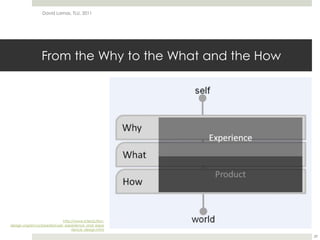
Experience designSo, how can we address experience design?Marc Hassenzahldistinguishes three different levels, when designing an experience through the interaction with an object…The Why levelThe What level; andThe How levelMarc Hassenzhal is also one the co-authors of the definition of user experience presented in the previous slideDavid Lamas, TLU, 201124
The why levelDavid Lamas, TLU, 201125
The what levelThe What addresses the things people can do through an interactive product, such as…making a telephone callbuying a booklistening to a songIt is reflected by a products' functionalityThe What is often intimately tied to the technology itself or a certain product genre. David Lamas, TLU, 201126
The how levelThe How level addresses acting through an object on an operational, sensory-motor levelButtons pressedKnobs turnedMenus navigatedTouch screens strokedRemotes waggledThe How is tied to the actual object to be designed and its context of useIt is the typical realm of the interaction designer…to make given functionality accessible in an aesthetically pleasing way.David Lamas, TLU, 201127
(back to) The why levelThe Why aims to clarify the needs and emotions involved in an activity, the meaning, the experienceOnly then, it determines…the functionality that is able to provide the experience (the What); andan appropriate way of putting the functionality to action (the How)David Lamas, TLU, 201128
From the Why to the What and the HowDavid Lamas, TLU, 201129http://www.interaction-design.org/encyclopedia/user_experience_and_experience_design.html
Design strategyDavid Lamas, TLU, 2011
Design strategyDesign strategy is the product and project planning that takes place at the beginning of a design processIt is a combination of…defining a vision for the end state of a project, anddetermining the tactics needed to execute that visionIt is composed of:Framing the problem (or opportunity) to be addressedDetermining key differentiators for the product to be designVisualizing and selling the strategy to the organizationCreating a product roadmap and a project plan to achieve its goalsDavid Lamas, TLU, 201131
Design strategyAlthough design strategies are usually driven by business strategiesThe reverse can also happenAfter the success of the iPod, Apple Computer became just Apple when as it realized that its future was also in consumer electronicsDavid Lamas, TLU, 201132
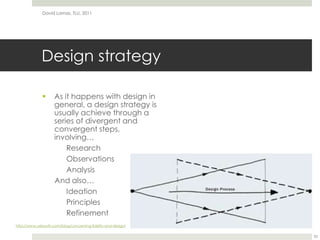
Design strategyAs it happens with design in general, a design strategy is usually achieve through a series of divergent and convergent steps, involving…ResearchObservationsAnalysisAnd also…IdeationPrinciplesRefinementDavid Lamas, TLU, 201133http://www.uxbooth.com/blog/concerning-fidelity-and-design/
Design strategy	But what is it exactly?Instead of letting a wish like “let’s design this new widget” drivea design process, making a design strategy explicit, allows questions like…What should we be designing hat will meet our organization’s needs and the needs of our customers?How should that solution be manifest? As a widget or something else?…determine how the design process should be drivenDavid Lamas, TLU, 201134
Common development lifecyclesDavid Lamas, TLU, 2011
Common development lifecycles A development lifecycle is a project management frameworkCurrent development lifecycles are the result of accumulated experience and best practices but should not, nevertheless, be dogmatically adoptedAlthough not sole relevant project management frameworks, these two approaches are the predominant development lifecyclesSystem development lifecycle, andAgile lifecycleDavid Lamas, TLU, 201136
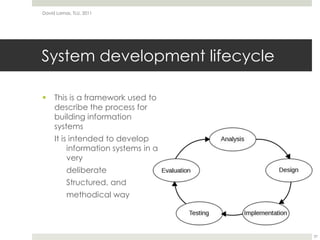
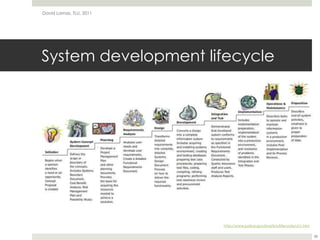
System development lifecycleThis is a framework used to describe the process for building information systemsIt is intended to develop information systems in a verydeliberateStructured, andmethodical wayDavid Lamas, TLU, 201137
System development lifecycleDavid Lamas, TLU, 201138http://www.justice.gov/jmd/irm/lifecycle/ch1.htm
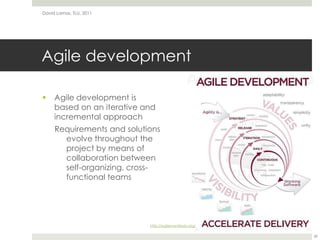
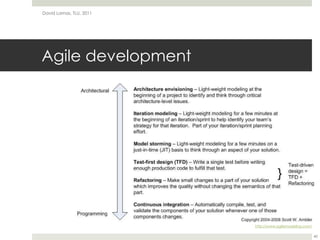
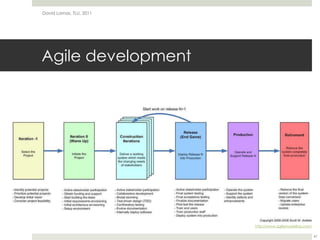
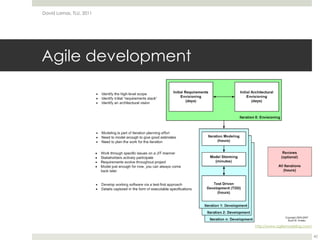
Agile developmentAgile development is based on an iterative and incremental approachRequirements and solutions evolve throughout the project by means of collaboration between self-organizing, cross-functional teams David Lamas, TLU, 201139http://agilemanifesto.org/
Agile developmentDavid Lamas, TLU, 201140http://www.agilemodeling.com/
Agile developmentDavid Lamas, TLU, 201141http://www.agilemodeling.com/
Agile developmentDavid Lamas, TLU, 201142http://www.agilemodeling.com/
Methods and techniquesDavid Lamas, TLU, 2011
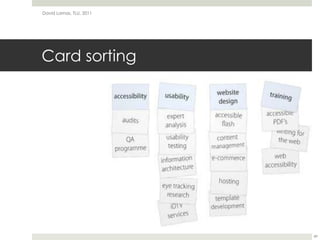
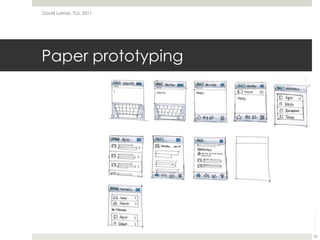
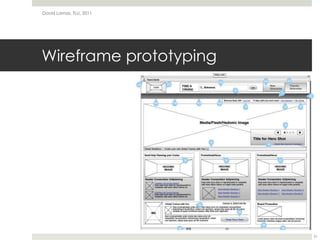
Methods and techniquesTo finalize, we will just go over some of methods and techniques used when designing for new mediaThese include…PersonasScenariosCard sortingPrototypingPaper prototyping, wireframe prototyping, etc…And many others…David Lamas, TLU, 201144
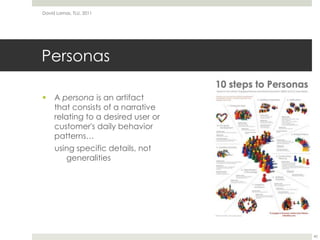
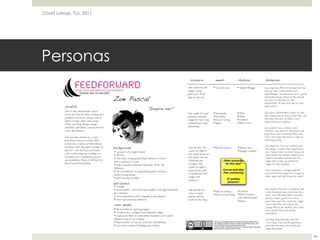
PersonasA personais an artifact that consists of a narrative relating to a desired user or customer's daily behavior patterns…using specific details, not generalitiesDavid Lamas, TLU, 201145
PersonasDavid Lamas, TLU, 201146
ScenariosDavid Lamas, TLU, 201147
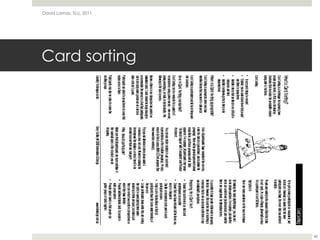
Card sortingDavid Lamas, TLU, 201148
Card sortingDavid Lamas, TLU, 201149
Paper prototypingDavid Lamas, TLU, 201150
Wireframe prototypingDavid Lamas, TLU, 201151
And many others…Methods for concept ideasCo-discoveryContextual LadderingExperiential Contextual InquiryMethods for early prototypesGroup-based expert walkthroughImmersionPerspective-Based InspectionExpert evaluationDavid Lamas, TLU, 201152
Design issues and processes recapDesignInteraction design Experience designDesign strategyDevelopment lifecyclesSystems development lifecycleAgile lifecycleMethods and techniquesDavid Lamas, TLU, 201153

Design issues and processes

  • 1.
    Introduction and TheoreticalFoundations of New MediaDesign issues and processes
  • 2.
    ContentsDesignInteraction design ExperiencedesignDesign strategyDevelopment lifecyclesSystems development lifecycleAgile lifecycleMethods and techniquesDavid Lamas, TLU, 20112
  • 3.
  • 4.
    Design From googleNounA planor drawing produced to show the look and function or workings of a building, garment, or other object before it is built or madeVerbDecide upon the look and functioning of (a building, garment, or other object), typically by making a detailed drawing of itDavid Lamas, TLU, 2011
  • 5.
    DesignDesign is acreative activity whose aim is to establish the mufti-faceted qualities ofObjectsProcessesServices, and theirSystems in whole life cyclesDesign is also…the central factor of innovative humanization of technologies; andthe crucial factor of cultural and economic exchangeDavid Lamas, TLU, 20115
  • 6.
    DesignThe rational modelstates thatDesigners attempt to optimize a design candidate for known constraints and objectivesThe design process is plan-drivenThe design process is understood in terms of a discrete sequence of stagesDavid Lamas, TLU, 20116
  • 7.
    DesignThe action-centered modelDesignersuse creativity and emotion to generate design candidatesThe design process is improvisedNo universal sequence of stages is apparentAnalysis, design and implementation are contemporary and inextricably linkedDavid Lamas, TLU, 20117
  • 8.
  • 9.
    Interaction designAccording toAllan Cooper…Interaction design is the practice of designing interactive digital products, environments, systems, and servicesFurther, interaction design is heavily focused on satisfying the needs and desires of the people who will use the productIt is, however, about behavior and not so much focused on form or appearanceAnd behavior is much harder to observe and understand than appearanceDavid Lamas, TLU, 20119
  • 10.
    Interaction designDan Safferidentifies three ways of looking at interaction designThese are views centered inTechnologyBehaviorSocietyDavid Lamas, TLU, 201110
  • 11.
    The technology centeredview Interaction designers make technology, particularly digital technology, useful and pleasurable to useThis is why the rise of software and the Internet was also de rise of the field if interaction designInteraction designers take the raw stuff produced by engineers and programmers and mold it into products that people enjoy usingDavid Lamas, TLU, 201111
  • 12.
    The behaviorist viewAccordingto Jodi Forlizzi and Robert Reimann…Interaction design is about defining the behavior of artifacts, environments and systemsThis view obviously focus on functionality and feedback being concerned on how products behave and provide feedback based on what the people engaged with them are doing David Lamas, TLU, 201112
  • 13.
    The social interactionviewInteraction design is inherently social, revolving around facilitating communication between humans through productsTechnology is nearly irrelevant in this viewAny kind of object or device can make a connection between people and these connections can take many formsThey can be one-to-one, as with a telephone callThey can be one-to many, as with a blogThey can be many-to-many, as in the stock marketDavid Lamas, TLU, 201113
  • 14.
    Interaction designAlthough theseare distinct conceptualizations of what interaction design is, the common ground is that……they all perceive interaction design as an applied art that solves specific problems, under a particular set of circumstances, using the available materialsHowever, generalizations have been made and true rules have emerged that defy the applied art claimDavid Lamas, TLU, 201114
  • 15.
    Interaction designCommon toall conceptualizations of interaction design are the four approaches to address itUser centered designActivity centered designSystems designGenius designAll have been used to create successful productsAnd it is typically up designers to select the approach that better addresses the problem at handDavid Lamas, TLU, 201115
  • 16.
  • 17.
    Interaction designAgain, commonassertions applyThese approaches can be used in many different situations to create distinct products and servicesMost problematic situations can be improved by deploying at least one of these approachesThe best designers are those who can move between approaches, applying the best approach to the problem at handAn individual designer will probably gravitate toward one specific approach in detriment of othersDesigners will generally work with the approaches they feel most comfortable however, some other approach might be the best way to address a given problem so interaction designers should know all four David Lamas, TLU, 201117
  • 18.
  • 19.
    Experience designBut whatis this experience or user experience?Different people understand it in very different waysA group of user experience experts has been working on a white paper, which is an important step towards a common understanding of the concept of user experience however, a number a distinct definitions still coexist, which indicate that this is not yet a mature conceptDavid Lamas, TLU, 201119Available in our shared dropbox
  • 20.
    But what isthis experience or user experience?The term user experience is often used as a synonym for…usabilityuser interfaceinteraction experienceinteraction designcustomer experienceweb site appealemotionwow effectgeneral experience…or as an umbrella term incorporating all or many of these conceptsDavid Lamas, TLU, 201120
  • 21.
    Experience designSome definitions…Allthe aspects of how people use an interactive product: the way it feels in their hands, how well they understand how it works, how they feel about it while they’re using it, how well it serves their purposes, and how well it fits into the entire context in which they are using it.http://delivery.acm.org/10.1145/240000/235010/p11-alben.pdf?key1=235010&key2=2405233021&coll=GUIDE&dl=GUIDE&CFID=16757653&CFTOKEN=13134697David Lamas, TLU, 201121
  • 22.
    Experience designSome definitions…Allaspects of the end-user’s interaction with the company, its services, and its products. The first requirement for an exemplary user experience is to meet the exact needs of the customer, without fuss or bother. Next comes simplicity and elegance that produce products that are a joy to own, a joy to use. True user experience goes far beyond giving customers what they say they want, or providing checklist features. In order to achieve high-quality user experience in a company’s offerings there must be a seamless merging of the services of multiple disciplines, including engineering, marketing, graphical and industrial design, and interface design.http://www.nngroup.com/about/userexperience.htmlDavid Lamas, TLU, 201122
  • 23.
    Experience designSome definitions…Aconsequence of a user’s internal state (predispositions, expectations, needs, motivation, mood, etc.), the characteristics of the designed system (e.g. complexity, purpose, usability, functionality, etc.) and the context (or the environment) within which the interaction occurs (e.g. organisational/social setting, meaningfulness of the activity, voluntariness of use, etc.)http://www.uni-landau.de/hassenzahl/pdfs/hassenzahl_LR_91-98.pdfDavid Lamas, TLU, 201123
  • 24.
    Experience designSo, howcan we address experience design?Marc Hassenzahldistinguishes three different levels, when designing an experience through the interaction with an object…The Why levelThe What level; andThe How levelMarc Hassenzhal is also one the co-authors of the definition of user experience presented in the previous slideDavid Lamas, TLU, 201124
  • 25.
    The why levelDavidLamas, TLU, 201125
  • 26.
    The what levelTheWhat addresses the things people can do through an interactive product, such as…making a telephone callbuying a booklistening to a songIt is reflected by a products' functionalityThe What is often intimately tied to the technology itself or a certain product genre. David Lamas, TLU, 201126
  • 27.
    The how levelTheHow level addresses acting through an object on an operational, sensory-motor levelButtons pressedKnobs turnedMenus navigatedTouch screens strokedRemotes waggledThe How is tied to the actual object to be designed and its context of useIt is the typical realm of the interaction designer…to make given functionality accessible in an aesthetically pleasing way.David Lamas, TLU, 201127
  • 28.
    (back to) Thewhy levelThe Why aims to clarify the needs and emotions involved in an activity, the meaning, the experienceOnly then, it determines…the functionality that is able to provide the experience (the What); andan appropriate way of putting the functionality to action (the How)David Lamas, TLU, 201128
  • 29.
    From the Whyto the What and the HowDavid Lamas, TLU, 201129http://www.interaction-design.org/encyclopedia/user_experience_and_experience_design.html
  • 30.
  • 31.
    Design strategyDesign strategyis the product and project planning that takes place at the beginning of a design processIt is a combination of…defining a vision for the end state of a project, anddetermining the tactics needed to execute that visionIt is composed of:Framing the problem (or opportunity) to be addressedDetermining key differentiators for the product to be designVisualizing and selling the strategy to the organizationCreating a product roadmap and a project plan to achieve its goalsDavid Lamas, TLU, 201131
  • 32.
    Design strategyAlthough designstrategies are usually driven by business strategiesThe reverse can also happenAfter the success of the iPod, Apple Computer became just Apple when as it realized that its future was also in consumer electronicsDavid Lamas, TLU, 201132
  • 33.
    Design strategyAs ithappens with design in general, a design strategy is usually achieve through a series of divergent and convergent steps, involving…ResearchObservationsAnalysisAnd also…IdeationPrinciplesRefinementDavid Lamas, TLU, 201133http://www.uxbooth.com/blog/concerning-fidelity-and-design/
  • 34.
    Design strategy But whatis it exactly?Instead of letting a wish like “let’s design this new widget” drivea design process, making a design strategy explicit, allows questions like…What should we be designing hat will meet our organization’s needs and the needs of our customers?How should that solution be manifest? As a widget or something else?…determine how the design process should be drivenDavid Lamas, TLU, 201134
  • 35.
  • 36.
    Common development lifecyclesA development lifecycle is a project management frameworkCurrent development lifecycles are the result of accumulated experience and best practices but should not, nevertheless, be dogmatically adoptedAlthough not sole relevant project management frameworks, these two approaches are the predominant development lifecyclesSystem development lifecycle, andAgile lifecycleDavid Lamas, TLU, 201136
  • 37.
    System development lifecycleThisis a framework used to describe the process for building information systemsIt is intended to develop information systems in a verydeliberateStructured, andmethodical wayDavid Lamas, TLU, 201137
  • 38.
    System development lifecycleDavidLamas, TLU, 201138http://www.justice.gov/jmd/irm/lifecycle/ch1.htm
  • 39.
    Agile developmentAgile developmentis based on an iterative and incremental approachRequirements and solutions evolve throughout the project by means of collaboration between self-organizing, cross-functional teams David Lamas, TLU, 201139http://agilemanifesto.org/
  • 40.
    Agile developmentDavid Lamas,TLU, 201140http://www.agilemodeling.com/
  • 41.
    Agile developmentDavid Lamas,TLU, 201141http://www.agilemodeling.com/
  • 42.
    Agile developmentDavid Lamas,TLU, 201142http://www.agilemodeling.com/
  • 43.
  • 44.
    Methods and techniquesTofinalize, we will just go over some of methods and techniques used when designing for new mediaThese include…PersonasScenariosCard sortingPrototypingPaper prototyping, wireframe prototyping, etc…And many others…David Lamas, TLU, 201144
  • 45.
    PersonasA personais anartifact that consists of a narrative relating to a desired user or customer's daily behavior patterns…using specific details, not generalitiesDavid Lamas, TLU, 201145
  • 46.
  • 47.
  • 48.
  • 49.
  • 50.
  • 51.
  • 52.
    And many others…Methodsfor concept ideasCo-discoveryContextual LadderingExperiential Contextual InquiryMethods for early prototypesGroup-based expert walkthroughImmersionPerspective-Based InspectionExpert evaluationDavid Lamas, TLU, 201152
  • 53.
    Design issues andprocesses recapDesignInteraction design Experience designDesign strategyDevelopment lifecyclesSystems development lifecycleAgile lifecycleMethods and techniquesDavid Lamas, TLU, 201153