Submitted by:
MOHAMMAD FAHAD ASLAM
MOHD. ANAS
CONTEMPORARY TECHNOLOGIES
INTELLIGENT
BUILDING FACADES
Submitted to:
Ar. MOHD. FIROZ ANWAR
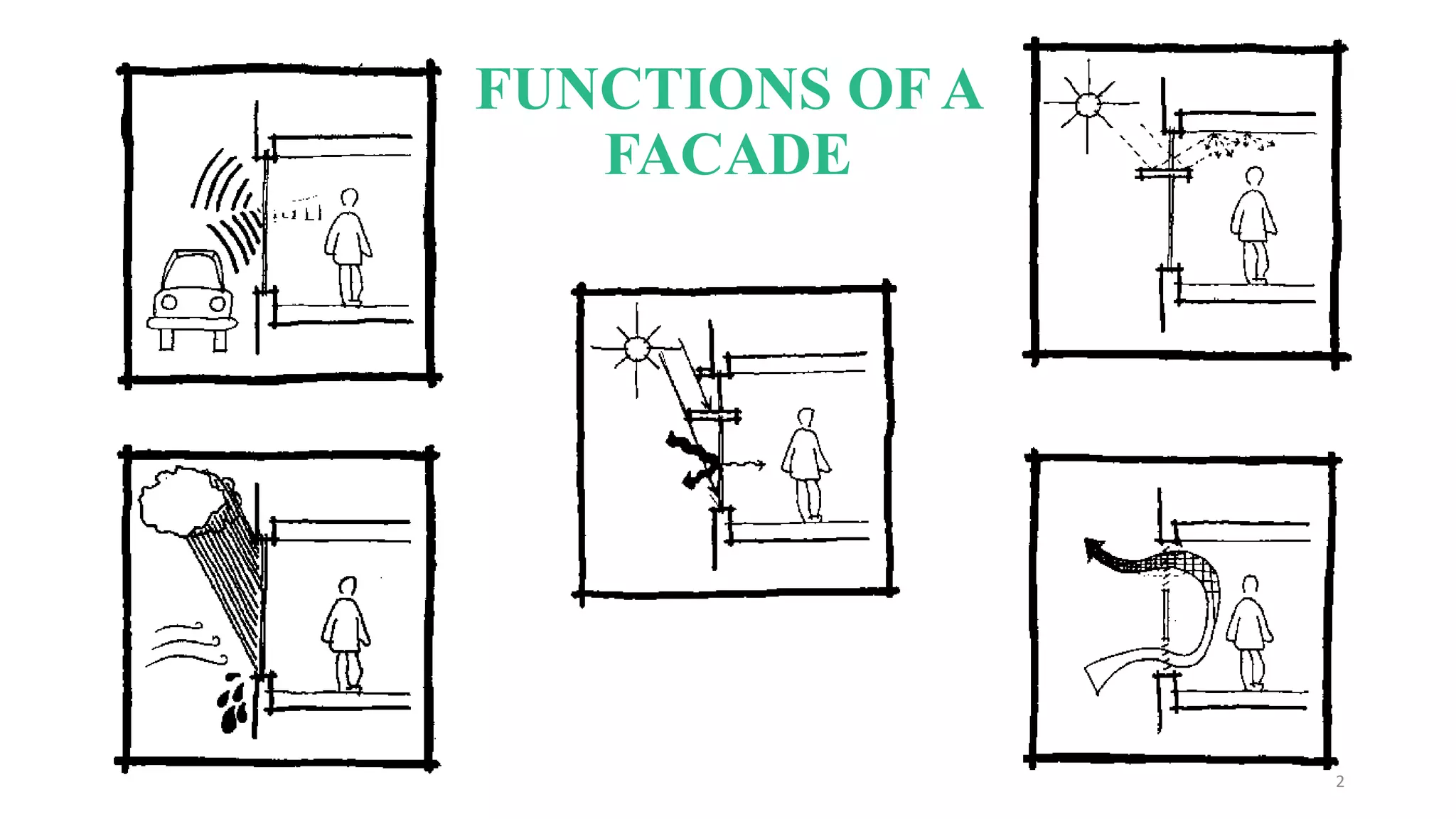
FUNCTIONS OF A
FACADE
2
INTELLIGENT FACADE
• Buildings able to adapt to changing climatic conditions are called
intelligent buildings. Adaptation means that buildings and façades
adapt to current weather conditions.
• Instead of shutting the environment out, it makes more sense to make
use of it since this will have a positive impact on the comfort level of
the occupants as well as on the energy consumption.
• Adaptive façade helps to minimise at least some of the disadvantages
so that a high comfort level can usually be achieved even without air-
conditioning. In so-called hybrid buildings the comfort level can be
further increased by integrating a supporting air-conditioning system
for extreme climatic conditions.
3
INTELLIGENT FACADE
• An intelligent building envelope adapts itself to its environment by
means of perception, reasoning and action. This innate adaptiveness
enables an intelligent building envelope to cope with new situations
and solve problems that arise in its interaction with the environment.
4
WHY INVEST IN FACADES
• India is the world’s fourth largest energy consumer (EIA, 2013) and
fifth largest source of greenhouse gas emissions (GOI, 2010). With the
building sector contributing 35% of the total electricity consumption
(Rawal et al, 2012), and a projected five-fold growth in the
constructed area anticipated by 2030 - from a 21 billion square feet in
2005 to 104 billion square feet, building energy efficiency plays a
major role in managing energy use in India (Seth, 2010).
5
WHY INVEST IN FACADES
• India’s national Energy Conservation Building Code (ECBC, 2008)
was revised in 2008, but remains voluntary and has not been adopted
by most of the Indian states. To encourage adoption of ECBC, a three-
tier approach has been proposed which advocates implementation of
the ECBC codes in phases, and allows time for training and capacity
building (Rawal et al., 2012).
• Tiers are categorized based on: ease of implementation within current
practice, the energy savings potential, and the ROI offered. Tier one
focuses on envelope-related measures, tier two on HVAC, while the
third tier regulates lighting measures.
6
INTELLIGENCE IN ARCHITECTURE
The intelligent features in a façade require integration of responsive dynamic
capabilities, which allow for changes in the façade’s configuration based on
daily and seasonal stimuli, and considering the surrounding environmental
context in order to reduce the energy consumption and increase the building
efficiency.
Developing buildings with intelligent features should achieve better
performance by implementing the following processes:
a) Creation of a relationship between the occupants’ behaviour and indoor
space condition.
b) Provision of automatic adjustments in response to environmental changes
and occupant’s requirements.
c) Generation cost-effective modifications based on changes on tasks and
users behaviour.
7
PERCEPTION
DATA ANALYSIS
AND
REASONING
RESPONSE
(ADAPTIVE)
8
The process of the adaptive feature and data flow through the
intelligent façade.
The operation of intelligent buildings should be treated as if they
possess smart features and some cognitive abilities that allow them
to perceive data, analyse it, and respond with an appropriate reaction
INTELLIGENCE IN ARCHITECTURE
9
10
11
12
13
14
15
16
17
18
19
20
21
22
23
24
25
26
27
28
29
THANK YOU!
30

INTELLIGENT BUILDING FACADES

  • 1.
    Submitted by: MOHAMMAD FAHADASLAM MOHD. ANAS CONTEMPORARY TECHNOLOGIES INTELLIGENT BUILDING FACADES Submitted to: Ar. MOHD. FIROZ ANWAR
  • 2.
  • 3.
    INTELLIGENT FACADE • Buildingsable to adapt to changing climatic conditions are called intelligent buildings. Adaptation means that buildings and façades adapt to current weather conditions. • Instead of shutting the environment out, it makes more sense to make use of it since this will have a positive impact on the comfort level of the occupants as well as on the energy consumption. • Adaptive façade helps to minimise at least some of the disadvantages so that a high comfort level can usually be achieved even without air- conditioning. In so-called hybrid buildings the comfort level can be further increased by integrating a supporting air-conditioning system for extreme climatic conditions. 3
  • 4.
    INTELLIGENT FACADE • Anintelligent building envelope adapts itself to its environment by means of perception, reasoning and action. This innate adaptiveness enables an intelligent building envelope to cope with new situations and solve problems that arise in its interaction with the environment. 4
  • 5.
    WHY INVEST INFACADES • India is the world’s fourth largest energy consumer (EIA, 2013) and fifth largest source of greenhouse gas emissions (GOI, 2010). With the building sector contributing 35% of the total electricity consumption (Rawal et al, 2012), and a projected five-fold growth in the constructed area anticipated by 2030 - from a 21 billion square feet in 2005 to 104 billion square feet, building energy efficiency plays a major role in managing energy use in India (Seth, 2010). 5
  • 6.
    WHY INVEST INFACADES • India’s national Energy Conservation Building Code (ECBC, 2008) was revised in 2008, but remains voluntary and has not been adopted by most of the Indian states. To encourage adoption of ECBC, a three- tier approach has been proposed which advocates implementation of the ECBC codes in phases, and allows time for training and capacity building (Rawal et al., 2012). • Tiers are categorized based on: ease of implementation within current practice, the energy savings potential, and the ROI offered. Tier one focuses on envelope-related measures, tier two on HVAC, while the third tier regulates lighting measures. 6
  • 7.
    INTELLIGENCE IN ARCHITECTURE Theintelligent features in a façade require integration of responsive dynamic capabilities, which allow for changes in the façade’s configuration based on daily and seasonal stimuli, and considering the surrounding environmental context in order to reduce the energy consumption and increase the building efficiency. Developing buildings with intelligent features should achieve better performance by implementing the following processes: a) Creation of a relationship between the occupants’ behaviour and indoor space condition. b) Provision of automatic adjustments in response to environmental changes and occupant’s requirements. c) Generation cost-effective modifications based on changes on tasks and users behaviour. 7
  • 8.
    PERCEPTION DATA ANALYSIS AND REASONING RESPONSE (ADAPTIVE) 8 The processof the adaptive feature and data flow through the intelligent façade. The operation of intelligent buildings should be treated as if they possess smart features and some cognitive abilities that allow them to perceive data, analyse it, and respond with an appropriate reaction INTELLIGENCE IN ARCHITECTURE
  • 9.
  • 10.
  • 11.
  • 12.
  • 13.
  • 14.
  • 15.
  • 16.
  • 17.
  • 18.
  • 19.
  • 20.
  • 21.
  • 22.
  • 23.
  • 24.
  • 25.
  • 26.
  • 27.
  • 28.
  • 29.
  • 30.