1
SMART BUILDINGS
I N T E L L E G E N T B U I L D I N G S T A N D A R D S
JAKUB MATYJA MAHMOUD KARAZ
2
AGENDA
• Brief history and IB definitions
• IB Market
• IB architecture
• BMS’s
• LCC & IB
• Pros & Cons
• IB Future
• Case study
3
4
HUMAN INTELLIGECE &
BUILDING INTELLIGECE
Interpersonal
Bodily-
Kinaesthetic
Visual
Spatial
Musical
Social
User
Interface
Acoustic
Background
music
Beauty
Measure for Spatial
instinct
Sensoring
Ergonomics
Empty Space
Interior Design
Human
Intelligence
Linguistic
Signs
Speech recognition
Logical
Mathematical
Integrated
Control
Building
Automation
Communication
Technology
Cabling
Interpersonal
Own space
Concentration in
peace
Rest Areas
Relaxation
Automated building
control
Intuitive
Silence
5
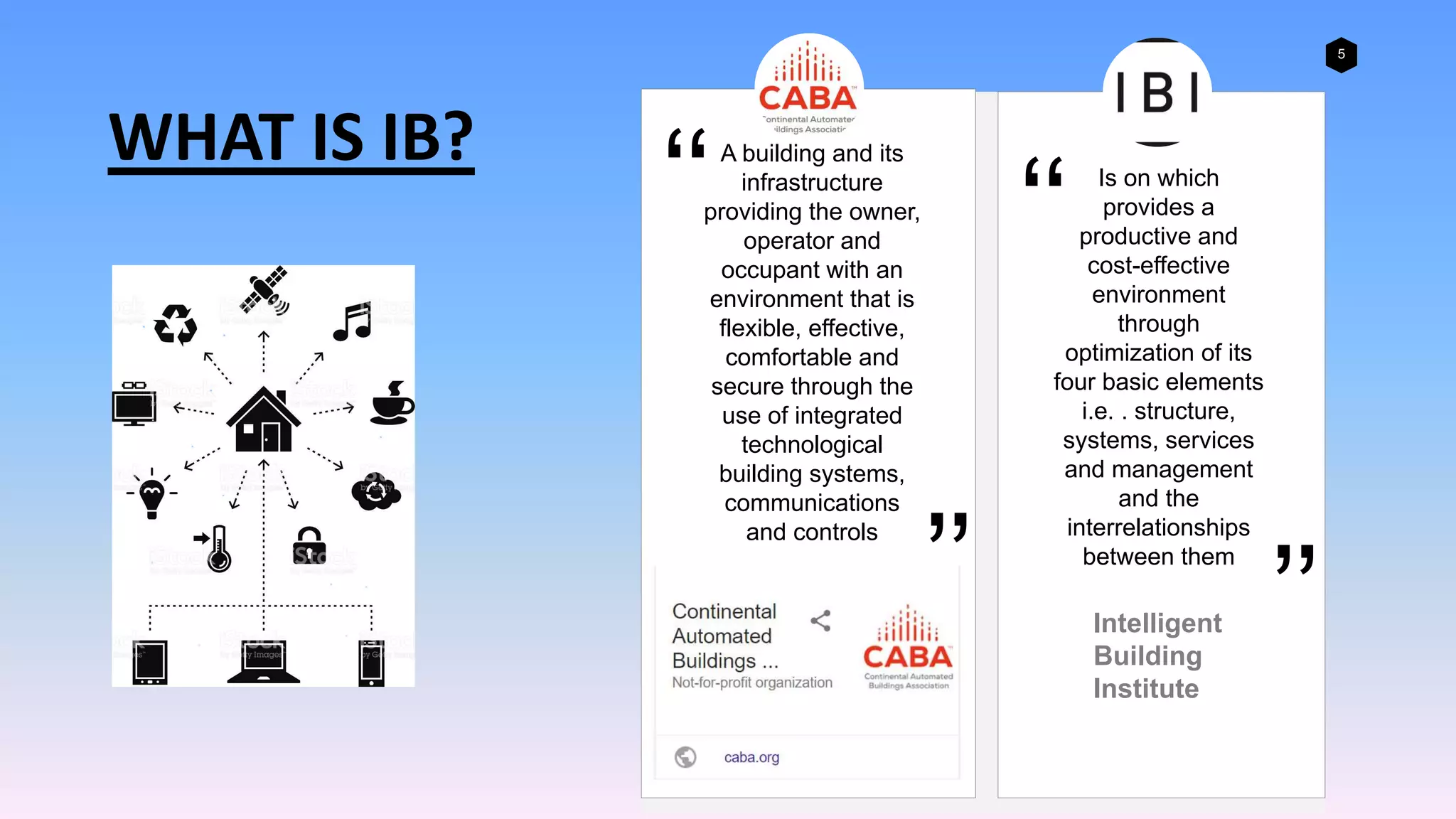
A building and its
infrastructure
providing the owner,
operator and
occupant with an
environment that is
flexible, effective,
comfortable and
secure through the
use of integrated
technological
building systems,
communications
and controls
‘‘
’’
Is on which
provides a
productive and
cost-effective
environment
through
optimization of its
four basic elements
i.e. . structure,
systems, services
and management
and the
interrelationships
between them
‘‘
’’
WHAT IS IB?
.
Intelligent
Building
Institute
6
European Standard PN-EN 15232:2012 (2010)
“Energy perfomance of buildings impact of building automation, control and
buiilding managment’’
...describes impact of BAS and BMS class on energy use in buildings and
contains recommendation as to the use of these systems,
The Standard includes two systems
BACS (Building Automation and Control System )
TBM ( Technical Building Management System)
Detailed description of fucntions, which have to be included for the building to
be classified in particular class is provided.
*This slide is adapted from dr hab. inż. arch. Zbigniew Bromberek lecture
7
European Standard PN-EN 15232:2012 (2010)
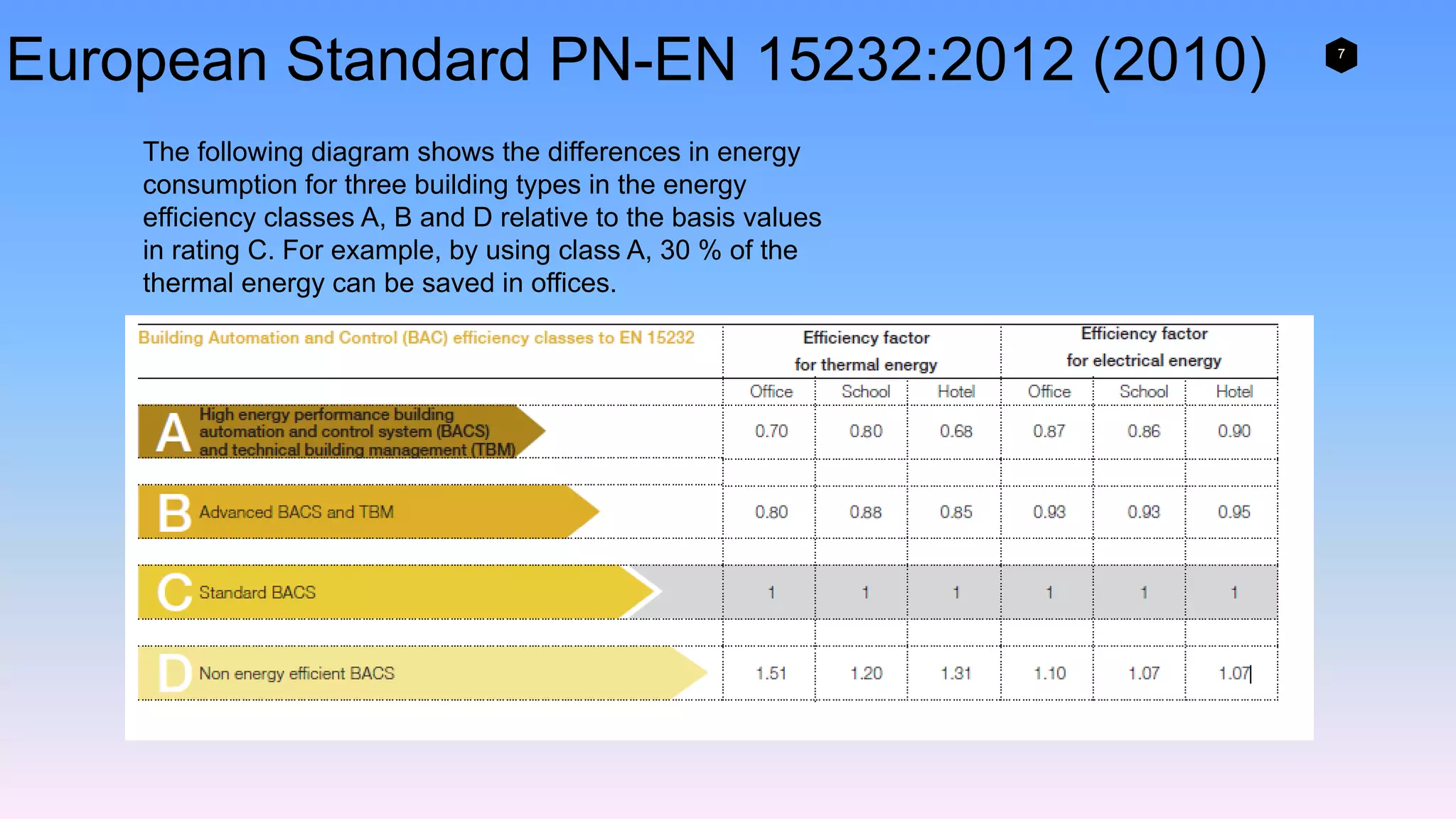
The following diagram shows the differences in energy
consumption for three building types in the energy
efficiency classes A, B and D relative to the basis values
in rating C. For example, by using class A, 30 % of the
thermal energy can be saved in offices.
8
After 2002Enterprise Network Integrated System
ENIS
Enterprise
Network
Integrated
Systems
1995-2002Computer Integrating Building
CIB
(Computer Integrated
Buildings)
1990-1995
Building Level Integrating
systems
1985-1990
Integrated
Multifunction
Systems
1980-1985
Single
Function
Dedicated
systems
Security
Control
Voice
communi
cation
Telefax &
Text
Communicat
ion
EDP &
Data
Communi
cation
Electrical
Lighting ,
Lifts, etc.
control
Access
Control
HVAC
Control
ImageVoice
Texts &
Data
HVAC &
other
Plant
Control
Security
& Acces
s Contro
l
Integration Building
Automation systems
Integrated
Communication
Systems
Cellular
Communication
(Image)
Cellular
Communication
(Voice&Data)
Single Apparatus
IB
HISTORY
Extracted from Shengwie Wang P22
9
IB MARKET
10
• Access System
• Fire/Alarm System
• HVAC System
• Audio/video System
• Light System
• Infrastructure management
• Parking management system
• Smart water management
• Elevators and escalators management system
IB SYSTEMS
11
The basic components of an access control system
are:
• A central host computer or server.
• Control panels or system controllers connected to
the host computer.
• Peripheral devices such as card readers, door
contacts, sirens, and sensors connected to the
control panels
Access System
Adapted from James Sinopoli 2009
12
Access System
Adapted from James Sinopoli 2009
13
The system components that detect the fire and initiate an alarm monitor one or more of
the fire’s characteristics.
The detection components of a fire alarm system are typically located in ceilings, HVAC
ducts, mechanical and electrical areas and equipment rooms. They include:
• Pull stations, in which a person sees a fire and pulls the fire alarm
• Thermal detectors, which sense a rise in temperature or the high
temperature of a fire.
• Smoke detectors, which sense vapors of small particles of carbon matter
generated by burning, including in-duct smoke detectors
• Flame detectors, which sense radiation and visible light from a fire
• Sprinkler water–flow sensors
• Fire-gas detectors, which sense gases such as carbon dioxide and
carbon monoxide
•Air-sampling fire detectors
Fire Alarm System
14
Fire Alarm System
Fire alarm notification devices include:
• Bells
• Chimes
• Horns
• Speakers
• Strobes
Adapted from James Sinopoli 2009
15
HVAC System
HVAC systems control :
• Temperature
• Humidity
• Air flow
• The overall air quality
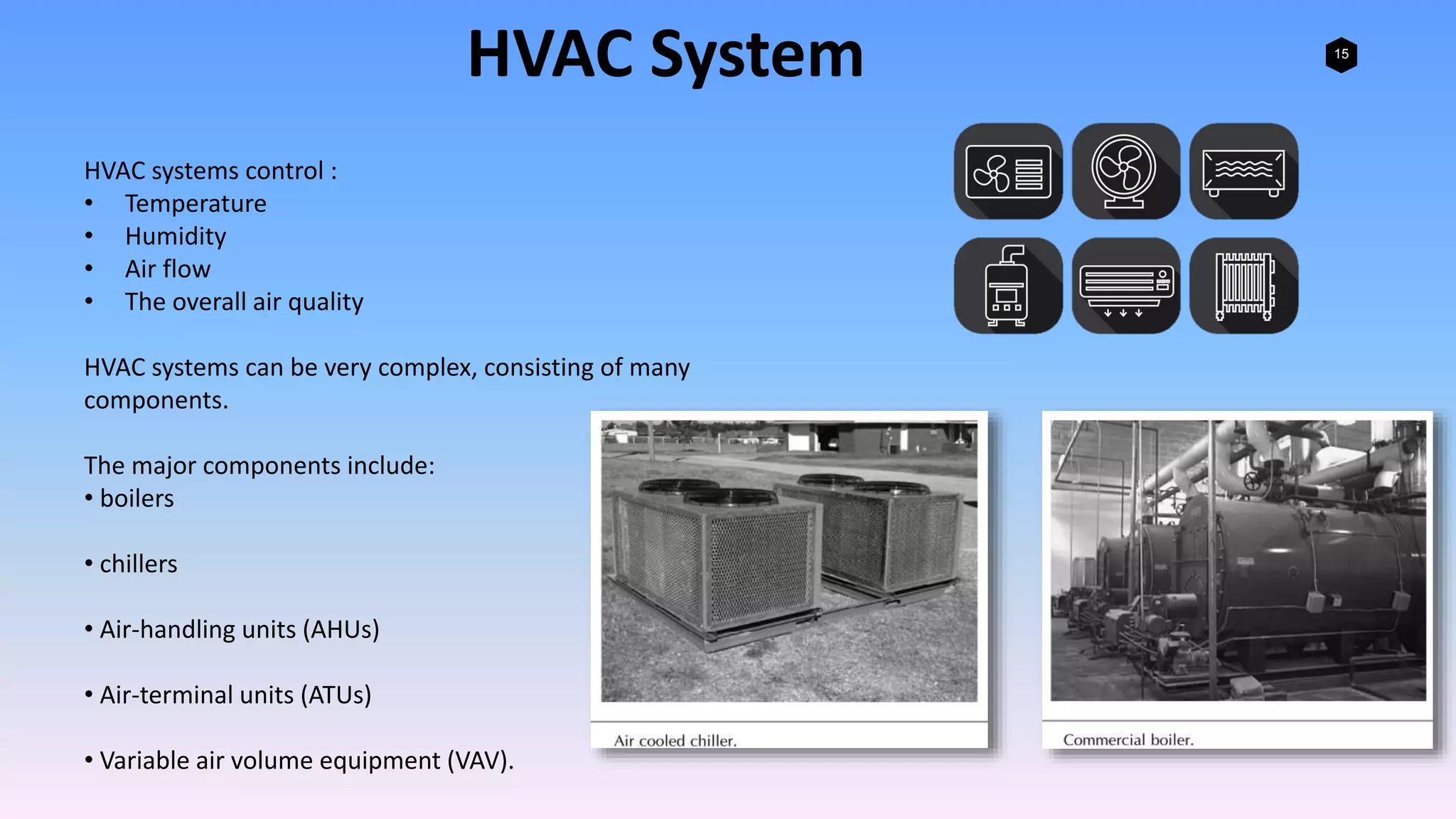
HVAC systems can be very complex, consisting of many
components.
The major components include:
• boilers
• chillers
• Air-handling units (AHUs)
• Air-terminal units (ATUs)
• Variable air volume equipment (VAV).
16
HVAC System
The top level of an HVAC control system is the management level consisting
of personal computers or multiple PCs connected via an Ethernet network
or wireless network .
The management level provides many functions:
• Administration and control of the HVAC system
• Programming for the system and other controllers
• Display of system information
• System reports
• System scheduling
• Archive and analysis of historical data
• Backup of controller databases
• Alarm reporting and analysis
• Trend analysis
17
Audio visual systems
Ethernet Network
Control Interface
Device
Windows Blinds
Motorized
Projector
Screen
Lighting System
Document
Camera
Remote Network
Via LAN WAN
Or internet
Audio Visual system with Ethernet interface
Projector
DVD Player
Audio visual systems are a complex topic as they
encompass scores of different types of
equipment and material,
multiple technical standards, and rapidly
changing technologies.
The components of audio visual systems:
• audio and visual sources
• microphones,
• electronic instruments
• speakers
• displays
18
Light System
Facility lighting is needed to provide visibility for building
occupants, aesthetic atmosphere for spaces or rooms and for life safety. It is estimated
that lighting accounts for 30 to 40% of electricity usage and costs in a typical building.
Therefore, unneeded and uncontrolled lighting in a building not only wastes
energy but also increases facility operational costs.
The heart of the lighting control center is typically a server that is web-enabled
and interconnected to other facility technology systems,
a workstation with a GUI interface and client software
for system administration.
The networked system allows any authorized individual,
including tenants or other occupants, to adjust
their lighting through the network or a web browser.
19
Light System
The need for lighting in a building varies by the type of building, spaces
within the building, time of day, and occupancy of the building. Consequently,
the control strategies and functions of a lighting control system reflect these
variables and primarily involve the following:
• Scheduling
• Occupancy sensors
• Daylight
• Window coatings
20
Parking Management System
SmartVALETTM
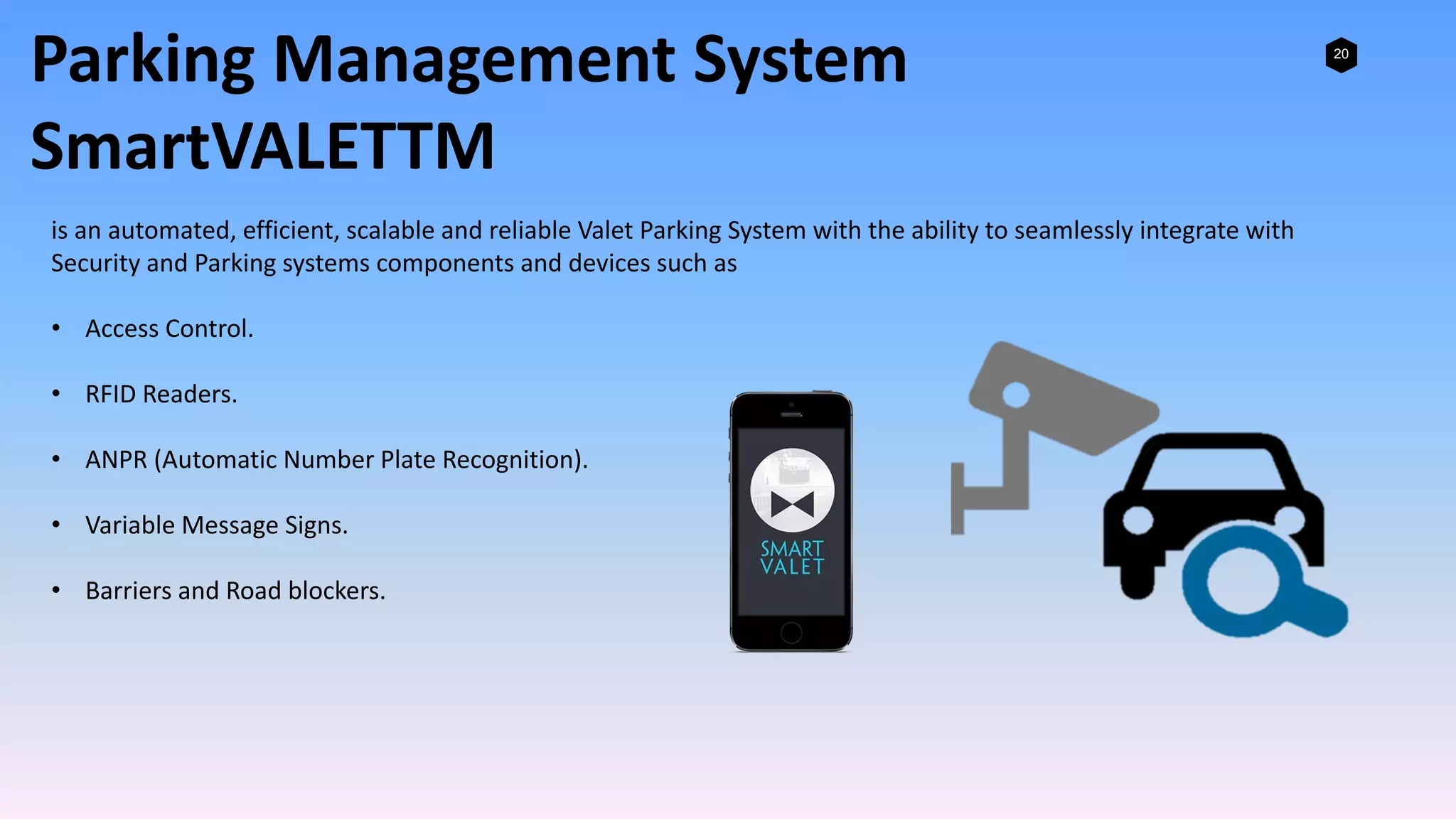
is an automated, efficient, scalable and reliable Valet Parking System with the ability to seamlessly integrate with
Security and Parking systems components and devices such as
• Access Control.
• RFID Readers.
• ANPR (Automatic Number Plate Recognition).
• Variable Message Signs.
• Barriers and Road blockers.
21
Smart water management
Applies monitoring and help
• Optimize the availability delivery
• The quality of water
• Waste
• Chemical treatment
22
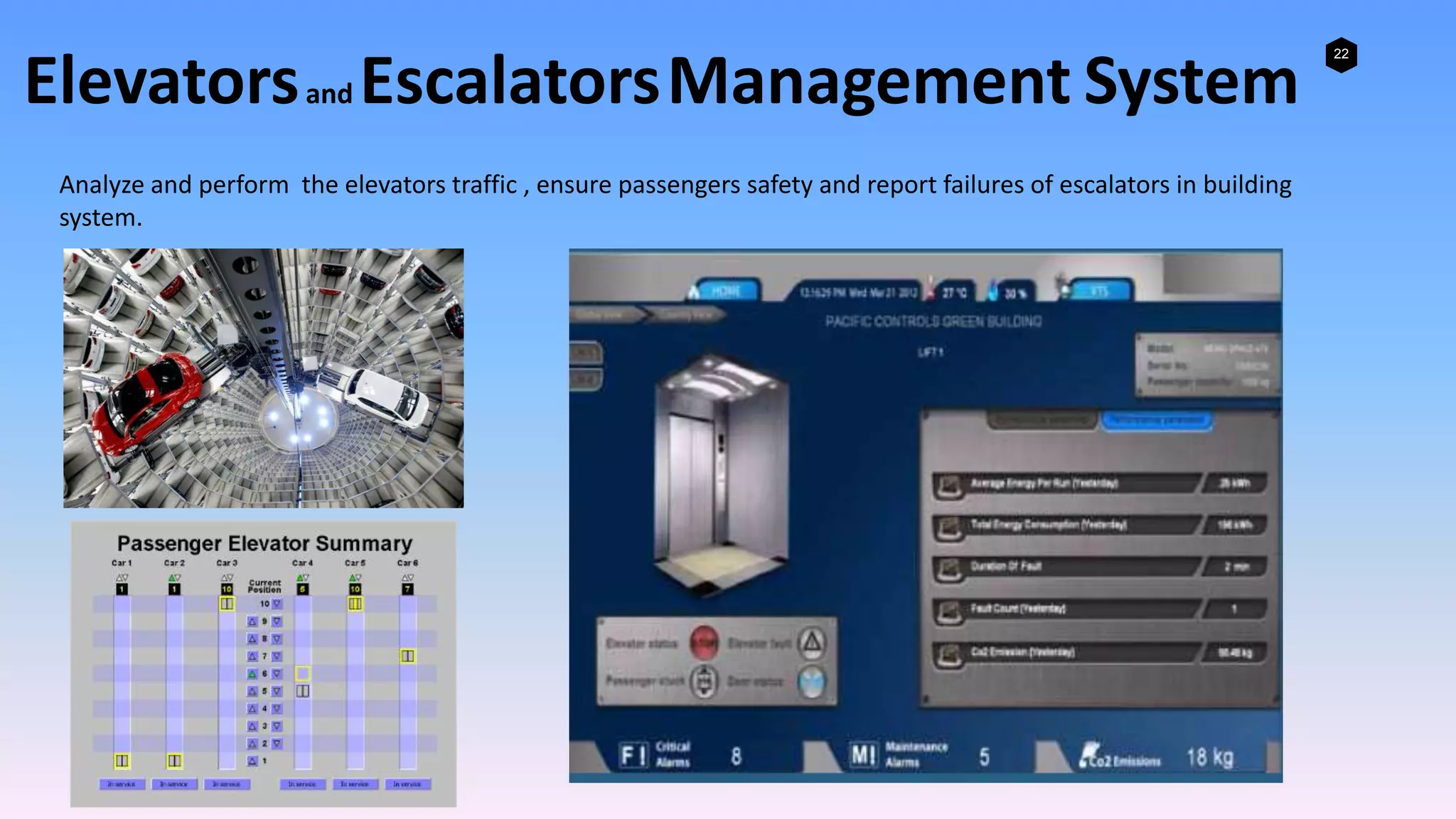
Elevatorsand EscalatorsManagement System
Analyze and perform the elevators traffic , ensure passengers safety and report failures of escalators in building
system.
23
The Foundations of a Smart Building
Smart buildings are built on open and standard communications networks which
make the following characteristics possible:
24
BAS based on open communication
protocols KNX/EIB, BACnet, LonWorks,
ModBus
System Quality and devlopment – open protocols result from many years of continious work,
maintained and further developed in response to arising needs and opportunities.
Flexibility of choice – standards are supported by all major players; the system can be
configured according to one’s needs, without long term commitments.
Flexibilty of expansion- additions and reconfigurations, replacements and updating are
relatively cheap and easy
Lower servicing costs – many service suppliers independent of a single manufacturer.
25
ZigBee
• High level communication protocol
• Using small, low-power digital radios
• Less expensive even than Bluetooth
ZigBee components
• ZigBee coordinator
• ZigBee router
• ZigBee End Device
• 10-75m range, 1mW radio
• Device discovery supported
• 128 bit keys for encryption
• ZWAVE- another low power wireless protocol for remote control
Wireless protocols
https://www.ecnmag.com/article/2015/01/home-future
Coordinator Router End Device
ZigBee
Coordinator ZigBee
Router
ZigBee
End Device
Computer
26
SMART CLOUDS
Adapted from Bachlor thesis in Software and
Information Engineering for Clemens Pühringer
27
Source : Living With Smart Machines By Tom Vander Ark
28
Facility Management
Facility
Management
Systems
Building
Management
Systems
Energy
Management
System
Computerized
Maintenance
Management
Systems
Facility Manager
Facility
Management
Software
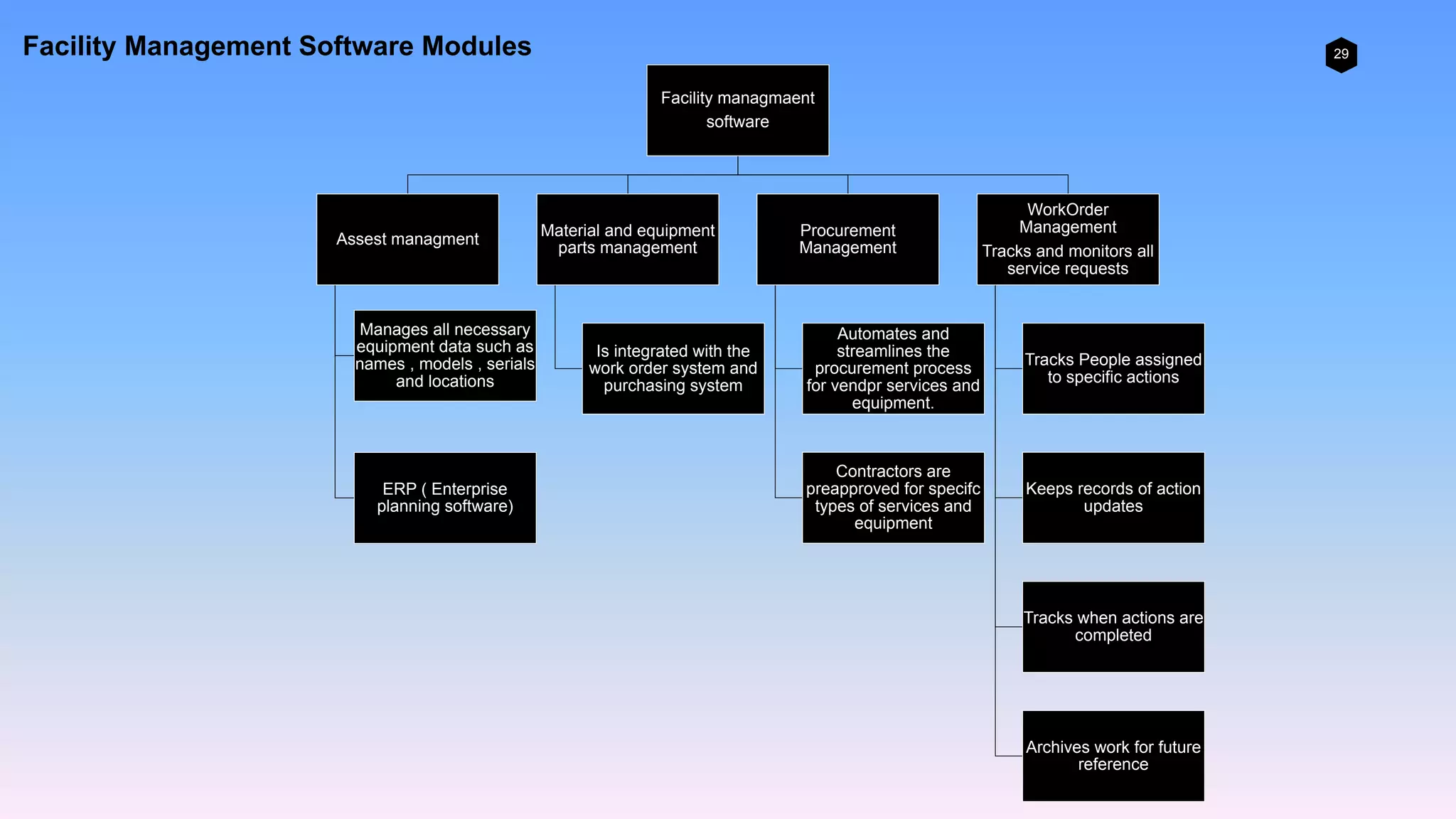
29Facility Management Software Modules
Facility managmaent
software
Assest managment
Manages all necessary
equipment data such as
names , models , serials
and locations
ERP ( Enterprise
planning software)
Material and equipment
parts management
Is integrated with the
work order system and
purchasing system
Procurement
Management
Automates and
streamlines the
procurement process
for vendpr services and
equipment.
Contractors are
preapproved for specifc
types of services and
equipment
WorkOrder
Management
Tracks and monitors all
service requests
Tracks People assigned
to specific actions
Keeps records of action
updates
Tracks when actions are
completed
Archives work for future
reference
30
It is a wide range of computerized building control systems, from special- purpose
controllers, to standalone remote stations, to larger systems including central
computer stations and printers. As discussed earlier, BAS is one of the major
intelligent building systems.
Building Automation / Management Systems
Increased reliability of plant and services
Reduced operating costs
Enhancing staff productivity
BAS & BMS
Protection of people and equipment
31
Building Management
A BMS monitors, supervises, controls and reports on smart building technology systems.
These systems may include access control, video surveillance, fire alarms, HVAC control, programmable
lighting and electric power management.
Its basic functions include:
Providing information on supervised building functions including.
• Detecting, annunciating, and managing alarm and other conditions
• Diagnostic monitoring and reporting of system functions, nodes,
devices, and communication networks
• Interfacing between individual smart building applications.
32
These systems typically display the following responses on
an operator’s workstation:
• Alarm summary
• Event summary
• Trend set displays
• Group control and group trend displays
• Communications status
• System status
• Configuration displays
• Communication links status
• System parameters configuration
Building Management
• Time schedule assignment
• Holiday assignment
• History assignment
• Events archive and retrieval
• Time period summary and configuration
• Point details for every configured point
33
EMS Energy Management System
DGLogik DGLux
What’s EMS do?
• Generates an info for energy usage
• Give a detailed report for costs in order to reduce costs .
• Maintaining a comfortable and safe environment for building occupants.
• Addresses the main electric and energy systems, namely HVAC, lighting
control and power management.
EMS Platforms
34
EMS Energy Management System
to optimize energy consumption and costs EMS may include the following programs :
• Tracking of utility bills to monitor usage and costs as well as comparing projected,
budgeted and actual usage and costs.
• Comparing the energy usage to other similar buildings, an exercise known as
“benchmarking”
• Calculating the effect of thermal comfort or lighting alternatives. That is, the cost for
different lighting control strategies, proper ventilation rates, and related elements.
• Equipment indicators that may signal possible malfunctions include the following:
CO2 , Energy consumption, Temperature , Humidity , Vibration, etc.
35
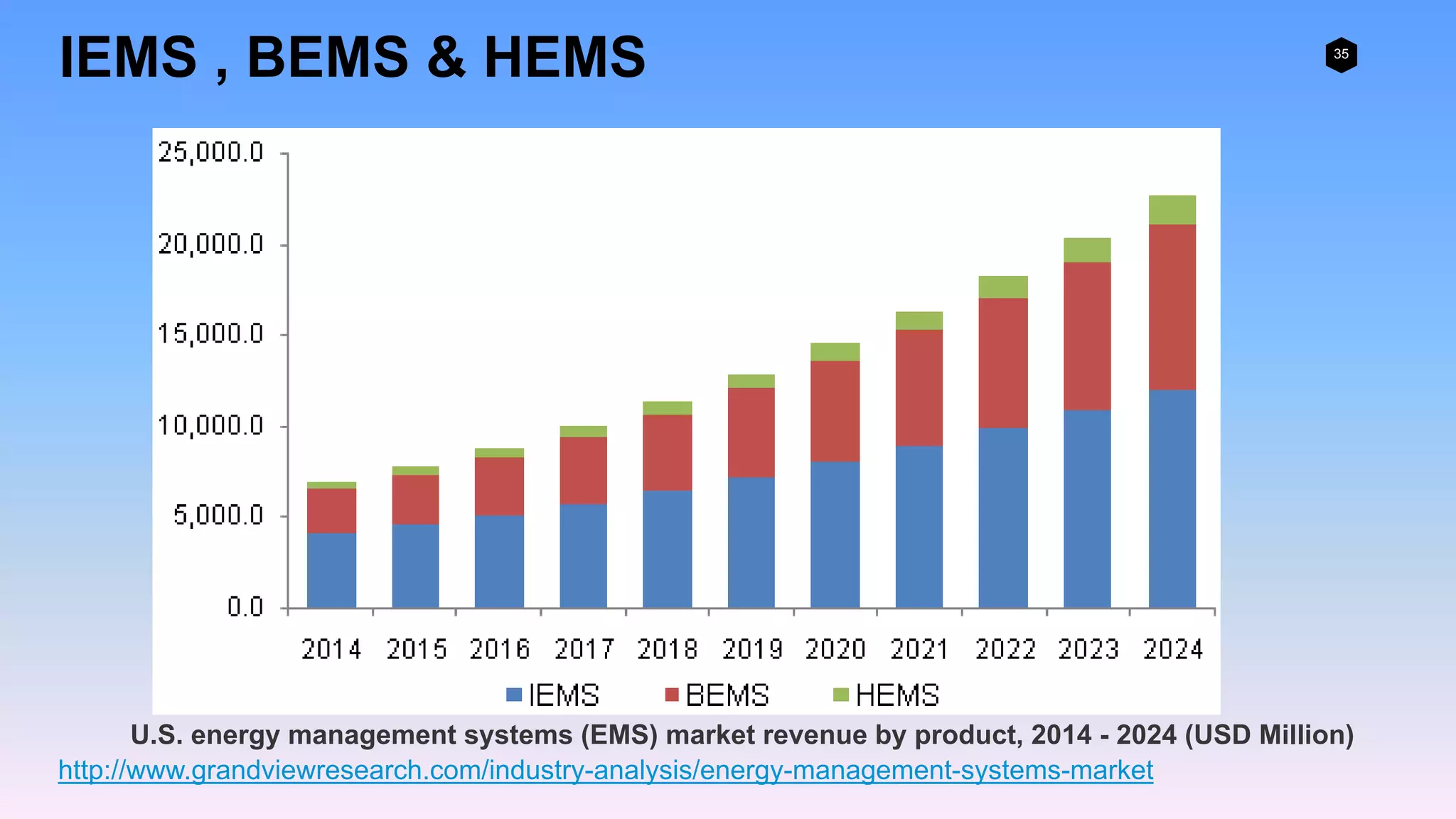
IEMS , BEMS & HEMS
U.S. energy management systems (EMS) market revenue by product, 2014 - 2024 (USD Million)
http://www.grandviewresearch.com/industry-analysis/energy-management-systems-market
36
GreenBuildings
SmartBuildings
Extracted from James Sinopoli, Smart Building Systems for Architects, Owners, and Builders P190
Commonality of
Green & Smart buildings
37
LCC & IB
• Some bussinessmen are careful with IB, they think only about the bottom line
• But with LCC it covers costs, and prevent loses
• Life Cycle Costing (LCC) is a science-based measurement of a project’s impact throughout its life.
• LCC calculator for intellegent building
http://measuresthatmatter.com/caba/
38
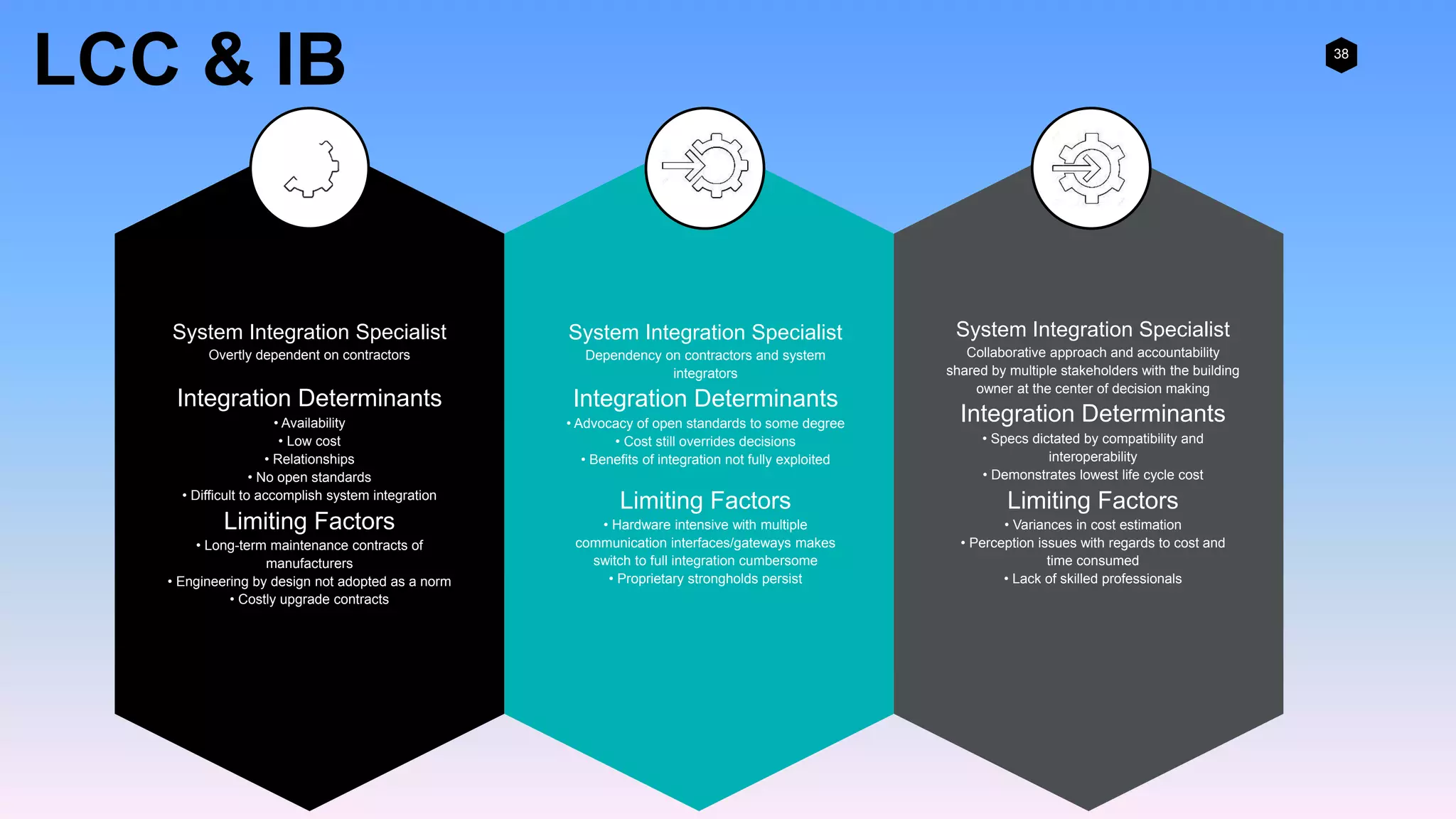
LCC & IB
System Integration Specialist
Overtly dependent on contractors
Integration Determinants
• Availability
• Low cost
• Relationships
• No open standards
• Difficult to accomplish system integration
Limiting Factors
• Long-term maintenance contracts of
manufacturers
• Engineering by design not adopted as a norm
• Costly upgrade contracts
System Integration Specialist
Dependency on contractors and system
integrators
Integration Determinants
• Advocacy of open standards to some degree
• Cost still overrides decisions
• Benefits of integration not fully exploited
Limiting Factors
• Hardware intensive with multiple
communication interfaces/gateways makes
switch to full integration cumbersome
• Proprietary strongholds persist
System Integration Specialist
Collaborative approach and accountability
shared by multiple stakeholders with the building
owner at the center of decision making
Integration Determinants
• Specs dictated by compatibility and
interoperability
• Demonstrates lowest life cycle cost
Limiting Factors
• Variances in cost estimation
• Perception issues with regards to cost and
time consumed
• Lack of skilled professionals
39
Pros and Cons
PROS:
• Adding Convenience to
your Daily Life
• Customization
• Security
• Ease of Use
• Save Money and the
Environment
CONS:
•Initial Cost
•Slight Learning Curve
•Reliability
•Communication security
40
Smart Grid
http://solutions.3m.com/wps/portal/3M/en_EU/SmartGrid/EU-Smart-Grid/
41
Case study
Smart Building Center in Jasin
42
43
Literature

Intelligent Buildings standards

  • 1.
    1 SMART BUILDINGS I NT E L L E G E N T B U I L D I N G S T A N D A R D S JAKUB MATYJA MAHMOUD KARAZ
  • 2.
    2 AGENDA • Brief historyand IB definitions • IB Market • IB architecture • BMS’s • LCC & IB • Pros & Cons • IB Future • Case study
  • 3.
  • 4.
    4 HUMAN INTELLIGECE & BUILDINGINTELLIGECE Interpersonal Bodily- Kinaesthetic Visual Spatial Musical Social User Interface Acoustic Background music Beauty Measure for Spatial instinct Sensoring Ergonomics Empty Space Interior Design Human Intelligence Linguistic Signs Speech recognition Logical Mathematical Integrated Control Building Automation Communication Technology Cabling Interpersonal Own space Concentration in peace Rest Areas Relaxation Automated building control Intuitive Silence
  • 5.
    5 A building andits infrastructure providing the owner, operator and occupant with an environment that is flexible, effective, comfortable and secure through the use of integrated technological building systems, communications and controls ‘‘ ’’ Is on which provides a productive and cost-effective environment through optimization of its four basic elements i.e. . structure, systems, services and management and the interrelationships between them ‘‘ ’’ WHAT IS IB? . Intelligent Building Institute
  • 6.
    6 European Standard PN-EN15232:2012 (2010) “Energy perfomance of buildings impact of building automation, control and buiilding managment’’ ...describes impact of BAS and BMS class on energy use in buildings and contains recommendation as to the use of these systems, The Standard includes two systems BACS (Building Automation and Control System ) TBM ( Technical Building Management System) Detailed description of fucntions, which have to be included for the building to be classified in particular class is provided. *This slide is adapted from dr hab. inż. arch. Zbigniew Bromberek lecture
  • 7.
    7 European Standard PN-EN15232:2012 (2010) The following diagram shows the differences in energy consumption for three building types in the energy efficiency classes A, B and D relative to the basis values in rating C. For example, by using class A, 30 % of the thermal energy can be saved in offices.
  • 8.
    8 After 2002Enterprise NetworkIntegrated System ENIS Enterprise Network Integrated Systems 1995-2002Computer Integrating Building CIB (Computer Integrated Buildings) 1990-1995 Building Level Integrating systems 1985-1990 Integrated Multifunction Systems 1980-1985 Single Function Dedicated systems Security Control Voice communi cation Telefax & Text Communicat ion EDP & Data Communi cation Electrical Lighting , Lifts, etc. control Access Control HVAC Control ImageVoice Texts & Data HVAC & other Plant Control Security & Acces s Contro l Integration Building Automation systems Integrated Communication Systems Cellular Communication (Image) Cellular Communication (Voice&Data) Single Apparatus IB HISTORY Extracted from Shengwie Wang P22
  • 9.
  • 10.
    10 • Access System •Fire/Alarm System • HVAC System • Audio/video System • Light System • Infrastructure management • Parking management system • Smart water management • Elevators and escalators management system IB SYSTEMS
  • 11.
    11 The basic componentsof an access control system are: • A central host computer or server. • Control panels or system controllers connected to the host computer. • Peripheral devices such as card readers, door contacts, sirens, and sensors connected to the control panels Access System Adapted from James Sinopoli 2009
  • 12.
    12 Access System Adapted fromJames Sinopoli 2009
  • 13.
    13 The system componentsthat detect the fire and initiate an alarm monitor one or more of the fire’s characteristics. The detection components of a fire alarm system are typically located in ceilings, HVAC ducts, mechanical and electrical areas and equipment rooms. They include: • Pull stations, in which a person sees a fire and pulls the fire alarm • Thermal detectors, which sense a rise in temperature or the high temperature of a fire. • Smoke detectors, which sense vapors of small particles of carbon matter generated by burning, including in-duct smoke detectors • Flame detectors, which sense radiation and visible light from a fire • Sprinkler water–flow sensors • Fire-gas detectors, which sense gases such as carbon dioxide and carbon monoxide •Air-sampling fire detectors Fire Alarm System
  • 14.
    14 Fire Alarm System Firealarm notification devices include: • Bells • Chimes • Horns • Speakers • Strobes Adapted from James Sinopoli 2009
  • 15.
    15 HVAC System HVAC systemscontrol : • Temperature • Humidity • Air flow • The overall air quality HVAC systems can be very complex, consisting of many components. The major components include: • boilers • chillers • Air-handling units (AHUs) • Air-terminal units (ATUs) • Variable air volume equipment (VAV).
  • 16.
    16 HVAC System The toplevel of an HVAC control system is the management level consisting of personal computers or multiple PCs connected via an Ethernet network or wireless network . The management level provides many functions: • Administration and control of the HVAC system • Programming for the system and other controllers • Display of system information • System reports • System scheduling • Archive and analysis of historical data • Backup of controller databases • Alarm reporting and analysis • Trend analysis
  • 17.
    17 Audio visual systems EthernetNetwork Control Interface Device Windows Blinds Motorized Projector Screen Lighting System Document Camera Remote Network Via LAN WAN Or internet Audio Visual system with Ethernet interface Projector DVD Player Audio visual systems are a complex topic as they encompass scores of different types of equipment and material, multiple technical standards, and rapidly changing technologies. The components of audio visual systems: • audio and visual sources • microphones, • electronic instruments • speakers • displays
  • 18.
    18 Light System Facility lightingis needed to provide visibility for building occupants, aesthetic atmosphere for spaces or rooms and for life safety. It is estimated that lighting accounts for 30 to 40% of electricity usage and costs in a typical building. Therefore, unneeded and uncontrolled lighting in a building not only wastes energy but also increases facility operational costs. The heart of the lighting control center is typically a server that is web-enabled and interconnected to other facility technology systems, a workstation with a GUI interface and client software for system administration. The networked system allows any authorized individual, including tenants or other occupants, to adjust their lighting through the network or a web browser.
  • 19.
    19 Light System The needfor lighting in a building varies by the type of building, spaces within the building, time of day, and occupancy of the building. Consequently, the control strategies and functions of a lighting control system reflect these variables and primarily involve the following: • Scheduling • Occupancy sensors • Daylight • Window coatings
  • 20.
    20 Parking Management System SmartVALETTM isan automated, efficient, scalable and reliable Valet Parking System with the ability to seamlessly integrate with Security and Parking systems components and devices such as • Access Control. • RFID Readers. • ANPR (Automatic Number Plate Recognition). • Variable Message Signs. • Barriers and Road blockers.
  • 21.
    21 Smart water management Appliesmonitoring and help • Optimize the availability delivery • The quality of water • Waste • Chemical treatment
  • 22.
    22 Elevatorsand EscalatorsManagement System Analyzeand perform the elevators traffic , ensure passengers safety and report failures of escalators in building system.
  • 23.
    23 The Foundations ofa Smart Building Smart buildings are built on open and standard communications networks which make the following characteristics possible:
  • 24.
    24 BAS based onopen communication protocols KNX/EIB, BACnet, LonWorks, ModBus System Quality and devlopment – open protocols result from many years of continious work, maintained and further developed in response to arising needs and opportunities. Flexibility of choice – standards are supported by all major players; the system can be configured according to one’s needs, without long term commitments. Flexibilty of expansion- additions and reconfigurations, replacements and updating are relatively cheap and easy Lower servicing costs – many service suppliers independent of a single manufacturer.
  • 25.
    25 ZigBee • High levelcommunication protocol • Using small, low-power digital radios • Less expensive even than Bluetooth ZigBee components • ZigBee coordinator • ZigBee router • ZigBee End Device • 10-75m range, 1mW radio • Device discovery supported • 128 bit keys for encryption • ZWAVE- another low power wireless protocol for remote control Wireless protocols https://www.ecnmag.com/article/2015/01/home-future Coordinator Router End Device ZigBee Coordinator ZigBee Router ZigBee End Device Computer
  • 26.
    26 SMART CLOUDS Adapted fromBachlor thesis in Software and Information Engineering for Clemens Pühringer
  • 27.
    27 Source : LivingWith Smart Machines By Tom Vander Ark
  • 28.
  • 29.
    29Facility Management SoftwareModules Facility managmaent software Assest managment Manages all necessary equipment data such as names , models , serials and locations ERP ( Enterprise planning software) Material and equipment parts management Is integrated with the work order system and purchasing system Procurement Management Automates and streamlines the procurement process for vendpr services and equipment. Contractors are preapproved for specifc types of services and equipment WorkOrder Management Tracks and monitors all service requests Tracks People assigned to specific actions Keeps records of action updates Tracks when actions are completed Archives work for future reference
  • 30.
    30 It is awide range of computerized building control systems, from special- purpose controllers, to standalone remote stations, to larger systems including central computer stations and printers. As discussed earlier, BAS is one of the major intelligent building systems. Building Automation / Management Systems Increased reliability of plant and services Reduced operating costs Enhancing staff productivity BAS & BMS Protection of people and equipment
  • 31.
    31 Building Management A BMSmonitors, supervises, controls and reports on smart building technology systems. These systems may include access control, video surveillance, fire alarms, HVAC control, programmable lighting and electric power management. Its basic functions include: Providing information on supervised building functions including. • Detecting, annunciating, and managing alarm and other conditions • Diagnostic monitoring and reporting of system functions, nodes, devices, and communication networks • Interfacing between individual smart building applications.
  • 32.
    32 These systems typicallydisplay the following responses on an operator’s workstation: • Alarm summary • Event summary • Trend set displays • Group control and group trend displays • Communications status • System status • Configuration displays • Communication links status • System parameters configuration Building Management • Time schedule assignment • Holiday assignment • History assignment • Events archive and retrieval • Time period summary and configuration • Point details for every configured point
  • 33.
    33 EMS Energy ManagementSystem DGLogik DGLux What’s EMS do? • Generates an info for energy usage • Give a detailed report for costs in order to reduce costs . • Maintaining a comfortable and safe environment for building occupants. • Addresses the main electric and energy systems, namely HVAC, lighting control and power management. EMS Platforms
  • 34.
    34 EMS Energy ManagementSystem to optimize energy consumption and costs EMS may include the following programs : • Tracking of utility bills to monitor usage and costs as well as comparing projected, budgeted and actual usage and costs. • Comparing the energy usage to other similar buildings, an exercise known as “benchmarking” • Calculating the effect of thermal comfort or lighting alternatives. That is, the cost for different lighting control strategies, proper ventilation rates, and related elements. • Equipment indicators that may signal possible malfunctions include the following: CO2 , Energy consumption, Temperature , Humidity , Vibration, etc.
  • 35.
    35 IEMS , BEMS& HEMS U.S. energy management systems (EMS) market revenue by product, 2014 - 2024 (USD Million) http://www.grandviewresearch.com/industry-analysis/energy-management-systems-market
  • 36.
    36 GreenBuildings SmartBuildings Extracted from JamesSinopoli, Smart Building Systems for Architects, Owners, and Builders P190 Commonality of Green & Smart buildings
  • 37.
    37 LCC & IB •Some bussinessmen are careful with IB, they think only about the bottom line • But with LCC it covers costs, and prevent loses • Life Cycle Costing (LCC) is a science-based measurement of a project’s impact throughout its life. • LCC calculator for intellegent building http://measuresthatmatter.com/caba/
  • 38.
    38 LCC & IB SystemIntegration Specialist Overtly dependent on contractors Integration Determinants • Availability • Low cost • Relationships • No open standards • Difficult to accomplish system integration Limiting Factors • Long-term maintenance contracts of manufacturers • Engineering by design not adopted as a norm • Costly upgrade contracts System Integration Specialist Dependency on contractors and system integrators Integration Determinants • Advocacy of open standards to some degree • Cost still overrides decisions • Benefits of integration not fully exploited Limiting Factors • Hardware intensive with multiple communication interfaces/gateways makes switch to full integration cumbersome • Proprietary strongholds persist System Integration Specialist Collaborative approach and accountability shared by multiple stakeholders with the building owner at the center of decision making Integration Determinants • Specs dictated by compatibility and interoperability • Demonstrates lowest life cycle cost Limiting Factors • Variances in cost estimation • Perception issues with regards to cost and time consumed • Lack of skilled professionals
  • 39.
    39 Pros and Cons PROS: •Adding Convenience to your Daily Life • Customization • Security • Ease of Use • Save Money and the Environment CONS: •Initial Cost •Slight Learning Curve •Reliability •Communication security
  • 40.
  • 41.
  • 42.
  • 43.

Editor's Notes

  • #6 CABA
  • #9 1-integrated at the level of a single or individual function subsystem. Integration and communication between the automation systems of different subsystems was impossible. 2-similar nature functions were integrated 3- IB , ICS 4-Ip Adress and Internet 5-Web Services, XML, remote portfolio management and helpdesk management,
  • #14 Fire consists of smoke, heat, and light.
  • #15 Fire consists of smoke, heat, and light.
  • #16 Fire consists of smoke, heat, and light.
  • #30 software modules that allow an owner or facility manager to select modules based on operational and facility management needs. Modules that may be included are described in following sections