ENERGY EFFICIENT CONCEPTS FOR SMART
CITIES
Usha Batra,
Chief Architect, CPWD, Mumbai
ENERGY SCENARIO IN INDIA
• India is projected to be the world’s most
populous country by 2025. and is the fourth
largest consumer of energy.
• Energy requirements due to urbanization and
population growth will increase manifolds.
• Twelfth Plan document of the Planning
Commission indicates that total domestic
energy production of 669.6 million tons of oil
equivalent (MTOE) will be reached by 2016-17
and 844 MTOE by 2021-22. This will meet
around 71 per cent and 69 per cent of
expected energy consumption, with the
balance to be met from imports, projected to
be about 267.8 MTOE by 2016-17 and 375.6
MTOE by 2021-22
BRIDGING GAP BETWEEN DEMAND AND SUPPLY
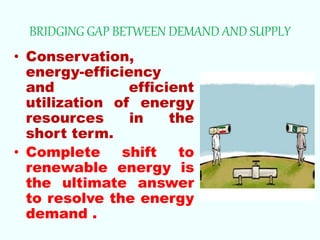
• Conservation,
energy-efficiency
and efficient
utilization of energy
resources in the
short term.
• Complete shift to
renewable energy is
the ultimate answer
to resolve the energy
demand .
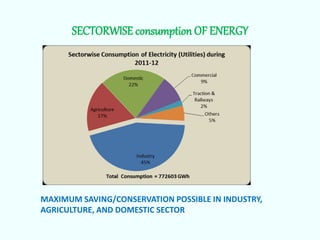
SECTORWISE consumption OF ENERGY
MAXIMUM SAVING/CONSERVATION POSSIBLE IN INDUSTRY,
AGRICULTURE, AND DOMESTIC SECTOR
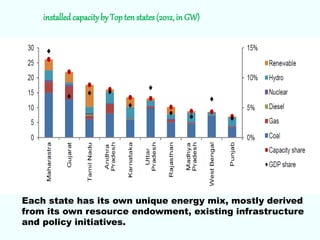
installed capacityby Topten states (2012, in GW)
Each state has its own unique energy mix, mostly derived
from its own resource endowment, existing infrastructure
and policy initiatives.
MAIN BENEFITS OF RENEWABLE ENERGY
• Strengthens climate change mitigation .
But …. Research on use of heat emitted by air -
conditioners and reflected back by high
performance glass is required for further
mitigation of climate change.
• Increases your independence.
• Provides bright economic and environmental
future.
• Reduces the trade deficit and propel India
forward as a “Green Nation.”
• Brings sustainability and energy security .
• Reduces Electricity bill.
• Minimises future utility rate increases.
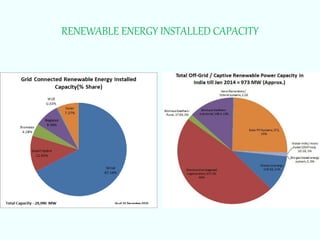
RENEWABLE ENERGY INSTALLED CAPACITY
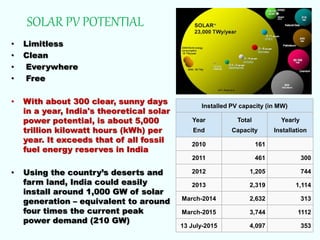
SOLAR PV POTENTIAL
• Limitless
• Clean
• Everywhere
• Free
• With about 300 clear, sunny days
in a year, India's theoretical solar
power potential, is about 5,000
trillion kilowatt hours (kWh) per
year. It exceeds that of all fossil
fuel energy reserves in India
• Using the country’s deserts and
farm land, India could easily
install around 1,000 GW of solar
generation – equivalent to around
four times the current peak
power demand (210 GW)
Installed PV capacity (in MW)
Year
End
Total
Capacity
Yearly
Installation
2010 161
2011 461 300
2012 1,205 744
2013 2,319 1,114
March-2014 2,632 313
March-2015 3,744 1112
13 July-2015 4,097 353
POTENTIAL OF OTHER RENEWABLES
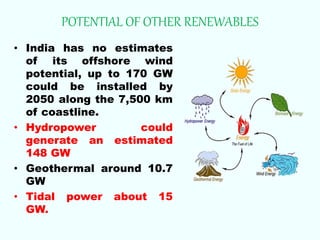
• India has no estimates
of its offshore wind
potential, up to 170 GW
could be installed by
2050 along the 7,500 km
of coastline.
• Hydropower could
generate an estimated
148 GW
• Geothermal around 10.7
GW
• Tidal power about 15
GW.
POTENTIAL OF OTHER RENEWABLES
• If these are properly developed and utilized, all of
India’s new energy production could be derived
from renewable energy sources by 2030.
• Also, all existing generation could be converted to
renewable energy by 2050 while maintaining a
reliable power supply in the interim. Barriers to
implementing are primarily social and political, not
technological or economic.
• Excess energy generated from renewable could be
stored in various forms .
ENERGY EFFICIENCY & SUSTAINABLE DEVELOPMENT
• 40% of the world’s energy is consumed in the
built environment and 40% of its materials
are also used in the built environment. As a
consequence, smart cities and energy
efficient cities are key to sustainable
development.
• As per Ministry of New and Renewable
Energy guidelines all power producers in
private and public sector will have to
generate 10 per cent of solar power of their
total installed capacities to lighten the smart
cities.
• Sustainability in buildings can be achieved by
All New buildings with net zero energy
requirements & Refurbishing of the existing
buildings to bring them to the lowest possible
energy consumption levels
MAINFEATURESOF ENERGY
EFFICIENTSMART CITY
• Uninterrupted and highly reliable
24x7 power supply .
• Maximisation of Renewable
energy sources.
• Each smart city to have it’s own
renewable energy smart grid
which can be linked to the
national grid .
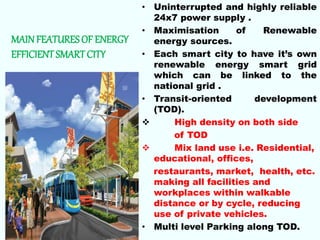
• Transit-oriented development
(TOD).
 High density on both side
of TOD
 Mix land use i.e. Residential,
educational, offices,
restaurants, market, health, etc.
making all facilities and
workplaces within walkable
distance or by cycle, reducing
use of private vehicles.
• Multi level Parking along TOD.
MAIN FEATURES OF ENERGY EFFICIENT , SMART CITY contd...
ORIGINAL COST ADDITIONAL COST TOTAL COST % INCREASE
5.84 CR 0.72 CR 6.56 CR 12.3 %
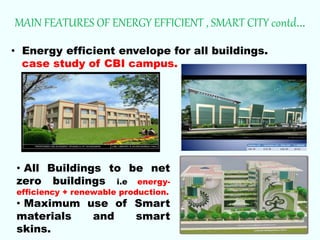
• Energy efficient envelope for all buildings.
case study of CBI campus.
• All Buildings to be net
zero buildings i.e energy-
efficiency + renewable production.
• Maximum use of Smart
materials and smart
skins.
MAIN FEATURES OF ENERGY EFFICIENT SMART CITY contd...
Once the envelop is energy-efficient, it
automatically reduces the need of
lighting and HVAC, bringing further
savings.
which can be achieved by ;
• Use of energy-efficient lighting,
appliances & equipment.
• Use of Energy efficient public and
individual transport system.
• Multiple use of daytime use buildings to
save on number of buildings thereby
saving on land , capital cost as well as
energy.
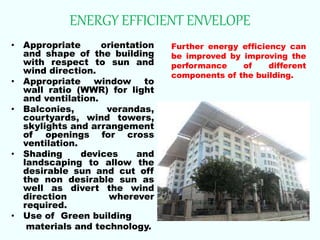
ENERGY EFFICIENT ENVELOPE
• Appropriate orientation
and shape of the building
with respect to sun and
wind direction.
• Appropriate window to
wall ratio (WWR) for light
and ventilation.
• Balconies, verandas,
courtyards, wind towers,
skylights and arrangement
of openings for cross
ventilation.
• Shading devices and
landscaping to allow the
desirable sun and cut off
the non desirable sun as
well as divert the wind
direction wherever
required.
• Use of Green building
materials and technology.
Further energy efficiency can
be improved by improving the
performance of different
components of the building.
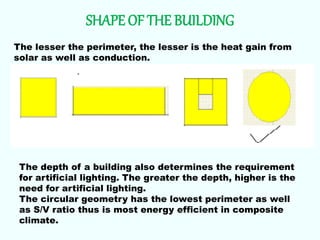
SHAPE OF THE BUILDING
The lesser the perimeter, the lesser is the heat gain from
solar as well as conduction.
The depth of a building also determines the requirement
for artificial lighting. The greater the depth, higher is the
need for artificial lighting.
The circular geometry has the lowest perimeter as well
as S/V ratio thus is most energy efficient in composite
climate.
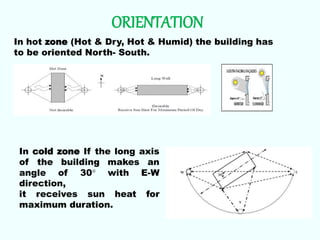
ORIENTATION
In hot zone (Hot & Dry, Hot & Humid) the building has
to be oriented North- South.
In cold zone If the long axis
of the building makes an
angle of 30 with E-W
direction,
it receives sun heat for
maximum duration.
APPROPRIATE WWR FOR LIGHT& MINIMISING HEAT
INGRESS
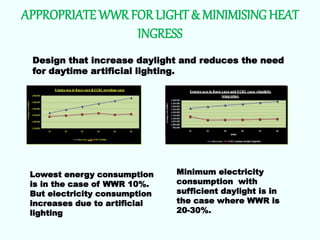
Design that increase daylight and reduces the need
for daytime artificial lighting.
Lowest energy consumption
is in the case of WWR 10%.
But electricity consumption
increases due to artificial
lighting
Minimum electricity
consumption with
sufficient daylight is in
the case where WWR is
20-30%.
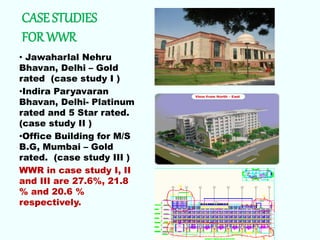
CASE STUDIES
FOR WWR
• Jawaharlal Nehru
Bhavan, Delhi – Gold
rated (case study I )
•Indira Paryavaran
Bhavan, Delhi- Platinum
rated and 5 Star rated.
(case study II )
•Office Building for M/S
B.G, Mumbai – Gold
rated. (case study III )
WWR in case study I, II
and III are 27.6%, 21.8
% and 20.6 %
respectively.
SHADING DEVICES
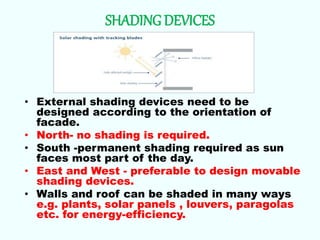
• External shading devices need to be
designed according to the orientation of
facade.
• North- no shading is required.
• South -permanent shading required as sun
faces most part of the day.
• East and West - preferable to design movable
shading devices.
• Walls and roof can be shaded in many ways
e.g. plants, solar panels , louvers, paragolas
etc. for energy-efficiency.
SMART MATERIALS
• Smart materials are specially designed
materials that have one or more properties that
can be significantly changed in a controlled
fashion by external stimuli such as stress,
temperature, moisture, electric or magnetic
fields.
• They save on cost & increase the life of
structure
 Smart concrete that will heal its own cracks.
 Shapeshifting Metal
 Self healing coatings
 Green materials
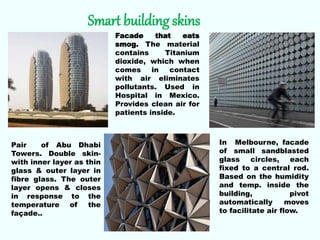
Smart building skins
Pair of Abu Dhabi
Towers. Double skin-
with inner layer as thin
glass & outer layer in
fibre glass. The outer
layer opens & closes
in response to the
temperature of the
façade..
Facade that eats
smog. The material
contains Titanium
dioxide, which when
comes in contact
with air eliminates
pollutants. Used in
Hospital in Mexico.
Provides clean air for
patients inside.
In Melbourne, facade
of small sandblasted
glass circles, each
fixed to a central rod.
Based on the humidity
and temp. inside the
building, pivot
automatically moves
to facilitate air flow.
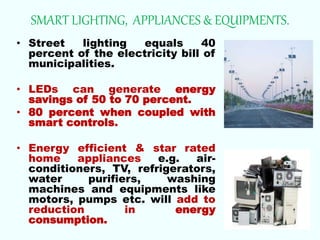
SMART LIGHTING, APPLIANCES & EQUIPMENTS.
• Street lighting equals 40
percent of the electricity bill of
municipalities.
• LEDs can generate energy
savings of 50 to 70 percent.
• 80 percent when coupled with
smart controls.
• Energy efficient & star rated
home appliances e.g. air-
conditioners, TV, refrigerators,
water purifiers, washing
machines and equipments like
motors, pumps etc. will add to
reduction in energy
consumption.
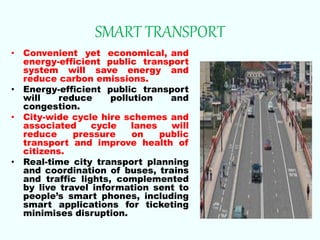
SMART TRANSPORT
• Convenient yet economical, and
energy-efficient public transport
system will save energy and
reduce carbon emissions.
• Energy-efficient public transport
will reduce pollution and
congestion.
• City-wide cycle hire schemes and
associated cycle lanes will
reduce pressure on public
transport and improve health of
citizens.
• Real-time city transport planning
and coordination of buses, trains
and traffic lights, complemented
by live travel information sent to
people’s smart phones, including
smart applications for ticketing
minimises disruption.
PROPOSED SMART
CITY AT
KARKARDOOMA
DELHI
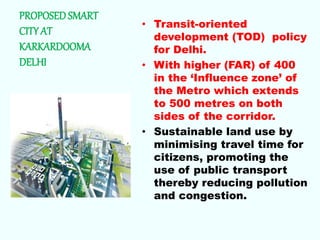
• Transit-oriented
development (TOD) policy
for Delhi.
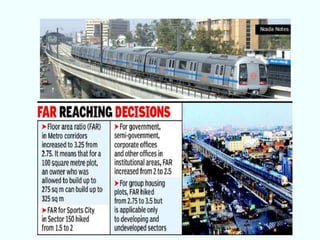
• With higher (FAR) of 400
in the ‘Influence zone’ of
the Metro which extends
to 500 metres on both
sides of the corridor.
• Sustainable land use by
minimising travel time for
citizens, promoting the
use of public transport
thereby reducing pollution
and congestion.
CONCLUSIONS
• Shift from western culture to design of
buildings & infrastructures of smart cities as
per climate of India to be emphasised .
• All Buildings to be net zero buildings .
• Each smart city to have it’s own renewable
energy smart grid which is linked to the
national grid .
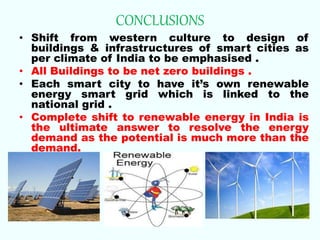
• Complete shift to renewable energy in India is
the ultimate answer to resolve the energy
demand as the potential is much more than the
demand.
THANK YOU

Ub energy efficient concepts for smart city ibc

  • 1.
    ENERGY EFFICIENT CONCEPTSFOR SMART CITIES Usha Batra, Chief Architect, CPWD, Mumbai
  • 2.
    ENERGY SCENARIO ININDIA • India is projected to be the world’s most populous country by 2025. and is the fourth largest consumer of energy. • Energy requirements due to urbanization and population growth will increase manifolds. • Twelfth Plan document of the Planning Commission indicates that total domestic energy production of 669.6 million tons of oil equivalent (MTOE) will be reached by 2016-17 and 844 MTOE by 2021-22. This will meet around 71 per cent and 69 per cent of expected energy consumption, with the balance to be met from imports, projected to be about 267.8 MTOE by 2016-17 and 375.6 MTOE by 2021-22
  • 3.
    BRIDGING GAP BETWEENDEMAND AND SUPPLY • Conservation, energy-efficiency and efficient utilization of energy resources in the short term. • Complete shift to renewable energy is the ultimate answer to resolve the energy demand .
  • 4.
    SECTORWISE consumption OFENERGY MAXIMUM SAVING/CONSERVATION POSSIBLE IN INDUSTRY, AGRICULTURE, AND DOMESTIC SECTOR
  • 5.
    installed capacityby Toptenstates (2012, in GW) Each state has its own unique energy mix, mostly derived from its own resource endowment, existing infrastructure and policy initiatives.
  • 6.
    MAIN BENEFITS OFRENEWABLE ENERGY • Strengthens climate change mitigation . But …. Research on use of heat emitted by air - conditioners and reflected back by high performance glass is required for further mitigation of climate change. • Increases your independence. • Provides bright economic and environmental future. • Reduces the trade deficit and propel India forward as a “Green Nation.” • Brings sustainability and energy security . • Reduces Electricity bill. • Minimises future utility rate increases.
  • 7.
  • 8.
    SOLAR PV POTENTIAL •Limitless • Clean • Everywhere • Free • With about 300 clear, sunny days in a year, India's theoretical solar power potential, is about 5,000 trillion kilowatt hours (kWh) per year. It exceeds that of all fossil fuel energy reserves in India • Using the country’s deserts and farm land, India could easily install around 1,000 GW of solar generation – equivalent to around four times the current peak power demand (210 GW) Installed PV capacity (in MW) Year End Total Capacity Yearly Installation 2010 161 2011 461 300 2012 1,205 744 2013 2,319 1,114 March-2014 2,632 313 March-2015 3,744 1112 13 July-2015 4,097 353
  • 9.
    POTENTIAL OF OTHERRENEWABLES • India has no estimates of its offshore wind potential, up to 170 GW could be installed by 2050 along the 7,500 km of coastline. • Hydropower could generate an estimated 148 GW • Geothermal around 10.7 GW • Tidal power about 15 GW.
  • 10.
    POTENTIAL OF OTHERRENEWABLES • If these are properly developed and utilized, all of India’s new energy production could be derived from renewable energy sources by 2030. • Also, all existing generation could be converted to renewable energy by 2050 while maintaining a reliable power supply in the interim. Barriers to implementing are primarily social and political, not technological or economic. • Excess energy generated from renewable could be stored in various forms .
  • 11.
    ENERGY EFFICIENCY &SUSTAINABLE DEVELOPMENT • 40% of the world’s energy is consumed in the built environment and 40% of its materials are also used in the built environment. As a consequence, smart cities and energy efficient cities are key to sustainable development. • As per Ministry of New and Renewable Energy guidelines all power producers in private and public sector will have to generate 10 per cent of solar power of their total installed capacities to lighten the smart cities. • Sustainability in buildings can be achieved by All New buildings with net zero energy requirements & Refurbishing of the existing buildings to bring them to the lowest possible energy consumption levels
  • 12.
    MAINFEATURESOF ENERGY EFFICIENTSMART CITY •Uninterrupted and highly reliable 24x7 power supply . • Maximisation of Renewable energy sources. • Each smart city to have it’s own renewable energy smart grid which can be linked to the national grid . • Transit-oriented development (TOD).  High density on both side of TOD  Mix land use i.e. Residential, educational, offices, restaurants, market, health, etc. making all facilities and workplaces within walkable distance or by cycle, reducing use of private vehicles. • Multi level Parking along TOD.
  • 13.
    MAIN FEATURES OFENERGY EFFICIENT , SMART CITY contd... ORIGINAL COST ADDITIONAL COST TOTAL COST % INCREASE 5.84 CR 0.72 CR 6.56 CR 12.3 % • Energy efficient envelope for all buildings. case study of CBI campus. • All Buildings to be net zero buildings i.e energy- efficiency + renewable production. • Maximum use of Smart materials and smart skins.
  • 14.
    MAIN FEATURES OFENERGY EFFICIENT SMART CITY contd... Once the envelop is energy-efficient, it automatically reduces the need of lighting and HVAC, bringing further savings. which can be achieved by ; • Use of energy-efficient lighting, appliances & equipment. • Use of Energy efficient public and individual transport system. • Multiple use of daytime use buildings to save on number of buildings thereby saving on land , capital cost as well as energy.
  • 15.
    ENERGY EFFICIENT ENVELOPE •Appropriate orientation and shape of the building with respect to sun and wind direction. • Appropriate window to wall ratio (WWR) for light and ventilation. • Balconies, verandas, courtyards, wind towers, skylights and arrangement of openings for cross ventilation. • Shading devices and landscaping to allow the desirable sun and cut off the non desirable sun as well as divert the wind direction wherever required. • Use of Green building materials and technology. Further energy efficiency can be improved by improving the performance of different components of the building.
  • 16.
    SHAPE OF THEBUILDING The lesser the perimeter, the lesser is the heat gain from solar as well as conduction. The depth of a building also determines the requirement for artificial lighting. The greater the depth, higher is the need for artificial lighting. The circular geometry has the lowest perimeter as well as S/V ratio thus is most energy efficient in composite climate.
  • 17.
    ORIENTATION In hot zone(Hot & Dry, Hot & Humid) the building has to be oriented North- South. In cold zone If the long axis of the building makes an angle of 30 with E-W direction, it receives sun heat for maximum duration.
  • 18.
    APPROPRIATE WWR FORLIGHT& MINIMISING HEAT INGRESS Design that increase daylight and reduces the need for daytime artificial lighting. Lowest energy consumption is in the case of WWR 10%. But electricity consumption increases due to artificial lighting Minimum electricity consumption with sufficient daylight is in the case where WWR is 20-30%.
  • 19.
    CASE STUDIES FOR WWR •Jawaharlal Nehru Bhavan, Delhi – Gold rated (case study I ) •Indira Paryavaran Bhavan, Delhi- Platinum rated and 5 Star rated. (case study II ) •Office Building for M/S B.G, Mumbai – Gold rated. (case study III ) WWR in case study I, II and III are 27.6%, 21.8 % and 20.6 % respectively.
  • 20.
    SHADING DEVICES • Externalshading devices need to be designed according to the orientation of facade. • North- no shading is required. • South -permanent shading required as sun faces most part of the day. • East and West - preferable to design movable shading devices. • Walls and roof can be shaded in many ways e.g. plants, solar panels , louvers, paragolas etc. for energy-efficiency.
  • 21.
    SMART MATERIALS • Smartmaterials are specially designed materials that have one or more properties that can be significantly changed in a controlled fashion by external stimuli such as stress, temperature, moisture, electric or magnetic fields. • They save on cost & increase the life of structure  Smart concrete that will heal its own cracks.  Shapeshifting Metal  Self healing coatings  Green materials
  • 23.
    Smart building skins Pairof Abu Dhabi Towers. Double skin- with inner layer as thin glass & outer layer in fibre glass. The outer layer opens & closes in response to the temperature of the façade.. Facade that eats smog. The material contains Titanium dioxide, which when comes in contact with air eliminates pollutants. Used in Hospital in Mexico. Provides clean air for patients inside. In Melbourne, facade of small sandblasted glass circles, each fixed to a central rod. Based on the humidity and temp. inside the building, pivot automatically moves to facilitate air flow.
  • 24.
    SMART LIGHTING, APPLIANCES& EQUIPMENTS. • Street lighting equals 40 percent of the electricity bill of municipalities. • LEDs can generate energy savings of 50 to 70 percent. • 80 percent when coupled with smart controls. • Energy efficient & star rated home appliances e.g. air- conditioners, TV, refrigerators, water purifiers, washing machines and equipments like motors, pumps etc. will add to reduction in energy consumption.
  • 25.
    SMART TRANSPORT • Convenientyet economical, and energy-efficient public transport system will save energy and reduce carbon emissions. • Energy-efficient public transport will reduce pollution and congestion. • City-wide cycle hire schemes and associated cycle lanes will reduce pressure on public transport and improve health of citizens. • Real-time city transport planning and coordination of buses, trains and traffic lights, complemented by live travel information sent to people’s smart phones, including smart applications for ticketing minimises disruption.
  • 26.
    PROPOSED SMART CITY AT KARKARDOOMA DELHI •Transit-oriented development (TOD) policy for Delhi. • With higher (FAR) of 400 in the ‘Influence zone’ of the Metro which extends to 500 metres on both sides of the corridor. • Sustainable land use by minimising travel time for citizens, promoting the use of public transport thereby reducing pollution and congestion.
  • 28.
    CONCLUSIONS • Shift fromwestern culture to design of buildings & infrastructures of smart cities as per climate of India to be emphasised . • All Buildings to be net zero buildings . • Each smart city to have it’s own renewable energy smart grid which is linked to the national grid . • Complete shift to renewable energy in India is the ultimate answer to resolve the energy demand as the potential is much more than the demand.
  • 29.