SUBMITTED TO :-
AR. GAURAV MATHUR
AR. SHRISHTI SHARMA
SUBMITTED BY :-
RISHABH MISHRA
VII SEM IV YEAR
BUILDING
CONSTRUCTION
SESSION : 2016 - 2017
Geodesic Domes
GEODESIC
DOMES
What are domes ?
 A dome is typically an element of architecture
that resembles the upper half of a sphere.
Domes are curved structures -- they have no
angles and no corners -- and they enclose an
enormous amount of space with the minimum of
materials as they don’t require interior supports.
Despite their thinness, domes are some of the
strongest and stiffest structures in existence
today.
Types of Domes
There are various kind of Domes but I am
focusing only on
Geodesic Dome
 Other domes structure are:
 Corbel Dome Monolithic Dome
 Onion Dome
 Drum Dome
 Oval Dome
 Sail Dome
 Saucer Dome
 Scalloped Dome
What are geodesic domes ?
 The geodesic dome was invented in the 1950s
by American engineer and architect Buckminster
Fuller. A geodesic dome is a sphere-like
structure composed of a complex network of
triangles. The triangles create a self-bracing
framework that gives structural strength while
using a minimum of material. The term geodesic
is from Latin, meaning earth dividing.
 It being a collection of triangles which, by
staying in
state of tension, together forms in the space a
hypothetical sphere.
 The structure becomes more and more
sphere like as the number of the diverse sizes of the
struts increases
 One of the most fascinating facts in the geodesic
dome is that in the first look it seems that all the
triangles are equilateral and all the struts have the
identical length. Looking better, we notice that
actually the struts have lengths which are similar,
but not identical, and here begin all the magic
behind the complicity of realizing a geodesic dome.
What are geodesic domes ?
Advantages
 Sustainability: The life expectancy of the home.
 Energy Efficiency: Utilities; Convenience Vs.
Conservation.
 Eco-Friendly: Minimal carbon footprint.
 Stronger Structure: Integrity & Support are
synonymous.
 Cost Effective: More space and less surface
area equals
 Natural Structure Design: The Standard of the
Cosmos.
Advantages
 Weather Resistant: Aerodynamics reduce
destruction.
 Aesthetically Pleasing: Invariably the most
eye catching.
 Highly Acoustic: Sound flows naturally in a
sphere.
 Higher R-Value : Thermal Resistance is a
high gain.
Disadvantages
 Unusable Space
 Doors and Windows-either make or special
order has to be given
 Permits-Building the home may also be a
challenge as drainage and fire escapes that
meet code are made more difficult by the
design of the home.
 Financing and Resale
Use of geodesic dome ?
 Green Housess
 Residential Homes
 Warehouses
 Water Reservoirs
 Entertainment Spots
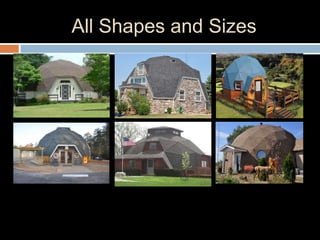
All Shapes and Sizes
Energy Efficiency
 Heat is both lost and absorbed through surfaces that
have direct contact with the outside. Being that
domes have the smallest surface area for a
given volume, this essentially provides better
insulation. Smaller surface area equals higher
R-value due to less surface area through which
thermal energy can be transferred.
 A dome home uses roughly 50% to 75% less
materials to construct than a normal home the
same volume – taking into account various
internal walls and such to adequately brace a
non-dome structure.
Energy Efficiency
 The primary factor affecting efficient use of
materials and energy in a structure is its shape.
A sphere represents the smallest amount of
material surface area needed to enclose a given
volume of space. A divided sphere becomes one
of the most efficient shapes known to enclose a
given floor area.
 Internally a dome has a much more open feeling
than a box shape building because of the lack of
corners, this also gives a dome better air
circulation.
Energy Efficiency
 A dome, having a smaller perimeter/square
footage ratio than a box-style home, will lose
less heat from the foundation.
 A dome has approximately one-third less
surface area to the outside than a box-style
structure. The amount surface area exposed
to the elements has a much greater impact
on energy efficiency than insulation values.
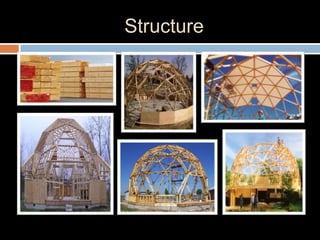
Structure
Structure
 Domes are the most efficient structures known
to man, they use less material, are lighter and
stronger than any other type of building bar
none.
 They are much stronger than any conventional
buildings.
 Domes can be built very quickly and
economically.
 The nature of the spherical design provides
strength because all the points of the
Structure
structure share the stress evenly as
opposed to the right angles of typical box
structures.
 Domes become super strong when they
are fixed to the ground by slab, crawl
space, or even full basement.
 Geodesic domes are the only man-made
structure that gets proportionally stronger
as it increases in size.
Eco-Friendly
 Extremely “Green” in terms of cost, building
materials, and future maintenance.
 The sphere has the greatest volume given a
certain surface area, it stands to reason that it
also is the most economic to construct in terms
of size and available budget.
 The environmental benefits of domes would also
play a part, as its proven to have a lesser
footprint and negative impact than that of a
rectangular home.
Eco-Friendly
 In addition, domes are easier to retrofit for
energy engineering such as: radiant heat,
solar energy, water collection systems,
compost toilets, and many other
alternative utilities.
Weather Resistant
 Domes are naturally hurricane resistant. Tract
style buildings generate huge amounts of
turbulence when high winds pass over them,
causing massive low-pressure which pulls the
roof off. High winds can pass smoothly over a
dome because it has no corners and flat
surfaces to cause turbulence high pressure air
presses the dome down towards the ground.
 Domes are aerodynamic, eliminate roof and
truss structures and are made of
Weather Resistant
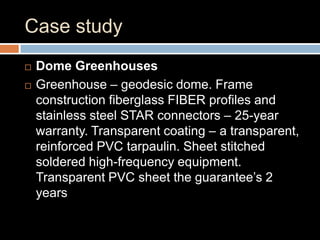
 high-performance green materials designed
to withstand considerable wind loads from
severe storms like tornados, hurricanes and
typhoons.
 Due to their high structural integrity, they
perform extremely well in such natural
disasters as earthquakes, floods and severe
wind storms.
 Ideal for disaster prone climates.
 Overall, an effective protection from the
environment
Case study
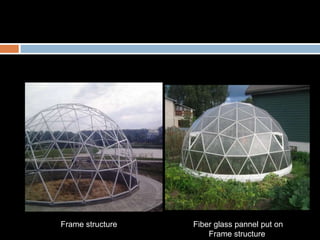
 Dome Greenhouses
 Greenhouse – geodesic dome. Frame
construction fiberglass FIBER profiles and
stainless steel STAR connectors – 25-year
warranty. Transparent coating – a transparent,
reinforced PVC tarpaulin. Sheet stitched
soldered high-frequency equipment.
Transparent PVC sheet the guarantee’s 2
years
Frame structure Fiber glass pannel put on
Frame structure
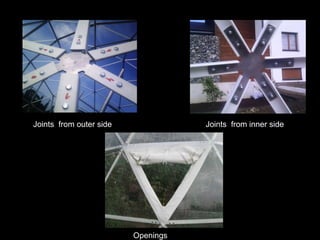
Joints from outer side Joints from inner side
Openings
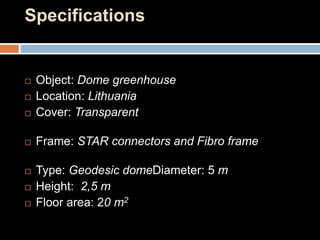
Specifications
 Object: Dome greenhouse
 Location: Lithuania
 Cover: Transparent
 Frame: STAR connectors and Fibro frame
 Type: Geodesic domeDiameter: 5 m
 Height: 2,5 m
 Floor area: 20 m2
References
 http://www.servicemagic.com/article.show.Geodesic-Domes-A-Better-
Structure.13679.html#ixzz1zTpGX3N3
 http://www.gardendome.com/dodeca_dome/dodeca_house.html
 http://www.domeofahome.com/dome_advantages.html
 http://www.dometimes.com/dometimes/Manufacturers.html
 http://www.leitgebindustries.com/Whyadome.html
 http://www.domehome.com/faqs.html#invent
 http://domevillage.tedhayes.us/
 http://www.domesintl.com/domebldgsconstruction3p/domebuildingsstructures2.htm
l
 http://www.naturalspacesdomes.com/#featured
 http://www.domehome.com/
 http://domesnorthwest.com/
 http://www.newagedomeconstruction.com/
 http://www.monolithic.com/topics/domes
Thank you

Geodesic dome{rishabh mishra}

  • 1.
    SUBMITTED TO :- AR.GAURAV MATHUR AR. SHRISHTI SHARMA SUBMITTED BY :- RISHABH MISHRA VII SEM IV YEAR BUILDING CONSTRUCTION SESSION : 2016 - 2017 Geodesic Domes
  • 2.
  • 3.
    What are domes?  A dome is typically an element of architecture that resembles the upper half of a sphere. Domes are curved structures -- they have no angles and no corners -- and they enclose an enormous amount of space with the minimum of materials as they don’t require interior supports. Despite their thinness, domes are some of the strongest and stiffest structures in existence today.
  • 4.
    Types of Domes Thereare various kind of Domes but I am focusing only on Geodesic Dome  Other domes structure are:  Corbel Dome Monolithic Dome  Onion Dome  Drum Dome  Oval Dome  Sail Dome  Saucer Dome  Scalloped Dome
  • 5.
    What are geodesicdomes ?  The geodesic dome was invented in the 1950s by American engineer and architect Buckminster Fuller. A geodesic dome is a sphere-like structure composed of a complex network of triangles. The triangles create a self-bracing framework that gives structural strength while using a minimum of material. The term geodesic is from Latin, meaning earth dividing.  It being a collection of triangles which, by staying in state of tension, together forms in the space a hypothetical sphere.
  • 6.
     The structurebecomes more and more sphere like as the number of the diverse sizes of the struts increases  One of the most fascinating facts in the geodesic dome is that in the first look it seems that all the triangles are equilateral and all the struts have the identical length. Looking better, we notice that actually the struts have lengths which are similar, but not identical, and here begin all the magic behind the complicity of realizing a geodesic dome. What are geodesic domes ?
  • 7.
    Advantages  Sustainability: Thelife expectancy of the home.  Energy Efficiency: Utilities; Convenience Vs. Conservation.  Eco-Friendly: Minimal carbon footprint.  Stronger Structure: Integrity & Support are synonymous.  Cost Effective: More space and less surface area equals  Natural Structure Design: The Standard of the Cosmos.
  • 8.
    Advantages  Weather Resistant:Aerodynamics reduce destruction.  Aesthetically Pleasing: Invariably the most eye catching.  Highly Acoustic: Sound flows naturally in a sphere.  Higher R-Value : Thermal Resistance is a high gain.
  • 9.
    Disadvantages  Unusable Space Doors and Windows-either make or special order has to be given  Permits-Building the home may also be a challenge as drainage and fire escapes that meet code are made more difficult by the design of the home.  Financing and Resale
  • 10.
    Use of geodesicdome ?  Green Housess  Residential Homes  Warehouses  Water Reservoirs  Entertainment Spots
  • 11.
  • 12.
    Energy Efficiency  Heatis both lost and absorbed through surfaces that have direct contact with the outside. Being that domes have the smallest surface area for a given volume, this essentially provides better insulation. Smaller surface area equals higher R-value due to less surface area through which thermal energy can be transferred.  A dome home uses roughly 50% to 75% less materials to construct than a normal home the same volume – taking into account various internal walls and such to adequately brace a non-dome structure.
  • 13.
    Energy Efficiency  Theprimary factor affecting efficient use of materials and energy in a structure is its shape. A sphere represents the smallest amount of material surface area needed to enclose a given volume of space. A divided sphere becomes one of the most efficient shapes known to enclose a given floor area.  Internally a dome has a much more open feeling than a box shape building because of the lack of corners, this also gives a dome better air circulation.
  • 14.
    Energy Efficiency  Adome, having a smaller perimeter/square footage ratio than a box-style home, will lose less heat from the foundation.  A dome has approximately one-third less surface area to the outside than a box-style structure. The amount surface area exposed to the elements has a much greater impact on energy efficiency than insulation values.
  • 15.
  • 16.
    Structure  Domes arethe most efficient structures known to man, they use less material, are lighter and stronger than any other type of building bar none.  They are much stronger than any conventional buildings.  Domes can be built very quickly and economically.  The nature of the spherical design provides strength because all the points of the
  • 17.
    Structure structure share thestress evenly as opposed to the right angles of typical box structures.  Domes become super strong when they are fixed to the ground by slab, crawl space, or even full basement.  Geodesic domes are the only man-made structure that gets proportionally stronger as it increases in size.
  • 18.
    Eco-Friendly  Extremely “Green”in terms of cost, building materials, and future maintenance.  The sphere has the greatest volume given a certain surface area, it stands to reason that it also is the most economic to construct in terms of size and available budget.  The environmental benefits of domes would also play a part, as its proven to have a lesser footprint and negative impact than that of a rectangular home.
  • 19.
    Eco-Friendly  In addition,domes are easier to retrofit for energy engineering such as: radiant heat, solar energy, water collection systems, compost toilets, and many other alternative utilities.
  • 20.
    Weather Resistant  Domesare naturally hurricane resistant. Tract style buildings generate huge amounts of turbulence when high winds pass over them, causing massive low-pressure which pulls the roof off. High winds can pass smoothly over a dome because it has no corners and flat surfaces to cause turbulence high pressure air presses the dome down towards the ground.  Domes are aerodynamic, eliminate roof and truss structures and are made of
  • 21.
    Weather Resistant  high-performancegreen materials designed to withstand considerable wind loads from severe storms like tornados, hurricanes and typhoons.  Due to their high structural integrity, they perform extremely well in such natural disasters as earthquakes, floods and severe wind storms.  Ideal for disaster prone climates.  Overall, an effective protection from the environment
  • 22.
    Case study  DomeGreenhouses  Greenhouse – geodesic dome. Frame construction fiberglass FIBER profiles and stainless steel STAR connectors – 25-year warranty. Transparent coating – a transparent, reinforced PVC tarpaulin. Sheet stitched soldered high-frequency equipment. Transparent PVC sheet the guarantee’s 2 years
  • 23.
    Frame structure Fiberglass pannel put on Frame structure
  • 24.
    Joints from outerside Joints from inner side Openings
  • 25.
    Specifications  Object: Domegreenhouse  Location: Lithuania  Cover: Transparent  Frame: STAR connectors and Fibro frame  Type: Geodesic domeDiameter: 5 m  Height: 2,5 m  Floor area: 20 m2
  • 26.
    References  http://www.servicemagic.com/article.show.Geodesic-Domes-A-Better- Structure.13679.html#ixzz1zTpGX3N3  http://www.gardendome.com/dodeca_dome/dodeca_house.html http://www.domeofahome.com/dome_advantages.html  http://www.dometimes.com/dometimes/Manufacturers.html  http://www.leitgebindustries.com/Whyadome.html  http://www.domehome.com/faqs.html#invent  http://domevillage.tedhayes.us/  http://www.domesintl.com/domebldgsconstruction3p/domebuildingsstructures2.htm l  http://www.naturalspacesdomes.com/#featured  http://www.domehome.com/  http://domesnorthwest.com/  http://www.newagedomeconstruction.com/  http://www.monolithic.com/topics/domes
  • 27.