
INTELLIGENT BUILDING
ENVELOPES
PRESENTED BY –
RAJAT NAINWAL
B. ARCH. VII SEM.
110695027
SAP, SHARDA UNIV.
Building envelopes function as an
environmental filters: they form a skin
around the building and control the
influence of the outdoor environment.
In a hot arid climate, due to problems
such as overheating and high solar
gain, intelligent design strategies and
technologies for building envelope are
necessary.
More than one third of energy is
consumed in buildings, more than in
industry or transport, and the absolute
figure is rising fast as the construction
booms.
Tall office buildings need attention due
to their large size, energy consumption
for cooling and lighting, and highly
glazed facades.
INTRODUCTION TO INTELLIGENT BUILDING ENVELOPE
An intelligent building envelope adapts itself to its environment by
means of perception, reasoning and action.
This adaptiveness enables an intelligent building envelope to cope with
new situations and solve problems that arise in its interaction with the
environment.
Intelligence may be related to the responsive performance of the
building envelope.
An i tellige t facade is not characterized primarily by how much it is
driven by technology, but instead by the interaction between the
facade, the uildi g s services and the environment. Building facades
are of great importance since they function as an environmental filter:
they form a skin around the building and control the influence of the
outdoor environment.
Facade design is very important for occupant well-being. High levels of occupant
satisfaction were easier to achieve when the following features were present:
- Shallower plan forms and depths of space (workstations typically 6 m or less from a
window).
- Thermal mass (provided the acoustics are satisfactory).
- Stable and comfortable thermal conditions.
- Freedom from distracting noise.
- Air infiltration under control.
- Operable windows close to the users.
- Views out.
- Effective controls with clear, usable interfaces.
- Window-to-wall area ratio
- Window geometry and location
- Type of glazing and shading
- Thermal insulation of wall
- Energy production
- Energy storage
- Control integration
SOME INTELLIGENT BUILDING FACADES
1). An Energy-Producing Algae
Facade
This 2,150-square-foot wall,
unveiled in Germany this spring, is
the result of three years of testing
by a group of designers
from Splitterwerk Architects and
Arup.
Its vibrant characteristic isn't just
an aesthetic flourish—in fact, it's
tinted by millions of microscopic
algae plants, which are being fed
nutrients and oxygen to spur
biomass production.
Facilitated by direct sunlight, the
speedily-growing little cells end up
heating the water, and that heat is
harvested by the system and
stored for use in the building.
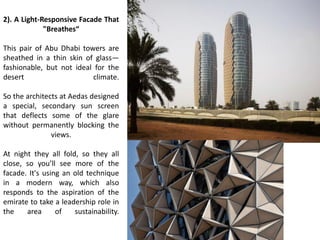
2). A Light-Responsive Facade That
"Breathes“
This pair of Abu Dhabi towers are
sheathed in a thin skin of glass—
fashionable, but not ideal for the
desert climate.
So the architects at Aedas designed
a special, secondary sun screen
that deflects some of the glare
without permanently blocking the
views.
At night they all fold, so they all
close, so you ll see more of the
facade. It's using an old technique
in a modern way, which also
responds to the aspiration of the
emirate to take a leadership role in
the area of sustainability.
3). A Facade That Eats Smog
Back in 2011, the chemical company Alcoa
unveiled a remarkable technology that
could clean the air around it. The material
contained titanium dioxide, which
effectively "scrubbed" the air of toxins by
releasing spongy free radicals that could
eliminate pollutants. The stuff has made
appearances on streets, clothing, and
architecture since then—most recently, on
the sun screen of a new Mexico City
hospital.
The hospital is cloaked in a 300-foot-long
skin of Prosolve tiles. The technology is
based on the same process: As air filters
around the sponge-shaped structures, UV-
light-activated free radicals destroy any
existing pollutants, leaving the air cleaner
for the patients inside.
Even the shape of the sun screen is
significant: It creates turbulence and slows
down air flow around the building, while
scattering the UV light needed to activate
the chemical reaction.
4). A Low-Tech, Operable
Skin
In Melbourne, Sean
Godsell
Architects sheathed
RMIT's design school in
thousands of small,
sandblasted glass circles—
each affixed to a central
rod.
Based on humidity and
temperature inside the
building, these rods pivot
automatically to facilitate
(or block) the flow of air
through the facade.
5). A Metal Mesh That Reacts to Heat
Bloom, a temporary installation by USC
architecture professor Doris Kim Sung, isn't
technically a facade.
Sung's research deals with biomimetics, or
how architecture can mimic the human body.
This sun shade was made with
thermobimetal—a material that's actually a
laminate of two different metals, each with its
own thermal expansion coefficient.
That means that each side reacts differently
to sunlight, expanding and contracting at
different rates—causing tension between the
two surfaces, and ultimately, a curling effect.
So when the surface gets hot, the thin panels
on the shade curl up to allow more air to pass
through to the space below—and when it
cools down, it closes up again.
SOME EXAMPLES
505 CST – A highly sustainable mixed-use tower on the
most prominent site in Nashville s central business
district.
The 505 CST design incorporates a unique twisting form to
achieve an environmentally strategic site orientation, a
double-skin façade with integrated photovoltaic panels,
solar shading, an under-floor air distribution system, two
Skygardens and a variety of cutting-edge building
systems—designed by PositivEnergy Practice—to produce
one of the most technologically advanced buildings of its
kind.
The building is also designed to take maximum advantage
of synergies with downtown Nashville s district heating
and cooling system, which will pipe chilled water to
storage tanks within 505 CST s below-grade parking
structure during off-peak hours at night, when the
demand and cost is lowest and the district syste s excess
generation capacity is highest. The stored chilled water
will be used during peak demand hours during the day
thus permitting the building to meet maximum cooling
loads at a fraction of the cost of a conventional system.
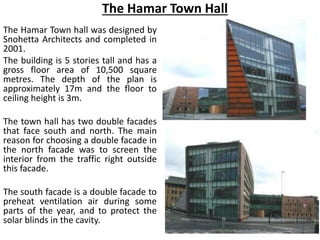
The Hamar Town Hall
The Hamar Town hall was designed by
Snohetta Architects and completed in
2001.
The building is 5 stories tall and has a
gross floor area of 10,500 square
metres. The depth of the plan is
approximately 17m and the floor to
ceiling height is 3m.
The town hall has two double facades
that face south and north. The main
reason for choosing a double facade in
the north facade was to screen the
interior from the traffic right outside
this facade.
The south facade is a double facade to
preheat ventilation air during some
parts of the year, and to protect the
solar blinds in the cavity.
The BP Solar facade at NTNU
BP Norway and BP Solar have commissioned
research units at the Norwegian University of
Science and Technology, NTNU and the
Foundation for Scientific and Industrial
Research at NTNU, SINTEF, to develop a
building system for facades, based on
photovoltaic (PV) solar cells. A prototype solar
facade system, combining a double facade with
a building-integrated PV system, was
constructed on an existing university building at
the Natural Sciences and Technology campus of
NTNU in the spring of 2000.
The facade area is 400 sq. m, of which around
100 sq. m. net area is covered with mono-
crystalline PV cells laminated between 2 sheets
of glass. The cavity behind can be vented, the
hatches is controlled by cavity temperature.
Home Oil Tower and Dome Tower, Calgary
Faced with escalating
energy costs and a
problematic curtain wall,
owners of these two
downtown towers were
considering replacing the
building envelope.
Instead, Halsall
implemented a phased
program of system
renewal to defer the
curtain wall replacement
(and the $22M price tag)
for up to fifteen years,
allowing the client to
focus capital on other
energy-saving initiatives.
Princeton
Citescape/Waterfront,
Calgary
University of Calgary
Downtown Campus, Calgary
Halsall provided durable
cladding and roofing details
that blended new and
existing systems for this
exciting renewal project,
which converted a 50-year-
old medical building into a
dynamic campus and
revitalized an entire
neighborhood.
Chateau Lake Louise, Lake Louise
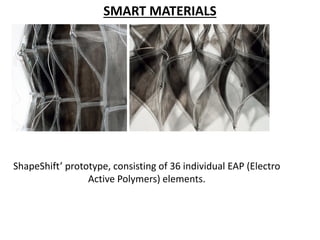
SMART MATERIALS
ShapeShift prototype, o sisti g of 36 i dividual EAP (Ele tro
Active Polymers) elements.
Smart Thermobimetal Self-Ventilating Skin: installation of prototype and
details of skin performance under different temperatures
THANK YOU

Intelligent building envelopes

  • 1.
    INTELLIGENT BUILDING ENVELOPES PRESENTED BY– RAJAT NAINWAL B. ARCH. VII SEM. 110695027 SAP, SHARDA UNIV.
  • 2.
    Building envelopes functionas an environmental filters: they form a skin around the building and control the influence of the outdoor environment. In a hot arid climate, due to problems such as overheating and high solar gain, intelligent design strategies and technologies for building envelope are necessary. More than one third of energy is consumed in buildings, more than in industry or transport, and the absolute figure is rising fast as the construction booms. Tall office buildings need attention due to their large size, energy consumption for cooling and lighting, and highly glazed facades.
  • 3.
    INTRODUCTION TO INTELLIGENTBUILDING ENVELOPE An intelligent building envelope adapts itself to its environment by means of perception, reasoning and action. This adaptiveness enables an intelligent building envelope to cope with new situations and solve problems that arise in its interaction with the environment. Intelligence may be related to the responsive performance of the building envelope. An i tellige t facade is not characterized primarily by how much it is driven by technology, but instead by the interaction between the facade, the uildi g s services and the environment. Building facades are of great importance since they function as an environmental filter: they form a skin around the building and control the influence of the outdoor environment.
  • 4.
    Facade design isvery important for occupant well-being. High levels of occupant satisfaction were easier to achieve when the following features were present: - Shallower plan forms and depths of space (workstations typically 6 m or less from a window). - Thermal mass (provided the acoustics are satisfactory). - Stable and comfortable thermal conditions. - Freedom from distracting noise. - Air infiltration under control. - Operable windows close to the users. - Views out. - Effective controls with clear, usable interfaces. - Window-to-wall area ratio - Window geometry and location - Type of glazing and shading - Thermal insulation of wall - Energy production - Energy storage - Control integration
  • 5.
    SOME INTELLIGENT BUILDINGFACADES 1). An Energy-Producing Algae Facade This 2,150-square-foot wall, unveiled in Germany this spring, is the result of three years of testing by a group of designers from Splitterwerk Architects and Arup. Its vibrant characteristic isn't just an aesthetic flourish—in fact, it's tinted by millions of microscopic algae plants, which are being fed nutrients and oxygen to spur biomass production. Facilitated by direct sunlight, the speedily-growing little cells end up heating the water, and that heat is harvested by the system and stored for use in the building.
  • 6.
    2). A Light-ResponsiveFacade That "Breathes“ This pair of Abu Dhabi towers are sheathed in a thin skin of glass— fashionable, but not ideal for the desert climate. So the architects at Aedas designed a special, secondary sun screen that deflects some of the glare without permanently blocking the views. At night they all fold, so they all close, so you ll see more of the facade. It's using an old technique in a modern way, which also responds to the aspiration of the emirate to take a leadership role in the area of sustainability.
  • 7.
    3). A FacadeThat Eats Smog Back in 2011, the chemical company Alcoa unveiled a remarkable technology that could clean the air around it. The material contained titanium dioxide, which effectively "scrubbed" the air of toxins by releasing spongy free radicals that could eliminate pollutants. The stuff has made appearances on streets, clothing, and architecture since then—most recently, on the sun screen of a new Mexico City hospital. The hospital is cloaked in a 300-foot-long skin of Prosolve tiles. The technology is based on the same process: As air filters around the sponge-shaped structures, UV- light-activated free radicals destroy any existing pollutants, leaving the air cleaner for the patients inside. Even the shape of the sun screen is significant: It creates turbulence and slows down air flow around the building, while scattering the UV light needed to activate the chemical reaction.
  • 8.
    4). A Low-Tech,Operable Skin In Melbourne, Sean Godsell Architects sheathed RMIT's design school in thousands of small, sandblasted glass circles— each affixed to a central rod. Based on humidity and temperature inside the building, these rods pivot automatically to facilitate (or block) the flow of air through the facade.
  • 9.
    5). A MetalMesh That Reacts to Heat Bloom, a temporary installation by USC architecture professor Doris Kim Sung, isn't technically a facade. Sung's research deals with biomimetics, or how architecture can mimic the human body. This sun shade was made with thermobimetal—a material that's actually a laminate of two different metals, each with its own thermal expansion coefficient. That means that each side reacts differently to sunlight, expanding and contracting at different rates—causing tension between the two surfaces, and ultimately, a curling effect. So when the surface gets hot, the thin panels on the shade curl up to allow more air to pass through to the space below—and when it cools down, it closes up again.
  • 10.
    SOME EXAMPLES 505 CST– A highly sustainable mixed-use tower on the most prominent site in Nashville s central business district. The 505 CST design incorporates a unique twisting form to achieve an environmentally strategic site orientation, a double-skin façade with integrated photovoltaic panels, solar shading, an under-floor air distribution system, two Skygardens and a variety of cutting-edge building systems—designed by PositivEnergy Practice—to produce one of the most technologically advanced buildings of its kind. The building is also designed to take maximum advantage of synergies with downtown Nashville s district heating and cooling system, which will pipe chilled water to storage tanks within 505 CST s below-grade parking structure during off-peak hours at night, when the demand and cost is lowest and the district syste s excess generation capacity is highest. The stored chilled water will be used during peak demand hours during the day thus permitting the building to meet maximum cooling loads at a fraction of the cost of a conventional system.
  • 11.
    The Hamar TownHall The Hamar Town hall was designed by Snohetta Architects and completed in 2001. The building is 5 stories tall and has a gross floor area of 10,500 square metres. The depth of the plan is approximately 17m and the floor to ceiling height is 3m. The town hall has two double facades that face south and north. The main reason for choosing a double facade in the north facade was to screen the interior from the traffic right outside this facade. The south facade is a double facade to preheat ventilation air during some parts of the year, and to protect the solar blinds in the cavity.
  • 12.
    The BP Solarfacade at NTNU BP Norway and BP Solar have commissioned research units at the Norwegian University of Science and Technology, NTNU and the Foundation for Scientific and Industrial Research at NTNU, SINTEF, to develop a building system for facades, based on photovoltaic (PV) solar cells. A prototype solar facade system, combining a double facade with a building-integrated PV system, was constructed on an existing university building at the Natural Sciences and Technology campus of NTNU in the spring of 2000. The facade area is 400 sq. m, of which around 100 sq. m. net area is covered with mono- crystalline PV cells laminated between 2 sheets of glass. The cavity behind can be vented, the hatches is controlled by cavity temperature.
  • 13.
    Home Oil Towerand Dome Tower, Calgary Faced with escalating energy costs and a problematic curtain wall, owners of these two downtown towers were considering replacing the building envelope. Instead, Halsall implemented a phased program of system renewal to defer the curtain wall replacement (and the $22M price tag) for up to fifteen years, allowing the client to focus capital on other energy-saving initiatives.
  • 14.
    Princeton Citescape/Waterfront, Calgary University of Calgary DowntownCampus, Calgary Halsall provided durable cladding and roofing details that blended new and existing systems for this exciting renewal project, which converted a 50-year- old medical building into a dynamic campus and revitalized an entire neighborhood.
  • 15.
  • 16.
    SMART MATERIALS ShapeShift prototype,o sisti g of 36 i dividual EAP (Ele tro Active Polymers) elements.
  • 17.
    Smart Thermobimetal Self-VentilatingSkin: installation of prototype and details of skin performance under different temperatures
  • 19.