Outline
• Who rules people or the natural environment?
• What is the sustainable architecture?
• The benefits of sustainable architecture.
• Renewable energy generation.
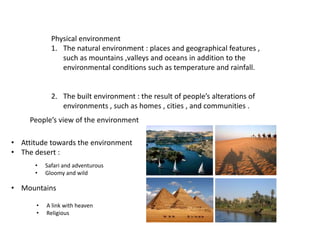
Physical environment
1. The natural environment : places and geographical features ,
such as mountains ,valleys and oceans in addition to the
environmental conditions such as temperature and rainfall.
2. The built environment : the result of people’s alterations of
environments , such as homes , cities , and communities .
People’s view of the environment
• Attitude towards the environment
• The desert :
• Safari and adventurous
• Gloomy and wild
• Mountains
• A link with heaven
• Religious
Who rules people or the natural
environment?
• Nature as a powerful force
• People as above nature
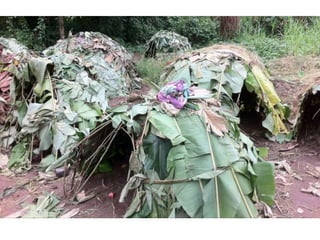
• People as a part of a nature
Nature as a powerful force
• People as a subject to nature: the inability to
control nature.
• Adapt the natural environment as best as
could be.
 Living in excessively harsh and unpredictable
conditions.
 Example: Japan.
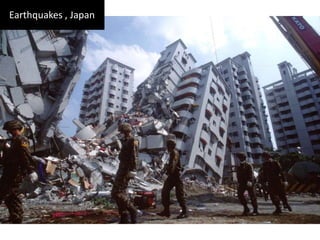
 Accept the power of nature (the earthquake regions).
 Adapt, bend and respect something that is beyond our
power.
Earthquakes , Japan
People as above nature
• People as above nature the ability to control
nature.
• Example:
• Conquer nature for the human sake.
 Human are separate from nature are superior to it
and in accordance with human needs.
• The industrial revolution and motor age.
• the digital revolution.
 build bridges and settle inhabitant land.
 Control temperature and explore outer
space.
People as a part of a nature
• All things in nature are sacred and are not to
be unduly exploited by people.
• Example: the oriental philosophy and religion.
• The modern ecology movement may also
reflect the idea of people in harmony with
nature.
 People are not the center of nature but are part of
nature and must blend with it and be responsible for it.
 Preserving wilderness nature.
 Recycling resources.
 Sustainability.
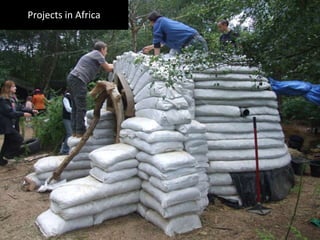
Projects in Africa
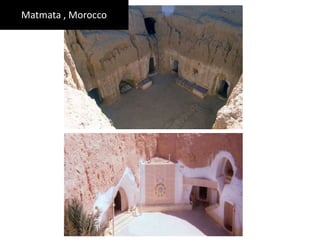
Matmata , Morocco
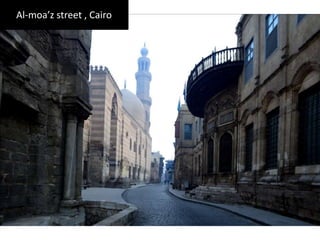
Al-moa’z street , Cairo
What is the sustainable architecture ?
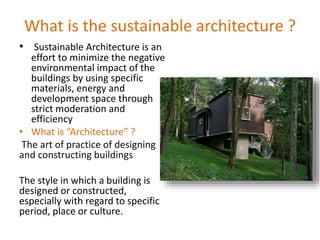
• Sustainable Architecture is an
effort to minimize the negative
environmental impact of the
buildings by using specific
materials, energy and
development space through
strict moderation and
efficiency
• What is “Architecture” ?
The art of practice of designing
and constructing buildings
The style in which a building is
designed or constructed,
especially with regard to specific
period, place or culture.
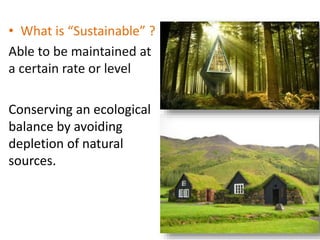
• What is “Sustainable” ?
Able to be maintained at
a certain rate or level
Conserving an ecological
balance by avoiding
depletion of natural
sources.
The benefits of sustainable architecture.
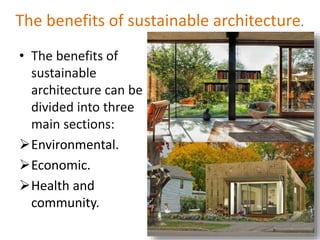
• The benefits of
sustainable
architecture can be
divided into three
main sections:
Environmental.
Economic.
Health and
community.
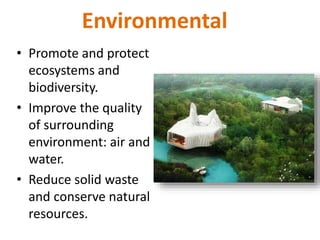
Environmental
• Promote and protect
ecosystems and
biodiversity.
• Improve the quality
of surrounding
environment: air and
water.
• Reduce solid waste
and conserve natural
resources.
USGBC
• According to the USGBC
• (US Green Building Council)
• Use 26% less energy.
• Cost 13% less to maintain.
• Have 27% higher occupant satisfaction and
produce 33% less greenhouses gas
emissions.
Economic
• Reduce utility bills/operating costs
• Higher employee satisfaction and productivity
• Higher probability of selling the
buildings/investment
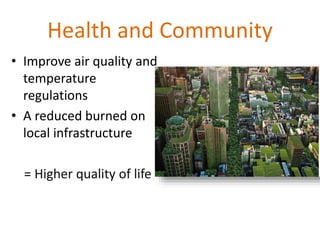
Health and Community
• Improve air quality and
temperature
regulations
• A reduced burned on
local infrastructure
= Higher quality of life
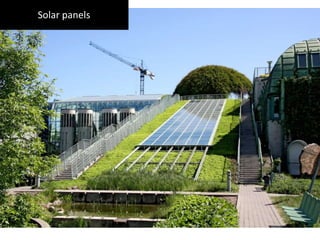
• Solar panels
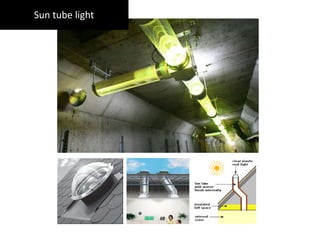
• Sun tube light
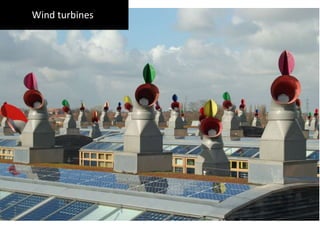
• Wind turbines
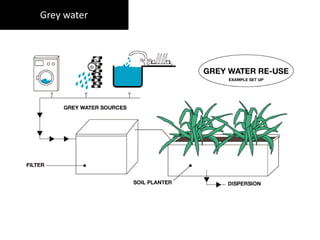
• Grey water
Renewable energy generation
Solar panels
Sun tube light
Wind turbines
Grey water
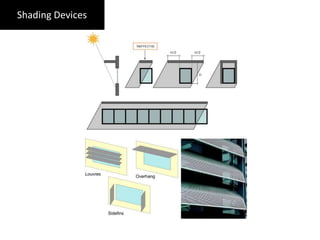
Shading Devices
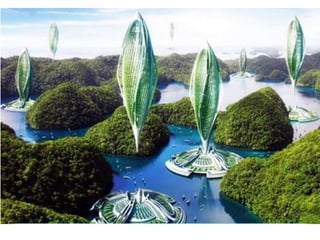
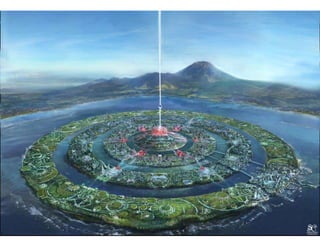
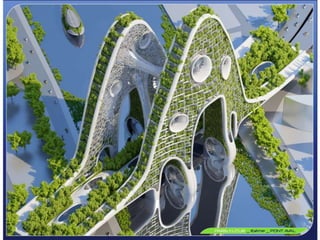
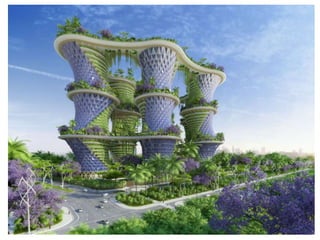
Sustainable Architecture In Future
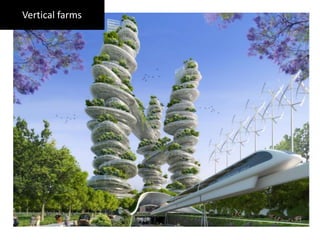
Vertical farms
Sustainable architecture

Sustainable architecture

  • 2.
    Outline • Who rulespeople or the natural environment? • What is the sustainable architecture? • The benefits of sustainable architecture. • Renewable energy generation.
  • 3.
    Physical environment 1. Thenatural environment : places and geographical features , such as mountains ,valleys and oceans in addition to the environmental conditions such as temperature and rainfall. 2. The built environment : the result of people’s alterations of environments , such as homes , cities , and communities . People’s view of the environment • Attitude towards the environment • The desert : • Safari and adventurous • Gloomy and wild • Mountains • A link with heaven • Religious
  • 4.
    Who rules peopleor the natural environment? • Nature as a powerful force • People as above nature • People as a part of a nature
  • 5.
    Nature as apowerful force • People as a subject to nature: the inability to control nature. • Adapt the natural environment as best as could be.  Living in excessively harsh and unpredictable conditions.  Example: Japan.  Accept the power of nature (the earthquake regions).  Adapt, bend and respect something that is beyond our power.
  • 6.
  • 7.
    People as abovenature • People as above nature the ability to control nature. • Example: • Conquer nature for the human sake.  Human are separate from nature are superior to it and in accordance with human needs. • The industrial revolution and motor age. • the digital revolution.  build bridges and settle inhabitant land.  Control temperature and explore outer space.
  • 9.
    People as apart of a nature • All things in nature are sacred and are not to be unduly exploited by people. • Example: the oriental philosophy and religion. • The modern ecology movement may also reflect the idea of people in harmony with nature.  People are not the center of nature but are part of nature and must blend with it and be responsible for it.  Preserving wilderness nature.  Recycling resources.  Sustainability.
  • 11.
  • 12.
  • 13.
  • 14.
    What is thesustainable architecture ? • Sustainable Architecture is an effort to minimize the negative environmental impact of the buildings by using specific materials, energy and development space through strict moderation and efficiency • What is “Architecture” ? The art of practice of designing and constructing buildings The style in which a building is designed or constructed, especially with regard to specific period, place or culture.
  • 15.
    • What is“Sustainable” ? Able to be maintained at a certain rate or level Conserving an ecological balance by avoiding depletion of natural sources.
  • 16.
    The benefits ofsustainable architecture. • The benefits of sustainable architecture can be divided into three main sections: Environmental. Economic. Health and community.
  • 17.
    Environmental • Promote andprotect ecosystems and biodiversity. • Improve the quality of surrounding environment: air and water. • Reduce solid waste and conserve natural resources.
  • 18.
    USGBC • According tothe USGBC • (US Green Building Council) • Use 26% less energy. • Cost 13% less to maintain. • Have 27% higher occupant satisfaction and produce 33% less greenhouses gas emissions.
  • 19.
    Economic • Reduce utilitybills/operating costs • Higher employee satisfaction and productivity • Higher probability of selling the buildings/investment
  • 20.
    Health and Community •Improve air quality and temperature regulations • A reduced burned on local infrastructure = Higher quality of life
  • 21.
    • Solar panels •Sun tube light • Wind turbines • Grey water Renewable energy generation
  • 22.
  • 23.
  • 24.
  • 25.
  • 26.
  • 27.
  • 28.