ZER0ENERGY
BUILDING ENVELOPE
COMPONENTS
Sanjay Neupane
(Objectives)
• Concept of Zero Energy Building
• Façade components & Z.E.B
• Integration of components
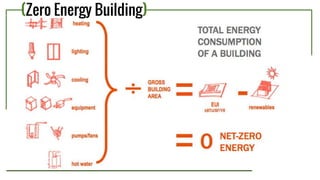
(Zero Energy Building)
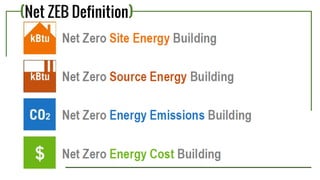
(Net ZEB Definition)
(Building Envelope)
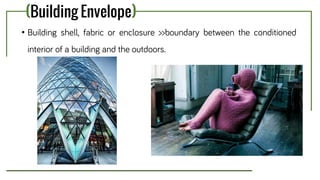
• Building shell, fabric or enclosure >>boundary between the conditioned
interior of a building and the outdoors.
(Building Envelope & Energy )
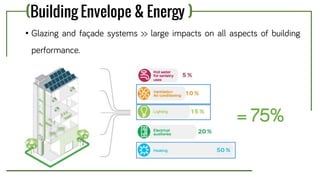
• Glazing and façade systems >> large impacts on all aspects of building
performance.
= 75%
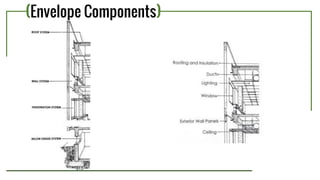
(Envelope Components)
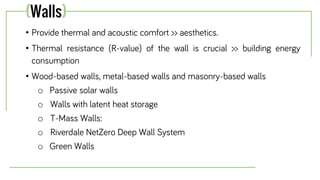
• Provide thermal and acoustic comfort >> aesthetics.
• Thermal resistance (R-value) of the wall is crucial >> building energy
consumption
• Wood-based walls, metal-based walls and masonry-based walls
o Passive solar walls
o Walls with latent heat storage
o T-Mass Walls:
o Riverdale NetZero Deep Wall System
o Green Walls
(Walls)
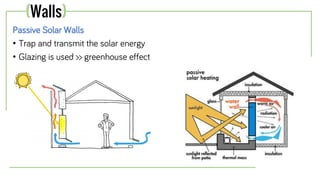
Passive Solar Walls
• Trap and transmit the solar energy
• Glazing is used >> greenhouse effect
(Walls)
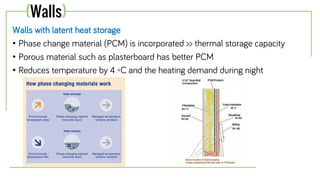
Walls with latent heat storage
• Phase change material (PCM) is incorporated >> thermal storage capacity
• Porous material such as plasterboard has better PCM
• Reduces temperature by 4 ◦C and the heating demand during night
(Walls)
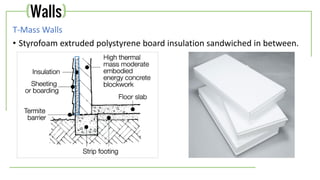
T-Mass Walls
• Styrofoam extruded polystyrene board insulation sandwiched in between.
(Walls)
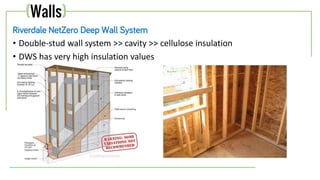
Riverdale NetZero Deep Wall System
• Double-stud wall system >> cavity >> cellulose insulation
• DWS has very high insulation values
(Walls)
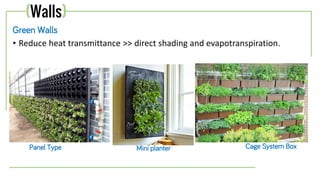
Green Walls
• Reduce heat transmittance >> direct shading and evapotranspiration.
(Walls)
Panel Type Mini planter Cage System Box
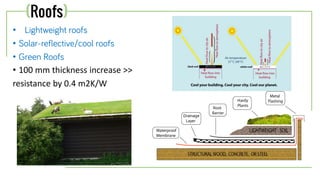
• Lightweight roofs
• Solar-reflective/cool roofs
• Green Roofs
• 100 mm thickness increase >>
resistance by 0.4 m2K/W
(Roofs)
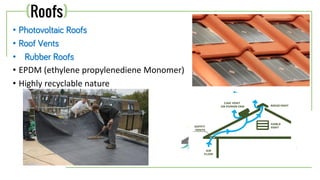
• Photovoltaic Roofs
• Roof Vents
• Rubber Roofs
• EPDM (ethylene propylenediene Monomer)
• Highly recyclable nature
(Roofs)
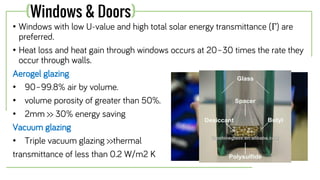
• Windows with low U-value and high total solar energy transmittance (Г) are
preferred.
• Heat loss and heat gain through windows occurs at 20–30 times the rate they
occur through walls.
Aerogel glazing
• 90–99.8% air by volume.
• volume porosity of greater than 50%.
• 2mm >> 30% energy saving
Vacuum glazing
• Triple vacuum glazing >>thermal
transmittance of less than 0.2 W/m2 K
(Windows & Doors)
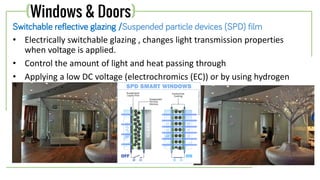
Switchable reflective glazing /Suspended particle devices (SPD) film
• Electrically switchable glazing , changes light transmission properties
when voltage is applied.
• Control the amount of light and heat passing through
• Applying a low DC voltage (electrochromics (EC)) or by using hydrogen
(gasochromics)
(Windows & Doors)
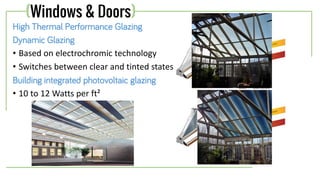
High Thermal Performance Glazing
Dynamic Glazing
• Based on electrochromic technology
• Switches between clear and tinted states
Building integrated photovoltaic glazing
• 10 to 12 Watts per ft²
(Windows & Doors)
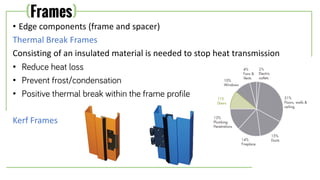
• Edge components (frame and spacer)
Thermal Break Frames
Consisting of an insulated material is needed to stop heat transmission
• Reduce heat loss
• Prevent frost/condensation
• Positive thermal break within the frame profile
Kerf Frames
(Frames)
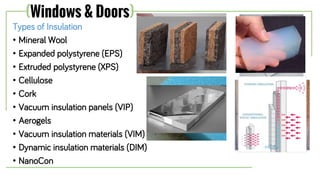
Types of Insulation
• Mineral Wool
• Expanded polystyrene (EPS)
• Extruded polystyrene (XPS)
• Cellulose
• Cork
• Vacuum insulation panels (VIP)
• Aerogels
• Vacuum insulation materials (VIM)
• Dynamic insulation materials (DIM)
• NanoCon
(Windows & Doors)
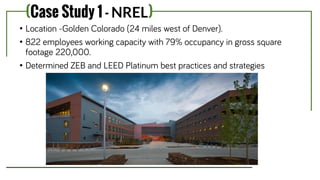
(Case Study 1 - NREL)
• Location -Golden Colorado (24 miles west of Denver).
• 822 employees working capacity with 79% occupancy in gross square
footage 220,000.
• Determined ZEB and LEED Platinum best practices and strategies
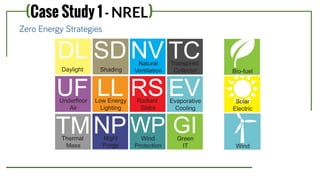
(Case Study 1 - NREL)
Zero Energy Strategies
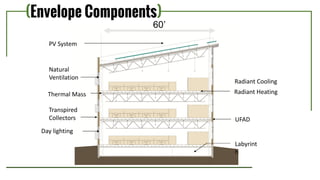
(Envelope Components)
PV System
Natural
Ventilation
Thermal Mass
UFAD
Labyrint
h
Transpired
Collectors
Radiant Cooling
Radiant Heating
Day lighting
60’
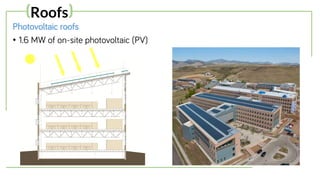
Photovoltaic roofs
• 1.6 MW of on-site photovoltaic (PV)
(Roofs)
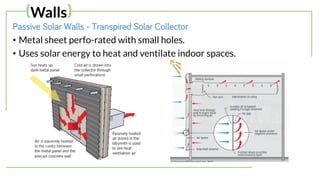
Passive Solar Walls - Transpired Solar Collector
• Metal sheet perfo-rated with small holes.
• Uses solar energy to heat and ventilate indoor spaces.
(Walls)
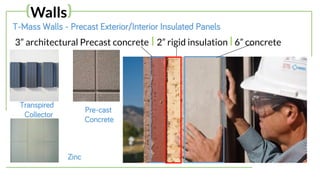
T-Mass Walls - Precast Exterior/Interior Insulated Panels
3” architectural Precast concrete l 2” rigid insulation l 6” concrete
(Walls)
Zinc
Pre-cast
Concrete
Transpired
Collector
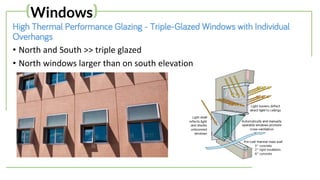
High Thermal Performance Glazing - Triple-Glazed Windows with Individual
Overhangs
• North and South >> triple glazed
• North windows larger than on south elevation
(Windows)
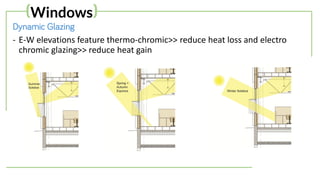
Dynamic Glazing
- E-W elevations feature thermo-chromic>> reduce heat loss and electro
chromic glazing>> reduce heat gain
(Windows)
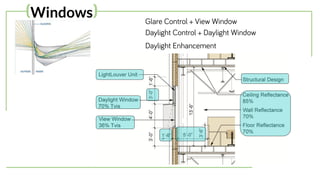
(Windows) Glare Control + View Window
Daylight Control + Daylight Window
Daylight Enhancement
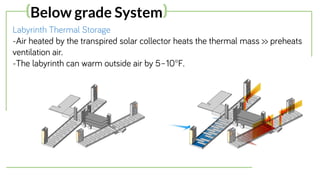
(Below grade System)
Labyrinth Thermal Storage
-Air heated by the transpired solar collector heats the thermal mass >> preheats
ventilation air.
-The labyrinth can warm outside air by 5–10°F.
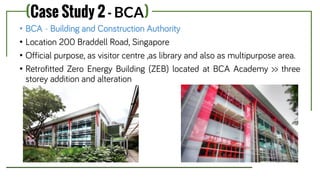
(Case Study 2 - BCA)
• BCA - Building and Construction Authority
• Location 200 Braddell Road, Singapore
• Official purpose, as visitor centre ,as library and also as multipurpose area.
• Retrofitted Zero Energy Building (ZEB) located at BCA Academy >> three
storey addition and alteration
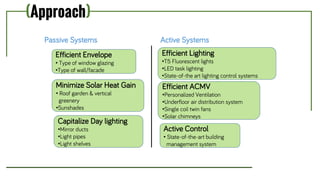
(Approach)
Active Systems
Efficient Lighting
•T5 Fluorescent lights
•LED task lighting
•State-of-the art lighting control systems
Efficient ACMV
•Personalized Ventilation
•Underfloor air distribution system
•Single coil twin fans
•Solar chimneys
Active Control
• State-of-the-art building
management system
Passive Systems
Efficient Envelope
• Type of window glazing
•Type of wall/facade
Minimize Solar Heat Gain
• Roof garden & vertical
greenery
•Sunshades
Capitalize Day lighting
•Mirror ducts
•Light pipes
•Light shelves
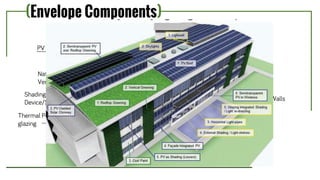
(Envelope Components)
PV System
Natural
Ventilation
Shading
Device/Solar cells
Thermal Performance
glazing
Green Walls
Vent/Solar Chimney
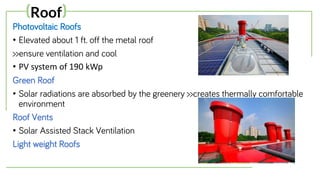
Photovoltaic Roofs
• Elevated about 1 ft. off the metal roof
>>ensure ventilation and cool
• PV system of 190 kWp
Green Roof
• Solar radiations are absorbed by the greenery >>creates thermally comfortable
environment
Roof Vents
• Solar Assisted Stack Ventilation
Light weight Roofs
(Roof)
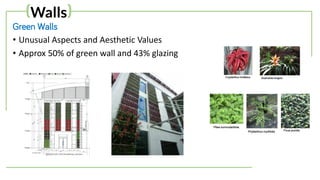
Green Walls
• Unusual Aspects and Aesthetic Values
• Approx 50% of green wall and 43% glazing
(Walls)
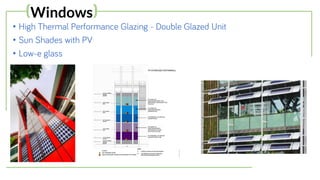
• High Thermal Performance Glazing - Double Glazed Unit
• Sun Shades with PV
• Low-e glass
(Windows)
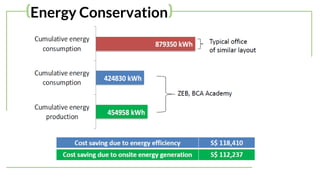
(Energy Conservation)
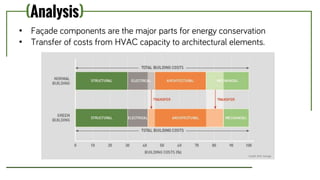
(Analysis)
• Façade components are the major parts for energy conservation
• Transfer of costs from HVAC capacity to architectural elements.
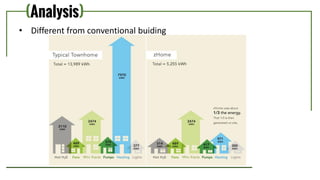
(Analysis)
• Different from conventional buiding
(Analysis)
• Impacts on all aspects of building performance.
• Influence peak heating and cooling loads, and indirectly influence
lighting loads
• Roof, walls, windows, doors, etc. >>considered for energy efficiency.
• Simpler forms i.e., cavity insulated walls, cool paints, double glazing and
low-emissivity glass
• Sophisticated façade systems – i.e., triple-glazing systems, double skin
façade systems, the use of photochromic glass and electrified glazing,
etc.
• The financial requirements depend on the choice of façade system.
(Analysis)
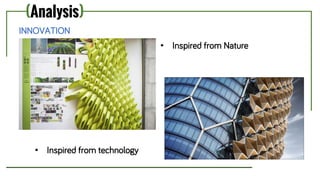
INNOVATION
• Inspired from Nature
• Inspired from technology
(Conclusion)
• Z.E.B >> Future of Building Design
• Façade >> important role in energy conservation
• Simple traditional techniques could help for better thermal efficiency
• Façade components such as walls, fenestration, roof, foundation,
thermal insulation, thermal mass, external shading devices etc. make
up this important part of any building.
(References)
• P. Torcellini, S. Pless and M. Deru, (2006), Zero Energy Buildings: A
Critical Look at the Definition, National Renewable Energy Laboratory
(NREL)
• Karma Swayer, (2014), Windows and Building Envelope Research and
Development: Road map for emerging Technologies
• Sunil Kumar Sharma, (2013), International Journal of Engineering
Research and Applications (IJERA)
• P. Torcellini, (2012), the Design Build Process for the Research Support
Facility
• US Department of Energy (2007), Annual Energy Review 2006
(References)
INTERNET SOURCE
• Solar Walls, How solar walls works,
http://solarwall.com/en/products/solarwall-air-heating/how-solarwall-
works.php, viewed 15th February 2016
• Building and construction authority, www.hpbmagazine.org, viewed 10th
February 2016
• High Performance Building Façade,
http://www.climatetechwiki.org/technology/high-performance-facades,
viewed 22 February 2016
• Building and construction authority, Singapore government,
http://www.greenmark.sg/about_proj_zero.html, viewed 29th January
2016
Let’s find beauty in the Number
ZERO

ZERO ENERGY BUILDING ENVELOPE COMPONENTS

  • 1.
  • 2.
    (Objectives) • Concept ofZero Energy Building • Façade components & Z.E.B • Integration of components
  • 4.
  • 5.
  • 6.
    (Building Envelope) • Buildingshell, fabric or enclosure >>boundary between the conditioned interior of a building and the outdoors.
  • 7.
    (Building Envelope &Energy ) • Glazing and façade systems >> large impacts on all aspects of building performance. = 75%
  • 8.
  • 9.
    • Provide thermaland acoustic comfort >> aesthetics. • Thermal resistance (R-value) of the wall is crucial >> building energy consumption • Wood-based walls, metal-based walls and masonry-based walls o Passive solar walls o Walls with latent heat storage o T-Mass Walls: o Riverdale NetZero Deep Wall System o Green Walls (Walls)
  • 10.
    Passive Solar Walls •Trap and transmit the solar energy • Glazing is used >> greenhouse effect (Walls)
  • 11.
    Walls with latentheat storage • Phase change material (PCM) is incorporated >> thermal storage capacity • Porous material such as plasterboard has better PCM • Reduces temperature by 4 ◦C and the heating demand during night (Walls)
  • 12.
    T-Mass Walls • Styrofoamextruded polystyrene board insulation sandwiched in between. (Walls)
  • 13.
    Riverdale NetZero DeepWall System • Double-stud wall system >> cavity >> cellulose insulation • DWS has very high insulation values (Walls)
  • 14.
    Green Walls • Reduceheat transmittance >> direct shading and evapotranspiration. (Walls) Panel Type Mini planter Cage System Box
  • 15.
    • Lightweight roofs •Solar-reflective/cool roofs • Green Roofs • 100 mm thickness increase >> resistance by 0.4 m2K/W (Roofs)
  • 16.
    • Photovoltaic Roofs •Roof Vents • Rubber Roofs • EPDM (ethylene propylenediene Monomer) • Highly recyclable nature (Roofs)
  • 17.
    • Windows withlow U-value and high total solar energy transmittance (Г) are preferred. • Heat loss and heat gain through windows occurs at 20–30 times the rate they occur through walls. Aerogel glazing • 90–99.8% air by volume. • volume porosity of greater than 50%. • 2mm >> 30% energy saving Vacuum glazing • Triple vacuum glazing >>thermal transmittance of less than 0.2 W/m2 K (Windows & Doors)
  • 18.
    Switchable reflective glazing/Suspended particle devices (SPD) film • Electrically switchable glazing , changes light transmission properties when voltage is applied. • Control the amount of light and heat passing through • Applying a low DC voltage (electrochromics (EC)) or by using hydrogen (gasochromics) (Windows & Doors)
  • 19.
    High Thermal PerformanceGlazing Dynamic Glazing • Based on electrochromic technology • Switches between clear and tinted states Building integrated photovoltaic glazing • 10 to 12 Watts per ft² (Windows & Doors)
  • 20.
    • Edge components(frame and spacer) Thermal Break Frames Consisting of an insulated material is needed to stop heat transmission • Reduce heat loss • Prevent frost/condensation • Positive thermal break within the frame profile Kerf Frames (Frames)
  • 21.
    Types of Insulation •Mineral Wool • Expanded polystyrene (EPS) • Extruded polystyrene (XPS) • Cellulose • Cork • Vacuum insulation panels (VIP) • Aerogels • Vacuum insulation materials (VIM) • Dynamic insulation materials (DIM) • NanoCon (Windows & Doors)
  • 22.
    (Case Study 1- NREL) • Location -Golden Colorado (24 miles west of Denver). • 822 employees working capacity with 79% occupancy in gross square footage 220,000. • Determined ZEB and LEED Platinum best practices and strategies
  • 23.
    (Case Study 1- NREL) Zero Energy Strategies
  • 24.
    (Envelope Components) PV System Natural Ventilation ThermalMass UFAD Labyrint h Transpired Collectors Radiant Cooling Radiant Heating Day lighting 60’
  • 25.
    Photovoltaic roofs • 1.6MW of on-site photovoltaic (PV) (Roofs)
  • 26.
    Passive Solar Walls- Transpired Solar Collector • Metal sheet perfo-rated with small holes. • Uses solar energy to heat and ventilate indoor spaces. (Walls)
  • 27.
    T-Mass Walls -Precast Exterior/Interior Insulated Panels 3” architectural Precast concrete l 2” rigid insulation l 6” concrete (Walls) Zinc Pre-cast Concrete Transpired Collector
  • 28.
    High Thermal PerformanceGlazing - Triple-Glazed Windows with Individual Overhangs • North and South >> triple glazed • North windows larger than on south elevation (Windows)
  • 29.
    Dynamic Glazing - E-Welevations feature thermo-chromic>> reduce heat loss and electro chromic glazing>> reduce heat gain (Windows)
  • 30.
    (Windows) Glare Control+ View Window Daylight Control + Daylight Window Daylight Enhancement
  • 31.
    (Below grade System) LabyrinthThermal Storage -Air heated by the transpired solar collector heats the thermal mass >> preheats ventilation air. -The labyrinth can warm outside air by 5–10°F.
  • 32.
    (Case Study 2- BCA) • BCA - Building and Construction Authority • Location 200 Braddell Road, Singapore • Official purpose, as visitor centre ,as library and also as multipurpose area. • Retrofitted Zero Energy Building (ZEB) located at BCA Academy >> three storey addition and alteration
  • 33.
    (Approach) Active Systems Efficient Lighting •T5Fluorescent lights •LED task lighting •State-of-the art lighting control systems Efficient ACMV •Personalized Ventilation •Underfloor air distribution system •Single coil twin fans •Solar chimneys Active Control • State-of-the-art building management system Passive Systems Efficient Envelope • Type of window glazing •Type of wall/facade Minimize Solar Heat Gain • Roof garden & vertical greenery •Sunshades Capitalize Day lighting •Mirror ducts •Light pipes •Light shelves
  • 34.
    (Envelope Components) PV System Natural Ventilation Shading Device/Solarcells Thermal Performance glazing Green Walls Vent/Solar Chimney
  • 35.
    Photovoltaic Roofs • Elevatedabout 1 ft. off the metal roof >>ensure ventilation and cool • PV system of 190 kWp Green Roof • Solar radiations are absorbed by the greenery >>creates thermally comfortable environment Roof Vents • Solar Assisted Stack Ventilation Light weight Roofs (Roof)
  • 36.
    Green Walls • UnusualAspects and Aesthetic Values • Approx 50% of green wall and 43% glazing (Walls)
  • 37.
    • High ThermalPerformance Glazing - Double Glazed Unit • Sun Shades with PV • Low-e glass (Windows)
  • 38.
  • 39.
    (Analysis) • Façade componentsare the major parts for energy conservation • Transfer of costs from HVAC capacity to architectural elements.
  • 40.
    (Analysis) • Different fromconventional buiding
  • 41.
    (Analysis) • Impacts onall aspects of building performance. • Influence peak heating and cooling loads, and indirectly influence lighting loads • Roof, walls, windows, doors, etc. >>considered for energy efficiency. • Simpler forms i.e., cavity insulated walls, cool paints, double glazing and low-emissivity glass • Sophisticated façade systems – i.e., triple-glazing systems, double skin façade systems, the use of photochromic glass and electrified glazing, etc. • The financial requirements depend on the choice of façade system.
  • 42.
    (Analysis) INNOVATION • Inspired fromNature • Inspired from technology
  • 43.
    (Conclusion) • Z.E.B >>Future of Building Design • Façade >> important role in energy conservation • Simple traditional techniques could help for better thermal efficiency • Façade components such as walls, fenestration, roof, foundation, thermal insulation, thermal mass, external shading devices etc. make up this important part of any building.
  • 44.
    (References) • P. Torcellini,S. Pless and M. Deru, (2006), Zero Energy Buildings: A Critical Look at the Definition, National Renewable Energy Laboratory (NREL) • Karma Swayer, (2014), Windows and Building Envelope Research and Development: Road map for emerging Technologies • Sunil Kumar Sharma, (2013), International Journal of Engineering Research and Applications (IJERA) • P. Torcellini, (2012), the Design Build Process for the Research Support Facility • US Department of Energy (2007), Annual Energy Review 2006
  • 45.
    (References) INTERNET SOURCE • SolarWalls, How solar walls works, http://solarwall.com/en/products/solarwall-air-heating/how-solarwall- works.php, viewed 15th February 2016 • Building and construction authority, www.hpbmagazine.org, viewed 10th February 2016 • High Performance Building Façade, http://www.climatetechwiki.org/technology/high-performance-facades, viewed 22 February 2016 • Building and construction authority, Singapore government, http://www.greenmark.sg/about_proj_zero.html, viewed 29th January 2016
  • 46.
    Let’s find beautyin the Number ZERO