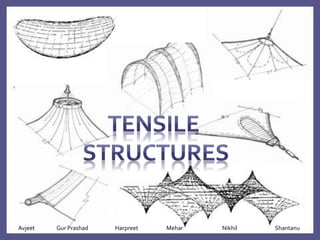
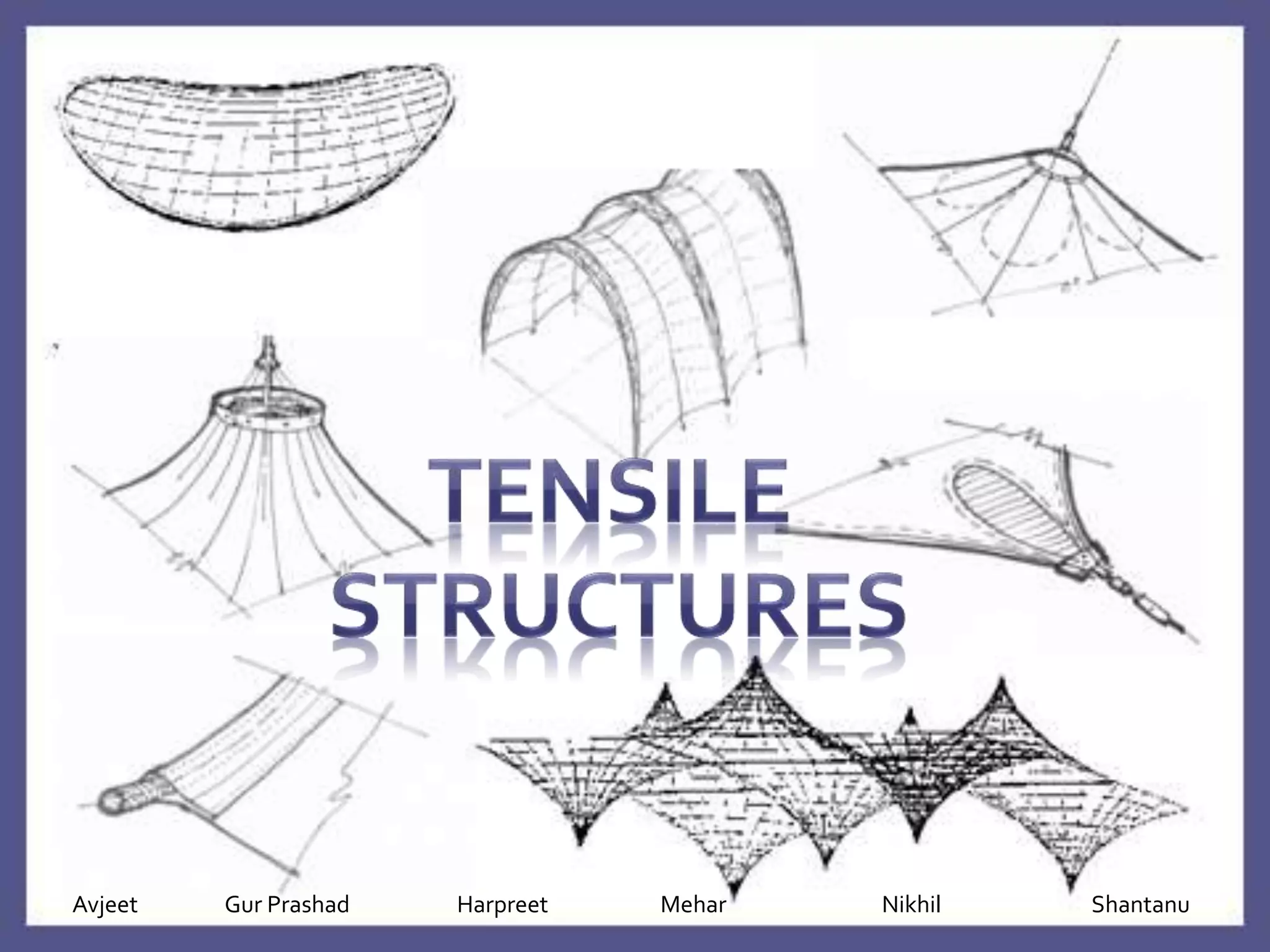
Avjeet Gur Prashad Harpreet Mehar Nikhil Shantanu
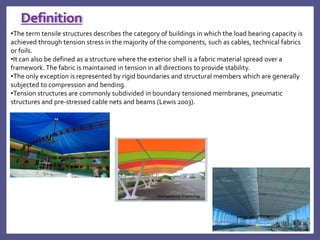
•The term tensile structures describes the category of buildings in which the load bearing capacity is
achieved through tension stress in the majority of the components, such as cables, technical fabrics
or foils.
•It can also be defined as a structure where the exterior shell is a fabric material spread over a
framework. The fabric is maintained in tension in all directions to provide stability.
•The only exception is represented by rigid boundaries and structural members which are generally
subjected to compression and bending.
•Tension structures are commonly subdivided in boundary tensioned membranes, pneumatic
structures and pre-stressed cable nets and beams (Lewis 2003).
Definition
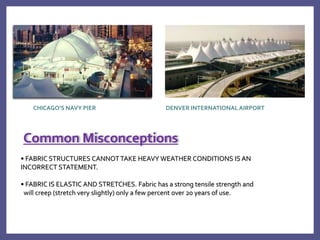
DENVER INTERNATIONALAIRPORTCHICAGO’S NAVY PIER
• FABRIC STRUCTURES CANNOTTAKE HEAVY WEATHER CONDITIONS IS AN
INCORRECT STATEMENT.
• FABRIC IS ELASTIC AND STRETCHES. Fabric has a strong tensile strength and
will creep (stretch very slightly) only a few percent over 20 years of use.
Common Misconceptions
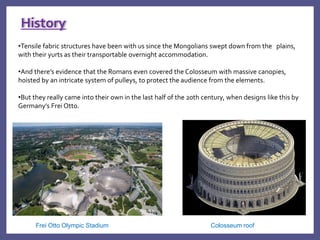
•Tensile fabric structures have been with us since the Mongolians swept down from the plains,
with their yurts as their transportable overnight accommodation.
•And there’s evidence that the Romans even covered the Colosseum with massive canopies,
hoisted by an intricate system of pulleys, to protect the audience from the elements.
•But they really came into their own in the last half of the 20th century, when designs like this by
Germany’s Frei Otto.
History
Frei Otto Olympic Stadium Colosseum roof
Why tensile are the shape they are?
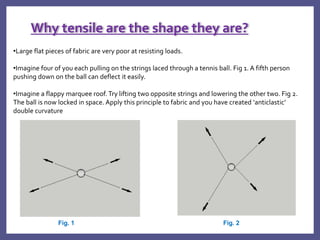
•Large flat pieces of fabric are very poor at resisting loads.
•Imagine four of you each pulling on the strings laced through a tennis ball. Fig 1. A fifth person
pushing down on the ball can deflect it easily.
•Imagine a flappy marquee roof.Try lifting two opposite strings and lowering the other two. Fig 2.
The ball is now locked in space. Apply this principle to fabric and you have created ‘anticlastic’
double curvature
Fig. 1 Fig. 2
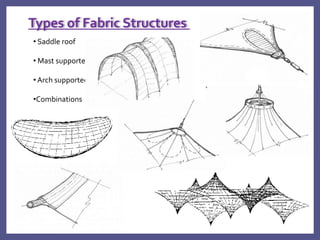
• Saddle roof
• Mast supported
• Arch supported
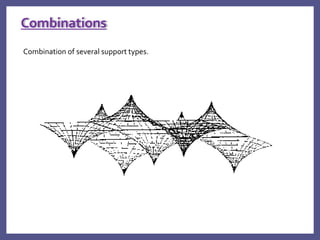
•Combinations
Types of Fabric Structures
`
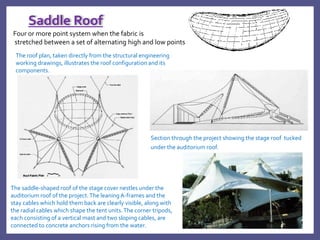
Four or more point system when the fabric is
stretched between a set of alternating high and low points
Saddle Roof
The roof plan, taken directly from the structural engineering
working drawings, illustrates the roof configuration and its
components.
The saddle-shaped roof of the stage cover nestles under the
auditorium roof of the project.The leaningA-frames and the
stay cables which hold them back are clearly visible, along with
the radial cables which shape the tent units.The corner tripods,
each consisting of a vertical mast and two sloping cables, are
connected to concrete anchors rising from the water.
Section through the project showing the stage roof tucked
under the auditorium roof.
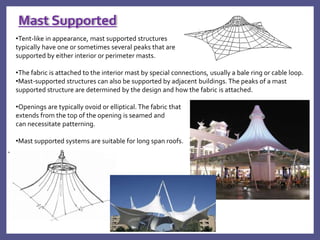
•Tent-like in appearance, mast supported structures
typically have one or sometimes several peaks that are
supported by either interior or perimeter masts.
•The fabric is attached to the interior mast by special connections, usually a bale ring or cable loop.
•Mast-supported structures can also be supported by adjacent buildings. The peaks of a mast
supported structure are determined by the design and how the fabric is attached.
•Openings are typically ovoid or elliptical. The fabric that
extends from the top of the opening is seamed and
can necessitate patterning.
•Mast supported systems are suitable for long span roofs.
Mast Supported
`
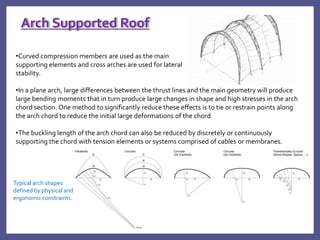
•Curved compression members are used as the main
supporting elements and cross arches are used for lateral
stability.
•In a plane arch, large differences between the thrust lines and the main geometry will produce
large bending moments that in turn produce large changes in shape and high stresses in the arch
chord section. One method to significantly reduce these effects is to tie or restrain points along
the arch chord to reduce the initial large deformations of the chord
•The buckling length of the arch chord can also be reduced by discretely or continuously
supporting the chord with tension elements or systems comprised of cables or membranes.
Arch Supported Roof
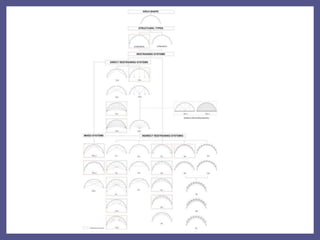
Typical arch shapes
defined by physical and
ergonomic constraints.
Combinations
Combination of several support types.
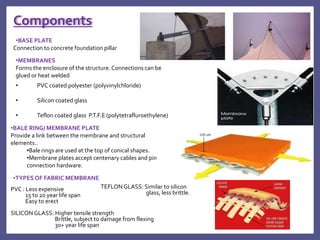
Components
Connection to concrete foundation pillar
•BASE PLATE
•MEMBRANES
Forms the enclosure of the structure. Connections can be
glued or heat welded
Provide a link between the membrane and structural
elements..
•Bale rings are used at the top of conical shapes.
•Membrane plates accept centenary cables and pin
connection hardware.
•BALE RING/ MEMBRANE PLATE
• PVC coated polyester (polyvinylchloride)
• Silicon coated glass
• Teflon coated glass P.T.F.E (polytetrafluroethylene)
•TYPES OF FABRIC MEMBRANE
PVC : Less expensive
15 to 20 year life span
Easy to erect
SILICONGLASS: Higher tensile strength
Brittle, subject to damage from flexing
30+ year life span
TEFLONGLASS: Similar to silicon
glass, less brittle.
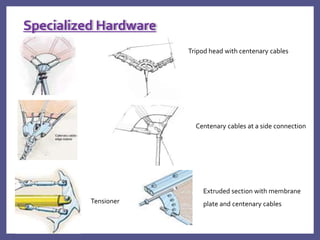
Specialized Hardware
Tripod head with centenary cables
Centenary cables at a side connection
Extruded section with membrane
plate and centenary cablesTensioner
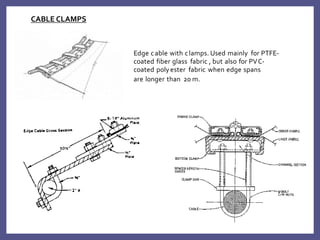
CABLE CLAMPS
Edge cable with clamps. Used mainly for PTFE-
coated fiber glass fabric , but also for PVC-
coated poly ester fabric when edge spans
are longer than 20 m.
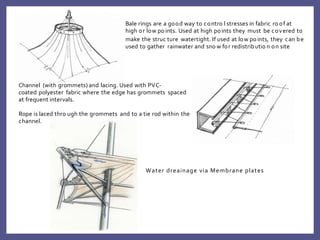
Bale rings are a good way to contro l stresses in fabric ro of at
high or low po ints. Used at high points they must be covered to
make the struc ture watertight. If used at low po ints, they can be
used to gather rainwater and sno w for redistributio n on site.
Channel (with grommets) and lacing. Used with PVC-
coated polyester fabric where the edge has grommets spaced
at frequent intervals.
Rope is laced thro ugh the grommets and to a tie rod within the
channel.
Water dreainage via Membrane plates
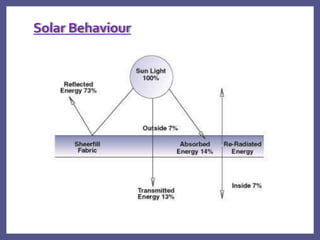
Solar Behaviour
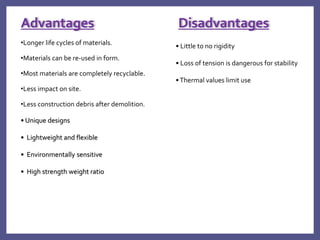
•Longer life cycles of materials.
•Materials can be re-used in form.
•Most materials are completely recyclable.
•Less impact on site.
•Less construction debris after demolition.
• Unique designs
• Lightweight and flexible
• Environmentally sensitive
• High strength weight ratio
Advantages Disadvantages
• Little to no rigidity
• Loss of tension is dangerous for stability
•Thermal values limit use
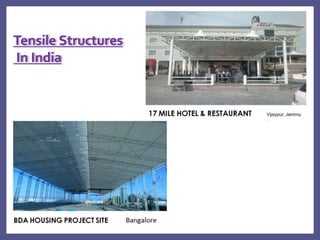
Tensile Structures
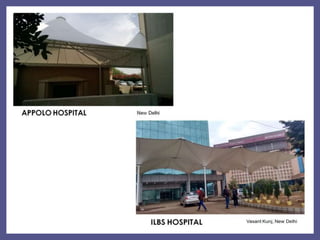
In India
Tensile structures

Tensile structures

  • 1.
    Avjeet Gur PrashadHarpreet Mehar Nikhil Shantanu
  • 2.
    •The term tensilestructures describes the category of buildings in which the load bearing capacity is achieved through tension stress in the majority of the components, such as cables, technical fabrics or foils. •It can also be defined as a structure where the exterior shell is a fabric material spread over a framework. The fabric is maintained in tension in all directions to provide stability. •The only exception is represented by rigid boundaries and structural members which are generally subjected to compression and bending. •Tension structures are commonly subdivided in boundary tensioned membranes, pneumatic structures and pre-stressed cable nets and beams (Lewis 2003). Definition
  • 3.
    DENVER INTERNATIONALAIRPORTCHICAGO’S NAVYPIER • FABRIC STRUCTURES CANNOTTAKE HEAVY WEATHER CONDITIONS IS AN INCORRECT STATEMENT. • FABRIC IS ELASTIC AND STRETCHES. Fabric has a strong tensile strength and will creep (stretch very slightly) only a few percent over 20 years of use. Common Misconceptions
  • 4.
    •Tensile fabric structureshave been with us since the Mongolians swept down from the plains, with their yurts as their transportable overnight accommodation. •And there’s evidence that the Romans even covered the Colosseum with massive canopies, hoisted by an intricate system of pulleys, to protect the audience from the elements. •But they really came into their own in the last half of the 20th century, when designs like this by Germany’s Frei Otto. History Frei Otto Olympic Stadium Colosseum roof
  • 5.
    Why tensile arethe shape they are? •Large flat pieces of fabric are very poor at resisting loads. •Imagine four of you each pulling on the strings laced through a tennis ball. Fig 1. A fifth person pushing down on the ball can deflect it easily. •Imagine a flappy marquee roof.Try lifting two opposite strings and lowering the other two. Fig 2. The ball is now locked in space. Apply this principle to fabric and you have created ‘anticlastic’ double curvature Fig. 1 Fig. 2
  • 6.
    • Saddle roof •Mast supported • Arch supported •Combinations Types of Fabric Structures `
  • 7.
    Four or morepoint system when the fabric is stretched between a set of alternating high and low points Saddle Roof The roof plan, taken directly from the structural engineering working drawings, illustrates the roof configuration and its components. The saddle-shaped roof of the stage cover nestles under the auditorium roof of the project.The leaningA-frames and the stay cables which hold them back are clearly visible, along with the radial cables which shape the tent units.The corner tripods, each consisting of a vertical mast and two sloping cables, are connected to concrete anchors rising from the water. Section through the project showing the stage roof tucked under the auditorium roof.
  • 8.
    •Tent-like in appearance,mast supported structures typically have one or sometimes several peaks that are supported by either interior or perimeter masts. •The fabric is attached to the interior mast by special connections, usually a bale ring or cable loop. •Mast-supported structures can also be supported by adjacent buildings. The peaks of a mast supported structure are determined by the design and how the fabric is attached. •Openings are typically ovoid or elliptical. The fabric that extends from the top of the opening is seamed and can necessitate patterning. •Mast supported systems are suitable for long span roofs. Mast Supported `
  • 9.
    •Curved compression membersare used as the main supporting elements and cross arches are used for lateral stability. •In a plane arch, large differences between the thrust lines and the main geometry will produce large bending moments that in turn produce large changes in shape and high stresses in the arch chord section. One method to significantly reduce these effects is to tie or restrain points along the arch chord to reduce the initial large deformations of the chord •The buckling length of the arch chord can also be reduced by discretely or continuously supporting the chord with tension elements or systems comprised of cables or membranes. Arch Supported Roof Typical arch shapes defined by physical and ergonomic constraints.
  • 12.
  • 13.
    Components Connection to concretefoundation pillar •BASE PLATE •MEMBRANES Forms the enclosure of the structure. Connections can be glued or heat welded Provide a link between the membrane and structural elements.. •Bale rings are used at the top of conical shapes. •Membrane plates accept centenary cables and pin connection hardware. •BALE RING/ MEMBRANE PLATE • PVC coated polyester (polyvinylchloride) • Silicon coated glass • Teflon coated glass P.T.F.E (polytetrafluroethylene) •TYPES OF FABRIC MEMBRANE PVC : Less expensive 15 to 20 year life span Easy to erect SILICONGLASS: Higher tensile strength Brittle, subject to damage from flexing 30+ year life span TEFLONGLASS: Similar to silicon glass, less brittle.
  • 14.
    Specialized Hardware Tripod headwith centenary cables Centenary cables at a side connection Extruded section with membrane plate and centenary cablesTensioner
  • 15.
    CABLE CLAMPS Edge cablewith clamps. Used mainly for PTFE- coated fiber glass fabric , but also for PVC- coated poly ester fabric when edge spans are longer than 20 m.
  • 16.
    Bale rings area good way to contro l stresses in fabric ro of at high or low po ints. Used at high points they must be covered to make the struc ture watertight. If used at low po ints, they can be used to gather rainwater and sno w for redistributio n on site. Channel (with grommets) and lacing. Used with PVC- coated polyester fabric where the edge has grommets spaced at frequent intervals. Rope is laced thro ugh the grommets and to a tie rod within the channel. Water dreainage via Membrane plates
  • 17.
  • 18.
    •Longer life cyclesof materials. •Materials can be re-used in form. •Most materials are completely recyclable. •Less impact on site. •Less construction debris after demolition. • Unique designs • Lightweight and flexible • Environmentally sensitive • High strength weight ratio Advantages Disadvantages • Little to no rigidity • Loss of tension is dangerous for stability •Thermal values limit use
  • 19.