Dr Rajkumar S Patil
Asst.Prof
KSS Vijayanagar College Of Education,
Hubli, Karnatak
7795202037
K S S
VIJAYANAGAR COLLEGE OF EDUCATION
HUBBALLI
NAAC Accrediated with B++grade 2017
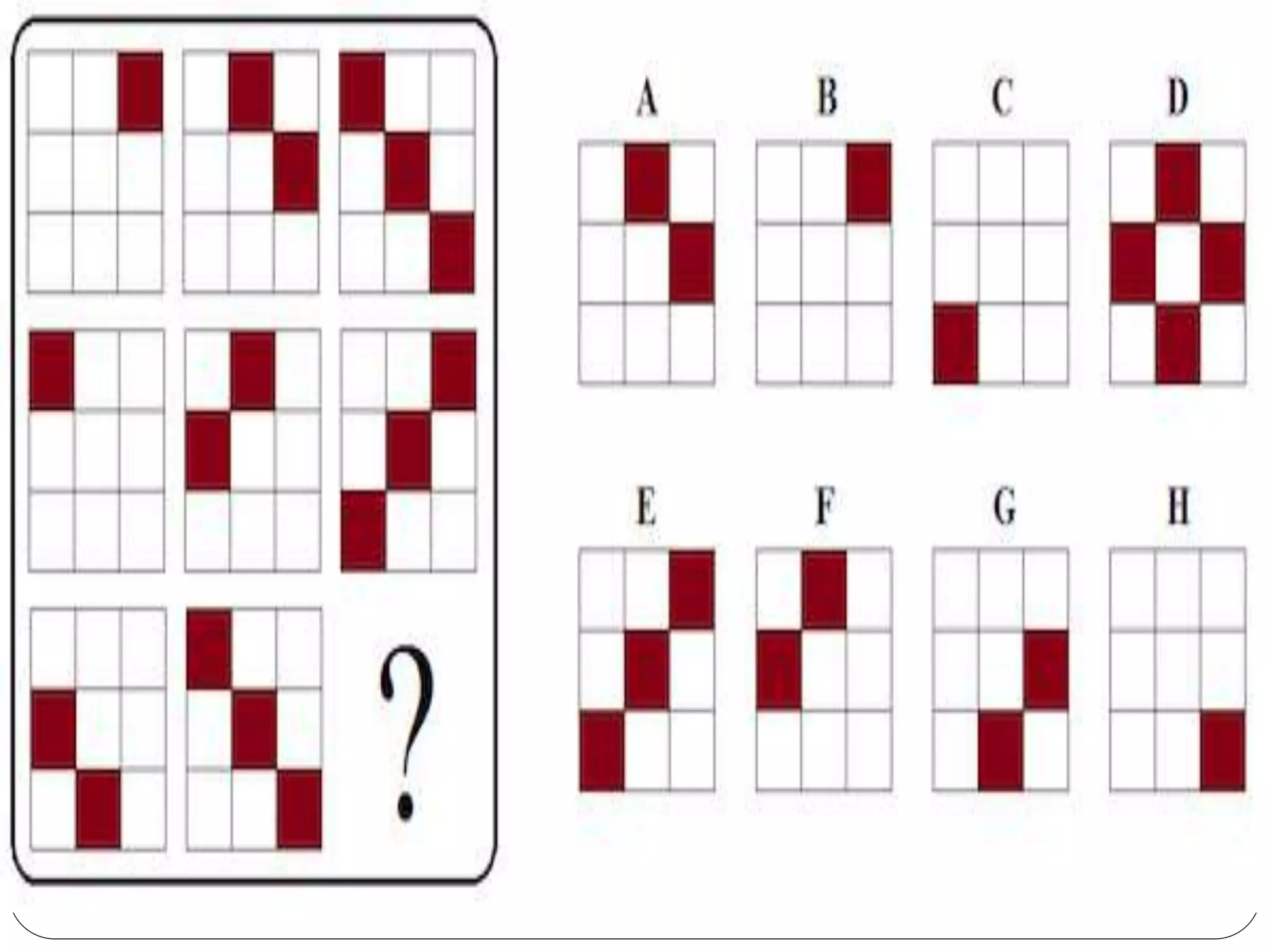
Raven's Progressive Matrices (often referred to simply
as Raven's Matrices) or RPM is a nonverbal
group test typically used in educational settings.
It is usually a 60-item test used in measuring abstract
reasoning and regarded as a non-verbal estimate of fluid
intelligence.
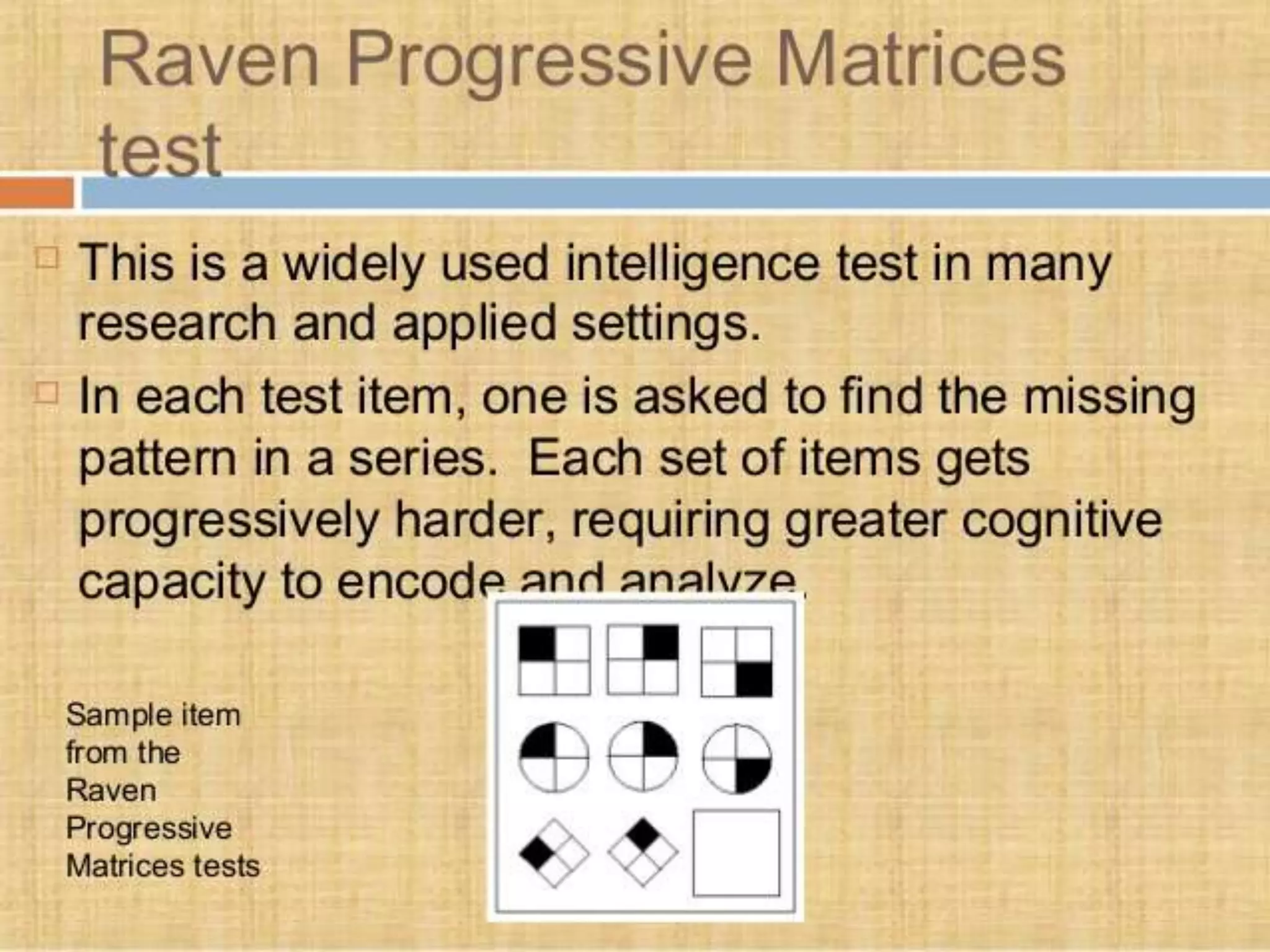
Raven’s matrices is a nonverbal ability test used to
assess abstract reasoning.
The test is progressive in the sense that questions get
harder as the test progresses.
The task is to determine the missing element in a
pattern which is generally presented in the form of a
matrix, hence the name Raven’s matrices.
The tests were originally developed by John C. Raven
in 19361 and are currently licensed by Pearson PLC.
Versions
The matrices are posed in three different forms for participants of different
ability:
Standard Progressive Matrices: These were the original form of the
matrices, first published in 1938. The booklet comprises five sets (A to E) of
12 items each (e.g., A1 through A12), with items within a set becoming
increasingly difficult, requiring ever greater cognitive capacity to encode and
analyze information. All items are presented in black ink on a white
background.
Coloured Progressive Matrices: Designed for younger children, the
elderly, and people with moderate or severe learning difficulties, this test
contains sets A and B from the standard matrices, with a further set of 12
items inserted between the two, as set Ab. Most items are presented on a
coloured background to make the test visually stimulating for participants.
However the very last few items in set B are presented as black-on-white; in
this way, if a subject exceeds the tester's expectations, transition to sets C,
D, and E of the standard matrices is eased.
Advanced Progressive Matrices: The advanced form of the matrices
contains 48 items, presented as one set of 12 (set I), and another of 36 (set
Ravens progressive matrices  test

Ravens progressive matrices test

  • 1.
    Dr Rajkumar SPatil Asst.Prof KSS Vijayanagar College Of Education, Hubli, Karnatak 7795202037 K S S VIJAYANAGAR COLLEGE OF EDUCATION HUBBALLI NAAC Accrediated with B++grade 2017
  • 7.
    Raven's Progressive Matrices(often referred to simply as Raven's Matrices) or RPM is a nonverbal group test typically used in educational settings. It is usually a 60-item test used in measuring abstract reasoning and regarded as a non-verbal estimate of fluid intelligence.
  • 8.
    Raven’s matrices isa nonverbal ability test used to assess abstract reasoning. The test is progressive in the sense that questions get harder as the test progresses. The task is to determine the missing element in a pattern which is generally presented in the form of a matrix, hence the name Raven’s matrices. The tests were originally developed by John C. Raven in 19361 and are currently licensed by Pearson PLC.
  • 9.
    Versions The matrices areposed in three different forms for participants of different ability: Standard Progressive Matrices: These were the original form of the matrices, first published in 1938. The booklet comprises five sets (A to E) of 12 items each (e.g., A1 through A12), with items within a set becoming increasingly difficult, requiring ever greater cognitive capacity to encode and analyze information. All items are presented in black ink on a white background. Coloured Progressive Matrices: Designed for younger children, the elderly, and people with moderate or severe learning difficulties, this test contains sets A and B from the standard matrices, with a further set of 12 items inserted between the two, as set Ab. Most items are presented on a coloured background to make the test visually stimulating for participants. However the very last few items in set B are presented as black-on-white; in this way, if a subject exceeds the tester's expectations, transition to sets C, D, and E of the standard matrices is eased. Advanced Progressive Matrices: The advanced form of the matrices contains 48 items, presented as one set of 12 (set I), and another of 36 (set