MENU
1.  What is behaviorism?                     Sub-slide two
   1. Sub-Slide one
2. How to reinforce Behaviorism.
   1. Sub-slide one
3. How do learners learn thru Behaviorism?
4. Behaviorism in the classroom.
   1. Sub-slide one
5. Who is responsible for behaviorism?
6. Personal Views of Behaviorism
   1. Sub-slide one
   2. Sub-slide two
   3. Sub-slide three
7. Works Cited
WHAT IS BEHAVIORISM?
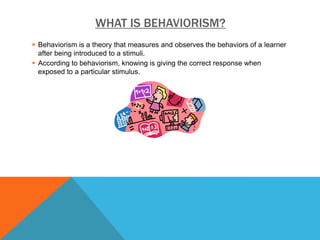
 Behaviorism is a theory that measures and observes the behaviors of a learner
  after being introduced to a stimuli.
 According to behaviorism, knowing is giving the correct response when
  exposed to a particular stimulus.
WHAT IS BEHAVIORISM?
•   In this theory the learner is not so much concern with how or why they got the
    answer but more so if it correct or not.
•   Educational effects of behaviorism are key in developing basic skills.
HOW IS BEHAVIORISM ENFORCED?
•   Negative or positive feedback can be given to the learner based on their
    response to the stimuli.
•   The approach of using positive and negative reinforcements to elicit desired
    behaviors of students is also useful in establishing and maintaining classroom
    management.
HOW IS BEHAVIORISM ENFORCED?
•   Reward with compliments and/or treats when desired behavior is shown.
•   Give constructive criticism with behavior is not desired.
HOW DO LEARNERS LEARN THRU BEHAVIORISM?
•   The learner uses low level processing skills to understand material and the
    material is often isolated from real-world contexts or situations.
•   Very little responsibility is given to the learner concerning their own
    education.
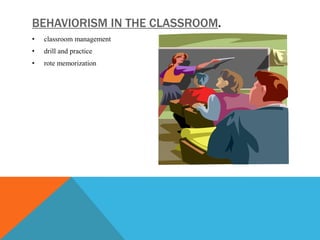
BEHAVIORISM IN THE CLASSROOM.
•   classroom management
•   drill and practice
•   rote memorization
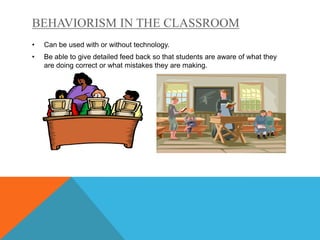
BEHAVIORISM IN THE CLASSROOM
•   Can be used with or without technology.
•   Be able to give detailed feed back so that students are aware of what they
    are doing correct or what mistakes they are making.
WHO IS RESPONSIBLE FOR BEHAVIORISM?
•   Ivan Pavlov- Known for his behavioral experiment with dogs and won the
    Nobel Prize in Physiology in 1904.
•   B.F. Skinner- Conducted a theory he called Operant Conditioning with
    pigeons where he reared them for desired behavior.
•   Albert Bandura – Know for his ideas on Social Learning that he renamed
    Social Cognitive Theory.
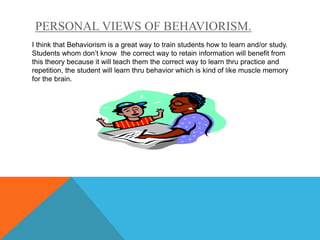
PERSONAL VIEWS OF BEHAVIORISM.
I think that Behaviorism is a great way to train students how to learn and/or study.
Students whom don’t know the correct way to retain information will benefit from
this theory because it will teach them the correct way to learn thru practice and
repetition, the student will learn thru behavior which is kind of like muscle memory
for the brain.
PERSONAL VIEWS OF BEHAVIORISM.
In order to incorporate Behaviorism in my classroom I
   would:
•    I would allow students to gain extra points on quizzes and tests by
     allowing to explain why the choose the answer they did, what is the
     correct answer, and why did they choose the new answer.
    • This will encourage to study before the test so they won’t have to do twice
      the work after the text.
PERSONAL VIEWS OF BEHAVIORISM.
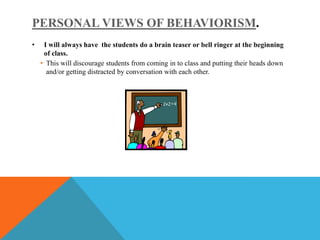
•    I will always have the students do a brain teaser or bell ringer at the beginning
     of class.
    • This will discourage students from coming in to class and putting their heads down
      and/or getting distracted by conversation with each other.
PERSONAL VIEWS OF BEHAVIORISM.
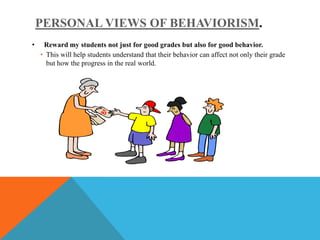
•    Reward my students not just for good grades but also for good behavior.
    • This will help students understand that their behavior can affect not only their grade
      but how the progress in the real world.
WORKS CITED
•   Shelly, Gary B., Glenda A. Gunter, and Randolph E. Gunter. Teachers
    Discovering Computers: Integrating Technology in a Connected World. 7th
    ed. Boston, MA: Course Technology Cengage Learning, 2012. 258-61. Print
•    "Behaviorism: Learning Theory." MSU.edu. Web. 8 Apr. 2012.
    <https://www.msu.edu/~purcelll/behaviorism%20theory.htm?pagewanted=all>
    .

Guilford theory

  • 2.
    MENU 1. Whatis behaviorism? Sub-slide two 1. Sub-Slide one 2. How to reinforce Behaviorism. 1. Sub-slide one 3. How do learners learn thru Behaviorism? 4. Behaviorism in the classroom. 1. Sub-slide one 5. Who is responsible for behaviorism? 6. Personal Views of Behaviorism 1. Sub-slide one 2. Sub-slide two 3. Sub-slide three 7. Works Cited
  • 3.
    WHAT IS BEHAVIORISM? Behaviorism is a theory that measures and observes the behaviors of a learner after being introduced to a stimuli.  According to behaviorism, knowing is giving the correct response when exposed to a particular stimulus.
  • 4.
    WHAT IS BEHAVIORISM? • In this theory the learner is not so much concern with how or why they got the answer but more so if it correct or not. • Educational effects of behaviorism are key in developing basic skills.
  • 5.
    HOW IS BEHAVIORISMENFORCED? • Negative or positive feedback can be given to the learner based on their response to the stimuli. • The approach of using positive and negative reinforcements to elicit desired behaviors of students is also useful in establishing and maintaining classroom management.
  • 6.
    HOW IS BEHAVIORISMENFORCED? • Reward with compliments and/or treats when desired behavior is shown. • Give constructive criticism with behavior is not desired.
  • 7.
    HOW DO LEARNERSLEARN THRU BEHAVIORISM? • The learner uses low level processing skills to understand material and the material is often isolated from real-world contexts or situations. • Very little responsibility is given to the learner concerning their own education.
  • 8.
    BEHAVIORISM IN THECLASSROOM. • classroom management • drill and practice • rote memorization
  • 9.
    BEHAVIORISM IN THECLASSROOM • Can be used with or without technology. • Be able to give detailed feed back so that students are aware of what they are doing correct or what mistakes they are making.
  • 10.
    WHO IS RESPONSIBLEFOR BEHAVIORISM? • Ivan Pavlov- Known for his behavioral experiment with dogs and won the Nobel Prize in Physiology in 1904. • B.F. Skinner- Conducted a theory he called Operant Conditioning with pigeons where he reared them for desired behavior. • Albert Bandura – Know for his ideas on Social Learning that he renamed Social Cognitive Theory.
  • 11.
    PERSONAL VIEWS OFBEHAVIORISM. I think that Behaviorism is a great way to train students how to learn and/or study. Students whom don’t know the correct way to retain information will benefit from this theory because it will teach them the correct way to learn thru practice and repetition, the student will learn thru behavior which is kind of like muscle memory for the brain.
  • 12.
    PERSONAL VIEWS OFBEHAVIORISM. In order to incorporate Behaviorism in my classroom I would: • I would allow students to gain extra points on quizzes and tests by allowing to explain why the choose the answer they did, what is the correct answer, and why did they choose the new answer. • This will encourage to study before the test so they won’t have to do twice the work after the text.
  • 13.
    PERSONAL VIEWS OFBEHAVIORISM. • I will always have the students do a brain teaser or bell ringer at the beginning of class. • This will discourage students from coming in to class and putting their heads down and/or getting distracted by conversation with each other.
  • 14.
    PERSONAL VIEWS OFBEHAVIORISM. • Reward my students not just for good grades but also for good behavior. • This will help students understand that their behavior can affect not only their grade but how the progress in the real world.
  • 15.
    WORKS CITED • Shelly, Gary B., Glenda A. Gunter, and Randolph E. Gunter. Teachers Discovering Computers: Integrating Technology in a Connected World. 7th ed. Boston, MA: Course Technology Cengage Learning, 2012. 258-61. Print • "Behaviorism: Learning Theory." MSU.edu. Web. 8 Apr. 2012. <https://www.msu.edu/~purcelll/behaviorism%20theory.htm?pagewanted=all> .