EE-471 HIGH VOLTAGE ENGINEERING
Voltage Testing & Partial Discharge
Measurement For Power Cable Accessories
PRESENTED BY : SYED ATIF CHISHTI
SUBMITEDTO : PROF DOC :BULENT BILIR
1
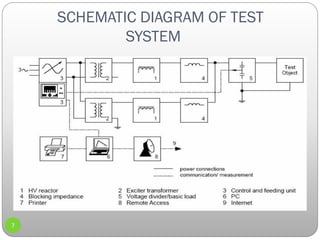
PRESENTATION SEQUENCE
2
 OBECTIVE
 INTRODUCTION
 ACTESTAFTER INSTALLATION
 ACRF TEST SYSTEM
 SCHEMATIC DIAGRAM OFTEST SYSTEM
 PARALLEL OPERATION MODE OFTEST SYSTEM
 PARTIAL DISCHARGE METHODS & PRINCIPLE.
 DISCUSSION & CONCLUSION.
OBJECTIVE :
 To compare best practices for cable testing.
 Predictive diagnostic programs to aging cable.
 To determine the faulty joints cable defects
INTRODUCTION
 Using Frequency tuned resonance
Test system (20-300 Hz) to calculate
PD measurement.
 PD measurement method are
necessary to trace defect and
insulation of cable.
 Voltage testing provide information
about defect in the insulation is
dangerous or not for later operation.
 Calibration is done through PD
calibrator on the cable termination.
3
 Power Cables importance in
Transmission & Distribution
system
 Consist of :
 Cable
 Joint
 Termination
 Identification & Localization of
partial discharge.
AC TEST AFTER INSTALLATION
4
 Follow the international standards IEC 60840 and IEC
62067 for testing of Power cable insulation and their
accessories.
 Apply : sinusoidal waveform, frequency: 20 and 300 Hz,
voltage applied for 1.7 U0 /1 hour
Methods of Voltage Generated
5
 By a reactor with variable inductance and fixed excitation
frequency 50 or 60 Hz (ACRL) test system.
 By a reactor with fixed inductance and frequency tuned
voltage excitation (ACRF) test systems.
ACRF TEST SYSTEM
6
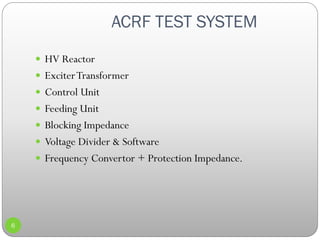
 HV Reactor
 ExciterTransformer
 Control Unit
 Feeding Unit
 Blocking Impedance
 Voltage Divider & Software
 Frequency Convertor + Protection Impedance.
7
SCHEMATIC DIAGRAM OF TEST
SYSTEM
PARALLEL OPERATION MODE OF TEST
SYSTEM
8
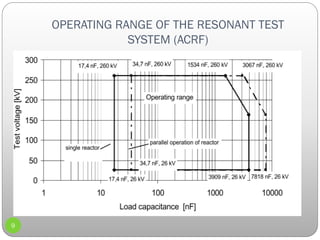
OPERATING RANGE OF THE RESONANT TEST
SYSTEM (ACRF)
9
PARTIAL DISCHARGE
 Partial discharges are a sensitive measure of local electrical
stress and the measurement is often used as a quality check of
the insulation.
Cable has small voids, cavities, insulating contaminant
conductive protrusions in different interfaces or mechanical cuts.
 Erosion by ion bombardment and chemical effects gradually
change small defects to electrical trees with consequent final
breakdown.
10
METHODS OF PD MEASUREMENTS
11
 HIGH FREQUENCY CURRENTTRANSFORMER
HFCT method at cross bonding box for 220 kV or earth wire of 66 kV for XLPE cable
systems Showed high sensitivity and calibration is possible using PD calibrator on the
cable terminations.
 COUPLING CAPACITOR
PD detection of high frequency signal generated from PD activities. Measurement by use of
a coupling capacitor is physically limited to a maximum detectable cable length of
approximately 2 km, depending on cable parameters and PD background noise.
WORKING PRINCIPLE
12
 The sensitivity of the partial discharge detector has to be modified until the
detector shows the calibration charge.
 For 220 kV, PD measurements carried out during HV tests, using a test
sequence providing several increase the voltage in steps of 127 Kv (U0) and take
a PD-measurement recording during 1 minute and afterwards increase the voltage in
further steps until 216 kV
 At each step note the measured PD value.
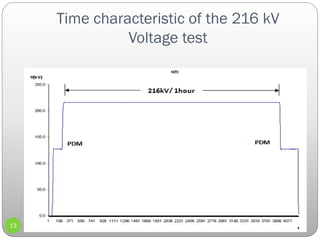
 Once reaching 216 kV leave this voltage applied for 1 hour and observes if
there is a change in the recorded PD pattern and value.
 While ramp the test voltage down, take another PD measurement for 1 minute
at 127 kV.
Time characteristic of the 216 kV
Voltage test
13
PARTIAL DISCHARGE
MEASUREMENT
14
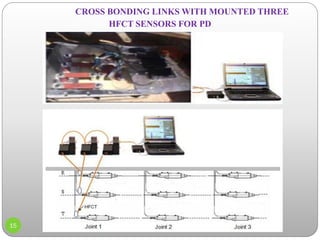
 Internal sensors integrated in each accessory or external
sensors HFCT placed inside bonding link boxes.
 The PD sensitivity using HFCT the central measuring
frequency is recommended is to lie between 2 MHz and 10
MHz in a flat zone of the frequency spectrum.
CROSS BONDING LINKS WITH MOUNTED THREE
HFCT SENSORS FOR PD
15
16
 Test carried out on two cables having specification
1x3x1600 mm2,CU /XLPE/LEAD/HDPE ,220 kV with approximately 13 km long,19
joints/phase, 3 straight joint box and 16 insulated joint box which are divided into two
sections by means of joints and it is terminated by composite three outdoor and three
GIS sealing ends per circuit.
 The result was a resonant frequency of 35.53 Hz for test voltage 216 kV.
 Inject a calibration pulse with known quantity of charge at the outdoor system
termination (i.e., between HV and ground terminals), the sensitivity of the PD detector
has to be modified until the detector shows the calibration charge.
 PD pulses occur in very short time, the width and rise time of the pulses are in the
nanosecond region. Consequently, PD pulses with energy frequency up to hundred
MHZ are generated these PD pulses will travel through the cable earth conductor and
finally can be recorded by the sensors
TEST RESULT & DISCUSSION
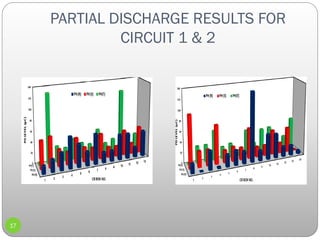
PARTIAL DISCHARGE RESULTS FOR
CIRCUIT 1 & 2
17
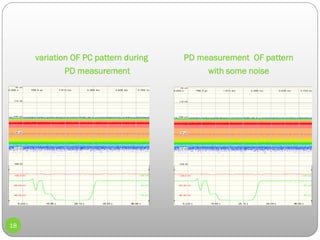
variation OF PC pattern during
PD measurement
PD measurement OF pattern
with some noise
18
19
EXAMPLE OF JOINT FAILURE DURING
WITH STAND TEST BY USING RESONANT TEST
SYSTEM
CONCLUSION
20
 After installation of cable , test for HV/EHV XLPE cables system
by using resonant test system of (20 Hz -300 Hz) combined with
PD detection is performed by using HFCT sensors at each cross
bonding (CB) link boxes reduces the risk from the service.
 After detecting the location of fault and repair the cables and
their accessories was done exactly in the same place given good
results.
 The experiences also show that the test voltage with U0 for 24 h
is not feasible for incidence of failure after the test could be
occurred.
21
22

Insulation testing of power cable

  • 1.
    EE-471 HIGH VOLTAGEENGINEERING Voltage Testing & Partial Discharge Measurement For Power Cable Accessories PRESENTED BY : SYED ATIF CHISHTI SUBMITEDTO : PROF DOC :BULENT BILIR 1
  • 2.
    PRESENTATION SEQUENCE 2  OBECTIVE INTRODUCTION  ACTESTAFTER INSTALLATION  ACRF TEST SYSTEM  SCHEMATIC DIAGRAM OFTEST SYSTEM  PARALLEL OPERATION MODE OFTEST SYSTEM  PARTIAL DISCHARGE METHODS & PRINCIPLE.  DISCUSSION & CONCLUSION. OBJECTIVE :  To compare best practices for cable testing.  Predictive diagnostic programs to aging cable.  To determine the faulty joints cable defects
  • 3.
    INTRODUCTION  Using Frequencytuned resonance Test system (20-300 Hz) to calculate PD measurement.  PD measurement method are necessary to trace defect and insulation of cable.  Voltage testing provide information about defect in the insulation is dangerous or not for later operation.  Calibration is done through PD calibrator on the cable termination. 3  Power Cables importance in Transmission & Distribution system  Consist of :  Cable  Joint  Termination  Identification & Localization of partial discharge.
  • 4.
    AC TEST AFTERINSTALLATION 4  Follow the international standards IEC 60840 and IEC 62067 for testing of Power cable insulation and their accessories.  Apply : sinusoidal waveform, frequency: 20 and 300 Hz, voltage applied for 1.7 U0 /1 hour
  • 5.
    Methods of VoltageGenerated 5  By a reactor with variable inductance and fixed excitation frequency 50 or 60 Hz (ACRL) test system.  By a reactor with fixed inductance and frequency tuned voltage excitation (ACRF) test systems.
  • 6.
    ACRF TEST SYSTEM 6 HV Reactor  ExciterTransformer  Control Unit  Feeding Unit  Blocking Impedance  Voltage Divider & Software  Frequency Convertor + Protection Impedance.
  • 7.
  • 8.
    PARALLEL OPERATION MODEOF TEST SYSTEM 8
  • 9.
    OPERATING RANGE OFTHE RESONANT TEST SYSTEM (ACRF) 9
  • 10.
    PARTIAL DISCHARGE  Partialdischarges are a sensitive measure of local electrical stress and the measurement is often used as a quality check of the insulation. Cable has small voids, cavities, insulating contaminant conductive protrusions in different interfaces or mechanical cuts.  Erosion by ion bombardment and chemical effects gradually change small defects to electrical trees with consequent final breakdown. 10
  • 11.
    METHODS OF PDMEASUREMENTS 11  HIGH FREQUENCY CURRENTTRANSFORMER HFCT method at cross bonding box for 220 kV or earth wire of 66 kV for XLPE cable systems Showed high sensitivity and calibration is possible using PD calibrator on the cable terminations.  COUPLING CAPACITOR PD detection of high frequency signal generated from PD activities. Measurement by use of a coupling capacitor is physically limited to a maximum detectable cable length of approximately 2 km, depending on cable parameters and PD background noise.
  • 12.
    WORKING PRINCIPLE 12  Thesensitivity of the partial discharge detector has to be modified until the detector shows the calibration charge.  For 220 kV, PD measurements carried out during HV tests, using a test sequence providing several increase the voltage in steps of 127 Kv (U0) and take a PD-measurement recording during 1 minute and afterwards increase the voltage in further steps until 216 kV  At each step note the measured PD value.  Once reaching 216 kV leave this voltage applied for 1 hour and observes if there is a change in the recorded PD pattern and value.  While ramp the test voltage down, take another PD measurement for 1 minute at 127 kV.
  • 13.
    Time characteristic ofthe 216 kV Voltage test 13
  • 14.
    PARTIAL DISCHARGE MEASUREMENT 14  Internalsensors integrated in each accessory or external sensors HFCT placed inside bonding link boxes.  The PD sensitivity using HFCT the central measuring frequency is recommended is to lie between 2 MHz and 10 MHz in a flat zone of the frequency spectrum.
  • 15.
    CROSS BONDING LINKSWITH MOUNTED THREE HFCT SENSORS FOR PD 15
  • 16.
    16  Test carriedout on two cables having specification 1x3x1600 mm2,CU /XLPE/LEAD/HDPE ,220 kV with approximately 13 km long,19 joints/phase, 3 straight joint box and 16 insulated joint box which are divided into two sections by means of joints and it is terminated by composite three outdoor and three GIS sealing ends per circuit.  The result was a resonant frequency of 35.53 Hz for test voltage 216 kV.  Inject a calibration pulse with known quantity of charge at the outdoor system termination (i.e., between HV and ground terminals), the sensitivity of the PD detector has to be modified until the detector shows the calibration charge.  PD pulses occur in very short time, the width and rise time of the pulses are in the nanosecond region. Consequently, PD pulses with energy frequency up to hundred MHZ are generated these PD pulses will travel through the cable earth conductor and finally can be recorded by the sensors TEST RESULT & DISCUSSION
  • 17.
    PARTIAL DISCHARGE RESULTSFOR CIRCUIT 1 & 2 17
  • 18.
    variation OF PCpattern during PD measurement PD measurement OF pattern with some noise 18
  • 19.
    19 EXAMPLE OF JOINTFAILURE DURING WITH STAND TEST BY USING RESONANT TEST SYSTEM
  • 20.
    CONCLUSION 20  After installationof cable , test for HV/EHV XLPE cables system by using resonant test system of (20 Hz -300 Hz) combined with PD detection is performed by using HFCT sensors at each cross bonding (CB) link boxes reduces the risk from the service.  After detecting the location of fault and repair the cables and their accessories was done exactly in the same place given good results.  The experiences also show that the test voltage with U0 for 24 h is not feasible for incidence of failure after the test could be occurred.
  • 21.
  • 22.