Angelo Baggini, angelo.baggini@unibg.it, Bergamo University - Engineering Department
Via Marconi 5, 24044 Dalmine (BG) – Italy
Principles of Cable Sizing
Introduction
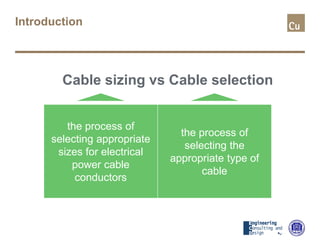
Cable sizing vs Cable selection
Cable sizing is the
process of selecting
appropriate sizes for
electrical power cable
conductors.
the process of
selecting appropriate
sizes for electrical
power cable
conductors
Cable sizing is the
process of selecting
appropriate sizes for
electrical power cable
conductors.
the process of
selecting the
appropriate type of
cable
Process of cable sizing
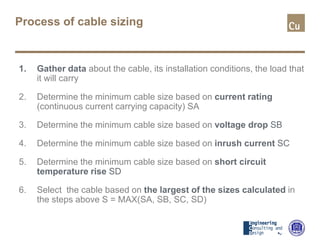
1. Gather data about the cable, its installation conditions, the load that
it will carry
2. Determine the minimum cable size based on current rating
(continuous current carrying capacity) SA
3. Determine the minimum cable size based on voltage drop SB
4. Determine the minimum cable size based on inrush current SC
5. Determine the minimum cable size based on short circuit
temperature rise SD
6. Select the cable based on the largest of the sizes calculated in
the steps above S = MAX(SA, SB, SC, SD)
1. Data gathering
Basic cable data
Load data
Cable installation
1. Data gathering
LOAD DATA
Number of phases
three phase or single phase
Voltage
Rated voltage, allowed voltage drops
Full load current (A) or power (kW or kVA)
Full load power factor (pu)
Length of line
from source to load - this length should be as close as possible to the actual
route of the cable and include enough contingency for vertical drops / rises and
termination of the cable tails
1. Data gathering
BASIC CABLE DATA
• Conductor material
Cu or Al
• Insulation or cable type
PVC, XLPE, EPR (IEC cables),
TW, THHW, XHH, etc. (NEC cables)
• Number of cores
1X, 2X, 3X … or 3G, 4G …
1. Data gathering
CABLE INSTALLATION
Installation method
cable tray / ladder, in conduit / raceways, on a wall, in air, directly
buried, etc
Ambient or soil temperature at the installation site
Cable grouping
number of other cables bunched together or installed in the same area
Cable spacing
whether cables are installed touching or spaced
Soil thermal resistivity
(for underground cables)
Trefoil or laid flat
(for single core three-phase cables)
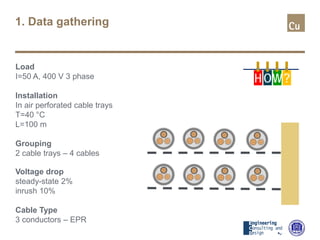
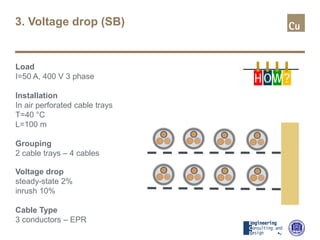
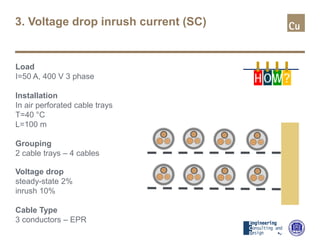
Load
I=50 A, 400 V 3 phase
Installation
In air perforated cable trays
T=40 °C
L=100 m
Grouping
2 cable trays – 4 cables
Voltage drop
steady-state 2%
inrush 10%
Cable Type
3 conductors – EPR
H OW?
1. Data gathering
2. Current rating (SA)
DATA:
• installation method
• cable type
• load sustained current (Ib)
Selection from the Standards of the:
• base current rating (Io)
• correction factors:
• k1 for variation in ambient temperature
• k2 for adjacent circuits
• k3 for variation in burial depth
• k4 for ground thermal resistance
The maximum sustained current rating (Iz):
Iz (S) >= Io · k1 · k2 · k3 · k4 >= Ib
2. Current rating (SA)
Thermal phenomena
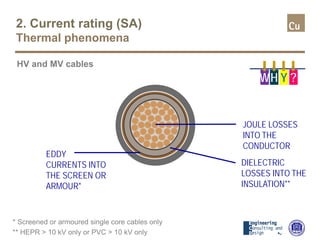
HV and MV cables
WH Y ?
JOULE LOSSES
INTO THE
CONDUCTOR
DIELECTRIC
LOSSES INTO THE
INSULATION**
EDDY
CURRENTS INTO
THE SCREEN OR
ARMOUR*
* Screened or armoured single core cables only
** HEPR > 10 kV only or PVC > 10 kV only
2. Current rating (SA)
Thermal phenomena
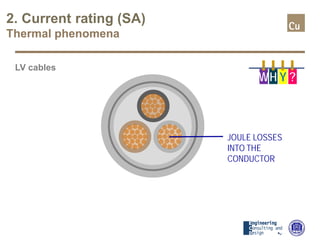
LV cables
WH Y ?
JOULE LOSSES
INTO THE
CONDUCTOR
2. Current rating (SA)
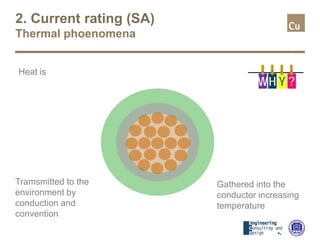
Thermal phoenomena
WH Y ?
Gathered into the
conductor increasing
temperature
Tramsmitted to the
environment by
conduction and
convention
Heat is
2. Current rating (SA)
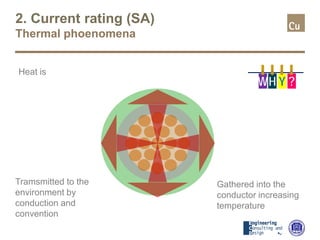
Thermal phoenomena
WH Y ?
Gathered into the
conductor increasing
temperature
Tramsmitted to the
environment by
conduction and
convention
Heat is
2. Current rating (SA)
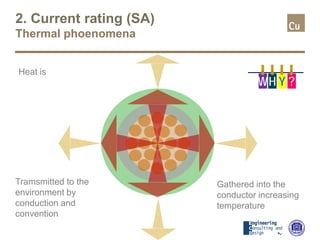
Thermal phoenomena
WH Y ?
Gathered into the
conductor increasing
temperature
Tramsmitted to the
environment by
conduction and
convention
Heat is
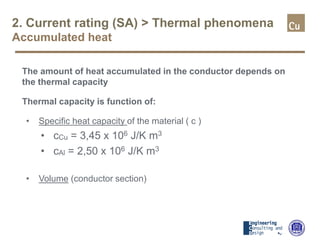
2. Current rating (SA) > Thermal phenomena
Accumulated heat
The amount of heat accumulated in the conductor depends on
the thermal capacity
Thermal capacity is function of:
• Specific heat capacity of the material ( c )
• cCu = 3,45 x 10⁶ J/K m3
• cAl = 2,50 x 10⁶ J/K m3
• Volume (conductor section)
2. Current rating (SA) > Thermal phenomena
Transferred heat
The quantity of transferred heat depends on:
• heat transfer modes (convection, conduction)
• thermal resistance of the "circuit"
2. Current rating (SA) > Thermal phenomena
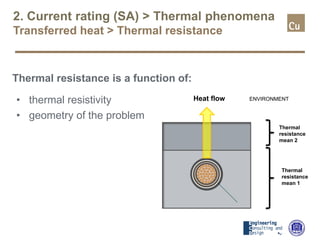
Transferred heat > Thermal resistance
Thermal resistance is a function of:
• thermal resistivity
• geometry of the problem
Heat flow ENVIRONMENT
Thermal
resistance
mean 2
Thermal
resistance
mean 1
2. Current rating (SA) > Thermal phenomena
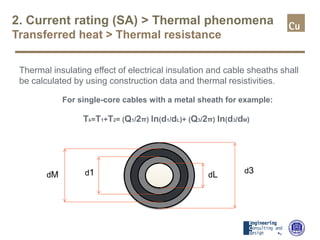
Transferred heat > Thermal resistance
Thermal insulating effect of electrical insulation and cable sheaths shall
be calculated by using construction data and thermal resistivities.
For single-core cables with a metal sheath for example:
Tk=T1+T2= (Q1/2π) ln(d1/dL)+ (Q3/2π) ln(d3/dM)
dM d1 dL d3
2. Current rating (SA) > Thermal phenomena
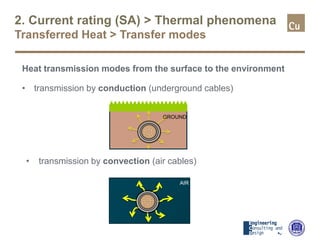
Transferred Heat > Transfer modes
Heat transmission modes from the surface to the environment
• transmission by conduction (underground cables)
• transmission by convection (air cables)
GROUND
AIR
2. Current rating (SA) > Thermal phenomena
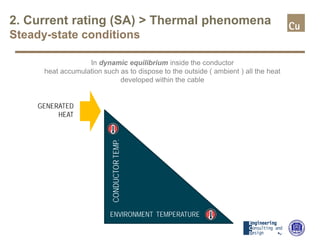
Steady-state conditions
CONDUCTORTEMP.
ENVIRONMENT TEMPERATURE
GENERATED
HEAT
In dynamic equilibrium inside the conductor
heat accumulation such as to dispose to the outside ( ambient ) all the heat
developed within the cable
2. Current rating (SA) > Thermal phenomena
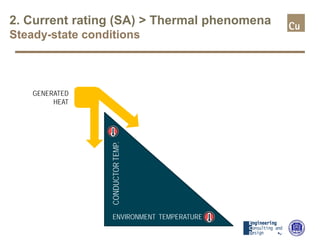
Steady-state conditions
CONDUCTORTEMP.
ENVIRONMENT TEMPERATURE
GENERATED
HEAT
2. Current rating (SA) > Thermal phenomena
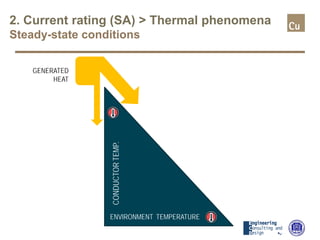
Steady-state conditions
CONDUCTORTEMP.
ENVIRONMENT TEMPERATURE
GENERATED
HEAT
2. Current rating (SA) > Thermal phenomena
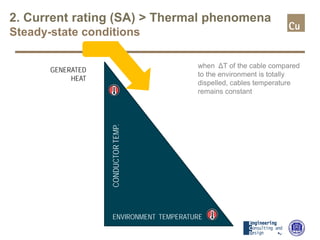
Steady-state conditions
CONDUCTORTEMP.
ENVIRONMENT TEMPERATURE
GENERATED
HEAT
when ΔT of the cable compared
to the environment is totally
dispelled, cables temperature
remains constant
2. Current rating (SA) > Thermal phenomena
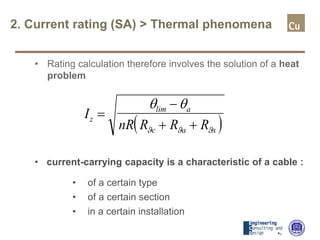
• Rating calculation therefore involves the solution of a heat
problem
• current-carrying capacity is a characteristic of a cable :
• of a certain type
• of a certain section
• in a certain installation
( )
I
nR R R R
z
a
c a x
=
−
+ +
θ θ
ϑ ϑ ϑ
lim
2. Current rating (SA) > Thermal phenomena
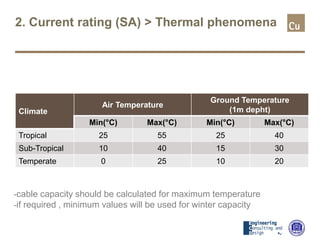
Climate
Air Temperature
Ground Temperature
(1m depht)
Min(°C) Max(°C) Min(°C) Max(°C)
Tropical 25 55 25 40
Sub-Tropical 10 40 15 30
Temperate 0 25 10 20
-cable capacity should be calculated for maximum temperature
-if required , minimum values ​​will be used for winter capacity
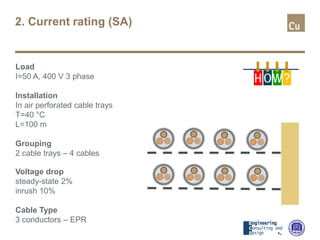
Load
I=50 A, 400 V 3 phase
Installation
In air perforated cable trays
T=40 °C
L=100 m
Grouping
2 cable trays – 4 cables
Voltage drop
steady-state 2%
inrush 10%
Cable Type
3 conductors – EPR
H OW?
2. Current rating (SA)
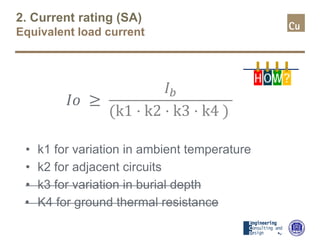
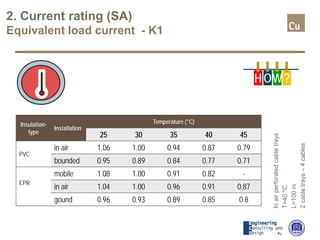
Equivalent load current
• k1 for variation in ambient temperature
• k2 for adjacent circuits
• k3 for variation in burial depth
• K4 for ground thermal resistance
𝐼𝐼𝐼𝐼 ≥
𝐼𝐼𝑏𝑏
(k1 · k2 · k3 · k4 )
H OW?
Inairperforatedcabletrays
T=40°C
L=100m
2cabletrays–4cables
2. Current rating (SA)
Equivalent load current - K1
Insulation-
type
Installation
Temperature (°C)
25 30 35 40 45
PVC
in air 1.06 1.00 0.94 0.87 0.79
bounded 0.95 0.89 0.84 0.77 0.71
EPR
mobile 1.08 1.00 0.91 0.82 -
in air 1.04 1.00 0.96 0.91 0.87
gound 0.96 0.93 0.89 0.85 0.8
H OW?
Inairperforatedcabletrays
T=40°C
L=100m
2cabletrays–4cables
2. Current rating (SA)
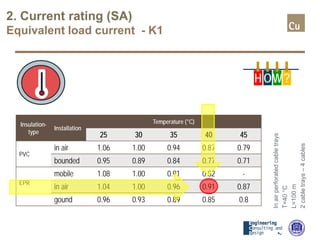
Equivalent load current - K1
Insulation-
type
Installation
Temperature (°C)
25 30 35 40 45
PVC
in air 1.06 1.00 0.94 0.87 0.79
bounded 0.95 0.89 0.84 0.77 0.71
EPR
mobile 1.08 1.00 0.91 0.82 -
in air 1.04 1.00 0.96 0.91 0.87
gound 0.96 0.93 0.89 0.85 0.8
H OW?
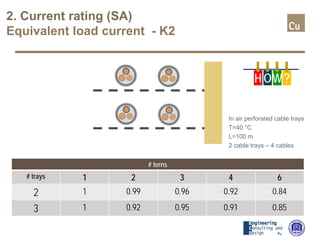
# terns
# trays 1 2 3 4 6
2 1 0.99 0.96 0.92 0.84
3 1 0.92 0.95 0.91 0.85
2. Current rating (SA)
Equivalent load current - K2
In air perforated cable trays
T=40 °C
L=100 m
2 cable trays – 4 cables
H OW?
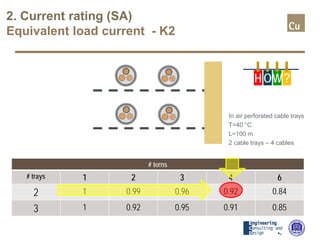
# terns
# trays 1 2 3 4 6
2 1 0.99 0.96 0.92 0.84
3 1 0.92 0.95 0.91 0.85
2. Current rating (SA)
Equivalent load current - K2
In air perforated cable trays
T=40 °C
L=100 m
2 cable trays – 4 cables
H OW?
2. Current rating (SA)
Equivalent load current
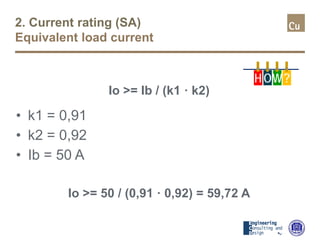
Io >= Ib / (k1 · k2)
• k1 = 0,91
• k2 = 0,92
• Ib = 50 A
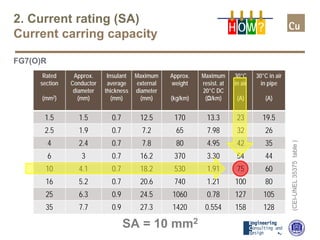
Io >= 50 / (0,91 · 0,92) = 59,72 A
H OW?
Rated
section
(mm2)
Approx.
Conductor
diameter
(mm)
Insulant
average
thickness
(mm)
Maximum
external
diameter
(mm)
Approx.
weight
(kg/km)
Maximum
resist. at
20°C DC
(Ω/km)
30°C
in air
(A)
30°C in air
in pipe
(A)
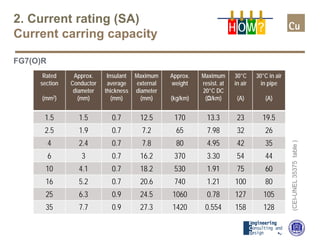
1.5 1.5 0.7 12.5 170 13.3 23 19.5
2.5 1.9 0.7 7.2 65 7.98 32 26
4 2.4 0.7 7.8 80 4.95 42 35
6 3 0.7 16.2 370 3.30 54 44
10 4.1 0.7 18.2 530 1.91 75 60
16 5.2 0.7 20.6 740 1.21 100 80
25 6.3 0.9 24.5 1060 0.78 127 105
35 7.7 0.9 27.3 1420 0.554 158 128
(CEI-UNEL35375table)
2. Current rating (SA)
Current carring capacity
FG7(O)R
H OW?
Rated
section
(mm2)
Approx.
Conductor
diameter
(mm)
Insulant
average
thickness
(mm)
Maximum
external
diameter
(mm)
Approx.
weight
(kg/km)
Maximum
resist. at
20°C DC
(Ω/km)
30°C
in air
(A)
30°C in air
in pipe
(A)
1.5 1.5 0.7 12.5 170 13.3 23 19.5
2.5 1.9 0.7 7.2 65 7.98 32 26
4 2.4 0.7 7.8 80 4.95 42 35
6 3 0.7 16.2 370 3.30 54 44
10 4.1 0.7 18.2 530 1.91 75 60
16 5.2 0.7 20.6 740 1.21 100 80
25 6.3 0.9 24.5 1060 0.78 127 105
35 7.7 0.9 27.3 1420 0.554 158 128
(CEI-UNEL35375table)
2. Current rating (SA)
Current carring capacity
FG7(O)R
H OW?
SA = 10 mm2
3. Voltage drop (SB)
DATA:
• Maximum voltage drop (standard)
• Cable R and X
• Line length (L)
• Load Current I (standard)
• Phase displacement (ϕ) (standard)
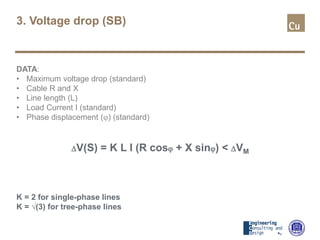
∆V(S) = K L I (R cosϕ + X sinϕ) < ∆VM
K = 2 for single-phase lines
K = √(3) for tree-phase lines
Load
I=50 A, 400 V 3 phase
Installation
In air perforated cable trays
T=40 °C
L=100 m
Grouping
2 cable trays – 4 cables
Voltage drop
steady-state 2%
inrush 10%
Cable Type
3 conductors – EPR
H OW?
3. Voltage drop (SB)
Inairperforatedcabletrays
L=100m
S=6mm2
T(r)=90°C
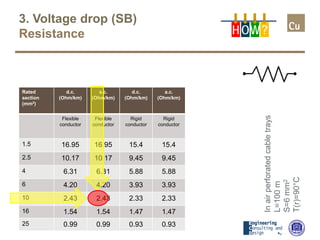
3. Voltage drop (SB)
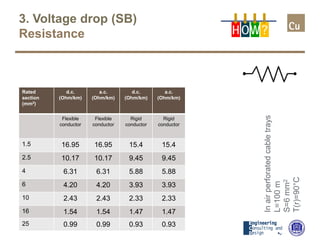
Resistance
Rated
section
(mm2)
d.c.
(Ohm/km)
a.c.
(Ohm/km)
d.c.
(Ohm/km)
a.c.
(Ohm/km)
Flexible
conductor
Flexible
conductor
Rigid
conductor
Rigid
conductor
1.5 16.95 16.95 15.4 15.4
2.5 10.17 10.17 9.45 9.45
4 6.31 6.31 5.88 5.88
6 4.20 4.20 3.93 3.93
10 2.43 2.43 2.33 2.33
16 1.54 1.54 1.47 1.47
25 0.99 0.99 0.93 0.93
H OW?
Inairperforatedcabletrays
L=100m
S=6mm2
T(r)=90°C
3. Voltage drop (SB)
Resistance
Rated
section
(mm2)
d.c.
(Ohm/km)
a.c.
(Ohm/km)
d.c.
(Ohm/km)
a.c.
(Ohm/km)
Flexible
conductor
Flexible
conductor
Rigid
conductor
Rigid
conductor
1.5 16.95 16.95 15.4 15.4
2.5 10.17 10.17 9.45 9.45
4 6.31 6.31 5.88 5.88
6 4.20 4.20 3.93 3.93
10 2.43 2.43 2.33 2.33
16 1.54 1.54 1.47 1.47
25 0.99 0.99 0.93 0.93
H OW?
Inairperforatedcabletrays
L=100m
S=6mm2
T(r)=90°C
F=50Hz
3. Voltage drop (SB)
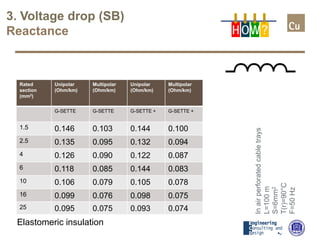
Reactance
Rated
section
(mm2)
Unipolar
(Ohm/km)
Multipolar
(Ohm/km)
Unipolar
(Ohm/km)
Multipolar
(Ohm/km)
G-SETTE G-SETTE G-SETTE + G-SETTE +
1.5 0.146 0.103 0.144 0.100
2.5 0.135 0.095 0.132 0.094
4 0.126 0.090 0.122 0.087
6 0.118 0.085 0.144 0.083
10 0.106 0.079 0.105 0.078
16 0.099 0.076 0.098 0.075
25 0.095 0.075 0.093 0.074
Elastomeric insulation
H OW?
Inairperforatedcabletrays
L=100m
S=6mm2
T(r)=90°C
F=50Hz
3. Voltage drop (SB)
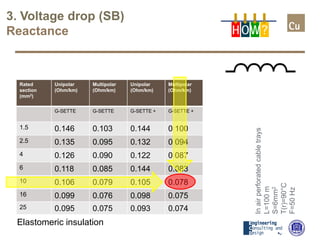
Reactance
Rated
section
(mm2)
Unipolar
(Ohm/km)
Multipolar
(Ohm/km)
Unipolar
(Ohm/km)
Multipolar
(Ohm/km)
G-SETTE G-SETTE G-SETTE + G-SETTE +
1.5 0.146 0.103 0.144 0.100
2.5 0.135 0.095 0.132 0.094
4 0.126 0.090 0.122 0.087
6 0.118 0.085 0.144 0.083
10 0.106 0.079 0.105 0.078
16 0.099 0.076 0.098 0.075
25 0.095 0.075 0.093 0.074
Elastomeric insulation
H OW?
3. Voltage drop (SB)
Size selection
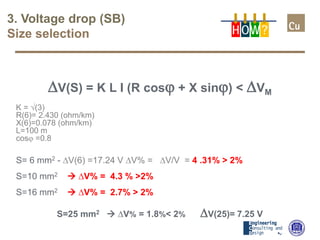
∆V(S) = K L I (R cosϕ + X sinϕ) < ∆VM
K = √(3)
R(6)= 2.430 (ohm/km)
X(6)=0.078 (ohm/km)
L=100 m
cosϕ =0.8
S= 6 mm2 - ∆V(6) =17.24 V ∆V% = ∆V/V = 4 .31% > 2%
S=10 mm2  ∆V% = 4.3 % >2%
S=16 mm2  ∆V% = 2.7% > 2%
S=25 mm2  ∆V% = 1.8%< 2% ∆V(25)= 7.25 V
H OW?
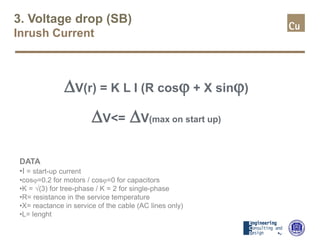
3. Voltage drop (SB)
Inrush Current
∆V(r) = K L I (R cosϕ + X sinϕ)
∆V<= ∆V(max on start up)
DATA
•I = start-up current
•cosϕ=0.2 for motors / cosϕ=0 for capacitors
•K = √(3) for tree-phase / K = 2 for single-phase
•R= resistance in the service temperature
•X= reactance in service of the cable (AC lines only)
•L= lenght
Load
I=50 A, 400 V 3 phase
Installation
In air perforated cable trays
T=40 °C
L=100 m
Grouping
2 cable trays – 4 cables
Voltage drop
steady-state 2%
inrush 10%
Cable Type
3 conductors – EPR
H OW?
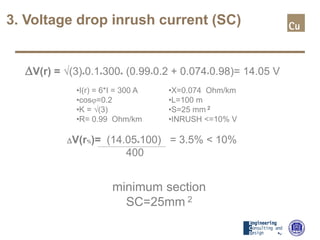
3. Voltage drop inrush current (SC)
∆V(r%)= (14.05*100) = 3.5% < 10%
400
•I(r) = 6*I = 300 A
•cosϕ=0.2
•K = √(3)
•R= 0.99 Ohm/km
∆V(r) = √(3)*0.1*300* (0.99*0.2 + 0.074*0.98)= 14.05 V
•X=0.074 Ohm/km
•L=100 m
•S=25 mm 2
•INRUSH <=10% V
minimum section
SC=25mm 2
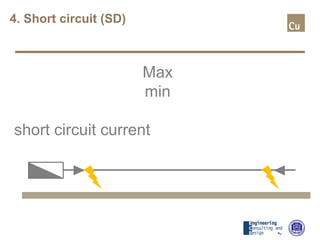
4. Short circuit (SD)
Max
min
short circuit current
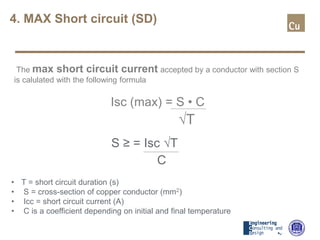
4. MAX Short circuit (SD)
S ≥ = Isc √T
C
• T = short circuit duration (s)
• S = cross-section of copper conductor (mm2)
• Icc = short circuit current (A)
• C is a coefficient depending on initial and final temperature
The max short circuit current accepted by a conductor with section S
is calulated with the following formula
Isc (max) = S • C
√T
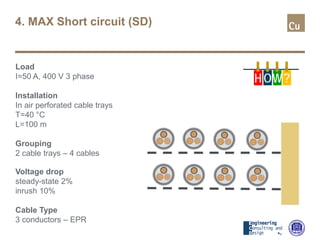
Load
I=50 A, 400 V 3 phase
Installation
In air perforated cable trays
T=40 °C
L=100 m
Grouping
2 cable trays – 4 cables
Voltage drop
steady-state 2%
inrush 10%
Cable Type
3 conductors – EPR
H OW?
4. MAX Short circuit (SD)
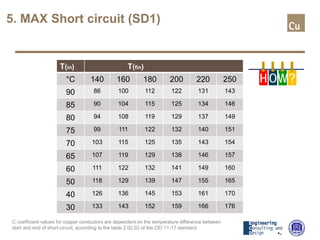
5. MAX Short circuit (SD1)
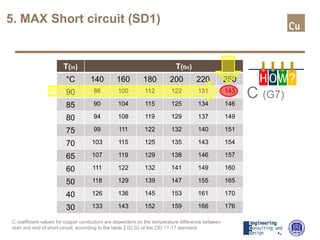
C coefficient values for copper conductors are dependent on the temperature difference between
start and end of short-circuit, according to the table 2.02.02 of the CEI 11-17 standard
T(in) T(fin)
°C 140 160 180 200 220 250
90 86 100 112 122 131 143
85 90 104 115 125 134 146
80 94 108 119 129 137 149
75 99 111 122 132 140 151
70 103 115 125 135 143 154
65 107 119 129 138 146 157
60 111 122 132 141 149 160
50 118 129 139 147 155 165
40 126 136 145 153 161 170
30 133 143 152 159 166 176
H OW?
5. MAX Short circuit (SD1)
C coefficient values for copper conductors are dependent on the temperature difference between
start and end of short-circuit, according to the table 2.02.02 of the CEI 11-17 standard
T(in) T(fin)
°C 140 160 180 200 220 250
90 86 100 112 122 131 143
85 90 104 115 125 134 146
80 94 108 119 129 137 149
75 99 111 122 132 140 151
70 103 115 125 135 143 154
65 107 119 129 138 146 157
60 111 122 132 141 149 160
50 118 129 139 147 155 165
40 126 136 145 153 161 170
30 133 143 152 159 166 176
C (G7)
H OW?
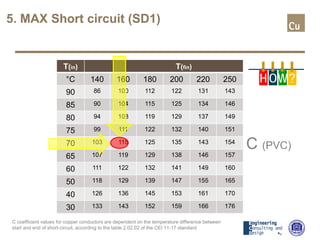
5. MAX Short circuit (SD1)
C coefficient values for copper conductors are dependent on the temperature difference between
start and end of short-circuit, according to the table 2.02.02 of the CEI 11-17 standard
T(in) T(fin)
°C 140 160 180 200 220 250
90 86 100 112 122 131 143
85 90 104 115 125 134 146
80 94 108 119 129 137 149
75 99 111 122 132 140 151
70 103 115 125 135 143 154
65 107 119 129 138 146 157
60 111 122 132 141 149 160
50 118 129 139 147 155 165
40 126 136 145 153 161 170
30 133 143 152 159 166 176
C (PVC)
H OW?
5. MAX Short circuit (SD1)
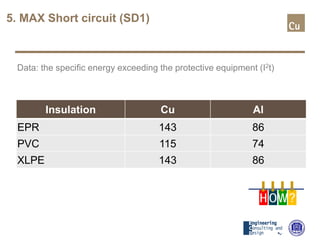
Data: the specific energy exceeding the protective equipment (I2t)
Insulation Cu Al
EPR 143 86
PVC 115 74
XLPE 143 86
H OW?
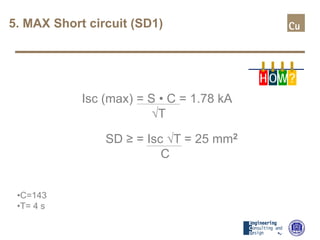
5. MAX Short circuit (SD1)
Isc (max) = S • C = 1.78 kA
√T
SD ≥ = Isc √T = 25 mm2
C
•C=143
•T= 4 s
H OW?
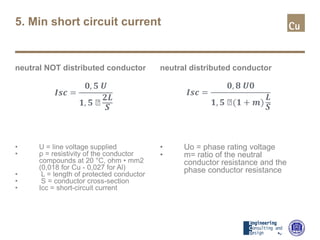
5. Min short circuit current
neutral NOT distributed conductor
𝑰𝑰𝑰𝑰𝑰𝑰 =
𝟎𝟎, 𝟓𝟓 𝑼𝑼
𝟏𝟏, 𝟓𝟓 �
𝟐𝟐𝟐𝟐
𝑺𝑺
• U = line voltage supplied
• ρ = resistivity of the conductor
compounds at 20 °C, ohm • mm2
(0,018 for Cu - 0,027 for Al)
• L = length of protected conductor
• S = conductor cross-section
• Icc = short-circuit current
neutral distributed conductor
𝑰𝑰𝑰𝑰𝑰𝑰 =
𝟎𝟎, 𝟖𝟖 𝑼𝑼𝑼𝑼
𝟏𝟏, 𝟓𝟓 �(𝟏𝟏 + 𝒎𝒎)
𝑳𝑳
𝑺𝑺
• Uo = phase rating voltage
• m= ratio of the neutral
conductor resistance and the
phase conductor resistance
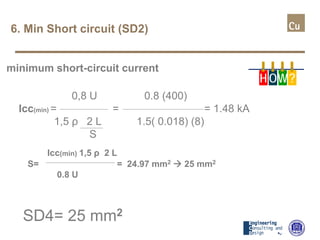
6. Min Short circuit (SD2)
minimum short-circuit current
0,8 U 0.8 (400)
Icc(min) = = = 1.48 kA
1,5 ρ 2 L 1.5( 0.018) (8)
S
SD4= 25 mm2
Icc(min) 1,5 ρ 2 L
S= = 24.97 mm2  25 mm2
0.8 U
H OW?
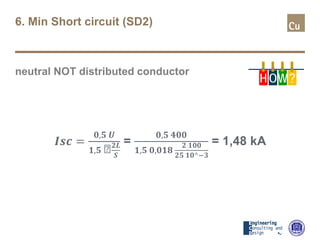
6. Min Short circuit (SD2)
neutral NOT distributed conductor
𝑰𝑰𝑰𝑰𝑰𝑰 =
𝟎𝟎,𝟓𝟓 𝑼𝑼
𝟏𝟏,𝟓𝟓 �𝟐𝟐𝟐𝟐
𝑺𝑺
=
𝟎𝟎,𝟓𝟓 𝟒𝟒𝟒𝟒𝟒𝟒
𝟏𝟏,𝟓𝟓 𝟎𝟎,𝟎𝟎𝟎𝟎𝟎𝟎
𝟐𝟐 𝟏𝟏𝟏𝟏𝟏𝟏
𝟐𝟐𝟐𝟐 𝟏𝟏𝟏𝟏^−𝟑𝟑
= 1,48 kA
H OW?
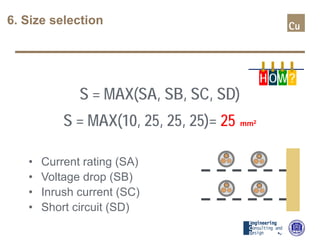
6. Size selection
S = MAX(SA, SB, SC, SD)
S = MAX(10, 25, 25, 25)= 25 mm2
• Current rating (SA)
• Voltage drop (SB)
• Inrush current (SC)
• Short circuit (SD)
H OW?
Thank you
| Presentation title and date
For more information please contact
Angelo Baggini
Università di Bergamo
Dipartimento di Ingegneria
Viale Marconi 5,
24044 Dalmine (BG) Italy
email: angelo.baggini@unibg.it
ECD Engineering Consulting and Design
Via Maffi 21 27100 PAVIA Italy

Principles of Cable Sizing

  • 1.
    Angelo Baggini, angelo.baggini@unibg.it,Bergamo University - Engineering Department Via Marconi 5, 24044 Dalmine (BG) – Italy Principles of Cable Sizing
  • 2.
    Introduction Cable sizing vsCable selection Cable sizing is the process of selecting appropriate sizes for electrical power cable conductors. the process of selecting appropriate sizes for electrical power cable conductors Cable sizing is the process of selecting appropriate sizes for electrical power cable conductors. the process of selecting the appropriate type of cable
  • 3.
    Process of cablesizing 1. Gather data about the cable, its installation conditions, the load that it will carry 2. Determine the minimum cable size based on current rating (continuous current carrying capacity) SA 3. Determine the minimum cable size based on voltage drop SB 4. Determine the minimum cable size based on inrush current SC 5. Determine the minimum cable size based on short circuit temperature rise SD 6. Select the cable based on the largest of the sizes calculated in the steps above S = MAX(SA, SB, SC, SD)
  • 4.
    1. Data gathering Basiccable data Load data Cable installation
  • 5.
    1. Data gathering LOADDATA Number of phases three phase or single phase Voltage Rated voltage, allowed voltage drops Full load current (A) or power (kW or kVA) Full load power factor (pu) Length of line from source to load - this length should be as close as possible to the actual route of the cable and include enough contingency for vertical drops / rises and termination of the cable tails
  • 6.
    1. Data gathering BASICCABLE DATA • Conductor material Cu or Al • Insulation or cable type PVC, XLPE, EPR (IEC cables), TW, THHW, XHH, etc. (NEC cables) • Number of cores 1X, 2X, 3X … or 3G, 4G …
  • 7.
    1. Data gathering CABLEINSTALLATION Installation method cable tray / ladder, in conduit / raceways, on a wall, in air, directly buried, etc Ambient or soil temperature at the installation site Cable grouping number of other cables bunched together or installed in the same area Cable spacing whether cables are installed touching or spaced Soil thermal resistivity (for underground cables) Trefoil or laid flat (for single core three-phase cables)
  • 8.
    Load I=50 A, 400V 3 phase Installation In air perforated cable trays T=40 °C L=100 m Grouping 2 cable trays – 4 cables Voltage drop steady-state 2% inrush 10% Cable Type 3 conductors – EPR H OW? 1. Data gathering
  • 9.
    2. Current rating(SA) DATA: • installation method • cable type • load sustained current (Ib) Selection from the Standards of the: • base current rating (Io) • correction factors: • k1 for variation in ambient temperature • k2 for adjacent circuits • k3 for variation in burial depth • k4 for ground thermal resistance The maximum sustained current rating (Iz): Iz (S) >= Io · k1 · k2 · k3 · k4 >= Ib
  • 10.
    2. Current rating(SA) Thermal phenomena HV and MV cables WH Y ? JOULE LOSSES INTO THE CONDUCTOR DIELECTRIC LOSSES INTO THE INSULATION** EDDY CURRENTS INTO THE SCREEN OR ARMOUR* * Screened or armoured single core cables only ** HEPR > 10 kV only or PVC > 10 kV only
  • 11.
    2. Current rating(SA) Thermal phenomena LV cables WH Y ? JOULE LOSSES INTO THE CONDUCTOR
  • 12.
    2. Current rating(SA) Thermal phoenomena WH Y ? Gathered into the conductor increasing temperature Tramsmitted to the environment by conduction and convention Heat is
  • 13.
    2. Current rating(SA) Thermal phoenomena WH Y ? Gathered into the conductor increasing temperature Tramsmitted to the environment by conduction and convention Heat is
  • 14.
    2. Current rating(SA) Thermal phoenomena WH Y ? Gathered into the conductor increasing temperature Tramsmitted to the environment by conduction and convention Heat is
  • 15.
    2. Current rating(SA) > Thermal phenomena Accumulated heat The amount of heat accumulated in the conductor depends on the thermal capacity Thermal capacity is function of: • Specific heat capacity of the material ( c ) • cCu = 3,45 x 10⁶ J/K m3 • cAl = 2,50 x 10⁶ J/K m3 • Volume (conductor section)
  • 16.
    2. Current rating(SA) > Thermal phenomena Transferred heat The quantity of transferred heat depends on: • heat transfer modes (convection, conduction) • thermal resistance of the "circuit"
  • 17.
    2. Current rating(SA) > Thermal phenomena Transferred heat > Thermal resistance Thermal resistance is a function of: • thermal resistivity • geometry of the problem Heat flow ENVIRONMENT Thermal resistance mean 2 Thermal resistance mean 1
  • 18.
    2. Current rating(SA) > Thermal phenomena Transferred heat > Thermal resistance Thermal insulating effect of electrical insulation and cable sheaths shall be calculated by using construction data and thermal resistivities. For single-core cables with a metal sheath for example: Tk=T1+T2= (Q1/2π) ln(d1/dL)+ (Q3/2π) ln(d3/dM) dM d1 dL d3
  • 19.
    2. Current rating(SA) > Thermal phenomena Transferred Heat > Transfer modes Heat transmission modes from the surface to the environment • transmission by conduction (underground cables) • transmission by convection (air cables) GROUND AIR
  • 20.
    2. Current rating(SA) > Thermal phenomena Steady-state conditions CONDUCTORTEMP. ENVIRONMENT TEMPERATURE GENERATED HEAT In dynamic equilibrium inside the conductor heat accumulation such as to dispose to the outside ( ambient ) all the heat developed within the cable
  • 21.
    2. Current rating(SA) > Thermal phenomena Steady-state conditions CONDUCTORTEMP. ENVIRONMENT TEMPERATURE GENERATED HEAT
  • 22.
    2. Current rating(SA) > Thermal phenomena Steady-state conditions CONDUCTORTEMP. ENVIRONMENT TEMPERATURE GENERATED HEAT
  • 23.
    2. Current rating(SA) > Thermal phenomena Steady-state conditions CONDUCTORTEMP. ENVIRONMENT TEMPERATURE GENERATED HEAT when ΔT of the cable compared to the environment is totally dispelled, cables temperature remains constant
  • 24.
    2. Current rating(SA) > Thermal phenomena • Rating calculation therefore involves the solution of a heat problem • current-carrying capacity is a characteristic of a cable : • of a certain type • of a certain section • in a certain installation ( ) I nR R R R z a c a x = − + + θ θ ϑ ϑ ϑ lim
  • 25.
    2. Current rating(SA) > Thermal phenomena Climate Air Temperature Ground Temperature (1m depht) Min(°C) Max(°C) Min(°C) Max(°C) Tropical 25 55 25 40 Sub-Tropical 10 40 15 30 Temperate 0 25 10 20 -cable capacity should be calculated for maximum temperature -if required , minimum values ​​will be used for winter capacity
  • 26.
    Load I=50 A, 400V 3 phase Installation In air perforated cable trays T=40 °C L=100 m Grouping 2 cable trays – 4 cables Voltage drop steady-state 2% inrush 10% Cable Type 3 conductors – EPR H OW? 2. Current rating (SA)
  • 27.
    2. Current rating(SA) Equivalent load current • k1 for variation in ambient temperature • k2 for adjacent circuits • k3 for variation in burial depth • K4 for ground thermal resistance 𝐼𝐼𝐼𝐼 ≥ 𝐼𝐼𝑏𝑏 (k1 · k2 · k3 · k4 ) H OW?
  • 28.
    Inairperforatedcabletrays T=40°C L=100m 2cabletrays–4cables 2. Current rating(SA) Equivalent load current - K1 Insulation- type Installation Temperature (°C) 25 30 35 40 45 PVC in air 1.06 1.00 0.94 0.87 0.79 bounded 0.95 0.89 0.84 0.77 0.71 EPR mobile 1.08 1.00 0.91 0.82 - in air 1.04 1.00 0.96 0.91 0.87 gound 0.96 0.93 0.89 0.85 0.8 H OW?
  • 29.
    Inairperforatedcabletrays T=40°C L=100m 2cabletrays–4cables 2. Current rating(SA) Equivalent load current - K1 Insulation- type Installation Temperature (°C) 25 30 35 40 45 PVC in air 1.06 1.00 0.94 0.87 0.79 bounded 0.95 0.89 0.84 0.77 0.71 EPR mobile 1.08 1.00 0.91 0.82 - in air 1.04 1.00 0.96 0.91 0.87 gound 0.96 0.93 0.89 0.85 0.8 H OW?
  • 30.
    # terns # trays1 2 3 4 6 2 1 0.99 0.96 0.92 0.84 3 1 0.92 0.95 0.91 0.85 2. Current rating (SA) Equivalent load current - K2 In air perforated cable trays T=40 °C L=100 m 2 cable trays – 4 cables H OW?
  • 31.
    # terns # trays1 2 3 4 6 2 1 0.99 0.96 0.92 0.84 3 1 0.92 0.95 0.91 0.85 2. Current rating (SA) Equivalent load current - K2 In air perforated cable trays T=40 °C L=100 m 2 cable trays – 4 cables H OW?
  • 32.
    2. Current rating(SA) Equivalent load current Io >= Ib / (k1 · k2) • k1 = 0,91 • k2 = 0,92 • Ib = 50 A Io >= 50 / (0,91 · 0,92) = 59,72 A H OW?
  • 33.
    Rated section (mm2) Approx. Conductor diameter (mm) Insulant average thickness (mm) Maximum external diameter (mm) Approx. weight (kg/km) Maximum resist. at 20°C DC (Ω/km) 30°C inair (A) 30°C in air in pipe (A) 1.5 1.5 0.7 12.5 170 13.3 23 19.5 2.5 1.9 0.7 7.2 65 7.98 32 26 4 2.4 0.7 7.8 80 4.95 42 35 6 3 0.7 16.2 370 3.30 54 44 10 4.1 0.7 18.2 530 1.91 75 60 16 5.2 0.7 20.6 740 1.21 100 80 25 6.3 0.9 24.5 1060 0.78 127 105 35 7.7 0.9 27.3 1420 0.554 158 128 (CEI-UNEL35375table) 2. Current rating (SA) Current carring capacity FG7(O)R H OW?
  • 34.
    Rated section (mm2) Approx. Conductor diameter (mm) Insulant average thickness (mm) Maximum external diameter (mm) Approx. weight (kg/km) Maximum resist. at 20°C DC (Ω/km) 30°C inair (A) 30°C in air in pipe (A) 1.5 1.5 0.7 12.5 170 13.3 23 19.5 2.5 1.9 0.7 7.2 65 7.98 32 26 4 2.4 0.7 7.8 80 4.95 42 35 6 3 0.7 16.2 370 3.30 54 44 10 4.1 0.7 18.2 530 1.91 75 60 16 5.2 0.7 20.6 740 1.21 100 80 25 6.3 0.9 24.5 1060 0.78 127 105 35 7.7 0.9 27.3 1420 0.554 158 128 (CEI-UNEL35375table) 2. Current rating (SA) Current carring capacity FG7(O)R H OW? SA = 10 mm2
  • 35.
    3. Voltage drop(SB) DATA: • Maximum voltage drop (standard) • Cable R and X • Line length (L) • Load Current I (standard) • Phase displacement (ϕ) (standard) ∆V(S) = K L I (R cosϕ + X sinϕ) < ∆VM K = 2 for single-phase lines K = √(3) for tree-phase lines
  • 36.
    Load I=50 A, 400V 3 phase Installation In air perforated cable trays T=40 °C L=100 m Grouping 2 cable trays – 4 cables Voltage drop steady-state 2% inrush 10% Cable Type 3 conductors – EPR H OW? 3. Voltage drop (SB)
  • 37.
    Inairperforatedcabletrays L=100m S=6mm2 T(r)=90°C 3. Voltage drop(SB) Resistance Rated section (mm2) d.c. (Ohm/km) a.c. (Ohm/km) d.c. (Ohm/km) a.c. (Ohm/km) Flexible conductor Flexible conductor Rigid conductor Rigid conductor 1.5 16.95 16.95 15.4 15.4 2.5 10.17 10.17 9.45 9.45 4 6.31 6.31 5.88 5.88 6 4.20 4.20 3.93 3.93 10 2.43 2.43 2.33 2.33 16 1.54 1.54 1.47 1.47 25 0.99 0.99 0.93 0.93 H OW?
  • 38.
    Inairperforatedcabletrays L=100m S=6mm2 T(r)=90°C 3. Voltage drop(SB) Resistance Rated section (mm2) d.c. (Ohm/km) a.c. (Ohm/km) d.c. (Ohm/km) a.c. (Ohm/km) Flexible conductor Flexible conductor Rigid conductor Rigid conductor 1.5 16.95 16.95 15.4 15.4 2.5 10.17 10.17 9.45 9.45 4 6.31 6.31 5.88 5.88 6 4.20 4.20 3.93 3.93 10 2.43 2.43 2.33 2.33 16 1.54 1.54 1.47 1.47 25 0.99 0.99 0.93 0.93 H OW?
  • 39.
    Inairperforatedcabletrays L=100m S=6mm2 T(r)=90°C F=50Hz 3. Voltage drop(SB) Reactance Rated section (mm2) Unipolar (Ohm/km) Multipolar (Ohm/km) Unipolar (Ohm/km) Multipolar (Ohm/km) G-SETTE G-SETTE G-SETTE + G-SETTE + 1.5 0.146 0.103 0.144 0.100 2.5 0.135 0.095 0.132 0.094 4 0.126 0.090 0.122 0.087 6 0.118 0.085 0.144 0.083 10 0.106 0.079 0.105 0.078 16 0.099 0.076 0.098 0.075 25 0.095 0.075 0.093 0.074 Elastomeric insulation H OW?
  • 40.
    Inairperforatedcabletrays L=100m S=6mm2 T(r)=90°C F=50Hz 3. Voltage drop(SB) Reactance Rated section (mm2) Unipolar (Ohm/km) Multipolar (Ohm/km) Unipolar (Ohm/km) Multipolar (Ohm/km) G-SETTE G-SETTE G-SETTE + G-SETTE + 1.5 0.146 0.103 0.144 0.100 2.5 0.135 0.095 0.132 0.094 4 0.126 0.090 0.122 0.087 6 0.118 0.085 0.144 0.083 10 0.106 0.079 0.105 0.078 16 0.099 0.076 0.098 0.075 25 0.095 0.075 0.093 0.074 Elastomeric insulation H OW?
  • 41.
    3. Voltage drop(SB) Size selection ∆V(S) = K L I (R cosϕ + X sinϕ) < ∆VM K = √(3) R(6)= 2.430 (ohm/km) X(6)=0.078 (ohm/km) L=100 m cosϕ =0.8 S= 6 mm2 - ∆V(6) =17.24 V ∆V% = ∆V/V = 4 .31% > 2% S=10 mm2  ∆V% = 4.3 % >2% S=16 mm2  ∆V% = 2.7% > 2% S=25 mm2  ∆V% = 1.8%< 2% ∆V(25)= 7.25 V H OW?
  • 42.
    3. Voltage drop(SB) Inrush Current ∆V(r) = K L I (R cosϕ + X sinϕ) ∆V<= ∆V(max on start up) DATA •I = start-up current •cosϕ=0.2 for motors / cosϕ=0 for capacitors •K = √(3) for tree-phase / K = 2 for single-phase •R= resistance in the service temperature •X= reactance in service of the cable (AC lines only) •L= lenght
  • 43.
    Load I=50 A, 400V 3 phase Installation In air perforated cable trays T=40 °C L=100 m Grouping 2 cable trays – 4 cables Voltage drop steady-state 2% inrush 10% Cable Type 3 conductors – EPR H OW? 3. Voltage drop inrush current (SC)
  • 44.
    3. Voltage dropinrush current (SC) ∆V(r%)= (14.05*100) = 3.5% < 10% 400 •I(r) = 6*I = 300 A •cosϕ=0.2 •K = √(3) •R= 0.99 Ohm/km ∆V(r) = √(3)*0.1*300* (0.99*0.2 + 0.074*0.98)= 14.05 V •X=0.074 Ohm/km •L=100 m •S=25 mm 2 •INRUSH <=10% V minimum section SC=25mm 2
  • 45.
    4. Short circuit(SD) Max min short circuit current
  • 46.
    4. MAX Shortcircuit (SD) S ≥ = Isc √T C • T = short circuit duration (s) • S = cross-section of copper conductor (mm2) • Icc = short circuit current (A) • C is a coefficient depending on initial and final temperature The max short circuit current accepted by a conductor with section S is calulated with the following formula Isc (max) = S • C √T
  • 47.
    Load I=50 A, 400V 3 phase Installation In air perforated cable trays T=40 °C L=100 m Grouping 2 cable trays – 4 cables Voltage drop steady-state 2% inrush 10% Cable Type 3 conductors – EPR H OW? 4. MAX Short circuit (SD)
  • 48.
    5. MAX Shortcircuit (SD1) C coefficient values for copper conductors are dependent on the temperature difference between start and end of short-circuit, according to the table 2.02.02 of the CEI 11-17 standard T(in) T(fin) °C 140 160 180 200 220 250 90 86 100 112 122 131 143 85 90 104 115 125 134 146 80 94 108 119 129 137 149 75 99 111 122 132 140 151 70 103 115 125 135 143 154 65 107 119 129 138 146 157 60 111 122 132 141 149 160 50 118 129 139 147 155 165 40 126 136 145 153 161 170 30 133 143 152 159 166 176 H OW?
  • 49.
    5. MAX Shortcircuit (SD1) C coefficient values for copper conductors are dependent on the temperature difference between start and end of short-circuit, according to the table 2.02.02 of the CEI 11-17 standard T(in) T(fin) °C 140 160 180 200 220 250 90 86 100 112 122 131 143 85 90 104 115 125 134 146 80 94 108 119 129 137 149 75 99 111 122 132 140 151 70 103 115 125 135 143 154 65 107 119 129 138 146 157 60 111 122 132 141 149 160 50 118 129 139 147 155 165 40 126 136 145 153 161 170 30 133 143 152 159 166 176 C (G7) H OW?
  • 50.
    5. MAX Shortcircuit (SD1) C coefficient values for copper conductors are dependent on the temperature difference between start and end of short-circuit, according to the table 2.02.02 of the CEI 11-17 standard T(in) T(fin) °C 140 160 180 200 220 250 90 86 100 112 122 131 143 85 90 104 115 125 134 146 80 94 108 119 129 137 149 75 99 111 122 132 140 151 70 103 115 125 135 143 154 65 107 119 129 138 146 157 60 111 122 132 141 149 160 50 118 129 139 147 155 165 40 126 136 145 153 161 170 30 133 143 152 159 166 176 C (PVC) H OW?
  • 51.
    5. MAX Shortcircuit (SD1) Data: the specific energy exceeding the protective equipment (I2t) Insulation Cu Al EPR 143 86 PVC 115 74 XLPE 143 86 H OW?
  • 52.
    5. MAX Shortcircuit (SD1) Isc (max) = S • C = 1.78 kA √T SD ≥ = Isc √T = 25 mm2 C •C=143 •T= 4 s H OW?
  • 53.
    5. Min shortcircuit current neutral NOT distributed conductor 𝑰𝑰𝑰𝑰𝑰𝑰 = 𝟎𝟎, 𝟓𝟓 𝑼𝑼 𝟏𝟏, 𝟓𝟓 � 𝟐𝟐𝟐𝟐 𝑺𝑺 • U = line voltage supplied • ρ = resistivity of the conductor compounds at 20 °C, ohm • mm2 (0,018 for Cu - 0,027 for Al) • L = length of protected conductor • S = conductor cross-section • Icc = short-circuit current neutral distributed conductor 𝑰𝑰𝑰𝑰𝑰𝑰 = 𝟎𝟎, 𝟖𝟖 𝑼𝑼𝑼𝑼 𝟏𝟏, 𝟓𝟓 �(𝟏𝟏 + 𝒎𝒎) 𝑳𝑳 𝑺𝑺 • Uo = phase rating voltage • m= ratio of the neutral conductor resistance and the phase conductor resistance
  • 54.
    6. Min Shortcircuit (SD2) minimum short-circuit current 0,8 U 0.8 (400) Icc(min) = = = 1.48 kA 1,5 ρ 2 L 1.5( 0.018) (8) S SD4= 25 mm2 Icc(min) 1,5 ρ 2 L S= = 24.97 mm2  25 mm2 0.8 U H OW?
  • 55.
    6. Min Shortcircuit (SD2) neutral NOT distributed conductor 𝑰𝑰𝑰𝑰𝑰𝑰 = 𝟎𝟎,𝟓𝟓 𝑼𝑼 𝟏𝟏,𝟓𝟓 �𝟐𝟐𝟐𝟐 𝑺𝑺 = 𝟎𝟎,𝟓𝟓 𝟒𝟒𝟒𝟒𝟒𝟒 𝟏𝟏,𝟓𝟓 𝟎𝟎,𝟎𝟎𝟎𝟎𝟎𝟎 𝟐𝟐 𝟏𝟏𝟏𝟏𝟏𝟏 𝟐𝟐𝟐𝟐 𝟏𝟏𝟏𝟏^−𝟑𝟑 = 1,48 kA H OW?
  • 56.
    6. Size selection S= MAX(SA, SB, SC, SD) S = MAX(10, 25, 25, 25)= 25 mm2 • Current rating (SA) • Voltage drop (SB) • Inrush current (SC) • Short circuit (SD) H OW?
  • 57.
    Thank you | Presentationtitle and date For more information please contact Angelo Baggini Università di Bergamo Dipartimento di Ingegneria Viale Marconi 5, 24044 Dalmine (BG) Italy email: angelo.baggini@unibg.it ECD Engineering Consulting and Design Via Maffi 21 27100 PAVIA Italy