DR JOEL ARUDCHELVAM
CONSULTANTVASCULAR ANDTRANSPLANT SURGEON
Arterial aneurysms
 Abnormal focal dilatation of a vessel of more
than 50 percent of its normal diameter
 Abdominal aorta more than 3 cms – normal
diameter is about 2 cms
 Ectasia - A focal dilatation between normal
size and 50%
 Arteriomegaly - diffuse dilatation of arteries
Types of aneurysm
Based on wall characteristics
True – all layers of the vessel wall is involved
False – all layers are not involved
 Wall is formed by organized haematoma and
center has flow
 Occur following vascular trauma and vessel wall
infection (Mycotic).
FALSE
ANEURYSM
Types of aneurysm
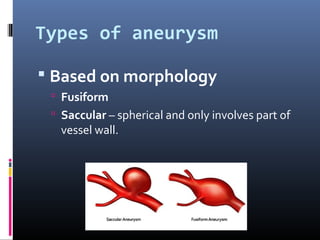
 Based on morphology
 Fusiform
 Saccular – spherical and only involves part of
vessel wall.
Types of aneurysm
 Based on location
 Aortic
 Femoral
 Popliteal
 Ect
Aneurysms -Causes
 Wall weakening
 Atherosclerosis and weakening of vessel wall –
commonest cause
 Trauma – false aneurysms
 Infection - tuberculosis, and others(mycotic)
 Collagen vascular disease – Marfan’s, Ehlers-
danlos
 Congenital weakness – e.g.berry
 Familial
Investigations
 Imaging
 Duplex scan
 Confirm the aneurysm
 Size
 CT Scan + Angiography
 Site
 Size
 Proximal and distal circulation
 Surrounding tissues
 infection
Management
Depends on
 Symptoms
 Size
 Complications
 Skin threat
 Infection
 Type of artery
 End artery – organ ischaemia
 Non essential artery (with collaterals) – radial /Ulnar, Tibial
etc
 True / false
Management
Abdominal Aortic
Aneurysm (AAA)
 Common in males (1:4)
 White men
 Prevalence increases with age
 5%–7% of the population older than 60 years
AAA
Classification
•Suprarenal
• Above the level of
renal arteries
•Juxta renal
• within 1cm of renal
arteries
•Infra renal
• Below the level of renal
arteries
Abdominal Aortic Aneurysm
(AAA)
Causes
Atherosclerosis and weakening of vessel wall –
commonest cause
Cystic medial necrosis
Aortitis - Syphilis
Collagen vascular disease – Marfan’s, Ehlers-
danlos
Infection – tuberculosis
Familial
Presentation
Incidental finding – Asymptomatic
Self-felt lump
Symptomatic – pain due to
 erosion of vertebrae
 Infection
 rapid expansion -0.5 cm/ year
Complications
 Rupture
 Thrombosis
 Embolism – blue toe syndrome
Screening
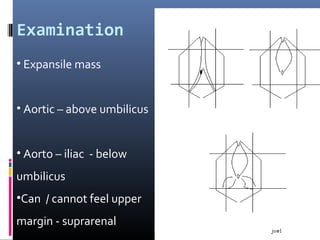
Examination
• Expansile mass
• Aortic – above umbilicus
• Aorto – iliac - below
umbilicus
•Can / cannot feel upper
margin - suprarenal
Imaging
 USS Abdomen – helps to confirm the
diagnosis and useful in follow-up and
screening.
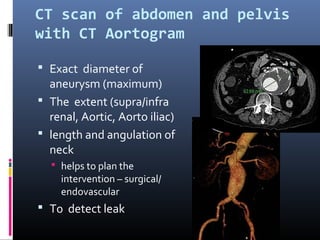
CT scan of abdomen and pelvis
with CT Aortogram
 Exact diameter of
aneurysm (maximum)
 The extent (supra/infra
renal, Aortic, Aorto iliac)
 length and angulation of
neck
 helps to plan the
intervention – surgical/
endovascular
 To detect leak
CT scan of abdomen and
pelvis with CT Aortogram
Management
 Indication for intervention include
 Diameter more than 5.5cms
 Symptomatic
 Complicated
Aortic Aneurysms
 Laplace’s Law
T = P x R
T - Tension
P - Pressure
R - Radius
Diameter and risk of rupture
Smaller Aneurysms
Aortic Aneurysms
surgery Risks
 Mortality
 About 5% with surgery
 Morbidity
 5-10% associated with cardiac events
 Endovascular Techniques are significantly
reduce
Interventional options
 Surgical – inlay repair with synthetic vascular
grafts (PTFE, Polyester)
 Endo Vascular Aneurysm Repair (EVAR) – for
patient who are unfit for open repair
AAA repair – inlay
technique
AAA repair – inlay
technique
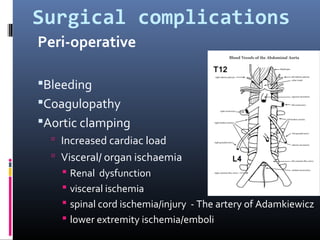
Surgical complications
Peri-operative
Bleeding
Coagulopathy
Aortic clamping
 Increased cardiac load
 Visceral/ organ ischaemia
 Renal dysfunction
 visceral ischemia
 spinal cord ischemia/injury - The artery of Adamkiewicz
 lower extremity ischemia/emboli
 Aortic clamp release
 Hypotension
 Reperfusion effects
 Late
 Aorto enteric fistula
Surgical complications
Endo Vascular Aneurysm Repair
EVAR
First introduced by Parodi et al. in 1991
Endo Vascular Aneurysm Repair
EVAR
 Anatomical requirements
 Length, angulation of infrarenal neck
 > 60° neck angulation – 70% complication
 Minimum length - 10 mm
 Iliac artery diameter
 To accommodate device (7 mm)
 To allow device to seal (1.5 cm)
 Absence of thrombus at aortic neck
 Thrombus does not allow good neck seal
Open vs. EVAR
Study Patients
Follow up
(yrs)
30d
Mortality
Mayo Clinic AAA
(Open)
307 36 5
Canadian AAA
(Open)
680 6 5.4
AneuRx I–III
(EVAR)
1192 4 1.9
EUROSTAR
(EVAR)
2955 4 1.7
Complication of EVAR
Device related
Graft migration
Endoleak
Procedure related
Dissection
Malpositioning
Renal failure
Thromboembolisation
Ischemic colitis
Systemic complications of
EVAR:
 Congestive heart failure
 Renal failure
leaking aortic aneurysm
 Sudden onset pain
 Back, abdominal
 Collapse / faintishness
Investigations
 Known patient with aortic aneurysm and
haemodynamic instability
 Immediate intervention
 If resuscitated
 CT scan
Investigations
 CT scan of abdomen and pelvis with CT
Aortogram
Management of leaking AAA
 Resuscitation and preparation - parallel
 Grouping and DT - transfuse to keep the blood pressure just enough to
keep vital organs perfused
 Prepare for emergency surgery
 inform surgeon
 Anaesthetist
 theatre
 ICU
 Explain the risk of surgery to the patient and the relatives and consent
Management of leaking AAA
 Surgical intervention is similar to non ruptured
aneurysm repair
 In actively bleeding patient
 proximal aorta is clamped first
 Transfusion
 surgery
Follow up
 Diameter less than 4.5 cms – yearly USS
 Diameter above – 6 monthly USS
 Treat the associated conditions
Thank
You

Aneurysms

  • 1.
  • 2.
    Arterial aneurysms  Abnormalfocal dilatation of a vessel of more than 50 percent of its normal diameter  Abdominal aorta more than 3 cms – normal diameter is about 2 cms  Ectasia - A focal dilatation between normal size and 50%  Arteriomegaly - diffuse dilatation of arteries
  • 3.
    Types of aneurysm Basedon wall characteristics True – all layers of the vessel wall is involved False – all layers are not involved  Wall is formed by organized haematoma and center has flow  Occur following vascular trauma and vessel wall infection (Mycotic).
  • 4.
  • 5.
    Types of aneurysm Based on morphology  Fusiform  Saccular – spherical and only involves part of vessel wall.
  • 6.
    Types of aneurysm Based on location  Aortic  Femoral  Popliteal  Ect
  • 7.
    Aneurysms -Causes  Wallweakening  Atherosclerosis and weakening of vessel wall – commonest cause  Trauma – false aneurysms  Infection - tuberculosis, and others(mycotic)  Collagen vascular disease – Marfan’s, Ehlers- danlos  Congenital weakness – e.g.berry  Familial
  • 8.
    Investigations  Imaging  Duplexscan  Confirm the aneurysm  Size  CT Scan + Angiography  Site  Size  Proximal and distal circulation  Surrounding tissues  infection
  • 9.
    Management Depends on  Symptoms Size  Complications  Skin threat  Infection  Type of artery  End artery – organ ischaemia  Non essential artery (with collaterals) – radial /Ulnar, Tibial etc  True / false
  • 10.
  • 11.
    Abdominal Aortic Aneurysm (AAA) Common in males (1:4)  White men  Prevalence increases with age  5%–7% of the population older than 60 years
  • 12.
    AAA Classification •Suprarenal • Above thelevel of renal arteries •Juxta renal • within 1cm of renal arteries •Infra renal • Below the level of renal arteries
  • 13.
    Abdominal Aortic Aneurysm (AAA) Causes Atherosclerosisand weakening of vessel wall – commonest cause Cystic medial necrosis Aortitis - Syphilis Collagen vascular disease – Marfan’s, Ehlers- danlos Infection – tuberculosis Familial
  • 14.
    Presentation Incidental finding –Asymptomatic Self-felt lump Symptomatic – pain due to  erosion of vertebrae  Infection  rapid expansion -0.5 cm/ year Complications  Rupture  Thrombosis  Embolism – blue toe syndrome Screening
  • 15.
    Examination • Expansile mass •Aortic – above umbilicus • Aorto – iliac - below umbilicus •Can / cannot feel upper margin - suprarenal
  • 16.
    Imaging  USS Abdomen– helps to confirm the diagnosis and useful in follow-up and screening.
  • 17.
    CT scan ofabdomen and pelvis with CT Aortogram  Exact diameter of aneurysm (maximum)  The extent (supra/infra renal, Aortic, Aorto iliac)  length and angulation of neck  helps to plan the intervention – surgical/ endovascular  To detect leak
  • 18.
    CT scan ofabdomen and pelvis with CT Aortogram
  • 19.
    Management  Indication forintervention include  Diameter more than 5.5cms  Symptomatic  Complicated
  • 20.
    Aortic Aneurysms  Laplace’sLaw T = P x R T - Tension P - Pressure R - Radius
  • 21.
  • 22.
  • 23.
    Aortic Aneurysms surgery Risks Mortality  About 5% with surgery  Morbidity  5-10% associated with cardiac events  Endovascular Techniques are significantly reduce
  • 24.
    Interventional options  Surgical– inlay repair with synthetic vascular grafts (PTFE, Polyester)  Endo Vascular Aneurysm Repair (EVAR) – for patient who are unfit for open repair
  • 25.
    AAA repair –inlay technique
  • 26.
    AAA repair –inlay technique
  • 27.
    Surgical complications Peri-operative Bleeding Coagulopathy Aortic clamping Increased cardiac load  Visceral/ organ ischaemia  Renal dysfunction  visceral ischemia  spinal cord ischemia/injury - The artery of Adamkiewicz  lower extremity ischemia/emboli
  • 28.
     Aortic clamprelease  Hypotension  Reperfusion effects  Late  Aorto enteric fistula Surgical complications
  • 29.
    Endo Vascular AneurysmRepair EVAR First introduced by Parodi et al. in 1991
  • 30.
    Endo Vascular AneurysmRepair EVAR  Anatomical requirements  Length, angulation of infrarenal neck  > 60° neck angulation – 70% complication  Minimum length - 10 mm  Iliac artery diameter  To accommodate device (7 mm)  To allow device to seal (1.5 cm)  Absence of thrombus at aortic neck  Thrombus does not allow good neck seal
  • 31.
    Open vs. EVAR StudyPatients Follow up (yrs) 30d Mortality Mayo Clinic AAA (Open) 307 36 5 Canadian AAA (Open) 680 6 5.4 AneuRx I–III (EVAR) 1192 4 1.9 EUROSTAR (EVAR) 2955 4 1.7
  • 32.
    Complication of EVAR Devicerelated Graft migration Endoleak Procedure related Dissection Malpositioning Renal failure Thromboembolisation Ischemic colitis
  • 33.
    Systemic complications of EVAR: Congestive heart failure  Renal failure
  • 34.
    leaking aortic aneurysm Sudden onset pain  Back, abdominal  Collapse / faintishness
  • 35.
    Investigations  Known patientwith aortic aneurysm and haemodynamic instability  Immediate intervention  If resuscitated  CT scan
  • 36.
    Investigations  CT scanof abdomen and pelvis with CT Aortogram
  • 37.
    Management of leakingAAA  Resuscitation and preparation - parallel  Grouping and DT - transfuse to keep the blood pressure just enough to keep vital organs perfused  Prepare for emergency surgery  inform surgeon  Anaesthetist  theatre  ICU  Explain the risk of surgery to the patient and the relatives and consent
  • 38.
    Management of leakingAAA  Surgical intervention is similar to non ruptured aneurysm repair  In actively bleeding patient  proximal aorta is clamped first  Transfusion  surgery
  • 39.
    Follow up  Diameterless than 4.5 cms – yearly USS  Diameter above – 6 monthly USS  Treat the associated conditions
  • 40.