Acute Peritonitis
Yuvaraj Karthick R
Peritnoeum
 Made of mesothelium.
 Largest cavity in the body
 Composed of flattened polyhedral cells, resting on fibro-elastic
membrane.
 Beneath the peritoneum lies loos areolar tissue which has rich
supply of capillaries and lymphatics.
 Visceral Peritoneum: Poorly supplied by blood vessels hence
cannot localize pain properly.
 Parietal Peritoneum: Richly supplied by blood vessels  can
localize pain better
Peritonitis
 Defined as inflammation of the peritoneum.
 May be localized or generalized.
 In most cases there is bacterial invasion hence when it is said that
there is peritonitis  Bacterial peritonitis.
 Even in patients with non bacterial peritonitis like those d/t
Pancreatitis  Eventually gets infected d/t transmural spread from
the gut.
Causes of Peritonitis:
 Bacterial  Gastrointestinal & non- gastrointestinal
 Chemical Bile, Barium
 Allergic  Starch
 Traumatic  Operative Handling
 Ischaemic  Strangulated bowel, vascular occlusion
 Miscellaneous  Familial Mediterranean fever.
Route of spread:
 Bowel perforation 
 Transmural Translocation 
 Exogenous contamination 
 Female genital tract 
 Hematogenous spread 
Microbiology: (Those from GI tract)
 Peritoneal infection is usually caused by more than 2 strains of
bacteria.
 Gram negative  endotoxins (lipopolysaccharides)  TNF
Endotoxic shock  Tissue perfusion
 These organisms are present in the lower GI tract and do respond
to Penicillins rather to metronidazole and clindamycin and
cephalosporins
Non gastrointestinal causes of Peritonitis
 Pelvic infection via fallopian tubes are one of the major causes of
Non GI cause of peritonitis.
 The most common organisms being Chlamydia or gonococcus.
 Chlamydia  Fitz Hugh Curtis Syndrome (perihepatitis)
 Fungal Peritonitis  In severely ill patients or
Immunocompramised patients.
MICROORGANISMS
 GASTRO INTESTINAL SOURCE:
E.coli
Streptococci
Bacteroids
K.pneumonia
 NON GASTROINTESTINAL SOURCE:
Chlamydia
Neisseria gonorrheoa
Streptococci
Mycobacterium & Fungal
Localized Peritonitis
 Anatomical and pathological factors help confining infection to
localized areas.
 Greater sac is divided into
 Subphrenic space
 The pelvis
 Peritoneal cavity proper.
Supracolic and infracolic (division by transverse colon and transverse
mesocolon)
 When supracolic compartment overflows, it does so over to
infracolic region/paracolic gutters/pelvis.
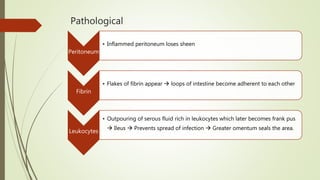
Pathological
Peritoneum
• Inflammed peritoneum loses sheen
Fibrin
• Flakes of fibrin appear  loops of intestine become adherent to each other
Leukocytes
• Outpouring of serous fluid rich in leukocytes which later becomes frank pus
 Ileus  Prevents spread of infection  Greater omentum seals the area.
Diffuse peritonitis
 Factors favoring spread of peritonitis.
 Speed of peritoneal contamination
 Ingestion of food.
 Virulence of infecting organism
 Young children with small omentum.
 Disruption of localized collection
 Immune deficiency
 With appropriate treatment localized disease will resolve
 About 20% progress to abscess.
Clinical features of localized peritonitis
 Symptoms and signs are those of the affected organ.
 Abdominal pain, specific GI symptoms, malaise, anorexia & nausea.
 Then peritoneum gets inflamed
 Pain worsens,
 Increased temp and pulse rate.
 Localized guarding ++
 Rebound tenderness ++
 If inflammation under the diaphragm  Shoulder tip Pain+
 Pelvic inflammation: Abdominal signs but severe tenderness of P/R or
P/V
Diffuse peritonitis
 Early
 Pain  Worsened by movement
 Initially at the site of lesion then followed by spread elsewhere.
 Tenderness and generalized guarding
 Decreased bowel sounds as Paralytic ileus sets in
 Increased temperature and pulse
Late peritonitis
 Abdomen becomes rigid.
 Distension +
 Bowel sounds –ve
 Shock  Cold clammy extremities
 Sunken eyes, dry tongue
 Rapid thread pulse
 Anxious facies.
Diagnostic aides:
 Bedside:
 Urine dipstick
 ECG
 Bloods:
 Baseline U&E
 CBC
 S. amylase
Imaging
 Erect X-ray abdomen – Air under the diaphragm
 Supine X-ray – Distended bowel loops
 CECT – To localize the condition.
 USG abdomen – To localize the condition.
Management
 General Care for the patient
 Correction of fluid loss and circulating volume.
 Urinary catheterization and output monitoring.
 Antibiotic therapy.
 Analgesia
 Specific treatment for the condition.
 Early surgery following localization of the lesion
 In case of causes relating to non GI like Salpingitis or Pancreatitis then
non-operative treatment.
Surgery:
Prognosis and complications:
 Mortality is 10% with modern treatment.
 Factors responsible for prognosis
 Load
 Age
 Onset of treatment
Complications:
 Systemic complications:
 Bacterimic or endotoxic shock
 SIRS
 MODS
 Abdominal Complications:
 Paralytic ileus
 Residual/recurrent abscess/ Inflammatory mass
 Portal pyemia/ Liver abscess
 Adhesions  Small bowel obstruction
Bile peritonitis:
 Usually occurs following Lap. Cholecystectomy on damaging the
biliary tract or a duodenal stump blow out.
 Extravasated bile gets collected and causes local chemical
peritonitis  laparotomy and evaluation
 Source of bile leak should be identified and treated.
 Laparotomy wound is not closed unless the leak is dealt with.
 Usually dealt with placement of drain and ERCP and stenting of the
CBD.
Primary peritonitis or Spontaneous bacterial
peritonitis:
 D/t Pneumococci  occurs in Cirrhosis or Nephrotic syndrome.
Rarely in Female children (3-9 yrs)
 Sudden onset with pain over lower abdomen
 Raised temp
 Vomiting but after 24-48 hrs  Profuse diarrhea
 Peritonism + but less than perforation peritonitis.
 Investigations:
 Leukocytes >30k with > 90 % polymorphs
 If peritoneal fluid is odourless and sticky then almost certain diagnosis
 Peritoneal fluid can be sent for evaluation

Acute peritonitis

  • 1.
  • 2.
    Peritnoeum  Made ofmesothelium.  Largest cavity in the body  Composed of flattened polyhedral cells, resting on fibro-elastic membrane.  Beneath the peritoneum lies loos areolar tissue which has rich supply of capillaries and lymphatics.
  • 3.
     Visceral Peritoneum:Poorly supplied by blood vessels hence cannot localize pain properly.  Parietal Peritoneum: Richly supplied by blood vessels  can localize pain better
  • 4.
    Peritonitis  Defined asinflammation of the peritoneum.  May be localized or generalized.  In most cases there is bacterial invasion hence when it is said that there is peritonitis  Bacterial peritonitis.  Even in patients with non bacterial peritonitis like those d/t Pancreatitis  Eventually gets infected d/t transmural spread from the gut.
  • 5.
    Causes of Peritonitis: Bacterial  Gastrointestinal & non- gastrointestinal  Chemical Bile, Barium  Allergic  Starch  Traumatic  Operative Handling  Ischaemic  Strangulated bowel, vascular occlusion  Miscellaneous  Familial Mediterranean fever.
  • 6.
    Route of spread: Bowel perforation   Transmural Translocation   Exogenous contamination   Female genital tract   Hematogenous spread 
  • 7.
    Microbiology: (Those fromGI tract)  Peritoneal infection is usually caused by more than 2 strains of bacteria.  Gram negative  endotoxins (lipopolysaccharides)  TNF Endotoxic shock  Tissue perfusion  These organisms are present in the lower GI tract and do respond to Penicillins rather to metronidazole and clindamycin and cephalosporins
  • 8.
    Non gastrointestinal causesof Peritonitis  Pelvic infection via fallopian tubes are one of the major causes of Non GI cause of peritonitis.  The most common organisms being Chlamydia or gonococcus.  Chlamydia  Fitz Hugh Curtis Syndrome (perihepatitis)  Fungal Peritonitis  In severely ill patients or Immunocompramised patients.
  • 9.
    MICROORGANISMS  GASTRO INTESTINALSOURCE: E.coli Streptococci Bacteroids K.pneumonia  NON GASTROINTESTINAL SOURCE: Chlamydia Neisseria gonorrheoa Streptococci Mycobacterium & Fungal
  • 10.
    Localized Peritonitis  Anatomicaland pathological factors help confining infection to localized areas.  Greater sac is divided into  Subphrenic space  The pelvis  Peritoneal cavity proper. Supracolic and infracolic (division by transverse colon and transverse mesocolon)  When supracolic compartment overflows, it does so over to infracolic region/paracolic gutters/pelvis.
  • 11.
    Pathological Peritoneum • Inflammed peritoneumloses sheen Fibrin • Flakes of fibrin appear  loops of intestine become adherent to each other Leukocytes • Outpouring of serous fluid rich in leukocytes which later becomes frank pus  Ileus  Prevents spread of infection  Greater omentum seals the area.
  • 12.
    Diffuse peritonitis  Factorsfavoring spread of peritonitis.  Speed of peritoneal contamination  Ingestion of food.  Virulence of infecting organism  Young children with small omentum.  Disruption of localized collection  Immune deficiency  With appropriate treatment localized disease will resolve  About 20% progress to abscess.
  • 13.
    Clinical features oflocalized peritonitis  Symptoms and signs are those of the affected organ.  Abdominal pain, specific GI symptoms, malaise, anorexia & nausea.  Then peritoneum gets inflamed  Pain worsens,  Increased temp and pulse rate.  Localized guarding ++  Rebound tenderness ++  If inflammation under the diaphragm  Shoulder tip Pain+  Pelvic inflammation: Abdominal signs but severe tenderness of P/R or P/V
  • 14.
    Diffuse peritonitis  Early Pain  Worsened by movement  Initially at the site of lesion then followed by spread elsewhere.  Tenderness and generalized guarding  Decreased bowel sounds as Paralytic ileus sets in  Increased temperature and pulse
  • 15.
    Late peritonitis  Abdomenbecomes rigid.  Distension +  Bowel sounds –ve  Shock  Cold clammy extremities  Sunken eyes, dry tongue  Rapid thread pulse  Anxious facies.
  • 16.
    Diagnostic aides:  Bedside: Urine dipstick  ECG  Bloods:  Baseline U&E  CBC  S. amylase
  • 17.
    Imaging  Erect X-rayabdomen – Air under the diaphragm  Supine X-ray – Distended bowel loops  CECT – To localize the condition.  USG abdomen – To localize the condition.
  • 18.
    Management  General Carefor the patient  Correction of fluid loss and circulating volume.  Urinary catheterization and output monitoring.  Antibiotic therapy.  Analgesia  Specific treatment for the condition.  Early surgery following localization of the lesion  In case of causes relating to non GI like Salpingitis or Pancreatitis then non-operative treatment.
  • 19.
  • 20.
    Prognosis and complications: Mortality is 10% with modern treatment.  Factors responsible for prognosis  Load  Age  Onset of treatment
  • 21.
    Complications:  Systemic complications: Bacterimic or endotoxic shock  SIRS  MODS  Abdominal Complications:  Paralytic ileus  Residual/recurrent abscess/ Inflammatory mass  Portal pyemia/ Liver abscess  Adhesions  Small bowel obstruction
  • 22.
    Bile peritonitis:  Usuallyoccurs following Lap. Cholecystectomy on damaging the biliary tract or a duodenal stump blow out.  Extravasated bile gets collected and causes local chemical peritonitis  laparotomy and evaluation  Source of bile leak should be identified and treated.  Laparotomy wound is not closed unless the leak is dealt with.  Usually dealt with placement of drain and ERCP and stenting of the CBD.
  • 23.
    Primary peritonitis orSpontaneous bacterial peritonitis:  D/t Pneumococci  occurs in Cirrhosis or Nephrotic syndrome. Rarely in Female children (3-9 yrs)  Sudden onset with pain over lower abdomen  Raised temp  Vomiting but after 24-48 hrs  Profuse diarrhea  Peritonism + but less than perforation peritonitis.  Investigations:  Leukocytes >30k with > 90 % polymorphs  If peritoneal fluid is odourless and sticky then almost certain diagnosis  Peritoneal fluid can be sent for evaluation