DAY CASE SURGERY
Dr. Alumona
OUTLINE
• Introduction
– Definition
– Other forms of ambulatory surgery
– Surgical importance
– History
• Models of care
– Office based care
– Stand alone day surgery facility
– Self contained Integrated Day surgery facility
– Integrated day and short stay surgery facility
• Day Case Work Flow
• Common Day case procedures
Outline cont…
• Selection Criteria
– Patient/medical criteria
– Social criteria
– Surgical criteria
• Pre-operative issues, assessment & management
– Pre existing organ function
– Nutritional status
– Physical fitness
– Pre operative fasting
– Patients education and consent
– Pre operative instruction form
• Peri operative management & scheduling
– The theater list
– Pre medication
Outline cont…
• Intra operative issues and management
– Anaesthetic technique
– Maintenance of normothermia
– Fluid management
– Minimization of Incision and Mini Invasive Surgery
• Post operative issues
– Pain, PONV etc
– Post op feeding
– Mobilisation
– Drains & catheters
• Discharge
• Follow up
• Challenges in the developing world
• Conclusion
INTRODUCTION
• The planned admission and discharge of a patient for a
specific surgical procedure within the 12-hour working day
• Requires full sterile theater and recovery room facility
• A patient pathway extending from first contact to final
discharge
• Success demands that each component of this pathway is
safe, efficient and performed in sequence
Intro. Cont…
• Other forms of ambulatory surgery
– Outpatient surgery: not admitted to a ward facility
– Procedure room surgery: surgery not requiring full sterile
theater facility
– Overnight stay/ 23-hour stay: overnight admission with
early morning discharge
– Short stay surgery: admission up to 72 hours
– Inpatient surgery: Requires more prolonged admission.
Patients who are planned as inpatients but discharged
home the same day of surgery counts as Inpatients with
zero length of stay
Surgical Importance
• Day case surgery represents high-quality patient care
with excellent patient satisfaction
• Shorter hospital stay and early mobilization reduce
rates of hospital-acquired infections and venous
thromboembolism
• Ensures smaller patient waiting times, less risks of
cancellations, reduces demands on healthcare
resources (human, non human and financial), less
interruption to social life of patients
History
– James Nicoll: 20th century Glaswegian surgeon.
9000 paediatric day case procedures. Motivated
by financial benefits, concerns over hospital
acquired infections and lack of bed space
– 1951: first Hospital based day surgery unit opened
in the US, UK (1969)
– 1989: formation of British association of Day case
Surgery (BADS). International Association of
Ambulatory surgery (1995)
Models of Care
• Office based care
– Diagnostic and ambulatory interventions are
performed in consultation premises
– Provides readily accessible health care to patients
– Limited to procedure under local anaesthesia +/-
conscious sedation
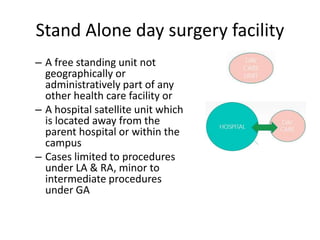
Stand Alone day surgery facility
– A free standing unit not
geographically or
administratively part of any
other health care facility or
– A hospital satellite unit which
is located away from the
parent hospital or within the
campus
– Cases limited to procedures
under LA & RA, minor to
intermediate procedures
under GA
Self contained integrated
facility/Hospital autonomous unit
– Structurally part of a hospital
but functionally separate
– Self sufficient: have own
reception, ward, theater, and
recovery areas
– Do not take emergency
admissions
– Have access to parent hospital
facility if required
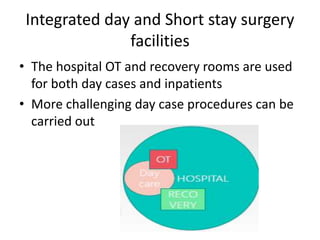
Integrated day and Short stay surgery
facilities
• The hospital OT and recovery rooms are used
for both day cases and inpatients
• More challenging day case procedures can be
carried out
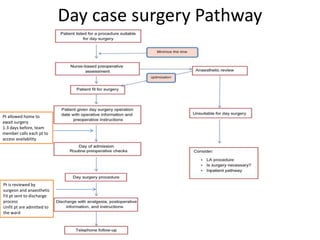
Day case surgery Pathway
Pt allowed home to
await surgery
1-3 days before, team
member calls each pt to
access availability
Pt is reviewed by
surgeon and anaesthetic
Fit pt sent to discharge
process
Unfit pt are admitted to
the ward
Common Day case procedures (BASKET OF 25)
• 1. ORCHIDOPEXY
• 2. CIRCUMCISION
• 3. INGUINAL HERNIA REPAIR
• 4. EXCISION OF BREAST LUMP
• 5. ANAL FISSURE DILATATION &
SPHICHTEROTOMY
• 6. HAEMORRHOIDECTOMY
• 7. LAPAROSCOPIC CHOLECYSTECTOMY
• 8. VARICOSE VEIN STRIPPING AND LIGATION
• 9. TRANSURETHRAL RESECTION OF BLADDER
TUMOUR
• 10. EXCISION OF DUPUYTRENS
CONTRACTURE
• 11. CARPAL TUNNEL DECOMPRESSION
• 12. GANGLION EXCISION
• 13. HYDROCELE
• 14. SURGERY FOR HALLUX
VALGUS
• 15. REMOVAL OF METALWARE
• 16. EXTRACTION OF CATARACT
• 17. CORRECTION OF SQUINT
• 18. MYRINGOTOMY
• 19. TONSILLECTOMY
• 20. SUBMUCOUS RESECTION
• 21. OPERATION FOR BAT EAR
• 22. REDUCTION OF NASAL
FRACTURE
• 23. D&C HYSTEROSCOPY
• 24. LAPAROSCOPY
• 25. TERMINATION OF
PREGNANCY
• TROLLEY of procedures: Recommended by the
British Association Of Day Surgery (BADS)
• Contains 50 procedures such as laparoscopic
fundoplication, laser prostatectomy, arthroscopy of
knee & shoulder, thoracic sympathectomy to be
done on day case basis.
Selection Criteria
• Medical criteria
• Social criteria
• Surgical criteria
Medical criteria
• Age: no upper age limit
• Comorbidity
– ASA 1&2 for stand alone units, ASA 3 for integrated
facilities
– Diabetes: controlled Types 1&2 with HBA1c < 8.5%
• Should be first on list
• Morning list patients can skip morning dose of oral
hypoglycemic meds or insulin
• Afternoon list patients and patients on continuous sc
infusion are managed closely with diabetic team
– Hypertension: <180/110mmhg
– Epilepsy: Well controlled pts continue routine
meds in the pre operative period
• Poorly controlled pts are reviewed with medical team.
• Social support is very important
– Obesity: not an absolute contraindication
• BMI: 40 for surface procedures, 38 for laparoscopies
• Reviewed for co-morbidities
• At risk of sleep apnea post operatively
– Anticoagulants: pts with atrial fibrillation, hx of
PTE, or on a metal heart valve must be reviewed
with a cardiologist if surgery requires
discontinuation of anticoagulation
Social criteria
• Consent: Patient/care giver must be willing to
cooperate, able to understand, comply and cope
with post-procedural instructions
• Escort: a responsible and physically able adult
• Transport: A journey time of 1hour or less
– Comfortable transportation
• Comfortable home facilities with appropriate toilet
facilities
• Communication: means of communication with
hospital
Surgical Criteria
• Simple surgery up to 2hours.
• Minimal risk of postoperative complications e.g.
haemorrhage or airway compromise.
• Minimal postoperative pain that can be controlled by
simple analgesia.
• No special postoperative nursing required post surgery.
• Procedure must not require prolonged immobilization post
operatively
• Rapid return of normal food and fluid intake possible after
the procedure
• Venous thromboembolic risk assessment for prolonged
procedures
Pre-operative assessment, issues & management
• Evaluation and optimization of pt’s fitness for
surgery
• Should be performed early in the pathway
• Past medical history and clinical examination
• Basic health screen: BMI, Blood pressure
• Appropriate investigations: FBC, EUCR, Clotting
profile, and other specific investigations
• Best performed by specialist nursing team
suported by an anaesthetist with interest in DCS
Assessment and optimization of
nutritional status
– Poor nutritional status is an independent risk
factor for complications after surgery
– Patients with Moderate and severe under-
nutrition benefit from preoperative nutritional
support preferably via enteral route for at least 7
days preoperatively
• Evidence supports that it may be beneficial to
provide a drink containing 100g of carbohydrate on
the evening before surgery and a second drink
containing a further 50g upto 2-3hrs before surgery.
– This measure improves
• preoperative feelings of thirst, hunger, anxiety
• reduces post operative insulin resistance and
• reduces the catabolic stress response to surgery
IMPROVEMENT OF PHYSICAL FITNESS
– Patients with poor baseline exercise tolerance and
physical conditioning are at increased risk of
serious perioperative complications.
– The strategy of augmenting physical capacity in
anticipation of an upcoming stressor is termed as
PREHABILITATION.
• Observational data suggests that simply instructing the patient to walk for
30min daily in the preoperative period may be beneficial without the need
for a formal individualized exercise program.
PRE-OPERATIVE FASTING
• Current preoperative fasting guidelines
recommend a 2 hour fasting for clear liquids
and a 6 hour fast for solids.
• Tailored to suit scheduled time for surgery
PATIENT EDUCATION and Consent
• Patient should be provided information about
– Benefits of day care program
– Goals for daily nutrition intake
– Early postoperative ambulation
– Discharge criteria
– Care at home and warning signs to seek medical care
– Expected hospital stay in the event of common
complications
• A written informed consent is obtained
PRE OPERATIVE
INSTRUCTIONS
FORM
Peri operative management & scheduling
• The theater list
– Dedicated DCS list
– Mixed inpatient and DCS list
• Pre medication
– Benzodiazepins
– Antiemetics eg ondasetron
– Antacids and H2 antagonists
– Analgesics (NSAIDS preferred over opiods)
Intra operative issues and management
• ANAESTHETIC TECHNIQUES
– General anaesthesia
• Propofol is the IV agent of choice for induction
• For maintainance anaesthesia desflurane and
sevoflurane are used as they fecilitate early recovery.
• Short or intermediate acting non depolarizing muscle
relaxants are used. Eg cisatracurium, mivacurium
• Sugamadex is a new compound which has shown to
provide faster reversal of non depolarising muscle
relaxants
Anaesthetic techniques
– Regional Anaesthesia techniques
– Spinal, epidural and peripheral nerve block have several
advantages over general anaesthesia like
• Improved pulmonary function,
• decreased cardiovascular demand,
• lower incidence of ileus and
• good quality of analgesia at rest and onambulation.
– For faster recovery, minidose lidocaine (10-30mg),
bupivacaine (3.5-7mg) or ropivacaine (5-10mg) spinal
anaesthetic techniques are combined with potent opoid
analgesic like fentanyl (10-25mcg) or sufentanyl (5-10mcg)
Anaesthetic techniques
• TIVA techniques using propofol are popular and offer
advantage of reduced post operative nausea and
vomiting.
• Caudal block is used to reduce pain in paediatric patients
for circumcision, herniorraphy, orchidopexy.
• Intra articular local anaesthetics are useful following
arthroscopy.
• Femoral and sciatic nerve block for knee surgery.
• Nerve blocks using portable infusion pumps which the
patient can continue at home.
Anaesthetic techniques
• INCISIONAL LOCAL ANAESTHESIA
– INFILTRATION of local anaesthetic is used for
surgical procedures like hernia repair, anal surgery,
breast procedures.
• Long acting local anaesthetic like bupivacaine
should be injected into the wound
Intra operative issues and management
• MAINTENANCE OF NORMOTHERMIA
– Mild hypothermia elicits a stress response during
recovery period.
– Maintenance of intraoperative normothermia
with the use of active and passive warming
devices and
– aggressive post operative management of
shivering and residual hypothermia decreases
incidence of wound infection, myocardial
ischeamia and protein breakdown.
Intra operative issues and management
• FLUID MANAGEMENT
– Strategies that avoid both hypovolemia and post
operative overload are important in facilitating
fast track recovery process.
– Intraoperative oesophageal Doppler monitoring
can facilitate goal directed fluid administration by
targeting specific values for the cardiac index.
– Soluset for paediatric patients
Intra operative issues and management
• MINIMIZATION OF INCISION AND MIS
– The incision should be as small as possible while
allowing adequate exposure
– Laparoscopic techniques must be used whenever
possible
Post operative issues
MAJOR MINOR
Pulmonary embolism Pain
Respiratory failure PONV
MI Drowsiness
Haemorrhage
• Reactionary (usually 4-6hours post op)
• Secondary (after 24hours post op)
Minor bleeds
Unrecognised damage to viscous Infection
Headache
POSTOPERATIVE FEEDING
• Commencement of oral feeding is tailored
based on
– the procedure and
– patients tolerance.
• For most abdominal surgeries:
– liquids on the night following the operation with
– light solids given on the morning of post op day 1
– normal diet initiated on post op day 2
MOBILISATION
• Emphasis on ‘OUT OF BED DAY 0’ strategy
• POST OPERATIVE bed rest should be discouraged.
• Structured post operative mobilization is an
important component of fast track surgery
protocols.
• Patient should be given written instructions that
include specific goals for each day.
• Adequate pain control also helps in early
mobilisation.
• DRAINS and catheters impede independent
mobilisation.
DISCHARGE CRITERIA
• Stable vital signs for at least 1hour
• Return to base line orientation
• Ambulation without dizziness
• Minimal pain and PONV
• Minimal bleeding at the surgical site
• Tolerate oral fluids
• Has passed urine
• Responsible adult to take pt home
• Has received supply of oral analgesia, written and verbal
instructions about post op care, follow up appointment
and emergency contact number
POST ANAESTHESIA DISCHARGE SCORING
(A TOTAL PADSS SCORE >/= 9
IS
CONSIDERED FIT FOR
DISCHARGE)
POST DISCHARGE FOLLOW UP
• PATIENT SHOULD BE ABLE TO Contact the team member
of the day care surgery team should any problem like
fever, wound redness, discharge arise.
• A follow up telephone call should be made 24 to 36 hrs
after the patient goes home.
• Patient should visit the clinic between post operative day
7 and 10 and then seen again at 1 month after the
operation
• Patients are given specific written instructions about the
recovery course.
Challenges of DCS in Developing countires
• Lack of awareness in the patient population,
• Poor communication and transport,
• Poor facilities for proper training of doctors in day
surgery specialty and
• Sidelining the surgical specialties.
• Health Ministries in favour of other programmes
particularly those related to HIV/AIDS, Malaria
and Tuberculosis as well as maternal and child
health.
Conclusion
• Day case surgery is now an established
practice with rates still increasing around the
world due to advances in anaesthesia and
surgical techniques
• Efforts should be made to utilize evidence
based care to push the frontlines in
developing countries
Refrences
• Daniel J Quemby, Mary E Stocker, Day Surgery
Development and practice: key factors for a successful
pathway, continuing Education in Anaesthesia Critical Care
& Pain, Volume 14, Issue 6, December 2014, Pages 256-261,
https://doi.org/10.1093/bjaceaccp/mkt066
• Normal S. Williams, P. Ronan O’Connell, Andrew W.
McCaskie (2018) Bailey & Love Short Practice of Surgery
27th ed.
• MANOJ VAIDYA, Ambulatory surgery, slideshare
• Mukhtiar Ahmad, Anesthesia for Day Case Surgery,
Slidshare
• Thank you

Day case surgery

  • 1.
  • 2.
    OUTLINE • Introduction – Definition –Other forms of ambulatory surgery – Surgical importance – History • Models of care – Office based care – Stand alone day surgery facility – Self contained Integrated Day surgery facility – Integrated day and short stay surgery facility • Day Case Work Flow • Common Day case procedures
  • 3.
    Outline cont… • SelectionCriteria – Patient/medical criteria – Social criteria – Surgical criteria • Pre-operative issues, assessment & management – Pre existing organ function – Nutritional status – Physical fitness – Pre operative fasting – Patients education and consent – Pre operative instruction form • Peri operative management & scheduling – The theater list – Pre medication
  • 4.
    Outline cont… • Intraoperative issues and management – Anaesthetic technique – Maintenance of normothermia – Fluid management – Minimization of Incision and Mini Invasive Surgery • Post operative issues – Pain, PONV etc – Post op feeding – Mobilisation – Drains & catheters • Discharge • Follow up • Challenges in the developing world • Conclusion
  • 5.
    INTRODUCTION • The plannedadmission and discharge of a patient for a specific surgical procedure within the 12-hour working day • Requires full sterile theater and recovery room facility • A patient pathway extending from first contact to final discharge • Success demands that each component of this pathway is safe, efficient and performed in sequence
  • 6.
    Intro. Cont… • Otherforms of ambulatory surgery – Outpatient surgery: not admitted to a ward facility – Procedure room surgery: surgery not requiring full sterile theater facility – Overnight stay/ 23-hour stay: overnight admission with early morning discharge – Short stay surgery: admission up to 72 hours – Inpatient surgery: Requires more prolonged admission. Patients who are planned as inpatients but discharged home the same day of surgery counts as Inpatients with zero length of stay
  • 7.
    Surgical Importance • Daycase surgery represents high-quality patient care with excellent patient satisfaction • Shorter hospital stay and early mobilization reduce rates of hospital-acquired infections and venous thromboembolism • Ensures smaller patient waiting times, less risks of cancellations, reduces demands on healthcare resources (human, non human and financial), less interruption to social life of patients
  • 8.
    History – James Nicoll:20th century Glaswegian surgeon. 9000 paediatric day case procedures. Motivated by financial benefits, concerns over hospital acquired infections and lack of bed space – 1951: first Hospital based day surgery unit opened in the US, UK (1969) – 1989: formation of British association of Day case Surgery (BADS). International Association of Ambulatory surgery (1995)
  • 9.
    Models of Care •Office based care – Diagnostic and ambulatory interventions are performed in consultation premises – Provides readily accessible health care to patients – Limited to procedure under local anaesthesia +/- conscious sedation
  • 10.
    Stand Alone daysurgery facility – A free standing unit not geographically or administratively part of any other health care facility or – A hospital satellite unit which is located away from the parent hospital or within the campus – Cases limited to procedures under LA & RA, minor to intermediate procedures under GA
  • 11.
    Self contained integrated facility/Hospitalautonomous unit – Structurally part of a hospital but functionally separate – Self sufficient: have own reception, ward, theater, and recovery areas – Do not take emergency admissions – Have access to parent hospital facility if required
  • 12.
    Integrated day andShort stay surgery facilities • The hospital OT and recovery rooms are used for both day cases and inpatients • More challenging day case procedures can be carried out
  • 13.
    Day case surgeryPathway Pt allowed home to await surgery 1-3 days before, team member calls each pt to access availability Pt is reviewed by surgeon and anaesthetic Fit pt sent to discharge process Unfit pt are admitted to the ward
  • 14.
    Common Day caseprocedures (BASKET OF 25) • 1. ORCHIDOPEXY • 2. CIRCUMCISION • 3. INGUINAL HERNIA REPAIR • 4. EXCISION OF BREAST LUMP • 5. ANAL FISSURE DILATATION & SPHICHTEROTOMY • 6. HAEMORRHOIDECTOMY • 7. LAPAROSCOPIC CHOLECYSTECTOMY • 8. VARICOSE VEIN STRIPPING AND LIGATION • 9. TRANSURETHRAL RESECTION OF BLADDER TUMOUR • 10. EXCISION OF DUPUYTRENS CONTRACTURE • 11. CARPAL TUNNEL DECOMPRESSION • 12. GANGLION EXCISION • 13. HYDROCELE • 14. SURGERY FOR HALLUX VALGUS • 15. REMOVAL OF METALWARE • 16. EXTRACTION OF CATARACT • 17. CORRECTION OF SQUINT • 18. MYRINGOTOMY • 19. TONSILLECTOMY • 20. SUBMUCOUS RESECTION • 21. OPERATION FOR BAT EAR • 22. REDUCTION OF NASAL FRACTURE • 23. D&C HYSTEROSCOPY • 24. LAPAROSCOPY • 25. TERMINATION OF PREGNANCY
  • 15.
    • TROLLEY ofprocedures: Recommended by the British Association Of Day Surgery (BADS) • Contains 50 procedures such as laparoscopic fundoplication, laser prostatectomy, arthroscopy of knee & shoulder, thoracic sympathectomy to be done on day case basis.
  • 16.
    Selection Criteria • Medicalcriteria • Social criteria • Surgical criteria
  • 17.
    Medical criteria • Age:no upper age limit • Comorbidity – ASA 1&2 for stand alone units, ASA 3 for integrated facilities – Diabetes: controlled Types 1&2 with HBA1c < 8.5% • Should be first on list • Morning list patients can skip morning dose of oral hypoglycemic meds or insulin • Afternoon list patients and patients on continuous sc infusion are managed closely with diabetic team – Hypertension: <180/110mmhg
  • 18.
    – Epilepsy: Wellcontrolled pts continue routine meds in the pre operative period • Poorly controlled pts are reviewed with medical team. • Social support is very important – Obesity: not an absolute contraindication • BMI: 40 for surface procedures, 38 for laparoscopies • Reviewed for co-morbidities • At risk of sleep apnea post operatively – Anticoagulants: pts with atrial fibrillation, hx of PTE, or on a metal heart valve must be reviewed with a cardiologist if surgery requires discontinuation of anticoagulation
  • 19.
    Social criteria • Consent:Patient/care giver must be willing to cooperate, able to understand, comply and cope with post-procedural instructions • Escort: a responsible and physically able adult • Transport: A journey time of 1hour or less – Comfortable transportation • Comfortable home facilities with appropriate toilet facilities • Communication: means of communication with hospital
  • 20.
    Surgical Criteria • Simplesurgery up to 2hours. • Minimal risk of postoperative complications e.g. haemorrhage or airway compromise. • Minimal postoperative pain that can be controlled by simple analgesia. • No special postoperative nursing required post surgery. • Procedure must not require prolonged immobilization post operatively • Rapid return of normal food and fluid intake possible after the procedure • Venous thromboembolic risk assessment for prolonged procedures
  • 21.
    Pre-operative assessment, issues& management • Evaluation and optimization of pt’s fitness for surgery • Should be performed early in the pathway • Past medical history and clinical examination • Basic health screen: BMI, Blood pressure • Appropriate investigations: FBC, EUCR, Clotting profile, and other specific investigations • Best performed by specialist nursing team suported by an anaesthetist with interest in DCS
  • 22.
    Assessment and optimizationof nutritional status – Poor nutritional status is an independent risk factor for complications after surgery – Patients with Moderate and severe under- nutrition benefit from preoperative nutritional support preferably via enteral route for at least 7 days preoperatively
  • 23.
    • Evidence supportsthat it may be beneficial to provide a drink containing 100g of carbohydrate on the evening before surgery and a second drink containing a further 50g upto 2-3hrs before surgery. – This measure improves • preoperative feelings of thirst, hunger, anxiety • reduces post operative insulin resistance and • reduces the catabolic stress response to surgery
  • 24.
    IMPROVEMENT OF PHYSICALFITNESS – Patients with poor baseline exercise tolerance and physical conditioning are at increased risk of serious perioperative complications. – The strategy of augmenting physical capacity in anticipation of an upcoming stressor is termed as PREHABILITATION. • Observational data suggests that simply instructing the patient to walk for 30min daily in the preoperative period may be beneficial without the need for a formal individualized exercise program.
  • 25.
    PRE-OPERATIVE FASTING • Currentpreoperative fasting guidelines recommend a 2 hour fasting for clear liquids and a 6 hour fast for solids. • Tailored to suit scheduled time for surgery
  • 26.
    PATIENT EDUCATION andConsent • Patient should be provided information about – Benefits of day care program – Goals for daily nutrition intake – Early postoperative ambulation – Discharge criteria – Care at home and warning signs to seek medical care – Expected hospital stay in the event of common complications • A written informed consent is obtained
  • 27.
  • 29.
    Peri operative management& scheduling • The theater list – Dedicated DCS list – Mixed inpatient and DCS list • Pre medication – Benzodiazepins – Antiemetics eg ondasetron – Antacids and H2 antagonists – Analgesics (NSAIDS preferred over opiods)
  • 30.
    Intra operative issuesand management • ANAESTHETIC TECHNIQUES – General anaesthesia • Propofol is the IV agent of choice for induction • For maintainance anaesthesia desflurane and sevoflurane are used as they fecilitate early recovery. • Short or intermediate acting non depolarizing muscle relaxants are used. Eg cisatracurium, mivacurium • Sugamadex is a new compound which has shown to provide faster reversal of non depolarising muscle relaxants
  • 31.
    Anaesthetic techniques – RegionalAnaesthesia techniques – Spinal, epidural and peripheral nerve block have several advantages over general anaesthesia like • Improved pulmonary function, • decreased cardiovascular demand, • lower incidence of ileus and • good quality of analgesia at rest and onambulation. – For faster recovery, minidose lidocaine (10-30mg), bupivacaine (3.5-7mg) or ropivacaine (5-10mg) spinal anaesthetic techniques are combined with potent opoid analgesic like fentanyl (10-25mcg) or sufentanyl (5-10mcg)
  • 32.
    Anaesthetic techniques • TIVAtechniques using propofol are popular and offer advantage of reduced post operative nausea and vomiting. • Caudal block is used to reduce pain in paediatric patients for circumcision, herniorraphy, orchidopexy. • Intra articular local anaesthetics are useful following arthroscopy. • Femoral and sciatic nerve block for knee surgery. • Nerve blocks using portable infusion pumps which the patient can continue at home.
  • 33.
    Anaesthetic techniques • INCISIONALLOCAL ANAESTHESIA – INFILTRATION of local anaesthetic is used for surgical procedures like hernia repair, anal surgery, breast procedures. • Long acting local anaesthetic like bupivacaine should be injected into the wound
  • 34.
    Intra operative issuesand management • MAINTENANCE OF NORMOTHERMIA – Mild hypothermia elicits a stress response during recovery period. – Maintenance of intraoperative normothermia with the use of active and passive warming devices and – aggressive post operative management of shivering and residual hypothermia decreases incidence of wound infection, myocardial ischeamia and protein breakdown.
  • 35.
    Intra operative issuesand management • FLUID MANAGEMENT – Strategies that avoid both hypovolemia and post operative overload are important in facilitating fast track recovery process. – Intraoperative oesophageal Doppler monitoring can facilitate goal directed fluid administration by targeting specific values for the cardiac index. – Soluset for paediatric patients
  • 36.
    Intra operative issuesand management • MINIMIZATION OF INCISION AND MIS – The incision should be as small as possible while allowing adequate exposure – Laparoscopic techniques must be used whenever possible
  • 37.
    Post operative issues MAJORMINOR Pulmonary embolism Pain Respiratory failure PONV MI Drowsiness Haemorrhage • Reactionary (usually 4-6hours post op) • Secondary (after 24hours post op) Minor bleeds Unrecognised damage to viscous Infection Headache
  • 38.
    POSTOPERATIVE FEEDING • Commencementof oral feeding is tailored based on – the procedure and – patients tolerance. • For most abdominal surgeries: – liquids on the night following the operation with – light solids given on the morning of post op day 1 – normal diet initiated on post op day 2
  • 39.
    MOBILISATION • Emphasis on‘OUT OF BED DAY 0’ strategy • POST OPERATIVE bed rest should be discouraged. • Structured post operative mobilization is an important component of fast track surgery protocols. • Patient should be given written instructions that include specific goals for each day. • Adequate pain control also helps in early mobilisation. • DRAINS and catheters impede independent mobilisation.
  • 40.
    DISCHARGE CRITERIA • Stablevital signs for at least 1hour • Return to base line orientation • Ambulation without dizziness • Minimal pain and PONV • Minimal bleeding at the surgical site • Tolerate oral fluids • Has passed urine • Responsible adult to take pt home • Has received supply of oral analgesia, written and verbal instructions about post op care, follow up appointment and emergency contact number
  • 41.
    POST ANAESTHESIA DISCHARGESCORING (A TOTAL PADSS SCORE >/= 9 IS CONSIDERED FIT FOR DISCHARGE)
  • 42.
    POST DISCHARGE FOLLOWUP • PATIENT SHOULD BE ABLE TO Contact the team member of the day care surgery team should any problem like fever, wound redness, discharge arise. • A follow up telephone call should be made 24 to 36 hrs after the patient goes home. • Patient should visit the clinic between post operative day 7 and 10 and then seen again at 1 month after the operation • Patients are given specific written instructions about the recovery course.
  • 43.
    Challenges of DCSin Developing countires • Lack of awareness in the patient population, • Poor communication and transport, • Poor facilities for proper training of doctors in day surgery specialty and • Sidelining the surgical specialties. • Health Ministries in favour of other programmes particularly those related to HIV/AIDS, Malaria and Tuberculosis as well as maternal and child health.
  • 44.
    Conclusion • Day casesurgery is now an established practice with rates still increasing around the world due to advances in anaesthesia and surgical techniques • Efforts should be made to utilize evidence based care to push the frontlines in developing countries
  • 45.
    Refrences • Daniel JQuemby, Mary E Stocker, Day Surgery Development and practice: key factors for a successful pathway, continuing Education in Anaesthesia Critical Care & Pain, Volume 14, Issue 6, December 2014, Pages 256-261, https://doi.org/10.1093/bjaceaccp/mkt066 • Normal S. Williams, P. Ronan O’Connell, Andrew W. McCaskie (2018) Bailey & Love Short Practice of Surgery 27th ed. • MANOJ VAIDYA, Ambulatory surgery, slideshare • Mukhtiar Ahmad, Anesthesia for Day Case Surgery, Slidshare
  • 46.