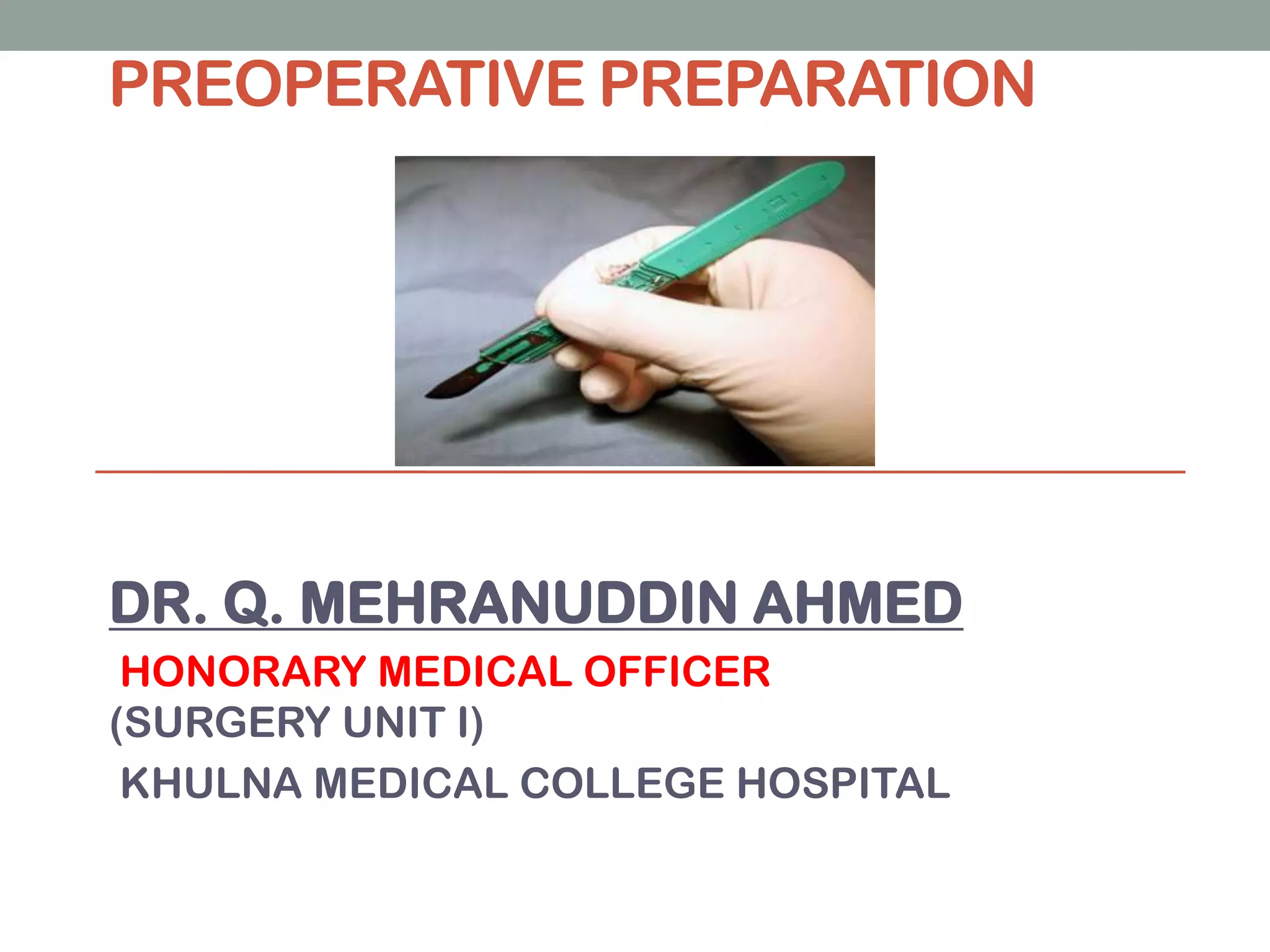
PREOPERATIVE PREPARATION

DR. Q. MEHRANUDDIN AHMED
HONORARY MEDICAL OFFICER
(SURGERY UNIT I)
KHULNA MEDICAL COLLEGE HOSPITAL
PREOPERATIVE PREPARATION
Definition: Preoperative preparation is the preparation of a patient
requiring surgery to optimise postoperative outcomes.
The preparation begins from the time of contact of the patient with the
surgeon and ends on the day of surgery in the preoperative room.

The approach is multidisciplinary. It involves participation of
anaesthetic and surgical teams, radiologists, pathologists, specialist
nursing staff and Operating Room staffs.
OBJECTIVES
• Surgical, medical and anaesthetic aspects of assessment
• How to optimise the patient's condition
• How to take consent
• How to organise an operating list
INTRODUCTION
A ‘preoperative assessment’ clinic is essential to gather all
information, optimise co morbidities, and then organise
anaesthetic, surgical and postoperative care before surgery
actually takes place.

Patients with severe co morbidities should be referred to the
relevant specialist to quantify the risks and to take appropriate
measures to minimise operative morbidity.
INTRODUCTION
• Surgery cannot be made risk free, but risks must be known so that

the patient can make an informed decision.
• Patients should be given advice on when they should be nil by mouth

(NBM) and what to do about regular medications and premedication.
• A plan for the operating list should be drawn up and all those involved

in making the list run smoothly should be informed.
PREOPERATIVE PLAN
Preoperative plan for the best patient outcomes
• Gather and record all relevant information
• Optimise patient condition
• Choose surgery that offers minimal risk and maximum benefit
• Anticipate and plan for adverse events

• Inform everyone concerned
PATIENT ASSESSMENT

HISTORY TAKING
• A standard history should be taken. A set of fixed questions are
needed to determine ‘fitness’ for surgery. Surgery-specific symptoms
(including features not present), onset, duration and exacerbating and
relieving factors should also be documented.
PATIENT ASSESSMENT
• Cardiovascular history : High blood pressure, chest pains,

palpitations, syncope, dyspnoea and poor exercise tolerance.
• Respiratory System history: History of smoking, productive cough,

wheeze, dyspnoea, hoarseness of voice or stridor present. Increasing
severity of symptoms generally indicates worsening of the condition.
• Past History:

Past surgery and anaesthesia can reveal problems that may present
during current hospitalisation (e.g. intra-abdominal adhesions and
suxamethonium apnoea).
• Drug History:

The use of recreational drugs and alcohol consumption should be
noted as they are known to be associated with adverse outcomes.
PRINCIPLES OF HISTORY TAKING
• Listen: What is the problem? (Open questions)

• Clarify: What does the patient expect? (Closed questions)

• Narrow: Differential diagnosis (Focused questions)

• Fitness: Co morbidities (Fixed questions)
EXAMINATION
Medical examination.
• General
o Anaemia, jaundice, cyanosis, nutritional status, sources of infection (teeth, feet, leg

ulcers)
• Cardiovascular
o Pulse, blood pressure, heart sounds, bruits, peripheral oedema

• Respiratory
o Respiratory rate and effort, chest expansion and percussion note, breath sounds,

oxygen saturation
• Gastrointestinal
o Abdominal masses, ascites, bowel sounds, hernia, genitalia

• Neurological
o Consciousness level, cognitive function, sensation, muscle power, tone and reflexes

• Airway assessment
EXAMINATION
Examination
▪ General: Positive findings even if not related to the proposed
procedure should be explored
▪ Surgery related: Type and site of surgery, complications which have
occurred due to underlying pathology
▪ Systemic: Co morbidities and their severity
▪ Specific: For example, suitability for positioning during surgery
EXAMINATION
Examination specific to surgery
The clinical findings, site, side, specific imaging or investigation
findings related to the pathology for which the surgery is proposed
should be noted.
Sources of potential bacteraemia can compromise surgical results
especially if artificial material is implanted, such as in joint
replacement surgery or arterial grafting. Check for and treat infections
in the preoperative period (e.g. infected toes, pressure sores, teeth
and urine; screen the patients for methicillin-resistant Staphylococcus
aureus colonisation).
INVESTIGATIONS
• Full blood count
• Serum creatinine
• Electrocardiography
• Chest radiography

• Urinalysis
• Blood glucose and HbA1C
• Others ( Clotting screening, β-Human chorionic gonadotrophin,

Arterial blood gases, Liver function tests, Relevant
investigations to assess capacity of specific organ system and
risk associated)
MANAGING SYSTEMIC DISEASES
Preoperative management of patients with systemic disease
• Capacity: Baseline organ function capacity should be assessed
• Optimisation: Medication, lifestyle changes, specialist referral will

improve organ capacity
• Alternative: Minimally impacting procedure, appropriate postoperative

care will improve outcomes
• Theatre preparations: Timing, teamwork, special instruments and

equipment
PREOPERATIVE ASSESSMENT IN
EMERGENCY SURGERY
• In emergency surgery, the principles of preoperative assessment is the

same as in elective surgery, except that the opportunity to optimise the
condition is limited by time constraints.
• Medical assessment and treatments should be started (e.g. according

to the Advanced Trauma Life Support (ATLS) guidelines) even if there
is no time to complete those before the surgical procedure is started.
• Some risks may be reduced, but some may persist and whenever

possible these need to be explained to the patient
RISK ASSESSMENT AND CONSENT
Risk assessment and consent
• Risks: Related to the co-morbidities, anaesthesia and surgery
• Explain: Advantages, side effects, prognosis

• Language: Simple, use daily life comparisons to explain risks
• Consents: Valid consent is necessary except in life-saving

circumstances
CONSENT
• Valid consent implies that it is given voluntarily by a competent and

informed person who is not under duress.

• In emergency situations or in an unconscious patient, consent may not

be obtained and the procedure carried out ‘in the best interests of the
patient’.
THE OPERATIVE TEAM
• Ward, theatre and specialist nursing staff
• Anaesthetic and surgical teams
• Radiology, pathology involvement
• Rehabilitation and social care workers
• Specific personnel in individual cases
DUTIES OF NURSES
The preoperative holding area nurse's primary responsibility is:
• To provide information and emotional support for patients and their

family members.
• To ensure that all preoperative data have been accumulated
• To maintain patients' baseline hemodynamic statuses.
• Instructing and demonstrating exercises that will benefit the patient

postoperatively.
ARRANGING THE THEATRE LIST
• The date, place and time of operation should be matched with

availability of personnel.
• Appropriate equipment and instruments should be made available.
• The operating list should be distributed as early as possible to all

staff who are involved in making the list run smoothly.
• Prioritise patients, e.g. children and diabetic patients should be placed

at the beginning of the list; life- and limb-threatening surgery should
take priority; cancer patients need to be treated early.
SPECIAL CONSIDERATIONS
Nil by mouth and regular medications
• Patients are advised not to take solids within 6 hours and clear

fluids (isotonic drinks and water) within 2 hours before
anaesthetic to avoid the risk of acid aspiration syndrome. Infants
are allowed a clear drink up to 2 hours, mother's milk up to 3
hours and cow or formula milk up to 6 hours before anaesthetic.
• Patients can continue to take their specified routine medications

with sips of water in the nil by mouth period.
MEDICATIONS
• Continue medication over the perioperative period, especially drugs

for hypertension, ischaemic heart disease and bronchodilators.
• Give patients on oral steroid therapy intravenous hydrocortisone.
• Stop oral warfarin anticoagulation 3-4 days preoperatively and check

the prothrombin time prior to surgery. If the prothrombin time remains
unacceptably high, the patient may require an infusion of fresh frozen
plasma.
• Those on warfarin who have had a life-threatening thrombotic episode

(e.g. pulmonary embolus) within the previous 3 months should be
switched to heparin intravenously until 6h before surgery; the heparin
can usually be recommenced 4h after surgery.
CONCLUSION

• The anticipated outcome of preoperative preparation is a patient who

is informed about the surgical course, and copes with it successfully.
The goal is to decrease complications and promote recovery.
• When patients are adequately prepared psychologically and

physically, and policies and guidelines have been followed, the risk of
postoperative complications should be low, leading to a quick
recovery.
Preoperative preparation

Preoperative preparation

  • 1.
    PREOPERATIVE PREPARATION DR. Q.MEHRANUDDIN AHMED HONORARY MEDICAL OFFICER (SURGERY UNIT I) KHULNA MEDICAL COLLEGE HOSPITAL
  • 2.
    PREOPERATIVE PREPARATION Definition: Preoperativepreparation is the preparation of a patient requiring surgery to optimise postoperative outcomes. The preparation begins from the time of contact of the patient with the surgeon and ends on the day of surgery in the preoperative room. The approach is multidisciplinary. It involves participation of anaesthetic and surgical teams, radiologists, pathologists, specialist nursing staff and Operating Room staffs.
  • 3.
    OBJECTIVES • Surgical, medicaland anaesthetic aspects of assessment • How to optimise the patient's condition • How to take consent • How to organise an operating list
  • 4.
    INTRODUCTION A ‘preoperative assessment’clinic is essential to gather all information, optimise co morbidities, and then organise anaesthetic, surgical and postoperative care before surgery actually takes place. Patients with severe co morbidities should be referred to the relevant specialist to quantify the risks and to take appropriate measures to minimise operative morbidity.
  • 5.
    INTRODUCTION • Surgery cannotbe made risk free, but risks must be known so that the patient can make an informed decision. • Patients should be given advice on when they should be nil by mouth (NBM) and what to do about regular medications and premedication. • A plan for the operating list should be drawn up and all those involved in making the list run smoothly should be informed.
  • 6.
    PREOPERATIVE PLAN Preoperative planfor the best patient outcomes • Gather and record all relevant information • Optimise patient condition • Choose surgery that offers minimal risk and maximum benefit • Anticipate and plan for adverse events • Inform everyone concerned
  • 7.
    PATIENT ASSESSMENT HISTORY TAKING •A standard history should be taken. A set of fixed questions are needed to determine ‘fitness’ for surgery. Surgery-specific symptoms (including features not present), onset, duration and exacerbating and relieving factors should also be documented.
  • 8.
    PATIENT ASSESSMENT • Cardiovascularhistory : High blood pressure, chest pains, palpitations, syncope, dyspnoea and poor exercise tolerance. • Respiratory System history: History of smoking, productive cough, wheeze, dyspnoea, hoarseness of voice or stridor present. Increasing severity of symptoms generally indicates worsening of the condition. • Past History: Past surgery and anaesthesia can reveal problems that may present during current hospitalisation (e.g. intra-abdominal adhesions and suxamethonium apnoea). • Drug History: The use of recreational drugs and alcohol consumption should be noted as they are known to be associated with adverse outcomes.
  • 9.
    PRINCIPLES OF HISTORYTAKING • Listen: What is the problem? (Open questions) • Clarify: What does the patient expect? (Closed questions) • Narrow: Differential diagnosis (Focused questions) • Fitness: Co morbidities (Fixed questions)
  • 10.
    EXAMINATION Medical examination. • General oAnaemia, jaundice, cyanosis, nutritional status, sources of infection (teeth, feet, leg ulcers) • Cardiovascular o Pulse, blood pressure, heart sounds, bruits, peripheral oedema • Respiratory o Respiratory rate and effort, chest expansion and percussion note, breath sounds, oxygen saturation • Gastrointestinal o Abdominal masses, ascites, bowel sounds, hernia, genitalia • Neurological o Consciousness level, cognitive function, sensation, muscle power, tone and reflexes • Airway assessment
  • 11.
    EXAMINATION Examination ▪ General: Positivefindings even if not related to the proposed procedure should be explored ▪ Surgery related: Type and site of surgery, complications which have occurred due to underlying pathology ▪ Systemic: Co morbidities and their severity ▪ Specific: For example, suitability for positioning during surgery
  • 12.
    EXAMINATION Examination specific tosurgery The clinical findings, site, side, specific imaging or investigation findings related to the pathology for which the surgery is proposed should be noted. Sources of potential bacteraemia can compromise surgical results especially if artificial material is implanted, such as in joint replacement surgery or arterial grafting. Check for and treat infections in the preoperative period (e.g. infected toes, pressure sores, teeth and urine; screen the patients for methicillin-resistant Staphylococcus aureus colonisation).
  • 13.
    INVESTIGATIONS • Full bloodcount • Serum creatinine • Electrocardiography • Chest radiography • Urinalysis • Blood glucose and HbA1C • Others ( Clotting screening, β-Human chorionic gonadotrophin, Arterial blood gases, Liver function tests, Relevant investigations to assess capacity of specific organ system and risk associated)
  • 14.
    MANAGING SYSTEMIC DISEASES Preoperativemanagement of patients with systemic disease • Capacity: Baseline organ function capacity should be assessed • Optimisation: Medication, lifestyle changes, specialist referral will improve organ capacity • Alternative: Minimally impacting procedure, appropriate postoperative care will improve outcomes • Theatre preparations: Timing, teamwork, special instruments and equipment
  • 15.
    PREOPERATIVE ASSESSMENT IN EMERGENCYSURGERY • In emergency surgery, the principles of preoperative assessment is the same as in elective surgery, except that the opportunity to optimise the condition is limited by time constraints. • Medical assessment and treatments should be started (e.g. according to the Advanced Trauma Life Support (ATLS) guidelines) even if there is no time to complete those before the surgical procedure is started. • Some risks may be reduced, but some may persist and whenever possible these need to be explained to the patient
  • 16.
    RISK ASSESSMENT ANDCONSENT Risk assessment and consent • Risks: Related to the co-morbidities, anaesthesia and surgery • Explain: Advantages, side effects, prognosis • Language: Simple, use daily life comparisons to explain risks • Consents: Valid consent is necessary except in life-saving circumstances
  • 17.
    CONSENT • Valid consentimplies that it is given voluntarily by a competent and informed person who is not under duress. • In emergency situations or in an unconscious patient, consent may not be obtained and the procedure carried out ‘in the best interests of the patient’.
  • 18.
    THE OPERATIVE TEAM •Ward, theatre and specialist nursing staff • Anaesthetic and surgical teams • Radiology, pathology involvement • Rehabilitation and social care workers • Specific personnel in individual cases
  • 19.
    DUTIES OF NURSES Thepreoperative holding area nurse's primary responsibility is: • To provide information and emotional support for patients and their family members. • To ensure that all preoperative data have been accumulated • To maintain patients' baseline hemodynamic statuses. • Instructing and demonstrating exercises that will benefit the patient postoperatively.
  • 20.
    ARRANGING THE THEATRELIST • The date, place and time of operation should be matched with availability of personnel. • Appropriate equipment and instruments should be made available. • The operating list should be distributed as early as possible to all staff who are involved in making the list run smoothly. • Prioritise patients, e.g. children and diabetic patients should be placed at the beginning of the list; life- and limb-threatening surgery should take priority; cancer patients need to be treated early.
  • 21.
    SPECIAL CONSIDERATIONS Nil bymouth and regular medications • Patients are advised not to take solids within 6 hours and clear fluids (isotonic drinks and water) within 2 hours before anaesthetic to avoid the risk of acid aspiration syndrome. Infants are allowed a clear drink up to 2 hours, mother's milk up to 3 hours and cow or formula milk up to 6 hours before anaesthetic. • Patients can continue to take their specified routine medications with sips of water in the nil by mouth period.
  • 22.
    MEDICATIONS • Continue medicationover the perioperative period, especially drugs for hypertension, ischaemic heart disease and bronchodilators. • Give patients on oral steroid therapy intravenous hydrocortisone. • Stop oral warfarin anticoagulation 3-4 days preoperatively and check the prothrombin time prior to surgery. If the prothrombin time remains unacceptably high, the patient may require an infusion of fresh frozen plasma. • Those on warfarin who have had a life-threatening thrombotic episode (e.g. pulmonary embolus) within the previous 3 months should be switched to heparin intravenously until 6h before surgery; the heparin can usually be recommenced 4h after surgery.
  • 23.
    CONCLUSION • The anticipatedoutcome of preoperative preparation is a patient who is informed about the surgical course, and copes with it successfully. The goal is to decrease complications and promote recovery. • When patients are adequately prepared psychologically and physically, and policies and guidelines have been followed, the risk of postoperative complications should be low, leading to a quick recovery.