ENDOSCOPIC RETROGRADE 
CHOLANGIOPANCREATOGRAPHY (ERCP) 
Jinu Janet Varghese 
Group IV 
Year III
INTRODUCTION 
Endoscopic retrograde cholangiopancreatography (ERCP) is a technique 
that combines the use of endoscopy and fluoroscopy to diagnose and 
treat certain problems of : 
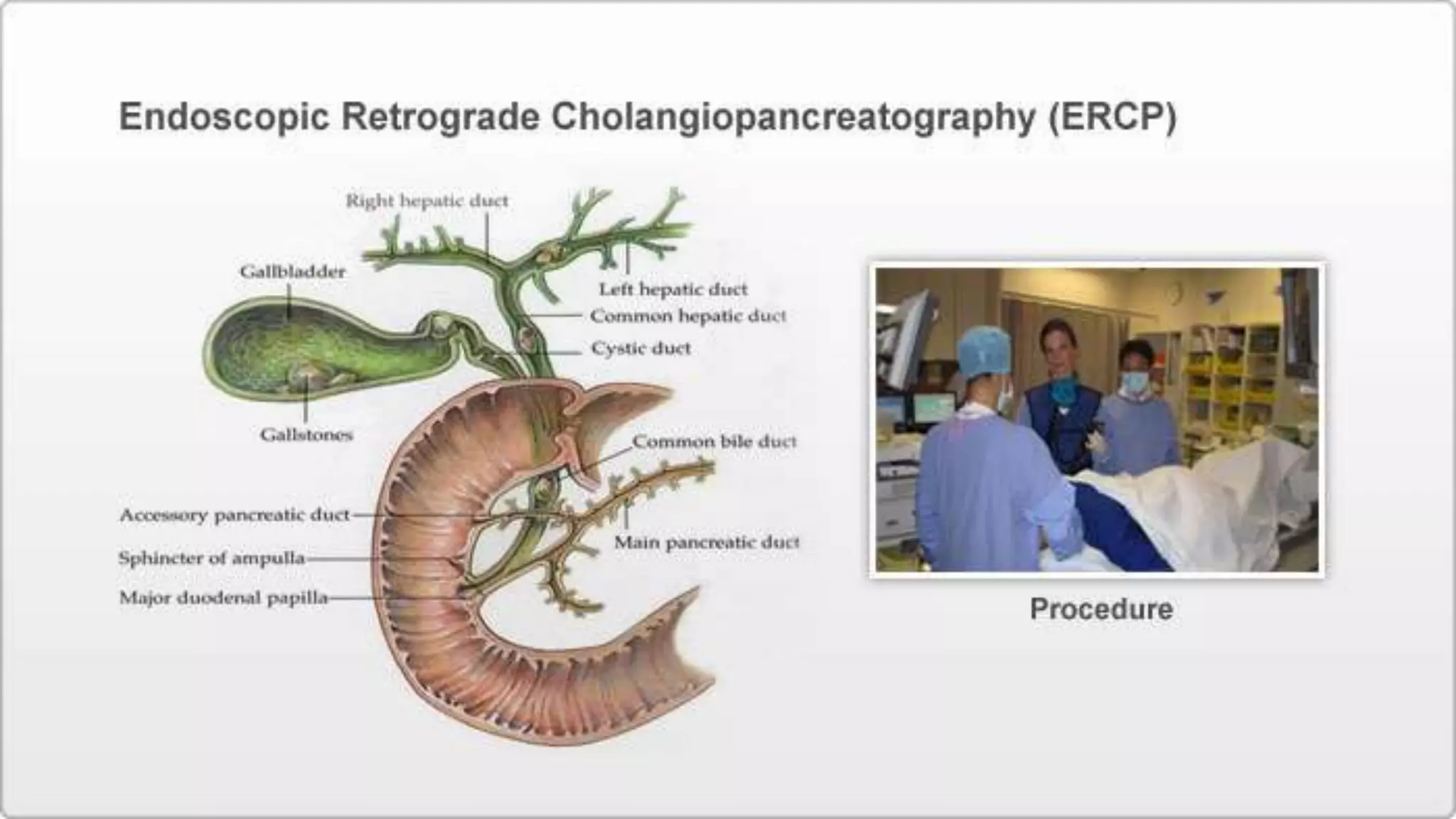
• the duodenum (the first portion of the small intestine), 
• the papilla of Vater (a small structure with openings leading to the 
bile ducts and the pancreatic duct), 
• the bile ducts, and 
• the gallbladder and the pancreatic duct.
USES 
Diagnostic 
Used when it is suspected a person’s bile or pancreatic ducts may be 
narrowed or blocked due to: 
• tumors 
• gallstones that form in the gallbladder and become stuck in the ducts 
• inflammation due to trauma or illness, such as pancreatitis 
• infection 
• Dysfunction of valves in the ducts, called sphincters, 
• scarring of the ducts (sclerosis), 
• Pseudo-cysts—accumulations of fluid and tissue debris
Therapeutic 
• Sphincterotomy 
• Stone Removal 
• Stent Placement 
• Balloon Dilation 
• Tissue Sampling
PREPARATION OF PATIENT BEFORE ERCP 
• The upper GI tract must be empty. Generally, no eating or drinking is 
allowed 8 hours before ERCP. 
• Smoking and chewing gum are also prohibited during this time. 
• Current medications may need to be adjusted or avoided. Most 
medications can be continued as usual. 
• Removal of any dentures, jewelry, or contact lenses before having an 
ERCP.
• Before ERCP, all of the patient’s previous abdominal imaging findings 
(from CT scans, magnetic resonance imaging [MRI], ultrasonography, 
and cholangiography or pancreatography) should be reviewed. 
• Deep sedation is desirable during ERCP because a stable endoscopic 
position in the duodenum is important for proper cannulation, 
therapeutic intervention, and avoidance of complications.
PROCEDURE 
• Patients receive a local anesthetic that is gargled or sprayed on the 
back of the throat & IV sedatives. 
• patients lie on their back or side on an x-ray table 
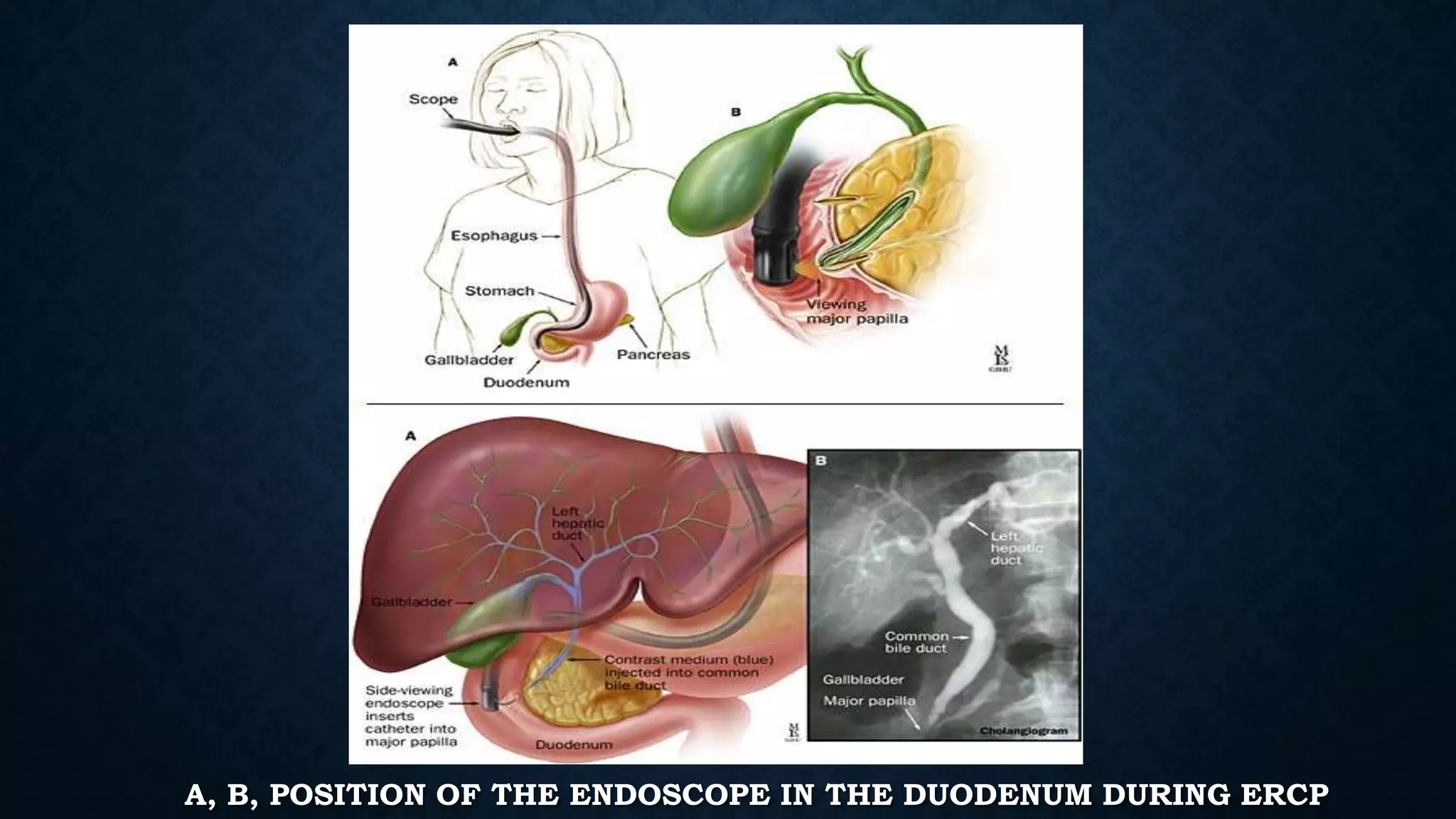
• Then a flexible camera (endoscope) is inserted through the mouth, 
down the esophagus, into the stomach, through the pylorus into the 
duodenum where the ampulla of Vater (the opening of the common 
bile duct and pancreatic duct) exists. The sphincter of Oddi is a 
muscular valve that controls the opening of the ampulla. The region 
can be directly visualized with the endoscopic camera while various 
procedures are performed.
• A plastic catheter or cannula is inserted through the ampulla, and 
radiocontrast is injected into the bile ducts and/or pancreatic duct. 
Fluoroscopy is used to look for blockages, or other lesions such as 
stones. 
• When needed, the opening of the ampulla can be enlarged 
(sphincterotomy) with an electrified wire (sphincterotome) and access 
into the bile duct obtained so that gallstones may be removed or other 
therapy performed.
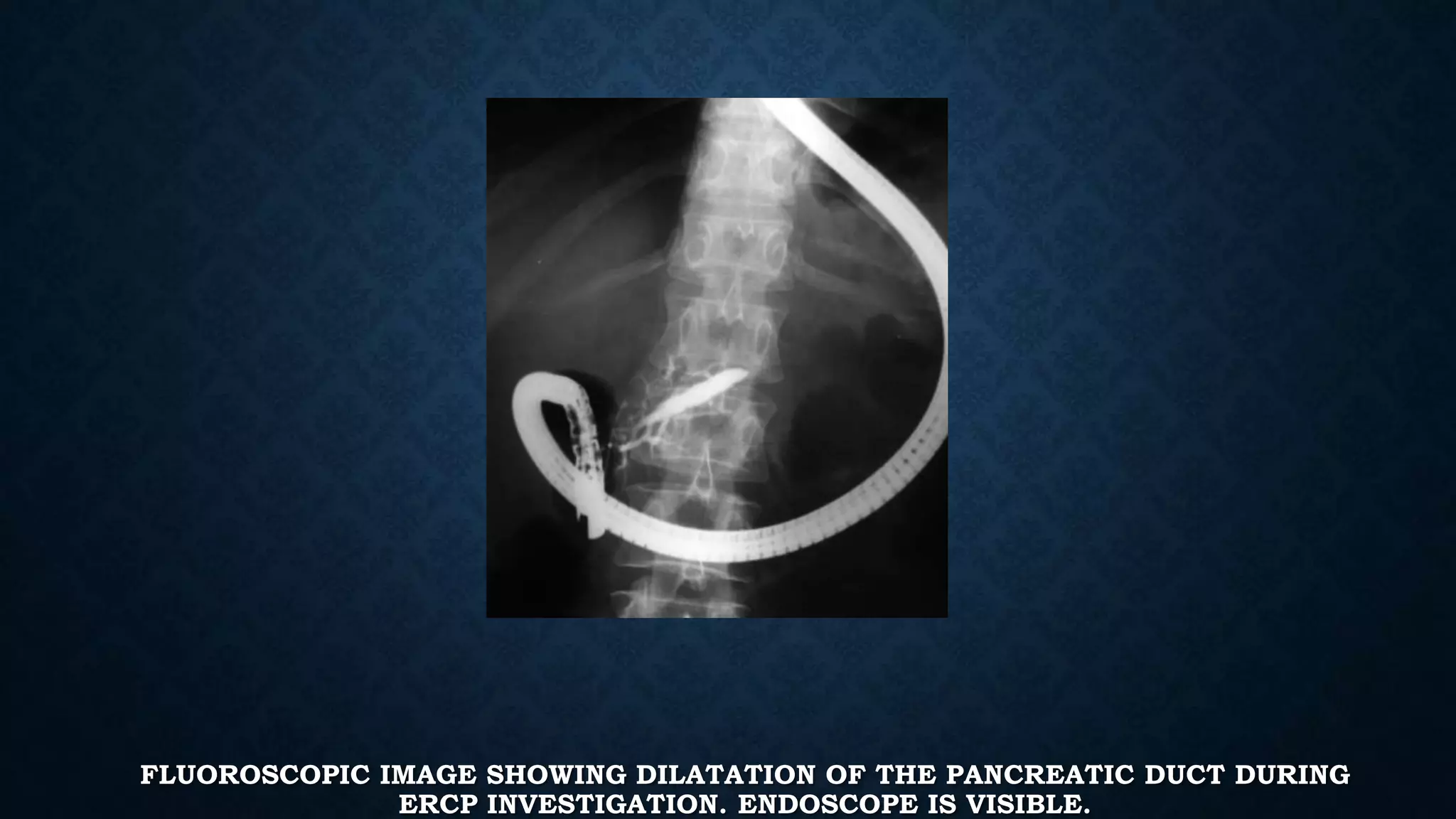
FLUOROSCOPIC IMAGE SHOWING DILATATION OF THE PANCREATIC DUCT DURING 
ERCP INVESTIGATION. ENDOSCOPE IS VISIBLE.
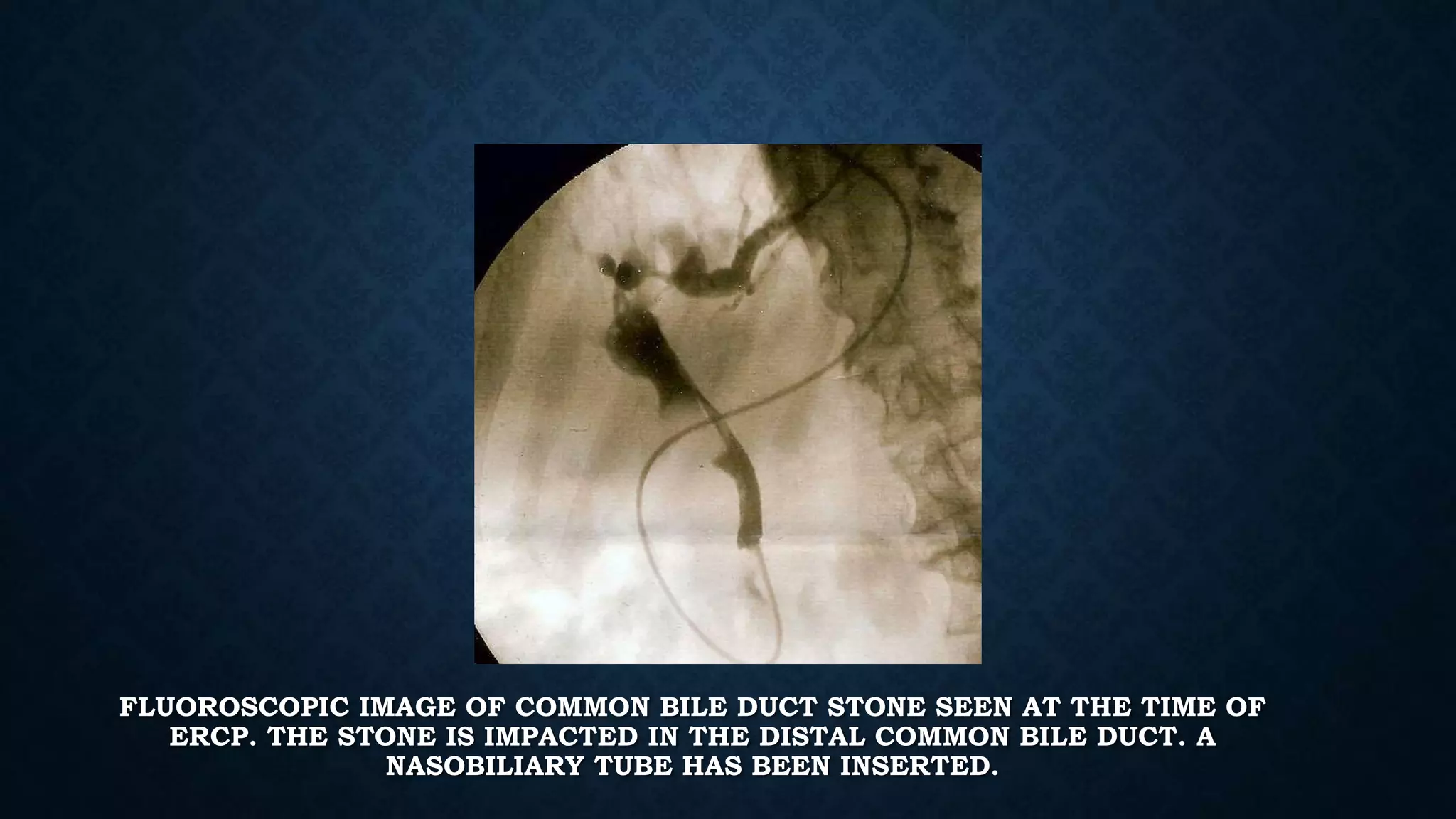
FLUOROSCOPIC IMAGE OF COMMON BILE DUCT STONE SEEN AT THE TIME OF 
ERCP. THE STONE IS IMPACTED IN THE DISTAL COMMON BILE DUCT. A 
NASOBILIARY TUBE HAS BEEN INSERTED.
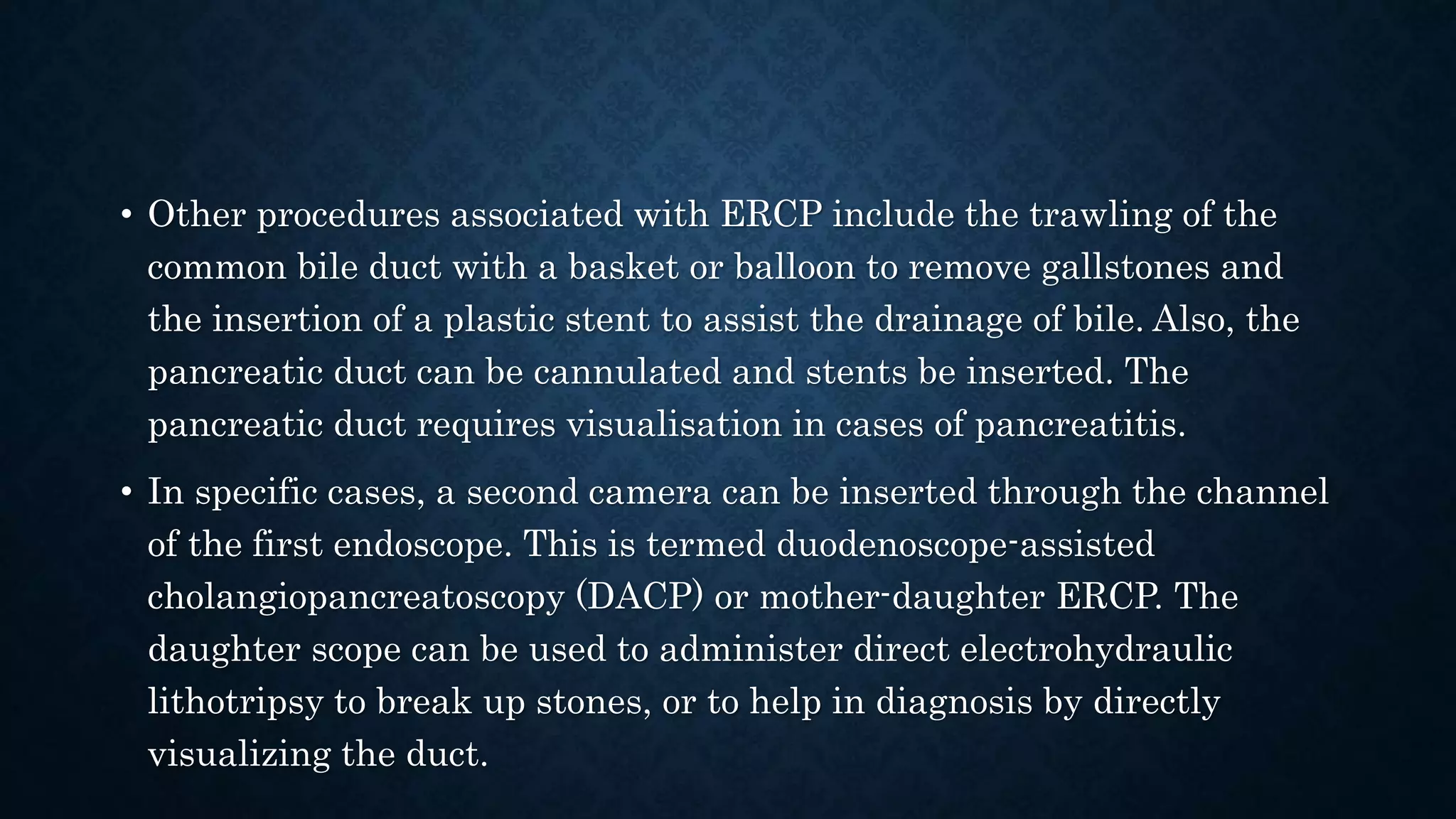
• Other procedures associated with ERCP include the trawling of the 
common bile duct with a basket or balloon to remove gallstones and 
the insertion of a plastic stent to assist the drainage of bile. Also, the 
pancreatic duct can be cannulated and stents be inserted. The 
pancreatic duct requires visualisation in cases of pancreatitis. 
• In specific cases, a second camera can be inserted through the channel 
of the first endoscope. This is termed duodenoscope-assisted 
cholangiopancreatoscopy (DACP) or mother-daughter ERCP. The 
daughter scope can be used to administer direct electrohydraulic 
lithotripsy to break up stones, or to help in diagnosis by directly 
visualizing the duct.
AFTER THE PROCEDURE 
• Patients are monitored in the endoscopy area for 1-2 hours until the 
effects of the sedatives have worn off & observed for complications. 
• Eating or drinking is allowed if the throat is no longer numb and are 
able to swallow without choking. 
• If a gallstone was removed or placed a stent during the test, the 
patient is made to stay in the hospital overnight.
AN EXAMPLE (BILE DUCT CANCER 
(CHOLANGIOCARCINOMA) 
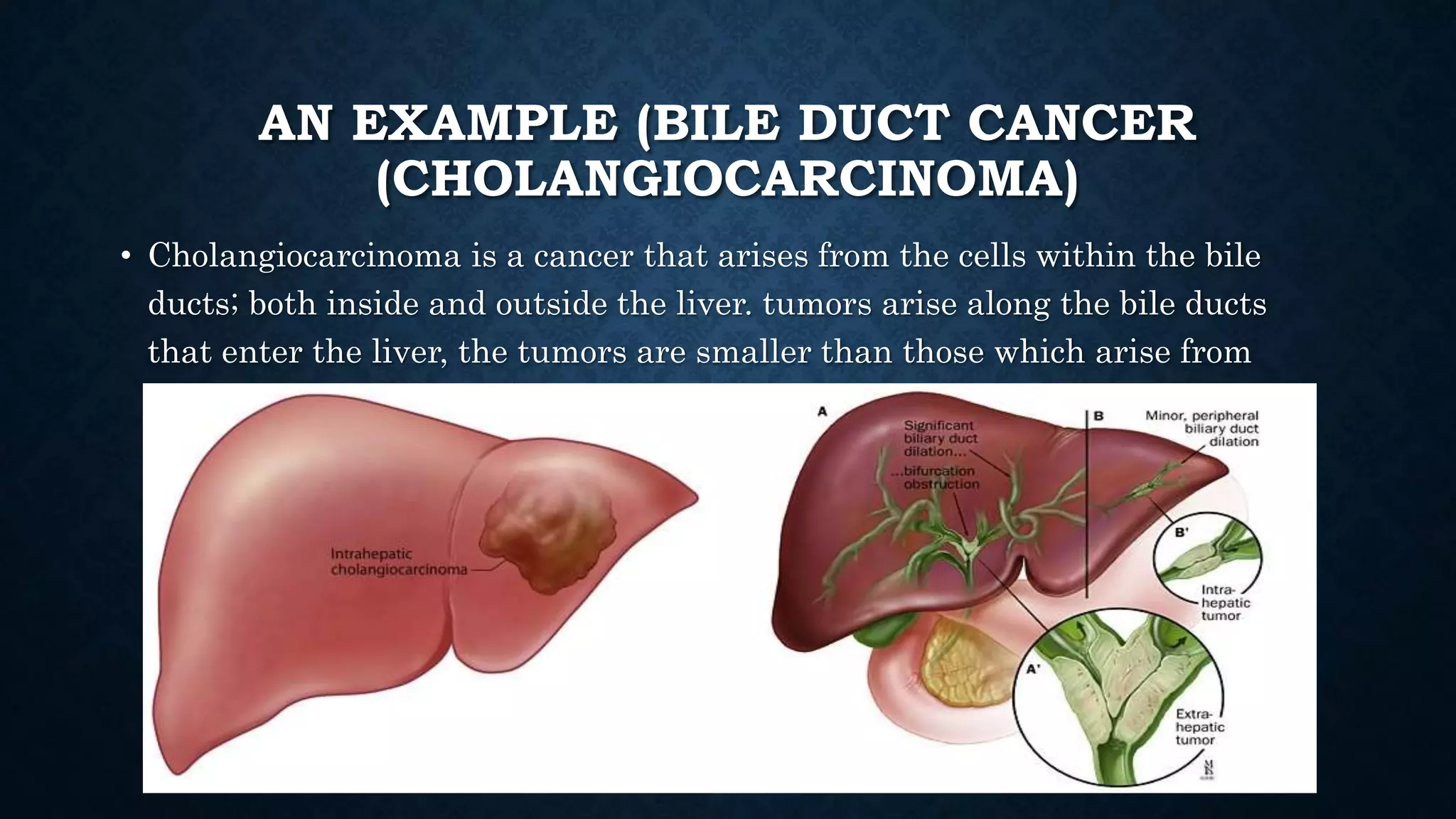
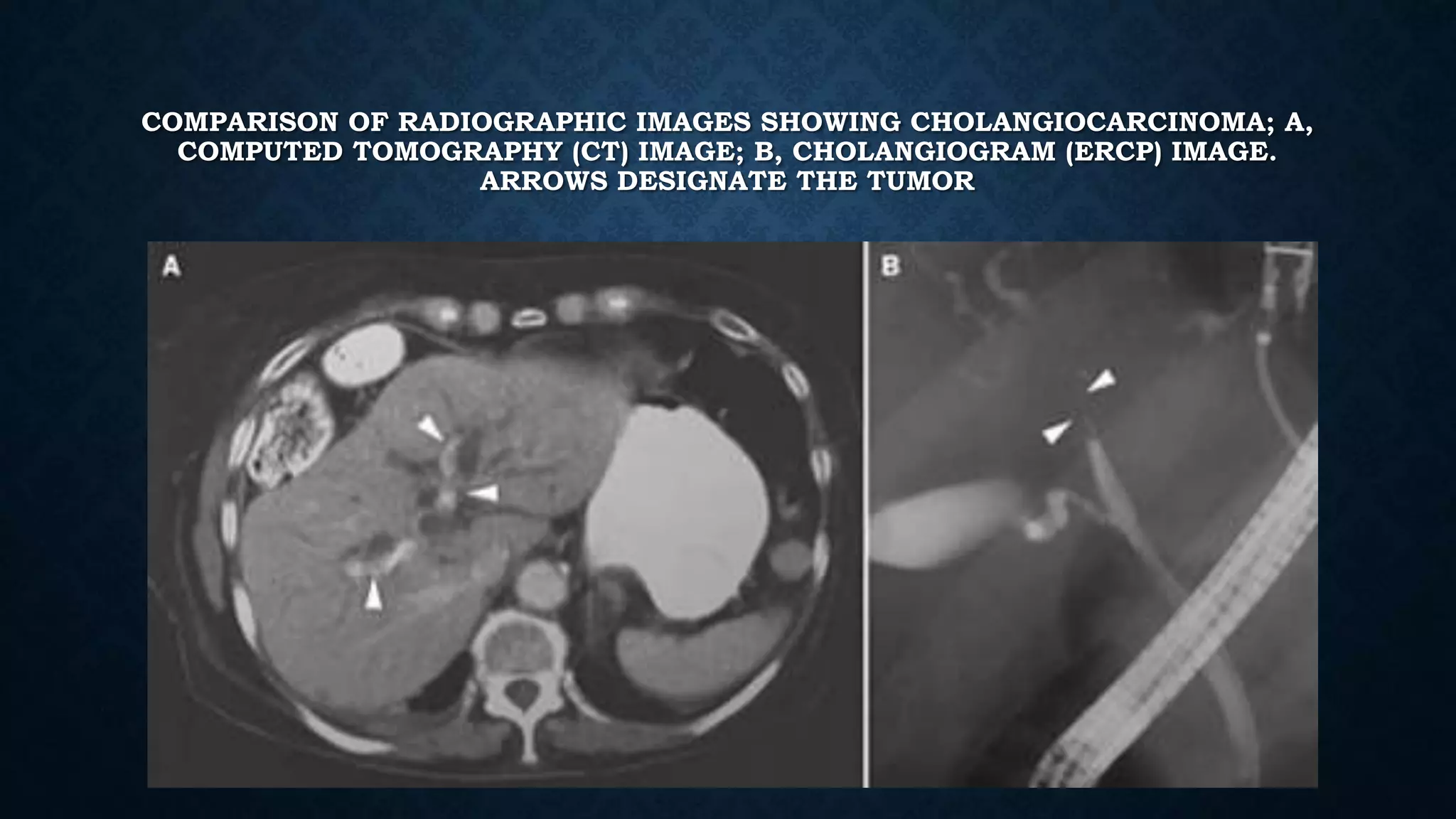
• Cholangiocarcinoma is a cancer that arises from the cells within the bile 
ducts; both inside and outside the liver. tumors arise along the bile ducts 
that enter the liver, the tumors are smaller than those which arise from 
within.
COMPARISON OF RADIOGRAPHIC IMAGES SHOWING CHOLANGIOCARCINOMA; A, 
COMPUTED TOMOGRAPHY (CT) IMAGE; B, CHOLANGIOGRAM (ERCP) IMAGE. 
ARROWS DESIGNATE THE TUMOR
A, B, POSITION OF THE ENDOSCOPE IN THE DUODENUM DURING ERCP
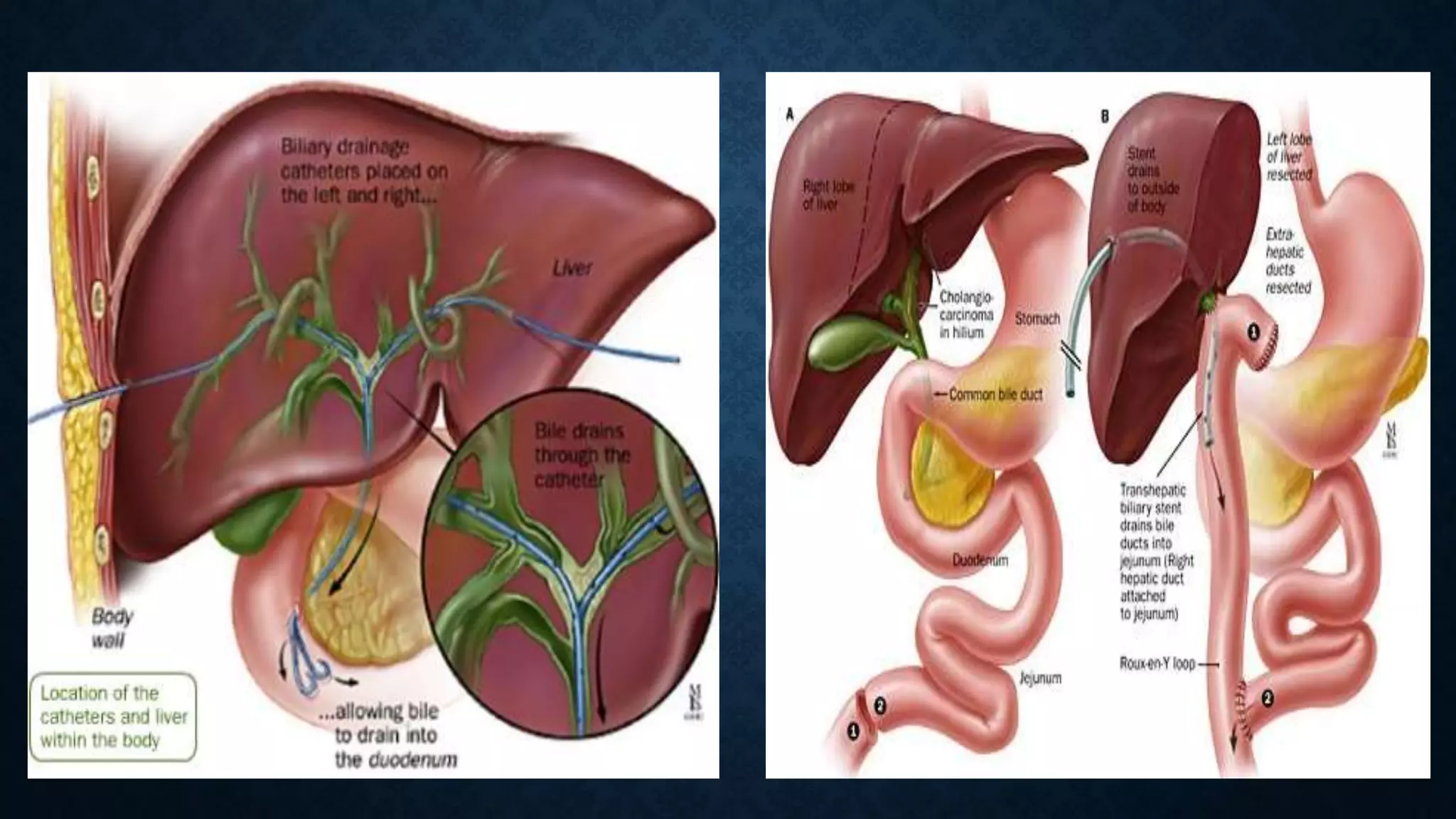
A, TECHNIQUE OF TRANSHEPATIC PERCUTANEOUS CHOLANGIOGRAPHY; B, 
CORRESPONDING PERCUTANEOUS
COMPLICATIONS 
• ERCP is a highly specialized procedure which requires a lot of 
experience and skill. 
• The procedure is quite safe and is associated with a very low risk 
when it is performed by experienced physicians. 
• The success rate in performing this procedure varies from 70% to 95% 
depending on the experience of the physician. 
• Complications can occur in approximately one to five percent 
depending on the skill of the physician and the underlying disorder.
Significant risks associated with ERCP include 
• infection 
• pancreatitis 
• allergic reaction to sedatives 
• excessive bleeding, called hemorrhage 
• puncture of the GI tract or ducts 
• tissue damage from radiation exposure 
• death, in rare circumstances
CONTRAINDICATIONS 
• Unstable cardiopulmonary, neurologic, or cardiovascular status; and 
existing bowel perforation. 
• Structural abnormalities of the esophagus, stomach, or small intestine 
may be relative contraindications for ERCP. 
• An altered surgical anatomy. 
• ERCP with sphincterotomy or ampullectomy is relatively 
contraindicated in coagulopathic patients.
REFERENCES 
• http://www.webmd.com/digestive-disorders/endoscopic-retrograde-cholangiopancreatogram- 
ercp?page=5 
• http://digestive.niddk.nih.gov/ddiseases/pubs/ercp/ 
• http://en.wikipedia.org/wiki/Endoscopic_retrograde_cholangiopancreatography 
• http://www.medicinenet.com/ercp/page3.htm 
• http://www.asge.org/patients/patients.aspx?id=386 
• http://www.sages.org/publications/patient-information/patient-information-for-ercp-endoscopic- 
retrograde-cholangio-pancreatography-from-sages/ 
• http://www.patient.co.uk/health/ercp

Ercp

  • 1.
    ENDOSCOPIC RETROGRADE CHOLANGIOPANCREATOGRAPHY(ERCP) Jinu Janet Varghese Group IV Year III
  • 2.
    INTRODUCTION Endoscopic retrogradecholangiopancreatography (ERCP) is a technique that combines the use of endoscopy and fluoroscopy to diagnose and treat certain problems of : • the duodenum (the first portion of the small intestine), • the papilla of Vater (a small structure with openings leading to the bile ducts and the pancreatic duct), • the bile ducts, and • the gallbladder and the pancreatic duct.
  • 4.
    USES Diagnostic Usedwhen it is suspected a person’s bile or pancreatic ducts may be narrowed or blocked due to: • tumors • gallstones that form in the gallbladder and become stuck in the ducts • inflammation due to trauma or illness, such as pancreatitis • infection • Dysfunction of valves in the ducts, called sphincters, • scarring of the ducts (sclerosis), • Pseudo-cysts—accumulations of fluid and tissue debris
  • 5.
    Therapeutic • Sphincterotomy • Stone Removal • Stent Placement • Balloon Dilation • Tissue Sampling
  • 6.
    PREPARATION OF PATIENTBEFORE ERCP • The upper GI tract must be empty. Generally, no eating or drinking is allowed 8 hours before ERCP. • Smoking and chewing gum are also prohibited during this time. • Current medications may need to be adjusted or avoided. Most medications can be continued as usual. • Removal of any dentures, jewelry, or contact lenses before having an ERCP.
  • 7.
    • Before ERCP,all of the patient’s previous abdominal imaging findings (from CT scans, magnetic resonance imaging [MRI], ultrasonography, and cholangiography or pancreatography) should be reviewed. • Deep sedation is desirable during ERCP because a stable endoscopic position in the duodenum is important for proper cannulation, therapeutic intervention, and avoidance of complications.
  • 8.
    PROCEDURE • Patientsreceive a local anesthetic that is gargled or sprayed on the back of the throat & IV sedatives. • patients lie on their back or side on an x-ray table • Then a flexible camera (endoscope) is inserted through the mouth, down the esophagus, into the stomach, through the pylorus into the duodenum where the ampulla of Vater (the opening of the common bile duct and pancreatic duct) exists. The sphincter of Oddi is a muscular valve that controls the opening of the ampulla. The region can be directly visualized with the endoscopic camera while various procedures are performed.
  • 9.
    • A plasticcatheter or cannula is inserted through the ampulla, and radiocontrast is injected into the bile ducts and/or pancreatic duct. Fluoroscopy is used to look for blockages, or other lesions such as stones. • When needed, the opening of the ampulla can be enlarged (sphincterotomy) with an electrified wire (sphincterotome) and access into the bile duct obtained so that gallstones may be removed or other therapy performed.
  • 10.
    FLUOROSCOPIC IMAGE SHOWINGDILATATION OF THE PANCREATIC DUCT DURING ERCP INVESTIGATION. ENDOSCOPE IS VISIBLE.
  • 11.
    FLUOROSCOPIC IMAGE OFCOMMON BILE DUCT STONE SEEN AT THE TIME OF ERCP. THE STONE IS IMPACTED IN THE DISTAL COMMON BILE DUCT. A NASOBILIARY TUBE HAS BEEN INSERTED.
  • 12.
    • Other proceduresassociated with ERCP include the trawling of the common bile duct with a basket or balloon to remove gallstones and the insertion of a plastic stent to assist the drainage of bile. Also, the pancreatic duct can be cannulated and stents be inserted. The pancreatic duct requires visualisation in cases of pancreatitis. • In specific cases, a second camera can be inserted through the channel of the first endoscope. This is termed duodenoscope-assisted cholangiopancreatoscopy (DACP) or mother-daughter ERCP. The daughter scope can be used to administer direct electrohydraulic lithotripsy to break up stones, or to help in diagnosis by directly visualizing the duct.
  • 13.
    AFTER THE PROCEDURE • Patients are monitored in the endoscopy area for 1-2 hours until the effects of the sedatives have worn off & observed for complications. • Eating or drinking is allowed if the throat is no longer numb and are able to swallow without choking. • If a gallstone was removed or placed a stent during the test, the patient is made to stay in the hospital overnight.
  • 14.
    AN EXAMPLE (BILEDUCT CANCER (CHOLANGIOCARCINOMA) • Cholangiocarcinoma is a cancer that arises from the cells within the bile ducts; both inside and outside the liver. tumors arise along the bile ducts that enter the liver, the tumors are smaller than those which arise from within.
  • 15.
    COMPARISON OF RADIOGRAPHICIMAGES SHOWING CHOLANGIOCARCINOMA; A, COMPUTED TOMOGRAPHY (CT) IMAGE; B, CHOLANGIOGRAM (ERCP) IMAGE. ARROWS DESIGNATE THE TUMOR
  • 16.
    A, B, POSITIONOF THE ENDOSCOPE IN THE DUODENUM DURING ERCP
  • 17.
    A, TECHNIQUE OFTRANSHEPATIC PERCUTANEOUS CHOLANGIOGRAPHY; B, CORRESPONDING PERCUTANEOUS
  • 19.
    COMPLICATIONS • ERCPis a highly specialized procedure which requires a lot of experience and skill. • The procedure is quite safe and is associated with a very low risk when it is performed by experienced physicians. • The success rate in performing this procedure varies from 70% to 95% depending on the experience of the physician. • Complications can occur in approximately one to five percent depending on the skill of the physician and the underlying disorder.
  • 20.
    Significant risks associatedwith ERCP include • infection • pancreatitis • allergic reaction to sedatives • excessive bleeding, called hemorrhage • puncture of the GI tract or ducts • tissue damage from radiation exposure • death, in rare circumstances
  • 21.
    CONTRAINDICATIONS • Unstablecardiopulmonary, neurologic, or cardiovascular status; and existing bowel perforation. • Structural abnormalities of the esophagus, stomach, or small intestine may be relative contraindications for ERCP. • An altered surgical anatomy. • ERCP with sphincterotomy or ampullectomy is relatively contraindicated in coagulopathic patients.
  • 22.
    REFERENCES • http://www.webmd.com/digestive-disorders/endoscopic-retrograde-cholangiopancreatogram- ercp?page=5 • http://digestive.niddk.nih.gov/ddiseases/pubs/ercp/ • http://en.wikipedia.org/wiki/Endoscopic_retrograde_cholangiopancreatography • http://www.medicinenet.com/ercp/page3.htm • http://www.asge.org/patients/patients.aspx?id=386 • http://www.sages.org/publications/patient-information/patient-information-for-ercp-endoscopic- retrograde-cholangio-pancreatography-from-sages/ • http://www.patient.co.uk/health/ercp