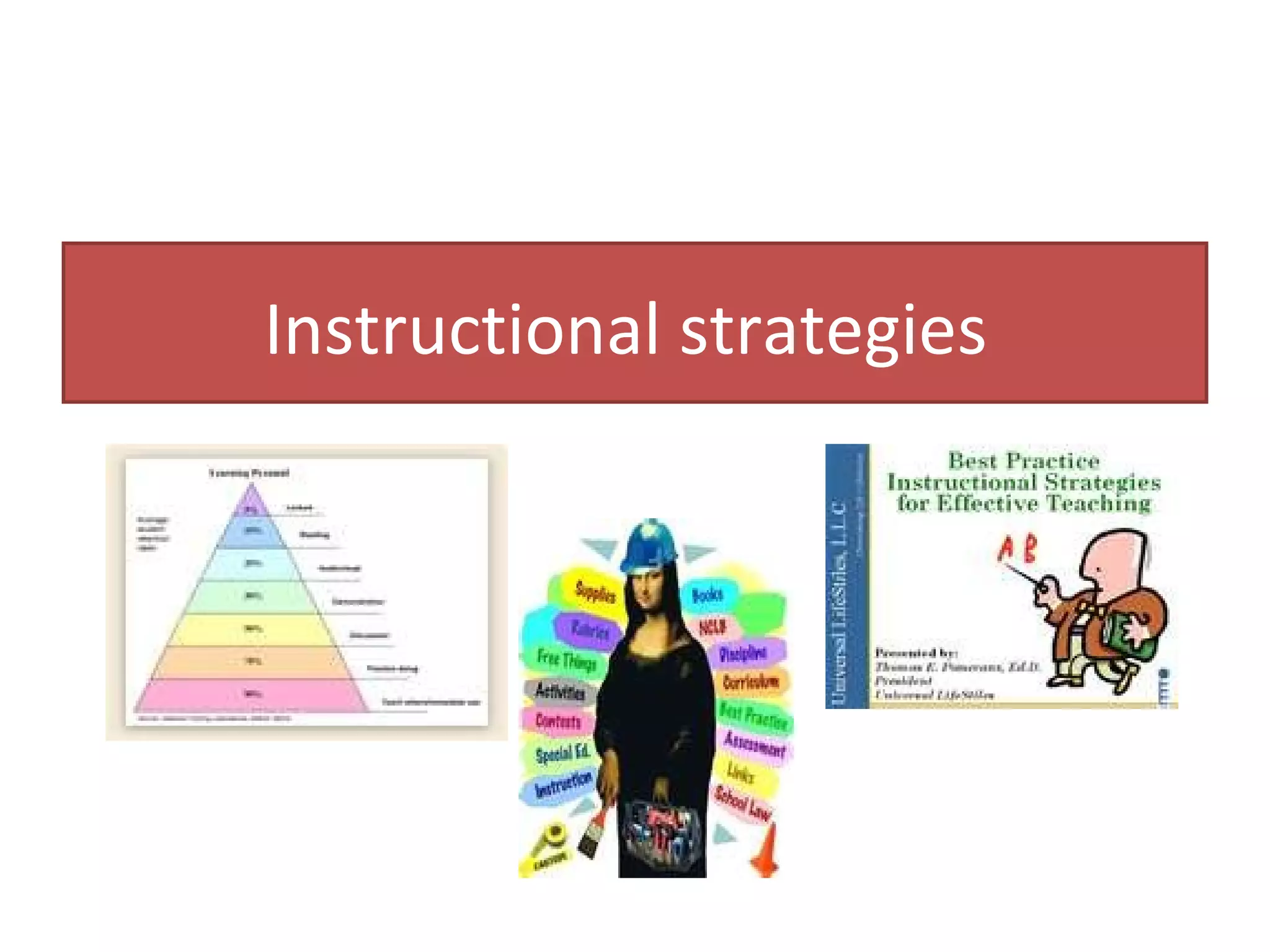
Instructional strategies
• determine the approach a teacher may take
  to achieve learning objectives.
Five categories
Direct instruction strategy
• is highly teacher-directed and is among the most
  commonly used. This strategy is effective for providing
  information or developing step-by-step skills.
Possible Methods
• Structured Overview
• Lecture
• Explicit Teaching
• Drill & Practice
• Compare & Contrast
• Didactic Questions
• Demonstrations
• Guided & Shared - reading, listening, viewing, thinking
Indirect instruction
• seeks a high level of student involvement in observing,
  investigating, drawing inferences from data, or forming hypotheses.
• It takes advantage of students' interest and curiosity, often
  encouraging them to generate alternatives or solve problems.
Possible Methods
• Problem Solving
• Case Studies
• Reading for Meaning
• Inquiry
• Reflective Discussion
• Writing to Inform
• Concept Formation
• Concept Mapping
• Concept Attainment
• Cloze Procedure
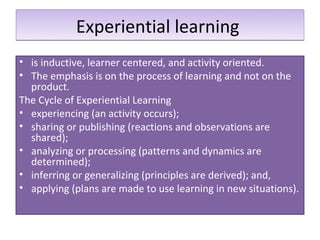
Experiential learning
• is inductive, learner centered, and activity oriented.
• The emphasis is on the process of learning and not on the
  product.
The Cycle of Experiential Learning
• experiencing (an activity occurs);
• sharing or publishing (reactions and observations are
  shared);
• analyzing or processing (patterns and dynamics are
  determined);
• inferring or generalizing (principles are derived); and,
• applying (plans are made to use learning in new situations).
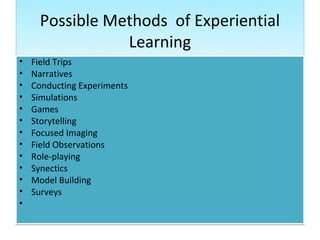
Possible Methods of Experiential
                Learning
•   Field Trips
•   Narratives
•   Conducting Experiments
•   Simulations
•   Games
•   Storytelling
•   Focused Imaging
•   Field Observations
•   Role-playing
•   Synectics
•   Model Building
•   Surveys
•
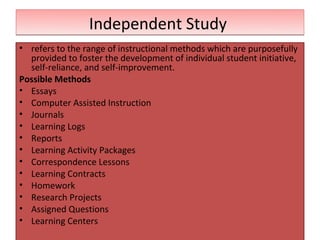
Independent Study
• refers to the range of instructional methods which are purposefully
  provided to foster the development of individual student initiative,
  self-reliance, and self-improvement.
Possible Methods
• Essays
• Computer Assisted Instruction
• Journals
• Learning Logs
• Reports
• Learning Activity Packages
• Correspondence Lessons
• Learning Contracts
• Homework
• Research Projects
• Assigned Questions
• Learning Centers
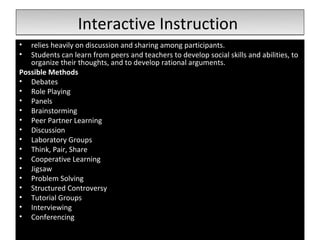
Interactive Instruction
•  relies heavily on discussion and sharing among participants.
•  Students can learn from peers and teachers to develop social skills and abilities, to
   organize their thoughts, and to develop rational arguments.
Possible Methods
• Debates
• Role Playing
• Panels
• Brainstorming
• Peer Partner Learning
• Discussion
• Laboratory Groups
• Think, Pair, Share
• Cooperative Learning
• Jigsaw
• Problem Solving
• Structured Controversy
• Tutorial Groups
• Interviewing
• Conferencing
Other Specific Strategies in
Teaching Students with Special
            Needs
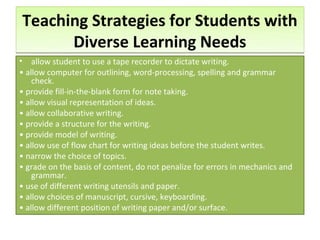
Teaching Strategies for Students with
      Diverse Learning Needs
• allow student to use a tape recorder to dictate writing.
• allow computer for outlining, word-processing, spelling and grammar
    check.
• provide fill-in-the-blank form for note taking.
• allow visual representation of ideas.
• allow collaborative writing.
• provide a structure for the writing.
• provide model of writing.
• allow use of flow chart for writing ideas before the student writes.
• narrow the choice of topics.
• grade on the basis of content, do not penalize for errors in mechanics and
    grammar.
• use of different writing utensils and paper.
• allow choices of manuscript, cursive, keyboarding.
• allow different position of writing paper and/or surface.
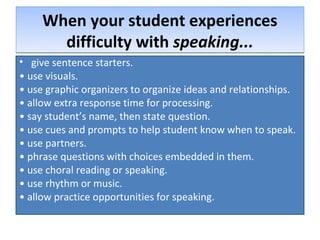
When your student experiences
       difficulty with speaking...
• give sentence starters.
• use visuals.
• use graphic organizers to organize ideas and relationships.
• allow extra response time for processing.
• say student’s name, then state question.
• use cues and prompts to help student know when to speak.
• use partners.
• phrase questions with choices embedded in them.
• use choral reading or speaking.
• use rhythm or music.
• allow practice opportunities for speaking.
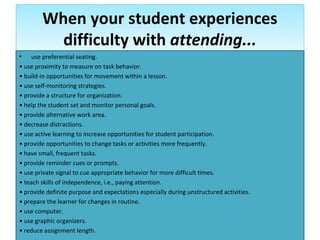
When your student experiences
          difficulty with attending...
•    use preferential seating.
• use proximity to measure on task behavior.
• build-in opportunities for movement within a lesson.
• use self-monitoring strategies.
• provide a structure for organization.
• help the student set and monitor personal goals.
• provide alternative work area.
• decrease distractions.
• use active learning to increase opportunities for student participation.
• provide opportunities to change tasks or activities more frequently.
• have small, frequent tasks.
• provide reminder cues or prompts.
• use private signal to cue appropriate behavior for more difficult times.
• teach skills of independence, i.e., paying attention.
• provide definite purpose and expectations especially during unstructured activities.
• prepare the learner for changes in routine.
• use computer.
• use graphic organizers.
• reduce assignment length.

Instructional Strategies

  • 1.
  • 2.
    Instructional strategies • determinethe approach a teacher may take to achieve learning objectives. Five categories
  • 3.
    Direct instruction strategy •is highly teacher-directed and is among the most commonly used. This strategy is effective for providing information or developing step-by-step skills. Possible Methods • Structured Overview • Lecture • Explicit Teaching • Drill & Practice • Compare & Contrast • Didactic Questions • Demonstrations • Guided & Shared - reading, listening, viewing, thinking
  • 4.
    Indirect instruction • seeksa high level of student involvement in observing, investigating, drawing inferences from data, or forming hypotheses. • It takes advantage of students' interest and curiosity, often encouraging them to generate alternatives or solve problems. Possible Methods • Problem Solving • Case Studies • Reading for Meaning • Inquiry • Reflective Discussion • Writing to Inform • Concept Formation • Concept Mapping • Concept Attainment • Cloze Procedure
  • 5.
    Experiential learning • isinductive, learner centered, and activity oriented. • The emphasis is on the process of learning and not on the product. The Cycle of Experiential Learning • experiencing (an activity occurs); • sharing or publishing (reactions and observations are shared); • analyzing or processing (patterns and dynamics are determined); • inferring or generalizing (principles are derived); and, • applying (plans are made to use learning in new situations).
  • 6.
    Possible Methods ofExperiential Learning • Field Trips • Narratives • Conducting Experiments • Simulations • Games • Storytelling • Focused Imaging • Field Observations • Role-playing • Synectics • Model Building • Surveys •
  • 7.
    Independent Study • refersto the range of instructional methods which are purposefully provided to foster the development of individual student initiative, self-reliance, and self-improvement. Possible Methods • Essays • Computer Assisted Instruction • Journals • Learning Logs • Reports • Learning Activity Packages • Correspondence Lessons • Learning Contracts • Homework • Research Projects • Assigned Questions • Learning Centers
  • 8.
    Interactive Instruction • relies heavily on discussion and sharing among participants. • Students can learn from peers and teachers to develop social skills and abilities, to organize their thoughts, and to develop rational arguments. Possible Methods • Debates • Role Playing • Panels • Brainstorming • Peer Partner Learning • Discussion • Laboratory Groups • Think, Pair, Share • Cooperative Learning • Jigsaw • Problem Solving • Structured Controversy • Tutorial Groups • Interviewing • Conferencing
  • 9.
    Other Specific Strategiesin Teaching Students with Special Needs
  • 10.
    Teaching Strategies forStudents with Diverse Learning Needs • allow student to use a tape recorder to dictate writing. • allow computer for outlining, word-processing, spelling and grammar check. • provide fill-in-the-blank form for note taking. • allow visual representation of ideas. • allow collaborative writing. • provide a structure for the writing. • provide model of writing. • allow use of flow chart for writing ideas before the student writes. • narrow the choice of topics. • grade on the basis of content, do not penalize for errors in mechanics and grammar. • use of different writing utensils and paper. • allow choices of manuscript, cursive, keyboarding. • allow different position of writing paper and/or surface.
  • 11.
    When your studentexperiences difficulty with speaking... • give sentence starters. • use visuals. • use graphic organizers to organize ideas and relationships. • allow extra response time for processing. • say student’s name, then state question. • use cues and prompts to help student know when to speak. • use partners. • phrase questions with choices embedded in them. • use choral reading or speaking. • use rhythm or music. • allow practice opportunities for speaking.
  • 12.
    When your studentexperiences difficulty with attending... • use preferential seating. • use proximity to measure on task behavior. • build-in opportunities for movement within a lesson. • use self-monitoring strategies. • provide a structure for organization. • help the student set and monitor personal goals. • provide alternative work area. • decrease distractions. • use active learning to increase opportunities for student participation. • provide opportunities to change tasks or activities more frequently. • have small, frequent tasks. • provide reminder cues or prompts. • use private signal to cue appropriate behavior for more difficult times. • teach skills of independence, i.e., paying attention. • provide definite purpose and expectations especially during unstructured activities. • prepare the learner for changes in routine. • use computer. • use graphic organizers. • reduce assignment length.