OTHER TEACHING METHODS AND
TECHNIQUES
OBJECTIVES:
At the end of the topic, learners should be able to:
 Define teaching methods and teaching techniques;
 Differentiate teaching method to technique; and
 Identify the other teaching methods and techniques.
CONTENTS:
A. Definition of Teaching Methods and Techniques
B. Other teaching methods and techniques
Definition
Teaching Methods
The term teaching method refers to the general principles, pedagogy and
management strategies used for classroom instruction.
Your choice of teaching method depends on what fits you — your educational
philosophy, classroom demographic, and subject area(s).
Teaching Techniques
Teaching techniques are such steps we follow when we teach. (Procedures)
It is a well-defined procedure used to accomplish a specific activity or task.
For example, when we want to help students learn the meaning of new vocabulary
words we can use a teaching technique known as Definition Clues.
Other Teaching Methods and Strategies are the
following:
 Interactive Learning
 Simulations/Mock Teaching
 Games
 Workshops/Seminars
 Multimedia Instruction
 Problem Solving
 Film Showing
INTERACTIVE LEARNING
Interactive learning is a hands-on/real life approach to education founded upon building
student engagement through guided social interaction.
Carefully designed and structured activities facilitate learning in groups, fostering a
challenging but encouraging space for students to wrestle with novel concepts and
develop practical skills. Typical “homework” activities like applying course topics, solving
problems, working through issues, are done together in class.
Students then come to class with their curiosity piqued by engaging with topics in
advance and are then given a problem, a project, a case to role-play or some other active
learning exercise which engages them with their peers and teaching staff in an interactive
and energetic learning environment.
Interactive learning is a holistic methodology that has both online and offline
components, which together make a complete educational experience.
SIMULATIONS/MOCK TEACHING
Simulations are instructional scenarios where the learner is placed in a "world" defined by
the teacher. They represent a reality within which students interact. The teacher controls
the parameters of this "world" and uses it to achieve the desired instructional results.
Students experience the reality of the scenario and gather meaning from it.
Simulation is a controlled representation of reality.
Simulation means role- playing or rehearsal in which the process of teaching is carried
out artificially.
Simulations take a number of forms. They may contain elements of:
 a game
 a role-play, or
 an activity that acts as a metaphor.
GAMES
While playing games is a great leisure activity that people of all ages can enjoy, games
can also be used for learning and educational experiences. Some games have been found
to improve cognitive functions like memory and reasoning.
Games help people develop a disposition toward collaboration, problem-solving,
communication, experimentation, and exploration of identities.
Games are like a form of entertainment while learning. Because games include rules,
definitive objectives, measurable goals and competition, they deliver an interactive
experience that promotes a sense of achievement for all of the participants.
WORKSHOPS/SEMINARS
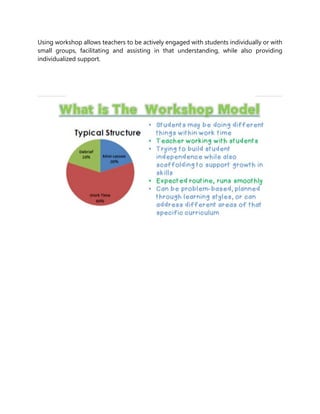
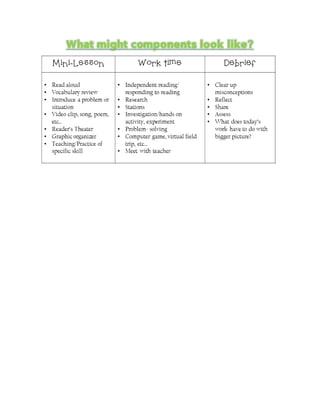
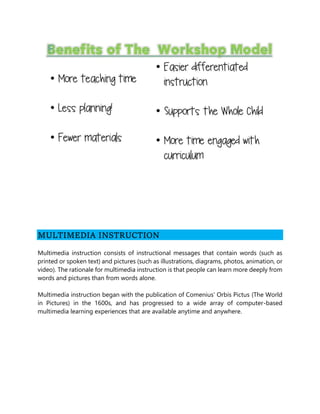
Workshop is a teaching structure that pushes students to be creative and responsible in
their own learning.
The Workshop Model asks students to take charge of their own learning, becoming active
and engaged in their work and development of understanding.
Using workshop allows teachers to be actively engaged with students individually or with
small groups, facilitating and assisting in that understanding, while also providing
individualized support.
MULTIMEDIA INSTRUCTION
Multimedia instruction consists of instructional messages that contain words (such as
printed or spoken text) and pictures (such as illustrations, diagrams, photos, animation, or
video). The rationale for multimedia instruction is that people can learn more deeply from
words and pictures than from words alone.
Multimedia instruction began with the publication of Comenius’ Orbis Pictus (The World
in Pictures) in the 1600s, and has progressed to a wide array of computer-based
multimedia learning experiences that are available anytime and anywhere.
PROBLEM SOLVING
Problem solving is a teaching strategy that employs the scientific method in searching for
information.
The five basic steps of scientific method or investigatory process are:
1. Sensing and defining the problem
2. Formulating hypothesis
3. Testing the likely hypothesis
4. Analysis, interpretation and evaluation of evidence
5. Formulating conclusion
ADVANTAGES OF PROBLEM SOLVING STRATEGY
This method is most effective in developing skill in employing the science
processes.
The scientific method can likewise be used effectively in other-non science
subjects.
The students’ active involvement resulting in meaningful experiences serves as a
strong motivation to follow the scientific procedure in future undertakings.
Problem solving develops higher level thinking skills.
A keen sense of responsibility, originality and resourcefulness are developed, which
are much needed ingredients for independent study.
The students become appreciative and grateful for the achievement of scientists.
Critical thinking, open-mindedness and wise judgment are among scientific
attitudes and values inculcated through competence in the scientific method.
The student learn to accept the opinions and evidence shared by others.
FILM SHOWING
Film showing strategy is a strategy where the teacher plays a film to the learners to bring
an element of realism into the classroom, which cannot be obtained by many medium of
instruction.
Films are a comfortable, familiar medium to contemporary students that can keep learner
interest in the theories and concepts under discussion.
The students can see the theories and concepts in action.
In more than a figurative sense, theories and concepts leap from the screen.
Films also are an economical substitute for field trips and other real world visits.
Students can hone their analytical skills by analyzing film scenes using the theories and
concepts they are studying.
Students also can see and experience worlds beyond their own, especially when the
scenes sharply differ from their local environment.
Films offer both cognitive and affective experiences.
They can provoke good discussion, assessment of ones values, and assessment of self
if the scenes that have strong emotional content.
Prepared by:
JOHNLERY S. GUZMAN, LPT
MS Math Educ. Student

OTHER METHODS AND TECHNIQUES.docx

  • 1.
    OTHER TEACHING METHODSAND TECHNIQUES OBJECTIVES: At the end of the topic, learners should be able to:  Define teaching methods and teaching techniques;  Differentiate teaching method to technique; and  Identify the other teaching methods and techniques. CONTENTS: A. Definition of Teaching Methods and Techniques B. Other teaching methods and techniques Definition Teaching Methods The term teaching method refers to the general principles, pedagogy and management strategies used for classroom instruction. Your choice of teaching method depends on what fits you — your educational philosophy, classroom demographic, and subject area(s). Teaching Techniques Teaching techniques are such steps we follow when we teach. (Procedures) It is a well-defined procedure used to accomplish a specific activity or task. For example, when we want to help students learn the meaning of new vocabulary words we can use a teaching technique known as Definition Clues.
  • 2.
    Other Teaching Methodsand Strategies are the following:  Interactive Learning  Simulations/Mock Teaching  Games  Workshops/Seminars  Multimedia Instruction  Problem Solving  Film Showing INTERACTIVE LEARNING Interactive learning is a hands-on/real life approach to education founded upon building student engagement through guided social interaction. Carefully designed and structured activities facilitate learning in groups, fostering a challenging but encouraging space for students to wrestle with novel concepts and develop practical skills. Typical “homework” activities like applying course topics, solving problems, working through issues, are done together in class. Students then come to class with their curiosity piqued by engaging with topics in advance and are then given a problem, a project, a case to role-play or some other active learning exercise which engages them with their peers and teaching staff in an interactive and energetic learning environment. Interactive learning is a holistic methodology that has both online and offline components, which together make a complete educational experience. SIMULATIONS/MOCK TEACHING
  • 3.
    Simulations are instructionalscenarios where the learner is placed in a "world" defined by the teacher. They represent a reality within which students interact. The teacher controls the parameters of this "world" and uses it to achieve the desired instructional results. Students experience the reality of the scenario and gather meaning from it. Simulation is a controlled representation of reality. Simulation means role- playing or rehearsal in which the process of teaching is carried out artificially. Simulations take a number of forms. They may contain elements of:  a game  a role-play, or  an activity that acts as a metaphor. GAMES While playing games is a great leisure activity that people of all ages can enjoy, games can also be used for learning and educational experiences. Some games have been found to improve cognitive functions like memory and reasoning. Games help people develop a disposition toward collaboration, problem-solving, communication, experimentation, and exploration of identities. Games are like a form of entertainment while learning. Because games include rules, definitive objectives, measurable goals and competition, they deliver an interactive experience that promotes a sense of achievement for all of the participants. WORKSHOPS/SEMINARS Workshop is a teaching structure that pushes students to be creative and responsible in their own learning. The Workshop Model asks students to take charge of their own learning, becoming active and engaged in their work and development of understanding.
  • 4.
    Using workshop allowsteachers to be actively engaged with students individually or with small groups, facilitating and assisting in that understanding, while also providing individualized support.
  • 6.
    MULTIMEDIA INSTRUCTION Multimedia instructionconsists of instructional messages that contain words (such as printed or spoken text) and pictures (such as illustrations, diagrams, photos, animation, or video). The rationale for multimedia instruction is that people can learn more deeply from words and pictures than from words alone. Multimedia instruction began with the publication of Comenius’ Orbis Pictus (The World in Pictures) in the 1600s, and has progressed to a wide array of computer-based multimedia learning experiences that are available anytime and anywhere.
  • 7.
    PROBLEM SOLVING Problem solvingis a teaching strategy that employs the scientific method in searching for information. The five basic steps of scientific method or investigatory process are: 1. Sensing and defining the problem 2. Formulating hypothesis 3. Testing the likely hypothesis 4. Analysis, interpretation and evaluation of evidence 5. Formulating conclusion ADVANTAGES OF PROBLEM SOLVING STRATEGY This method is most effective in developing skill in employing the science processes. The scientific method can likewise be used effectively in other-non science subjects. The students’ active involvement resulting in meaningful experiences serves as a strong motivation to follow the scientific procedure in future undertakings. Problem solving develops higher level thinking skills. A keen sense of responsibility, originality and resourcefulness are developed, which are much needed ingredients for independent study. The students become appreciative and grateful for the achievement of scientists. Critical thinking, open-mindedness and wise judgment are among scientific attitudes and values inculcated through competence in the scientific method. The student learn to accept the opinions and evidence shared by others. FILM SHOWING Film showing strategy is a strategy where the teacher plays a film to the learners to bring an element of realism into the classroom, which cannot be obtained by many medium of instruction. Films are a comfortable, familiar medium to contemporary students that can keep learner interest in the theories and concepts under discussion.
  • 8.
    The students cansee the theories and concepts in action. In more than a figurative sense, theories and concepts leap from the screen. Films also are an economical substitute for field trips and other real world visits. Students can hone their analytical skills by analyzing film scenes using the theories and concepts they are studying. Students also can see and experience worlds beyond their own, especially when the scenes sharply differ from their local environment. Films offer both cognitive and affective experiences. They can provoke good discussion, assessment of ones values, and assessment of self if the scenes that have strong emotional content. Prepared by: JOHNLERY S. GUZMAN, LPT MS Math Educ. Student