Michelle DeLaRosa
A concept is a set of specific objects, symbols or events which are grouped together on the basis of shared characteristics and which can be referenced by a particular name or symbol. (Merrill & Tennyson, 1977, p. 3)
computer house adverb haiku triangle blue Cold War pulley cumulus cloud
Concrete Known by their physical characteristics Abstract Are not identified by their appearance Sometimes concepts can fall into either category depending on the ability of the learner. Classificatory Being able to recognize examples and nonexamples of the concept but not have the ability to tell why. Formal Can identify examples and non examples and tell why.
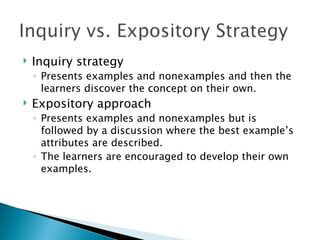
Inquiry strategy Presents examples and nonexamples and then the learners discover the concept on their own. Expository approach Presents examples and nonexamples but is followed by a discussion where the best example’s attributes are described. The learners are encouraged to develop their own examples.
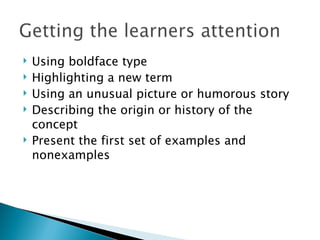
Using boldface type Highlighting a new term Using an unusual picture or humorous story Describing the origin or history of the concept Present the first set of examples and nonexamples
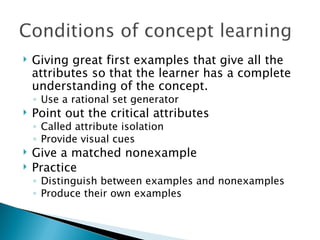
Giving great first examples that give all the attributes so that the learner has a complete understanding of the concept. Use a rational set generator Point out the critical attributes Called attribute isolation Provide visual cues Give a matched nonexample Practice Distinguish between examples and nonexamples Produce their own examples
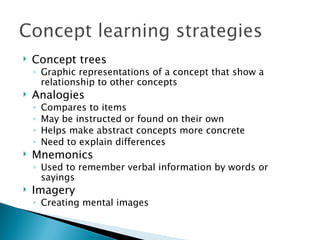
Concept trees Graphic representations of a concept that show a relationship to other concepts Analogies Compares to items May be instructed or found on their own Helps make abstract concepts more concrete Need to explain differences Mnemonics Used to remember verbal information by words or sayings Imagery Creating mental images
Explain why it is or is not an example of the concept Categorize examples and nonexamples, with or without an explanation Produce their own examples Can also be assessed on the ability to use the concept to draw inferences Must be applied rather than recalled
A concept that will be taught for my final project will be using PowerPoint to create a slideshow. I will show examples of good presentations (some that contain all the important elements) and some not so good presentations (some that are missing things) I will use visuals and handouts to help explain how to create a slideshow. After they practice they will have to create their own slideshow.
Material taken from Chapter 9: Strategies for Instruction Leading to Concept Learning in the book  Instructional Design  by Smith and Ragen

Concept Learning

  • 1.
  • 2.
    A concept isa set of specific objects, symbols or events which are grouped together on the basis of shared characteristics and which can be referenced by a particular name or symbol. (Merrill & Tennyson, 1977, p. 3)
  • 3.
    computer house adverbhaiku triangle blue Cold War pulley cumulus cloud
  • 4.
    Concrete Known bytheir physical characteristics Abstract Are not identified by their appearance Sometimes concepts can fall into either category depending on the ability of the learner. Classificatory Being able to recognize examples and nonexamples of the concept but not have the ability to tell why. Formal Can identify examples and non examples and tell why.
  • 5.
    Inquiry strategy Presentsexamples and nonexamples and then the learners discover the concept on their own. Expository approach Presents examples and nonexamples but is followed by a discussion where the best example’s attributes are described. The learners are encouraged to develop their own examples.
  • 6.
    Using boldface typeHighlighting a new term Using an unusual picture or humorous story Describing the origin or history of the concept Present the first set of examples and nonexamples
  • 7.
    Giving great firstexamples that give all the attributes so that the learner has a complete understanding of the concept. Use a rational set generator Point out the critical attributes Called attribute isolation Provide visual cues Give a matched nonexample Practice Distinguish between examples and nonexamples Produce their own examples
  • 8.
    Concept trees Graphicrepresentations of a concept that show a relationship to other concepts Analogies Compares to items May be instructed or found on their own Helps make abstract concepts more concrete Need to explain differences Mnemonics Used to remember verbal information by words or sayings Imagery Creating mental images
  • 9.
    Explain why itis or is not an example of the concept Categorize examples and nonexamples, with or without an explanation Produce their own examples Can also be assessed on the ability to use the concept to draw inferences Must be applied rather than recalled
  • 10.
    A concept thatwill be taught for my final project will be using PowerPoint to create a slideshow. I will show examples of good presentations (some that contain all the important elements) and some not so good presentations (some that are missing things) I will use visuals and handouts to help explain how to create a slideshow. After they practice they will have to create their own slideshow.
  • 11.
    Material taken fromChapter 9: Strategies for Instruction Leading to Concept Learning in the book Instructional Design by Smith and Ragen