GINALYN A. COMENDADOR
MS GEN SCI ED
CENTRAL MINDANAO UNIVERSITY
DEMONSTRATION METHOD
o SciEd 205 Instructional Methods and
Strategies for Science Teaching
To teach a skill, concept or principle
Aims of Demonstration Method
To demonstrate delicate work
involving careful manipulations
To achieve psychomotor and
cognitive objectives
Demonstration teaching is anchored on
the ff. principles:
• Learning by doing
• Skills can be
developed by imitation
• The perception helps
in imitation
In demonstration method,
 the teacher is called the demonstrator and
must possess the technical know-how
 He is concerned that the learner understands
the logical step-by-step procedures in doing
the job, the principles that apply, and the
related information
 The presenter shows how a process is done
while the students become observers
- the best way to teach "how" is to "show how"
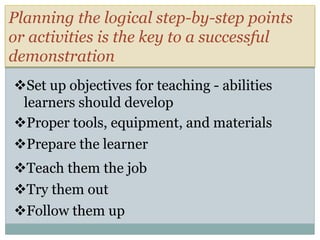
Planning the logical step-by-step points
or activities is the key to a successful
demonstration
Set up objectives for teaching - abilities
learners should develop
Proper tools, equipment, and materials
Prepare the learner
Teach them the job
Try them out
Follow them up
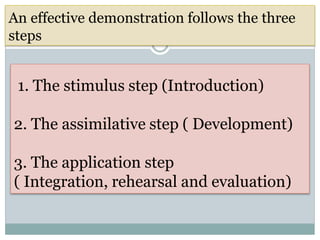
An effective demonstration follows the three
steps
1. The stimulus step (Introduction)
2. The assimilative step ( Development)
3. The application step
( Integration, rehearsal and evaluation)
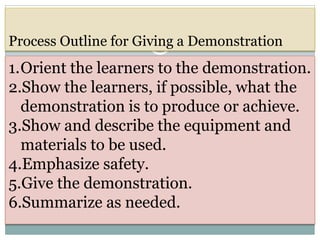
Process Outline for Giving a Demonstration
1.Orient the learners to the demonstration.
2.Show the learners, if possible, what the
demonstration is to produce or achieve.
3.Show and describe the equipment and
materials to be used.
4.Emphasize safety.
5.Give the demonstration.
6.Summarize as needed.
Advantages:
Involves various senses that make
learning permanent
Teacher invites cooperation of pupils
Develop interest and motivation for
active participation
Helps achieve psychomotor objectives
Increases leadership and
self-confidence among demonstrators
Disadvantages
Can only be used in skills subject
Only the attention of the learners is
invited towards the activity
demonstrated.
Due to poor economic condition of
the government schools, there is
scarcity of audio-visual aids and
equipment
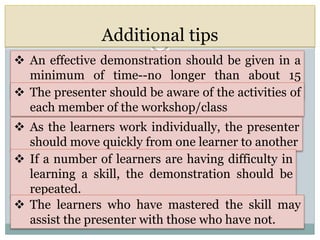
Additional tips
 An effective demonstration should be given in a
minimum of time--no longer than about 15
minutes. The presenter should be aware of the activities of
each member of the workshop/class
 As the learners work individually, the presenter
should move quickly from one learner to another
 If a number of learners are having difficulty in
learning a skill, the demonstration should be
repeated.
 The learners who have mastered the skill may
assist the presenter with those who have not.
Thank you for
Listening

Demonstration method

  • 1.
    GINALYN A. COMENDADOR MSGEN SCI ED CENTRAL MINDANAO UNIVERSITY DEMONSTRATION METHOD o SciEd 205 Instructional Methods and Strategies for Science Teaching
  • 2.
    To teach askill, concept or principle Aims of Demonstration Method To demonstrate delicate work involving careful manipulations To achieve psychomotor and cognitive objectives
  • 3.
    Demonstration teaching isanchored on the ff. principles: • Learning by doing • Skills can be developed by imitation • The perception helps in imitation
  • 4.
    In demonstration method, the teacher is called the demonstrator and must possess the technical know-how  He is concerned that the learner understands the logical step-by-step procedures in doing the job, the principles that apply, and the related information  The presenter shows how a process is done while the students become observers - the best way to teach "how" is to "show how"
  • 5.
    Planning the logicalstep-by-step points or activities is the key to a successful demonstration Set up objectives for teaching - abilities learners should develop Proper tools, equipment, and materials Prepare the learner Teach them the job Try them out Follow them up
  • 6.
    An effective demonstrationfollows the three steps 1. The stimulus step (Introduction) 2. The assimilative step ( Development) 3. The application step ( Integration, rehearsal and evaluation)
  • 7.
    Process Outline forGiving a Demonstration 1.Orient the learners to the demonstration. 2.Show the learners, if possible, what the demonstration is to produce or achieve. 3.Show and describe the equipment and materials to be used. 4.Emphasize safety. 5.Give the demonstration. 6.Summarize as needed.
  • 8.
    Advantages: Involves various sensesthat make learning permanent Teacher invites cooperation of pupils Develop interest and motivation for active participation Helps achieve psychomotor objectives Increases leadership and self-confidence among demonstrators
  • 9.
    Disadvantages Can only beused in skills subject Only the attention of the learners is invited towards the activity demonstrated. Due to poor economic condition of the government schools, there is scarcity of audio-visual aids and equipment
  • 10.
    Additional tips  Aneffective demonstration should be given in a minimum of time--no longer than about 15 minutes. The presenter should be aware of the activities of each member of the workshop/class  As the learners work individually, the presenter should move quickly from one learner to another  If a number of learners are having difficulty in learning a skill, the demonstration should be repeated.  The learners who have mastered the skill may assist the presenter with those who have not.
  • 11.