Laws concerning PeopleLaws concerning People
with Disabilitieswith Disabilities
The Three Laws
Americans with
Disabilities Act (ADA) PL
101-336
Section 504 of the
Rehabilitation Act of 1973
(Section 504)PL 93-112
Individuals with
Disabilities Education
Act (IDEA) PL 94-142
A Federal civil rights statute. A Federal funding statute.
Passed in 1990 to provide a
comprehensive approach to
eliminate discrimination on the
basis of a disability throughout
the nation.
Passed in 1973 to eliminate
discrimination on the basis of
disability in any program or
activity receiving Federal
financial assistance.
Passed in 1975 to provide Federal
financial assistance to state and
local education agencies to assist
them to educate children with
disabilities.
Applies to all public and certain
private entities whether or not
they receive Federal financial
assistance.
Applies to state and local education
agencies which receive IDEA
funds.
Applies to recipients of Federal
financial assistance.
Covers employment practices,
public services, public
accommodations and
commercial facilities, and
telecommunications services.
Covers employment practices,
program accessibility, preschool,
elementary, and secondary
education programs, post-
secondary education programs,
and health, welfare and social
services.
Covers the provision of special
education and related services to
eligible disabled children aged 3
through 21.
A Federal civil rights statute.
Foundations of IDEAFoundations of IDEA
Zero RejectZero Reject
Free and Appropriate Public EducationFree and Appropriate Public Education
and the provision on IEPand the provision on IEP
Least Restrictive EnvironmentLeast Restrictive Environment
Nondiscriminatory EvaluationNondiscriminatory Evaluation
Due Process and Procedural SafeguardsDue Process and Procedural Safeguards
Technology-related assistanceTechnology-related assistance
Major Amendments to IDEAMajor Amendments to IDEA
 PL 99-457 Preschool GrantsPL 99-457 Preschool Grants
Program with the provision of IFSPProgram with the provision of IFSP
 PL 101 476 “People FirstPL 101 476 “People First
Language”, added Autism, & TBI &Language”, added Autism, & TBI &
ITP age 16ITP age 16
 PL 105-17 (1997 Amendments)PL 105-17 (1997 Amendments)
Participation in the State andParticipation in the State and
District-wide assessment programs,District-wide assessment programs,
intervention to EBD, ITP age 14intervention to EBD, ITP age 14
 2004 Amendments “Full funding” for2004 Amendments “Full funding” for
IDEAIDEA
 www.nichcy.org/reauth/index.html/.www.nichcy.org/reauth/index.html/.
The Philippine LawsThe Philippine Laws
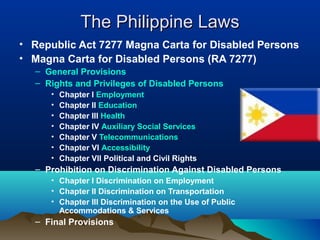
• Republic Act 7277 Magna Carta for Disabled Persons
• Magna Carta for Disabled Persons (RA 7277)
– General Provisions
– Rights and Privileges of Disabled Persons
• Chapter I Employment
• Chapter II Education
• Chapter III Health
• Chapter IV Auxiliary Social Services
• Chapter V Telecommunications
• Chapter VI Accessibility
• Chapter VII Political and Civil Rights
– Prohibition on Discrimination Against Disabled Persons
• Chapter I Discrimination on Employment
• Chapter II Discrimination on Transportation
• Chapter III Discrimination on the Use of Public
Accommodations & Services
– Final Provisions
PhilosophyPhilosophy
• The State shall promote the right of every individual to
relevant quality education regardless of sex, age, breed,
socio-economic status, physical and mental condition,
social or ethnic origin, political and other affiliation. The
State shall therefore promote and maintain equality of
access to education as well as the enjoyment of benefits
of education by all its citizens (BP Blg. 232).
• Every child with special needs has a right to an
educational program that is suitable to his needs.
Special Education shares with regular education basic
responsibilities of the educational system to fulfill the
right of the child to develop to his full potential.
Goals and ObjectivesGoals and Objectives
• The ultimate goal of special education shall be the
integration or mainstreaming of learners with special
needs into the regular school system and eventually in
the community.
• Special education shall aim to develop the maximum
potential of the child with special needs to enable him to
become self-reliant and shall be geared towards
providing him with the opportunities for a full and happy
life.
• The specific objectives of special education shall be the
development and maximization of learning
competencies, as well as the inculcation of values to
make the learners with special needs a useful and
effective member of society.
Rights and PrivilegesRights and Privileges
 Employment ( equal opportunity,Employment ( equal opportunity,
sheltered employment, incentives forsheltered employment, incentives for
employees, vocational rehabilitation,employees, vocational rehabilitation,
guidance and counseling)guidance and counseling)
 Education (access to quality education,Education (access to quality education,
assistance to disabled students,assistance to disabled students,
special education, vocational andspecial education, vocational and
technical training programs, non-formaltechnical training programs, non-formal
education and state and universitieseducation and state and universities
and colleges)and colleges)
Rights and PrivilegesRights and Privileges
 Auxiliary Social ServicesAuxiliary Social Services
( prosthesis, special training, family( prosthesis, special training, family
care services)care services)
 Telecommunications (provision ofTelecommunications (provision of
sign language in television, specialsign language in television, special
devices in telephones, free postaldevices in telephones, free postal
postage )postage )
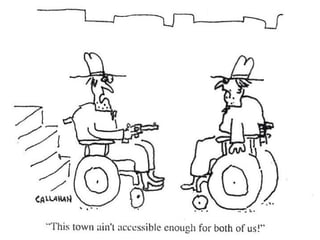
 Accessibility ( barrier freeAccessibility ( barrier free
environment, mobility and access toenvironment, mobility and access to
public transportation)public transportation)
 http://www.dinf.ne.jp/doc/english/intl/z15/z15007le/zhttp://www.dinf.ne.jp/doc/english/intl/z15/z15007le/z
1500711.htm#2-21500711.htm#2-2
Qualified Person with a DisabilityQualified Person with a Disability
 Must have a physical or mental impairmentMust have a physical or mental impairment
which substantially limits a major life activitywhich substantially limits a major life activity
(e.g., learning).(e.g., learning).
 Learning substantially limited if noLearning substantially limited if no
educational benefit.educational benefit.
 Qualified person with disability must beQualified person with disability must be
provided aids, benefits, or services asprovided aids, benefits, or services as
effective as those provided non disabledeffective as those provided non disabled
students.students.
When to Consider the PossibleWhen to Consider the Possible
Existence of a DisabilityExistence of a Disability
 When a disability of any kind is suspected.When a disability of any kind is suspected.
 When a student shows a pattern of not benefiting fromWhen a student shows a pattern of not benefiting from
the instruction provided.the instruction provided.
 When a student is referred for evaluation for specialWhen a student is referred for evaluation for special
education but it is determined not to do an evaluation.education but it is determined not to do an evaluation.
 When a student is evaluated but is determined notWhen a student is evaluated but is determined not
IDEA eligible.IDEA eligible.
 When the student is identified as “at risk” or exhibitsWhen the student is identified as “at risk” or exhibits
the potential for dropping out.the potential for dropping out.
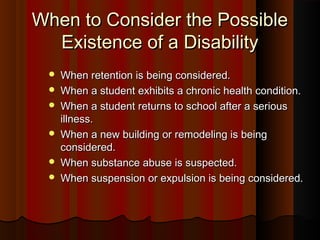
When to Consider the PossibleWhen to Consider the Possible
Existence of a DisabilityExistence of a Disability
 When retention is being considered.When retention is being considered.
 When a student exhibits a chronic health condition.When a student exhibits a chronic health condition.
 When a student returns to school after a seriousWhen a student returns to school after a serious
illness.illness.
 When a new building or remodeling is beingWhen a new building or remodeling is being
considered.considered.
 When substance abuse is suspected.When substance abuse is suspected.
 When suspension or expulsion is being considered.When suspension or expulsion is being considered.

Laws concerning people with disabilities

  • 1.
    Laws concerning PeopleLawsconcerning People with Disabilitieswith Disabilities
  • 3.
    The Three Laws Americanswith Disabilities Act (ADA) PL 101-336 Section 504 of the Rehabilitation Act of 1973 (Section 504)PL 93-112 Individuals with Disabilities Education Act (IDEA) PL 94-142 A Federal civil rights statute. A Federal funding statute. Passed in 1990 to provide a comprehensive approach to eliminate discrimination on the basis of a disability throughout the nation. Passed in 1973 to eliminate discrimination on the basis of disability in any program or activity receiving Federal financial assistance. Passed in 1975 to provide Federal financial assistance to state and local education agencies to assist them to educate children with disabilities. Applies to all public and certain private entities whether or not they receive Federal financial assistance. Applies to state and local education agencies which receive IDEA funds. Applies to recipients of Federal financial assistance. Covers employment practices, public services, public accommodations and commercial facilities, and telecommunications services. Covers employment practices, program accessibility, preschool, elementary, and secondary education programs, post- secondary education programs, and health, welfare and social services. Covers the provision of special education and related services to eligible disabled children aged 3 through 21. A Federal civil rights statute.
  • 4.
    Foundations of IDEAFoundationsof IDEA Zero RejectZero Reject Free and Appropriate Public EducationFree and Appropriate Public Education and the provision on IEPand the provision on IEP Least Restrictive EnvironmentLeast Restrictive Environment Nondiscriminatory EvaluationNondiscriminatory Evaluation Due Process and Procedural SafeguardsDue Process and Procedural Safeguards Technology-related assistanceTechnology-related assistance
  • 5.
    Major Amendments toIDEAMajor Amendments to IDEA  PL 99-457 Preschool GrantsPL 99-457 Preschool Grants Program with the provision of IFSPProgram with the provision of IFSP  PL 101 476 “People FirstPL 101 476 “People First Language”, added Autism, & TBI &Language”, added Autism, & TBI & ITP age 16ITP age 16  PL 105-17 (1997 Amendments)PL 105-17 (1997 Amendments) Participation in the State andParticipation in the State and District-wide assessment programs,District-wide assessment programs, intervention to EBD, ITP age 14intervention to EBD, ITP age 14  2004 Amendments “Full funding” for2004 Amendments “Full funding” for IDEAIDEA  www.nichcy.org/reauth/index.html/.www.nichcy.org/reauth/index.html/.
  • 6.
    The Philippine LawsThePhilippine Laws • Republic Act 7277 Magna Carta for Disabled Persons • Magna Carta for Disabled Persons (RA 7277) – General Provisions – Rights and Privileges of Disabled Persons • Chapter I Employment • Chapter II Education • Chapter III Health • Chapter IV Auxiliary Social Services • Chapter V Telecommunications • Chapter VI Accessibility • Chapter VII Political and Civil Rights – Prohibition on Discrimination Against Disabled Persons • Chapter I Discrimination on Employment • Chapter II Discrimination on Transportation • Chapter III Discrimination on the Use of Public Accommodations & Services – Final Provisions
  • 7.
    PhilosophyPhilosophy • The Stateshall promote the right of every individual to relevant quality education regardless of sex, age, breed, socio-economic status, physical and mental condition, social or ethnic origin, political and other affiliation. The State shall therefore promote and maintain equality of access to education as well as the enjoyment of benefits of education by all its citizens (BP Blg. 232). • Every child with special needs has a right to an educational program that is suitable to his needs. Special Education shares with regular education basic responsibilities of the educational system to fulfill the right of the child to develop to his full potential.
  • 8.
    Goals and ObjectivesGoalsand Objectives • The ultimate goal of special education shall be the integration or mainstreaming of learners with special needs into the regular school system and eventually in the community. • Special education shall aim to develop the maximum potential of the child with special needs to enable him to become self-reliant and shall be geared towards providing him with the opportunities for a full and happy life. • The specific objectives of special education shall be the development and maximization of learning competencies, as well as the inculcation of values to make the learners with special needs a useful and effective member of society.
  • 9.
    Rights and PrivilegesRightsand Privileges  Employment ( equal opportunity,Employment ( equal opportunity, sheltered employment, incentives forsheltered employment, incentives for employees, vocational rehabilitation,employees, vocational rehabilitation, guidance and counseling)guidance and counseling)  Education (access to quality education,Education (access to quality education, assistance to disabled students,assistance to disabled students, special education, vocational andspecial education, vocational and technical training programs, non-formaltechnical training programs, non-formal education and state and universitieseducation and state and universities and colleges)and colleges)
  • 10.
    Rights and PrivilegesRightsand Privileges  Auxiliary Social ServicesAuxiliary Social Services ( prosthesis, special training, family( prosthesis, special training, family care services)care services)  Telecommunications (provision ofTelecommunications (provision of sign language in television, specialsign language in television, special devices in telephones, free postaldevices in telephones, free postal postage )postage )  Accessibility ( barrier freeAccessibility ( barrier free environment, mobility and access toenvironment, mobility and access to public transportation)public transportation)  http://www.dinf.ne.jp/doc/english/intl/z15/z15007le/zhttp://www.dinf.ne.jp/doc/english/intl/z15/z15007le/z 1500711.htm#2-21500711.htm#2-2
  • 12.
    Qualified Person witha DisabilityQualified Person with a Disability  Must have a physical or mental impairmentMust have a physical or mental impairment which substantially limits a major life activitywhich substantially limits a major life activity (e.g., learning).(e.g., learning).  Learning substantially limited if noLearning substantially limited if no educational benefit.educational benefit.  Qualified person with disability must beQualified person with disability must be provided aids, benefits, or services asprovided aids, benefits, or services as effective as those provided non disabledeffective as those provided non disabled students.students.
  • 13.
    When to Considerthe PossibleWhen to Consider the Possible Existence of a DisabilityExistence of a Disability  When a disability of any kind is suspected.When a disability of any kind is suspected.  When a student shows a pattern of not benefiting fromWhen a student shows a pattern of not benefiting from the instruction provided.the instruction provided.  When a student is referred for evaluation for specialWhen a student is referred for evaluation for special education but it is determined not to do an evaluation.education but it is determined not to do an evaluation.  When a student is evaluated but is determined notWhen a student is evaluated but is determined not IDEA eligible.IDEA eligible.  When the student is identified as “at risk” or exhibitsWhen the student is identified as “at risk” or exhibits the potential for dropping out.the potential for dropping out.
  • 14.
    When to Considerthe PossibleWhen to Consider the Possible Existence of a DisabilityExistence of a Disability  When retention is being considered.When retention is being considered.  When a student exhibits a chronic health condition.When a student exhibits a chronic health condition.  When a student returns to school after a seriousWhen a student returns to school after a serious illness.illness.  When a new building or remodeling is beingWhen a new building or remodeling is being considered.considered.  When substance abuse is suspected.When substance abuse is suspected.  When suspension or expulsion is being considered.When suspension or expulsion is being considered.