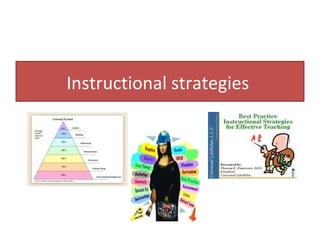
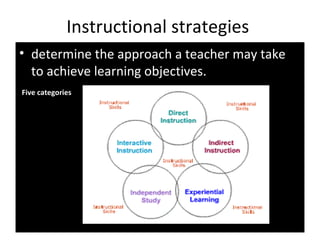
Instructional strategies
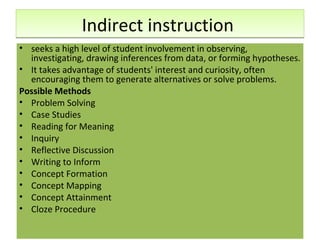
Instructional strategies  determine the approach a teacher may take to achieve learning objectives.  Five categories
Direct instruction strategy  is highly teacher-directed and is among the most commonly used. This strategy is effective for providing information or developing step-by-step skills. Possible Methods  Structured Overview Lecture Explicit Teaching Drill & Practice Compare & Contrast Didactic Questions Demonstrations Guided & Shared - reading, listening, viewing, thinking
Indirect instruction  seeks a high level of student involvement in observing, investigating, drawing inferences from data, or forming hypotheses.  It takes advantage of students' interest and curiosity, often encouraging them to generate alternatives or solve problems.  Possible Methods   Problem Solving Case Studies Reading for Meaning Inquiry Reflective Discussion Writing to Inform Concept Formation Concept Mapping Concept Attainment Cloze Procedure
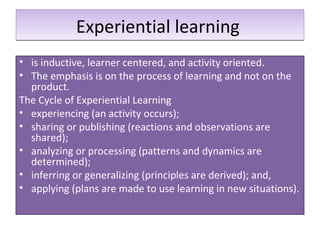
Experiential learning  is inductive, learner centered, and activity oriented. The emphasis is on the process of learning and not on the product.  The Cycle of Experiential Learning experiencing (an activity occurs); sharing or publishing (reactions and observations are shared);  analyzing or processing (patterns and dynamics are determined);  inferring or generalizing (principles are derived); and,  applying (plans are made to use learning in new situations).
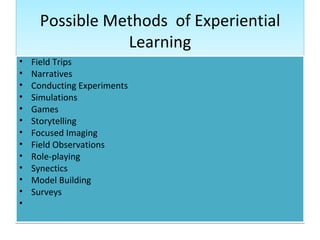
Possible Methods  of Experiential Learning Field Trips Narratives Conducting Experiments Simulations Games Storytelling Focused Imaging Field Observations Role-playing Synectics Model Building Surveys  
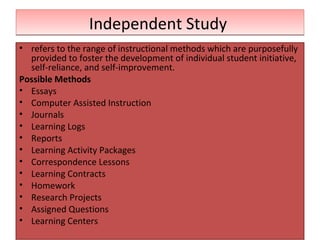
Independent Study  refers to the range of instructional methods which are purposefully provided to foster the development of individual student initiative, self-reliance, and self-improvement.  Possible Methods  Essays Computer Assisted Instruction Journals  Learning Logs Reports Learning Activity Packages Correspondence Lessons Learning Contracts Homework Research Projects Assigned Questions Learning Centers
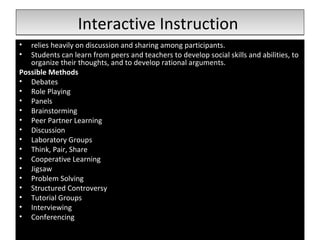
Interactive Instruction  relies heavily on discussion and sharing among participants.  Students can learn from peers and teachers to develop social skills and abilities, to organize their thoughts, and to develop rational arguments.  Possible Methods   Debates Role Playing Panels Brainstorming Peer Partner Learning Discussion Laboratory Groups Think, Pair, Share Cooperative Learning Jigsaw Problem Solving Structured Controversy Tutorial Groups Interviewing Conferencing
Other Specific Strategies in Teaching Students with Special Needs
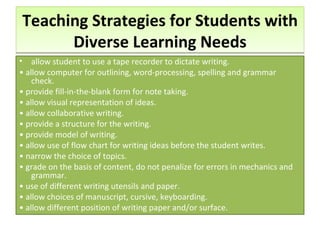
Teaching Strategies for Students with Diverse Learning Needs allow student to use a tape recorder to dictate writing. •  allow computer for outlining, word-processing, spelling and grammar check. •  provide fill-in-the-blank form for note taking. •  allow visual representation of ideas. •  allow collaborative writing. •  provide a structure for the writing. •  provide model of writing. •  allow use of flow chart for writing ideas before the student writes. •  narrow the choice of topics. •  grade on the basis of content, do not penalize for errors in mechanics and grammar. •  use of different writing utensils and paper. •  allow choices of manuscript, cursive, keyboarding. •  allow different position of writing paper and/or surface.
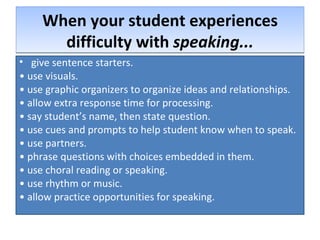
When your student experiences difficulty with  speaking... give sentence starters. •  use visuals. •  use graphic organizers to organize ideas and relationships. •  allow extra response time for processing. •  say student’s name, then state question. •  use cues and prompts to help student know when to speak. •  use partners. •  phrase questions with choices embedded in them. •  use choral reading or speaking. •  use rhythm or music. •  allow practice opportunities for speaking.
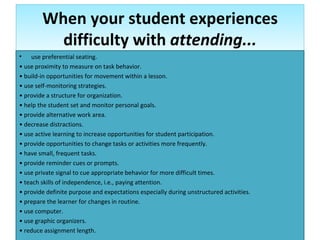
When your student experiences difficulty with  attending... use preferential seating. •  use proximity to measure on task behavior. •  build-in opportunities for movement within a lesson. •  use self-monitoring strategies. •  provide a structure for organization. •  help the student set and monitor personal goals. •  provide alternative work area. •  decrease distractions. •  use active learning to increase opportunities for student participation. •  provide opportunities to change tasks or activities more frequently. •  have small, frequent tasks. •  provide reminder cues or prompts. •  use private signal to cue appropriate behavior for more difficult times. •  teach skills of independence, i.e., paying attention. •  provide definite purpose and expectations especially during unstructured activities. •  prepare the learner for changes in routine. •  use computer. •  use graphic organizers. •  reduce assignment length.

Instructional Strategies

  • 1.
  • 2.
    Instructional strategies determine the approach a teacher may take to achieve learning objectives. Five categories
  • 3.
    Direct instruction strategy is highly teacher-directed and is among the most commonly used. This strategy is effective for providing information or developing step-by-step skills. Possible Methods Structured Overview Lecture Explicit Teaching Drill & Practice Compare & Contrast Didactic Questions Demonstrations Guided & Shared - reading, listening, viewing, thinking
  • 4.
    Indirect instruction seeks a high level of student involvement in observing, investigating, drawing inferences from data, or forming hypotheses. It takes advantage of students' interest and curiosity, often encouraging them to generate alternatives or solve problems. Possible Methods Problem Solving Case Studies Reading for Meaning Inquiry Reflective Discussion Writing to Inform Concept Formation Concept Mapping Concept Attainment Cloze Procedure
  • 5.
    Experiential learning is inductive, learner centered, and activity oriented. The emphasis is on the process of learning and not on the product. The Cycle of Experiential Learning experiencing (an activity occurs); sharing or publishing (reactions and observations are shared); analyzing or processing (patterns and dynamics are determined); inferring or generalizing (principles are derived); and, applying (plans are made to use learning in new situations).
  • 6.
    Possible Methods of Experiential Learning Field Trips Narratives Conducting Experiments Simulations Games Storytelling Focused Imaging Field Observations Role-playing Synectics Model Building Surveys  
  • 7.
    Independent Study refers to the range of instructional methods which are purposefully provided to foster the development of individual student initiative, self-reliance, and self-improvement. Possible Methods Essays Computer Assisted Instruction Journals Learning Logs Reports Learning Activity Packages Correspondence Lessons Learning Contracts Homework Research Projects Assigned Questions Learning Centers
  • 8.
    Interactive Instruction relies heavily on discussion and sharing among participants. Students can learn from peers and teachers to develop social skills and abilities, to organize their thoughts, and to develop rational arguments. Possible Methods Debates Role Playing Panels Brainstorming Peer Partner Learning Discussion Laboratory Groups Think, Pair, Share Cooperative Learning Jigsaw Problem Solving Structured Controversy Tutorial Groups Interviewing Conferencing
  • 9.
    Other Specific Strategiesin Teaching Students with Special Needs
  • 10.
    Teaching Strategies forStudents with Diverse Learning Needs allow student to use a tape recorder to dictate writing. • allow computer for outlining, word-processing, spelling and grammar check. • provide fill-in-the-blank form for note taking. • allow visual representation of ideas. • allow collaborative writing. • provide a structure for the writing. • provide model of writing. • allow use of flow chart for writing ideas before the student writes. • narrow the choice of topics. • grade on the basis of content, do not penalize for errors in mechanics and grammar. • use of different writing utensils and paper. • allow choices of manuscript, cursive, keyboarding. • allow different position of writing paper and/or surface.
  • 11.
    When your studentexperiences difficulty with speaking... give sentence starters. • use visuals. • use graphic organizers to organize ideas and relationships. • allow extra response time for processing. • say student’s name, then state question. • use cues and prompts to help student know when to speak. • use partners. • phrase questions with choices embedded in them. • use choral reading or speaking. • use rhythm or music. • allow practice opportunities for speaking.
  • 12.
    When your studentexperiences difficulty with attending... use preferential seating. • use proximity to measure on task behavior. • build-in opportunities for movement within a lesson. • use self-monitoring strategies. • provide a structure for organization. • help the student set and monitor personal goals. • provide alternative work area. • decrease distractions. • use active learning to increase opportunities for student participation. • provide opportunities to change tasks or activities more frequently. • have small, frequent tasks. • provide reminder cues or prompts. • use private signal to cue appropriate behavior for more difficult times. • teach skills of independence, i.e., paying attention. • provide definite purpose and expectations especially during unstructured activities. • prepare the learner for changes in routine. • use computer. • use graphic organizers. • reduce assignment length.