Presented by:
Pono, Jacqueline
Cantoria, Alissa
Chua, Charisse
Cotiangco, Khamille
Bonita, Nikki
Cabrillos, Rosemarie
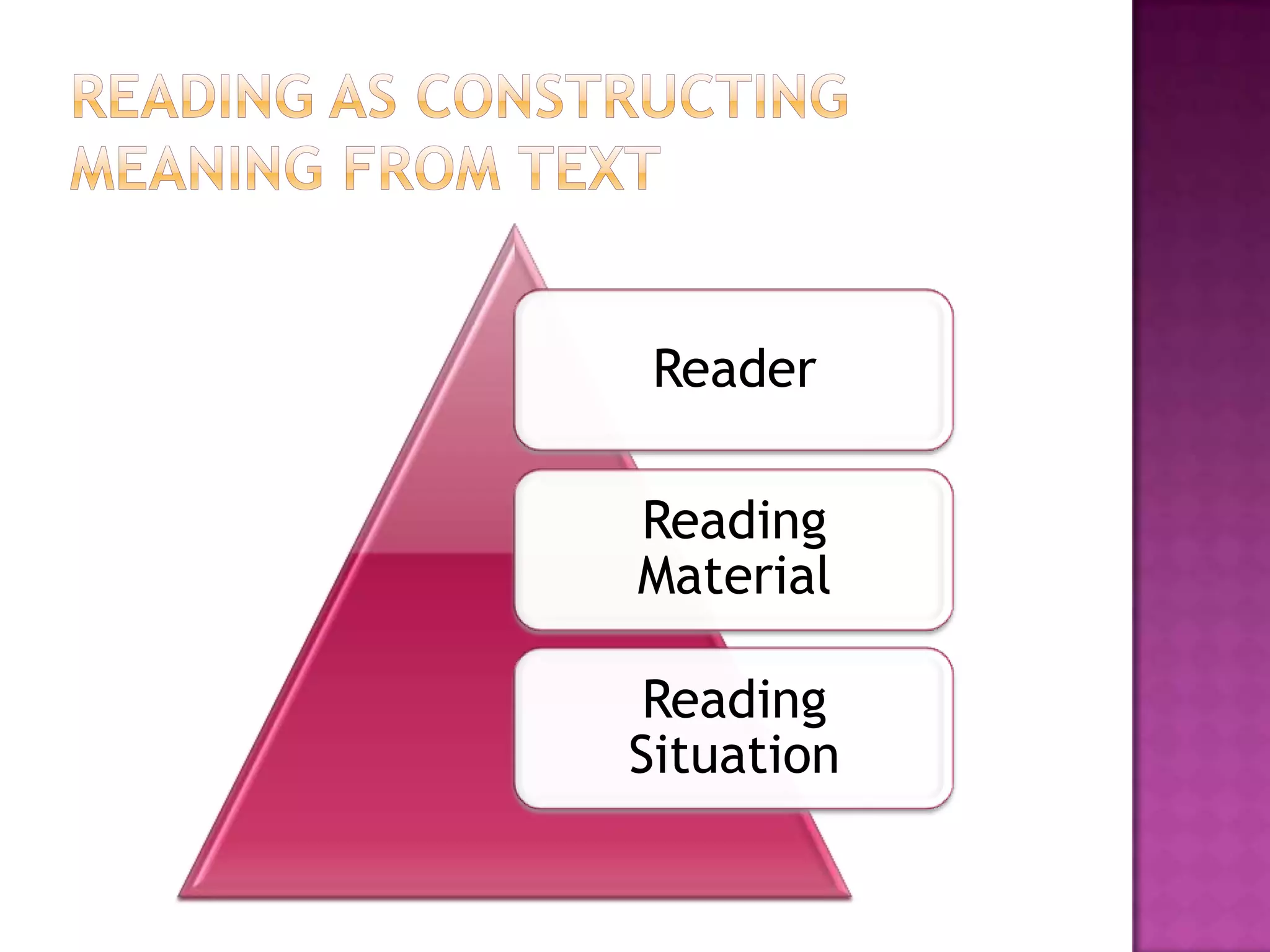
Reader
Reading
Material
Reading
Situation
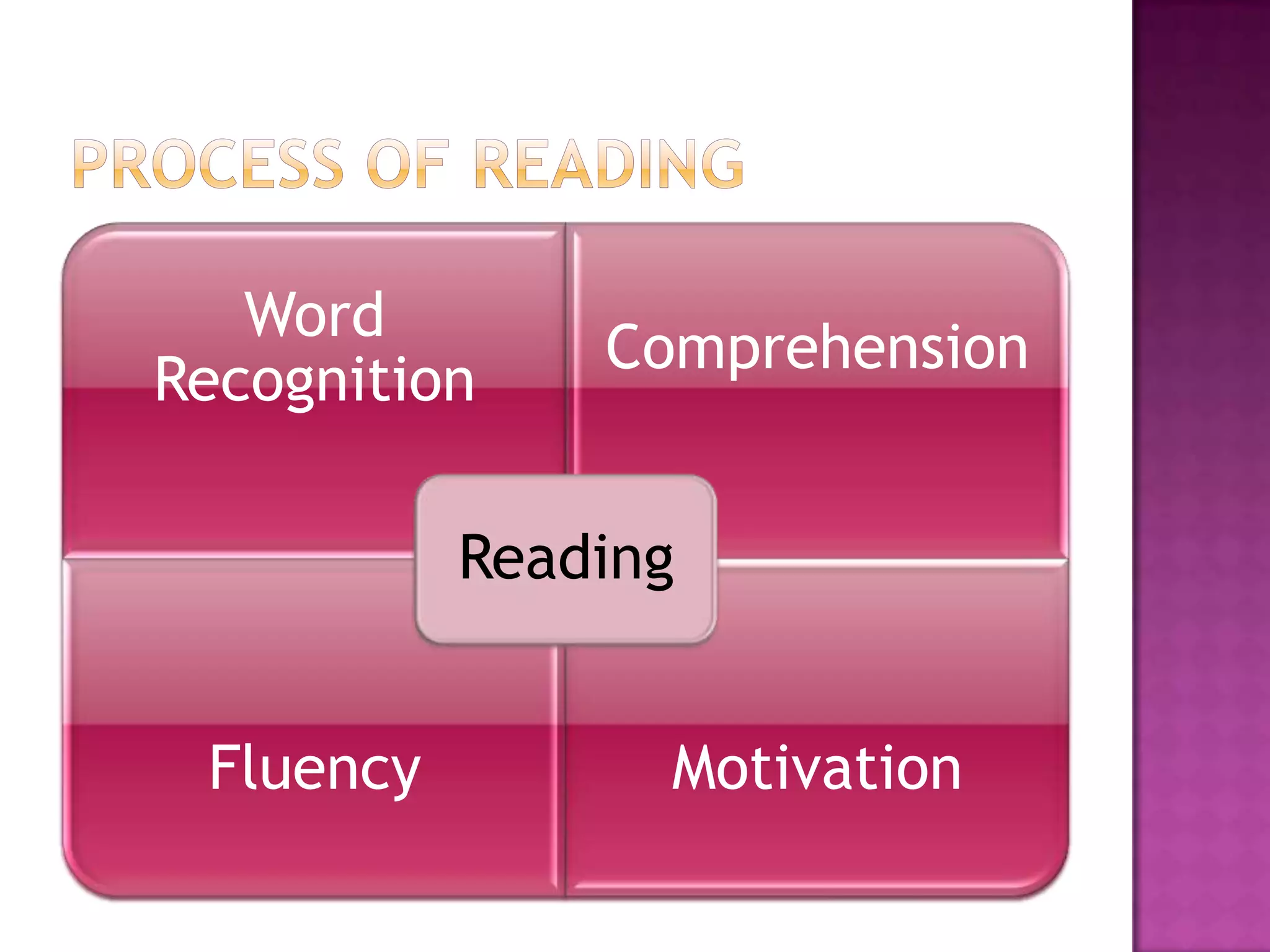
Word
Recognition
Comprehension
Fluency Motivation
Reading
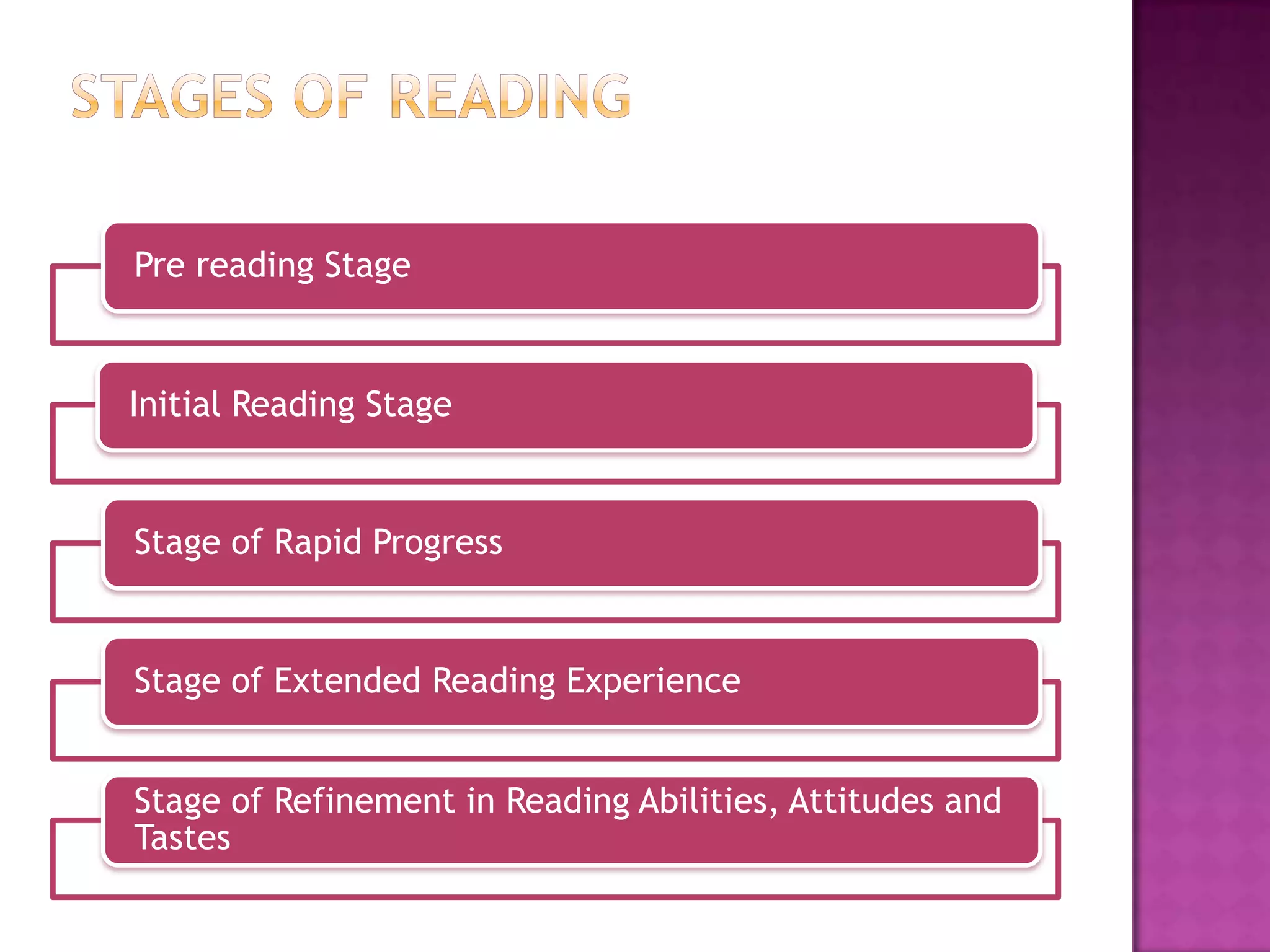
Pre reading Stage
Initial Reading Stage
Stage of Rapid Progress
Stage of Extended Reading Experience
Stage of Refinement in Reading Abilities, Attitudes and
Tastes
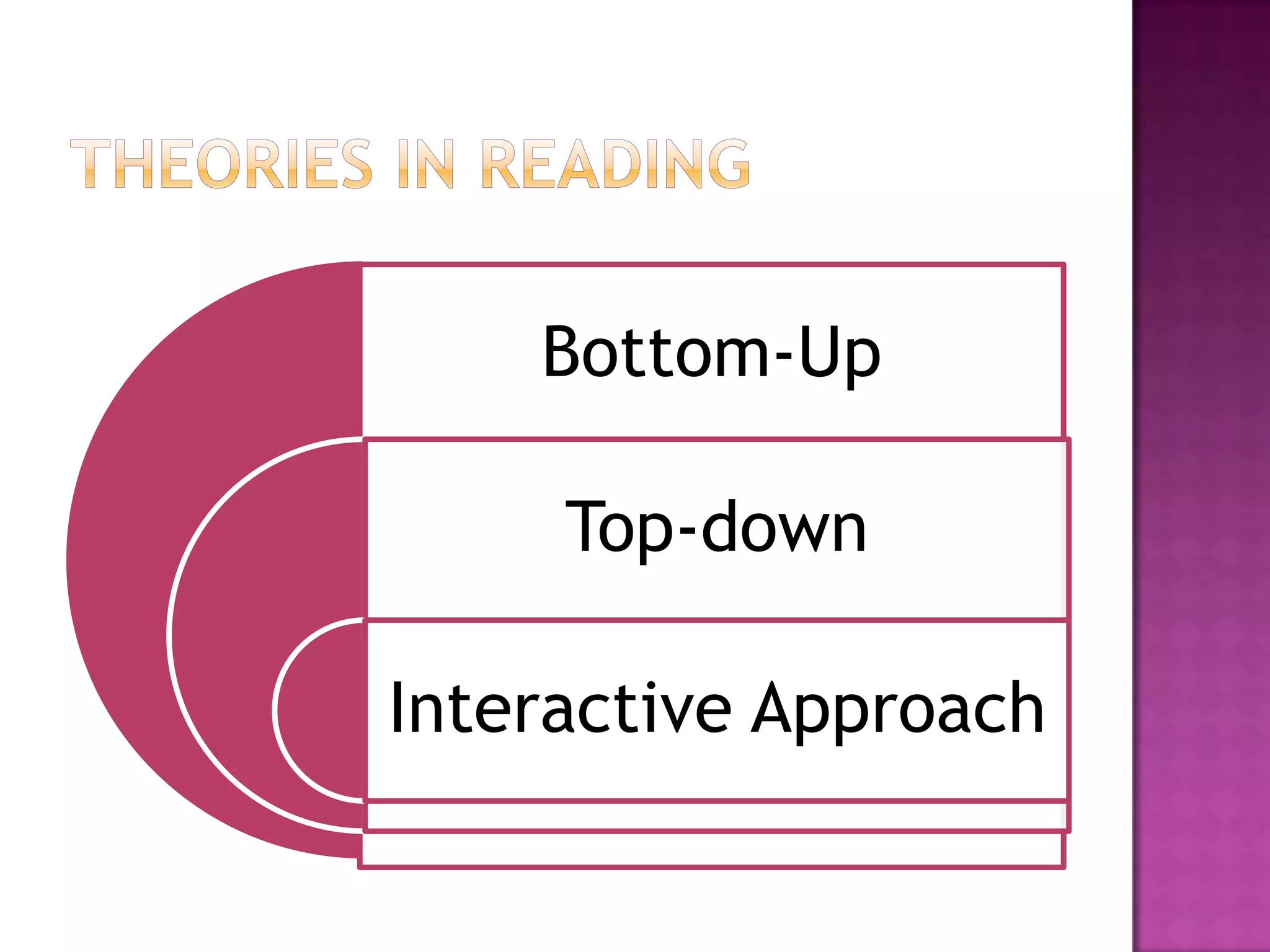
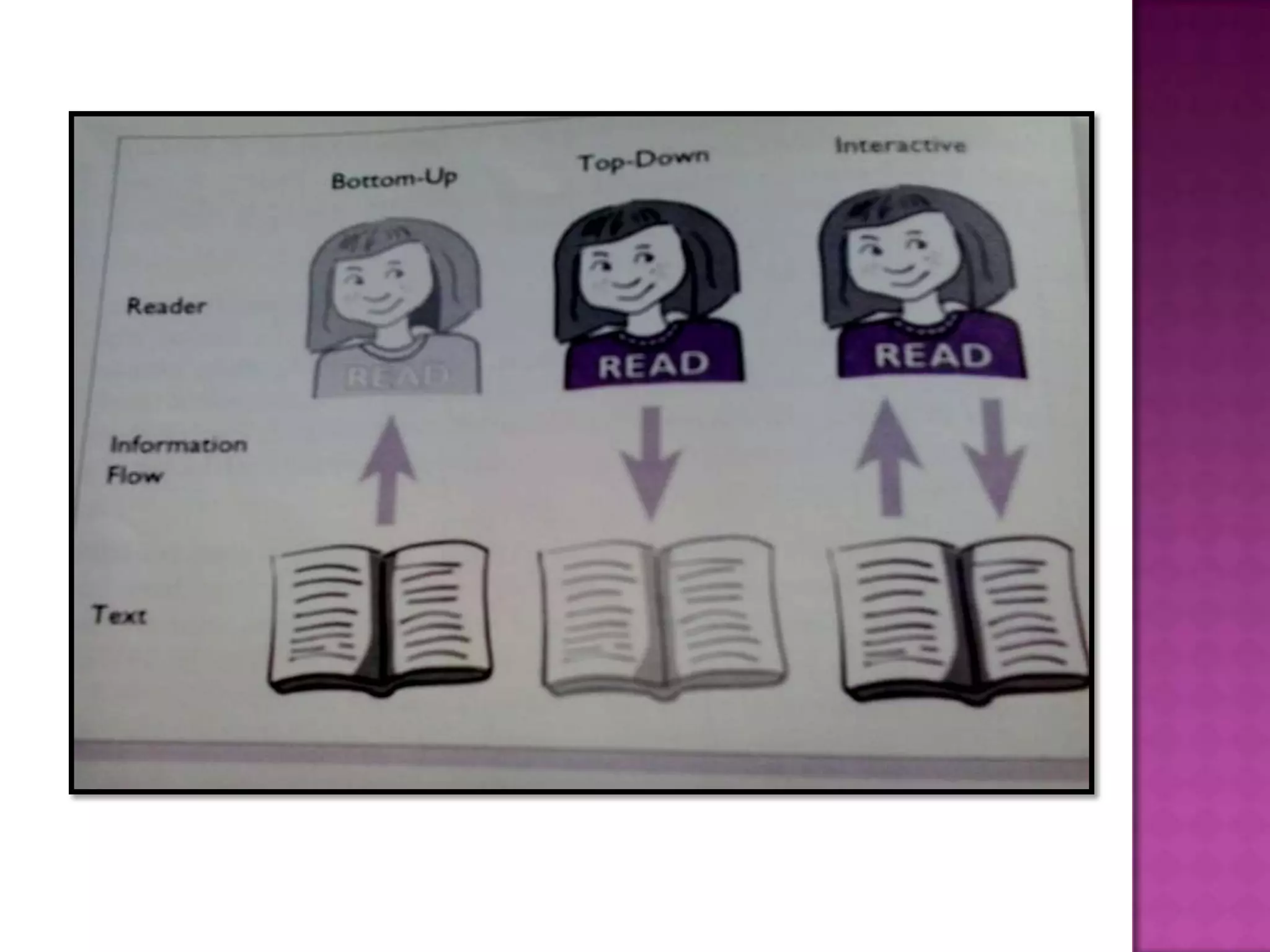
Bottom-Up
Top-down
Interactive Approach
“Critical literacy requires that
readers be able to do something,
not merely know something…”
- Graves, Juel and Graves (1998)
“Critical literacy requires attaining a deep-
understanding of what is read, remembering
important information, and linking newly-learned
information to existing schemata, knowing when
and where to use that information , using it
appropriately in varied contexts in and out of
school, and communicating effectively with
others. Critical literacy requires that readers be
able to do something, not merely know
something…”
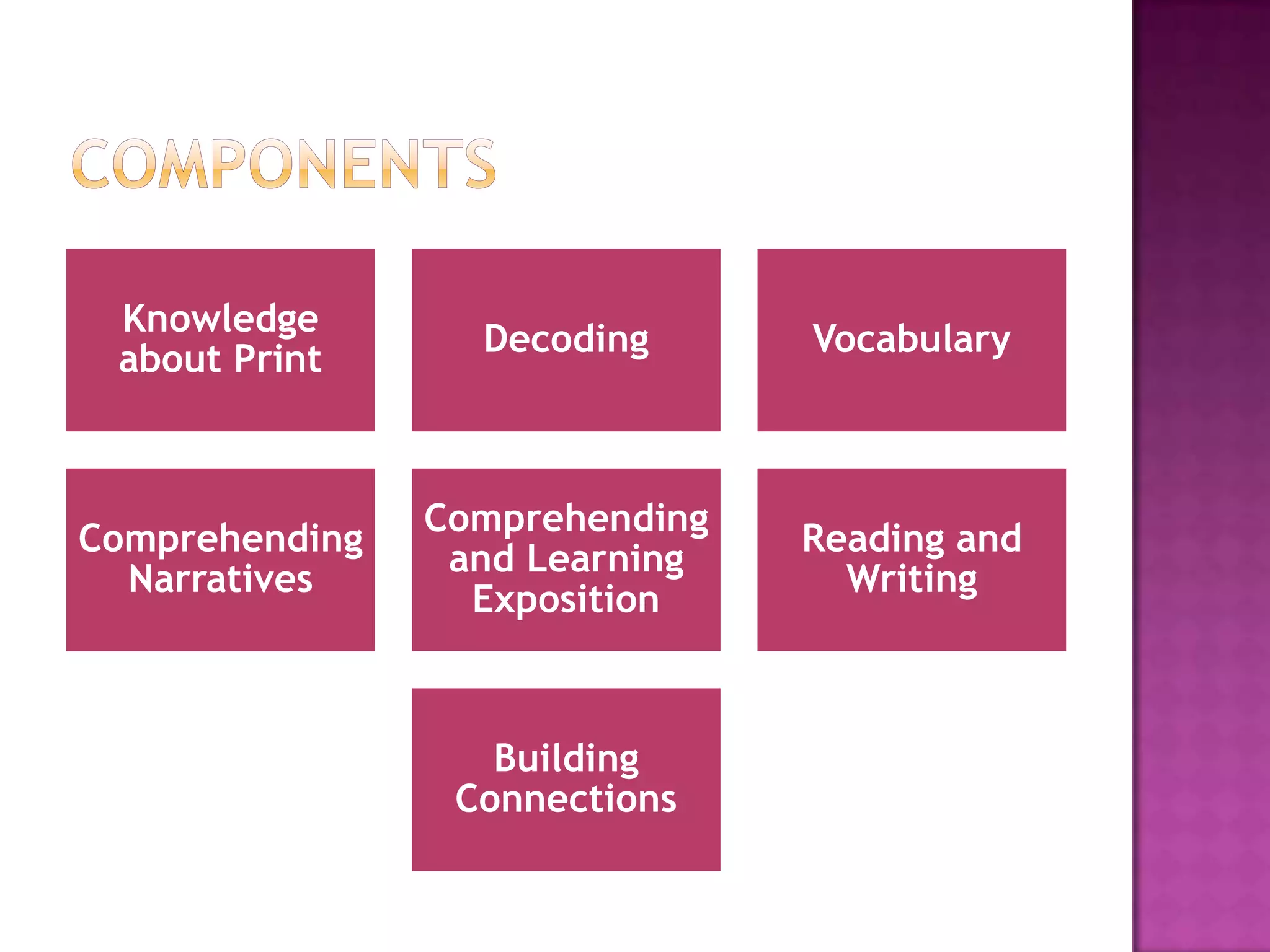
Knowledge
about Print
Decoding Vocabulary
Comprehending
Narratives
Comprehending
and Learning
Exposition
Reading and
Writing
Building
Connections
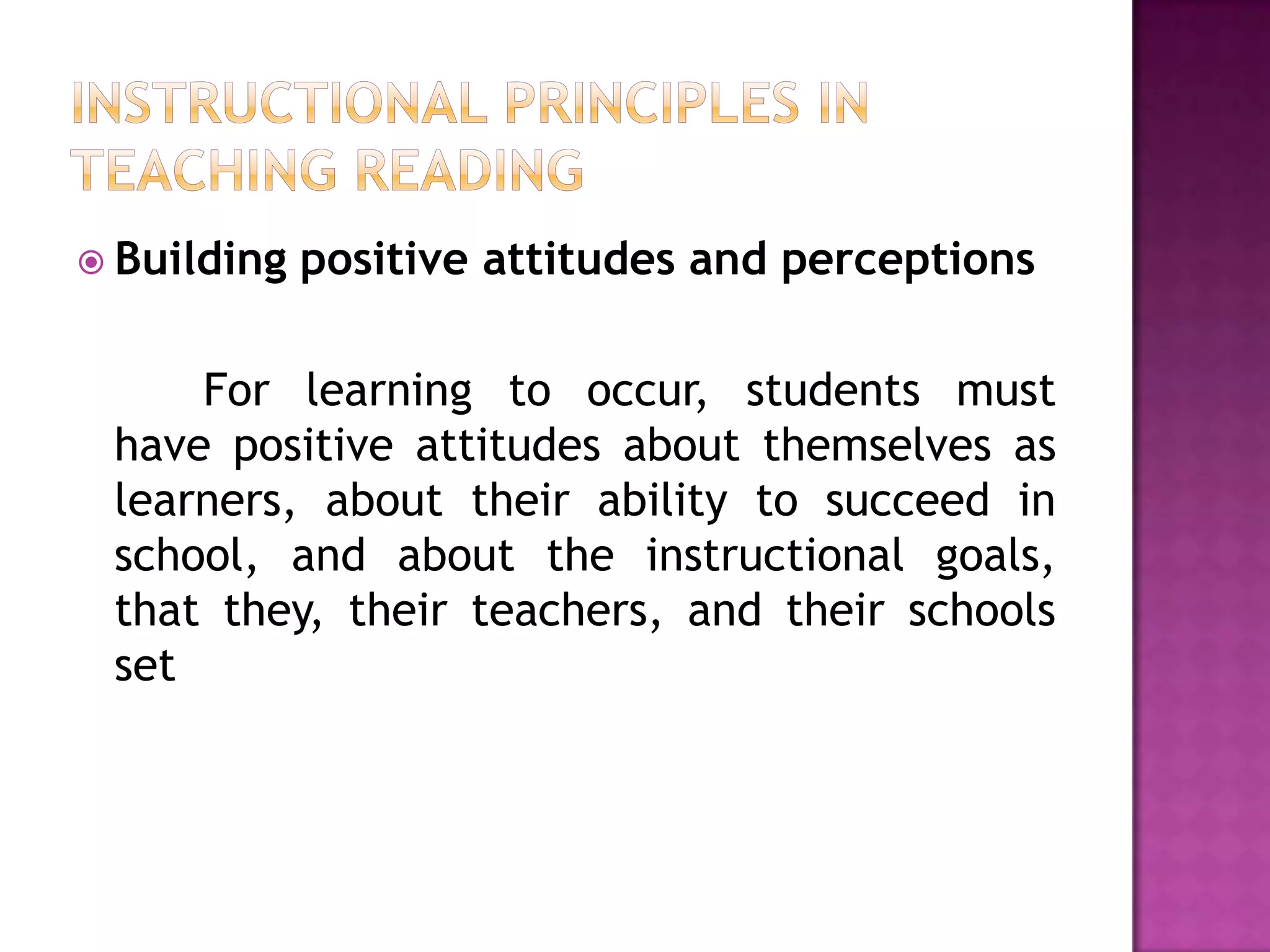
 Building positive attitudes and perceptions
For learning to occur, students must
have positive attitudes about themselves as
learners, about their ability to succeed in
school, and about the instructional goals,
that they, their teachers, and their schools
set
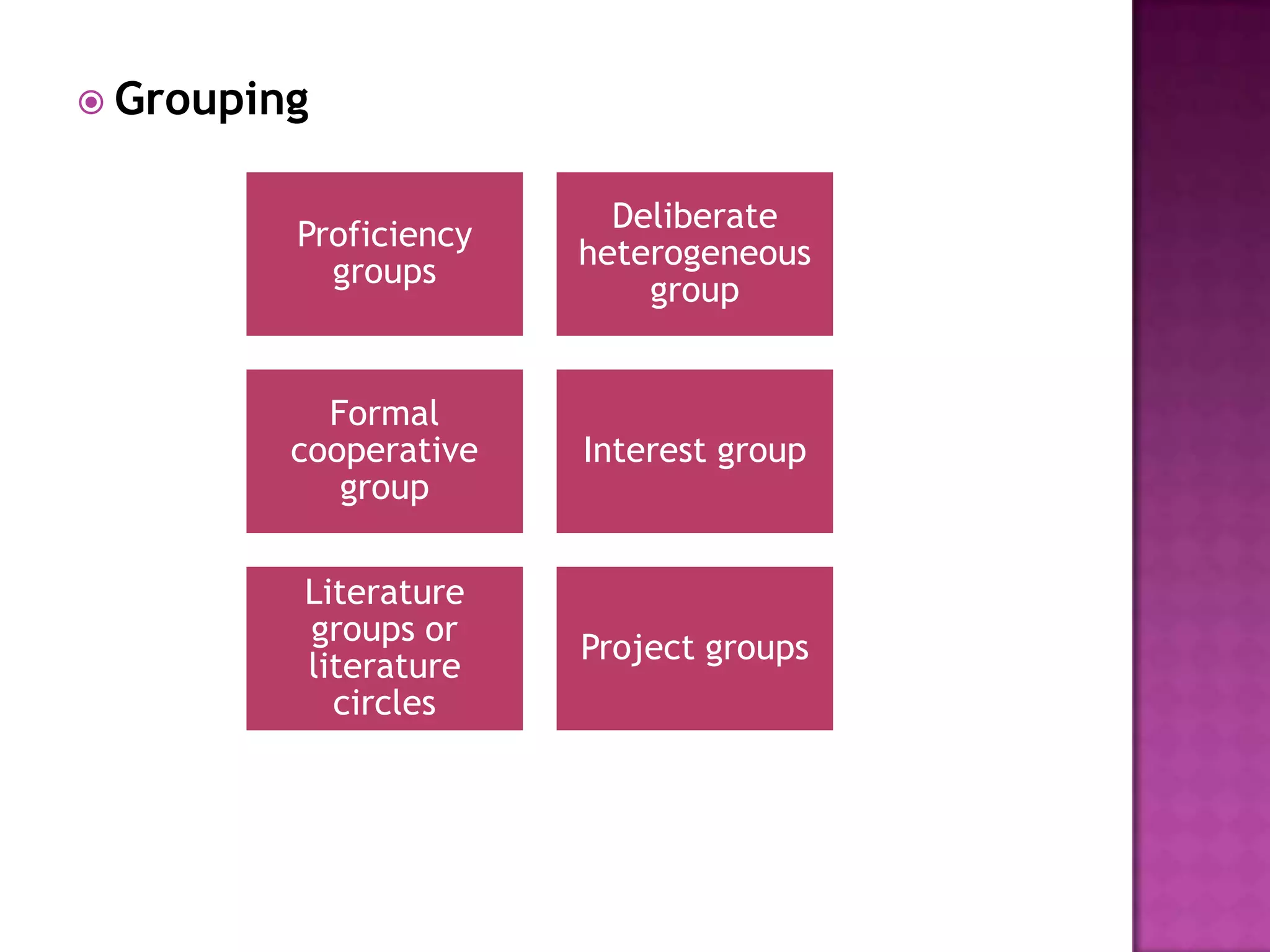
 Grouping
Proficiency
groups
Deliberate
heterogeneous
group
Formal
cooperative
group
Interest group
Literature
groups or
literature
circles
Project groups
 Traditional Principle
 Active teaching and Active learning
 Practice and Instruction
 Proactive teaching vs. Reactive Teaching
 Feedback
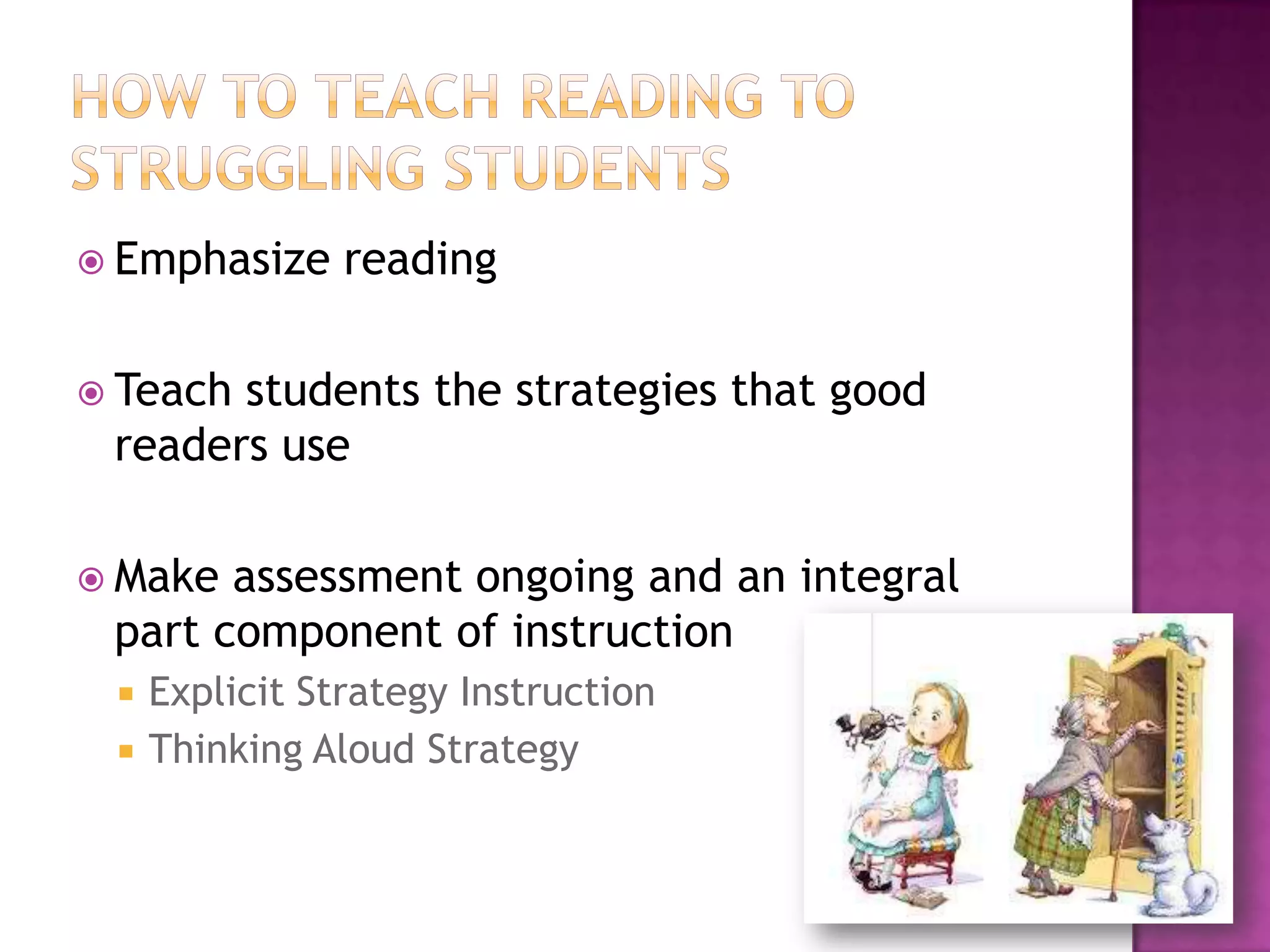
 Emphasize reading
 Teach students the strategies that good
readers use
 Make assessment ongoing and an integral
part component of instruction
 Explicit Strategy Instruction
 Thinking Aloud Strategy
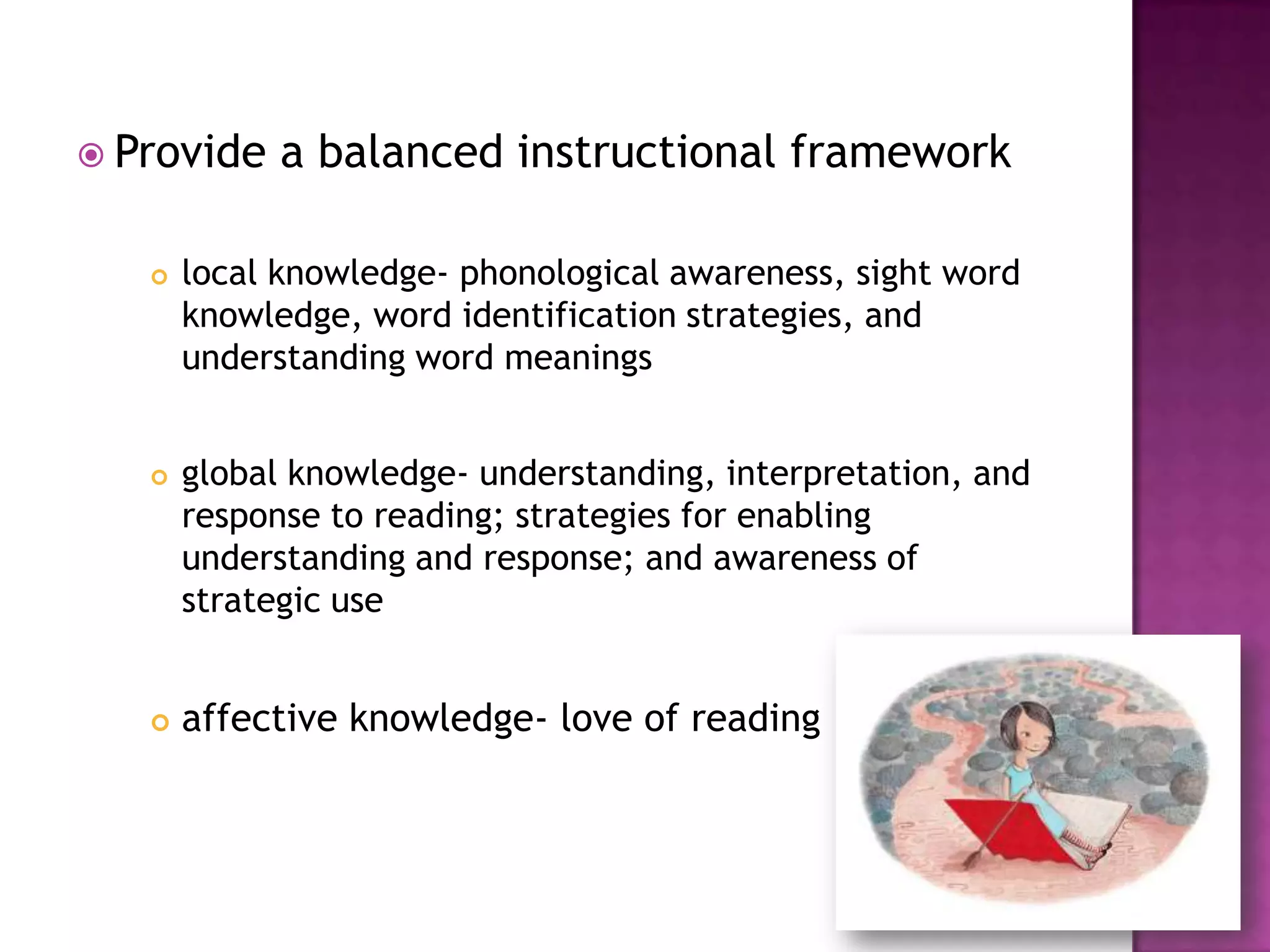
 Provide a balanced instructional framework
 local knowledge- phonological awareness, sight word
knowledge, word identification strategies, and
understanding word meanings
 global knowledge- understanding, interpretation, and
response to reading; strategies for enabling
understanding and response; and awareness of
strategic use
 affective knowledge- love of reading
 Provide consistent instructional structure and
use time effectively
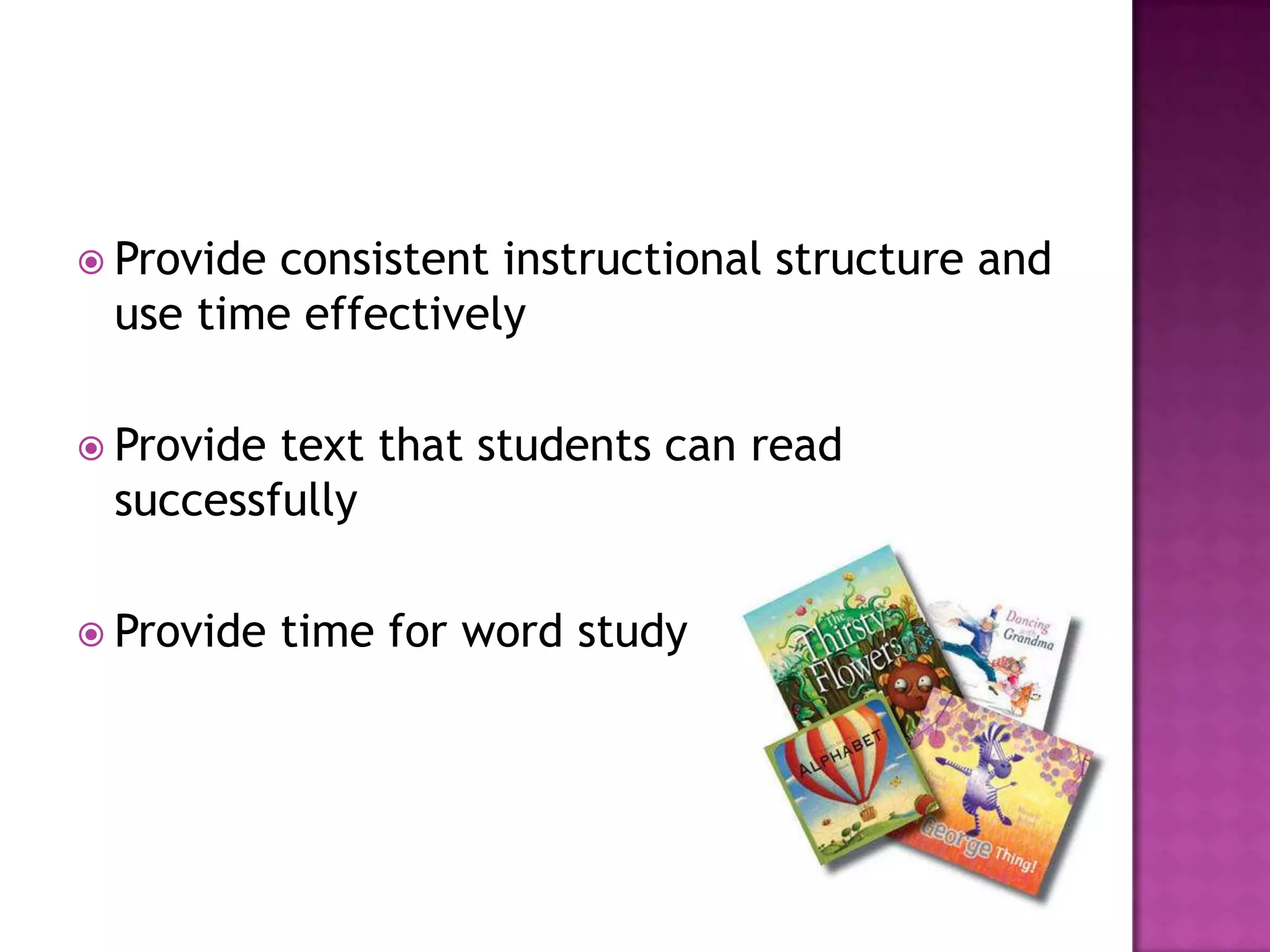
 Provide text that students can read
successfully
 Provide time for word study
 Encourage independent reading
 Include writing as part of the lesson
structure
 Keep the size of the group as small as
possible
 Coordinate intervention instruction and
classroom instruction
 Build rapport by fostering acceptance,
security, and success
 Graves, M., Juel,C., & Graves,B. (2007).
Teaching reading in the 21st Century. (4th
Ed.). Boston: Pearson Education Inc.

Teaching reading

Editor's Notes

  • #7 Definition according to Diane Henry Liepzig
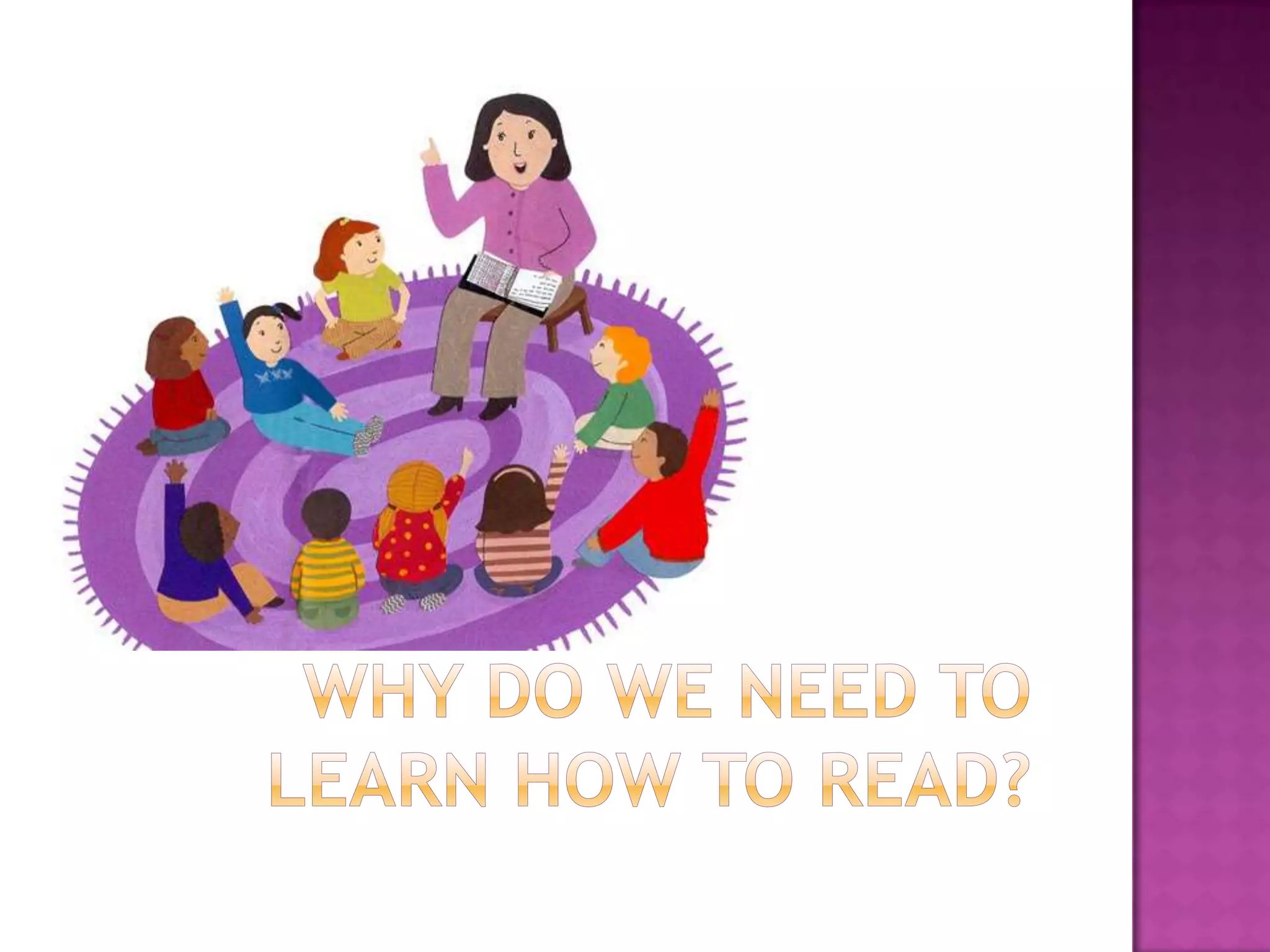
  • #12 Ask class what they think is the meaning of this
  • #13 According to Graves, Juel and Graves (1998); READ TOGETHER WITH CLASS
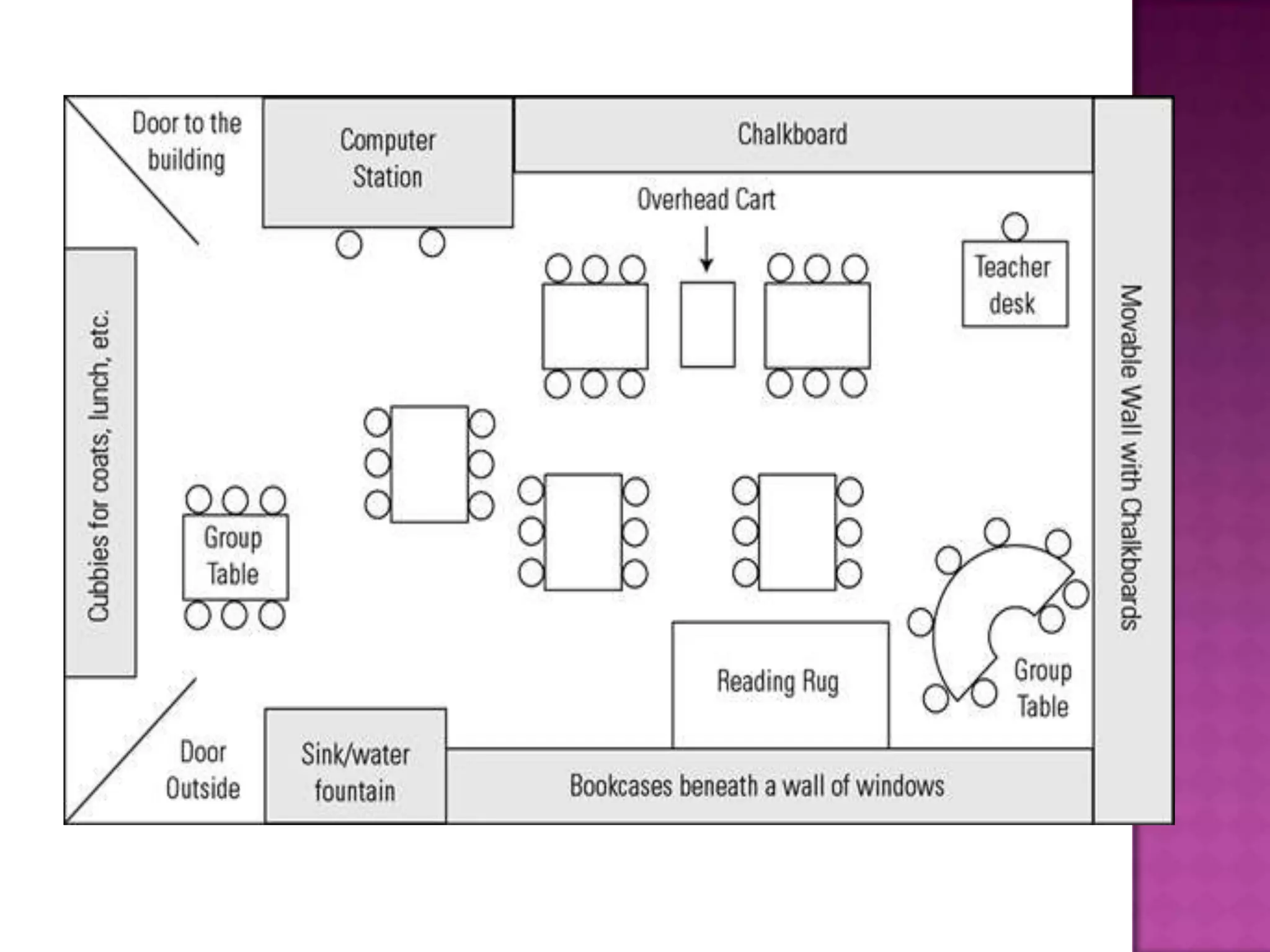
  • #17 How can the classroom lay-out help in building positive attitudes and perceptions in reading?
  • #18 BEFORE:Which is more convenient? Teaching in large groups or smaller groups? AFTER: What do you think is the reason why we shouldn’t always group low-achieving students together all the time?
  • #19 What comes in to your mind upon hearing the following terms