
ADE605
Theory & Approaches in Art
        Education:

  Definitions of concepts:
   pedagogy, andragogy,
teaching, & learning styles
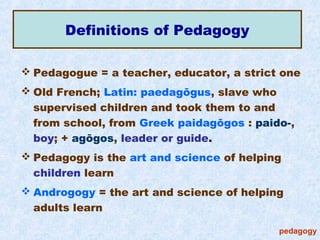
Definitions of Pedagogy

 Pedagogue = a teacher, educator, a strict one
 Old French; Latin: paedagōgus, slave who
  supervised children and took them to and
  from school, from Greek paidagōgos : paido-,
  boy; + agōgos, leader or guide.
 Pedagogy is the art and science of helping
  children learn
 Androgogy = the art and science of helping
  adults learn

                                           pedagogy
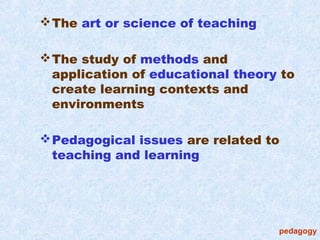
 The art or science of teaching

 The study of methods and
  application of educational theory to
  create learning contexts and
  environments

 Pedagogical issues are related to
  teaching and learning


                                   pedagogy
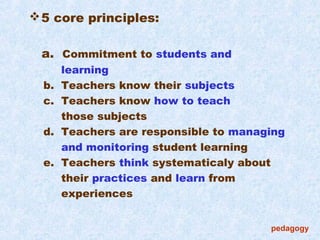
 5 core principles:

 a. Commitment to students and
       learning
  b.   Teachers know their subjects
  c.   Teachers know how to teach
       those subjects
  d.   Teachers are responsible to managing
       and monitoring student learning
  e.   Teachers think systematicaly about
       their practices and learn from
       experiences


                                        pedagogy
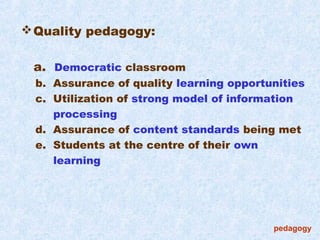
 Quality pedagogy:

 a. Democratic classroom
  b. Assurance of quality learning opportunities
  c. Utilization of strong model of information
     processing
  d. Assurance of content standards being met
  e. Students at the centre of their own
     learning


                                          pedagogy
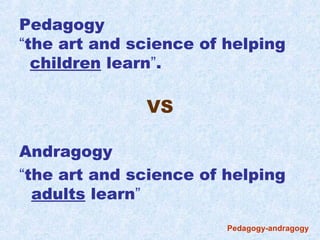
Pedagogy
“the art and science of helping
  children learn”.

              VS

Andragogy
“the art and science of helping
  adults learn”
                        Pedagogy-andragogy
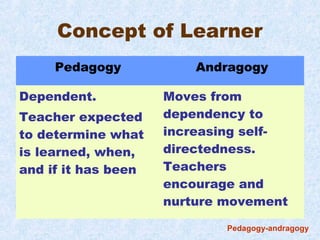
Concept of Learner
     Pedagogy            Andragogy

Dependent.           Moves from
Teacher expected     dependency to
to determine what    increasing self-
is learned, when,    directedness.
and if it has been   Teachers
                     encourage and
                     nurture movement

                             Pedagogy-andragogy
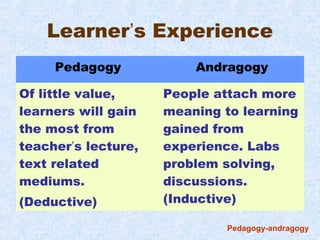
Learner’s Experience
     Pedagogy            Andragogy

Of little value,     People attach more
learners will gain   meaning to learning
the most from        gained from
teacher’s lecture,   experience. Labs
text related         problem solving,
mediums.             discussions.
(Deductive)          (Inductive)

                              Pedagogy-andragogy
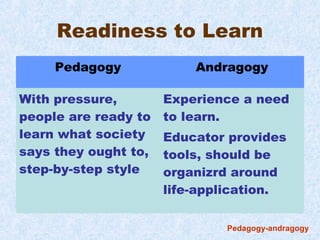
Readiness to Learn
     Pedagogy             Andragogy

With pressure,        Experience a need
people are ready to   to learn.
learn what society    Educator provides
says they ought to,   tools, should be
step-by-step style    organizrd around
                      life-application.

                              Pedagogy-andragogy
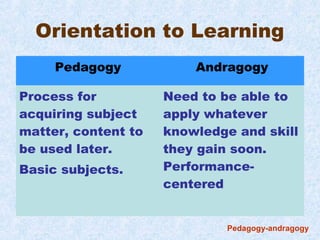
Orientation to Learning
     Pedagogy            Andragogy

Process for          Need to be able to
acquiring subject    apply whatever
matter, content to   knowledge and skill
be used later.       they gain soon.
Basic subjects.      Performance-
                     centered


                              Pedagogy-andragogy
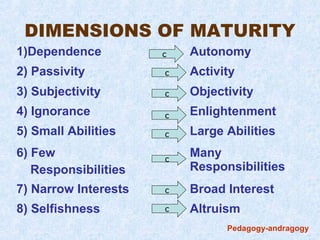
DIMENSIONS OF MATURITY
1)Dependence          c   Autonomy
2) Passivity          c   Activity
3) Subjectivity       c   Objectivity
4) Ignorance          c   Enlightenment
5) Small Abilities    c   Large Abilities
6) Few                c
                          Many
   Responsibilities       Responsibilities
7) Narrow Interests   c   Broad Interest
8) Selfishness        c   Altruism
                                Pedagogy-andragogy
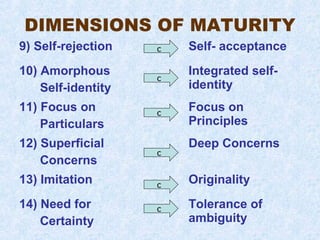
DIMENSIONS OF MATURITY
9) Self-rejection   c   Self- acceptance
10) Amorphous           Integrated self-
                    c
    Self-identity       identity
11) Focus on        c
                        Focus on
    Particulars         Principles
12) Superficial         Deep Concerns
                    c
    Concerns
13) Imitation       c
                        Originality
14) Need for        c   Tolerance of
    Certainty           ambiguity
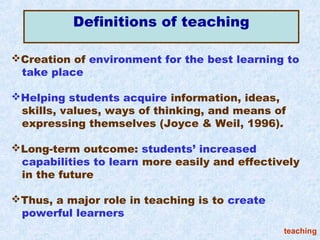
Definitions of teaching

Creation of environment for the best learning to
 take place

Helping students acquire information, ideas,
 skills, values, ways of thinking, and means of
 expressing themselves (Joyce & Weil, 1996).

Long-term outcome: students’ increased
 capabilities to learn more easily and effectively
 in the future

Thus, a major role in teaching is to create
 powerful learners
                                               teaching
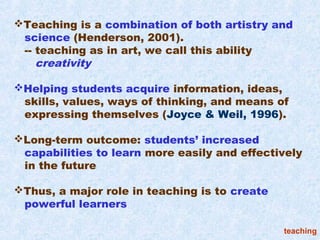
Teaching is a combination of both artistry and
 science (Henderson, 2001).
 -- teaching as in art, we call this ability
    creativity

Helping students acquire information, ideas,
 skills, values, ways of thinking, and means of
 expressing themselves (Joyce & Weil, 1996).

Long-term outcome: students’ increased
 capabilities to learn more easily and effectively
 in the future

Thus, a major role in teaching is to create
 powerful learners

                                               teaching
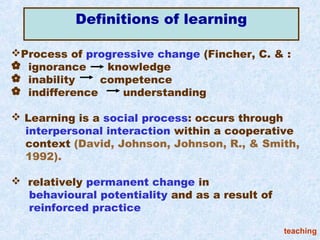
Definitions of learning

Process of progressive change (Fincher, C. & :
 ignorance     knowledge
 inability    competence
 indifference    understanding

 Learning is a social process: occurs through
  interpersonal interaction within a cooperative
  context (David, Johnson, Johnson, R., & Smith,
  1992).

 relatively permanent change in
  behavioural potentiality and as a result of
  reinforced practice

                                                teaching
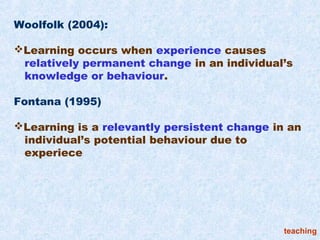
Woolfolk (2004):

Learning occurs when experience causes
 relatively permanent change in an individual’s
 knowledge or behaviour.

Fontana (1995)

Learning is a relevantly persistent change in an
 individual’s potential behaviour due to
 experiece


                                              teaching
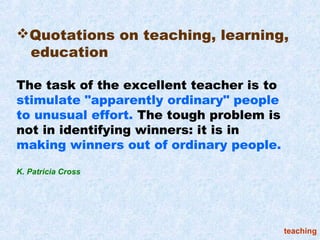
Quotations on teaching, learning,
 education

The task of the excellent teacher is to
stimulate "apparently ordinary" people
to unusual effort. The tough problem is
not in identifying winners: it is in
making winners out of ordinary people.

K. Patricia Cross


                                          teaching
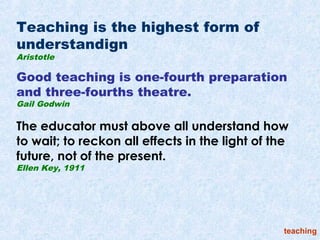
Teaching is the highest form of
understandign
Aristotle

Good teaching is one-fourth preparation
and three-fourths theatre.
Gail Godwin

The educator must above all understand how
to wait; to reckon all effects in the light of the
future, not of the present.
Ellen Key, 1911


                                                 teaching
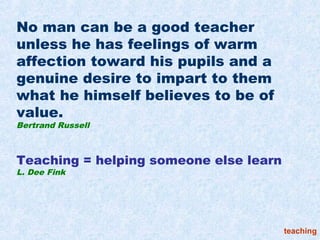
No man can be a good teacher
unless he has feelings of warm
affection toward his pupils and a
genuine desire to impart to them
what he himself believes to be of
value.
Bertrand Russell


Teaching = helping someone else learn
L. Dee Fink


                                        teaching
On learning:

Memorization is what we resort
to when what we are learning
makes no sense.
Anonymous


It is what we think we know
already that often prevents us from
learning.
Claude Bernard


                                  teaching
On education:

The main hope of a nation lies in the proper
education of its youth.
Erasmus

All education springs from some image of the
 future. If the image of the future held by a
society is grossly inaccurate, its education
system will betray its youth.
Alvin Toffler


Education's purpose is to replace an empty
mind with an open one.
Malcom S. Forbes


                                                teaching
Every act of conscious learning requires
the willingness to suffer an injury to
one's self-esteem. That is why young
children, before they are aware of their
own self-importance learn so easily; and
why older persons, especially if vain or
important, canno’t learn at all.


Thomas Szasz, 1973


                                      teaching
Learning Styles

Learning styles are important because they
 are the educational-relevant expressions of
 the uniqueness of the individual (Joyce & Weil,
 1996)

Learning styles, also called cognitive styles
 are students’ preferred ways of learning or
 processing information (Messick, 1994;
 Sternbert & Crignorenko, 1997)


                                          Learning styles
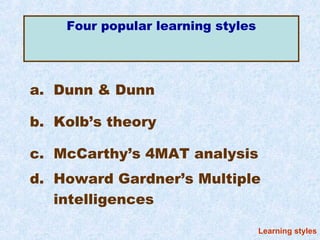
Four popular learning styles


a. Dunn & Dunn

b. Kolb’s theory

c. McCarthy’s 4MAT analysis
d. Howard Gardner’s Multiple
   intelligences

                                   Learning styles
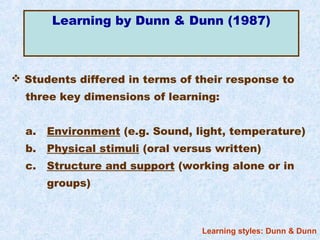
Learning by Dunn & Dunn (1987)


 Students differed in terms of their response to
  three key dimensions of learning:


  a.   Environment (e.g. Sound, light, temperature)
  b.   Physical stimuli (oral versus written)
  c.   Structure and support (working alone or in
       groups)


                                  Learning styles: Dunn & Dunn
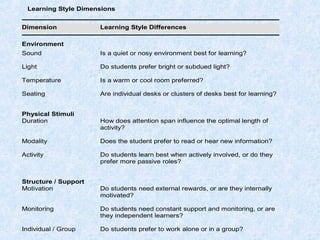
Learning Style Dimensions


Dimension             Learning Style Differences

Environment
Sound                 Is a quiet or nosy environment best for learning?

Light                 Do students prefer bright or subdued light?

Temperature           Is a warm or cool room preferred?

Seating               Are individual desks or clusters of desks best for learning?


Physical Stimuli
Duration              How does attention span influence the optimal length of
                      activity?

Modality              Does the student prefer to read or hear new information?

Activity              Do students learn best when actively involved, or do they
                      prefer more passive roles?


Structure / Support
Motivation            Do students need external rewards, or are they internally
                      motivated?

Monitoring            Do students need constant support and monitoring, or are
                      they independent learners?

Individual / Group    Do students prefer to work alone or in a group?
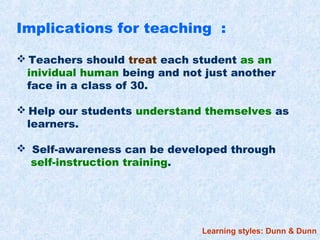
Implications for teaching :

 Teachers should treat each student as an
 inividual human being and not just another
 face in a class of 30.

 Help our students understand themselves as
 learners.

 Self-awareness can be developed through
  self-instruction training.


                              Learning styles: Dunn & Dunn
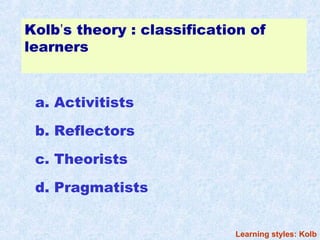
Kolb’s theory : classification of
learners


 a. Activitists
 b. Reflectors
 c. Theorists
 d. Pragmatists


                            Learning styles: Kolb
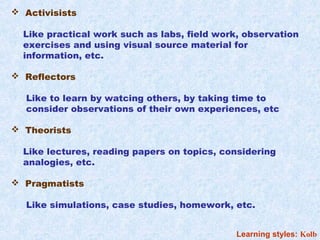
 Activisists

  Like practical work such as labs, field work, observation
  exercises and using visual source material for
  information, etc.

 Reflectors

  Like to learn by watcing others, by taking time to
  consider observations of their own experiences, etc

 Theorists

  Like lectures, reading papers on topics, considering
  analogies, etc.

 Pragmatists

  Like simulations, case studies, homework, etc.


                                              Learning styles: Kolb
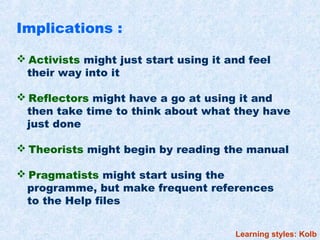
Implications :

 Activists might just start using it and feel
 their way into it

 Reflectors might have a go at using it and
 then take time to think about what they have
 just done

 Theorists might begin by reading the manual

 Pragmatists might start using the
 programme, but make frequent references
 to the Help files


                                       Learning styles: Kolb
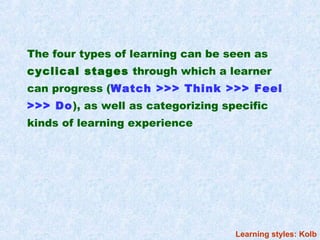
The four types of learning can be seen as
cyclical stages through which a learner
can progress (Watch >>> Think >>> Feel
>>> Do), as well as categorizing specific
kinds of learning experience


                                   Learning styles: Kolb
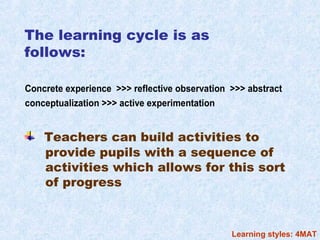
The learning cycle is as
follows:

Concrete experience >>> reflective observation >>> abstract
conceptualization >>> active experimentation


    Teachers can build activities to
    provide pupils with a sequence of
    activities which allows for this sort
    of progress


                                               Learning styles: 4MAT
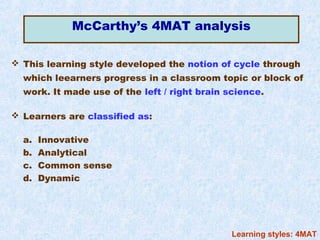
McCarthy’s 4MAT analysis

 This learning style developed the notion of cycle through
  which leearners progress in a classroom topic or block of
  work. It made use of the left / right brain science.

 Learners are classified as:

  a.   Innovative
  b.   Analytical
  c.   Common sense
  d.   Dynamic


                                               Learning styles: 4MAT
The most important message teachers
should take from Gardner’s work is
that students are complex,
multifaceted individual who need to be
treated with sensistivity, and taught
through a variety of teaching methods.


                                     Learning styles: MI
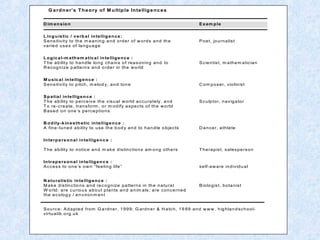
G a rd n e r’s T h e o ry o f M u ltip l e In te llig e n c e s


D im e n s io n                                                                               E x a m p le

L in g u is tic / v e rb a l in te llig e n c e :
S e n s itiv it y to th e m e a n in g a n d o rd e r o f w o rd s a n d th e                 P o e t, jo u rn a lis t
va rie d u s e s o f la n g u a g e

L o g ic a l-m a th e m a tic a l in te llig e n c e :
T h e a b ilit y to h a n d le lo n g c h a in s o f re a s o n in g a n d to                 S c ie n tis t, m a th e m a tic ia n
R e c o g n ize p a tte rn s a n d o rd e r in th e w o rld

M u s ic a l in te llig e n c e :
S e n s itiv it y to p itc h , m e lo d y, a n d to n e                                       C o m p o s e r, v io lin is t

S p a tia l in te llig e n c e :
T h e a b ilit y to p e rc e iv e th e v is u a l w o rld a c c u ra te ly, a n d             S c u lp to r, n a v ig a to r
T o re -c re a te , tra n s fo rm , o r m o d ify a s p e c ts o f th e w o rld
B a s e d o n o n e ’s p e rc e p tio n s

B o d ily -k in e s th e tic in te ll ig e n c e :
A fin e -tu n e d a b ility to u s e th e b o d y a n d to h a n d le o b je c ts             D a n c e r, a th le te

In te rp e rs o n a l in te llig e n c e :

T h e a b ilit y to n o tic e a n d m a k e d is tin c tio n s a m o n g o th e rs            T h e ra p is t, s a le s p e rs o n

In tra p e rs o n a l in te llig e n c e :
A c c e s s to o n e ’s o w n “fe e lin g life ”                                              s e lf-a w a re in d ivid u a l


N a tu ra lis tic in te llig e n c e :
M a k e d is tin c tio n s a n d re c o g n ize p a tte rn s in th e n a tu ra l              B io lo g is t, b o ta n is t
W o rld : a re c u rio u s a b o u t p la n ts a n d a n im a ls ; a re c o n c e rn e d
th e e c o lo g y / e n v iro n m e n t


S o u rc e : A d a p te d fro m G a rdn e r, 1 9 9 9 ; G a rd n e r & H a tc h , 1 9 8 9 a n d w w w . h ig h la n d s c h o o l-
virtu a lib .o rg .u k

Week 4 Concepts of Learning

  • 1.
    ADE605 Theory & Approachesin Art Education: Definitions of concepts: pedagogy, andragogy, teaching, & learning styles
  • 2.
    Definitions of Pedagogy Pedagogue = a teacher, educator, a strict one  Old French; Latin: paedagōgus, slave who supervised children and took them to and from school, from Greek paidagōgos : paido-, boy; + agōgos, leader or guide.  Pedagogy is the art and science of helping children learn  Androgogy = the art and science of helping adults learn pedagogy
  • 3.
     The artor science of teaching  The study of methods and application of educational theory to create learning contexts and environments  Pedagogical issues are related to teaching and learning pedagogy
  • 4.
     5 coreprinciples: a. Commitment to students and learning b. Teachers know their subjects c. Teachers know how to teach those subjects d. Teachers are responsible to managing and monitoring student learning e. Teachers think systematicaly about their practices and learn from experiences pedagogy
  • 5.
     Quality pedagogy: a. Democratic classroom b. Assurance of quality learning opportunities c. Utilization of strong model of information processing d. Assurance of content standards being met e. Students at the centre of their own learning pedagogy
  • 6.
    Pedagogy “the art andscience of helping children learn”. VS Andragogy “the art and science of helping adults learn” Pedagogy-andragogy
  • 7.
    Concept of Learner Pedagogy Andragogy Dependent. Moves from Teacher expected dependency to to determine what increasing self- is learned, when, directedness. and if it has been Teachers encourage and nurture movement Pedagogy-andragogy
  • 8.
    Learner’s Experience Pedagogy Andragogy Of little value, People attach more learners will gain meaning to learning the most from gained from teacher’s lecture, experience. Labs text related problem solving, mediums. discussions. (Deductive) (Inductive) Pedagogy-andragogy
  • 9.
    Readiness to Learn Pedagogy Andragogy With pressure, Experience a need people are ready to to learn. learn what society Educator provides says they ought to, tools, should be step-by-step style organizrd around life-application. Pedagogy-andragogy
  • 10.
    Orientation to Learning Pedagogy Andragogy Process for Need to be able to acquiring subject apply whatever matter, content to knowledge and skill be used later. they gain soon. Basic subjects. Performance- centered Pedagogy-andragogy
  • 11.
    DIMENSIONS OF MATURITY 1)Dependence c Autonomy 2) Passivity c Activity 3) Subjectivity c Objectivity 4) Ignorance c Enlightenment 5) Small Abilities c Large Abilities 6) Few c Many Responsibilities Responsibilities 7) Narrow Interests c Broad Interest 8) Selfishness c Altruism Pedagogy-andragogy
  • 12.
    DIMENSIONS OF MATURITY 9)Self-rejection c Self- acceptance 10) Amorphous Integrated self- c Self-identity identity 11) Focus on c Focus on Particulars Principles 12) Superficial Deep Concerns c Concerns 13) Imitation c Originality 14) Need for c Tolerance of Certainty ambiguity
  • 13.
    Definitions of teaching Creationof environment for the best learning to take place Helping students acquire information, ideas, skills, values, ways of thinking, and means of expressing themselves (Joyce & Weil, 1996). Long-term outcome: students’ increased capabilities to learn more easily and effectively in the future Thus, a major role in teaching is to create powerful learners teaching
  • 14.
    Teaching is acombination of both artistry and science (Henderson, 2001). -- teaching as in art, we call this ability creativity Helping students acquire information, ideas, skills, values, ways of thinking, and means of expressing themselves (Joyce & Weil, 1996). Long-term outcome: students’ increased capabilities to learn more easily and effectively in the future Thus, a major role in teaching is to create powerful learners teaching
  • 15.
    Definitions of learning Processof progressive change (Fincher, C. & :  ignorance knowledge  inability competence  indifference understanding  Learning is a social process: occurs through interpersonal interaction within a cooperative context (David, Johnson, Johnson, R., & Smith, 1992).  relatively permanent change in behavioural potentiality and as a result of reinforced practice teaching
  • 16.
    Woolfolk (2004): Learning occurswhen experience causes relatively permanent change in an individual’s knowledge or behaviour. Fontana (1995) Learning is a relevantly persistent change in an individual’s potential behaviour due to experiece teaching
  • 17.
    Quotations on teaching,learning, education The task of the excellent teacher is to stimulate "apparently ordinary" people to unusual effort. The tough problem is not in identifying winners: it is in making winners out of ordinary people. K. Patricia Cross teaching
  • 18.
    Teaching is thehighest form of understandign Aristotle Good teaching is one-fourth preparation and three-fourths theatre. Gail Godwin The educator must above all understand how to wait; to reckon all effects in the light of the future, not of the present. Ellen Key, 1911 teaching
  • 19.
    No man canbe a good teacher unless he has feelings of warm affection toward his pupils and a genuine desire to impart to them what he himself believes to be of value. Bertrand Russell Teaching = helping someone else learn L. Dee Fink teaching
  • 20.
    On learning: Memorization iswhat we resort to when what we are learning makes no sense. Anonymous It is what we think we know already that often prevents us from learning. Claude Bernard teaching
  • 21.
    On education: The mainhope of a nation lies in the proper education of its youth. Erasmus All education springs from some image of the future. If the image of the future held by a society is grossly inaccurate, its education system will betray its youth. Alvin Toffler Education's purpose is to replace an empty mind with an open one. Malcom S. Forbes teaching
  • 22.
    Every act ofconscious learning requires the willingness to suffer an injury to one's self-esteem. That is why young children, before they are aware of their own self-importance learn so easily; and why older persons, especially if vain or important, canno’t learn at all. Thomas Szasz, 1973 teaching
  • 23.
    Learning Styles Learning stylesare important because they are the educational-relevant expressions of the uniqueness of the individual (Joyce & Weil, 1996) Learning styles, also called cognitive styles are students’ preferred ways of learning or processing information (Messick, 1994; Sternbert & Crignorenko, 1997) Learning styles
  • 24.
    Four popular learningstyles a. Dunn & Dunn b. Kolb’s theory c. McCarthy’s 4MAT analysis d. Howard Gardner’s Multiple intelligences Learning styles
  • 25.
    Learning by Dunn& Dunn (1987)  Students differed in terms of their response to three key dimensions of learning: a. Environment (e.g. Sound, light, temperature) b. Physical stimuli (oral versus written) c. Structure and support (working alone or in groups) Learning styles: Dunn & Dunn
  • 26.
    Learning Style Dimensions Dimension Learning Style Differences Environment Sound Is a quiet or nosy environment best for learning? Light Do students prefer bright or subdued light? Temperature Is a warm or cool room preferred? Seating Are individual desks or clusters of desks best for learning? Physical Stimuli Duration How does attention span influence the optimal length of activity? Modality Does the student prefer to read or hear new information? Activity Do students learn best when actively involved, or do they prefer more passive roles? Structure / Support Motivation Do students need external rewards, or are they internally motivated? Monitoring Do students need constant support and monitoring, or are they independent learners? Individual / Group Do students prefer to work alone or in a group?
  • 27.
    Implications for teaching:  Teachers should treat each student as an inividual human being and not just another face in a class of 30.  Help our students understand themselves as learners.  Self-awareness can be developed through self-instruction training. Learning styles: Dunn & Dunn
  • 28.
    Kolb’s theory :classification of learners a. Activitists b. Reflectors c. Theorists d. Pragmatists Learning styles: Kolb
  • 29.
     Activisists Like practical work such as labs, field work, observation exercises and using visual source material for information, etc.  Reflectors Like to learn by watcing others, by taking time to consider observations of their own experiences, etc  Theorists Like lectures, reading papers on topics, considering analogies, etc.  Pragmatists Like simulations, case studies, homework, etc. Learning styles: Kolb
  • 30.
    Implications :  Activistsmight just start using it and feel their way into it  Reflectors might have a go at using it and then take time to think about what they have just done  Theorists might begin by reading the manual  Pragmatists might start using the programme, but make frequent references to the Help files Learning styles: Kolb
  • 31.
    The four typesof learning can be seen as cyclical stages through which a learner can progress (Watch >>> Think >>> Feel >>> Do), as well as categorizing specific kinds of learning experience Learning styles: Kolb
  • 32.
    The learning cycleis as follows: Concrete experience >>> reflective observation >>> abstract conceptualization >>> active experimentation Teachers can build activities to provide pupils with a sequence of activities which allows for this sort of progress Learning styles: 4MAT
  • 33.
    McCarthy’s 4MAT analysis This learning style developed the notion of cycle through which leearners progress in a classroom topic or block of work. It made use of the left / right brain science.  Learners are classified as: a. Innovative b. Analytical c. Common sense d. Dynamic Learning styles: 4MAT
  • 35.
    The most importantmessage teachers should take from Gardner’s work is that students are complex, multifaceted individual who need to be treated with sensistivity, and taught through a variety of teaching methods. Learning styles: MI
  • 36.
    G a rdn e r’s T h e o ry o f M u ltip l e In te llig e n c e s D im e n s io n E x a m p le L in g u is tic / v e rb a l in te llig e n c e : S e n s itiv it y to th e m e a n in g a n d o rd e r o f w o rd s a n d th e P o e t, jo u rn a lis t va rie d u s e s o f la n g u a g e L o g ic a l-m a th e m a tic a l in te llig e n c e : T h e a b ilit y to h a n d le lo n g c h a in s o f re a s o n in g a n d to S c ie n tis t, m a th e m a tic ia n R e c o g n ize p a tte rn s a n d o rd e r in th e w o rld M u s ic a l in te llig e n c e : S e n s itiv it y to p itc h , m e lo d y, a n d to n e C o m p o s e r, v io lin is t S p a tia l in te llig e n c e : T h e a b ilit y to p e rc e iv e th e v is u a l w o rld a c c u ra te ly, a n d S c u lp to r, n a v ig a to r T o re -c re a te , tra n s fo rm , o r m o d ify a s p e c ts o f th e w o rld B a s e d o n o n e ’s p e rc e p tio n s B o d ily -k in e s th e tic in te ll ig e n c e : A fin e -tu n e d a b ility to u s e th e b o d y a n d to h a n d le o b je c ts D a n c e r, a th le te In te rp e rs o n a l in te llig e n c e : T h e a b ilit y to n o tic e a n d m a k e d is tin c tio n s a m o n g o th e rs T h e ra p is t, s a le s p e rs o n In tra p e rs o n a l in te llig e n c e : A c c e s s to o n e ’s o w n “fe e lin g life ” s e lf-a w a re in d ivid u a l N a tu ra lis tic in te llig e n c e : M a k e d is tin c tio n s a n d re c o g n ize p a tte rn s in th e n a tu ra l B io lo g is t, b o ta n is t W o rld : a re c u rio u s a b o u t p la n ts a n d a n im a ls ; a re c o n c e rn e d th e e c o lo g y / e n v iro n m e n t S o u rc e : A d a p te d fro m G a rdn e r, 1 9 9 9 ; G a rd n e r & H a tc h , 1 9 8 9 a n d w w w . h ig h la n d s c h o o l- virtu a lib .o rg .u k