Did you that…….? There is no direct relationship between intelligence & severity of physical disability? The major goal of professionals working with children who have physical disabilities is to alter the environment so the children can function? An orthopedic impairment by itself, is no reason for special placement? If individuals with disabilities are not able to compensate for environmental or functional demands in given situations, they will be handicapped in those situations but not necessarily in all situations?
Physical & Health Impairment Orthopedic Impairment – means a severe orthopedic impairment that adversely affects a child’s educational performance.  The term includes impairment caused by congenital anomaly ( clubfoot, absence of some member, etc.), impairments caused by disease ( poliomyelitis, bone tuberculosis,etc.), and impairment from other causes ( cerebral palsy, amputations, and fractures or burns that cause contractures).
Other Health Impairment Means having limited strength, vitality, or alertness, due to chronic or acute health problems such as a heart condition, tuberculosis, rheumatic fever, nephritis, asthma, sickle cell anemia, hemophilia, epilepsy, lead poisoning, leukemia or diabetes, that adversely affects a child’s educational performance.
Physical Disabilities Neurological Cerebral Palsy, Spina Bifida, Convulsive Disorder, Poliomyelitis Musculoskeletal Muscular Dystrophy, Arthrogryposis, Legg-Perthes, Osteogenesis Imperfecta, Juvenile Rheumatoid arthritis, Scoliosis Other Health Impairment  Congenital Malformation, Cystic Fibrosis, Sickle Cell Anemia, Hemophilia, Juvenile Diabetes Mellitus, Asthma, Rheumatic Fever Contagious Diseases STDs, AIDS
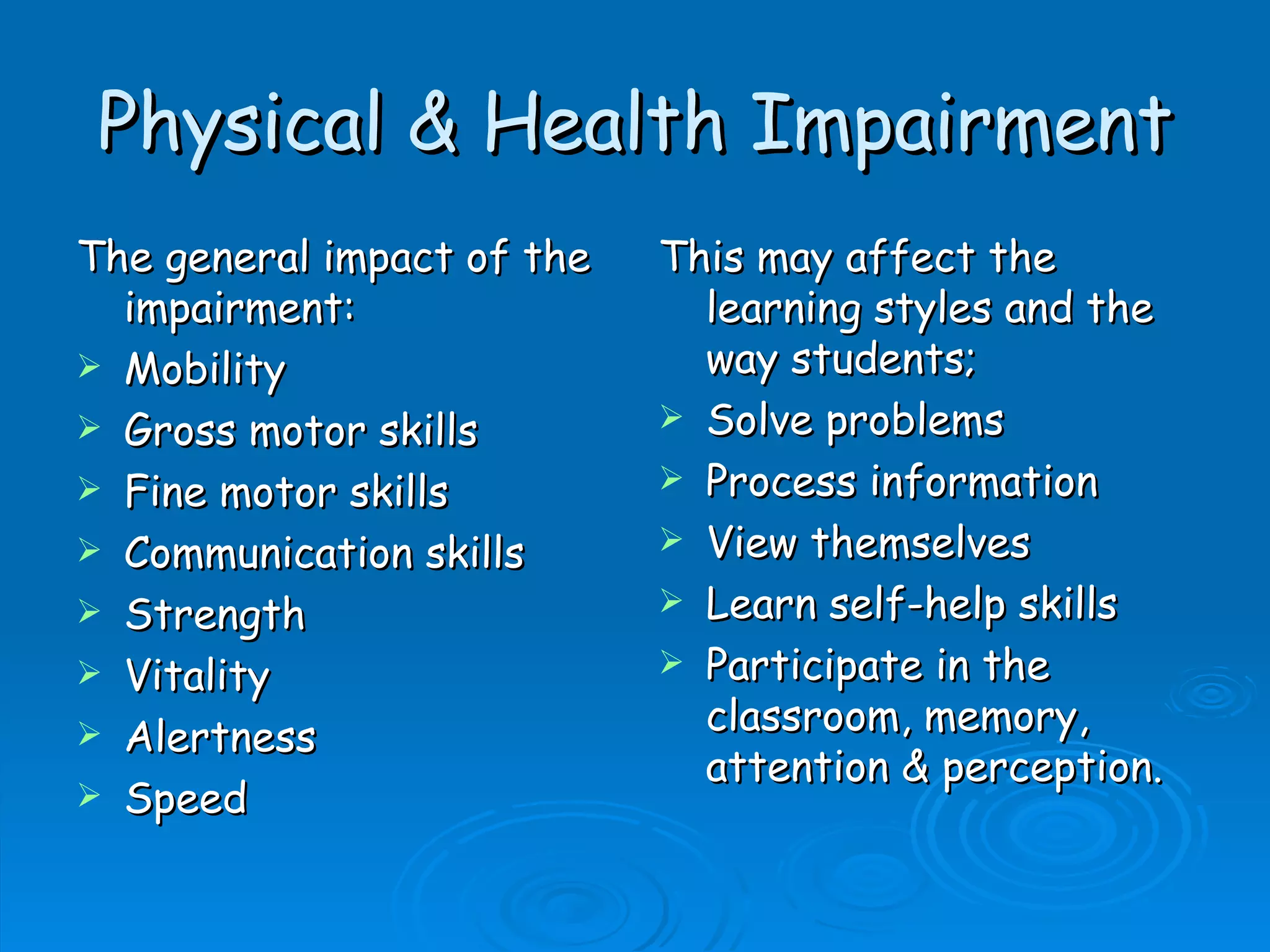
Physical & Health Impairment The general impact of the impairment: Mobility Gross motor skills Fine motor skills Communication skills Strength Vitality Alertness Speed This may affect the learning styles and the way students; Solve problems Process information View themselves Learn self-help skills Participate in the classroom, memory, attention & perception.
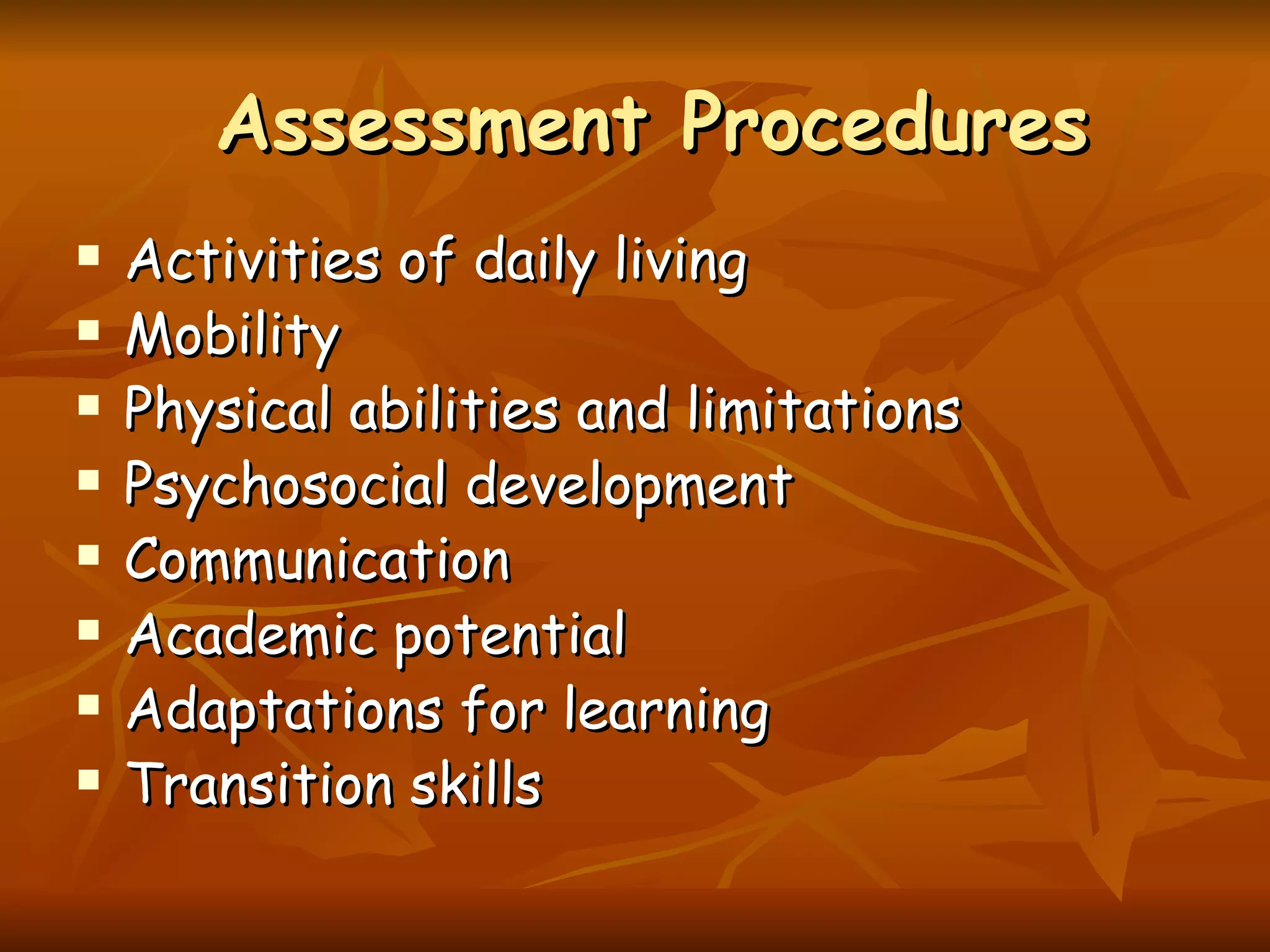
Assessment Procedures Activities of daily living Mobility Physical abilities and limitations Psychosocial development Communication Academic potential Adaptations for learning Transition skills
Curriculum Imperatives for PHI Self-care and social skills Vocational Skills Play activities Special subjects (Adapted P.E.) Instructional Materials/Resources Death Education
Educational Consideration Educational program and placement Related Strategies Stamina and Scheduling Positioning Architectural Barriers Assistive Technology (mobility, motor, functioning, communication)
IEP Goals for PHI By the end of the school year, Hank will demonstrate the basic skills necessary to participate in two groups oriented recreational activities. Person responsible:  Adapted physical education teacher By the end of the school year, Hank will read materials at the sixth grade level with adequate word recognition and comprehension. Person responsible: Resource teacher

Physical and Health Impairment

  • 1.
    Did you that…….?There is no direct relationship between intelligence & severity of physical disability? The major goal of professionals working with children who have physical disabilities is to alter the environment so the children can function? An orthopedic impairment by itself, is no reason for special placement? If individuals with disabilities are not able to compensate for environmental or functional demands in given situations, they will be handicapped in those situations but not necessarily in all situations?
  • 2.
    Physical & HealthImpairment Orthopedic Impairment – means a severe orthopedic impairment that adversely affects a child’s educational performance. The term includes impairment caused by congenital anomaly ( clubfoot, absence of some member, etc.), impairments caused by disease ( poliomyelitis, bone tuberculosis,etc.), and impairment from other causes ( cerebral palsy, amputations, and fractures or burns that cause contractures).
  • 3.
    Other Health ImpairmentMeans having limited strength, vitality, or alertness, due to chronic or acute health problems such as a heart condition, tuberculosis, rheumatic fever, nephritis, asthma, sickle cell anemia, hemophilia, epilepsy, lead poisoning, leukemia or diabetes, that adversely affects a child’s educational performance.
  • 4.
    Physical Disabilities NeurologicalCerebral Palsy, Spina Bifida, Convulsive Disorder, Poliomyelitis Musculoskeletal Muscular Dystrophy, Arthrogryposis, Legg-Perthes, Osteogenesis Imperfecta, Juvenile Rheumatoid arthritis, Scoliosis Other Health Impairment Congenital Malformation, Cystic Fibrosis, Sickle Cell Anemia, Hemophilia, Juvenile Diabetes Mellitus, Asthma, Rheumatic Fever Contagious Diseases STDs, AIDS
  • 5.
    Physical & HealthImpairment The general impact of the impairment: Mobility Gross motor skills Fine motor skills Communication skills Strength Vitality Alertness Speed This may affect the learning styles and the way students; Solve problems Process information View themselves Learn self-help skills Participate in the classroom, memory, attention & perception.
  • 6.
    Assessment Procedures Activitiesof daily living Mobility Physical abilities and limitations Psychosocial development Communication Academic potential Adaptations for learning Transition skills
  • 7.
    Curriculum Imperatives forPHI Self-care and social skills Vocational Skills Play activities Special subjects (Adapted P.E.) Instructional Materials/Resources Death Education
  • 8.
    Educational Consideration Educationalprogram and placement Related Strategies Stamina and Scheduling Positioning Architectural Barriers Assistive Technology (mobility, motor, functioning, communication)
  • 9.
    IEP Goals forPHI By the end of the school year, Hank will demonstrate the basic skills necessary to participate in two groups oriented recreational activities. Person responsible: Adapted physical education teacher By the end of the school year, Hank will read materials at the sixth grade level with adequate word recognition and comprehension. Person responsible: Resource teacher