Concept Learning:
Strategies for Instruction
Presented by Kit Keller
IX510: Instructional Design
Roundtable discussion
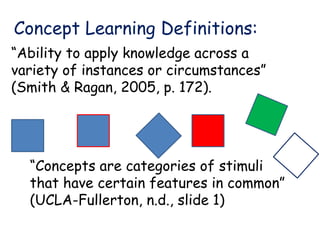
Concept Learning Definitions:
“Ability to apply knowledge across a
variety of instances or circumstances”
(Smith & Ragan, 2005, p. 172).
“Concepts are categories of stimuli
that have certain features in common”
(UCLA-Fullerton, n.d., slide 1)
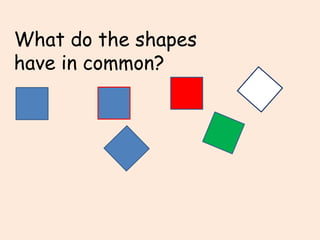
What do the shapes
have in common?
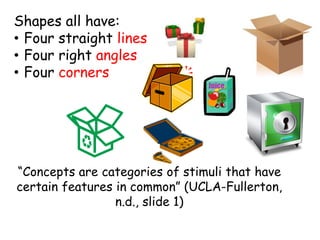
“Concepts are categories of stimuli that have
certain features in common” (UCLA-Fullerton,
n.d., slide 1)
Shapes all have:
• Four straight lines
• Four right angles
• Four corners
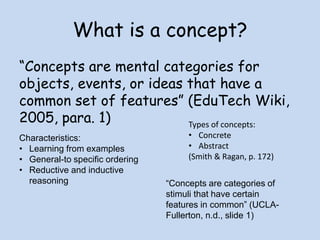
What is a concept?
“Concepts are mental categories for
objects, events, or ideas that have a
common set of features” (EduTech Wiki,
2005, para. 1)
Characteristics:
• Learning from examples
• General-to specific ordering
• Reductive and inductive
reasoning “Concepts are categories of
stimuli that have certain
features in common” (UCLA-
Fullerton, n.d., slide 1)
Types of concepts:
• Concrete
• Abstract
(Smith & Ragan, p. 172)
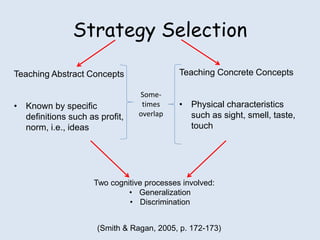
Strategy Selection
Teaching Abstract Concepts
• Known by specific
definitions such as profit,
norm, i.e., ideas
Teaching Concrete Concepts
• Physical characteristics
such as sight, smell, taste,
touch
(Smith & Ragan, 2005, p. 172-173)
Some-
times
overlap
Two cognitive processes involved:
• Generalization
• Discrimination
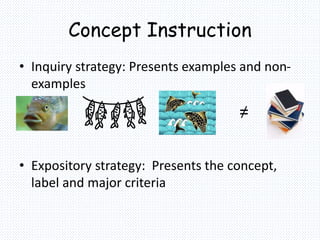
Concept Instruction
• Inquiry strategy: Presents examples and non-
examples
• Expository strategy: Presents the concept,
label and major criteria
≠
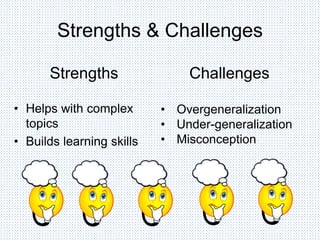
Strengths & Challenges
Strengths
• Helps with complex
topics
• Builds learning skills
Challenges
• Overgeneralization
• Under-generalization
• Misconception
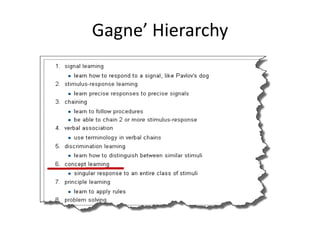
Gagne’ Hierarchy
References
EduTech Wiki. (2010). Concept learning. Retrieved from
http://edutechwiki.unige.ch/en/Concept_learning
EduTech Wiki. (201e). Learning level. Retrieved from
http://edutechwiki.unige.ch/en/Learning_level
Smith, P. L., & Ragan, T. J. (2005). Instructional design (3rd ed.). Hoboken,
NJ: John Wiley & Sons, Inc.
UCLA-Fullerton. (n.d.). Concept learning. Retrieved from
http://psych.fullerton.edu/navarick/concept.ppt

Concept learning presentation: overview

  • 1.
    Concept Learning: Strategies forInstruction Presented by Kit Keller IX510: Instructional Design Roundtable discussion
  • 2.
    Concept Learning Definitions: “Abilityto apply knowledge across a variety of instances or circumstances” (Smith & Ragan, 2005, p. 172). “Concepts are categories of stimuli that have certain features in common” (UCLA-Fullerton, n.d., slide 1)
  • 3.
    What do theshapes have in common?
  • 4.
    “Concepts are categoriesof stimuli that have certain features in common” (UCLA-Fullerton, n.d., slide 1) Shapes all have: • Four straight lines • Four right angles • Four corners
  • 5.
    What is aconcept? “Concepts are mental categories for objects, events, or ideas that have a common set of features” (EduTech Wiki, 2005, para. 1) Characteristics: • Learning from examples • General-to specific ordering • Reductive and inductive reasoning “Concepts are categories of stimuli that have certain features in common” (UCLA- Fullerton, n.d., slide 1) Types of concepts: • Concrete • Abstract (Smith & Ragan, p. 172)
  • 6.
    Strategy Selection Teaching AbstractConcepts • Known by specific definitions such as profit, norm, i.e., ideas Teaching Concrete Concepts • Physical characteristics such as sight, smell, taste, touch (Smith & Ragan, 2005, p. 172-173) Some- times overlap Two cognitive processes involved: • Generalization • Discrimination
  • 7.
    Concept Instruction • Inquirystrategy: Presents examples and non- examples • Expository strategy: Presents the concept, label and major criteria ≠
  • 8.
    Strengths & Challenges Strengths •Helps with complex topics • Builds learning skills Challenges • Overgeneralization • Under-generalization • Misconception
  • 9.
  • 10.
    References EduTech Wiki. (2010).Concept learning. Retrieved from http://edutechwiki.unige.ch/en/Concept_learning EduTech Wiki. (201e). Learning level. Retrieved from http://edutechwiki.unige.ch/en/Learning_level Smith, P. L., & Ragan, T. J. (2005). Instructional design (3rd ed.). Hoboken, NJ: John Wiley & Sons, Inc. UCLA-Fullerton. (n.d.). Concept learning. Retrieved from http://psych.fullerton.edu/navarick/concept.ppt