DEFINITION
All materials used in the classroom or in other teachig
situations to facilitate the understanding of the written or
spoken word are called AUDIO VISUAL AIDS
Audiovisual aids are defined as any device used to aid in the communication of an idea.
From this definition, virtually anything can be used as an aid, providing it successfully com-
municates the idea or information for which it is designed. In this chapter, we not only use the
term “Audiovisual Aids” but “Instructional Aids,” “Teaching Aids,” “Audio Aids,” and
“Visual Aids” as well. An audiovisual product is any audiovisual (AV) item such as still
photography, motion picture, audio or video tape, slide or filmstrip, that is prepared singly or
in combination to communicate information or to elicit a desired audience response. Even
though early aids, such as maps and drawings, are still in use, advances in the audiovisual field have
opened up new methods of presenting these aids, such as videotapes and multimedia equip-
ment which allow more professional and enter- taining presentations to be presented. Most of
the visual aids covered in this chapter can be grouped into the following categories—nonpro-
jected aids and projected aids. NONPROJECTED AIDS Nonprojected aids are those that do not
require the use of audiovisual equipment such as a projector and screen. Included in this category
are charts, graphs, maps, illustrations, photographs, brochures, and handouts. Charts
Charts are in common use almost every- where. A chart is a diagram which shows rela-
tionships. An example of a chart is shown in figure 7-2. The organizational chart is one of the
most widely used. This chart shows the various branches of a particular organization. Air and sea
maps that are used for navigation purposes are also charts. 7-4
PURPOSES:
1. To facilitate perceptual and conceptual learning
2. To stimulate the interest and motivate the students
3. To help retention of learning and to memorise the content
4. To hold the attention and encourage active participation
5. To save time and energy
6. To cover a large group of students
7. To overcome language barrier for effective communication
8. To provide concrete, realistic and life likeness in teaching
and learning situation
9. To bring remote events of either space or time into the class
room
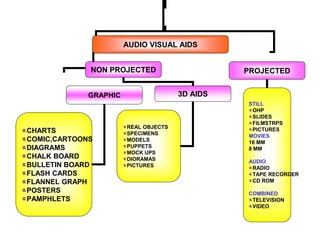
AUDIO VISUAL AIDS
NON PROJECTED PROJECTED
GRAPHIC 3D AIDS
CHARTS
COMIC,CARTOONS
DIAGRAMS
CHALK BOARD
BULLETIN BOARD
FLASH CARDS
FLANNEL GRAPH
POSTERS
PAMPHLETS
REAL OBJECTS
SPECIMENS
MODELS
PUPPETS
MOCK UPS
DIORAMAS
PICTURES
STILL
OHP
SLIDES
FILMSTRPS
PICTURES
MOVIES
16 MM
8 MM
AUDIO
RADIO
TAPE RECORDER
CD ROM
COMBINED
TELEVISION
VIDEO
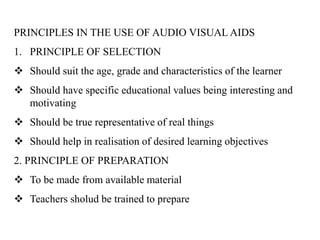
PRINCIPLES IN THE USE OF AUDIO VISUAL AIDS
1. PRINCIPLE OF SELECTION
 Should suit the age, grade and characteristics of the learner
 Should have specific educational values being interesting and
motivating
 Should be true representative of real things
 Should help in realisation of desired learning objectives
2. PRINCIPLE OF PREPARATION
 To be made from available material
 Teachers sholud be trained to prepare
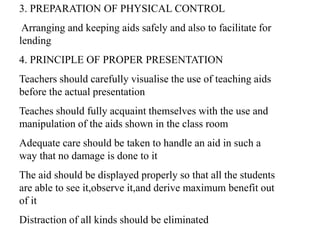
3. PREPARATION OF PHYSICAL CONTROL
Arranging and keeping aids safely and also to facilitate for
lending
4. PRINCIPLE OF PROPER PRESENTATION
Teachers should carefully visualise the use of teaching aids
before the actual presentation
Teaches should fully acquaint themselves with the use and
manipulation of the aids shown in the class room
Adequate care should be taken to handle an aid in such a
way that no damage is done to it
The aid should be displayed properly so that all the students
are able to see it,observe it,and derive maximum benefit out
of it
Distraction of all kinds should be eliminated
5.PRINCIPLE OF RESPONSE
The teacher should guide the student to respond actively
6.PRINCIPLE OF EVALUATION
FACTORS TO BE CONSIDERED IN SELECTING AN AV
AID
1. Objective
2. Group
3. Ability of the Instructor to use the particular AV AID
4. Duration available for Instruction
5. Budget
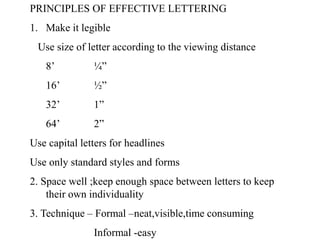
PRINCIPLES OF EFFECTIVE LETTERING
1. Make it legible
Use size of letter according to the viewing distance
8’ ¼”
16’ ½”
32’ 1”
64’ 2”
Use capital letters for headlines
Use only standard styles and forms
2. Space well ;keep enough space between letters to keep
their own individuality
3. Technique – Formal –neat,visible,time consuming
Informal -easy
Audio-Visual-AIDS.ppt

Audio-Visual-AIDS.ppt

  • 2.
    DEFINITION All materials usedin the classroom or in other teachig situations to facilitate the understanding of the written or spoken word are called AUDIO VISUAL AIDS
  • 3.
    Audiovisual aids aredefined as any device used to aid in the communication of an idea. From this definition, virtually anything can be used as an aid, providing it successfully com- municates the idea or information for which it is designed. In this chapter, we not only use the term “Audiovisual Aids” but “Instructional Aids,” “Teaching Aids,” “Audio Aids,” and “Visual Aids” as well. An audiovisual product is any audiovisual (AV) item such as still photography, motion picture, audio or video tape, slide or filmstrip, that is prepared singly or in combination to communicate information or to elicit a desired audience response. Even though early aids, such as maps and drawings, are still in use, advances in the audiovisual field have opened up new methods of presenting these aids, such as videotapes and multimedia equip- ment which allow more professional and enter- taining presentations to be presented. Most of the visual aids covered in this chapter can be grouped into the following categories—nonpro- jected aids and projected aids. NONPROJECTED AIDS Nonprojected aids are those that do not require the use of audiovisual equipment such as a projector and screen. Included in this category are charts, graphs, maps, illustrations, photographs, brochures, and handouts. Charts Charts are in common use almost every- where. A chart is a diagram which shows rela- tionships. An example of a chart is shown in figure 7-2. The organizational chart is one of the most widely used. This chart shows the various branches of a particular organization. Air and sea maps that are used for navigation purposes are also charts. 7-4
  • 4.
    PURPOSES: 1. To facilitateperceptual and conceptual learning 2. To stimulate the interest and motivate the students 3. To help retention of learning and to memorise the content 4. To hold the attention and encourage active participation 5. To save time and energy 6. To cover a large group of students 7. To overcome language barrier for effective communication 8. To provide concrete, realistic and life likeness in teaching and learning situation 9. To bring remote events of either space or time into the class room
  • 9.
    AUDIO VISUAL AIDS NONPROJECTED PROJECTED GRAPHIC 3D AIDS CHARTS COMIC,CARTOONS DIAGRAMS CHALK BOARD BULLETIN BOARD FLASH CARDS FLANNEL GRAPH POSTERS PAMPHLETS REAL OBJECTS SPECIMENS MODELS PUPPETS MOCK UPS DIORAMAS PICTURES STILL OHP SLIDES FILMSTRPS PICTURES MOVIES 16 MM 8 MM AUDIO RADIO TAPE RECORDER CD ROM COMBINED TELEVISION VIDEO
  • 10.
    PRINCIPLES IN THEUSE OF AUDIO VISUAL AIDS 1. PRINCIPLE OF SELECTION  Should suit the age, grade and characteristics of the learner  Should have specific educational values being interesting and motivating  Should be true representative of real things  Should help in realisation of desired learning objectives 2. PRINCIPLE OF PREPARATION  To be made from available material  Teachers sholud be trained to prepare
  • 11.
    3. PREPARATION OFPHYSICAL CONTROL Arranging and keeping aids safely and also to facilitate for lending 4. PRINCIPLE OF PROPER PRESENTATION Teachers should carefully visualise the use of teaching aids before the actual presentation Teaches should fully acquaint themselves with the use and manipulation of the aids shown in the class room Adequate care should be taken to handle an aid in such a way that no damage is done to it The aid should be displayed properly so that all the students are able to see it,observe it,and derive maximum benefit out of it Distraction of all kinds should be eliminated
  • 12.
    5.PRINCIPLE OF RESPONSE Theteacher should guide the student to respond actively 6.PRINCIPLE OF EVALUATION
  • 13.
    FACTORS TO BECONSIDERED IN SELECTING AN AV AID 1. Objective 2. Group 3. Ability of the Instructor to use the particular AV AID 4. Duration available for Instruction 5. Budget
  • 14.
    PRINCIPLES OF EFFECTIVELETTERING 1. Make it legible Use size of letter according to the viewing distance 8’ ¼” 16’ ½” 32’ 1” 64’ 2” Use capital letters for headlines Use only standard styles and forms 2. Space well ;keep enough space between letters to keep their own individuality 3. Technique – Formal –neat,visible,time consuming Informal -easy