INTRODUTION
Audio-Visual Aids are sensitive tools used in teaching that
facilitates learning.
They are multisensory materials which Motivate, Clarify and
Stimulate individuals towards learning.
Audio visual aids are technological media or learning devices
It helps the teacher to
 Clarify
 Establish correlation
 Coordinate accurate concepts
 Interpretation and appreciation
 Enable to make learning effective, interesting
 Inspirational , meaningful
 It helps in completing the triangular process of learning
DEFINITION
 An audio-visual aid is an instructional device in which
the message can be heard as well seen.
 Audio visual aids are any novice, which can be used to
make the learning experience more concrete, realistic
and dynamic.
-KINDER
 Audio visual aids at those which help in completing
the triangular process of learning that is motivation,
classification and stimulation – CARTER V.GOOD
PURPOSES OF A.V. AIDS
 AV AIDS  EDUCATION COMMUNICATION MEDIA
 Improves and makes teaching effective
 Enable audience to listen
 Makes learning interesting
 Quicken the phase of learning
 Develops knowledge
 Add newness to lesson
 Bring change in behaviour
 Stimulate curiosity
 Contact with reality
 Clear accurate image
 Increase attention and concentration
 Active participation
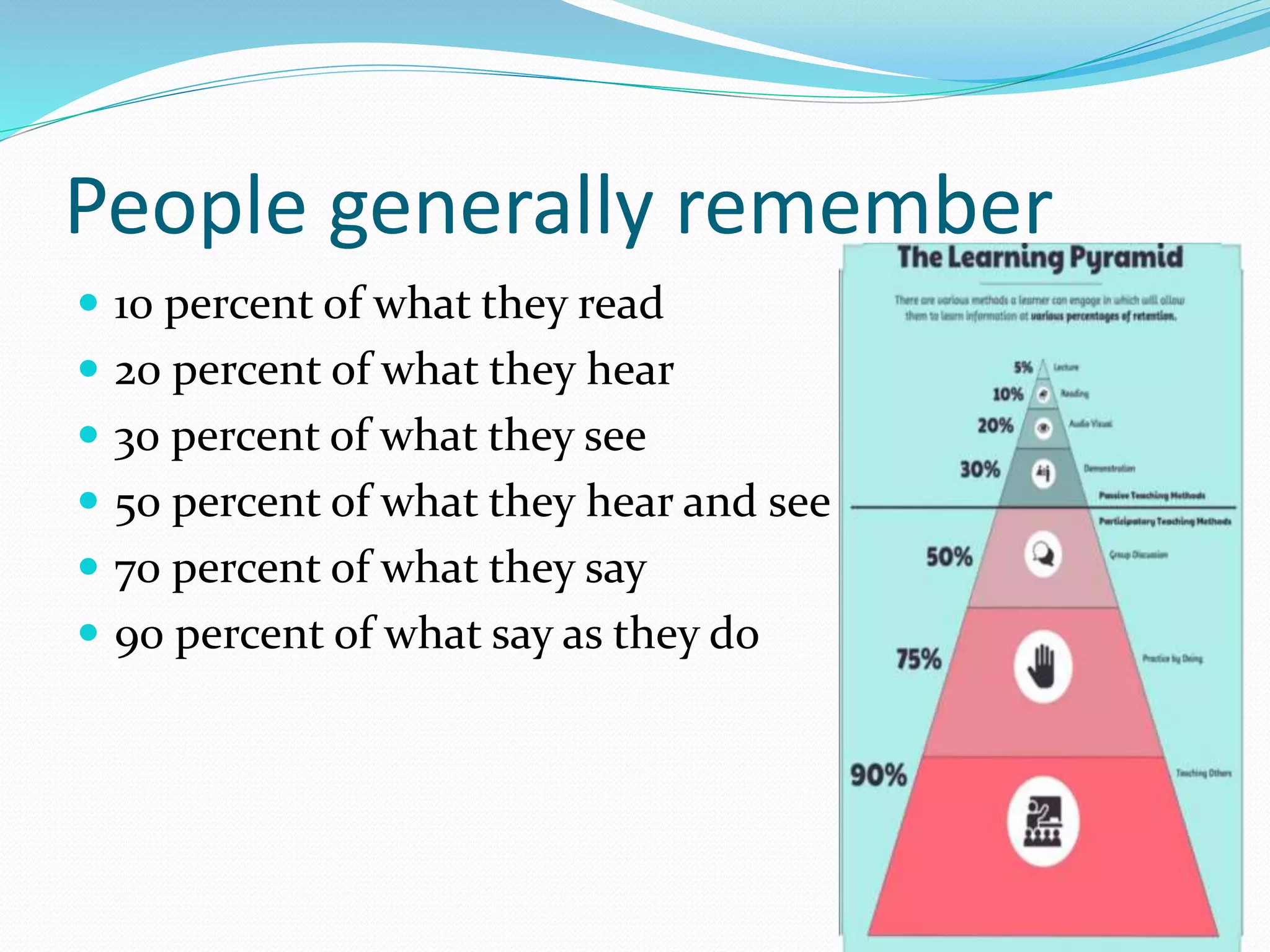
People generally remember
 10 percent of what they read
 20 percent of what they hear
 30 percent of what they see
 50 percent of what they hear and see
 70 percent of what they say
 90 percent of what say as they do
CHARACTERISTICS OF GOOD
INSTRUCTIONAL AID
 It must be adapted to the intellectual maturity of the
students.
 It should be meaningful and purposeful
 It should be improved
 It should be simple
 It should be cost effective
 It should be up to date
 It should be easily portable
 It should be large enough to be seen by the whole
class.
PRINCIPLES FOR EFFECTIVE USE OF
AUDIO-VISUAL AIDS
 The following are the principles for effective use of
audio visual aids.
 Principle of selection
 Principle of preparation
 Principle of physical control
 Principle of proper presentation
 Principle of response
 Principle of evaluation
FACTORS INFLUENCING SELECTION
OF AUDIO VISUAL AIDS
 Audiovisual aids can be used either single or in
combination the factors influencing are,
 The objective or the purpose
 The nature of the subject matter
 The nature of the audience
 The number of audiences
 The age, education
 Interest and experience
 Knowledge of the subject
 Cost
 Skill in selection and preparation
 Knowledge of resources
CRITERIA FOR SELECTING AUDIO
VISUAL AIDS
 THE TEACHER HAS TO PUT THE FOLLOWING
QUESTION IN MIND
 Do the material give a true picture of idea
 Are they meaningful
 Is the material approprirate
 Is the physical condition satisfactory
 Do they improve human relation.
 Is the material worth the time and effort
 If the teacher finds it satisfactory then he has to
choose the material.
GUIDELINES FOR SELECTING AND
MAKING AV AIDS
 Easy and understandable
 Simple and direct
 Focus on key points
 Good working condition
 Time and place
 Accuracy
 Presentation
 Brief , clear and easy
 Letters should be neat
 Space between letters
 Space between lines
 Interesting and positive attitude
 Natural attractive colors
ADVANTAGES OF AV AIDS
 Inaccessible materials , event, object, could easily be
brought in classroom virtually
 Students in the large classroom may not be able to see a
demonstration or small models
 Helps to solve communication problems.
 Greater acquisition of knowledge.
 Motivate students to participate actively.
 Source of experience
 Improves critical thinking
 Helps in interaction
 Motivate students to gain further knowledge
CLASSIFICATION OF
INSTRUCTIONAL AIDS
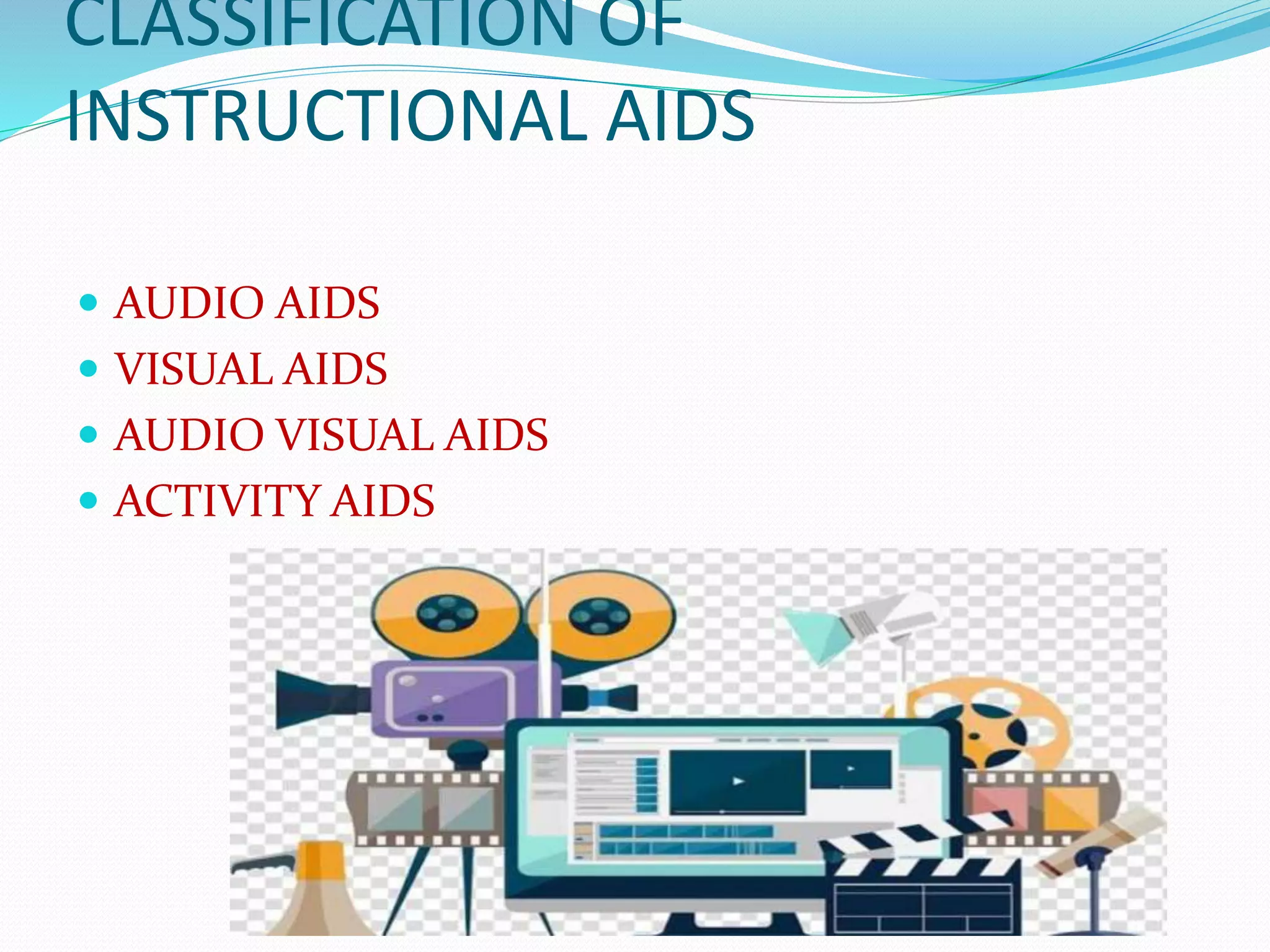
 AUDIO AIDS
 VISUAL AIDS
 AUDIO VISUAL AIDS
 ACTIVITY AIDS
AUDIO AIDS
This group consists of those aids which can be heard.
 Learners use their hearing organs (ears)to listen to the
sound
 the aids that involve a sense of hearing
 Examples :
HEALTH EDUCATION
PUBLIC AWARENESS
PROVIDE INFORMATION
TYPES AUDIO AIDS
 RADIO
 TAPE RECORDER
 GRAMOPHONE
 COMPACT DISCS
 VOICE MAIL
A. RADIO
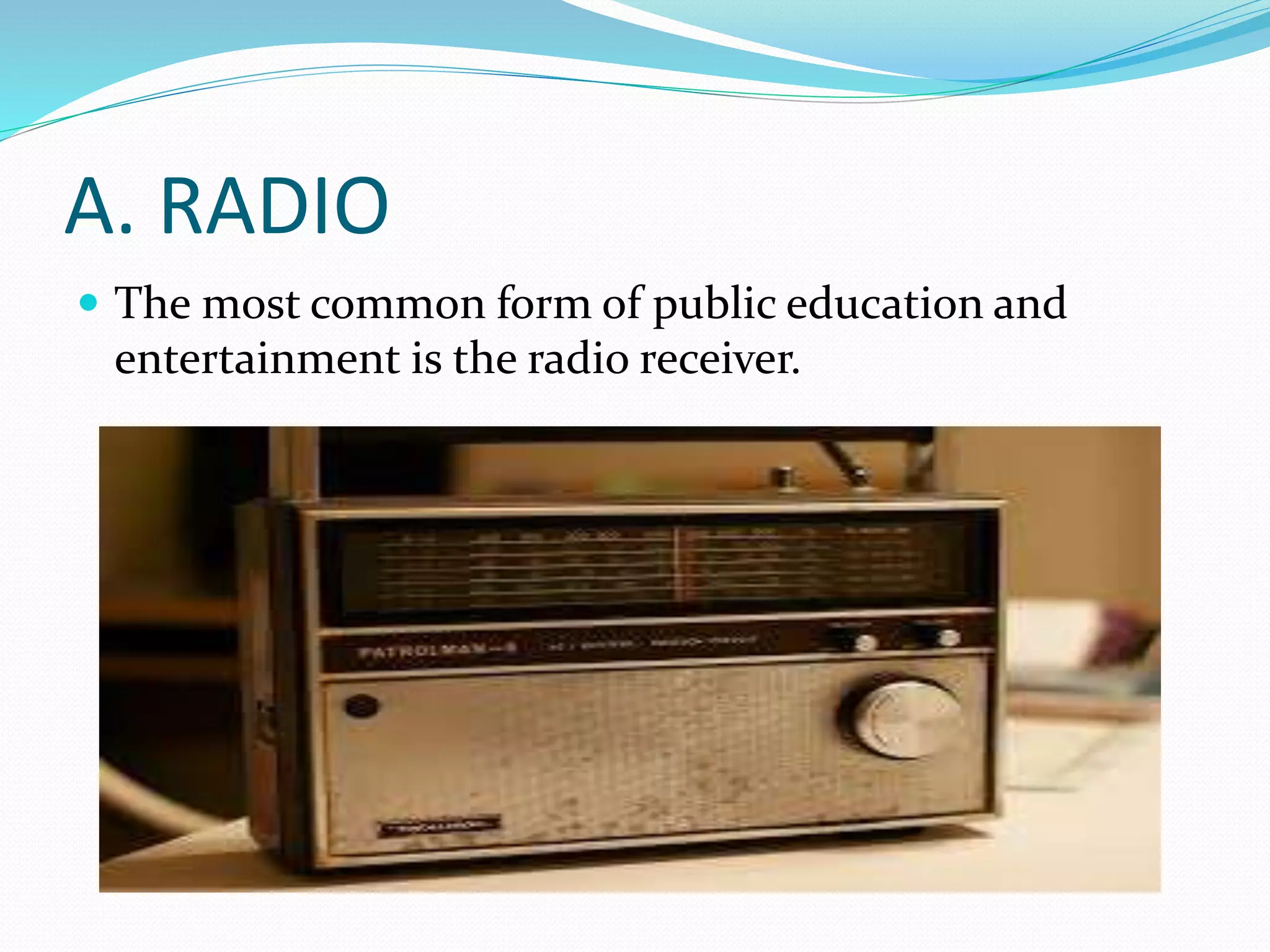
 The most common form of public education and
entertainment is the radio receiver.
PURPOSES OF RADIO
 Radio a are portable
 Educational programs can be given
 Latest information can be provided
 Increase student interest
 Develops positive attitude
 Increases general knowledge
ADVANTAGES
 Increased listening skills
 Good for mass education
 Effective for distance education
DISADVANTAGES:
 One way communication
 May not seek attention
 May not be heard by students
B.TAPE RECORDER
 A tape recorder is a portable electronic gadget to
record, reproduce, erase and record sounds on the
magnetic tape.
ADVANTAGES OF RECORDING
 Recordings are two way communication
 It eliminates the time adjustments problems of radio
 It enables one to listen , hear recordings previously
made
 Provides students to hear their own voice
DISADVANTAGES :
 Cannot maintain eye to eye contact
 May be difficult to control classroom
 Less attention
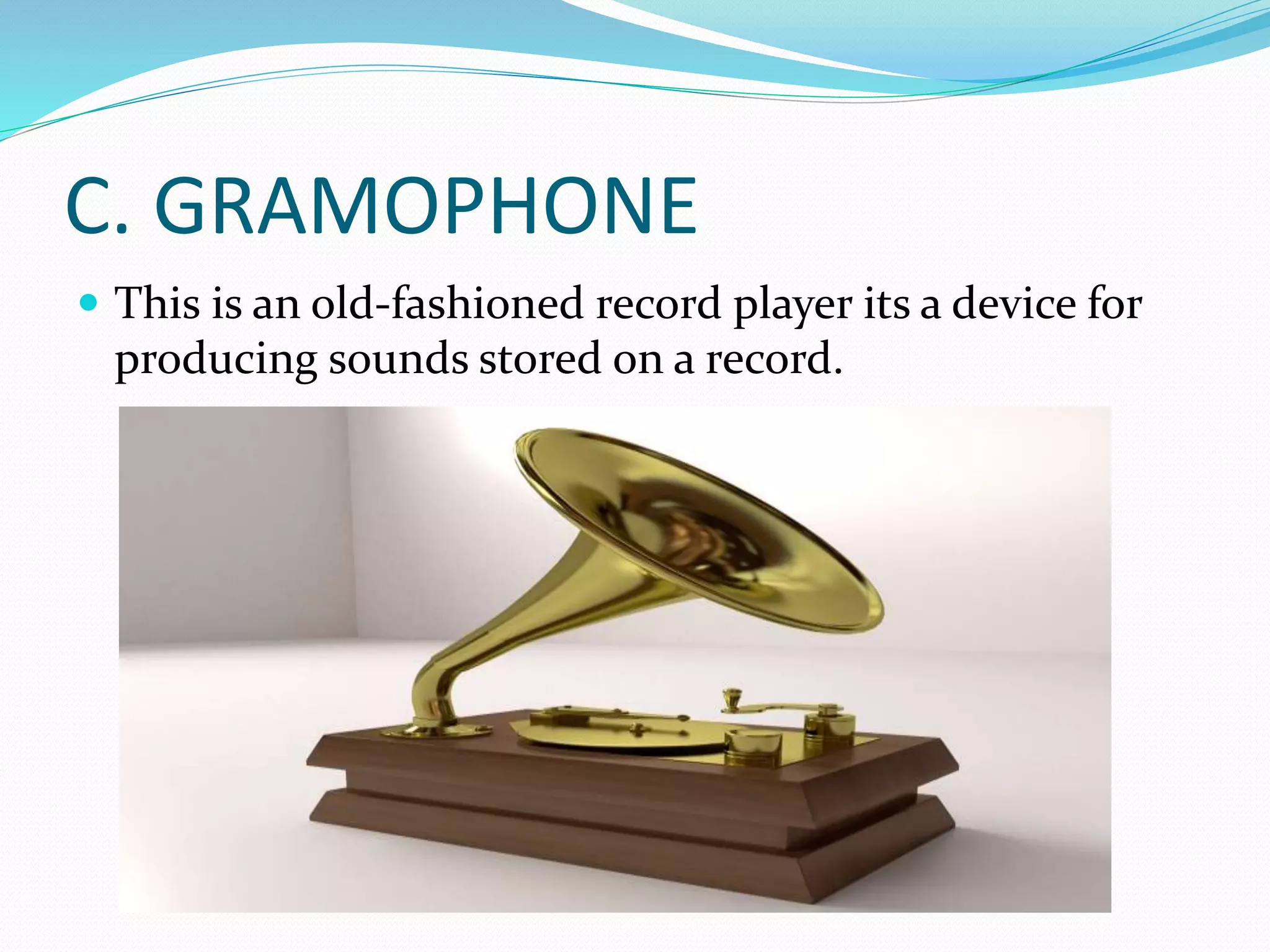
C. GRAMOPHONE
 This is an old-fashioned record player its a device for
producing sounds stored on a record.
D.COMPACT DISCS
 Compact disc also called as CD, are small plastic disc
which store and retrieve computer data.
 They are faster and could hold more information
 They can hold up to 700mb of data
 Example : documentary of people in rural areas and
problems faced by them
E. VOICE MAIL
 A centralized electronic system which can store
messages from telephone callers.
VISUAL AIDS
 Visual aids for learning has a huge impact in how
students retain information
 It is highly interactive
 The information is presented visually
 Visual aids are of two kinds
 1. NON PROJECTED AIDS
 2.PROJECTED AIDS
TYPES OF PROJECTED VISUAL AIDS
 Maps
 Cartoons
 Charts
 Posters
 Chalk boards
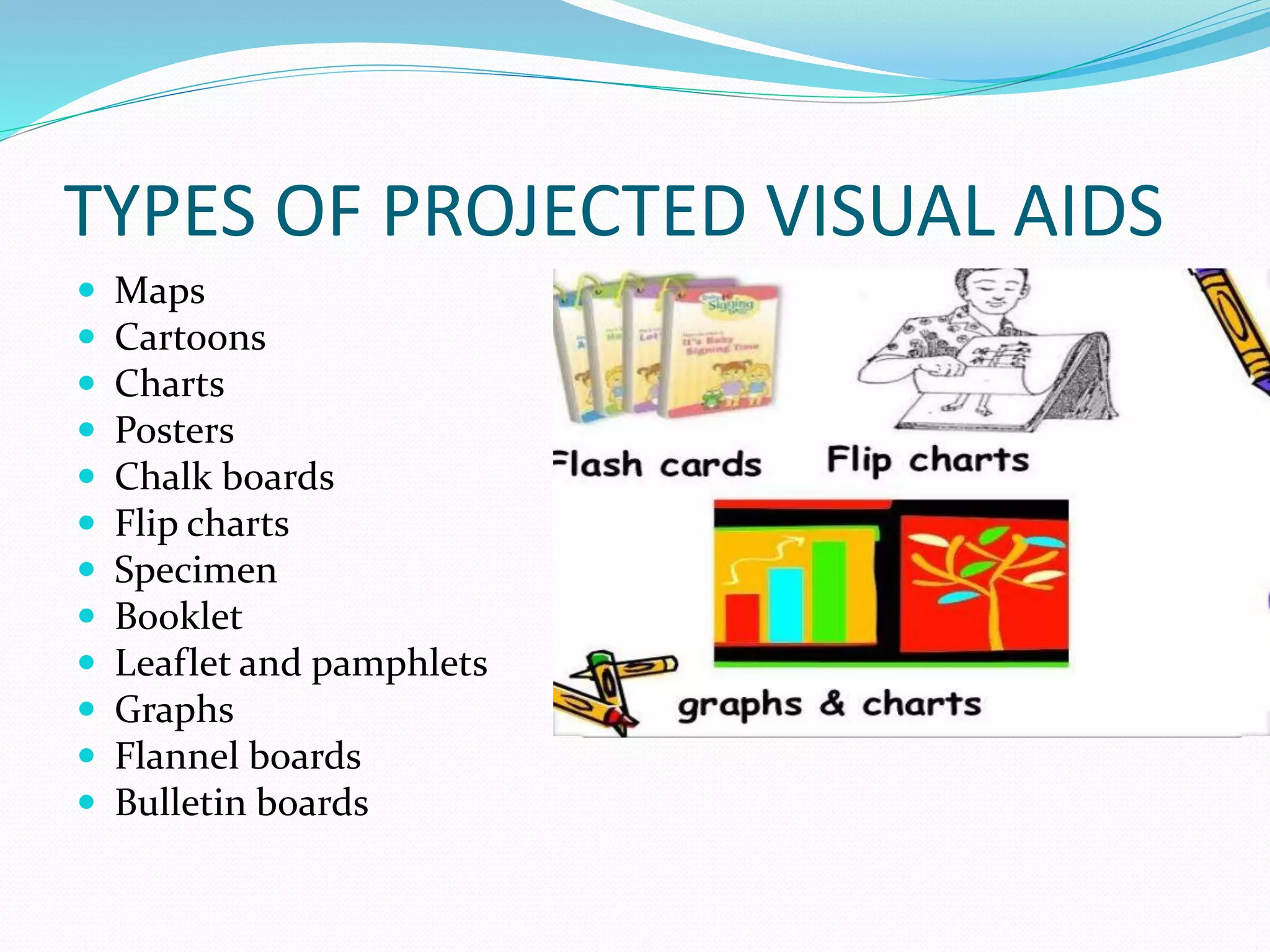
 Flip charts
 Specimen
 Booklet
 Leaflet and pamphlets
 Graphs
 Flannel boards
 Bulletin boards
MAPS
 Pictures of earths surface
 Using maps in the classroom increased curiosity
 Encourages exploration
 Inspires problem solving
 Used for exploration
 Helps in visual learning
 Improves skills
CARTOONS
 Using humour in class is a valuable teaching tool
 They motivate students
 Increases interest
 Maintains attention
 Encourages imagination
 Strengthen critical thinking
 Helps in better understanding
 Effective way for moral education
CHARTS
 Charts are the graphic aids which provide information in
the form of tables pictures and graphics
 PURPOSES :
 For summarizing information
 For presenting material,
 To show continuity in the process
 For motivating students
 PRINCIPLE:
Should be self-explanatory
Should be in bold letters
Highlighted
Should be large enough
TYPES OF CHARTS
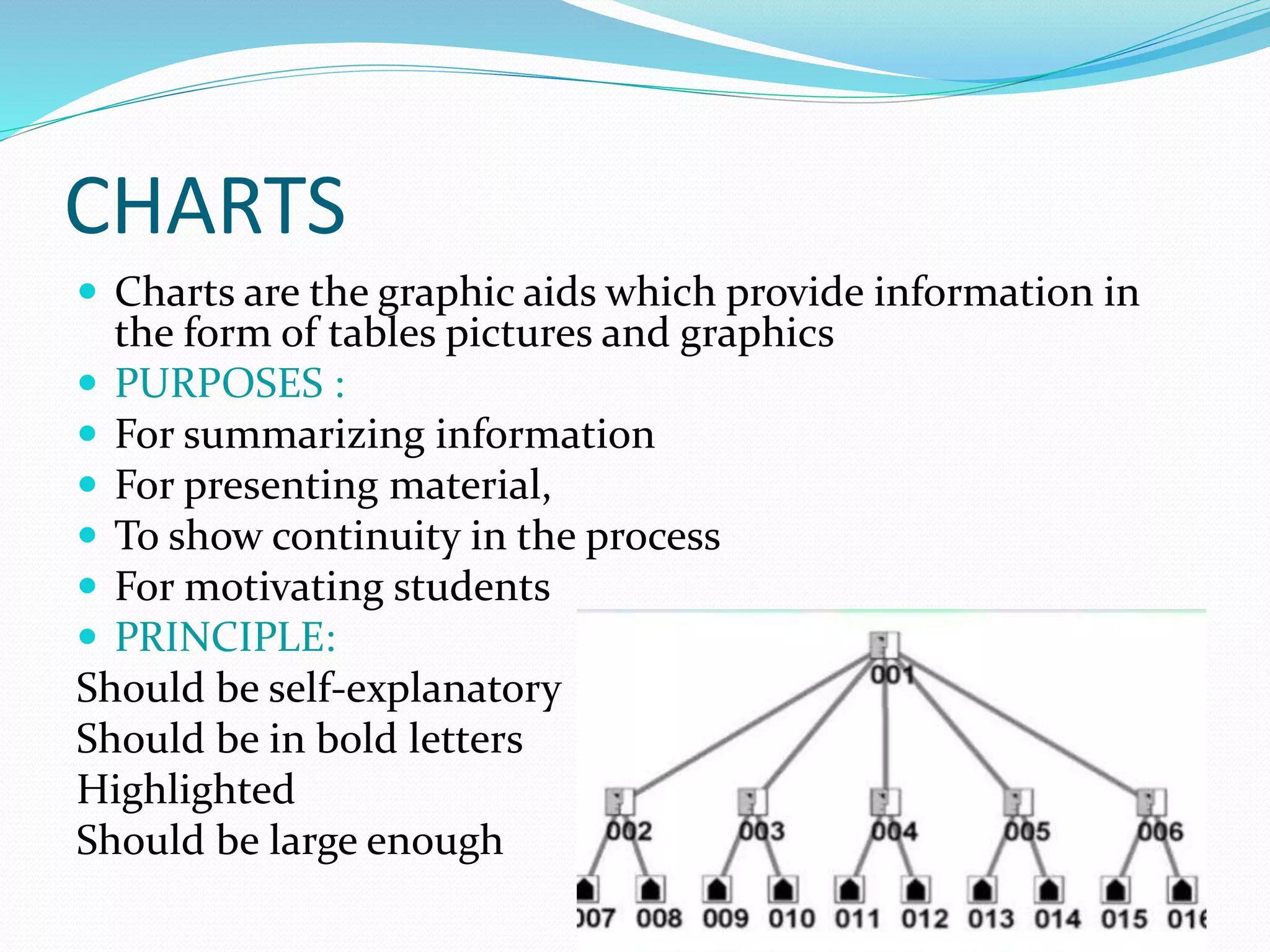
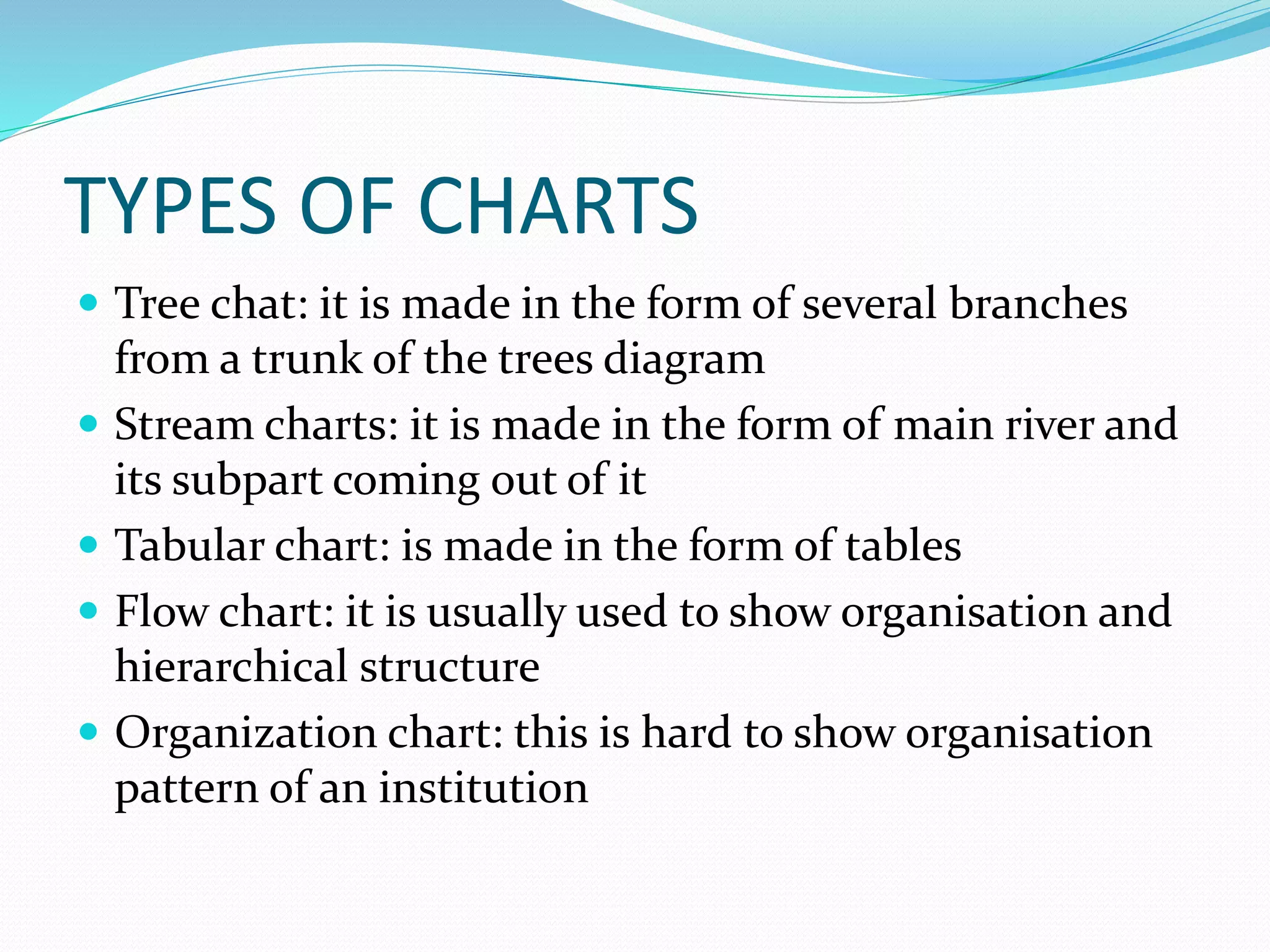
 Tree chat: it is made in the form of several branches
from a trunk of the trees diagram
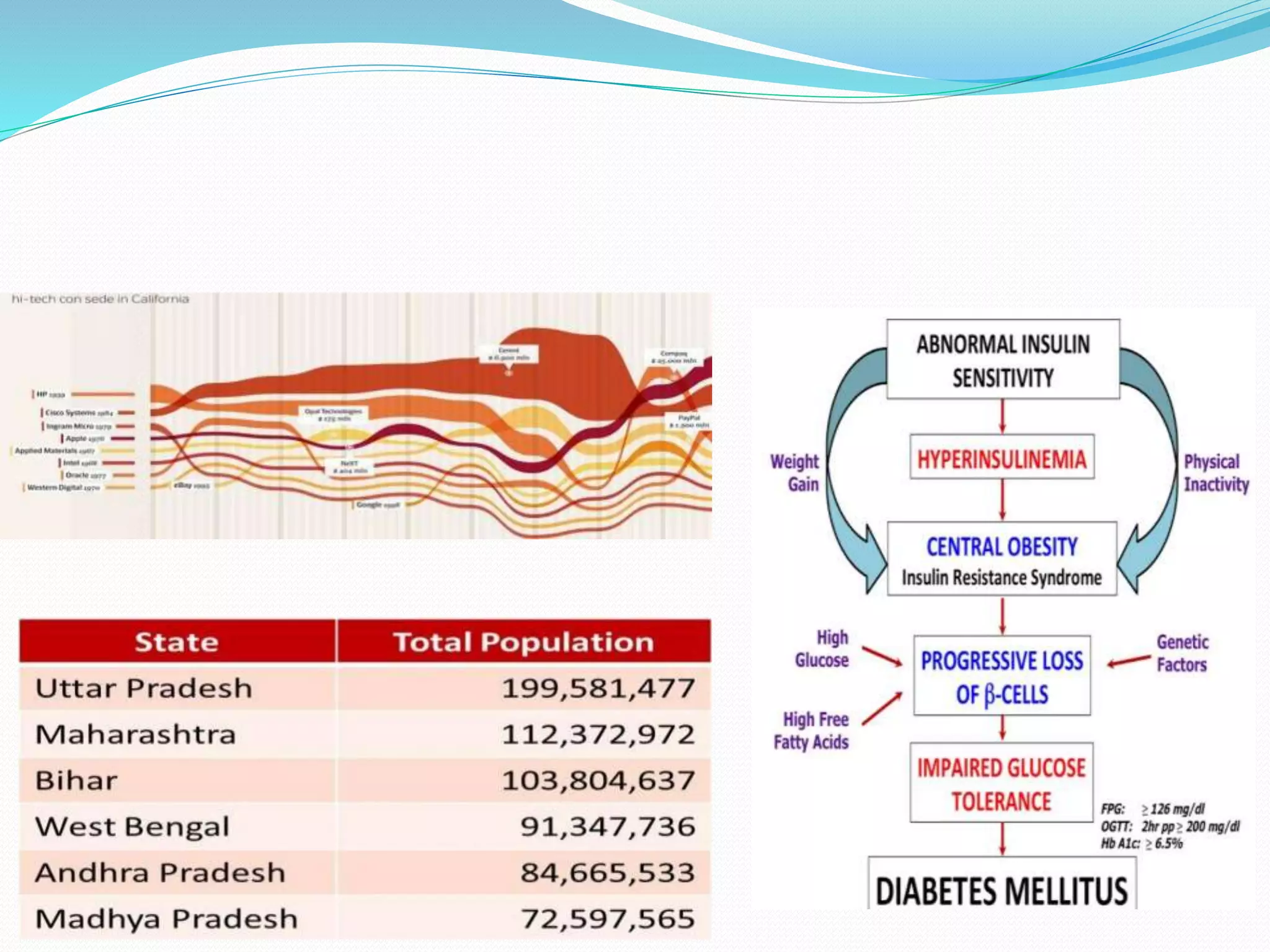
 Stream charts: it is made in the form of main river and
its subpart coming out of it
 Tabular chart: is made in the form of tables
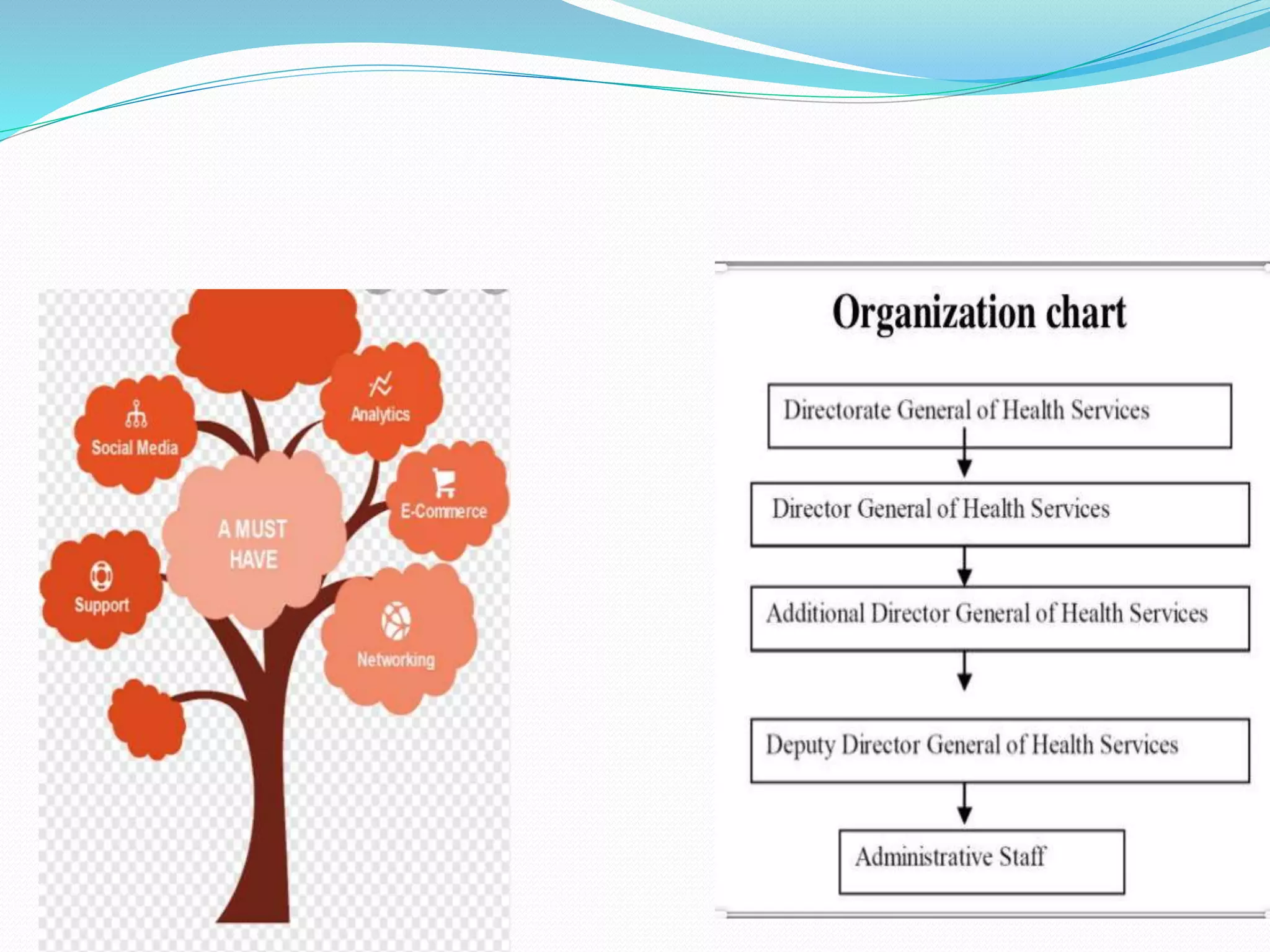
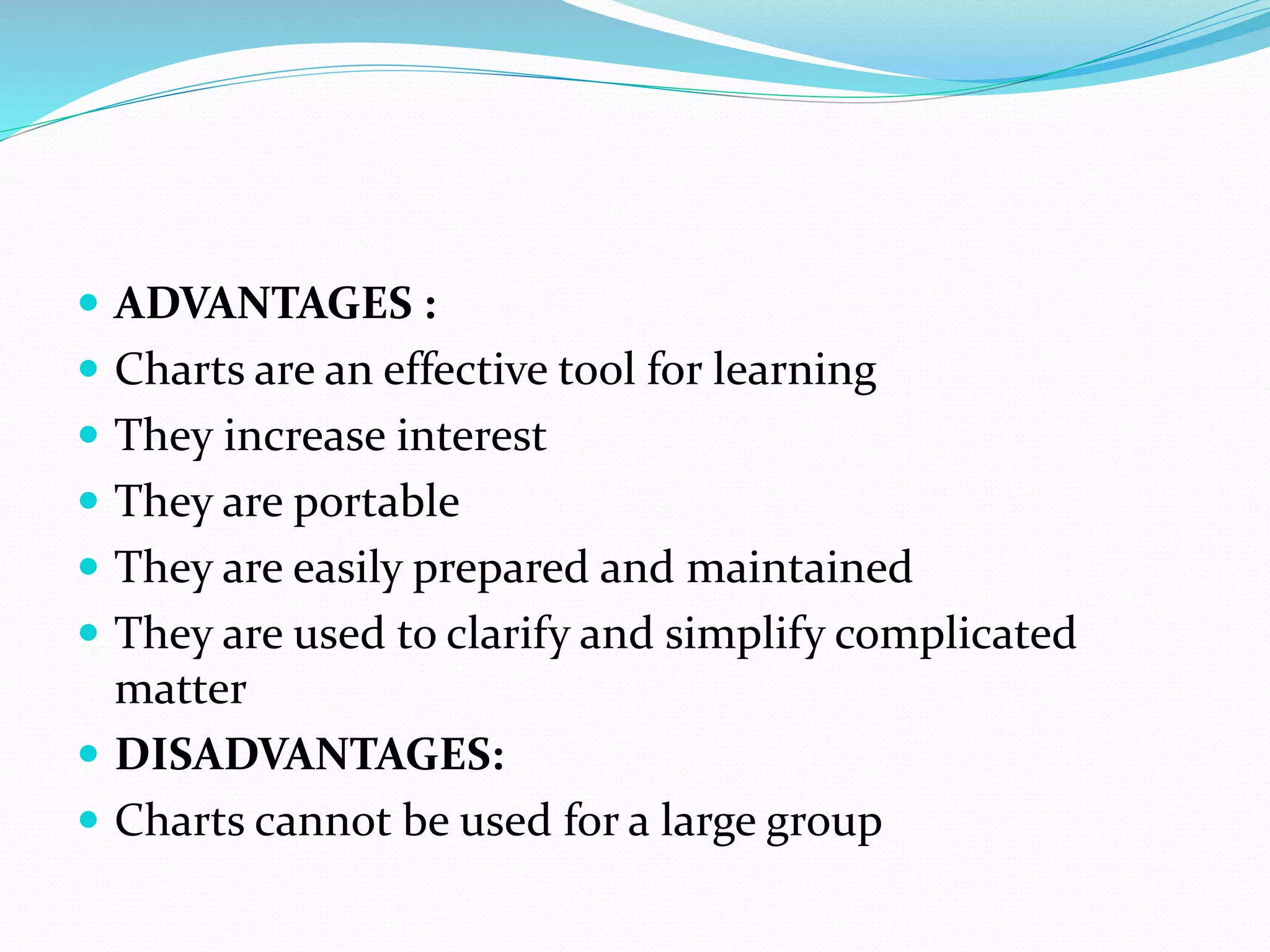
 Flow chart: it is usually used to show organisation and
hierarchical structure
 Organization chart: this is hard to show organisation
pattern of an institution
 ADVANTAGES :
 Charts are an effective tool for learning
 They increase interest
 They are portable
 They are easily prepared and maintained
 They are used to clarify and simplify complicated
matter
 DISADVANTAGES:
 Charts cannot be used for a large group
POSTERS
 Posters are graphic aids with short, quick and typical
messages with attention capturing the painting
 They are graphical presentations of simple ideas which
combine picture and short headings
 CHARACTERISTICS
 It should be attractive
 It should be brief
 It should be clear
 The design should attract audience
 It varies from simple printed card to a complicated artistic
design
Rules to prepare poster
 Demostrative
 To promote a point
 Planned for specific people
 Use of bold letters
 Use if pleasing colors
 Use simple and few words
 Convey an idea
 It should be placed where people pass or gather
 Material: drawing papers , poster Board, crayons, water color,
bright color pencil
Features of good poster
 BREVITY
 SIMPLICITY
 IDEA
 LAYOUT
 COLOR
 DISPLAY
CHALK BOARDS
 It is a slightly abrasive writing surface made of wood ,
,ply, hard board, cement , asbestos with black or green
paint on it.
 PURPOSE:
To illustrate an example of fact
To present outlines
To give directions.
To give examination.
It is a mean of group work.
ADVANTAGE
 It is a convenient usual and for group teaching
 It is economical teaching aid
 Is is a good visual aid for detail and revision
 It is useful for drawing
 It can easily used for giving lesson notes to students
DISADVANTAGES:
 It makes students dependent on teacher
 It makes chalk powder spread and inhaled
 It makes a lesson routine
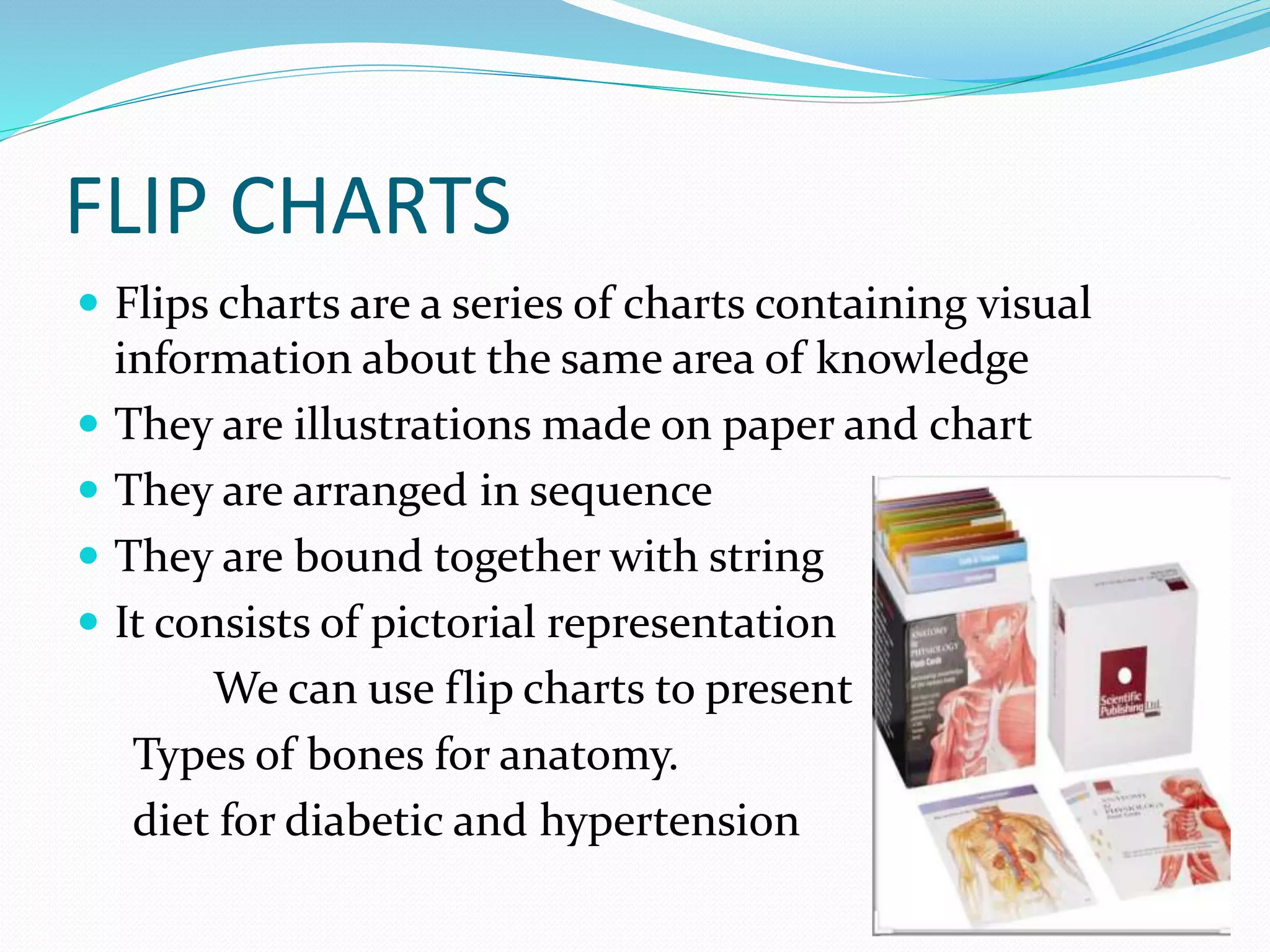
FLIP CHARTS
 Flips charts are a series of charts containing visual
information about the same area of knowledge
 They are illustrations made on paper and chart
 They are arranged in sequence
 They are bound together with string
 It consists of pictorial representation
We can use flip charts to present
Types of bones for anatomy.
diet for diabetic and hypertension
GRAPHS
 It shows numerical or quantitative relationship or
statistic data are presented in the form of visual
symbols.
 It represents the quantitative data for analysis.
 It helps in the interpretation of data
 It helps to make comparisions
TYPES OF GRAPH
 Line graph
 Bar graph
 Simple bar graph
 Mutiple graph
 Pie graph
 Pictorial graph
 LINE GRAPH: are used when a considerable quantity
of data is to be plotted or when the data are
continuous
 BAR GRAPH: It consists of bars arranged in
horizontal or vertical rows.
 SIMPLE BAR GRAPH : may be vertically or
horizontally arranged.
 MULTIPLE BAR GRAPH: it has multiple columns
 PIE GRAPH : the pie graph is usually drawn as circle ,
The section of which are used to represent component
parts of the whole.
 PICTORIAL GRAPH: it is an outstanding method of
picture graphic representation.
 ADVANTAGES
 Helps to show numerical statistics
 Helps in explaining, comparison among two
DISADAVANTAGES
 Only statistical data
 Lesson is not effectively grasped by student
 Any simple mistake will change the whole statistics.
SPECIMEN
 The specimen is a part of an object
 It may represent a sample that shows quality of the
structure of the actual
USES :
1. It provides real life experiences
2. Motivate students
3. Stimulates discussion
We can use specimens
like anatomical parts.
BOOKLETS ,LEAFLET,PAMPHLETS
 They are printed materials small in size covered bound
containing information on a subject or specific topic
and providing opportunities for learning and referring
FLANNEL BOARD
 A flannel board is a display board made if wood ,
cardboard covered with flannel of woolen cloth
 Display material like the cut outs pictures , and
drawing, light objects with rough surface like strips
and flannel strips.
BULLETIN BOARD
 It is used for both informational and education
purposes
 Atteacts attention
 Promote creativeiry
 Effective educational media
PROJECTIVE AIDS
 A projected aid is one in which item to be observed are
projected on a screen using mechanical mechanical
devices
 The various projective aids are
1. Slide projector
2. Microfilm projector
3. Overhead projector
SLIDE PROJECTOR
 A small piece of transparent material on which a single
pictorial image or graphic image is placed
MICROFLIM PROJECTOR
 Microfilm contains photographed
 reading materials
 When the microfilm is passed
through a microfilm reader
then an enlarged image
is formed on the screen
and the observer can
read all the matter
OVERHEAD PROJECTOR
 Over head projector is a device for projecting a matter
which is written or drawn on a transparent sheet of
acetate on to a scree
 It is very simple and easy
AUDIO VISUAL AIDS
 Audio visual aids are the teaching methods which
could be heard and visualised at the same time
 It’s the most effective method of teaching and learning
 Educational materials are directed at both the sense of
hearing and sense of sight
 It has a deeper impact on learning
 It maintains attention
 Help to retain the concepts
TYPES OF AUDIO VISUAL AIDS
 TELEVISION
 LCD PROJECTOR
 COMPUTER
TELEVISION
 Television is being acknowledged as a powerful
medium of mass education
 Televsion is being used for impacting information and
distance learning
 A television can bring the real outside world into
classroom
 Televsion for education can be described as an
electronic chalk board
LIQUID CRYSTAL DISPLAY
PROJECTOR
 An lcd projector is a type of video projector for
displaying video or computer data on screen
 It is a modern equivalent to the slide projector
 It has brighter images clear
 True and natural colors
 Images are easy on the eyes
COMPUTER
 Audio visual aids strengthen an instructors verbal
presentation while helping the students capture a
specific message
 It keeps the attention throughout a presentation
 It helps them to remember particular information
 Computers have revolutionised teaching methods and
strategies
 The computer is used to aid in teaching
 The students interacts with computer for learning ,
testing, immediate feedback and reinforcement
DEVELOPING LEARNING
RESOURCES
 The effective use if audio visual aids are
 PLANNING:
 PREPARATION
 PRESENTATION
 EVALUATION
1.PLANNING: know the objective
 Plan well in advance
 Anticipate the problem
 Anticipate the size of the audience
 Plan for use if variety of colourful aids
 Keep up the audience interest
 Plan in advance the time of presentation.
 PREPARATION :
Select a convenient place
Anticipate the need for lighting
 Make sure all the equipment are working
 Prepare by rehearsing
 Arrange in sequence
 Preview the order
 Make a smooth presentation
 PRESENTATION
 motivate the audience
 Stress the key points
 Present aids at right moment
 Remove all unrelated material
 Speak facing the audience
 Display one at a time
 Display in proper sequence
 EVALUATION:
 At the end evaluate by providing discussion and
application to discover misunderstanding and doubts
 Undertake follow up studies
 Observe results
Hence audio visual aids are useful for the teaching
process , a great tool to catch the audience attention
and it doesn’t distract a student from learning
experience..
Audio Visual Aids

Audio Visual Aids

  • 2.
    INTRODUTION Audio-Visual Aids aresensitive tools used in teaching that facilitates learning. They are multisensory materials which Motivate, Clarify and Stimulate individuals towards learning. Audio visual aids are technological media or learning devices It helps the teacher to  Clarify  Establish correlation  Coordinate accurate concepts  Interpretation and appreciation  Enable to make learning effective, interesting  Inspirational , meaningful  It helps in completing the triangular process of learning
  • 3.
    DEFINITION  An audio-visualaid is an instructional device in which the message can be heard as well seen.  Audio visual aids are any novice, which can be used to make the learning experience more concrete, realistic and dynamic. -KINDER  Audio visual aids at those which help in completing the triangular process of learning that is motivation, classification and stimulation – CARTER V.GOOD
  • 4.
    PURPOSES OF A.V.AIDS  AV AIDS EDUCATION COMMUNICATION MEDIA  Improves and makes teaching effective  Enable audience to listen  Makes learning interesting  Quicken the phase of learning  Develops knowledge  Add newness to lesson  Bring change in behaviour  Stimulate curiosity  Contact with reality  Clear accurate image  Increase attention and concentration  Active participation
  • 5.
    People generally remember 10 percent of what they read  20 percent of what they hear  30 percent of what they see  50 percent of what they hear and see  70 percent of what they say  90 percent of what say as they do
  • 6.
    CHARACTERISTICS OF GOOD INSTRUCTIONALAID  It must be adapted to the intellectual maturity of the students.  It should be meaningful and purposeful  It should be improved  It should be simple  It should be cost effective  It should be up to date  It should be easily portable  It should be large enough to be seen by the whole class.
  • 7.
    PRINCIPLES FOR EFFECTIVEUSE OF AUDIO-VISUAL AIDS  The following are the principles for effective use of audio visual aids.  Principle of selection  Principle of preparation  Principle of physical control  Principle of proper presentation  Principle of response  Principle of evaluation
  • 8.
    FACTORS INFLUENCING SELECTION OFAUDIO VISUAL AIDS  Audiovisual aids can be used either single or in combination the factors influencing are,  The objective or the purpose  The nature of the subject matter  The nature of the audience  The number of audiences  The age, education  Interest and experience  Knowledge of the subject  Cost  Skill in selection and preparation  Knowledge of resources
  • 9.
    CRITERIA FOR SELECTINGAUDIO VISUAL AIDS  THE TEACHER HAS TO PUT THE FOLLOWING QUESTION IN MIND  Do the material give a true picture of idea  Are they meaningful  Is the material approprirate  Is the physical condition satisfactory  Do they improve human relation.  Is the material worth the time and effort  If the teacher finds it satisfactory then he has to choose the material.
  • 10.
    GUIDELINES FOR SELECTINGAND MAKING AV AIDS  Easy and understandable  Simple and direct  Focus on key points  Good working condition  Time and place  Accuracy  Presentation  Brief , clear and easy  Letters should be neat  Space between letters  Space between lines  Interesting and positive attitude  Natural attractive colors
  • 11.
    ADVANTAGES OF AVAIDS  Inaccessible materials , event, object, could easily be brought in classroom virtually  Students in the large classroom may not be able to see a demonstration or small models  Helps to solve communication problems.  Greater acquisition of knowledge.  Motivate students to participate actively.  Source of experience  Improves critical thinking  Helps in interaction  Motivate students to gain further knowledge
  • 12.
    CLASSIFICATION OF INSTRUCTIONAL AIDS AUDIO AIDS  VISUAL AIDS  AUDIO VISUAL AIDS  ACTIVITY AIDS
  • 13.
    AUDIO AIDS This groupconsists of those aids which can be heard.  Learners use their hearing organs (ears)to listen to the sound  the aids that involve a sense of hearing  Examples : HEALTH EDUCATION PUBLIC AWARENESS PROVIDE INFORMATION
  • 14.
    TYPES AUDIO AIDS RADIO  TAPE RECORDER  GRAMOPHONE  COMPACT DISCS  VOICE MAIL
  • 15.
    A. RADIO  Themost common form of public education and entertainment is the radio receiver.
  • 16.
    PURPOSES OF RADIO Radio a are portable  Educational programs can be given  Latest information can be provided  Increase student interest  Develops positive attitude  Increases general knowledge
  • 17.
    ADVANTAGES  Increased listeningskills  Good for mass education  Effective for distance education DISADVANTAGES:  One way communication  May not seek attention  May not be heard by students
  • 18.
    B.TAPE RECORDER  Atape recorder is a portable electronic gadget to record, reproduce, erase and record sounds on the magnetic tape.
  • 19.
    ADVANTAGES OF RECORDING Recordings are two way communication  It eliminates the time adjustments problems of radio  It enables one to listen , hear recordings previously made  Provides students to hear their own voice DISADVANTAGES :  Cannot maintain eye to eye contact  May be difficult to control classroom  Less attention
  • 20.
    C. GRAMOPHONE  Thisis an old-fashioned record player its a device for producing sounds stored on a record.
  • 21.
    D.COMPACT DISCS  Compactdisc also called as CD, are small plastic disc which store and retrieve computer data.  They are faster and could hold more information  They can hold up to 700mb of data  Example : documentary of people in rural areas and problems faced by them
  • 22.
    E. VOICE MAIL A centralized electronic system which can store messages from telephone callers.
  • 23.
    VISUAL AIDS  Visualaids for learning has a huge impact in how students retain information  It is highly interactive  The information is presented visually  Visual aids are of two kinds  1. NON PROJECTED AIDS  2.PROJECTED AIDS
  • 24.
    TYPES OF PROJECTEDVISUAL AIDS  Maps  Cartoons  Charts  Posters  Chalk boards  Flip charts  Specimen  Booklet  Leaflet and pamphlets  Graphs  Flannel boards  Bulletin boards
  • 25.
    MAPS  Pictures ofearths surface  Using maps in the classroom increased curiosity  Encourages exploration  Inspires problem solving  Used for exploration  Helps in visual learning  Improves skills
  • 26.
    CARTOONS  Using humourin class is a valuable teaching tool  They motivate students  Increases interest  Maintains attention  Encourages imagination  Strengthen critical thinking  Helps in better understanding  Effective way for moral education
  • 27.
    CHARTS  Charts arethe graphic aids which provide information in the form of tables pictures and graphics  PURPOSES :  For summarizing information  For presenting material,  To show continuity in the process  For motivating students  PRINCIPLE: Should be self-explanatory Should be in bold letters Highlighted Should be large enough
  • 28.
    TYPES OF CHARTS Tree chat: it is made in the form of several branches from a trunk of the trees diagram  Stream charts: it is made in the form of main river and its subpart coming out of it  Tabular chart: is made in the form of tables  Flow chart: it is usually used to show organisation and hierarchical structure  Organization chart: this is hard to show organisation pattern of an institution
  • 31.
     ADVANTAGES : Charts are an effective tool for learning  They increase interest  They are portable  They are easily prepared and maintained  They are used to clarify and simplify complicated matter  DISADVANTAGES:  Charts cannot be used for a large group
  • 32.
    POSTERS  Posters aregraphic aids with short, quick and typical messages with attention capturing the painting  They are graphical presentations of simple ideas which combine picture and short headings  CHARACTERISTICS  It should be attractive  It should be brief  It should be clear  The design should attract audience  It varies from simple printed card to a complicated artistic design
  • 33.
    Rules to prepareposter  Demostrative  To promote a point  Planned for specific people  Use of bold letters  Use if pleasing colors  Use simple and few words  Convey an idea  It should be placed where people pass or gather  Material: drawing papers , poster Board, crayons, water color, bright color pencil
  • 34.
    Features of goodposter  BREVITY  SIMPLICITY  IDEA  LAYOUT  COLOR  DISPLAY
  • 35.
    CHALK BOARDS  Itis a slightly abrasive writing surface made of wood , ,ply, hard board, cement , asbestos with black or green paint on it.  PURPOSE: To illustrate an example of fact To present outlines To give directions. To give examination. It is a mean of group work.
  • 36.
    ADVANTAGE  It isa convenient usual and for group teaching  It is economical teaching aid  Is is a good visual aid for detail and revision  It is useful for drawing  It can easily used for giving lesson notes to students DISADVANTAGES:  It makes students dependent on teacher  It makes chalk powder spread and inhaled  It makes a lesson routine
  • 37.
    FLIP CHARTS  Flipscharts are a series of charts containing visual information about the same area of knowledge  They are illustrations made on paper and chart  They are arranged in sequence  They are bound together with string  It consists of pictorial representation We can use flip charts to present Types of bones for anatomy. diet for diabetic and hypertension
  • 38.
    GRAPHS  It showsnumerical or quantitative relationship or statistic data are presented in the form of visual symbols.  It represents the quantitative data for analysis.  It helps in the interpretation of data  It helps to make comparisions
  • 39.
    TYPES OF GRAPH Line graph  Bar graph  Simple bar graph  Mutiple graph  Pie graph  Pictorial graph
  • 40.
     LINE GRAPH:are used when a considerable quantity of data is to be plotted or when the data are continuous
  • 41.
     BAR GRAPH:It consists of bars arranged in horizontal or vertical rows.  SIMPLE BAR GRAPH : may be vertically or horizontally arranged.  MULTIPLE BAR GRAPH: it has multiple columns
  • 42.
     PIE GRAPH: the pie graph is usually drawn as circle , The section of which are used to represent component parts of the whole.
  • 43.
     PICTORIAL GRAPH:it is an outstanding method of picture graphic representation.
  • 44.
     ADVANTAGES  Helpsto show numerical statistics  Helps in explaining, comparison among two DISADAVANTAGES  Only statistical data  Lesson is not effectively grasped by student  Any simple mistake will change the whole statistics.
  • 45.
    SPECIMEN  The specimenis a part of an object  It may represent a sample that shows quality of the structure of the actual USES : 1. It provides real life experiences 2. Motivate students 3. Stimulates discussion We can use specimens like anatomical parts.
  • 46.
    BOOKLETS ,LEAFLET,PAMPHLETS  Theyare printed materials small in size covered bound containing information on a subject or specific topic and providing opportunities for learning and referring
  • 47.
    FLANNEL BOARD  Aflannel board is a display board made if wood , cardboard covered with flannel of woolen cloth  Display material like the cut outs pictures , and drawing, light objects with rough surface like strips and flannel strips.
  • 48.
    BULLETIN BOARD  Itis used for both informational and education purposes  Atteacts attention  Promote creativeiry  Effective educational media
  • 49.
    PROJECTIVE AIDS  Aprojected aid is one in which item to be observed are projected on a screen using mechanical mechanical devices  The various projective aids are 1. Slide projector 2. Microfilm projector 3. Overhead projector
  • 50.
    SLIDE PROJECTOR  Asmall piece of transparent material on which a single pictorial image or graphic image is placed
  • 51.
    MICROFLIM PROJECTOR  Microfilmcontains photographed  reading materials  When the microfilm is passed through a microfilm reader then an enlarged image is formed on the screen and the observer can read all the matter
  • 52.
    OVERHEAD PROJECTOR  Overhead projector is a device for projecting a matter which is written or drawn on a transparent sheet of acetate on to a scree  It is very simple and easy
  • 53.
    AUDIO VISUAL AIDS Audio visual aids are the teaching methods which could be heard and visualised at the same time  It’s the most effective method of teaching and learning  Educational materials are directed at both the sense of hearing and sense of sight  It has a deeper impact on learning  It maintains attention  Help to retain the concepts
  • 54.
    TYPES OF AUDIOVISUAL AIDS  TELEVISION  LCD PROJECTOR  COMPUTER
  • 55.
    TELEVISION  Television isbeing acknowledged as a powerful medium of mass education  Televsion is being used for impacting information and distance learning  A television can bring the real outside world into classroom  Televsion for education can be described as an electronic chalk board
  • 56.
    LIQUID CRYSTAL DISPLAY PROJECTOR An lcd projector is a type of video projector for displaying video or computer data on screen  It is a modern equivalent to the slide projector  It has brighter images clear  True and natural colors  Images are easy on the eyes
  • 57.
    COMPUTER  Audio visualaids strengthen an instructors verbal presentation while helping the students capture a specific message  It keeps the attention throughout a presentation  It helps them to remember particular information  Computers have revolutionised teaching methods and strategies  The computer is used to aid in teaching  The students interacts with computer for learning , testing, immediate feedback and reinforcement
  • 58.
    DEVELOPING LEARNING RESOURCES  Theeffective use if audio visual aids are  PLANNING:  PREPARATION  PRESENTATION  EVALUATION 1.PLANNING: know the objective  Plan well in advance  Anticipate the problem  Anticipate the size of the audience  Plan for use if variety of colourful aids  Keep up the audience interest  Plan in advance the time of presentation.
  • 59.
     PREPARATION : Selecta convenient place Anticipate the need for lighting  Make sure all the equipment are working  Prepare by rehearsing  Arrange in sequence  Preview the order  Make a smooth presentation
  • 60.
     PRESENTATION  motivatethe audience  Stress the key points  Present aids at right moment  Remove all unrelated material  Speak facing the audience  Display one at a time  Display in proper sequence
  • 61.
     EVALUATION:  Atthe end evaluate by providing discussion and application to discover misunderstanding and doubts  Undertake follow up studies  Observe results Hence audio visual aids are useful for the teaching process , a great tool to catch the audience attention and it doesn’t distract a student from learning experience..