MODERATOR:
Mr. ANKIT GERG
LECTURER,
UPCHAR COLLEGE
OF NURSING
PRESENTED BY:
Mr. ASHISH DADHEECH
M.Sc. NURSING PREVIOUS YEAR
UPCHAR COLLEGE OF NURSING
Introduction:
 Audio- visual aids, audio-visual
materials, communication technology,
educational or instructional media
and learning resources, all these
terms have same meaning.
 The revolution in the field of
technology is due to the development
of electronics like television,
computer etc.
Definitions:
 According to Burton “Audio visual aids are those
sensory objects or images which initiate or
stimulate and reinforce learning”.
 Carter said “Audio visual aids are those aids
which help in completing the triangular process
of learning, i.e. motivation, classification and
stimulation”.
 According to Dale “Audio visual aids are those
devices by the use of which communication of
ideas between persons and group in various
teaching and training situation is helped. These
are also termed as multi-sensory materials”.
 According to Kinder “Audio visual aids
are any device which can be used to
make the learning experience more
concrete, realistic and dynamic.
 According to Mckown and Roberts
“Audio visual aids are supplementary
devices by which the teacher, through
utilization of more than one sensory
channel is able to clarify, establish and
co-relate concepts, interpretations and
appreciations”
General Uses of A.V. aids:
 To provide basis for effective
perceptional and conceptional
learning.
 To increase and sustain concentration
and attention and personal
involvement of student.
 To provide corrections, realism and life
linkers in teaching learning situations.
 To explicate and increase the
meaningfulness of abstract concepts.
 To bring remote events either of space
or time in classroom.
 To introduce opportunities for
situational and field types of learning.
 To facilitate and advance the process
of applying what is to learned in
realishe performance and life
situations.
IMPORTANCE OF TEACHING
AIDS
 Motivation
Teaching aids motivate the students so that they can
learn better.
 Clarification
Through teaching aids, the teacher clarify the subject
matter more easily.
 Discouragement of Cramming
Teaching aids can facilitate the proper understanding to
the students which discourage the act of cramming.
 Increase the Vocabulary
Teaching aids helps to increase the vocabulary of the
students more effectively.
IMPORTANCE CONTD..
 Saves Time and Money
 Classroom Live and active
Teaching aids make the classroom live and active.
 Avoids Dullness
 Direct Experience
Teaching aids provide direct experience to the students
ADVANTAGES OF A.V. AIDS:
 Antidote to disease of verbal instruction.
 Best motivators.
 Clear images.
 Vicarious experience.
 Variety.
 Freedom.
 Opportunities to handle and manipulate.
 Retentivity.
 Based on maxims of teaching.
 Helpful in attracting attention.
 Helpful in fixing up new learning.
 Saving of energy and time.
 Realism
 Vividness.
 Meeting individual differences.
 Encouragement to healthy classroom
interaction.
 Spread of education.
 Promotion of scientific temper.
 Development of higher faculties.
 Reinforcement of learners.
 Positive transfer of learning and
training.
 Positive environment.
CHARACTERISTICS OF GOOD
TEACHING AIDS:
 Meaningful and purposeful.
 Accurate.
 Simple and cheap
 They should be improvised.
 Should be large enough to be
properly seen by students.
CLASSIFICATION:
CLASSIFICATION NO.1:
 Projected aids.
 Non-projected aids.
CLASSFICATION NO.2:
 Audio materials
 Visual materials
 Audio-visual materials
PROJECTED aids:
Projected aids are those that
require audiovisual equipment in
order to be presented
properly. Some of the aids
included in this
category are slides, filmstrips,
overhead transparencies (vu-
graphs), and motion pictures.
Slides
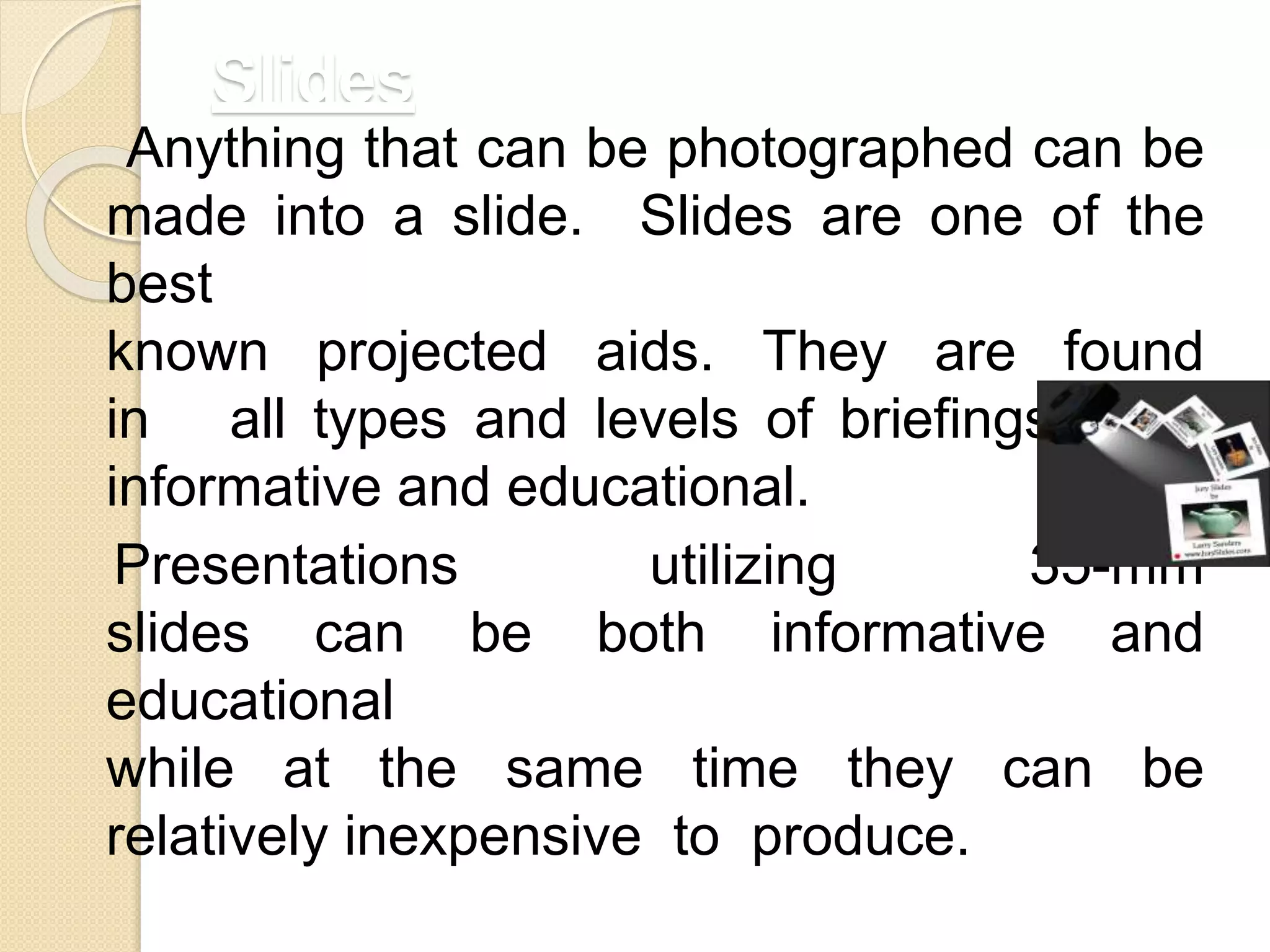
Anything that can be photographed can be
made into a slide. Slides are one of the
best
known projected aids. They are found
in all types and levels of briefings, both
informative and educational.
Presentations utilizing 35-mm
slides can be both informative and
educational
while at the same time they can be
relatively inexpensive to produce.
Types of slides
Photographic slides:
 Black and white
 Colored
Handmade slides:
 Acetate sheet
 Cellophane
 Etched glass
 Plain glass
 Lumarith
 Slides can be made from photographs
and pictures by teachers and pupils
taking photographs and snapshots
when they go on fieldtrips for
historical, geographical, literacy or
scientific excursions.
 The arrangement of slides in proper
sequence, according to the topic
discussed, is an important aspect of
teaching with them.
Advantages:
 Requires only filming, processing and
mounting by self or laboratory.
 Results in colourful, realistic, reproduction
original subject.
 Preparation with any 35mm camera for most
uses.
 Easy to revise and up-date.
 Easily handled, stored and re-arranged for
various uses.
 Can be combined with tape narration or can
control time for discussion.
 May be adapted to group or individual use
Filmstrips
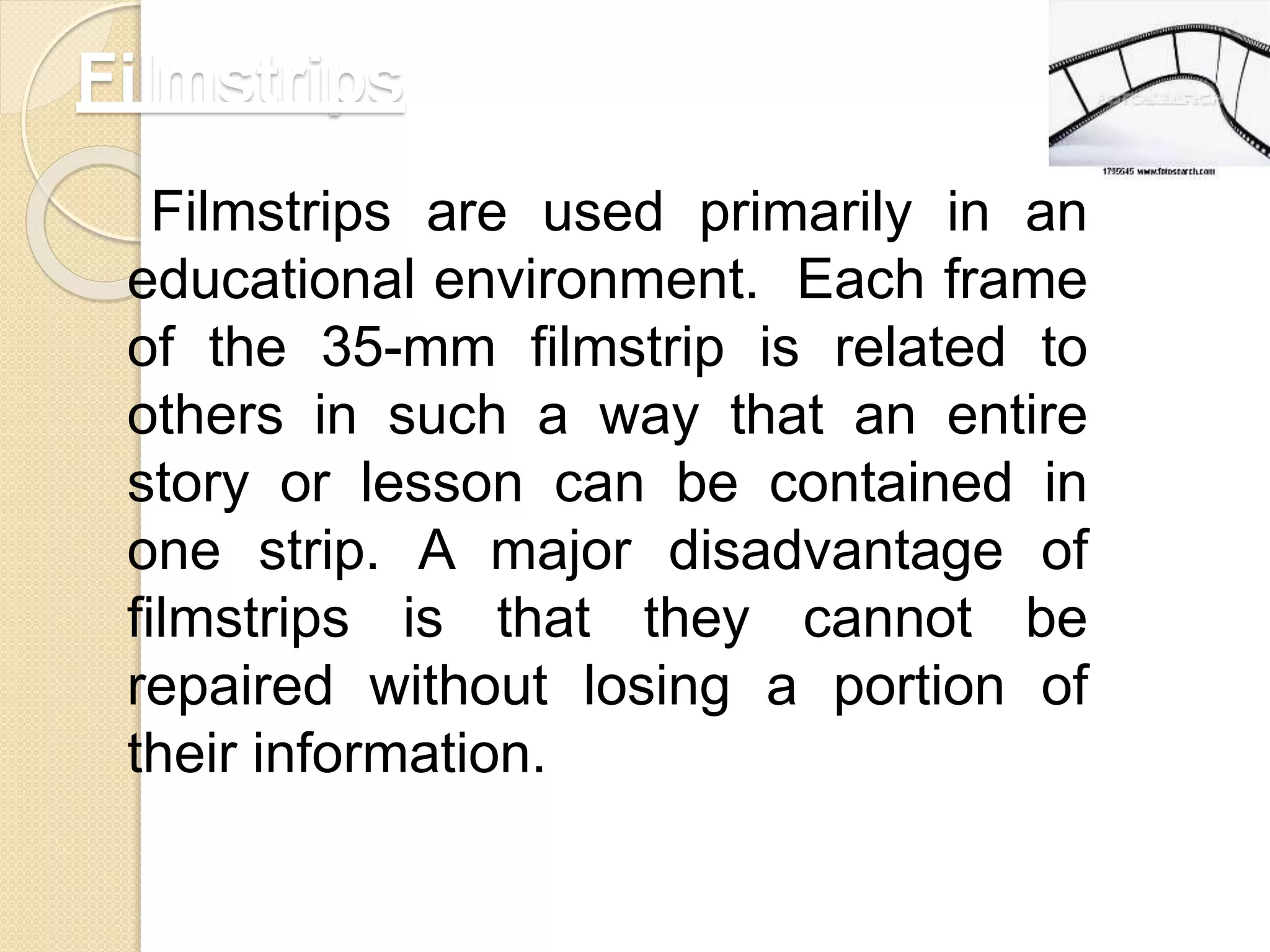
Filmstrips are used primarily in an
educational environment. Each frame
of the 35-mm filmstrip is related to
others in such a way that an entire
story or lesson can be contained in
one strip. A major disadvantage of
filmstrips is that they cannot be
repaired without losing a portion of
their information.
Principles
 Preview filmstrips before using them are
selected carefully to meet the needs of
the topic to be taught.
 Show again any part of the filmstrip
needing more specific study.
 Use filmstrip to stimulate emotions, build
attitudes and to point up problems.
 It should be introduced appropriately and
its relationship to the topic of the study
brought out.
 Use a pointer to direct attention, to
specific details on the screen.
Types of filmstrip:
 Discussion filmstrip: it is continuous
strip of film consisting of individual
frames arranged in sequence usually
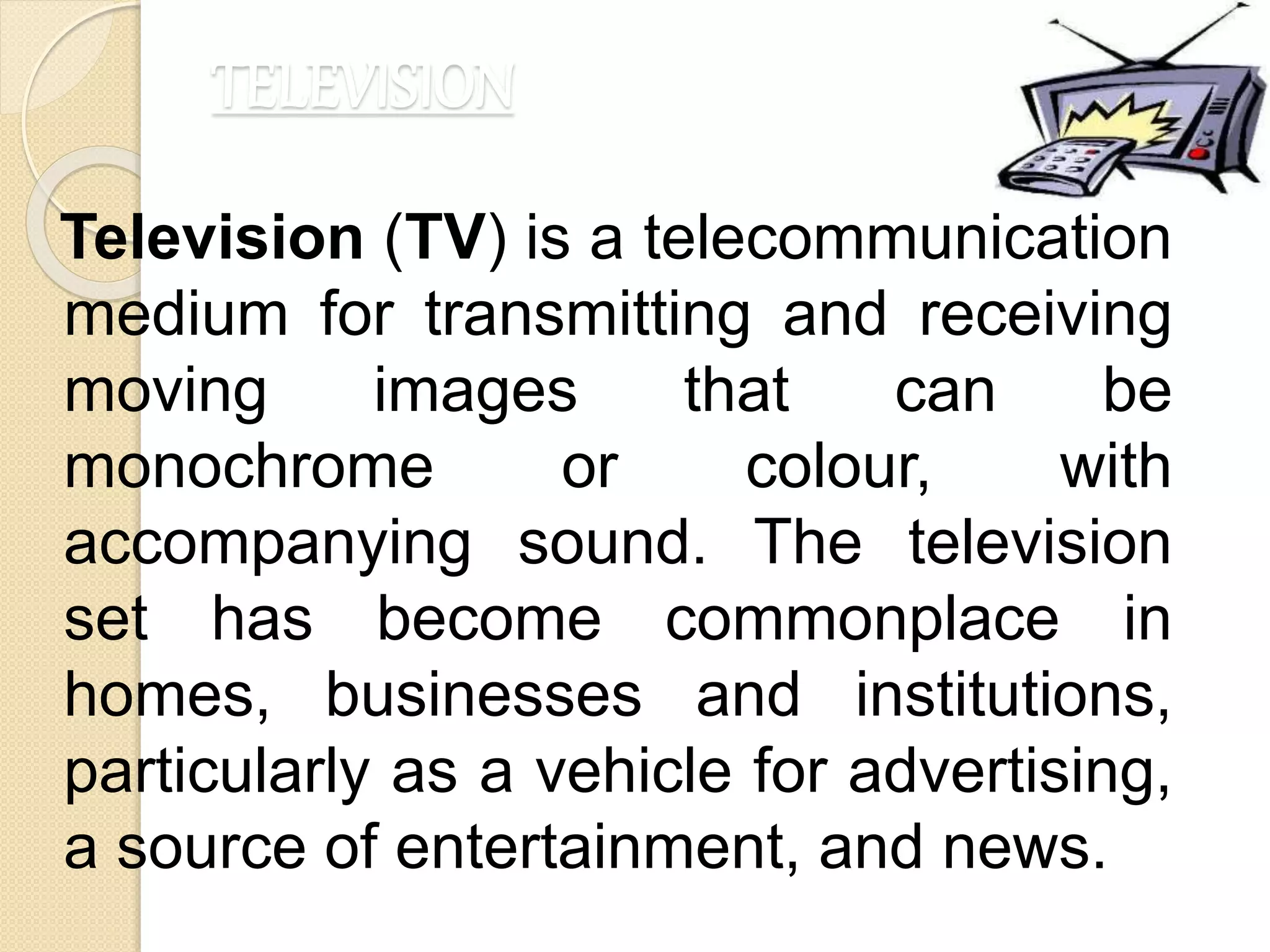
with explanatory titles.
 Sound slide film: it is similar to
filmstrip but instead of explanatory
titles or spoken discussion recorded
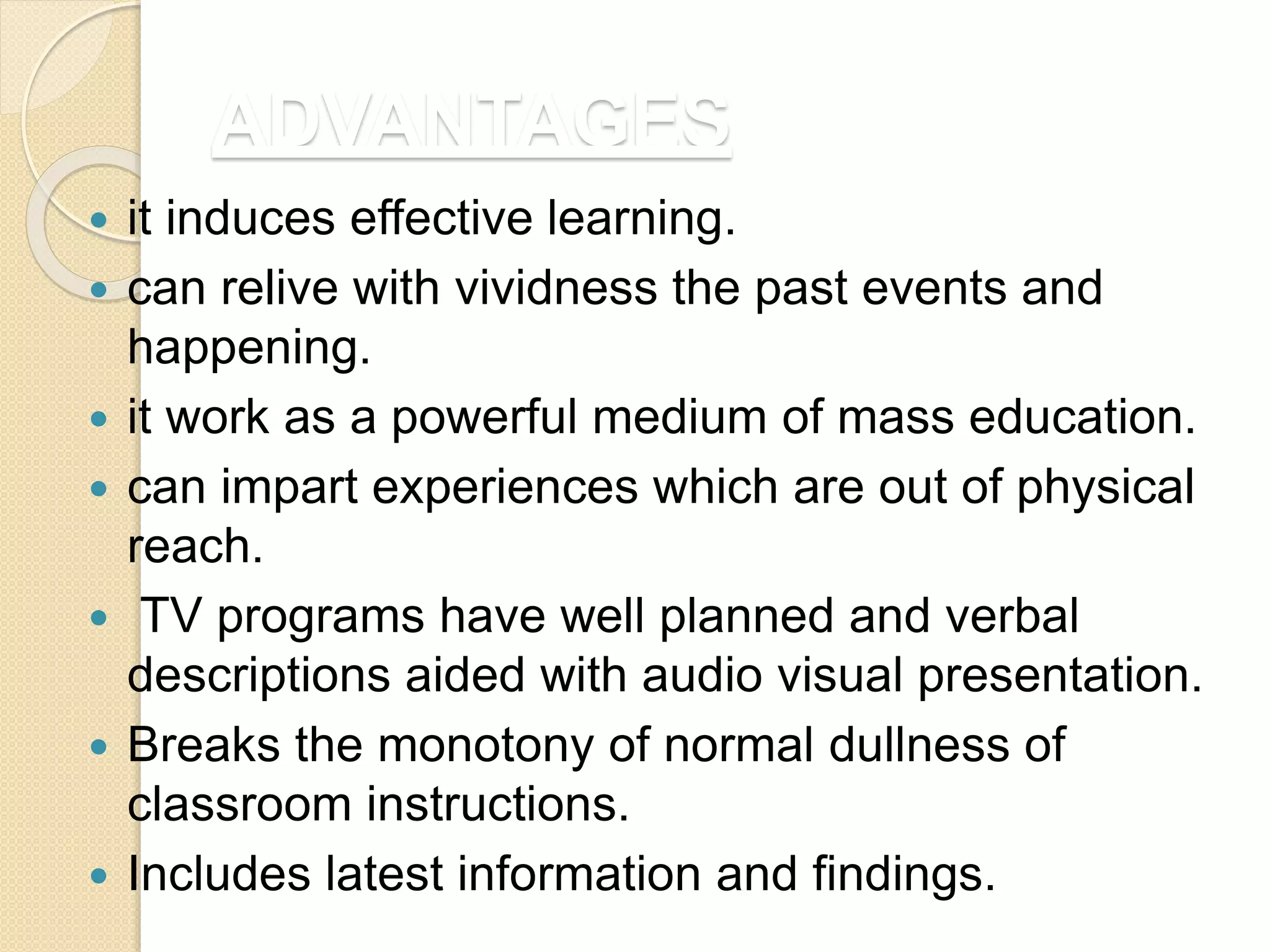
explanation is audible, which is
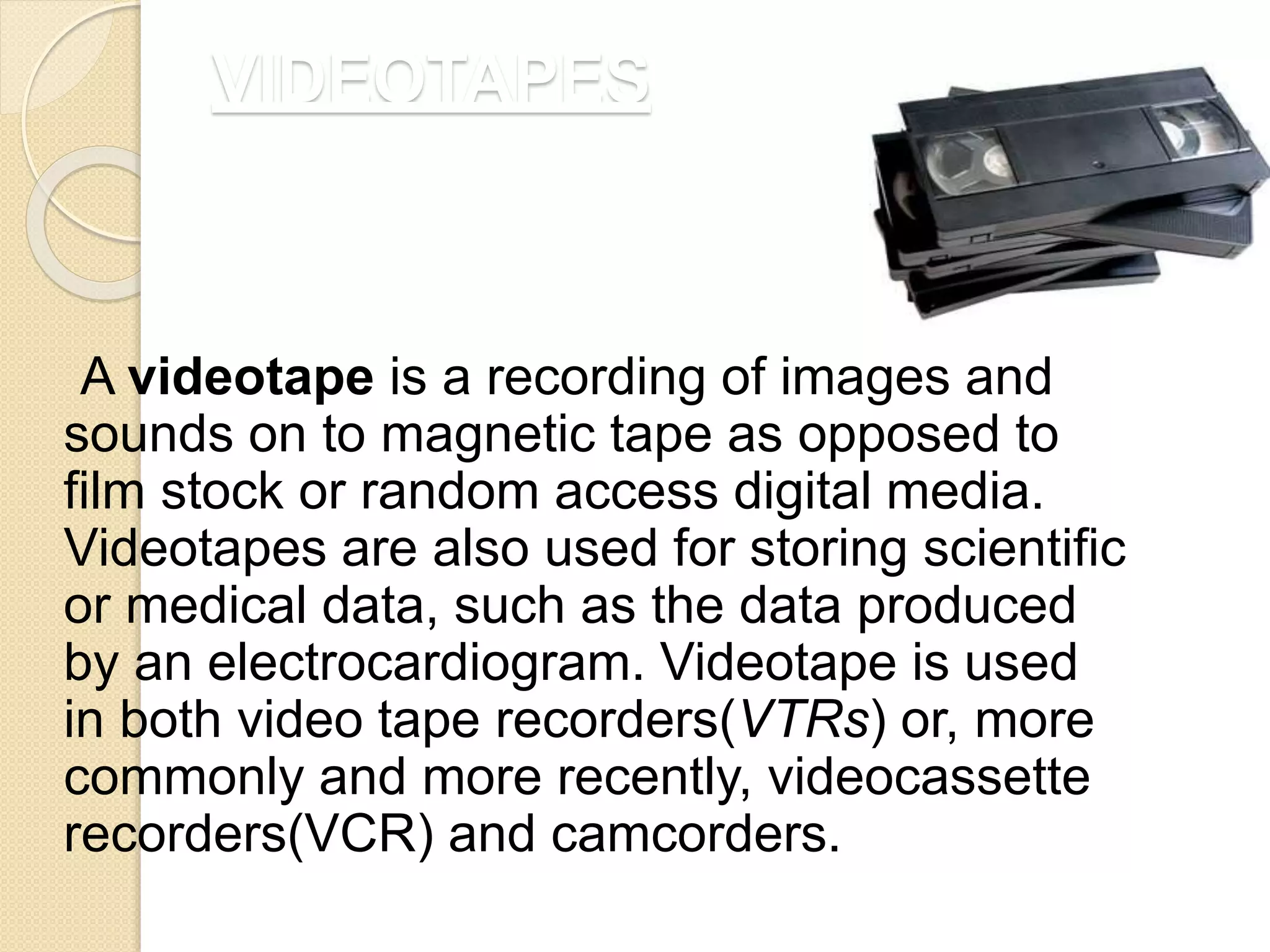
synchronized with the pictures.
Advantages:
 Are compact, easily handled and
always in proper sequence.
 Can be supplemented with
recordings.
 are inexpensive when quantity
reproduction is required.
 are useful for group or individual study
at projection rate is controlled by
instructor or user.
 Are projected with simple light weight
equipment.
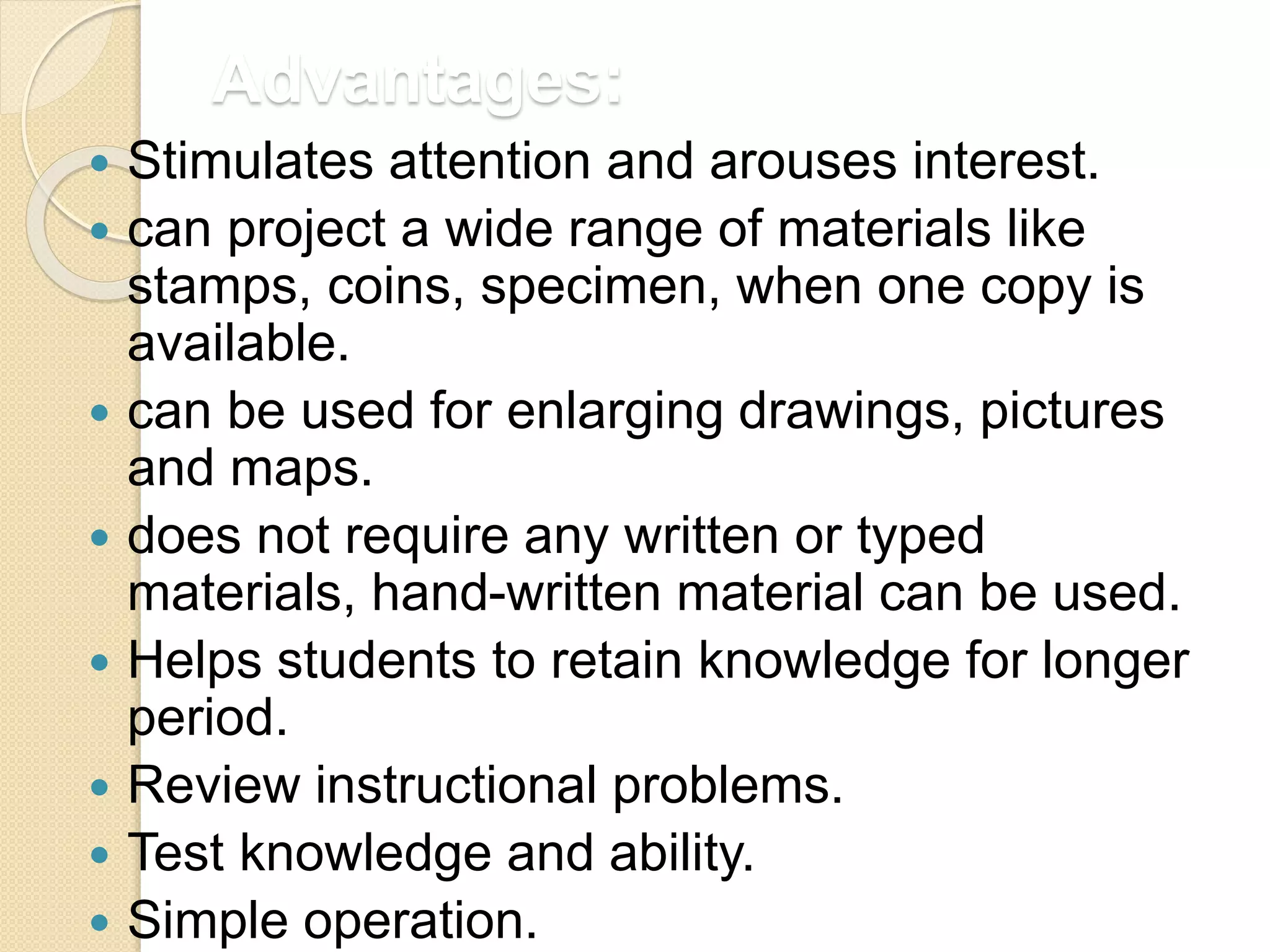
OPAQUE PROJECTOR
The opaque projector, epidioscope,
epidiascope or episcope is a device which
displays opaque materials by shining a bright
lamp onto the object from above. A system of
mirrors, prisms and/or imaging lenses is used
to focus an image of the material onto a
viewing screen. Because they must project
the reflected light, opaque projectors require
brighter bulbs and larger lenses than
overhead projectors. Care must be taken that
the materials are not damaged by the heat
generated by the light source.
Advantages:
 Stimulates attention and arouses interest.
 can project a wide range of materials like
stamps, coins, specimen, when one copy is
available.
 can be used for enlarging drawings, pictures
and maps.
 does not require any written or typed
materials, hand-written material can be used.
 Helps students to retain knowledge for longer
period.
 Review instructional problems.
 Test knowledge and ability.
 Simple operation.
Disadvantages:
Costly equipment.
needs to use it with care.
needs a dark room for
projection
Two main classes of opaque
projectors thus existed:
the episcope, which solely
projected images of opaque
objects
the epidiascope, which was
capable of projecting images of
both opaque and transparent
images
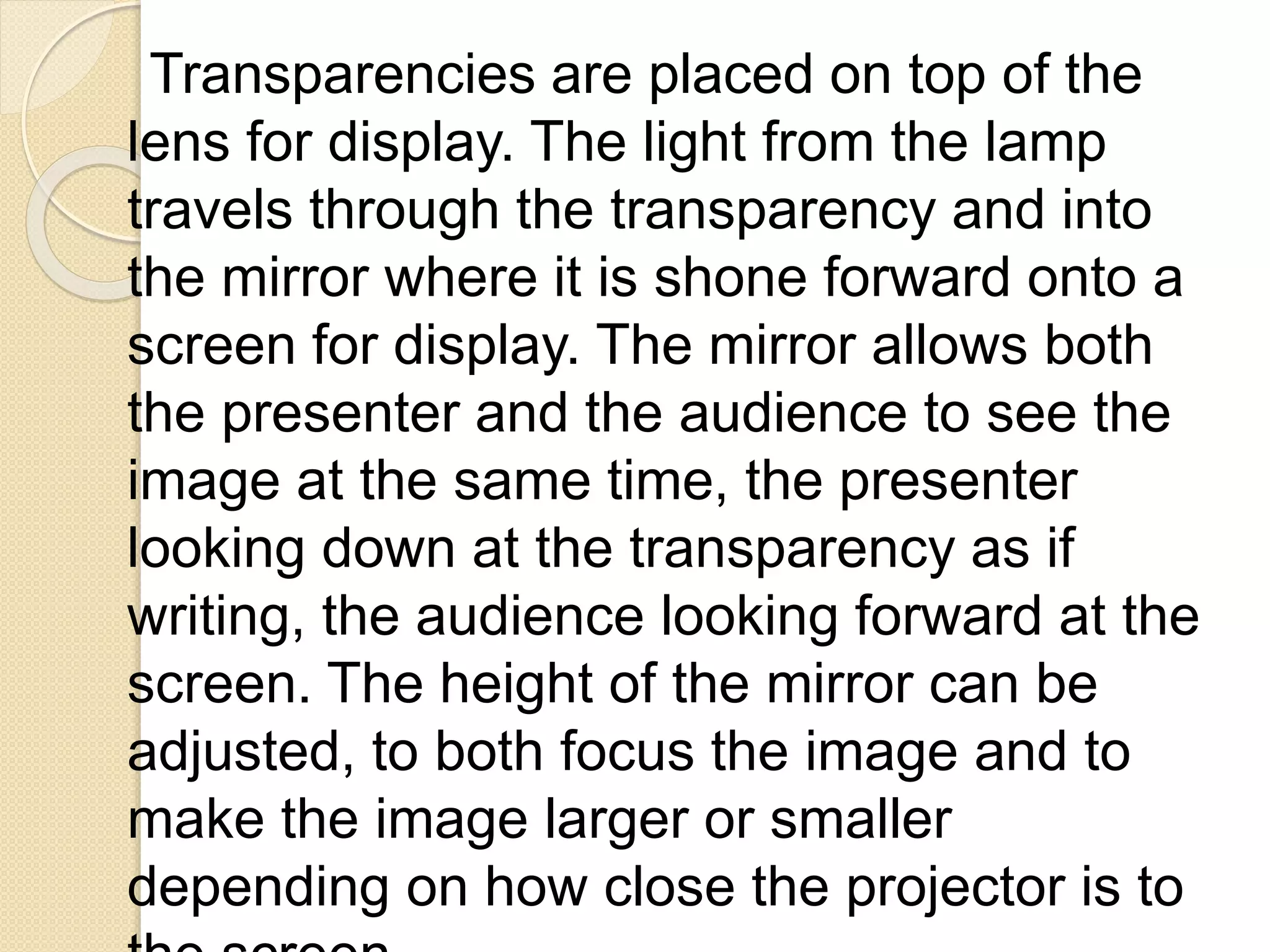
Overhead projector:
 An overhead projector is a variant of slide
projector that is used to display images to
an audience
 An overhead projector typically consists of
a large box containing a very bright lamp
and a fan to cool it. On top of the box is a
large Fresnel lens that collimates the light.
Above the box, typically on a long arm, is a
mirror and lens that focuses and redirects
the light forward instead of up.
Transparencies are placed on top of the
lens for display. The light from the lamp
travels through the transparency and into
the mirror where it is shone forward onto a
screen for display. The mirror allows both
the presenter and the audience to see the
image at the same time, the presenter
looking down at the transparency as if
writing, the audience looking forward at the
screen. The height of the mirror can be
adjusted, to both focus the image and to
make the image larger or smaller
depending on how close the projector is to
Purposes:
 To develop concepts and sequences in a
subject matter area.
 To make marginal notes on the
transparencies for the use of the teacher
that can carry with out exposing them to the
class.
 To test students performances, while other
classmates observe.
 To show relationships by means of
transparent overlays in contrasting color.
 To give the illusion of motion in the
Advantages:
 it permits the teacher to stand in
front of the class while using the
projector, thus enabling her to
point out features appearing on
the screen by pointing to the
materials at the projector itself
and at the same time, to observe
the students reactions to her
discussion.
 Gains attention of the student
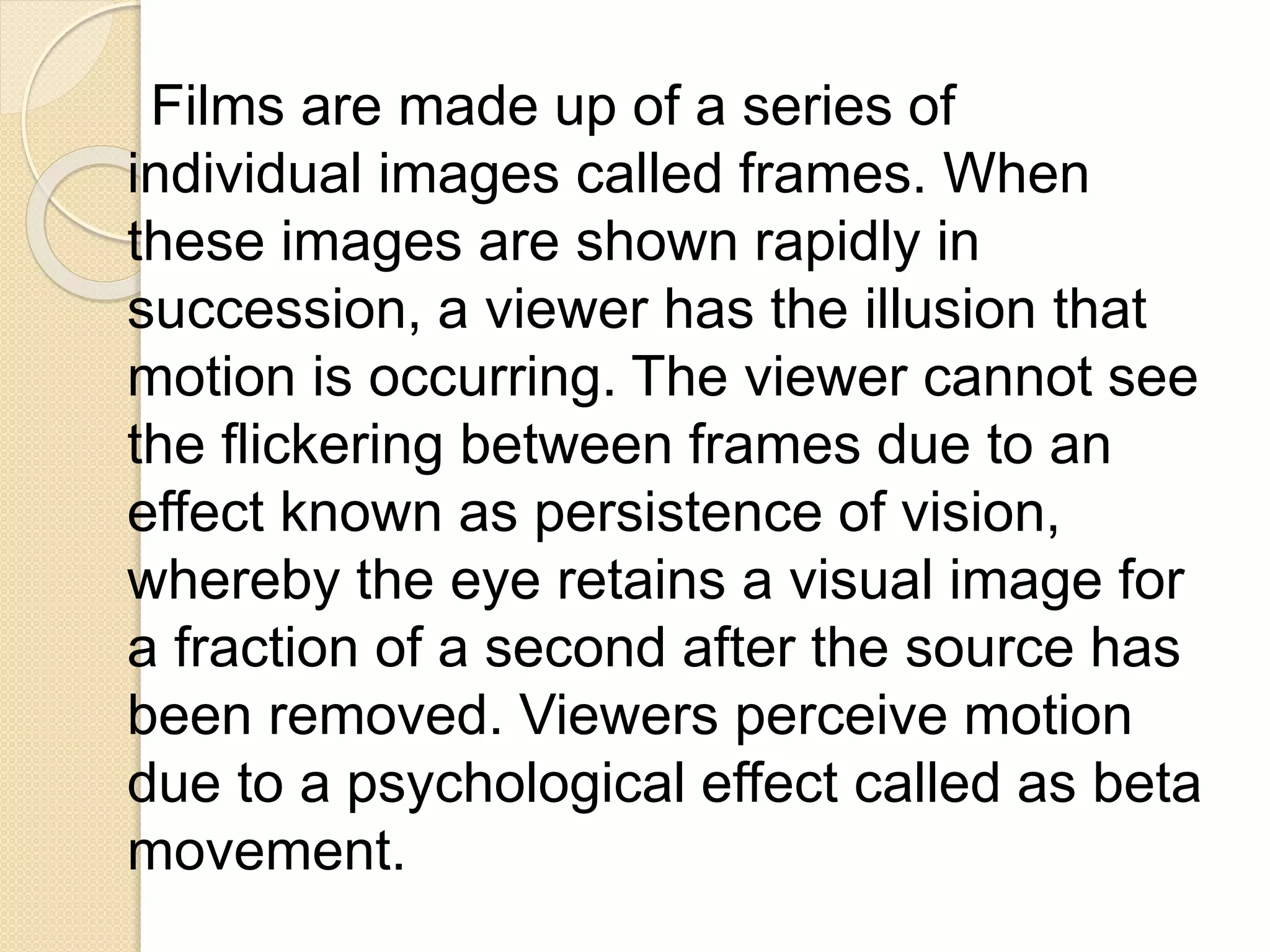
FILMS:
A film, also called a movie or
motion picture, is a series of still or
moving images. It is produced by
recording photographic images with
cameras, or by creating images using
animation techniques or visual
effects. The process of filmmaking
has developed into an art form and
industry.
Films are made up of a series of
individual images called frames. When
these images are shown rapidly in
succession, a viewer has the illusion that
motion is occurring. The viewer cannot see
the flickering between frames due to an
effect known as persistence of vision,
whereby the eye retains a visual image for
a fraction of a second after the source has
been removed. Viewers perceive motion
due to a psychological effect called as beta
movement.
AUDIO VISUAL AIDS
DEMONSTRATIONS
TELEVISION
VIDEOTAPES
FIELD TRIPS
VIDEO WITH SOUND
RECORDING
 Demonstration involves showing by
reason or proof, explaining or making
clear by use of examples or experiments.
But more simply, demonstration means to
clearly show. Teachers not only
demonstrate specific learning concepts
within the classroom, they can also
participate in demonstration classrooms to
help improve their own teaching
strategies, which may or may not be
demonstrative in nature.
DEMONSTRATIONS
DEMONSTRATIONS CONTD…
 Demonstration method is a concrete visual
aid, because of its wide use in the teaching
of nurses. In nursing education, it is used
for this purpose and also for clinics,
conferences, laboratory classes, autopsies
and teaching of health to patients. The
demonstration method teaches by
explanation and exhibition. In short, it is a
performance to show a process or activity
to others. When a teacher demonstrates,
students observe and imitate to learn.
ADVANTAGES OF DEMONSTRATION:-
 It activates several senses. This increases
learning, because it gives a better opportunity
for observational learning.
 It clarifies the underlying principles by
demonstrating the ‘why’ or ‘how’ of the
procedure.
 It provokes interest by use of concrete
illustrations.
 It correlates theory with practice engages
student’s attention and concentration.
 It encourages student’s participation in
learning through questions and answers as the
teacher performs
TELEVISION
Television (TV) is a telecommunication
medium for transmitting and receiving
moving images that can be
monochrome or colour, with
accompanying sound. The television
set has become commonplace in
homes, businesses and institutions,
particularly as a vehicle for advertising,
a source of entertainment, and news.
ADVANTAGES
 it induces effective learning.
 can relive with vividness the past events and
happening.
 it work as a powerful medium of mass education.
 can impart experiences which are out of physical
reach.
 TV programs have well planned and verbal
descriptions aided with audio visual presentation.
 Breaks the monotony of normal dullness of
classroom instructions.
 Includes latest information and findings.
VIDEOTAPES
A videotape is a recording of images and
sounds on to magnetic tape as opposed to
film stock or random access digital media.
Videotapes are also used for storing scientific
or medical data, such as the data produced
by an electrocardiogram. Videotape is used
in both video tape recorders(VTRs) or, more
commonly and more recently, videocassette
recorders(VCR) and camcorders.
Tape is a linear method of storing
information and, since nearly all video
recordings made nowadays are digital
direct to disk recording, it is expected
to gradually lose importance as non-
linear/random-access methods of
storing digital video data become
more common
VIDEOTAPE CONTD…
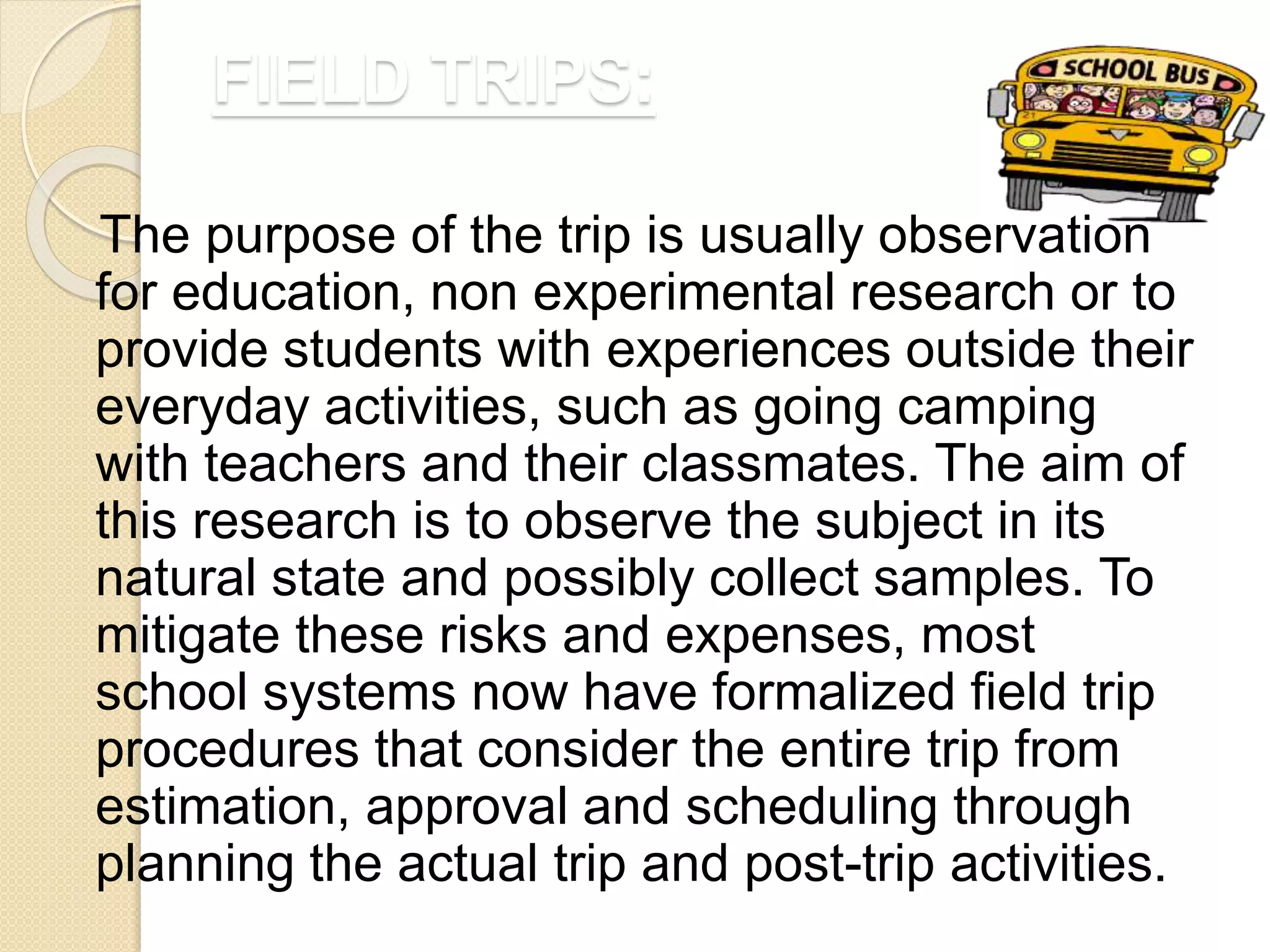
FIELD TRIPS:
The purpose of the trip is usually observation
for education, non experimental research or to
provide students with experiences outside their
everyday activities, such as going camping
with teachers and their classmates. The aim of
this research is to observe the subject in its
natural state and possibly collect samples. To
mitigate these risks and expenses, most
school systems now have formalized field trip
procedures that consider the entire trip from
estimation, approval and scheduling through
planning the actual trip and post-trip activities.
ADVANTAGES OF FIELD
TRIPS
 They are a way to reinforce and expand on
concepts taught in class.
 They offer students another method to learn
concepts and are especially good for the
many tactile/kinaesthetic students in your
classroom.
 They allow for a shared reference that can
be referred to later as you are teaching new
concepts. (E.g. remember when we saw...)
 They allow you and your students a different
format in which to get to know each other
and bond.
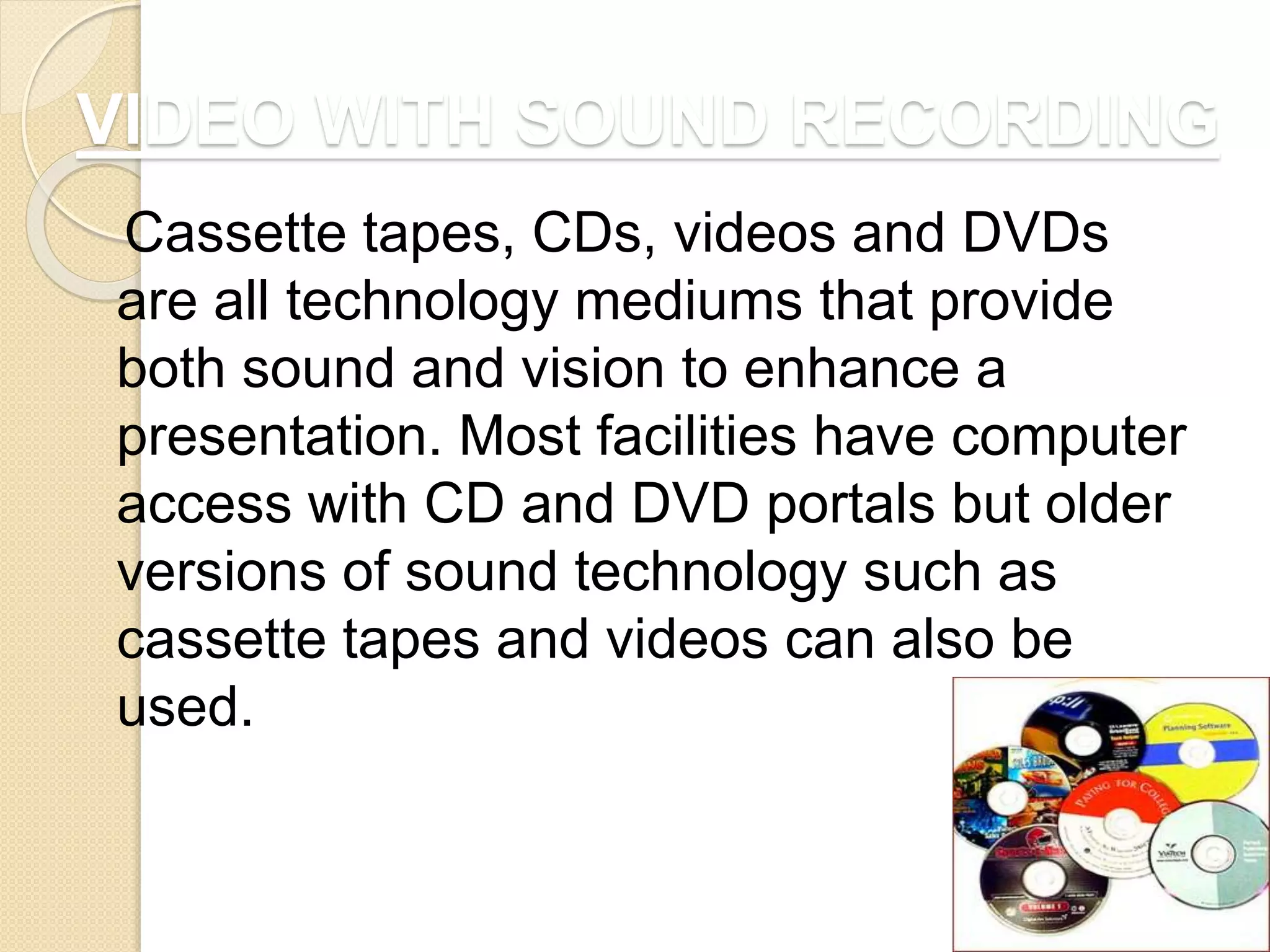
VIDEO WITH SOUND RECORDING
Cassette tapes, CDs, videos and DVDs
are all technology mediums that provide
both sound and vision to enhance a
presentation. Most facilities have computer
access with CD and DVD portals but older
versions of sound technology such as
cassette tapes and videos can also be
used.
ADVANTAGES OF VIDEO WITH
SOUND RECORDING
 It can store a large amount of data of
all kinds.
 Digitized video is much more
versatile and much easier to integrate
into educational multimedia
documents.
ASHISH DADHEECH TOPIC EXPLAIN ABOUT AV AIDS

ASHISH DADHEECH TOPIC EXPLAIN ABOUT AV AIDS

  • 1.
    MODERATOR: Mr. ANKIT GERG LECTURER, UPCHARCOLLEGE OF NURSING PRESENTED BY: Mr. ASHISH DADHEECH M.Sc. NURSING PREVIOUS YEAR UPCHAR COLLEGE OF NURSING
  • 2.
    Introduction:  Audio- visualaids, audio-visual materials, communication technology, educational or instructional media and learning resources, all these terms have same meaning.  The revolution in the field of technology is due to the development of electronics like television, computer etc.
  • 3.
    Definitions:  According toBurton “Audio visual aids are those sensory objects or images which initiate or stimulate and reinforce learning”.  Carter said “Audio visual aids are those aids which help in completing the triangular process of learning, i.e. motivation, classification and stimulation”.  According to Dale “Audio visual aids are those devices by the use of which communication of ideas between persons and group in various teaching and training situation is helped. These are also termed as multi-sensory materials”.
  • 4.
     According toKinder “Audio visual aids are any device which can be used to make the learning experience more concrete, realistic and dynamic.  According to Mckown and Roberts “Audio visual aids are supplementary devices by which the teacher, through utilization of more than one sensory channel is able to clarify, establish and co-relate concepts, interpretations and appreciations”
  • 5.
    General Uses ofA.V. aids:  To provide basis for effective perceptional and conceptional learning.  To increase and sustain concentration and attention and personal involvement of student.  To provide corrections, realism and life linkers in teaching learning situations.
  • 6.
     To explicateand increase the meaningfulness of abstract concepts.  To bring remote events either of space or time in classroom.  To introduce opportunities for situational and field types of learning.  To facilitate and advance the process of applying what is to learned in realishe performance and life situations.
  • 7.
    IMPORTANCE OF TEACHING AIDS Motivation Teaching aids motivate the students so that they can learn better.  Clarification Through teaching aids, the teacher clarify the subject matter more easily.  Discouragement of Cramming Teaching aids can facilitate the proper understanding to the students which discourage the act of cramming.  Increase the Vocabulary Teaching aids helps to increase the vocabulary of the students more effectively.
  • 8.
    IMPORTANCE CONTD..  SavesTime and Money  Classroom Live and active Teaching aids make the classroom live and active.  Avoids Dullness  Direct Experience Teaching aids provide direct experience to the students
  • 9.
    ADVANTAGES OF A.V.AIDS:  Antidote to disease of verbal instruction.  Best motivators.  Clear images.  Vicarious experience.  Variety.  Freedom.  Opportunities to handle and manipulate.  Retentivity.
  • 10.
     Based onmaxims of teaching.  Helpful in attracting attention.  Helpful in fixing up new learning.  Saving of energy and time.  Realism  Vividness.  Meeting individual differences.  Encouragement to healthy classroom interaction.
  • 11.
     Spread ofeducation.  Promotion of scientific temper.  Development of higher faculties.  Reinforcement of learners.  Positive transfer of learning and training.  Positive environment.
  • 12.
    CHARACTERISTICS OF GOOD TEACHINGAIDS:  Meaningful and purposeful.  Accurate.  Simple and cheap  They should be improvised.  Should be large enough to be properly seen by students.
  • 13.
    CLASSIFICATION: CLASSIFICATION NO.1:  Projectedaids.  Non-projected aids. CLASSFICATION NO.2:  Audio materials  Visual materials  Audio-visual materials
  • 14.
    PROJECTED aids: Projected aidsare those that require audiovisual equipment in order to be presented properly. Some of the aids included in this category are slides, filmstrips, overhead transparencies (vu- graphs), and motion pictures.
  • 15.
    Slides Anything that canbe photographed can be made into a slide. Slides are one of the best known projected aids. They are found in all types and levels of briefings, both informative and educational. Presentations utilizing 35-mm slides can be both informative and educational while at the same time they can be relatively inexpensive to produce.
  • 16.
    Types of slides Photographicslides:  Black and white  Colored Handmade slides:  Acetate sheet  Cellophane  Etched glass  Plain glass  Lumarith
  • 17.
     Slides canbe made from photographs and pictures by teachers and pupils taking photographs and snapshots when they go on fieldtrips for historical, geographical, literacy or scientific excursions.  The arrangement of slides in proper sequence, according to the topic discussed, is an important aspect of teaching with them.
  • 18.
    Advantages:  Requires onlyfilming, processing and mounting by self or laboratory.  Results in colourful, realistic, reproduction original subject.  Preparation with any 35mm camera for most uses.  Easy to revise and up-date.  Easily handled, stored and re-arranged for various uses.  Can be combined with tape narration or can control time for discussion.  May be adapted to group or individual use
  • 19.
    Filmstrips Filmstrips are usedprimarily in an educational environment. Each frame of the 35-mm filmstrip is related to others in such a way that an entire story or lesson can be contained in one strip. A major disadvantage of filmstrips is that they cannot be repaired without losing a portion of their information.
  • 20.
    Principles  Preview filmstripsbefore using them are selected carefully to meet the needs of the topic to be taught.  Show again any part of the filmstrip needing more specific study.  Use filmstrip to stimulate emotions, build attitudes and to point up problems.  It should be introduced appropriately and its relationship to the topic of the study brought out.  Use a pointer to direct attention, to specific details on the screen.
  • 21.
    Types of filmstrip: Discussion filmstrip: it is continuous strip of film consisting of individual frames arranged in sequence usually with explanatory titles.  Sound slide film: it is similar to filmstrip but instead of explanatory titles or spoken discussion recorded explanation is audible, which is synchronized with the pictures.
  • 22.
    Advantages:  Are compact,easily handled and always in proper sequence.  Can be supplemented with recordings.  are inexpensive when quantity reproduction is required.  are useful for group or individual study at projection rate is controlled by instructor or user.  Are projected with simple light weight equipment.
  • 23.
    OPAQUE PROJECTOR The opaqueprojector, epidioscope, epidiascope or episcope is a device which displays opaque materials by shining a bright lamp onto the object from above. A system of mirrors, prisms and/or imaging lenses is used to focus an image of the material onto a viewing screen. Because they must project the reflected light, opaque projectors require brighter bulbs and larger lenses than overhead projectors. Care must be taken that the materials are not damaged by the heat generated by the light source.
  • 24.
    Advantages:  Stimulates attentionand arouses interest.  can project a wide range of materials like stamps, coins, specimen, when one copy is available.  can be used for enlarging drawings, pictures and maps.  does not require any written or typed materials, hand-written material can be used.  Helps students to retain knowledge for longer period.  Review instructional problems.  Test knowledge and ability.  Simple operation.
  • 25.
    Disadvantages: Costly equipment. needs touse it with care. needs a dark room for projection
  • 26.
    Two main classesof opaque projectors thus existed: the episcope, which solely projected images of opaque objects the epidiascope, which was capable of projecting images of both opaque and transparent images
  • 27.
    Overhead projector:  Anoverhead projector is a variant of slide projector that is used to display images to an audience  An overhead projector typically consists of a large box containing a very bright lamp and a fan to cool it. On top of the box is a large Fresnel lens that collimates the light. Above the box, typically on a long arm, is a mirror and lens that focuses and redirects the light forward instead of up.
  • 28.
    Transparencies are placedon top of the lens for display. The light from the lamp travels through the transparency and into the mirror where it is shone forward onto a screen for display. The mirror allows both the presenter and the audience to see the image at the same time, the presenter looking down at the transparency as if writing, the audience looking forward at the screen. The height of the mirror can be adjusted, to both focus the image and to make the image larger or smaller depending on how close the projector is to
  • 29.
    Purposes:  To developconcepts and sequences in a subject matter area.  To make marginal notes on the transparencies for the use of the teacher that can carry with out exposing them to the class.  To test students performances, while other classmates observe.  To show relationships by means of transparent overlays in contrasting color.  To give the illusion of motion in the
  • 30.
    Advantages:  it permitsthe teacher to stand in front of the class while using the projector, thus enabling her to point out features appearing on the screen by pointing to the materials at the projector itself and at the same time, to observe the students reactions to her discussion.  Gains attention of the student
  • 31.
    FILMS: A film, alsocalled a movie or motion picture, is a series of still or moving images. It is produced by recording photographic images with cameras, or by creating images using animation techniques or visual effects. The process of filmmaking has developed into an art form and industry.
  • 32.
    Films are madeup of a series of individual images called frames. When these images are shown rapidly in succession, a viewer has the illusion that motion is occurring. The viewer cannot see the flickering between frames due to an effect known as persistence of vision, whereby the eye retains a visual image for a fraction of a second after the source has been removed. Viewers perceive motion due to a psychological effect called as beta movement.
  • 33.
  • 34.
     Demonstration involvesshowing by reason or proof, explaining or making clear by use of examples or experiments. But more simply, demonstration means to clearly show. Teachers not only demonstrate specific learning concepts within the classroom, they can also participate in demonstration classrooms to help improve their own teaching strategies, which may or may not be demonstrative in nature. DEMONSTRATIONS
  • 35.
    DEMONSTRATIONS CONTD…  Demonstrationmethod is a concrete visual aid, because of its wide use in the teaching of nurses. In nursing education, it is used for this purpose and also for clinics, conferences, laboratory classes, autopsies and teaching of health to patients. The demonstration method teaches by explanation and exhibition. In short, it is a performance to show a process or activity to others. When a teacher demonstrates, students observe and imitate to learn.
  • 36.
    ADVANTAGES OF DEMONSTRATION:- It activates several senses. This increases learning, because it gives a better opportunity for observational learning.  It clarifies the underlying principles by demonstrating the ‘why’ or ‘how’ of the procedure.  It provokes interest by use of concrete illustrations.  It correlates theory with practice engages student’s attention and concentration.  It encourages student’s participation in learning through questions and answers as the teacher performs
  • 37.
    TELEVISION Television (TV) isa telecommunication medium for transmitting and receiving moving images that can be monochrome or colour, with accompanying sound. The television set has become commonplace in homes, businesses and institutions, particularly as a vehicle for advertising, a source of entertainment, and news.
  • 38.
    ADVANTAGES  it induceseffective learning.  can relive with vividness the past events and happening.  it work as a powerful medium of mass education.  can impart experiences which are out of physical reach.  TV programs have well planned and verbal descriptions aided with audio visual presentation.  Breaks the monotony of normal dullness of classroom instructions.  Includes latest information and findings.
  • 39.
    VIDEOTAPES A videotape isa recording of images and sounds on to magnetic tape as opposed to film stock or random access digital media. Videotapes are also used for storing scientific or medical data, such as the data produced by an electrocardiogram. Videotape is used in both video tape recorders(VTRs) or, more commonly and more recently, videocassette recorders(VCR) and camcorders.
  • 40.
    Tape is alinear method of storing information and, since nearly all video recordings made nowadays are digital direct to disk recording, it is expected to gradually lose importance as non- linear/random-access methods of storing digital video data become more common VIDEOTAPE CONTD…
  • 41.
    FIELD TRIPS: The purposeof the trip is usually observation for education, non experimental research or to provide students with experiences outside their everyday activities, such as going camping with teachers and their classmates. The aim of this research is to observe the subject in its natural state and possibly collect samples. To mitigate these risks and expenses, most school systems now have formalized field trip procedures that consider the entire trip from estimation, approval and scheduling through planning the actual trip and post-trip activities.
  • 42.
    ADVANTAGES OF FIELD TRIPS They are a way to reinforce and expand on concepts taught in class.  They offer students another method to learn concepts and are especially good for the many tactile/kinaesthetic students in your classroom.  They allow for a shared reference that can be referred to later as you are teaching new concepts. (E.g. remember when we saw...)  They allow you and your students a different format in which to get to know each other and bond.
  • 43.
    VIDEO WITH SOUNDRECORDING Cassette tapes, CDs, videos and DVDs are all technology mediums that provide both sound and vision to enhance a presentation. Most facilities have computer access with CD and DVD portals but older versions of sound technology such as cassette tapes and videos can also be used.
  • 44.
    ADVANTAGES OF VIDEOWITH SOUND RECORDING  It can store a large amount of data of all kinds.  Digitized video is much more versatile and much easier to integrate into educational multimedia documents.