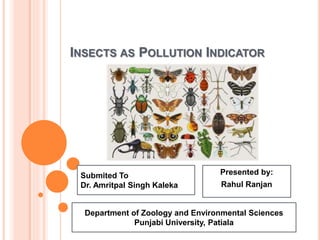
INSECTS AS POLLUTION INDICATOR
Submited To
Dr. Amritpal Singh Kaleka
Presented by:
Rahul Ranjan
Department of Zoology and Environmental Sciences
Punjabi University, Patiala
WHAT IS POLLUTION ?
 Pollution is addition of harmful substances (solid, liquid,
gaseous and even light) to the environment which has
negative effects.
 These effects are like degradation of natural resources
and nature.
 Effects of pollution are slow and gradual but last long.
The major types of Pollution are as follows:
I. Water Pollution
II. Terrestial Pollution
III. Air Pollution
IV. Noise Pollution and
V. Light Pollution
WHAT IS BIOINDICATOR ?
 Species of an ecosystem which can be used to
study or assess ecological performance and
sensitive against changes in their environment,
called as bioindicator.
 They indicate or show how changes are taking place
and are used to monitor the overall health of an
ecosystem.
 Bio-indicators can tell us about the cumulative
effects of different pollutants in the ecosystem.
INSECTS AS BIOLOGICAL INDICATOR
 Insect is an organism with three pair of legs,
body is divisible into three parts (head, thorax
and abdomen) and presence of compound
eyes.
 Insects are used as bio indicators because
they are the most abundant animals in almost
all ecosystems and can be used to evaluate
the impact of environmental changes.
oIt respond quickly to environmental changes
and show high sensitivity for detecting early
changes in their geographical area.
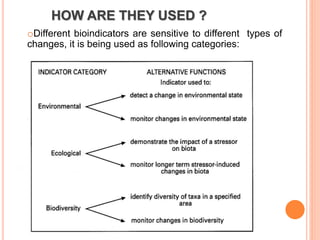
HOW ARE THEY USED ?
oDifferent bioindicators are sensitive to different types of
changes, it is being used as following categories:
BIO-INDICATOR GROUPS OF INSECTS
1. Dragonflies and
damselflies
2. Mayflies
3. Caddisflies
4. Bugs
5. Stoneflies
6. Honey bees
7. Beetles
8. Collembolans
9. Butterflies and
Moths
10. Ants
11. Syrphid fly
INSECTS AS WATER POLLUTION INDICATOR
o Insects which live completely or carry a major part
of their life cycle in water can tell directly about
water pollution.
o Larvae of mosquitoes, odonates and neuropterans
can only live in fresh water. Absence of these larvae
indicate towards presence of Arsenic and Lead
concentrations in water.
o Several aquatic insects groups can be used as
aquatic environment bioindicators, which is as
followes:
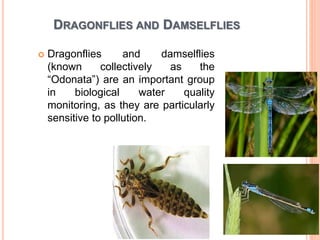
DRAGONFLIES AND DAMSELFLIES
 Dragonflies and damselflies
(known collectively as the
“Odonata”) are an important group
in biological water quality
monitoring, as they are particularly
sensitive to pollution.
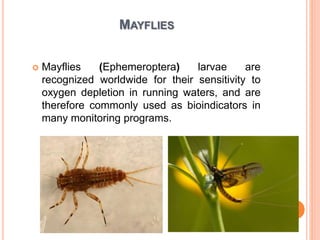
MAYFLIES
 Mayflies (Ephemeroptera) larvae are
recognized worldwide for their sensitivity to
oxygen depletion in running waters, and are
therefore commonly used as bioindicators in
many monitoring programs.
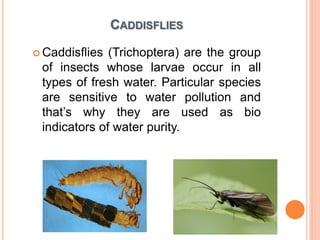
CADDISFLIES
 Caddisflies (Trichoptera) are the group
of insects whose larvae occur in all
types of fresh water. Particular species
are sensitive to water pollution and
that’s why they are used as bio
indicators of water purity.
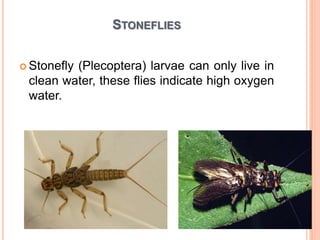
STONEFLIES
 Stonefly (Plecoptera) larvae can only live in
clean water, these flies indicate high oxygen
water.
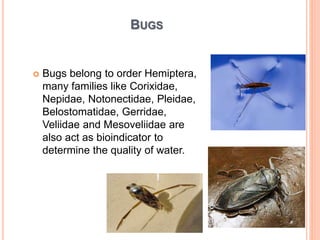
BUGS
 Bugs belong to order Hemiptera,
many families like Corixidae,
Nepidae, Notonectidae, Pleidae,
Belostomatidae, Gerridae,
Veliidae and Mesoveliidae are
also act as bioindicator to
determine the quality of water.
oLand insects are good bioindicators in various types of
environmental change.
oOccurrence of excess acidic or alkaline content, fertilizers or
industrial waste kills larvae, nymphs and adults of these
insects.
oPolluted land areas are not fit for insects to lay eggs.
oSeveral insects groups can be used as terrestrial
environment bioindicator, which is as follows:
INSECTS AS TERRESTRIAL POLLUTION
INDICATOR
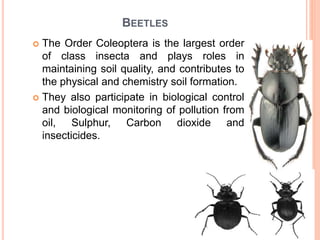
BEETLES
 The Order Coleoptera is the largest order
of class insecta and plays roles in
maintaining soil quality, and contributes to
the physical and chemistry soil formation.
 They also participate in biological control
and biological monitoring of pollution from
oil, Sulphur, Carbon dioxide and
insecticides.
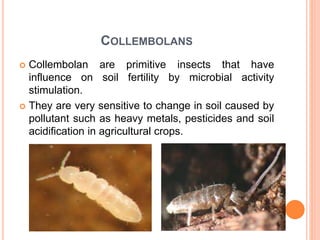
COLLEMBOLANS
 Collembolan are primitive insects that have
influence on soil fertility by microbial activity
stimulation.
 They are very sensitive to change in soil caused by
pollutant such as heavy metals, pesticides and soil
acidification in agricultural crops.
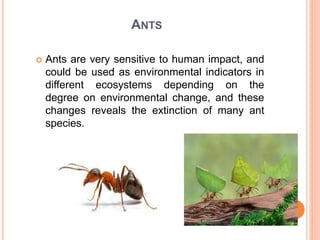
ANTS
 Ants are very sensitive to human impact, and
could be used as environmental indicators in
different ecosystems depending on the
degree on environmental change, and these
changes reveals the extinction of many ant
species.
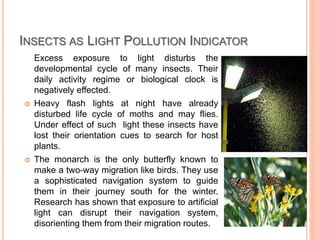
INSECTS AS LIGHT POLLUTION INDICATOR
Excess exposure to light disturbs the
developmental cycle of many insects. Their
daily activity regime or biological clock is
negatively effected.
 Heavy flash lights at night have already
disturbed life cycle of moths and may flies.
Under effect of such light these insects have
lost their orientation cues to search for host
plants.
 The monarch is the only butterfly known to
make a two-way migration like birds. They use
a sophisticated navigation system to guide
them in their journey south for the winter.
Research has shown that exposure to artificial
light can disrupt their navigation system,
disorienting them from their migration routes.
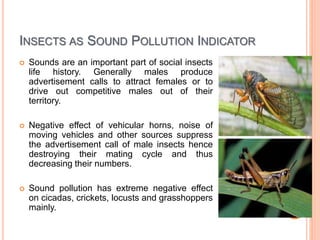
INSECTS AS SOUND POLLUTION INDICATOR
 Sounds are an important part of social insects
life history. Generally males produce
advertisement calls to attract females or to
drive out competitive males out of their
territory.
 Negative effect of vehicular horns, noise of
moving vehicles and other sources suppress
the advertisement call of male insects hence
destroying their mating cycle and thus
decreasing their numbers.
 Sound pollution has extreme negative effect
on cicadas, crickets, locusts and grasshoppers
mainly.
INSECTS AS INDUSTRIAL POLLUTION INDICATOR
 Industrial pollution pollutes the entire ecosystem as whole.
 Unprocessed industrial output, when enters ecosystem leads to a
phenomenon called biomagnification.
 Biomagnification – When a carcinogenic or toxic substance is
consumed by primary trophic unit and consequently reached every
trophic level in a food chain with increased potency. Thus,
hampering the complete system.
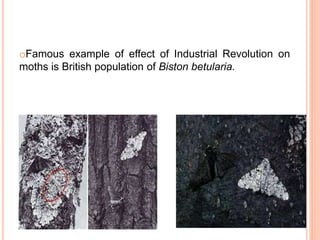
oFamous example of effect of Industrial Revolution on
moths is British population of Biston betularia.
INSECTS AS AIR POLLUTION INDICATOR
 Air pollution blocks trachea/spiracle
openings of insects.
 Orientation cues of insects to search host
plant, mate or ovipositional sites are
damaged.
 Several insects groups can be used as air
pollution indicators, which is as follows:
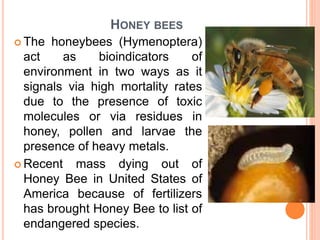
HONEY BEES
 The honeybees (Hymenoptera)
act as bioindicators of
environment in two ways as it
signals via high mortality rates
due to the presence of toxic
molecules or via residues in
honey, pollen and larvae the
presence of heavy metals.
 Recent mass dying out of
Honey Bee in United States of
America because of fertilizers
has brought Honey Bee to list of
endangered species.
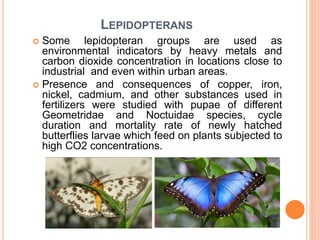
LEPIDOPTERANS
 Some lepidopteran groups are used as
environmental indicators by heavy metals and
carbon dioxide concentration in locations close to
industrial and even within urban areas.
 Presence and consequences of copper, iron,
nickel, cadmium, and other substances used in
fertilizers were studied with pupae of different
Geometridae and Noctuidae species, cycle
duration and mortality rate of newly hatched
butterflies larvae which feed on plants subjected to
high CO2 concentrations.
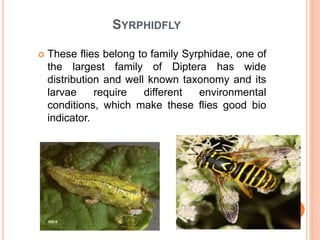
SYRPHIDFLY
 These flies belong to family Syrphidae, one of
the largest family of Diptera has wide
distribution and well known taxonomy and its
larvae require different environmental
conditions, which make these flies good bio
indicator.
CONCLUSION
 The use of bioindicators is essential for
environmental monitoring.
 The main characteristics of a bioindicator are:
richness and diversity species, ecological
faithfulness, fragility to small environmental
changes and good organism responses.
 Class Insecta has all of them. Therefore, this study
concluded that the Class Insecta has many
potential representatives that can be used as
environmental bioindicators.
Insect as pollution indicator

Insect as pollution indicator

  • 1.
    INSECTS AS POLLUTIONINDICATOR Submited To Dr. Amritpal Singh Kaleka Presented by: Rahul Ranjan Department of Zoology and Environmental Sciences Punjabi University, Patiala
  • 2.
    WHAT IS POLLUTION?  Pollution is addition of harmful substances (solid, liquid, gaseous and even light) to the environment which has negative effects.  These effects are like degradation of natural resources and nature.  Effects of pollution are slow and gradual but last long. The major types of Pollution are as follows: I. Water Pollution II. Terrestial Pollution III. Air Pollution IV. Noise Pollution and V. Light Pollution
  • 3.
    WHAT IS BIOINDICATOR?  Species of an ecosystem which can be used to study or assess ecological performance and sensitive against changes in their environment, called as bioindicator.  They indicate or show how changes are taking place and are used to monitor the overall health of an ecosystem.  Bio-indicators can tell us about the cumulative effects of different pollutants in the ecosystem.
  • 4.
    INSECTS AS BIOLOGICALINDICATOR  Insect is an organism with three pair of legs, body is divisible into three parts (head, thorax and abdomen) and presence of compound eyes.  Insects are used as bio indicators because they are the most abundant animals in almost all ecosystems and can be used to evaluate the impact of environmental changes. oIt respond quickly to environmental changes and show high sensitivity for detecting early changes in their geographical area.
  • 5.
    HOW ARE THEYUSED ? oDifferent bioindicators are sensitive to different types of changes, it is being used as following categories:
  • 6.
    BIO-INDICATOR GROUPS OFINSECTS 1. Dragonflies and damselflies 2. Mayflies 3. Caddisflies 4. Bugs 5. Stoneflies 6. Honey bees 7. Beetles 8. Collembolans 9. Butterflies and Moths 10. Ants 11. Syrphid fly
  • 7.
    INSECTS AS WATERPOLLUTION INDICATOR o Insects which live completely or carry a major part of their life cycle in water can tell directly about water pollution. o Larvae of mosquitoes, odonates and neuropterans can only live in fresh water. Absence of these larvae indicate towards presence of Arsenic and Lead concentrations in water. o Several aquatic insects groups can be used as aquatic environment bioindicators, which is as followes:
  • 8.
    DRAGONFLIES AND DAMSELFLIES Dragonflies and damselflies (known collectively as the “Odonata”) are an important group in biological water quality monitoring, as they are particularly sensitive to pollution.
  • 9.
    MAYFLIES  Mayflies (Ephemeroptera)larvae are recognized worldwide for their sensitivity to oxygen depletion in running waters, and are therefore commonly used as bioindicators in many monitoring programs.
  • 10.
    CADDISFLIES  Caddisflies (Trichoptera)are the group of insects whose larvae occur in all types of fresh water. Particular species are sensitive to water pollution and that’s why they are used as bio indicators of water purity.
  • 11.
    STONEFLIES  Stonefly (Plecoptera)larvae can only live in clean water, these flies indicate high oxygen water.
  • 12.
    BUGS  Bugs belongto order Hemiptera, many families like Corixidae, Nepidae, Notonectidae, Pleidae, Belostomatidae, Gerridae, Veliidae and Mesoveliidae are also act as bioindicator to determine the quality of water.
  • 13.
    oLand insects aregood bioindicators in various types of environmental change. oOccurrence of excess acidic or alkaline content, fertilizers or industrial waste kills larvae, nymphs and adults of these insects. oPolluted land areas are not fit for insects to lay eggs. oSeveral insects groups can be used as terrestrial environment bioindicator, which is as follows: INSECTS AS TERRESTRIAL POLLUTION INDICATOR
  • 14.
    BEETLES  The OrderColeoptera is the largest order of class insecta and plays roles in maintaining soil quality, and contributes to the physical and chemistry soil formation.  They also participate in biological control and biological monitoring of pollution from oil, Sulphur, Carbon dioxide and insecticides.
  • 15.
    COLLEMBOLANS  Collembolan areprimitive insects that have influence on soil fertility by microbial activity stimulation.  They are very sensitive to change in soil caused by pollutant such as heavy metals, pesticides and soil acidification in agricultural crops.
  • 16.
    ANTS  Ants arevery sensitive to human impact, and could be used as environmental indicators in different ecosystems depending on the degree on environmental change, and these changes reveals the extinction of many ant species.
  • 17.
    INSECTS AS LIGHTPOLLUTION INDICATOR Excess exposure to light disturbs the developmental cycle of many insects. Their daily activity regime or biological clock is negatively effected.  Heavy flash lights at night have already disturbed life cycle of moths and may flies. Under effect of such light these insects have lost their orientation cues to search for host plants.  The monarch is the only butterfly known to make a two-way migration like birds. They use a sophisticated navigation system to guide them in their journey south for the winter. Research has shown that exposure to artificial light can disrupt their navigation system, disorienting them from their migration routes.
  • 18.
    INSECTS AS SOUNDPOLLUTION INDICATOR  Sounds are an important part of social insects life history. Generally males produce advertisement calls to attract females or to drive out competitive males out of their territory.  Negative effect of vehicular horns, noise of moving vehicles and other sources suppress the advertisement call of male insects hence destroying their mating cycle and thus decreasing their numbers.  Sound pollution has extreme negative effect on cicadas, crickets, locusts and grasshoppers mainly.
  • 19.
    INSECTS AS INDUSTRIALPOLLUTION INDICATOR  Industrial pollution pollutes the entire ecosystem as whole.  Unprocessed industrial output, when enters ecosystem leads to a phenomenon called biomagnification.  Biomagnification – When a carcinogenic or toxic substance is consumed by primary trophic unit and consequently reached every trophic level in a food chain with increased potency. Thus, hampering the complete system.
  • 20.
    oFamous example ofeffect of Industrial Revolution on moths is British population of Biston betularia.
  • 21.
    INSECTS AS AIRPOLLUTION INDICATOR  Air pollution blocks trachea/spiracle openings of insects.  Orientation cues of insects to search host plant, mate or ovipositional sites are damaged.  Several insects groups can be used as air pollution indicators, which is as follows:
  • 22.
    HONEY BEES  Thehoneybees (Hymenoptera) act as bioindicators of environment in two ways as it signals via high mortality rates due to the presence of toxic molecules or via residues in honey, pollen and larvae the presence of heavy metals.  Recent mass dying out of Honey Bee in United States of America because of fertilizers has brought Honey Bee to list of endangered species.
  • 23.
    LEPIDOPTERANS  Some lepidopterangroups are used as environmental indicators by heavy metals and carbon dioxide concentration in locations close to industrial and even within urban areas.  Presence and consequences of copper, iron, nickel, cadmium, and other substances used in fertilizers were studied with pupae of different Geometridae and Noctuidae species, cycle duration and mortality rate of newly hatched butterflies larvae which feed on plants subjected to high CO2 concentrations.
  • 24.
    SYRPHIDFLY  These fliesbelong to family Syrphidae, one of the largest family of Diptera has wide distribution and well known taxonomy and its larvae require different environmental conditions, which make these flies good bio indicator.
  • 25.
    CONCLUSION  The useof bioindicators is essential for environmental monitoring.  The main characteristics of a bioindicator are: richness and diversity species, ecological faithfulness, fragility to small environmental changes and good organism responses.  Class Insecta has all of them. Therefore, this study concluded that the Class Insecta has many potential representatives that can be used as environmental bioindicators.