Environmental sampling
 Environmental sampling is defined as an
observation of changing environmental states.
 The goal of sampling is information mining about
the frequency distribution of environmental data
or about their probability distribution parameters.
Biomonitoring
Biomonitoring
 The practical use of biological indicators to monitor
environmental quality has a long history.
Centuries back it was used in observation of:
effect of sulfur dioxide on the vegetation surrounding
smelters;
effect of pollutants on the population of flora and fauna
living in natural waters.
 What is biomonitoring?
Bioindicator species
 Bioindicators are the organism that indicate or
monitor the health of the environment.
 A good bioindicator will indicate the presence of
the pollutant and also attempt to provide
additional information about the amount and
intensity of the exposure.
BIOINDICTOR SPECIES
How are bioindicator species used
 Different bioindicators are sensitive to different
types of changes.
 Scientists observe changes in the populations of
animal and plant bioindicators to see if an
environment is healthy .
 Biological response of bioindicator reveals the
presence of the pollutants by the occurrence of
typical symptoms or measurable responses, and is
therefore more qualitative .
CLASSIFICATION OF BIOINDICATORS
1. BASED ON THE AIM OF INDICATORS
• COMPLIANCE INDICATORS –E.g. fish population attributes are
measured at the population, community or ecosystem levels
and are focused on issues such as the sustainability of
population.
• DIAGNOSTIC INDICATORS – They are used to measure on the
individual or sub organism (biomarker)
• EARLY WARNING INDICATORS – They focus on rapid and
sensitive response to environmental changes.
• ACCUMULATION INDICATORS – They are distinguished for
toxic effects bioindicator, with the effects being studied on
different biological organisation level e.g. lichens , mussels
etc.
2. BASED ON THE APPLICATIONS OF INDICATORS
ENVIRONMENTAL INDICATOR
 This is a species or group of species responding predictably to
environmental disturbances or change (e.g. sentinels, detector,
exploiters, accumulators, bioassay organisms).
 An environmental indicators system is an act set of indicators
aiming at diagnosing the state of the environment for
environmental policy making.
2. BASED ON THE APPLICATIONS OF INDICATORS
ECOLOGICAL INDICATOR
 This is a species that is known to be sensitive to pollution,
habitat fragmentation or other stresses.
 The response of the indicator is representative for the
community.
2. BASED ON THE APPLICATIONS OF INDICATORS
BIODIVERSITY INDICATOR
 Indicator for species richness of a community.
 However, the definition has been broadened to
measurable parameter of biodiversity including species
richness, endemism, genetic parameter, population-
specific parameter and landscape parameter
BASED ON INTERNATIONAL UNION OF BIOLOGICAL
SCIENCES (IUBS) BIOINDICATORS ARE GROUPED
INTO :
 Microbial system
 Plant system
 Animal system
 Cell biology and genetics system
Microbial system
 Microorganisms are
diverse group of
organisms found in large
quantities and are easier
to detect and sample.
 The presence of some
microorganisms is well
correlated with particular
type of pollution and it
serves as standard
indicator of pollution.
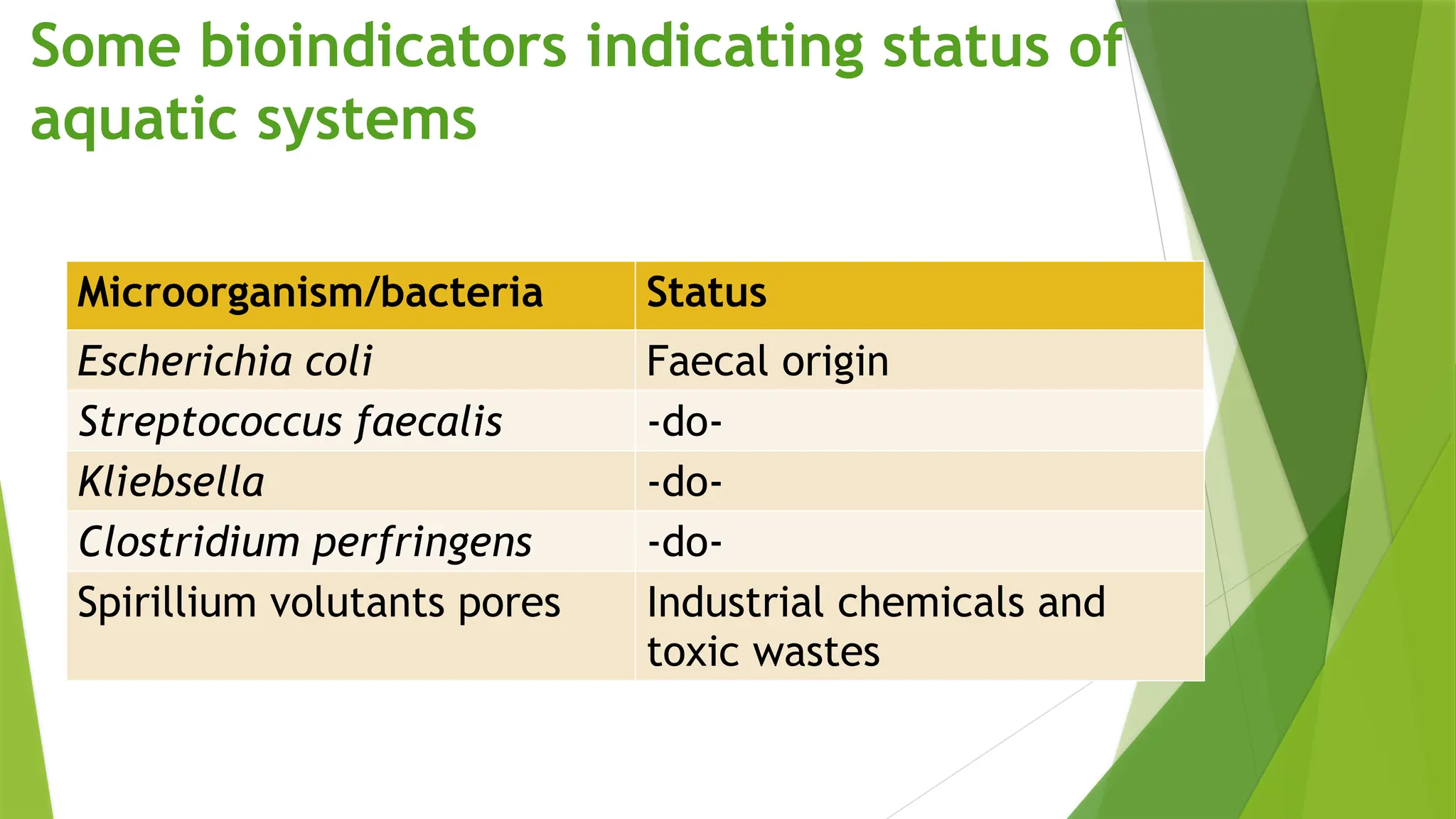
Some bioindicators indicating status of
aquatic systems
Microorganism/bacteria Status
Escherichia coli Faecal origin
Streptococcus faecalis -do-
Kliebsella -do-
Clostridium perfringens -do-
Spirillium volutants pores Industrial chemicals and
toxic wastes
Bioluminescent bacteria as
bioindicators
 Bioluminescent bacteria are used to
test water for environmental toxins.
 If there are toxins present in the
water, the cellular metabolism of
bacteria is inhibited or disrupted.
 This affects quality or amount of
light emitted by bacteria.
 It is very quick method and takes just
30 minutes to complete but could not
identify the toxin.
Vibrio fischeri
PLANT SYSTEM
 The presence or absence of certain plant or other
vegetative life in an ecosystem can provide
important
clues about the health of the environment.
 They can be from both higher and lower classes of
Plantae
PLANT SYSTEM
Lower plants
 Different plants indicate the nature of environment.
The susceptibility of resistance towards a substance in
the environment varies with species, e.g. lichens
 Lichens are alga and fungi living symbiotically
(they have to live together to survive) Lichens can live in
extreme conditions, but they hate pollution
 The cleaner the air the bigger and more elaborate the
lichen. So by looking at the lichens growing in a certain
area you can tell how bad the air pollution is
Indicator lichens
Lower plants
 Changes in Diatom
community , decrease
in plankton algae and
aquatic hydrophyte
indicated increased
water acidity .
 Specific changes in
aquatic flora can
indicate the pH of the
fresh water correctly
Higher plants
• Various groups of higher plants serve as bioindicators.
• Sensitive species are employed to detect and monitor
specific air pollutants.
• Studies on higher plants are more specified on its
ability to indicate the heavy metal pollution in water.
Higher plants
• The chlortic flakes of pine needle are good
examples of ozone damages. The collapse,
glazing and bronzing of leaf cells are products
of damage by peroxyacetyl nitrate (PAN).
• Caesalpinia pulcherrima and grass (Cyndon
dactylon) was evaluated as the bioindicators
of heavy metals such as the Lead (Pb), Copper
(Cu), Cadmium (Cd), Manganese (Mn), Zinc
(Zn), Chromium (Cr) and Nickel (Ni)
Higher plants
 Abundance of Eichhornia
indicates sewage and heavy
metal pollution of water.
 Equisetum spp. Indicate the
presence of gold in the soil.
 Annual weeds and short lived
perennials like Amaranthus,
Chenopodium and Polygonum
etc. grow better in overgrazed
areas. They are the indicators
of overgrazing .
ANIMAL SYSTEM
 An increase or decrease in an animal population
may indicate damage to ecosystem caused by
pollution.
 In addition to monitoring the size and number of
certain species, other mechanisms of animal
indication include monitoring the concentration of
toxins in animal tissues, or monitoring the rate at
which deformities arise in animal population.
ANIMAL SYSTEM
 Earthworm density and biomass are
strongly influence by contamination.
Therefore the earth worm is used as
bioindicator to determine acute
toxicity.
 Frogs are considered accurate
indicators of environmental stress and
the health of biosphere as a whole.
 Fish is a good indicator of water
pollution.
 Macro invertebrates are often used as
bioindicators because they are very
sensitive to pollution, excess nutrients,
increased turbidity, chlorine, etc.
CELL BIOLOGY, GENETICS
SYSTEM
 Cellular and sub-cellular components, including
chromosomes, adapted to specific environmental
conditions, form an excellent parameter for
bioindicator.
 Many animals show behavioural responses following
the detection of environmental changes in the
functioning of endocrine, nervous, muscular,
cardiovascular and excretory systems.
 Such changes may be investigated at morphological,
biochemical or physiological levels and can indicate
the presence of toxic substances.
Criteria for selecting
bioindicator
 Sensitivity – dose responsiveness to specific
stressors.
 Specificity – responds to specific stressors
 Broad Applicability – over temporal and spatial scale.
 Representativeness – role as surrogate for other
responses.
 Cost – reasonable for available resources and scope
of study.
Bioindicator and biomonitoring
 Bioindicators qualitatively assesses biotic responses to
environmental stress (e.g., presence of the lichen,
indicates poor air quality) while biomonitors
quantitatively determine a response (e.g., reductions in
lichen chlorophyll content or diversity indicates the
presence and severity of air pollution)
 Chemical measurement of pollutant area is like
snapshot of that area while biological measurement is
like taking video tape.
 Bioindicators actually indicate the general toxicity of
the environment , without telling the exact quantity of
the toxicity.
Why Are Bioindicators Better
than Traditional Methods?
 Scientists have traditionally conducted chemical assays and
directly measured physical parameters of the environment (e.g.,
ambient temperature, salinity, nutrients, pollutants, available
light and gas levels), whereas the use of bioindicators uses the
biota to assess the cumulative impacts of both chemical
pollutants and habitat alterations over time.
Why Are Bioindicators Better
than Traditional Methods?
 Bioindicators have the ability to indicate indirect
biotic effects of pollutants when many physical or
chemical measurements cannot.
 Through bioindicators scientists need to observe only
the single indicating species to check on the
environment , they don’t have to monitor whole
community.
CASE STUDY: Roadside Plants as Bio-indicators of
Urban Air Pollution A.P Deepalakshmi, et al.
 Case study describes about air pollution tolerance
among roadside plants exposed to varying degrees of
vehicular pollutants.
 Evaluation of air pollution tolerance index (APTI) of 10
selected wild plant species was carried out to assess
their response to ambient levels of air pollutants along
the busy roadways of Bangalore.
 Four parameters namely total chlorophyll, ascorbic
acid, pH of leaf extract and relative water content
were determined and computed together to signify air
pollution tolerance index (APTI) of plants.
Plants selected
RESULTS
 The observed significant reduction in total
chlorophyll, ascorbic acid and relative water content
showed inverse relationship with traffic density.
 Similarly, pH of leaf extract followed an exponential
decrease with increase in traffic density and drifted
towards acidic range.
 Comparison of APTI values from control to polluted
sites revealed maximum reduction in Bougainvillea
spectabilis while least change was noted in
Peltophorum pterocarpum.
RESULTS
 While Peltophorum pterocarpum and Portulaca
oleraceae are tolerant species since they have shown
least percent reduction in APTI.
 Among the plants studied maximum net percent
reduction of APTI over control was seen in Bougainvillea
spectabilis and Ageratum conyzoides and are considered
to be sensitive species.
CASE STUDY -CONCLUSION
 Air pollution has been considered as a potential
selection force for plants, therefore the species
growing in such adverse roadside environment
present the best material to ascertain the levels
of susceptibility rather than drawing interpretations
from measurements obtained from lab conditions.
 APTI determination provides a reliable method
for screening large number of plants with
respect to their response to air pollutants
CONCLUSION
 Bioindicator have a remarkable potential in
forecasting of disasters, prevention of pollution,
exploration and conservation of natural resources,
all aiming at a sustainable development with
minimum destruction of the biosphere
 Bioindicator can be applied in predicting the
impact of anthropogenic activities particularly
pollutants and predicting environmental change in
a timely manner.
REFERENCE
 Burger, Joanna. Bioindicators :- Types, Development, and Use in Ecological Assessment and
Research. Environmental Indicator.2006. Pg. 22-39. DOI: 10.1080/15555270590966483
 Deepalakshmi, A.P., et al. Roadside plants as bioindicators of urban air pollution. IOSR Journal of
Environment Science , Toxicology and Food Technology (IOSR- JESTFT). VOL-3 Issue -3 .
March- April-2013. Pg 10-14.
 Gerhart ,a. Bioindicator species and their use in bioindicatoring. Environmental monitoring vol-1
http://www.eolss.net
 Haeba, Maher.et.al. Earthworm as bioindicator of soil. Environmental and Analytical Toxicolgy. 2013.
http://dxdoi.org/10.4172/2161052910000189.
 Holt, Emily A. Miller, Scott W. 2010. Bioindictors: Using Organisms to Measure Environmental
Impacts. Nature Education Knowledge. 3(8) 10
 Indicator organism. http://en.wikipedia.org.
 Odonker ,Stephen T. Ampofo , Joseph K. Escherichia coli as the indicator of bacteriological
quality of water: an overview . microbiology research 2013. Pg 5-11. doi:10.4081/mr.2013.e2
 Plant Indictor: Characteristic, Type and Physiological Changes . 2013. http://www.biologydiscussion.com
 Saulovk , Durdija. Blocanin, rade. Rodriguez , bibiana . BIOINDICATORS IN HUMAN
ENVIRONMENT .Pg 140-147
 Sharma, P.D . Ecology and Environment . 11TH ed. Pg 574-571. Merrut . rastogi publication.
 http://staff.concog.org
 http://en.wikipedia.org

Environmental Sampling-Biomonitoring.pptx

  • 1.
    Environmental sampling  Environmentalsampling is defined as an observation of changing environmental states.  The goal of sampling is information mining about the frequency distribution of environmental data or about their probability distribution parameters.
  • 2.
  • 3.
    Biomonitoring  The practicaluse of biological indicators to monitor environmental quality has a long history. Centuries back it was used in observation of: effect of sulfur dioxide on the vegetation surrounding smelters; effect of pollutants on the population of flora and fauna living in natural waters.  What is biomonitoring?
  • 4.
    Bioindicator species  Bioindicatorsare the organism that indicate or monitor the health of the environment.  A good bioindicator will indicate the presence of the pollutant and also attempt to provide additional information about the amount and intensity of the exposure.
  • 5.
  • 6.
    How are bioindicatorspecies used  Different bioindicators are sensitive to different types of changes.  Scientists observe changes in the populations of animal and plant bioindicators to see if an environment is healthy .  Biological response of bioindicator reveals the presence of the pollutants by the occurrence of typical symptoms or measurable responses, and is therefore more qualitative .
  • 7.
    CLASSIFICATION OF BIOINDICATORS 1.BASED ON THE AIM OF INDICATORS • COMPLIANCE INDICATORS –E.g. fish population attributes are measured at the population, community or ecosystem levels and are focused on issues such as the sustainability of population. • DIAGNOSTIC INDICATORS – They are used to measure on the individual or sub organism (biomarker) • EARLY WARNING INDICATORS – They focus on rapid and sensitive response to environmental changes. • ACCUMULATION INDICATORS – They are distinguished for toxic effects bioindicator, with the effects being studied on different biological organisation level e.g. lichens , mussels etc.
  • 8.
    2. BASED ONTHE APPLICATIONS OF INDICATORS ENVIRONMENTAL INDICATOR  This is a species or group of species responding predictably to environmental disturbances or change (e.g. sentinels, detector, exploiters, accumulators, bioassay organisms).  An environmental indicators system is an act set of indicators aiming at diagnosing the state of the environment for environmental policy making.
  • 9.
    2. BASED ONTHE APPLICATIONS OF INDICATORS ECOLOGICAL INDICATOR  This is a species that is known to be sensitive to pollution, habitat fragmentation or other stresses.  The response of the indicator is representative for the community.
  • 10.
    2. BASED ONTHE APPLICATIONS OF INDICATORS BIODIVERSITY INDICATOR  Indicator for species richness of a community.  However, the definition has been broadened to measurable parameter of biodiversity including species richness, endemism, genetic parameter, population- specific parameter and landscape parameter
  • 11.
    BASED ON INTERNATIONALUNION OF BIOLOGICAL SCIENCES (IUBS) BIOINDICATORS ARE GROUPED INTO :  Microbial system  Plant system  Animal system  Cell biology and genetics system
  • 12.
    Microbial system  Microorganismsare diverse group of organisms found in large quantities and are easier to detect and sample.  The presence of some microorganisms is well correlated with particular type of pollution and it serves as standard indicator of pollution.
  • 13.
    Some bioindicators indicatingstatus of aquatic systems Microorganism/bacteria Status Escherichia coli Faecal origin Streptococcus faecalis -do- Kliebsella -do- Clostridium perfringens -do- Spirillium volutants pores Industrial chemicals and toxic wastes
  • 14.
    Bioluminescent bacteria as bioindicators Bioluminescent bacteria are used to test water for environmental toxins.  If there are toxins present in the water, the cellular metabolism of bacteria is inhibited or disrupted.  This affects quality or amount of light emitted by bacteria.  It is very quick method and takes just 30 minutes to complete but could not identify the toxin. Vibrio fischeri
  • 15.
    PLANT SYSTEM  Thepresence or absence of certain plant or other vegetative life in an ecosystem can provide important clues about the health of the environment.  They can be from both higher and lower classes of Plantae
  • 16.
    PLANT SYSTEM Lower plants Different plants indicate the nature of environment. The susceptibility of resistance towards a substance in the environment varies with species, e.g. lichens  Lichens are alga and fungi living symbiotically (they have to live together to survive) Lichens can live in extreme conditions, but they hate pollution  The cleaner the air the bigger and more elaborate the lichen. So by looking at the lichens growing in a certain area you can tell how bad the air pollution is
  • 17.
  • 18.
    Lower plants  Changesin Diatom community , decrease in plankton algae and aquatic hydrophyte indicated increased water acidity .  Specific changes in aquatic flora can indicate the pH of the fresh water correctly
  • 19.
    Higher plants • Variousgroups of higher plants serve as bioindicators. • Sensitive species are employed to detect and monitor specific air pollutants. • Studies on higher plants are more specified on its ability to indicate the heavy metal pollution in water.
  • 20.
    Higher plants • Thechlortic flakes of pine needle are good examples of ozone damages. The collapse, glazing and bronzing of leaf cells are products of damage by peroxyacetyl nitrate (PAN). • Caesalpinia pulcherrima and grass (Cyndon dactylon) was evaluated as the bioindicators of heavy metals such as the Lead (Pb), Copper (Cu), Cadmium (Cd), Manganese (Mn), Zinc (Zn), Chromium (Cr) and Nickel (Ni)
  • 21.
    Higher plants  Abundanceof Eichhornia indicates sewage and heavy metal pollution of water.  Equisetum spp. Indicate the presence of gold in the soil.  Annual weeds and short lived perennials like Amaranthus, Chenopodium and Polygonum etc. grow better in overgrazed areas. They are the indicators of overgrazing .
  • 22.
    ANIMAL SYSTEM  Anincrease or decrease in an animal population may indicate damage to ecosystem caused by pollution.  In addition to monitoring the size and number of certain species, other mechanisms of animal indication include monitoring the concentration of toxins in animal tissues, or monitoring the rate at which deformities arise in animal population.
  • 23.
    ANIMAL SYSTEM  Earthwormdensity and biomass are strongly influence by contamination. Therefore the earth worm is used as bioindicator to determine acute toxicity.  Frogs are considered accurate indicators of environmental stress and the health of biosphere as a whole.  Fish is a good indicator of water pollution.  Macro invertebrates are often used as bioindicators because they are very sensitive to pollution, excess nutrients, increased turbidity, chlorine, etc.
  • 24.
    CELL BIOLOGY, GENETICS SYSTEM Cellular and sub-cellular components, including chromosomes, adapted to specific environmental conditions, form an excellent parameter for bioindicator.  Many animals show behavioural responses following the detection of environmental changes in the functioning of endocrine, nervous, muscular, cardiovascular and excretory systems.  Such changes may be investigated at morphological, biochemical or physiological levels and can indicate the presence of toxic substances.
  • 25.
    Criteria for selecting bioindicator Sensitivity – dose responsiveness to specific stressors.  Specificity – responds to specific stressors  Broad Applicability – over temporal and spatial scale.  Representativeness – role as surrogate for other responses.  Cost – reasonable for available resources and scope of study.
  • 26.
    Bioindicator and biomonitoring Bioindicators qualitatively assesses biotic responses to environmental stress (e.g., presence of the lichen, indicates poor air quality) while biomonitors quantitatively determine a response (e.g., reductions in lichen chlorophyll content or diversity indicates the presence and severity of air pollution)  Chemical measurement of pollutant area is like snapshot of that area while biological measurement is like taking video tape.  Bioindicators actually indicate the general toxicity of the environment , without telling the exact quantity of the toxicity.
  • 27.
    Why Are BioindicatorsBetter than Traditional Methods?  Scientists have traditionally conducted chemical assays and directly measured physical parameters of the environment (e.g., ambient temperature, salinity, nutrients, pollutants, available light and gas levels), whereas the use of bioindicators uses the biota to assess the cumulative impacts of both chemical pollutants and habitat alterations over time.
  • 28.
    Why Are BioindicatorsBetter than Traditional Methods?  Bioindicators have the ability to indicate indirect biotic effects of pollutants when many physical or chemical measurements cannot.  Through bioindicators scientists need to observe only the single indicating species to check on the environment , they don’t have to monitor whole community.
  • 29.
    CASE STUDY: RoadsidePlants as Bio-indicators of Urban Air Pollution A.P Deepalakshmi, et al.  Case study describes about air pollution tolerance among roadside plants exposed to varying degrees of vehicular pollutants.  Evaluation of air pollution tolerance index (APTI) of 10 selected wild plant species was carried out to assess their response to ambient levels of air pollutants along the busy roadways of Bangalore.  Four parameters namely total chlorophyll, ascorbic acid, pH of leaf extract and relative water content were determined and computed together to signify air pollution tolerance index (APTI) of plants.
  • 30.
  • 31.
    RESULTS  The observedsignificant reduction in total chlorophyll, ascorbic acid and relative water content showed inverse relationship with traffic density.  Similarly, pH of leaf extract followed an exponential decrease with increase in traffic density and drifted towards acidic range.  Comparison of APTI values from control to polluted sites revealed maximum reduction in Bougainvillea spectabilis while least change was noted in Peltophorum pterocarpum.
  • 32.
    RESULTS  While Peltophorumpterocarpum and Portulaca oleraceae are tolerant species since they have shown least percent reduction in APTI.  Among the plants studied maximum net percent reduction of APTI over control was seen in Bougainvillea spectabilis and Ageratum conyzoides and are considered to be sensitive species.
  • 33.
    CASE STUDY -CONCLUSION Air pollution has been considered as a potential selection force for plants, therefore the species growing in such adverse roadside environment present the best material to ascertain the levels of susceptibility rather than drawing interpretations from measurements obtained from lab conditions.  APTI determination provides a reliable method for screening large number of plants with respect to their response to air pollutants
  • 34.
    CONCLUSION  Bioindicator havea remarkable potential in forecasting of disasters, prevention of pollution, exploration and conservation of natural resources, all aiming at a sustainable development with minimum destruction of the biosphere  Bioindicator can be applied in predicting the impact of anthropogenic activities particularly pollutants and predicting environmental change in a timely manner.
  • 35.
    REFERENCE  Burger, Joanna.Bioindicators :- Types, Development, and Use in Ecological Assessment and Research. Environmental Indicator.2006. Pg. 22-39. DOI: 10.1080/15555270590966483  Deepalakshmi, A.P., et al. Roadside plants as bioindicators of urban air pollution. IOSR Journal of Environment Science , Toxicology and Food Technology (IOSR- JESTFT). VOL-3 Issue -3 . March- April-2013. Pg 10-14.  Gerhart ,a. Bioindicator species and their use in bioindicatoring. Environmental monitoring vol-1 http://www.eolss.net  Haeba, Maher.et.al. Earthworm as bioindicator of soil. Environmental and Analytical Toxicolgy. 2013. http://dxdoi.org/10.4172/2161052910000189.  Holt, Emily A. Miller, Scott W. 2010. Bioindictors: Using Organisms to Measure Environmental Impacts. Nature Education Knowledge. 3(8) 10  Indicator organism. http://en.wikipedia.org.  Odonker ,Stephen T. Ampofo , Joseph K. Escherichia coli as the indicator of bacteriological quality of water: an overview . microbiology research 2013. Pg 5-11. doi:10.4081/mr.2013.e2  Plant Indictor: Characteristic, Type and Physiological Changes . 2013. http://www.biologydiscussion.com  Saulovk , Durdija. Blocanin, rade. Rodriguez , bibiana . BIOINDICATORS IN HUMAN ENVIRONMENT .Pg 140-147  Sharma, P.D . Ecology and Environment . 11TH ed. Pg 574-571. Merrut . rastogi publication.  http://staff.concog.org  http://en.wikipedia.org

Editor's Notes

  • #3 Since that time, our knowledge of the biological effects of the various environmental pollutants has increased enormously, and monitoring schemes employing biological indicator organisms have been proposed and are in fact in daily use Biomonitoring is the use of biological indicator organisms to assess change of the state of the environment.
  • #9 Every plant is a measure of the conditions under which it grows ... an index of soil and climate ... an indicator of the behavior of other plants and of animals in the same spot."
  • #18 The biologists used diatoms as a case study because these single-celled algae are very sensitive to changes in water conditions,
  • #27 Biological indicators are screening agents in that they respond to many different compounds, they are integrating devices in that they show the cumulative effects over a period of time or over some spatial area; but their primary advantage is that the bio-indicator directly measures the property that we are really interested in - is there something in the air or water that is harmful to life?