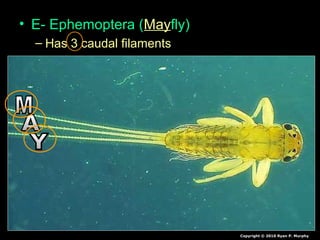
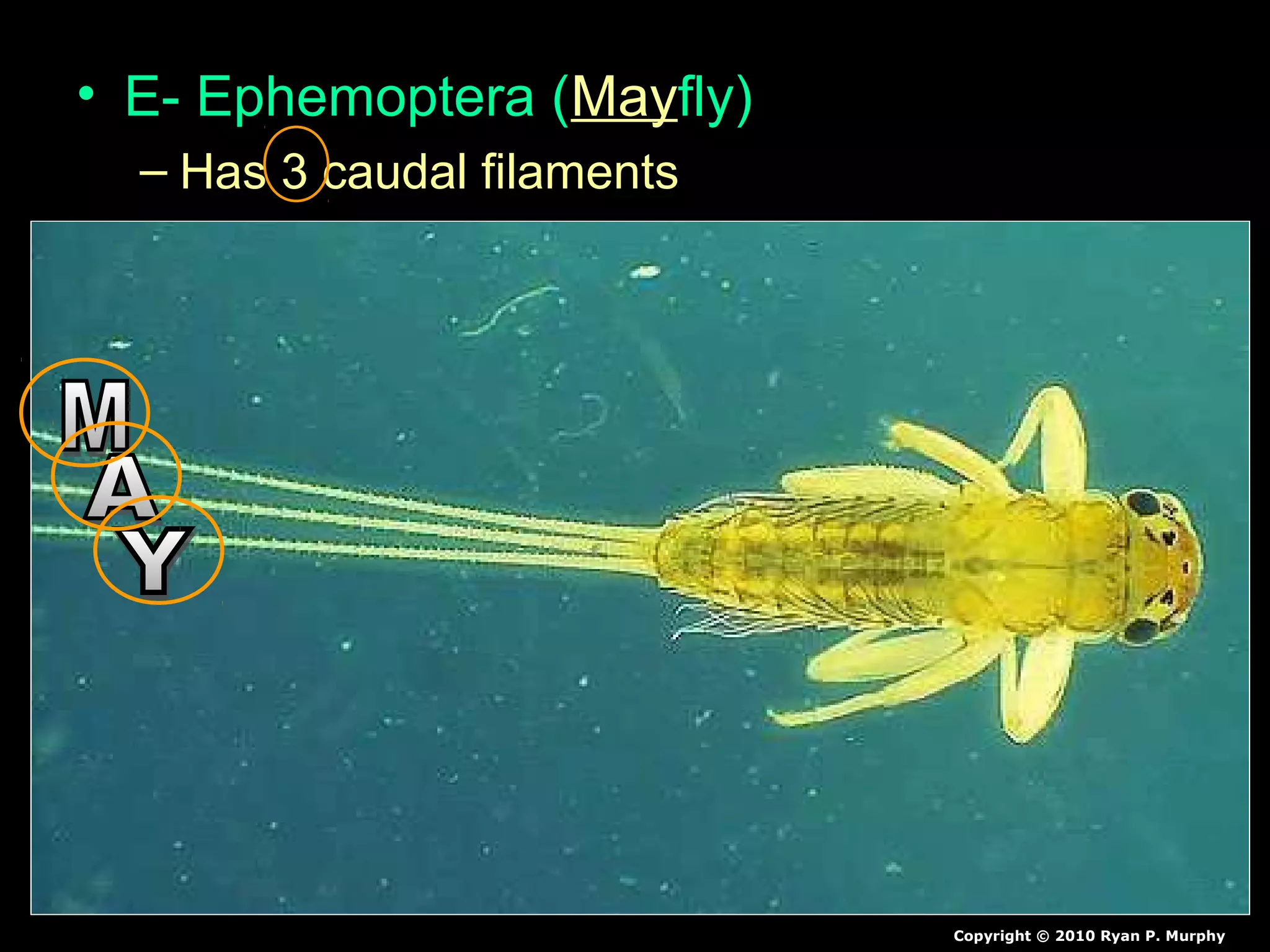
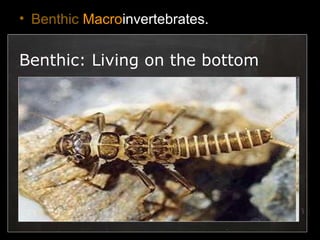
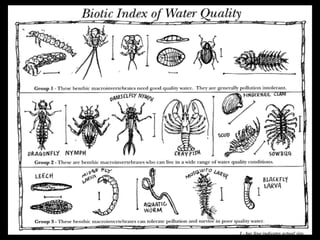
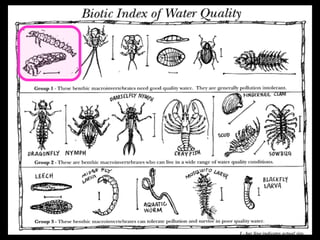
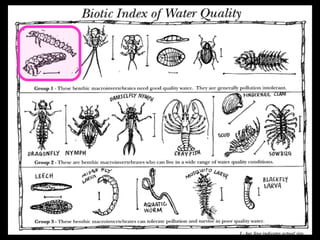
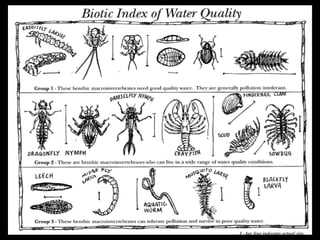
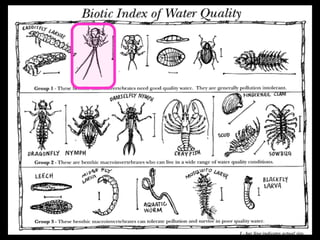
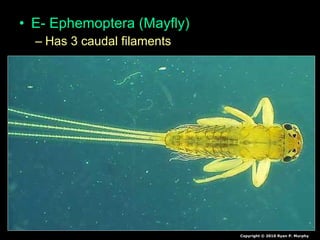
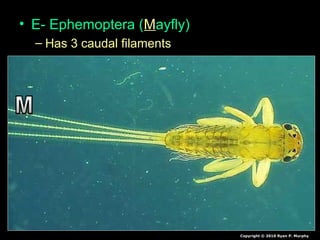
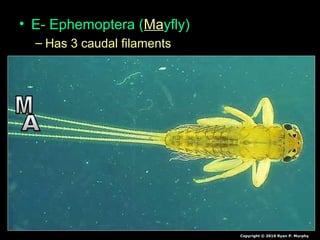
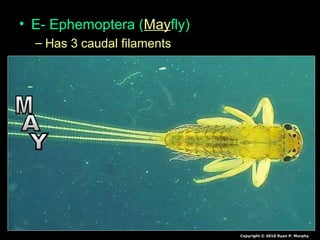
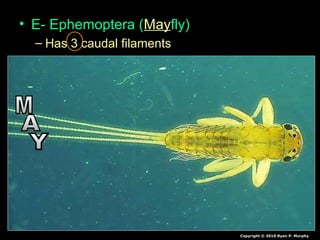
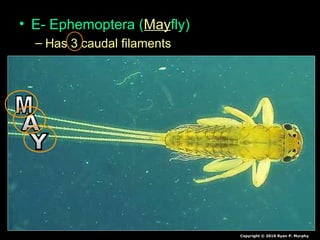
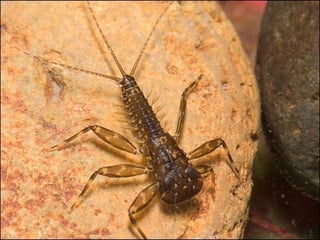
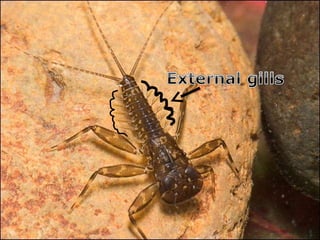
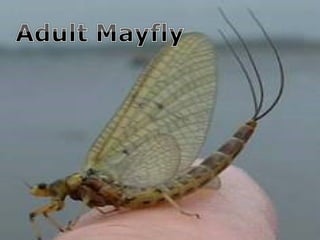
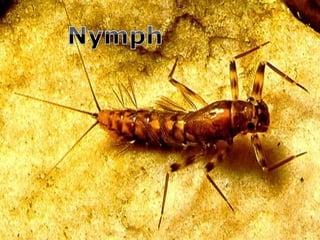
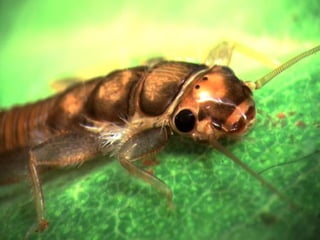
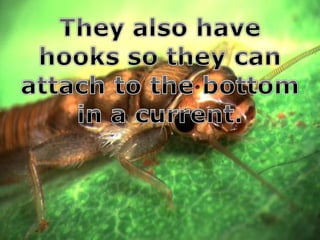
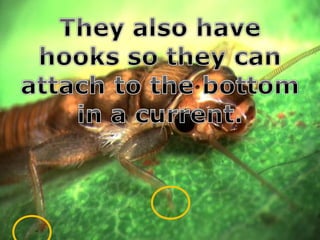
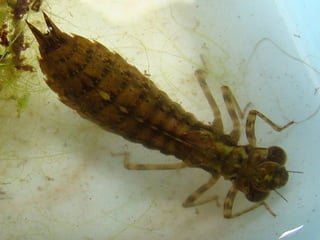
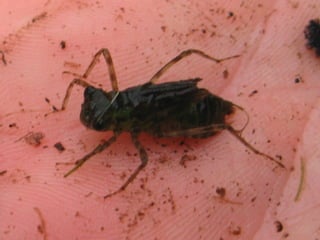
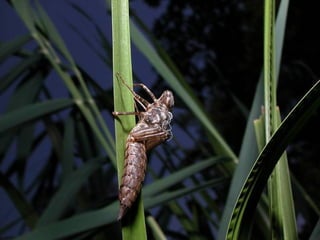
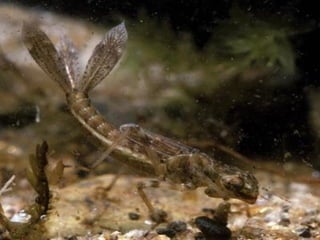
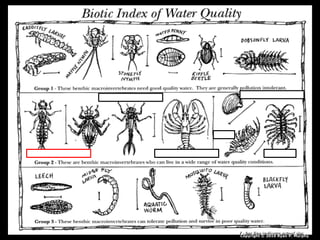
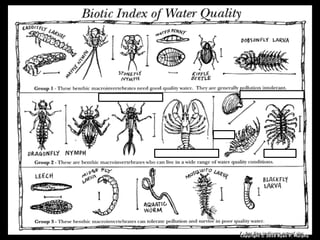
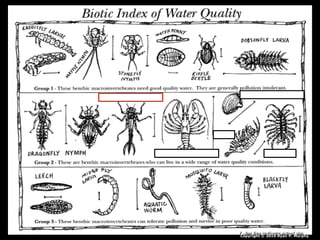
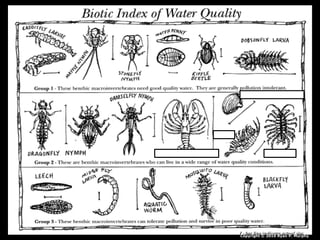
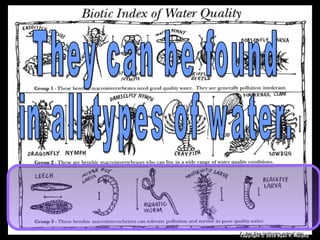
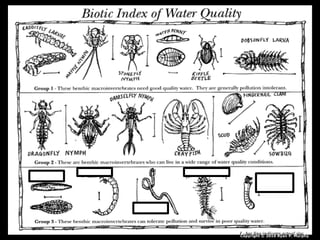
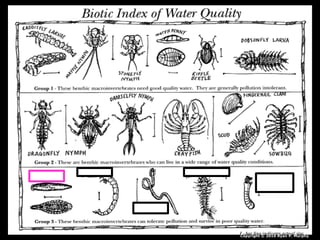
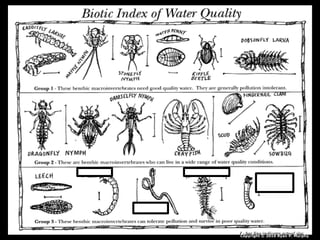
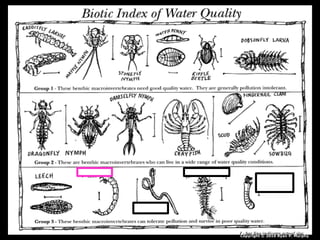
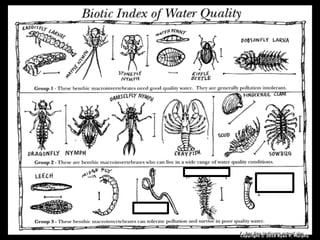
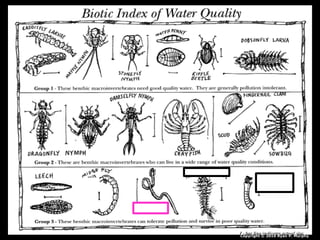
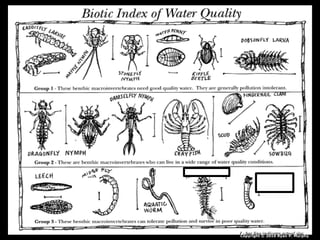
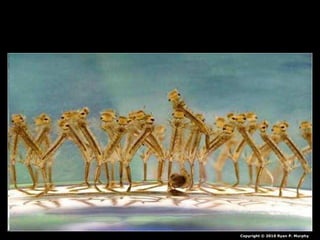
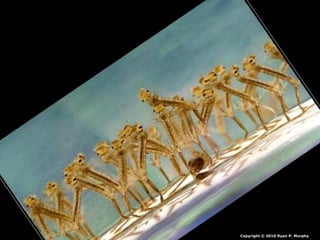
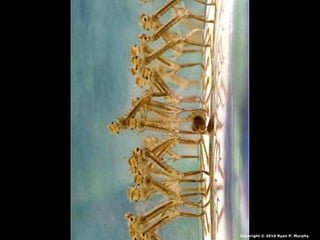
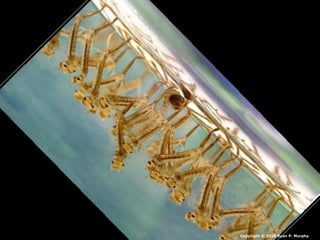
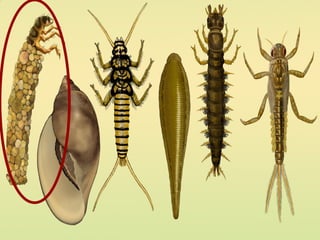
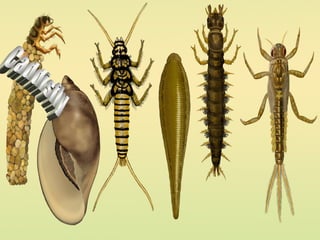
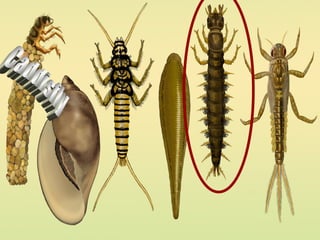
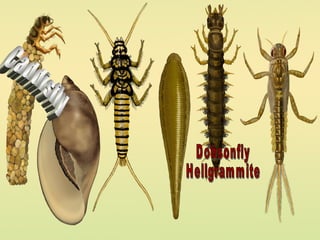
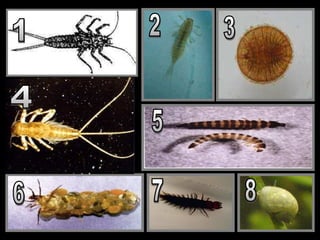
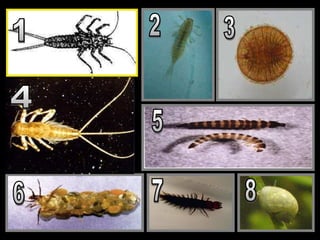
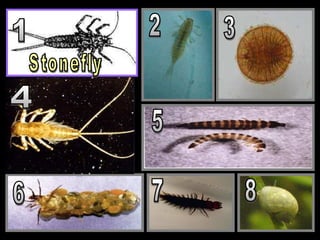
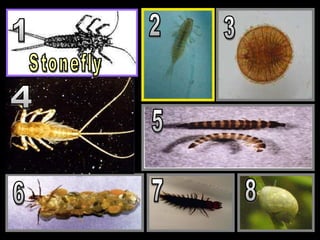
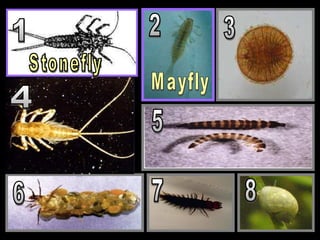
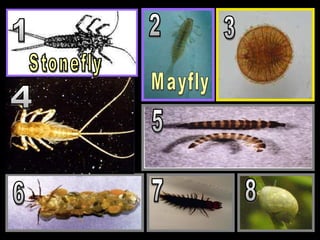
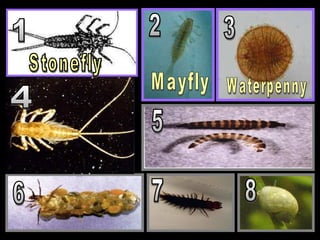
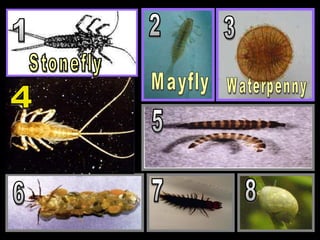
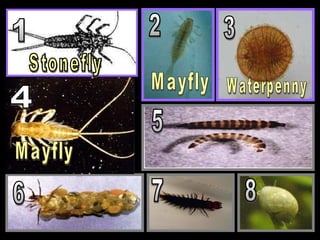
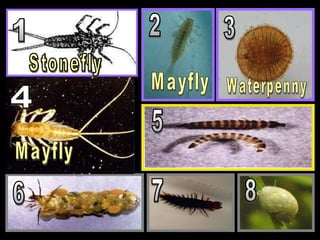
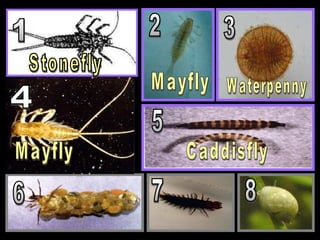
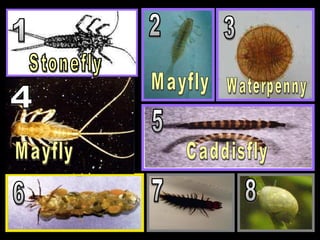
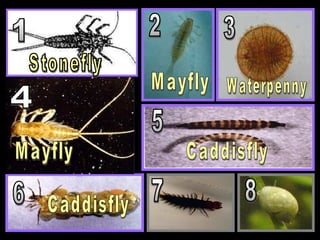
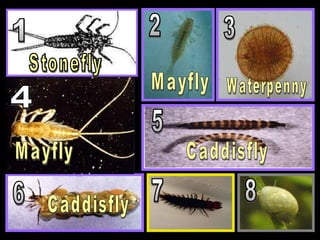
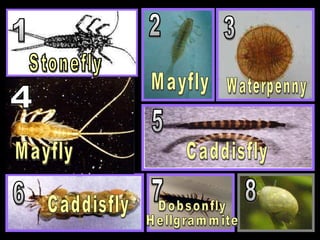
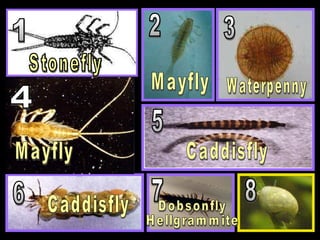
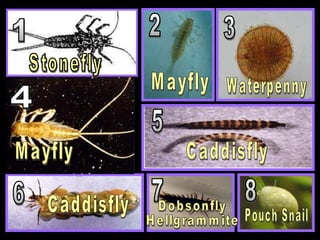
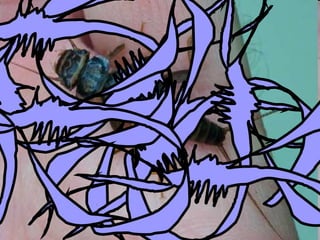
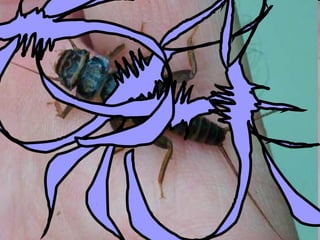
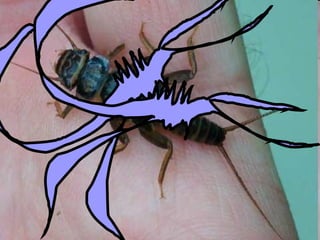
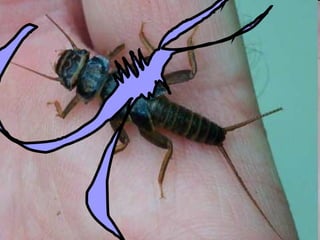
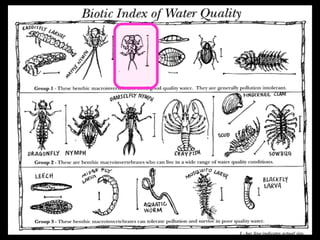
• E- Ephemoptera (Mayfly)
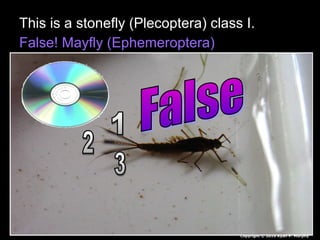
– Has 3 caudal filaments
Copyright © 2010 Ryan P. Murphy
• RED SLIDE: These are notes that are very
important and should be recorded in your
science journal.
Copyright © 2010 Ryan P. Murphy
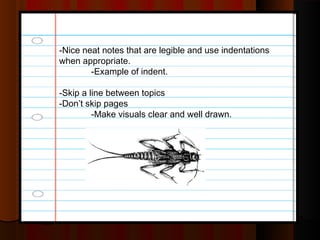
-Nice neat notes that are legible and use indentations
when appropriate.
-Example of indent.
-Skip a line between topics
-Don’t skip pages
-Make visuals clear and well drawn.
• http://sciencepowerpoint.com/
• RED SLIDE: These are notes that are very
important and should be recorded in your
science journal.
• BLACK SLIDE: Pay attention, follow
directions, complete projects as described
and answer required questions neatly.
Copyright © 2010 Ryan P. Murphy
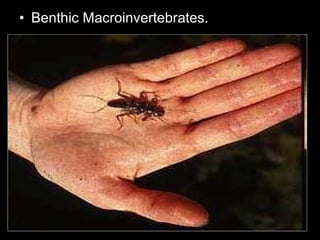
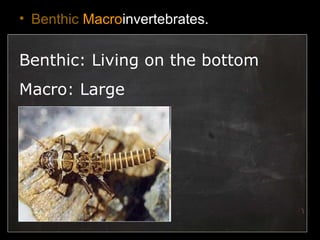
• Benthic Macroinvertebrates.
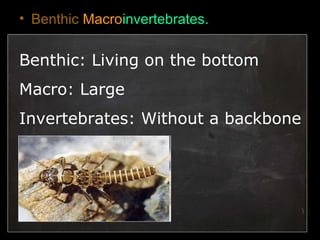
Benthic: Living on the bottom
• Benthic Macroinvertebrates.
Benthic: Living on the bottom
• Benthic Macroinvertebrates.
Benthic: Living on the bottom
• Benthic Macroinvertebrates.
Benthic: Living on the bottom
Macro: Large
• Benthic Macroinvertebrates.
Benthic: Living on the bottom
Macro: Large
• Benthic Macroinvertebrates.
Benthic: Living on the bottom
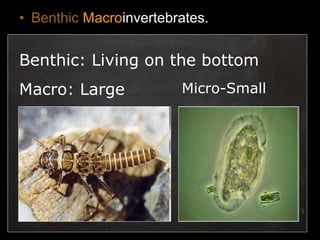
Macro: Large Micro-Small
• Benthic Macroinvertebrates.
Benthic: Living on the bottom
Macro: Large
• Benthic Macroinvertebrates.
Benthic: Living on the bottom
Macro: Large
Invertebrates: Without a backbone
• Benthic Macroinvertebrates.
Benthic: Living on the bottom
Macro: Large
Invertebrates: Without a backbone
• Benthic Macroinvertebrates.
Benthic: Living on the bottom
Macro: Large
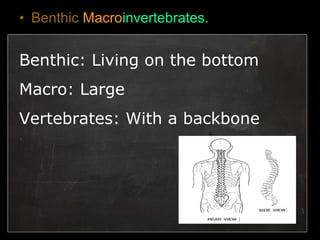
Vertebrates: With a backbone
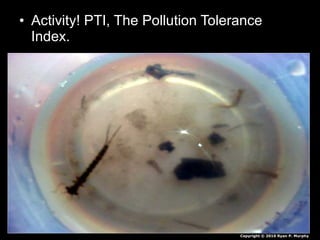
• Activity! PTI, The Pollution Tolerance
Index.
Copyright © 2010 Ryan P. Murphy
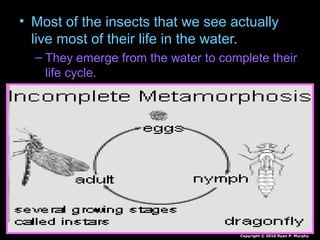
• Most of the insects that we see actually
live most of their life in the water.
– They emerge from the water to complete their
life cycle.
Copyright © 2010 Ryan P. Murphy
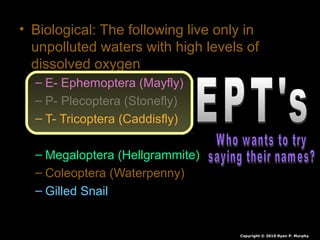
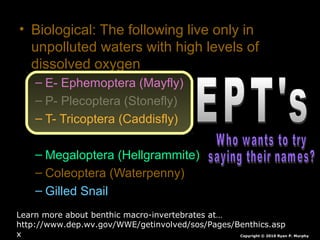
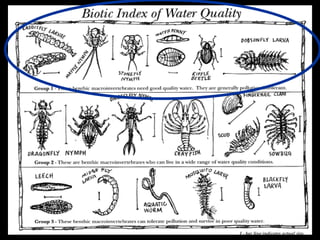
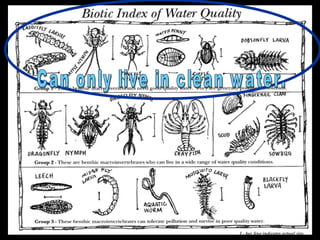
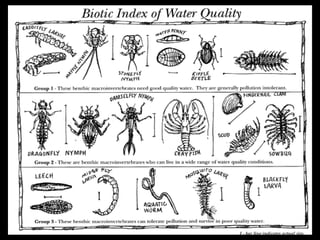
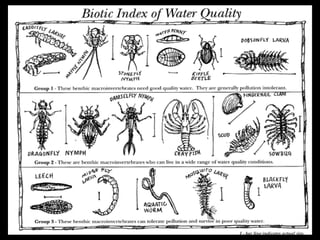
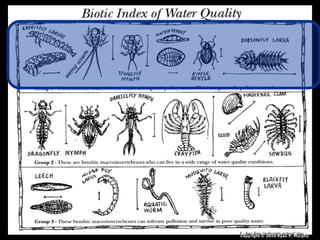
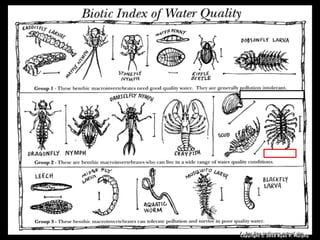
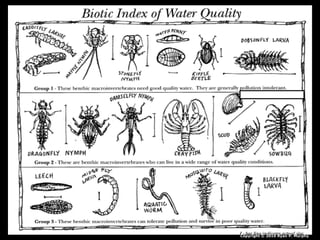
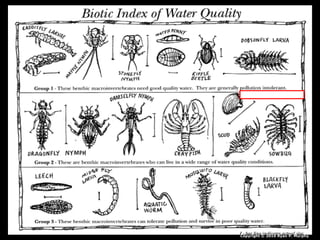
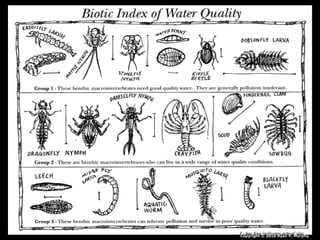
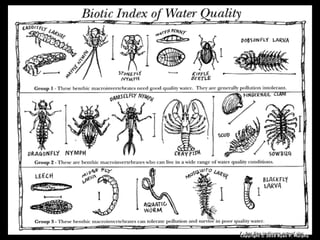
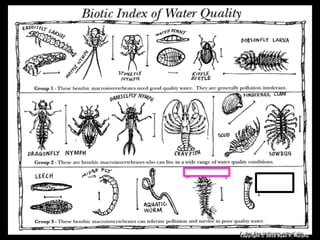
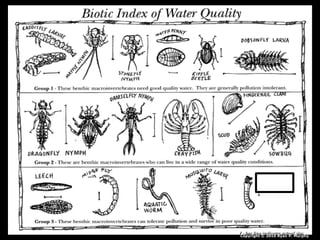
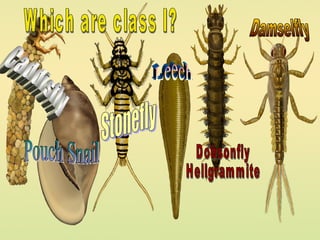
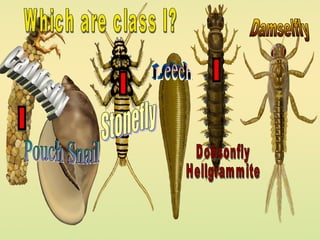
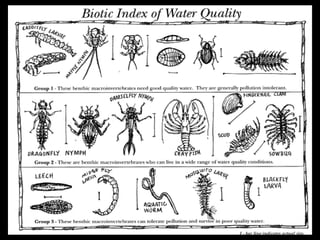
• Biological: The following live only in
unpolluted waters with high levels of
dissolved oxygen
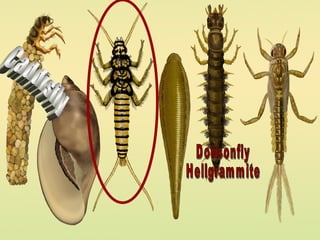
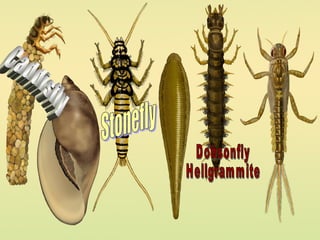
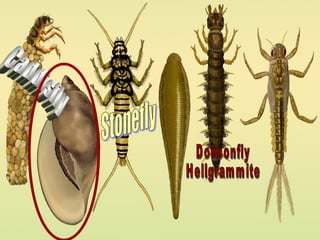
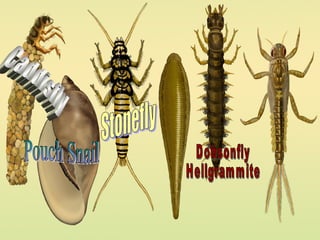
– E- Ephemoptera (Mayfly)
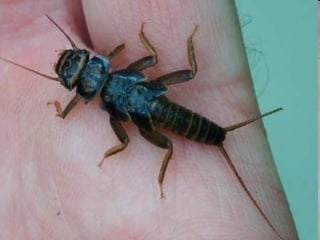
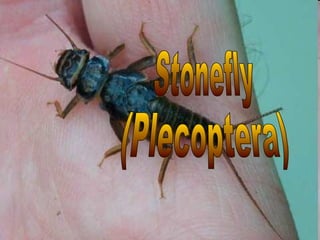
– P- Plecoptera (Stonefly)
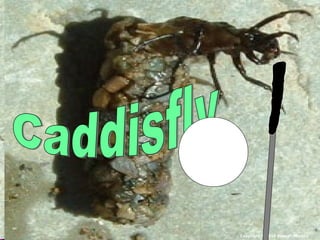
– T- Tricoptera (Caddisfly)
– Megaloptera (Hellgrammite)
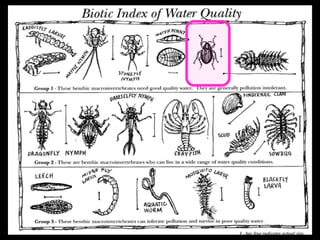
– Coleoptera (Waterpenny)
– Gilled Snail
Copyright © 2010 Ryan P. Murphy
• Biological: The following live only in
unpolluted waters with high levels of
dissolved oxygen
– E- Ephemoptera (Mayfly)
– P- Plecoptera (Stonefly)
– T- Tricoptera (Caddisfly)
– Megaloptera (Hellgrammite)
– Coleoptera (Waterpenny)
– Gilled Snail
Copyright © 2010 Ryan P. Murphy
• Biological: The following live only in
unpolluted waters with high levels of
dissolved oxygen
– E- Ephemoptera (Mayfly)
– P- Plecoptera (Stonefly)
– T- Tricoptera (Caddisfly)
– Megaloptera (Hellgrammite)
– Coleoptera (Waterpenny)
– Gilled Snail
Copyright © 2010 Ryan P. Murphy
• Biological: The following live only in
unpolluted waters with high levels of
dissolved oxygen
– E- Ephemoptera (Mayfly)
– P- Plecoptera (Stonefly)
– T- Tricoptera (Caddisfly)
– Megaloptera (Hellgrammite)
– Coleoptera (Waterpenny)
– Gilled Snail
Copyright © 2010 Ryan P. Murphy
• Biological: The following live only in
unpolluted waters with high levels of
dissolved oxygen
– E- Ephemoptera (Mayfly)
– P- Plecoptera (Stonefly)
– T- Tricoptera (Caddisfly)
– Megaloptera (Hellgrammite)
– Coleoptera (Waterpenny)
– Gilled Snail
Copyright © 2010 Ryan P. Murphy
Learn more about benthic macro-invertebrates at…
http://www.dep.wv.gov/WWE/getinvolved/sos/Pages/Benthics.asp
x
• E- Ephemoptera (Mayfly)
– Has 3 caudal filaments
Copyright © 2010 Ryan P. Murphy
• E- Ephemoptera (Mayfly)
– Has 3 caudal filaments
Copyright © 2010 Ryan P. Murphy
• E- Ephemoptera (Mayfly)
– Has 3 caudal filaments
Copyright © 2010 Ryan P. Murphy
• E- Ephemoptera (Mayfly)
– Has 3 caudal filaments
Copyright © 2010 Ryan P. Murphy
• E- Ephemoptera (Mayfly)
– Has 3 caudal filaments
Copyright © 2010 Ryan P. Murphy
• E- Ephemoptera (Mayfly)
– Has 3 caudal filaments
Copyright © 2010 Ryan P. Murphy
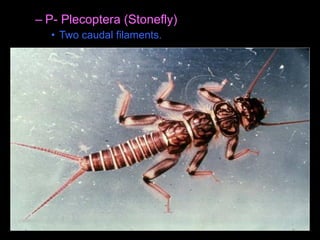
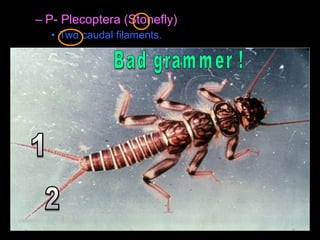
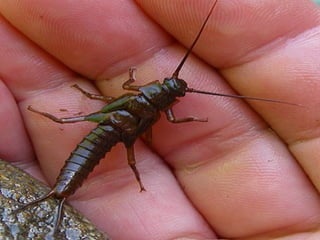
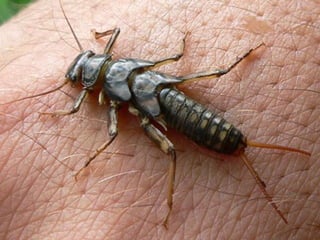
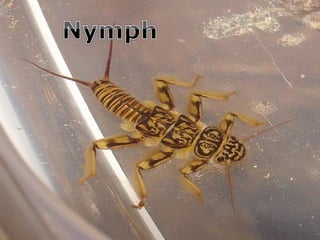
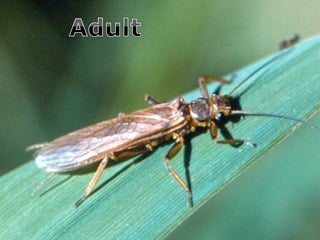
– P- Plecoptera (Stonefly)
• Two caudal filaments.
– P- Plecoptera (Stonefly)
• Two caudal filaments.
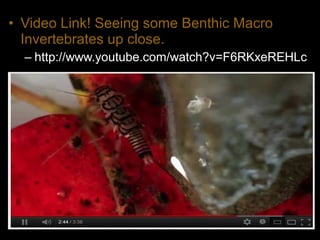
• Video Link! Seeing some Benthic Macro
Invertebrates up close.
– http://www.youtube.com/watch?v=F6RKxeREHLc
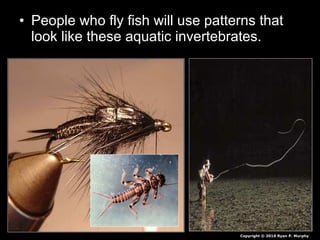
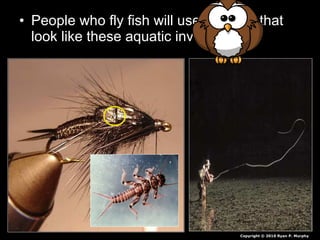
• People who fly fish will use patterns that
look like these aquatic invertebrates.
Copyright © 2010 Ryan P. Murphy
• People who fly fish will use patterns that
look like these aquatic invertebrates.
Copyright © 2010 Ryan P. Murphy
• People who fly fish will use patterns that
look like these aquatic invertebrates.
Copyright © 2010 Ryan P. Murphy
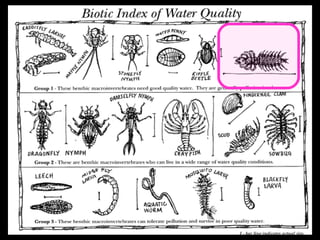
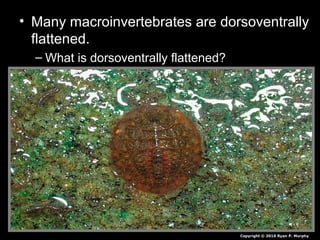
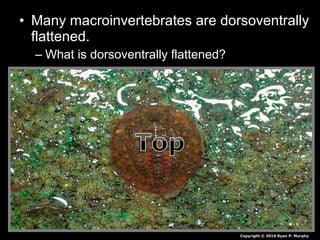
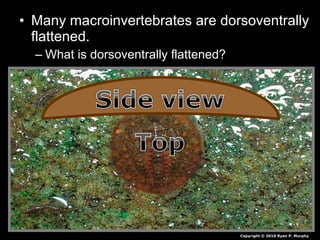
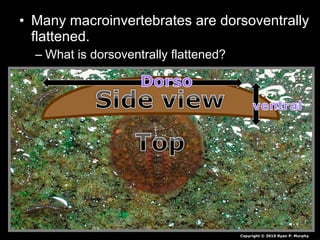
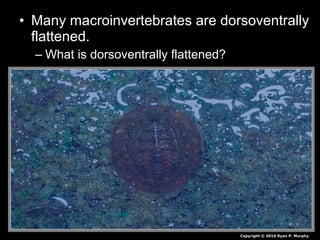
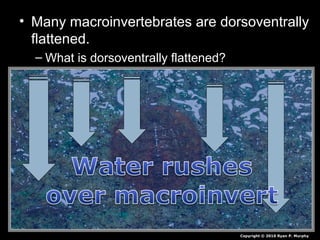
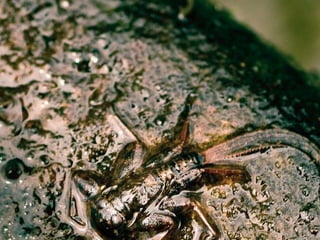
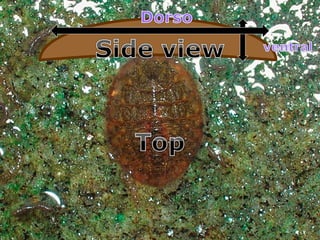
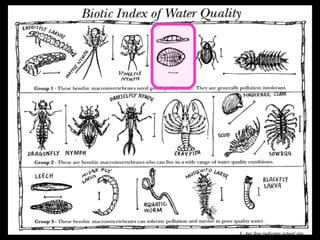
• Many macroinvertebrates are dorsoventrally
flattened.
– What is dorsoventrally flattened?
Copyright © 2010 Ryan P. Murphy
• Many macroinvertebrates are dorsoventrally
flattened.
– What is dorsoventrally flattened?
Copyright © 2010 Ryan P. Murphy
• Many macroinvertebrates are dorsoventrally
flattened.
– What is dorsoventrally flattened?
Copyright © 2010 Ryan P. Murphy
• Many macroinvertebrates are dorsoventrally
flattened.
– What is dorsoventrally flattened?
Copyright © 2010 Ryan P. Murphy
• Many macroinvertebrates are dorsoventrally
flattened.
– What is dorsoventrally flattened?
Copyright © 2010 Ryan P. Murphy
• Many macroinvertebrates are dorsoventrally
flattened.
– What is dorsoventrally flattened?
Copyright © 2010 Ryan P. Murphy
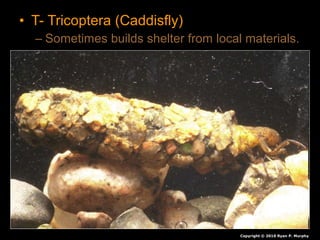
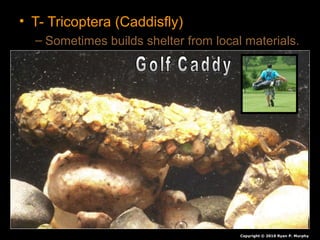
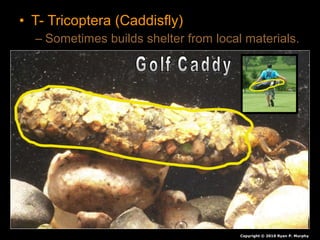
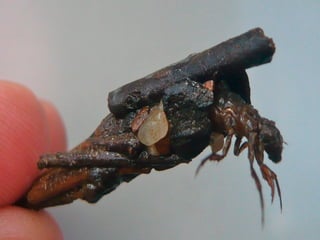
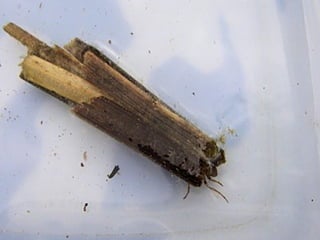
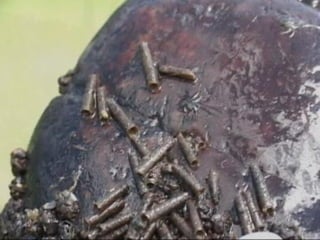
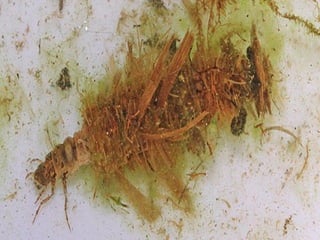
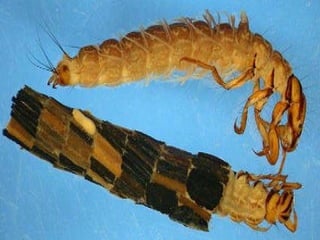
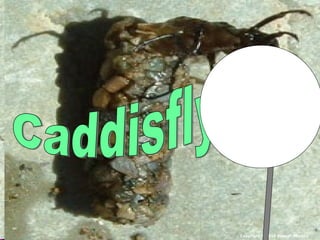
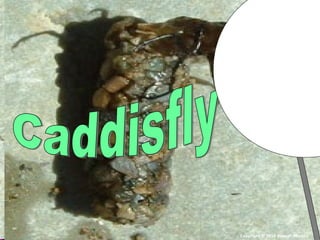
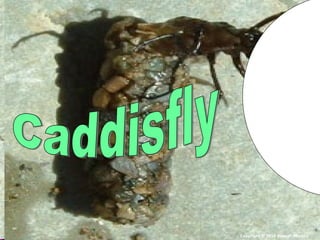
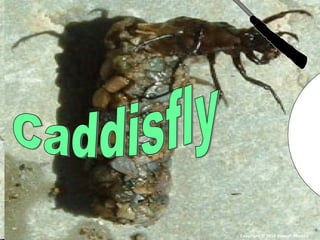
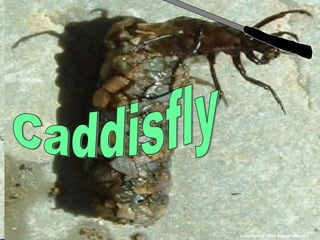
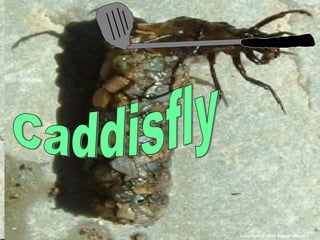
• T- Tricoptera (Caddisfly)
– Sometimes builds shelter from local materials.
Copyright © 2010 Ryan P. Murphy
• T- Tricoptera (Caddisfly)
– Sometimes builds shelter from local materials.
Copyright © 2010 Ryan P. Murphy
• T- Tricoptera (Caddisfly)
– Sometimes builds shelter from local materials.
Copyright © 2010 Ryan P. Murphy
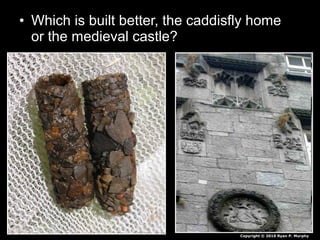
• Which is built better, the caddisfly home
or the medieval castle?
Copyright © 2010 Ryan P. Murphy
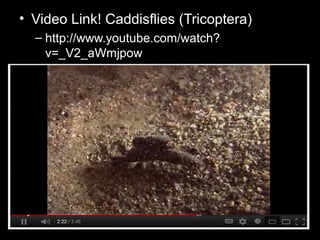
• Video Link! Caddisflies (Tricoptera)
– http://www.youtube.com/watch?
v=_V2_aWmjpow
• Many macroinvertebrates are dorsoventrally
flattened.
– What is dorsoventrally flattened?
Copyright © 2010 Ryan P. Murphy
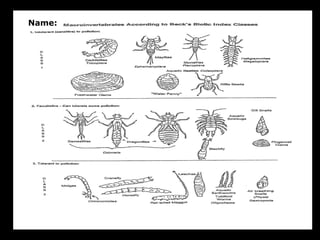
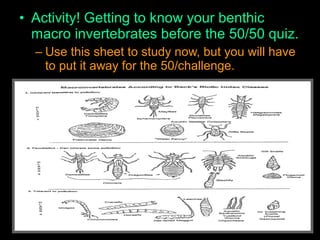
• Activity! Getting to know your benthic
macro invertebrates before the 50/50 quiz.
– Use this sheet to study now, but you will have
to put it away for the 50/challenge.
• Class I Benthic Macro-invertebrates Activity!
50/50 Round I/III
– If you get the question correct then you get to keep
your cd. If you get it wrong then you lose it .
– Everyone starts with on cd.
– Your table gets one token in round II, and one more
in round III.
– At the end of Part III, your groups gets a treat based
on how many cd’s you have.
• No cd’s = no treat 
• 1 cd = one treat each 
• 2 cd’s = two treats each 
• 3 cd’s = three treats each  etc.
Copyright © 2010 Ryan P. Murphy
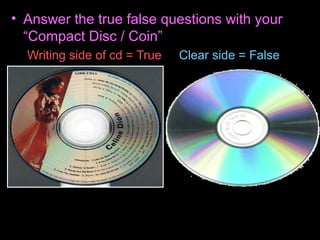
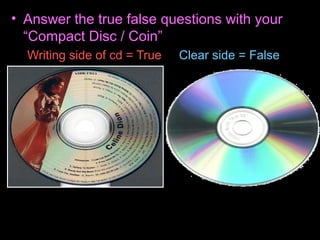
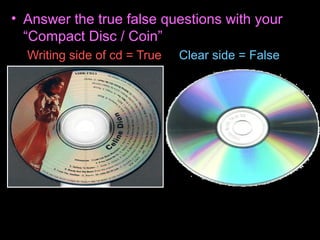
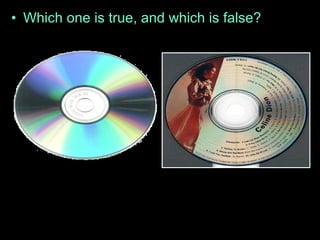
• Answer the true false questions with your
“Compact Disc / Coin”
Writing side of cd = True Clear side = False
• Which one is true, and which is false?
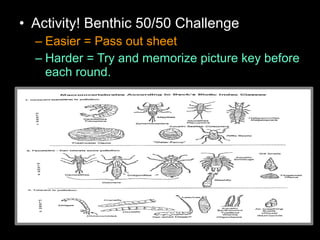
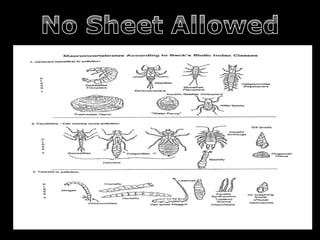
• Activity! Benthic 50/50 Challenge
– Easier = Pass out sheet
– Harder = Try and memorize picture key before
each round.
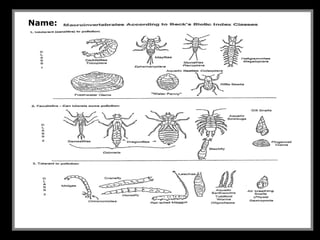
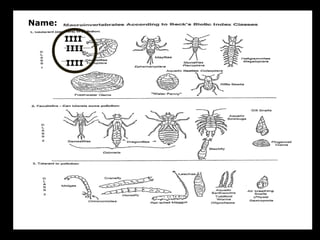
Name:
Copyright © 2010 Ryan P. Murphy
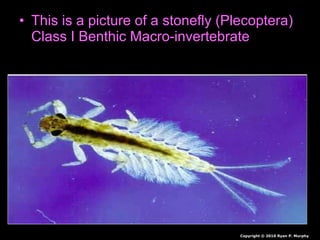
• This is a picture of a stonefly (Plecoptera)
Class I Benthic Macro-invertebrate
Copyright © 2010 Ryan P. Murphy
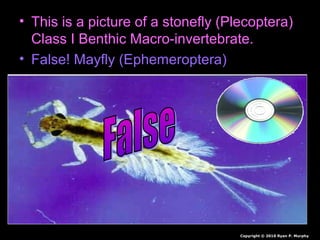
• This is a picture of a stonefly (Plecoptera)
Class I Benthic Macro-invertebrate.
• False! Mayfly (Ephemeroptera)
Copyright © 2010 Ryan P. Murphy
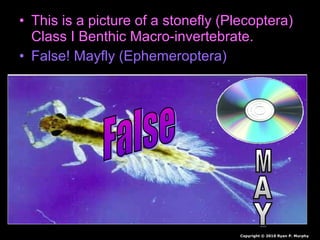
• This is a picture of a stonefly (Plecoptera)
Class I Benthic Macro-invertebrate.
• False! Mayfly (Ephemeroptera)
Copyright © 2010 Ryan P. Murphy
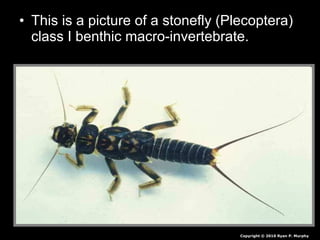
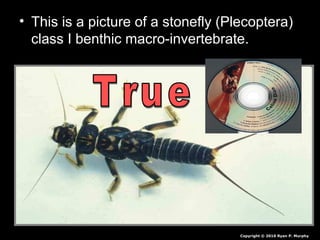
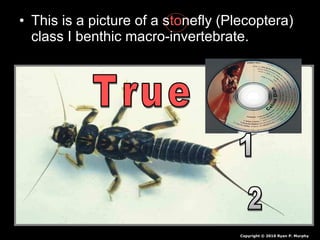
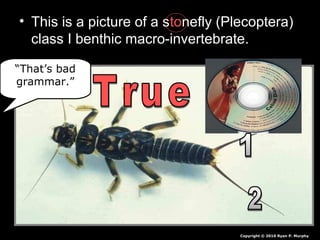
• This is a picture of a stonefly (Plecoptera)
class I benthic macro-invertebrate.
Copyright © 2010 Ryan P. Murphy
• This is a picture of a stonefly (Plecoptera)
class I benthic macro-invertebrate.
Copyright © 2010 Ryan P. Murphy
• This is a picture of a stonefly (Plecoptera)
class I benthic macro-invertebrate.
Copyright © 2010 Ryan P. Murphy
• This is a picture of a stonefly (Plecoptera)
class I benthic macro-invertebrate.
Copyright © 2010 Ryan P. Murphy
“That’s bad
grammar.”
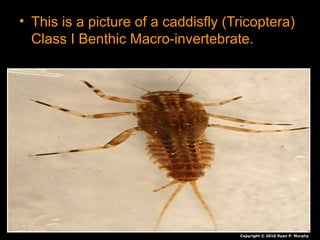
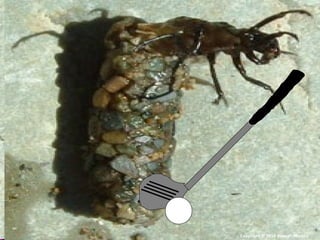
• This is a picture of a caddisfly (Tricoptera)
Class I Benthic Macro-invertebrate.
Copyright © 2010 Ryan P. Murphy
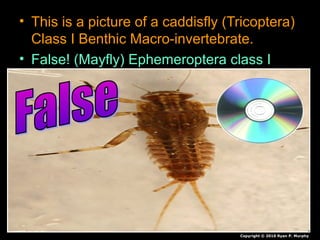
• This is a picture of a caddisfly (Tricoptera)
Class I Benthic Macro-invertebrate.
• False! (Mayfly) Ephemeroptera class I
Copyright © 2010 Ryan P. Murphy
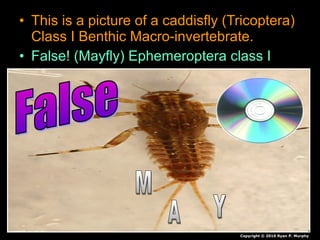
• This is a picture of a caddisfly (Tricoptera)
Class I Benthic Macro-invertebrate.
• False! (Mayfly) Ephemeroptera class I
Copyright © 2010 Ryan P. Murphy
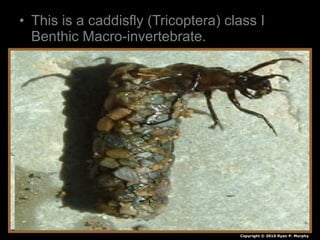
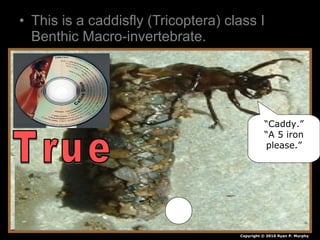
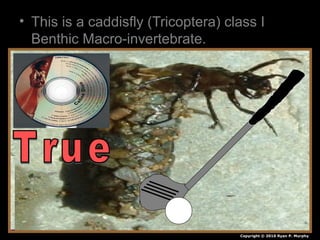
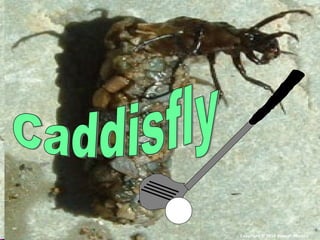
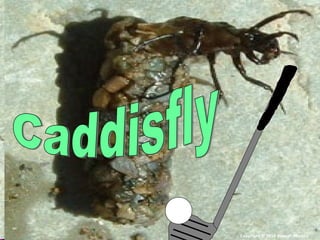
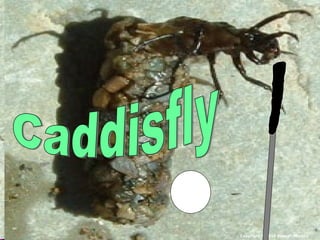
• This is a caddisfly (Tricoptera) class I
Benthic Macro-invertebrate.
• True!
Copyright © 2010 Ryan P. Murphy
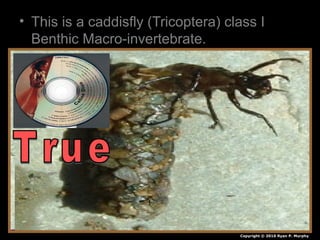
• This is a caddisfly (Tricoptera) class I
Benthic Macro-invertebrate.
• True!
Copyright © 2010 Ryan P. Murphy
• This is a caddisfly (Tricoptera) class I
Benthic Macro-invertebrate.
• True!
Copyright © 2010 Ryan P. Murphy
“Caddy.”
“A 5 iron
please.”
• This is a caddisfly (Tricoptera) class I
Benthic Macro-invertebrate.
• True!
Copyright © 2010 Ryan P. Murphy
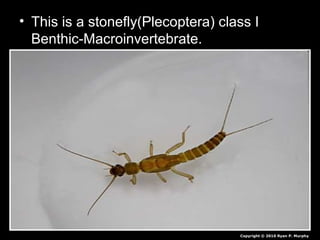
• This is a stonefly(Plecoptera) class I
Benthic-Macroinvertebrate.
• True!
Copyright © 2010 Ryan P. Murphy
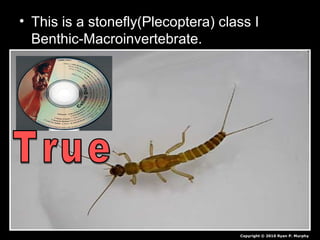
• This is a stonefly(Plecoptera) class I
Benthic-Macroinvertebrate.
• True!
Copyright © 2010 Ryan P. Murphy
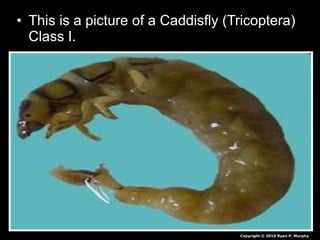
• This is a picture of a Caddisfly (Tricoptera)
Class I.
Copyright © 2010 Ryan P. Murphy
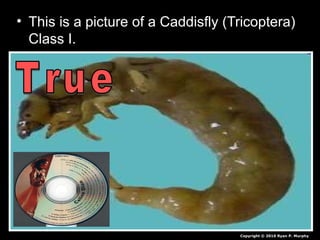
• This is a picture of a Caddisfly (Tricoptera)
Class I.
Copyright © 2010 Ryan P. Murphy
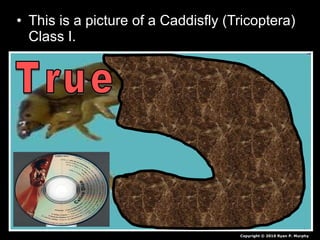
• This is a picture of a Caddisfly (Tricoptera)
Class I.
Copyright © 2010 Ryan P. Murphy
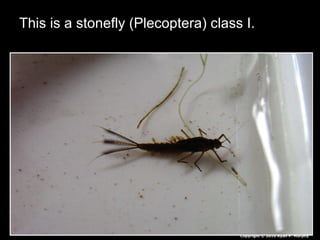
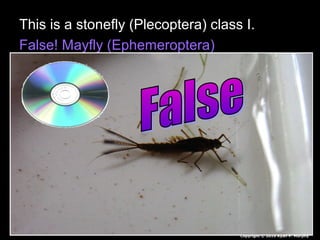
This is a stonefly (Plecoptera) class I.
Copyright © 2010 Ryan P. Murphy
This is a stonefly (Plecoptera) class I.
False! Mayfly (Ephemeroptera)
Copyright © 2010 Ryan P. Murphy
This is a stonefly (Plecoptera) class I.
False! Mayfly (Ephemeroptera)
Copyright © 2010 Ryan P. Murphy
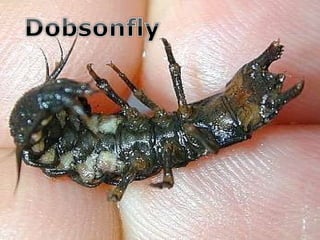
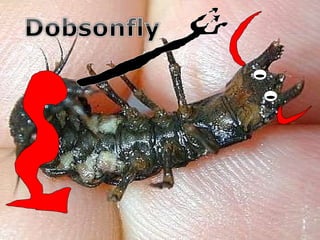
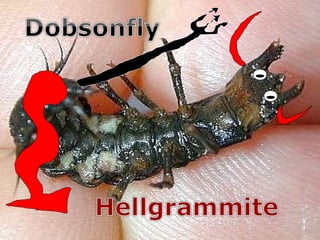
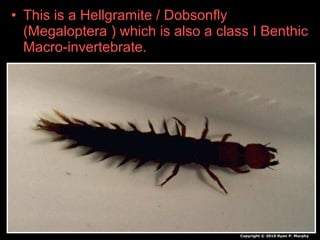
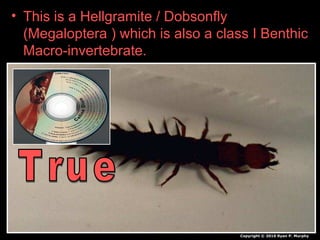
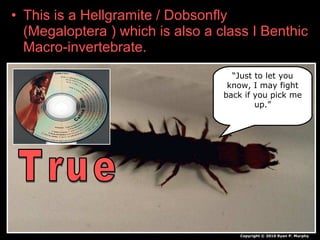
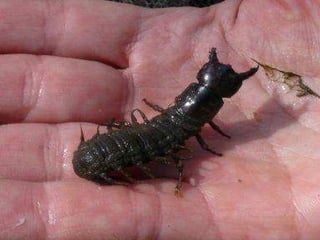
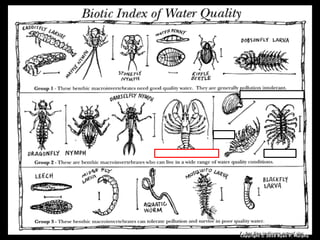
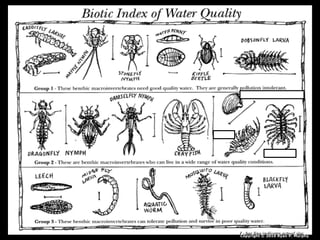
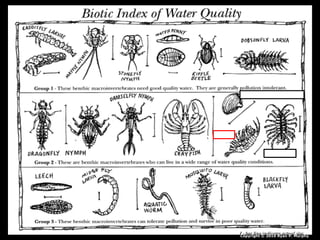
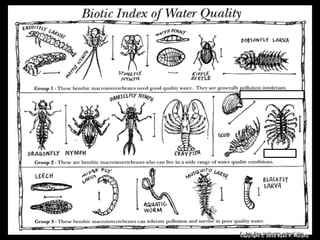
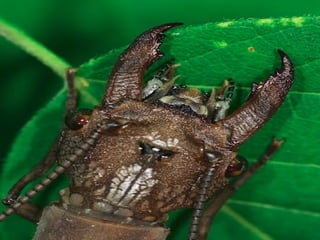
• This is a Hellgramite / Dobsonfly
(Megaloptera ) which is also a class I Benthic
Macro-invertebrate.
Copyright © 2010 Ryan P. Murphy
• This is a Hellgramite / Dobsonfly
(Megaloptera ) which is also a class I Benthic
Macro-invertebrate.
Copyright © 2010 Ryan P. Murphy
• This is a Hellgramite / Dobsonfly
(Megaloptera ) which is also a class I Benthic
Macro-invertebrate.
Copyright © 2010 Ryan P. Murphy
“Just to let you
know, I may fight
back if you pick me
up.”
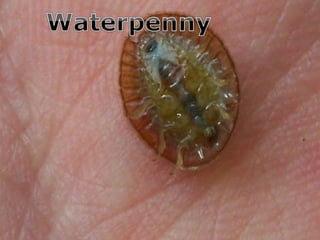
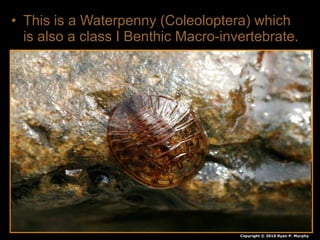
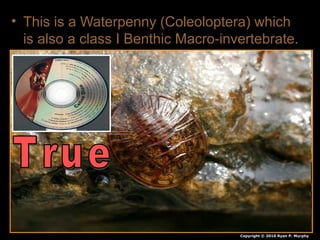
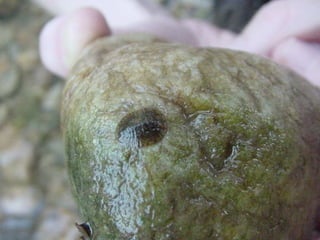
• This is a Waterpenny (Coleoloptera) which
is also a class I Benthic Macro-invertebrate.
Copyright © 2010 Ryan P. Murphy
• This is a Waterpenny (Coleoloptera) which
is also a class I Benthic Macro-invertebrate.
Copyright © 2010 Ryan P. Murphy
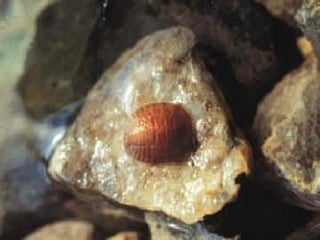
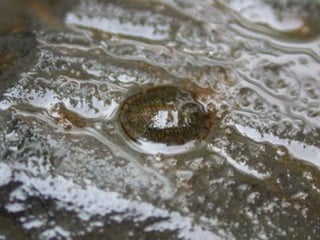
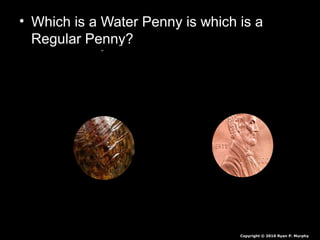
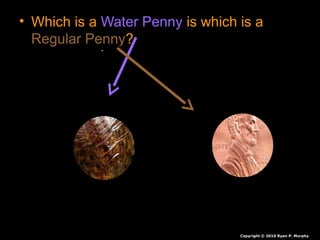
• Which is a Water Penny is which is a
Regular Penny?
Copyright © 2010 Ryan P. Murphy
• Which is a Water Penny is which is a
Regular Penny?
Copyright © 2010 Ryan P. Murphy
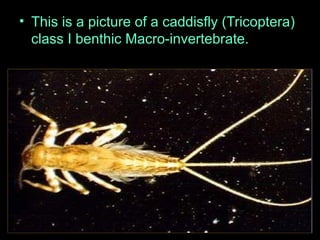
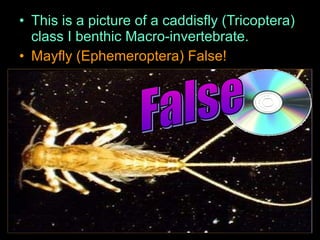
• This is a picture of a caddisfly (Tricoptera)
class I benthic Macro-invertebrate.
• This is a picture of a caddisfly (Tricoptera)
class I benthic Macro-invertebrate.
• Mayfly (Ephemeroptera) False!
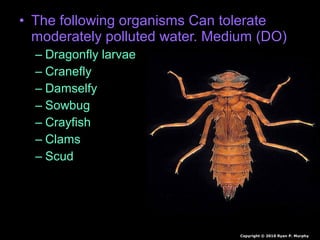
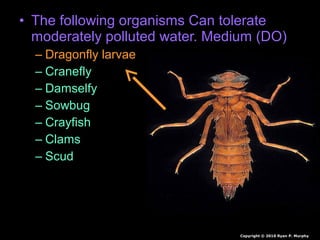
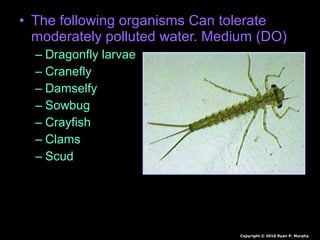
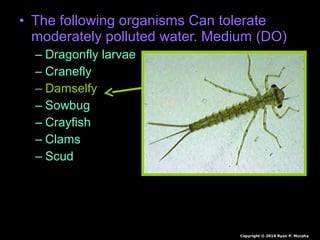
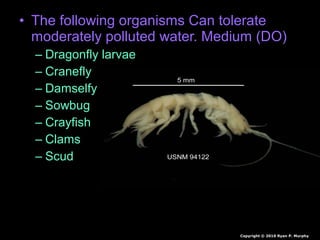
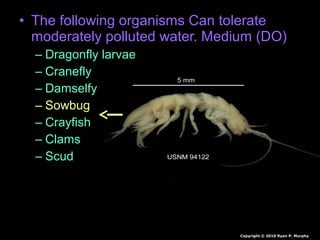
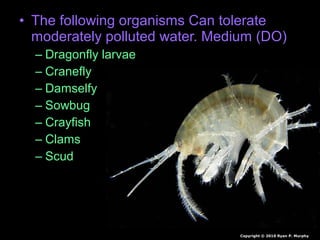
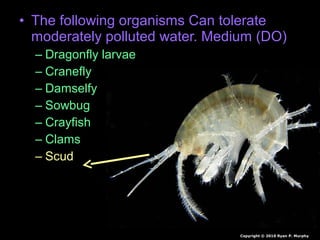
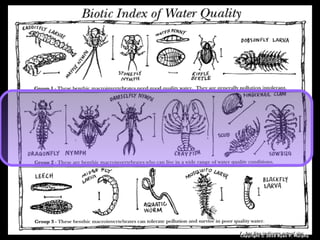
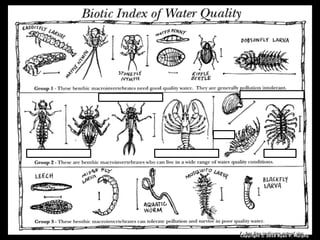
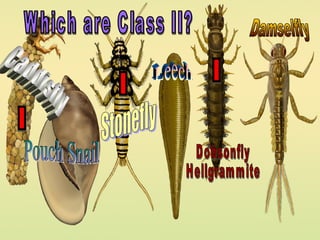
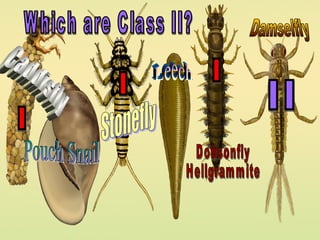
• The following organisms Can tolerate
moderately polluted water. Medium (DO)
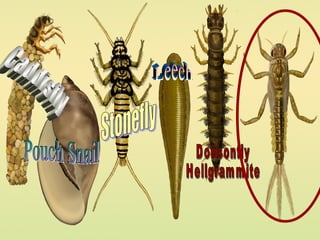
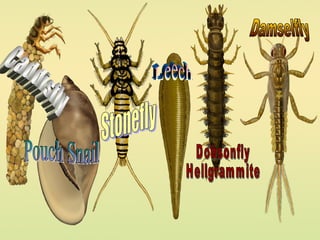
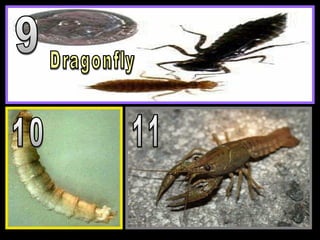
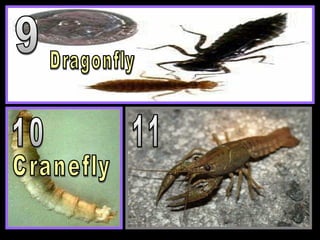
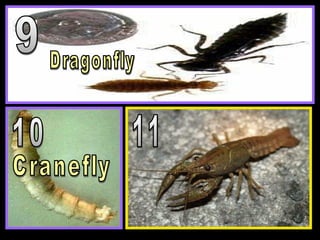
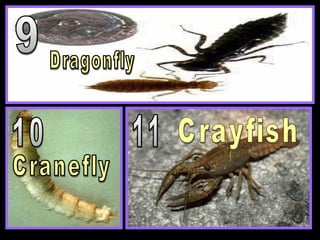
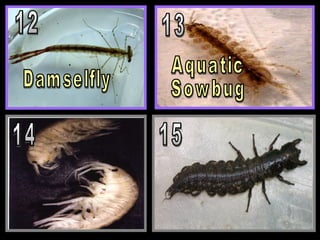
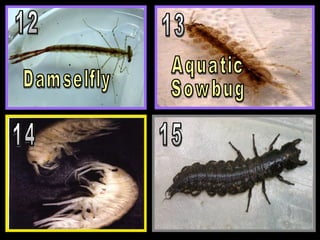
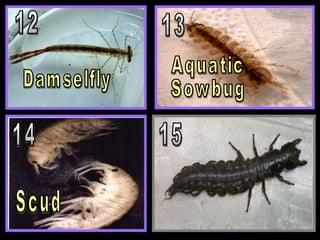
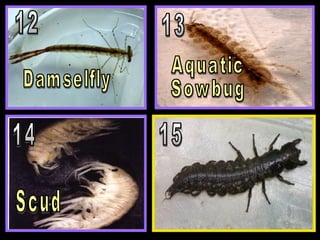
– Dragonfly larvae
– Cranefly
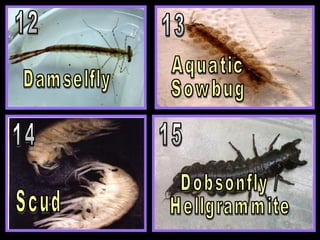
– Damselfy
– Sowbug
– Crayfish
– Clams
– Scud
Copyright © 2010 Ryan P. Murphy
• The following organisms Can tolerate
moderately polluted water. Medium (DO)
– Dragonfly larvae
– Cranefly
– Damselfy
– Sowbug
– Crayfish
– Clams
– Scud
Copyright © 2010 Ryan P. Murphy
• The following organisms Can tolerate
moderately polluted water. Medium (DO)
– Dragonfly larvae
– Cranefly
– Damselfy
– Sowbug
– Crayfish
– Clams
– Scud
Copyright © 2010 Ryan P. Murphy
• The following organisms Can tolerate
moderately polluted water. Medium (DO)
– Dragonfly larvae
– Cranefly
– Damselfy
– Sowbug
– Crayfish
– Clams
– Scud
Copyright © 2010 Ryan P. Murphy
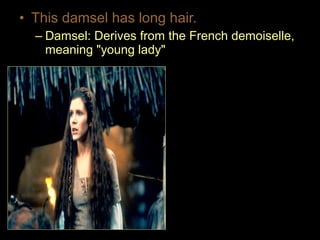
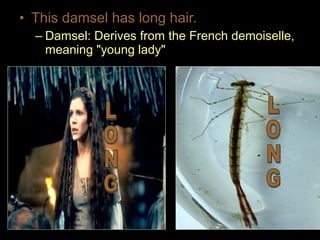
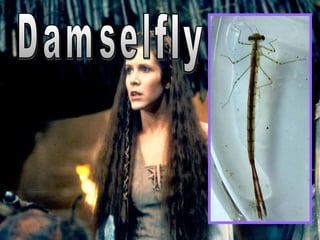
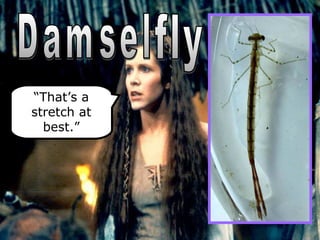
• This damsel has long hair.
– Damsel: Derives from the French demoiselle,
meaning "young lady"
• This damsel has long hair.
– Damsel: Derives from the French demoiselle,
meaning "young lady"
• The following organisms Can tolerate
moderately polluted water. Medium (DO)
– Dragonfly larvae
– Cranefly
– Damselfy
– Sowbug
– Crayfish
– Clams
– Scud
Copyright © 2010 Ryan P. Murphy
• The following organisms Can tolerate
moderately polluted water. Medium (DO)
– Dragonfly larvae
– Cranefly
– Damselfy
– Sowbug
– Crayfish
– Clams
– Scud
Copyright © 2010 Ryan P. Murphy
• The following organisms Can tolerate
moderately polluted water. Medium (DO)
– Dragonfly larvae
– Cranefly
– Damselfy
– Sowbug
– Crayfish
– Clams
– Scud
Copyright © 2010 Ryan P. Murphy
• The following organisms Can tolerate
moderately polluted water. Medium (DO)
– Dragonfly larvae
– Cranefly
– Damselfy
– Sowbug
– Crayfish
– Clams
– Scud
Copyright © 2010 Ryan P. Murphy
• Answer the true false questions with your
“Compact Disc / Coin”
Writing side of cd = True Clear side = False
• Which one is true, and which is false?
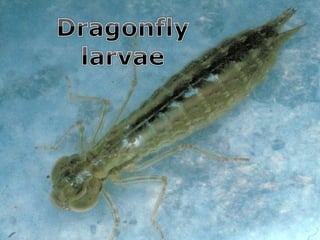
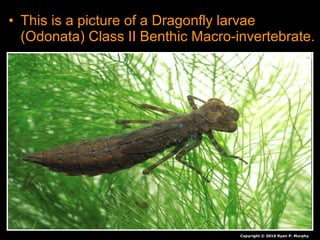
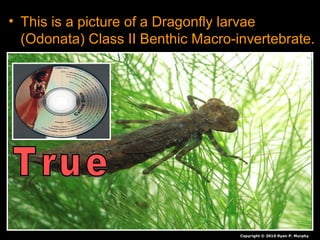
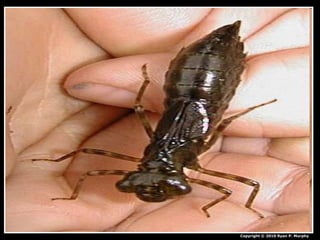
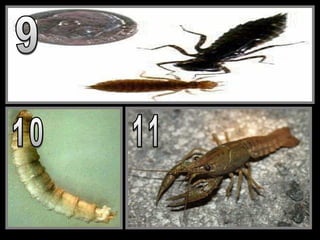
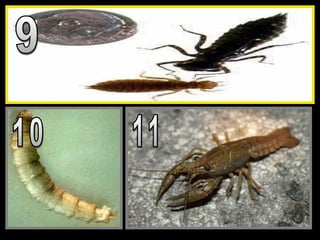
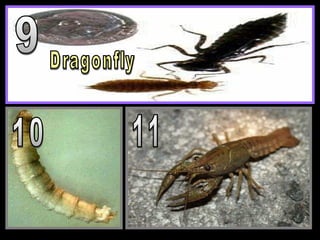
• This is a picture of a Dragonfly larvae
(Odonata) Class II Benthic Macro-invertebrate.
Copyright © 2010 Ryan P. Murphy
• This is a picture of a Dragonfly larvae
(Odonata) Class II Benthic Macro-invertebrate.
Copyright © 2010 Ryan P. Murphy
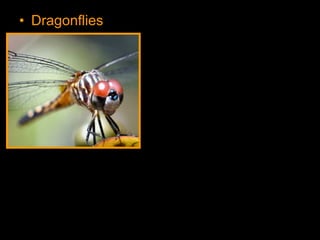
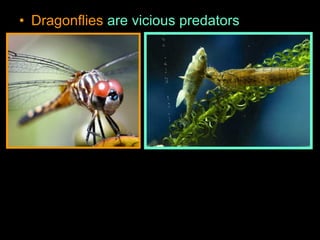
• Dragonflies are vicious predators
Copyright © 2010 Ryan P. Murphy
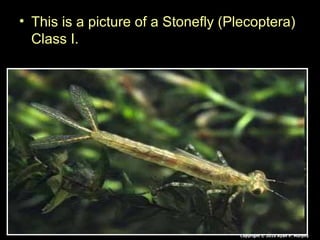
• This is a picture of a Stonefly (Plecoptera)
Class I.
Copyright © 2010 Ryan P. Murphy
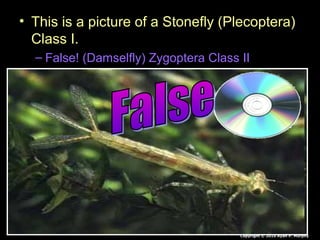
• This is a picture of a Stonefly (Plecoptera)
Class I.
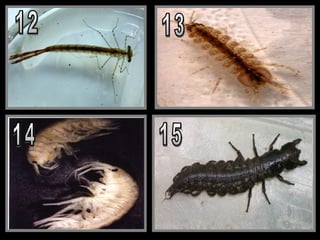
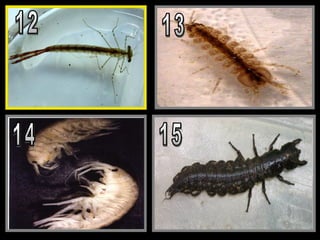
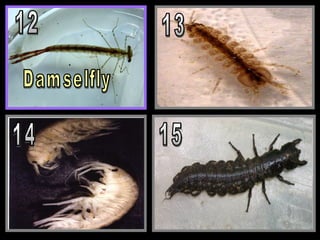
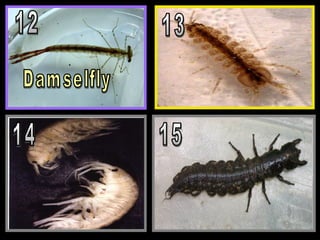
– False! (Damselfly) Zygoptera Class II
Copyright © 2010 Ryan P. Murphy
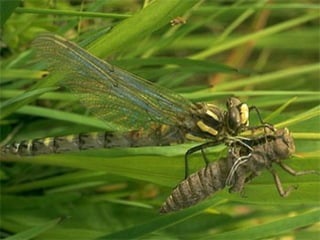
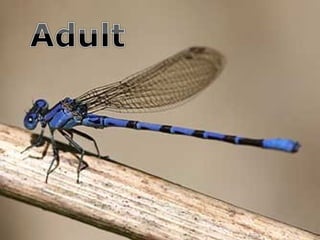
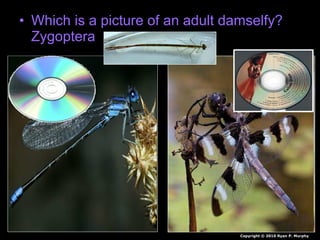
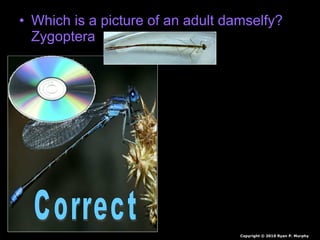
• Which is a picture of an adult damselfy?
Zygoptera
Copyright © 2010 Ryan P. Murphy
• Which is a picture of an adult damselfy?
Zygoptera
Copyright © 2010 Ryan P. Murphy
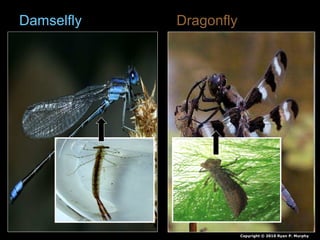
Damselfly Dragonfly
Copyright © 2010 Ryan P. Murphy
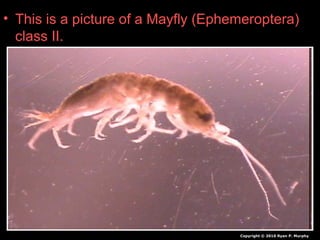
• This is a picture of a Mayfly (Ephemeroptera)
class II.
Copyright © 2010 Ryan P. Murphy
• This is a picture of a Mayfly (Ephemeroptera)
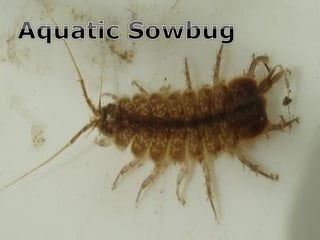
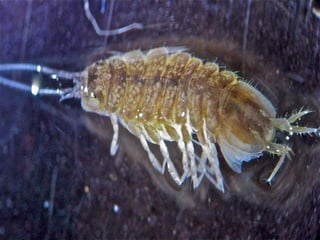
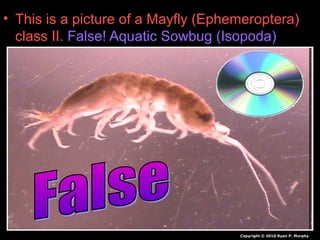
class II. False! Aquatic Sowbug (Isopoda)
Copyright © 2010 Ryan P. Murphy
• This is a picture of a Mayfly (Ephemeroptera)
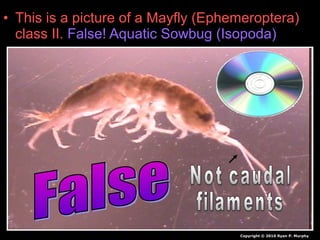
class II. False! Aquatic Sowbug (Isopoda)
Copyright © 2010 Ryan P. Murphy
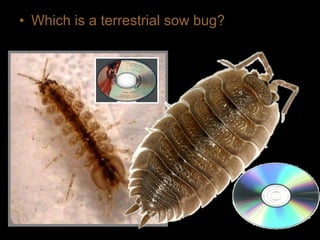
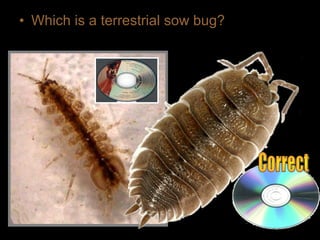
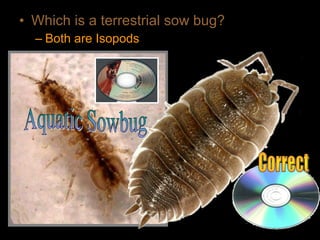
• Which is a terrestrial sow bug?
– Both are Isopods
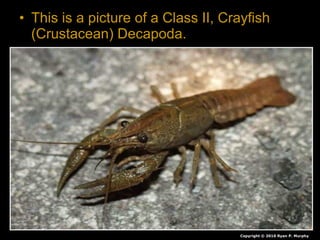
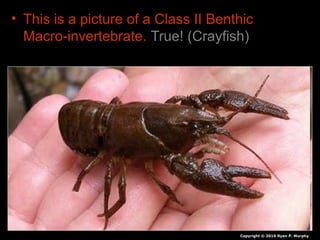
• This is a picture of a Class II, Crayfish
(Crustacean) Decapoda.
Copyright © 2010 Ryan P. Murphy
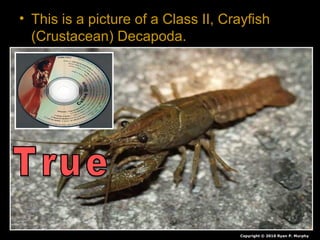
• This is a picture of a Class II, Crayfish
(Crustacean) Decapoda.
Copyright © 2010 Ryan P. Murphy
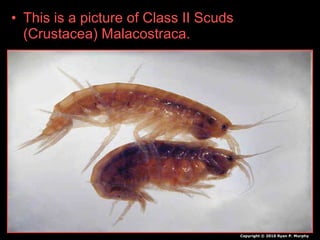
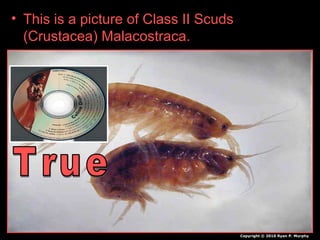
• This is a picture of Class II Scuds
(Crustacea) Malacostraca.
Copyright © 2010 Ryan P. Murphy
• This is a picture of Class II Scuds
(Crustacea) Malacostraca.
Copyright © 2010 Ryan P. Murphy
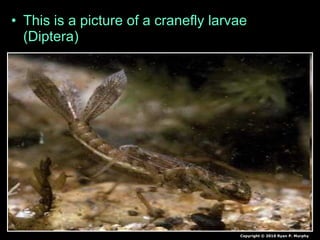
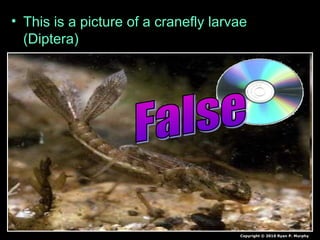
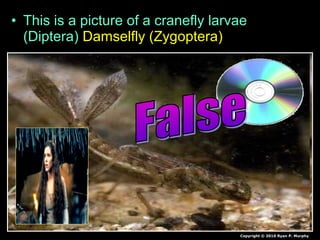
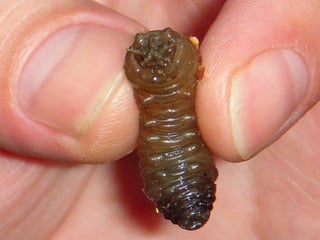
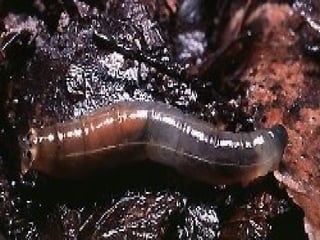
• This is a picture of a cranefly larvae
(Diptera)
Copyright © 2010 Ryan P. Murphy
• This is a picture of a cranefly larvae
(Diptera)
Copyright © 2010 Ryan P. Murphy
• This is a picture of a cranefly larvae
(Diptera) Damselfly (Zygoptera)
Copyright © 2010 Ryan P. Murphy
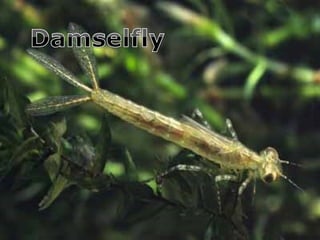
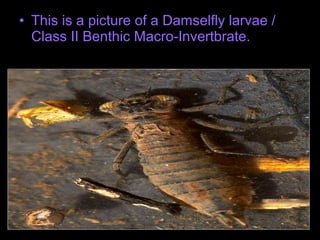
• This is a picture of a Damselfly larvae /
Class II Benthic Macro-Invertbrate.
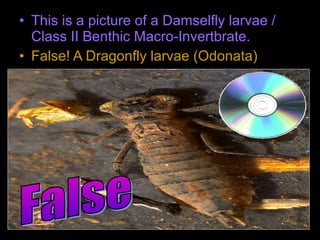
• This is a picture of a Damselfly larvae /
Class II Benthic Macro-Invertbrate.
• False! A Dragonfly larvae (Odonata)
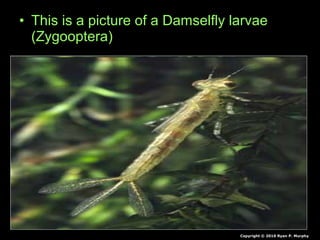
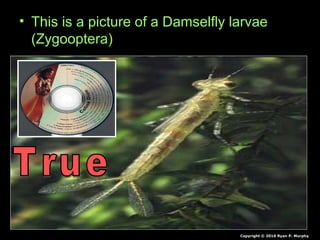
• This is a picture of a Damselfly larvae
(Zygooptera)
Copyright © 2010 Ryan P. Murphy
• This is a picture of a Damselfly larvae
(Zygooptera)
Copyright © 2010 Ryan P. Murphy
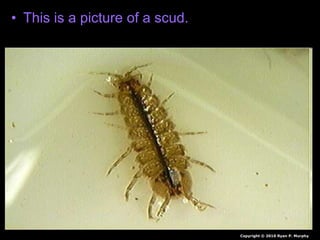
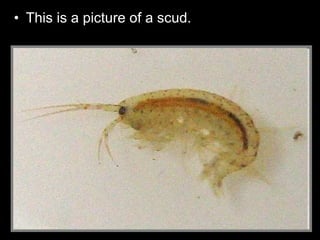
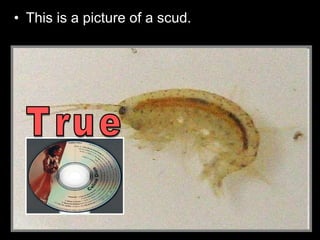
• This is a picture of a scud.
Copyright © 2010 Ryan P. Murphy
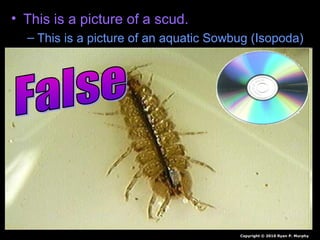
• This is a picture of a scud.
– This is a picture of an aquatic Sowbug (Isopoda)
Copyright © 2010 Ryan P. Murphy
• This is a picture of a scud.
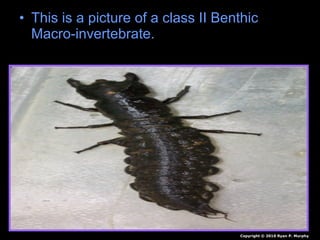
• This is a picture of a class II Benthic
Macro-invertebrate.
Copyright © 2010 Ryan P. Murphy
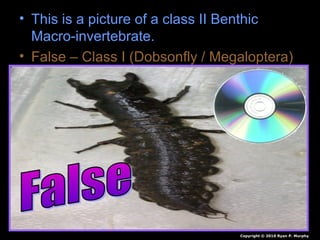
• This is a picture of a class II Benthic
Macro-invertebrate.
• False – Class I (Dobsonfly / Megaloptera)
Copyright © 2010 Ryan P. Murphy
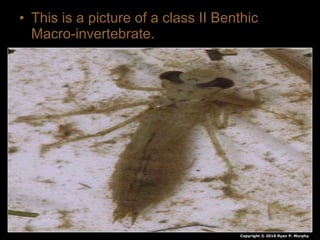
• This is a picture of a class II Benthic
Macro-invertebrate.
Copyright © 2010 Ryan P. Murphy
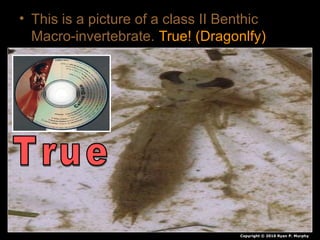
• This is a picture of a class II Benthic
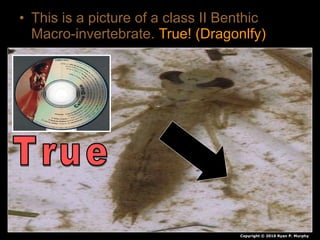
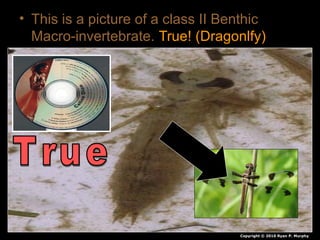
Macro-invertebrate. True! (Dragonlfy)
Copyright © 2010 Ryan P. Murphy
• This is a picture of a class II Benthic
Macro-invertebrate. True! (Dragonlfy)
Copyright © 2010 Ryan P. Murphy
• This is a picture of a class II Benthic
Macro-invertebrate. True! (Dragonlfy)
Copyright © 2010 Ryan P. Murphy
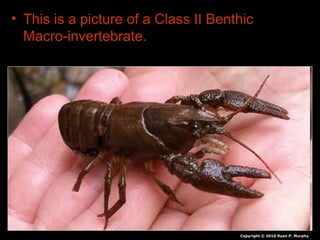
• This is a picture of a Class II Benthic
Macro-invertebrate.
Copyright © 2010 Ryan P. Murphy
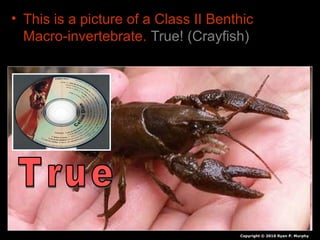
• This is a picture of a Class II Benthic
Macro-invertebrate. True! (Crayfish)
Copyright © 2010 Ryan P. Murphy
• This is a picture of a Class II Benthic
Macro-invertebrate. True! (Crayfish)
Copyright © 2010 Ryan P. Murphy
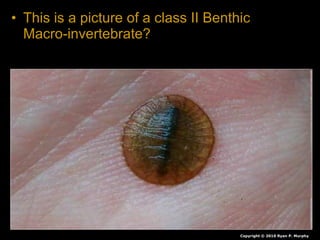
• This is a picture of a class II Benthic
Macro-invertebrate?
Copyright © 2010 Ryan P. Murphy
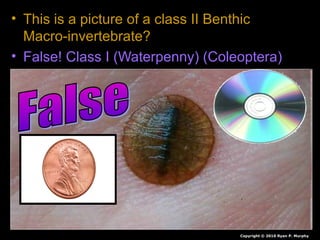
• This is a picture of a class II Benthic
Macro-invertebrate?
• False! Class I (Waterpenny) (Coleoptera)
Copyright © 2010 Ryan P. Murphy
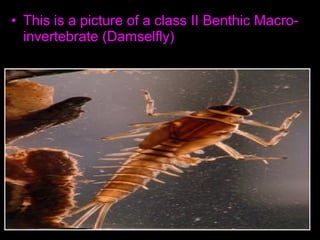
• This is a picture of a class II Benthic Macro-
invertebrate (Damselfly)
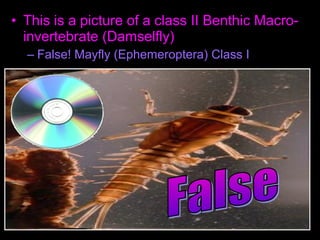
• This is a picture of a class II Benthic Macro-
invertebrate (Damselfly)
– False! Mayfly (Ephemeroptera) Class I
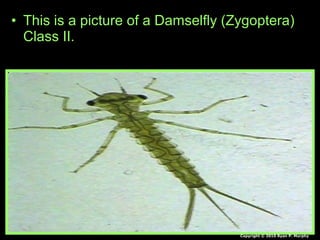
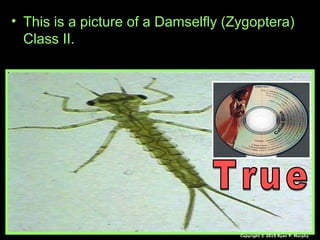
• This is a picture of a Damselfly (Zygoptera)
Class II.
Copyright © 2010 Ryan P. Murphy
• This is a picture of a Damselfly (Zygoptera)
Class II.
Copyright © 2010 Ryan P. Murphy
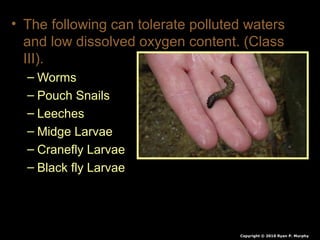
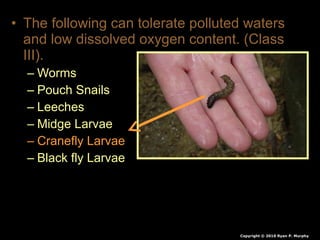
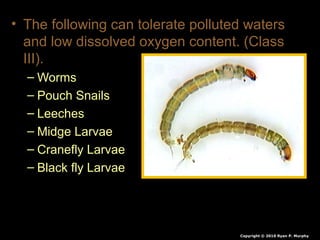
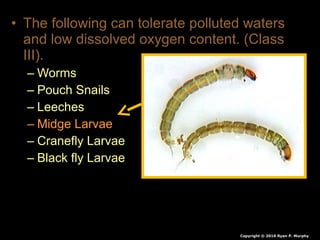
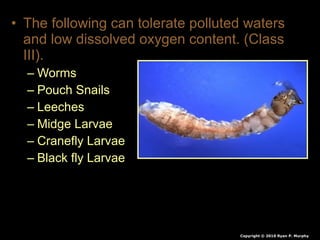
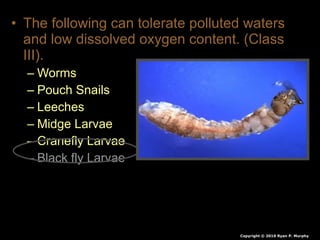
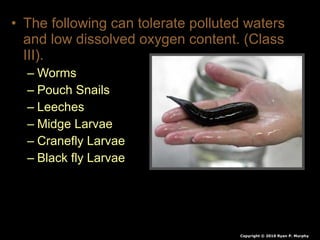
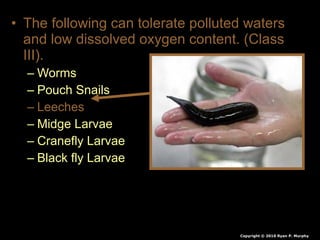
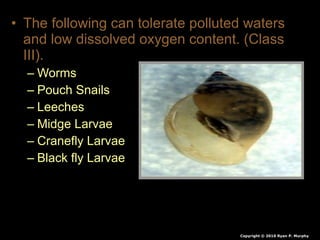
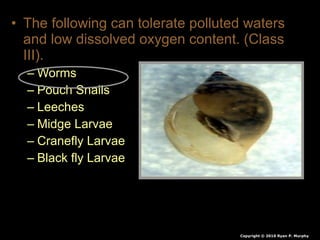
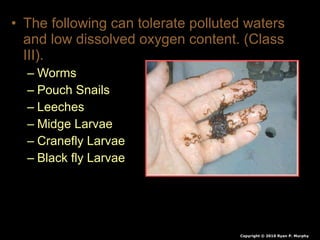
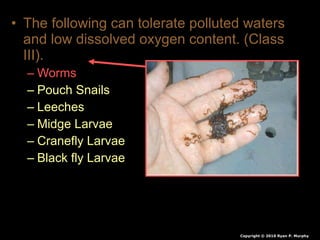
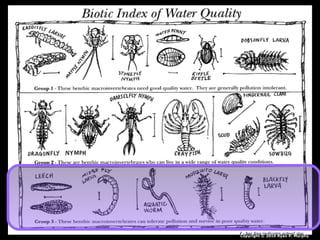
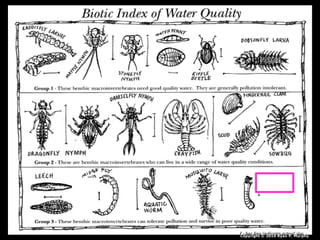
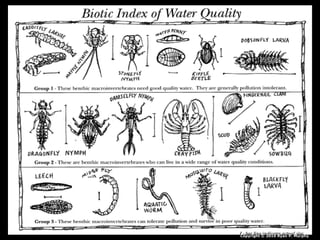
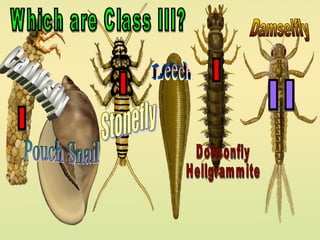
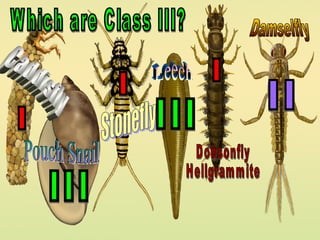
• The following can tolerate polluted waters
and low dissolved oxygen content. (Class
III).
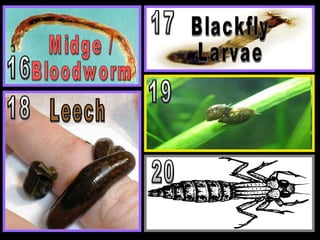
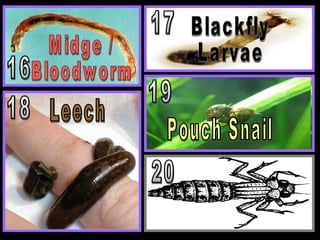
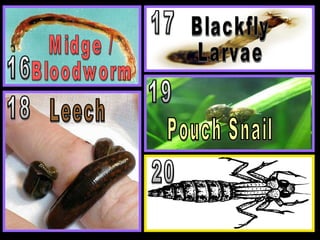
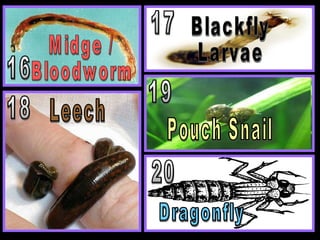
– Worms
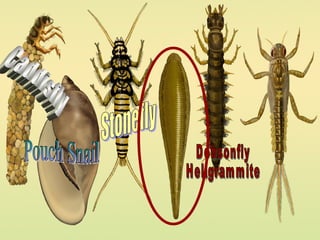
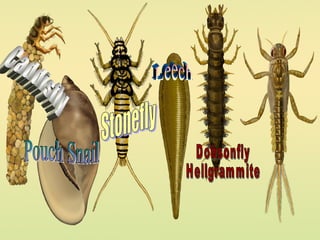
– Pouch Snails
– Leeches
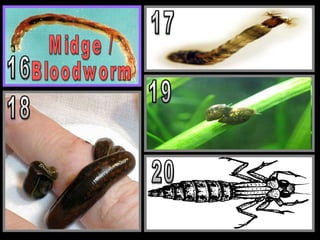
– Midge Larvae
– Cranefly Larvae
– Black fly Larvae
Copyright © 2010 Ryan P. Murphy
• The following can tolerate polluted waters
and low dissolved oxygen content. (Class
III).
– Worms
– Pouch Snails
– Leeches
– Midge Larvae
– Cranefly Larvae
– Black fly Larvae
Copyright © 2010 Ryan P. Murphy
• The following can tolerate polluted waters
and low dissolved oxygen content. (Class
III).
– Worms
– Pouch Snails
– Leeches
– Midge Larvae
– Cranefly Larvae
– Black fly Larvae
Copyright © 2010 Ryan P. Murphy
• The following can tolerate polluted waters
and low dissolved oxygen content. (Class
III).
– Worms
– Pouch Snails
– Leeches
– Midge Larvae
– Cranefly Larvae
– Black fly Larvae
Copyright © 2010 Ryan P. Murphy
• The following can tolerate polluted waters
and low dissolved oxygen content. (Class
III).
– Worms
– Pouch Snails
– Leeches
– Midge Larvae
– Cranefly Larvae
– Black fly Larvae
Copyright © 2010 Ryan P. Murphy
• The following can tolerate polluted waters
and low dissolved oxygen content. (Class
III).
– Worms
– Pouch Snails
– Leeches
– Midge Larvae
– Cranefly Larvae
– Black fly Larvae
Copyright © 2010 Ryan P. Murphy
• Video Link! Midge Life Cycle
– http://www.youtube.com/watch?
v=NGQEPZqNZU8
• The following can tolerate polluted waters
and low dissolved oxygen content. (Class
III).
– Worms
– Pouch Snails
– Leeches
– Midge Larvae
– Cranefly Larvae
– Black fly Larvae
Copyright © 2010 Ryan P. Murphy
• The following can tolerate polluted waters
and low dissolved oxygen content. (Class
III).
– Worms
– Pouch Snails
– Leeches
– Midge Larvae
– Cranefly Larvae
– Black fly Larvae
Copyright © 2010 Ryan P. Murphy
• The following can tolerate polluted waters
and low dissolved oxygen content. (Class
III).
– Worms
– Pouch Snails
– Leeches
– Midge Larvae
– Cranefly Larvae
– Black fly Larvae
Copyright © 2010 Ryan P. Murphy
• The following can tolerate polluted waters
and low dissolved oxygen content. (Class
III).
– Worms
– Pouch Snails
– Leeches
– Midge Larvae
– Cranefly Larvae
– Black fly Larvae
Copyright © 2010 Ryan P. Murphy
• The following can tolerate polluted waters
and low dissolved oxygen content. (Class
III).
– Worms
– Pouch Snails
– Leeches
– Midge Larvae
– Cranefly Larvae
– Black fly Larvae
Copyright © 2010 Ryan P. Murphy
• The following can tolerate polluted waters
and low dissolved oxygen content. (Class
III).
– Worms
– Pouch Snails
– Leeches
– Midge Larvae
– Cranefly Larvae
– Black fly Larvae
Copyright © 2010 Ryan P. Murphy
• The following can tolerate polluted waters
and low dissolved oxygen content. (Class
III).
– Worms
– Pouch Snails
– Leeches
– Midge Larvae
– Cranefly Larvae
– Black fly Larvae
Copyright © 2010 Ryan P. Murphy
• The following can tolerate polluted waters
and low dissolved oxygen content. (Class
III).
– Worms
– Pouch Snails
– Leeches
– Midge Larvae
– Cranefly Larvae
– Black fly Larvae
Copyright © 2010 Ryan P. Murphy
• Answer the true false questions with your
“Compact Disc / Coin”
Writing side of cd = True Clear side = False
• Which one is true, and which is false?
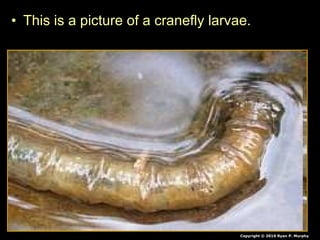
• This is a picture of a cranefly larvae.
Copyright © 2010 Ryan P. Murphy
• This is a picture of a cranefly larvae.
Copyright © 2010 Ryan P. Murphy
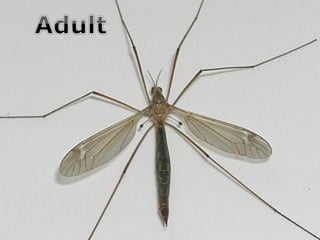
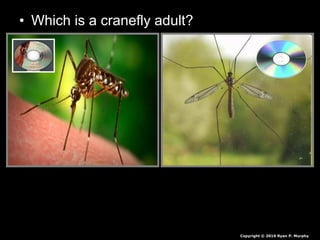
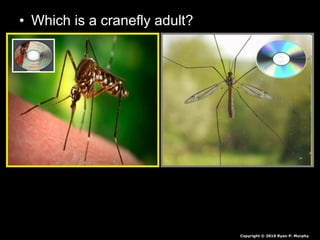
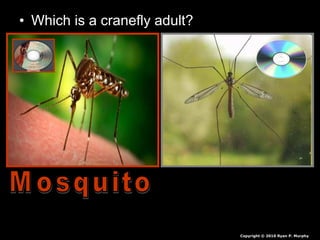
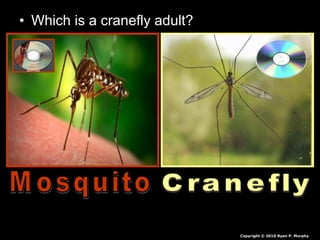
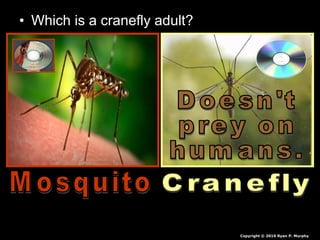
• Which is a cranefly adult?
Copyright © 2010 Ryan P. Murphy
• Which is a cranefly adult?
Copyright © 2010 Ryan P. Murphy
• Which is a cranefly adult?
Copyright © 2010 Ryan P. Murphy
• Which is a cranefly adult?
Copyright © 2010 Ryan P. Murphy
• Which is a cranefly adult?
Copyright © 2010 Ryan P. Murphy
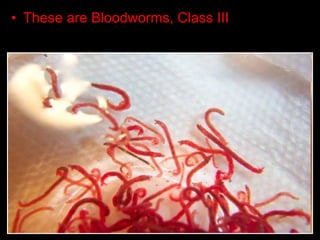
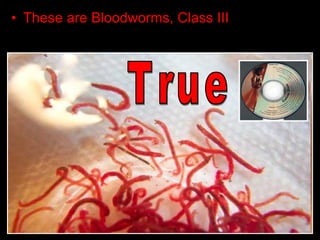
• These are Bloodworms, Class III
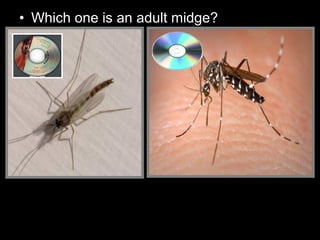
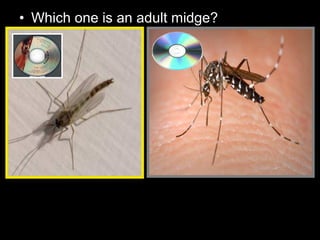
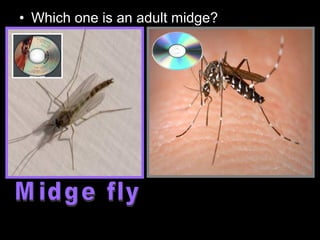
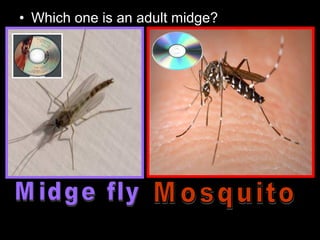
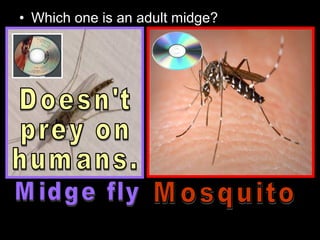
• Which one is an adult midge?
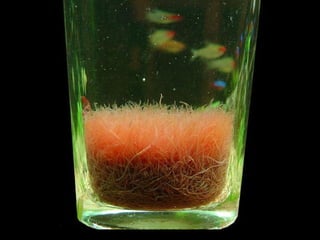
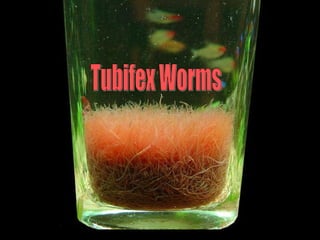
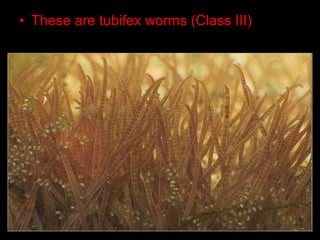
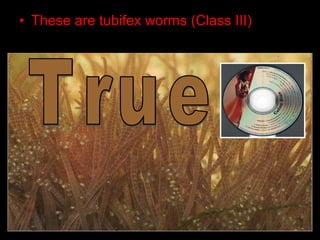
• These are tubifex worms (Class III)
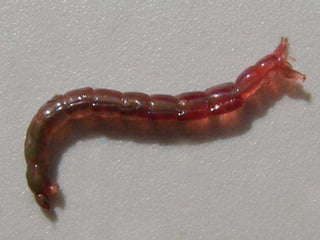
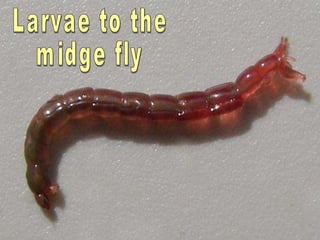
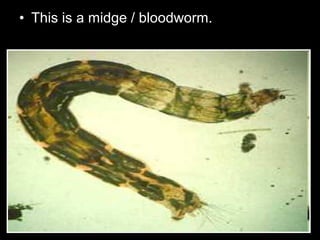
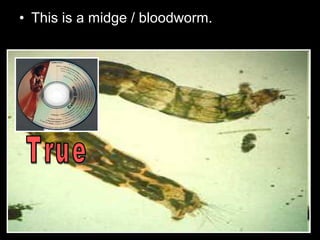
• This is a midge / bloodworm.
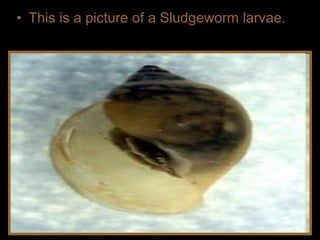
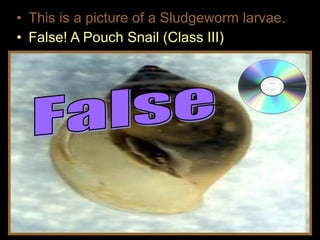
• This is a picture of a Sludgeworm larvae.
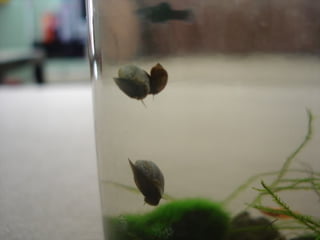
• False! A Pouch Snail (Class III)
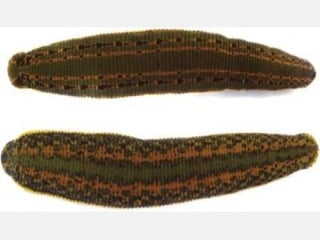
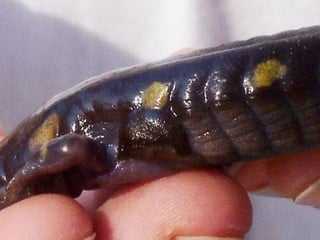
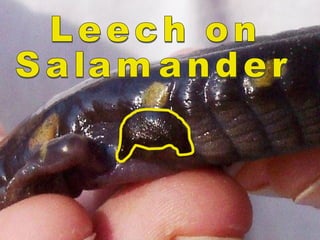
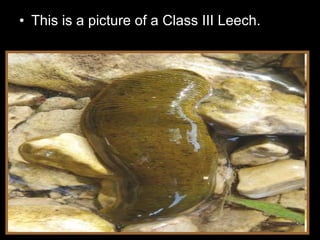
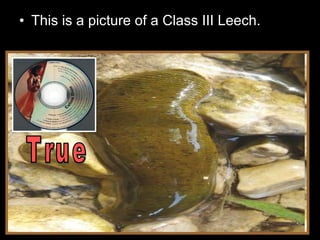
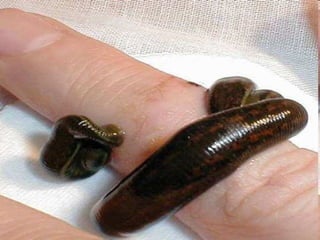
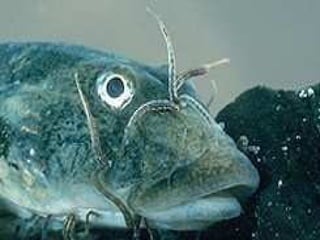
• This is a picture of a Class III Leech.
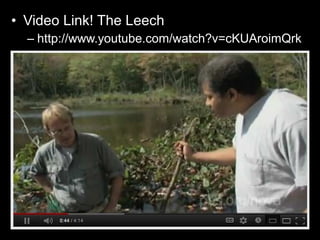
• Video Link! The Leech
– http://www.youtube.com/watch?v=cKUAroimQrk
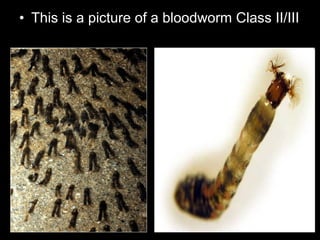
• This is a picture of a bloodworm Class II/III
• False! Blackfly larvae (Diptera)
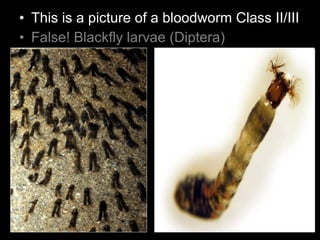
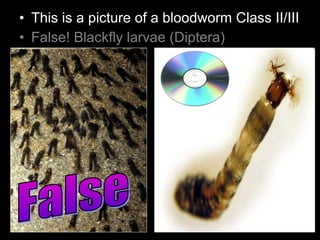
• This is a picture of a bloodworm Class II/III
• False! Blackfly larvae (Diptera)
Copyright © 2010 Ryan P. Murphy
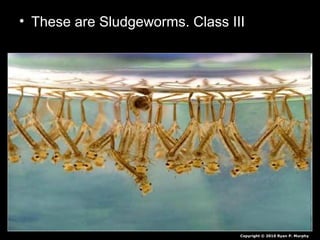
• These are Sludgeworms. Class III
Copyright © 2010 Ryan P. Murphy
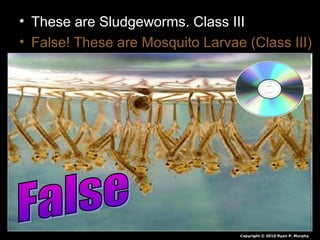
• These are Sludgeworms. Class III
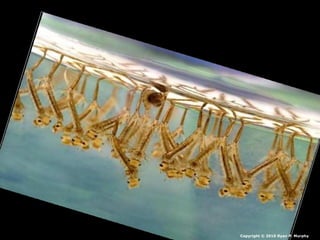
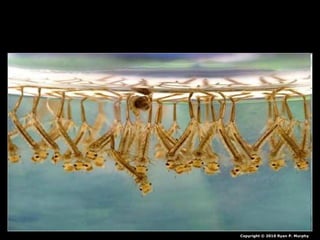
• False! These are Mosquito Larvae (Class III)
Copyright © 2010 Ryan P. Murphy
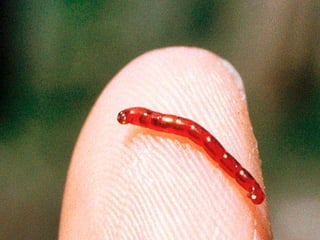
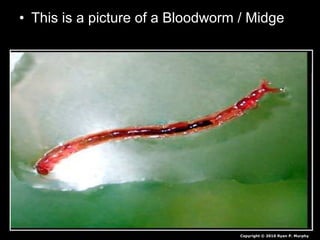
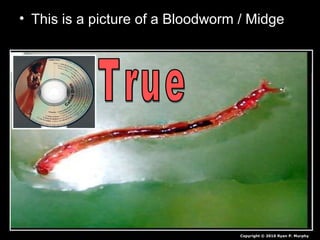
• This is a picture of a Bloodworm / Midge
Copyright © 2010 Ryan P. Murphy
• This is a picture of a Bloodworm / Midge
Copyright © 2010 Ryan P. Murphy
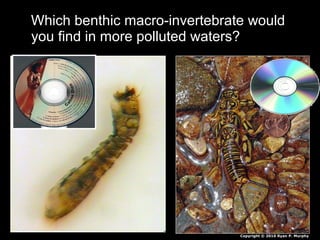
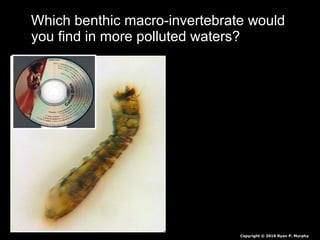
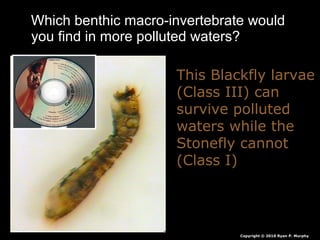
Which benthic macro-invertebrate would
you find in more polluted waters?
Copyright © 2010 Ryan P. Murphy
Which benthic macro-invertebrate would
you find in more polluted waters?
Copyright © 2010 Ryan P. Murphy
Which benthic macro-invertebrate would
you find in more polluted waters?
Copyright © 2010 Ryan P. Murphy
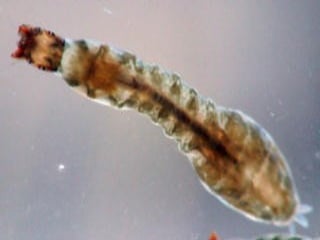
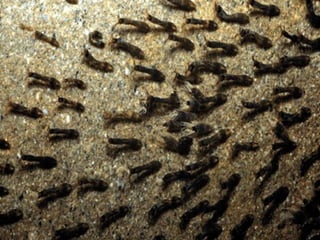
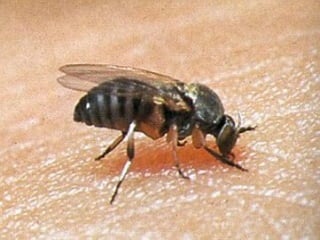
This Blackfly larvae
(Class III) can
survive polluted
waters while the
Stonefly cannot
(Class I)
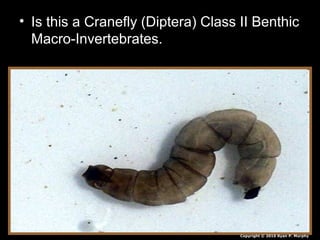
• Is this a Cranefly (Diptera) Class II Benthic
Macro-Invertebrates.
Copyright © 2010 Ryan P. Murphy
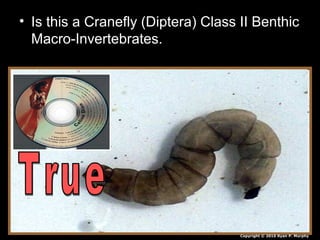
• Is this a Cranefly (Diptera) Class II Benthic
Macro-Invertebrates.
Copyright © 2010 Ryan P. Murphy
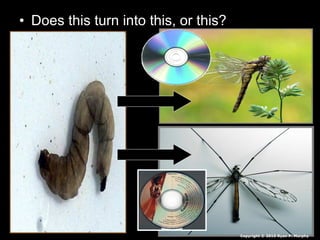
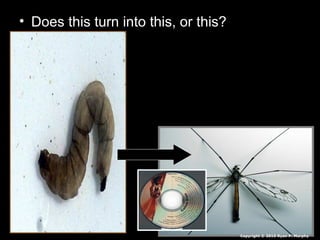
• Does this turn into this, or this?
Copyright © 2010 Ryan P. Murphy
• Does this turn into this, or this?
Copyright © 2010 Ryan P. Murphy
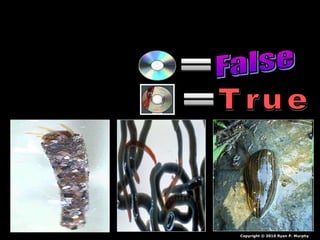
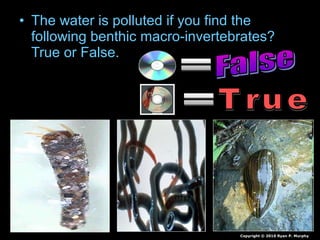
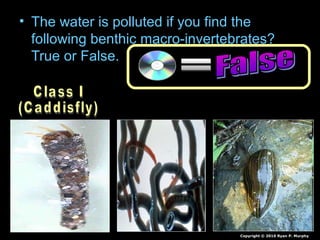
• The water is polluted if you find the
following benthic macro-invertebrates?
True or False.
Copyright © 2010 Ryan P. Murphy
• The water is polluted if you find the
following benthic macro-invertebrates?
True or False.
Copyright © 2010 Ryan P. Murphy
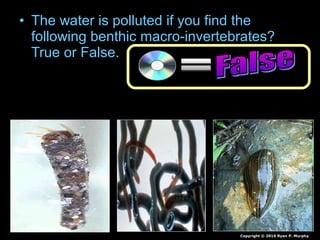
• The water is polluted if you find the
following benthic macro-invertebrates?
True or False.
Copyright © 2010 Ryan P. Murphy
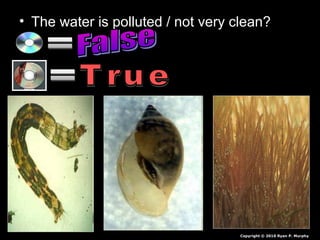
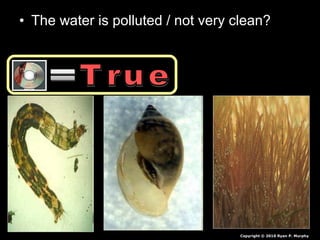
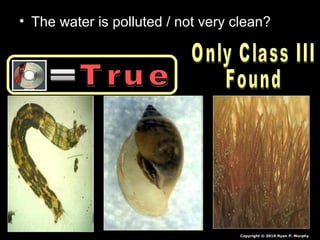
• The water is polluted / not very clean?
Copyright © 2010 Ryan P. Murphy
• The water is polluted / not very clean?
Copyright © 2010 Ryan P. Murphy
• The water is polluted / not very clean?
Copyright © 2010 Ryan P. Murphy
• Which groups still have a token after
playing 50/50?
Copyright © 2010 Ryan P. Murphy
• No cd’s = no treat 
• 1 cd = one treat each 
• 2 cd’s = two treats each 
• 3 cd’s = three treats each  etc.
Copyright © 2010 Ryan P. Murphy
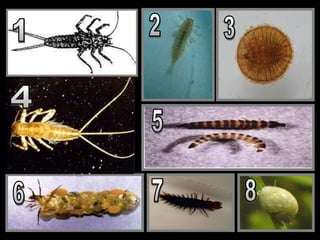
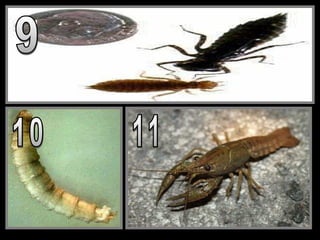
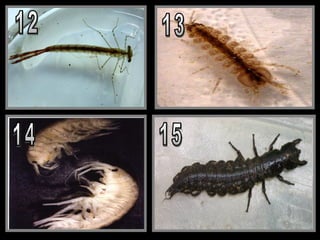
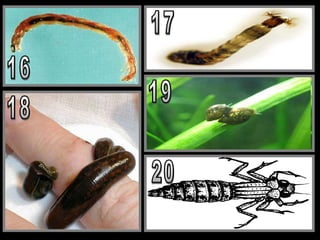
• Quiz 1-20 Name that Benthic Macro-
Invertebrate.
– Teacher to decide if you can use your sheet.
Copyright © 2010 Ryan P. Murphy
Name:
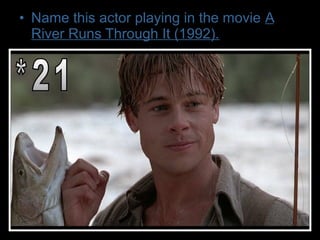
• Name this actor playing in the movie A
River Runs Through It (1992).
• Answers Quiz 1-20 Name that Benthic
Macro-Invertebrate.
• Name this actor playing in the movie A
River Runs Through It (1992).
• Name this actor playing in the movie A
River Runs Through It (1992).
• Name this actor playing in the movie A
River Runs Through It (1992).
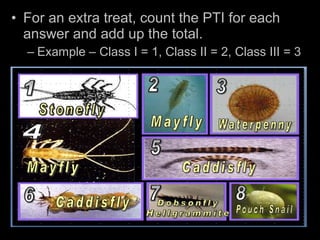
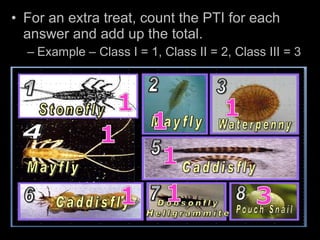
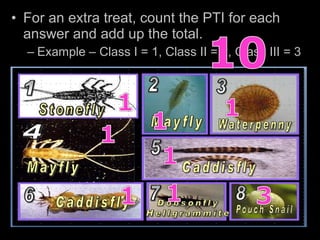
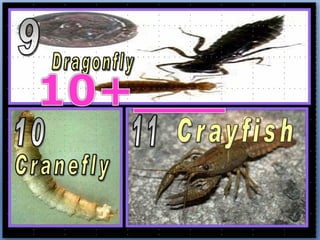
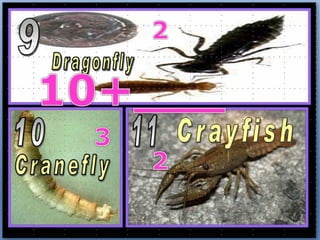
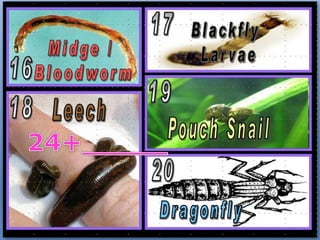
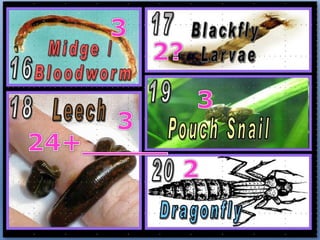
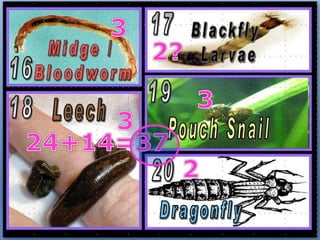
• For an extra treat, count the PTI for each
answer and add up the total.
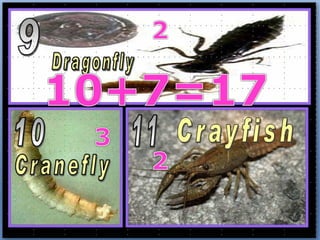
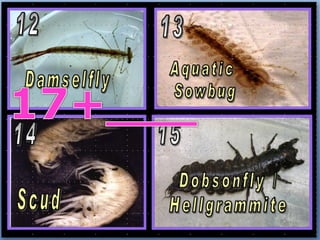
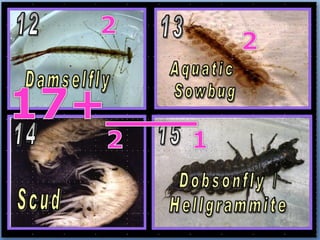
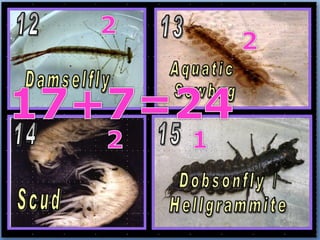
– Example – Class I = 1, Class II = 2, Class III = 3
• For an extra treat, count the PTI for each
answer and add up the total.
– Example – Class I = 1, Class II = 2, Class III = 3
• For an extra treat, count the PTI for each
answer and add up the total.
– Example – Class I = 1, Class II = 2, Class III = 3
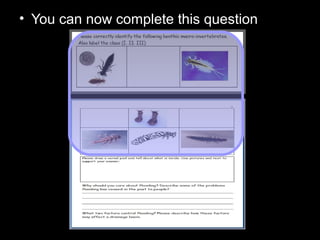
• You can now complete this question
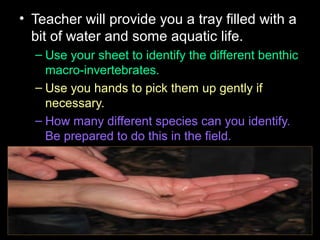
• Teacher will provide you a tray filled with a
bit of water and some aquatic life.
– Use your sheet to identify the different benthic
macro-invertebrates.
– Use you hands to pick them up gently if
necessary.
– How many different species can you identify.
Be prepared to do this in the field.
• Activity! (Optional) Benthic Macro-invertebrates.
– Visit a river / stream and have teacher / students kick
net for specimens.
• Bring specimens to trays on shore for data collection.
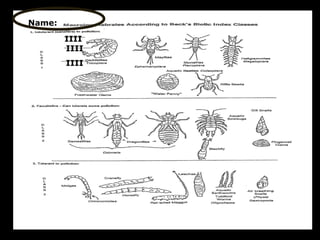
– Fill out sheet to determine the TOTAL NUMBER of
each type of Benthic-Macro-invertebrates by
recording a check next to each specimen.
• Example on next slide.
– Record final numbers in your journal with species
name according to class.
– Visit website:
http://www.cod.edu/people/faculty/chenpe/RiverWatc
h/MBI_calculator.html
Copyright © 2010 Ryan P. Murphy
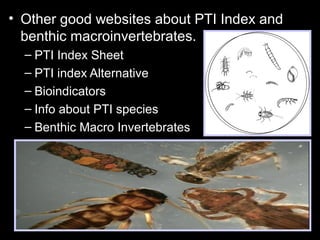
• Other good websites about PTI Index and
benthic macroinvertebrates.
– PTI Index Sheet
– PTI index Alternative
– Bioindicators
– Info about PTI species
– Benthic Macro Invertebrates
IIII
IIII
IIII
Name:
IIII
IIII
IIII
Name:
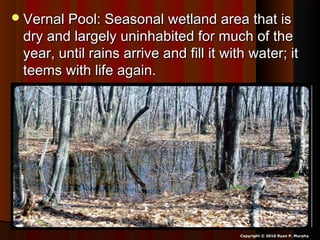
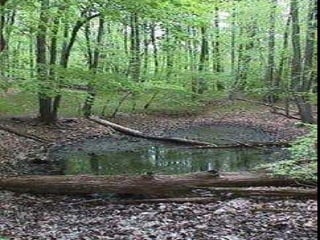
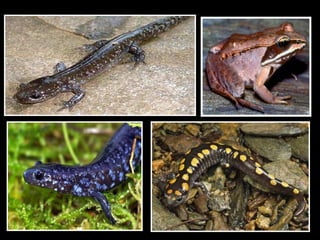
Vernal Pool: Seasonal wetland area that isVernal Pool: Seasonal wetland area that is
dry and largely uninhabited for much of thedry and largely uninhabited for much of the
year, until rains arrive and fill it with water; ityear, until rains arrive and fill it with water; it
teems with life again.teems with life again.
Copyright © 2010 Ryan P. Murphy
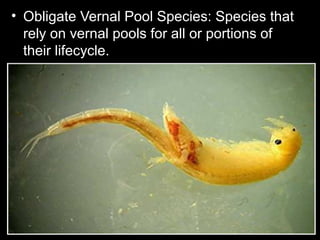
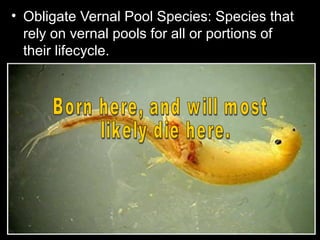
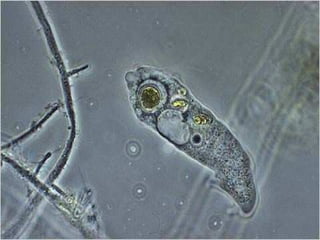
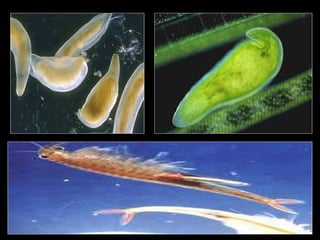
• Obligate Vernal Pool Species: Species that
rely on vernal pools for all or portions of
their lifecycle.
• Obligate Vernal Pool Species: Species that
rely on vernal pools for all or portions of
their lifecycle.
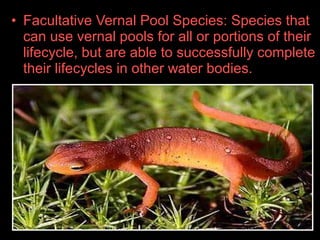
• Facultative Vernal Pool Species: Species that
can use vernal pools for all or portions of their
lifecycle, but are able to successfully complete
their lifecycles in other water bodies.
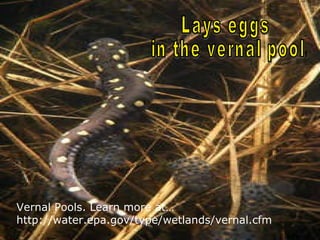
Vernal Pools. Learn more at…
http://water.epa.gov/type/wetlands/vernal.cfm
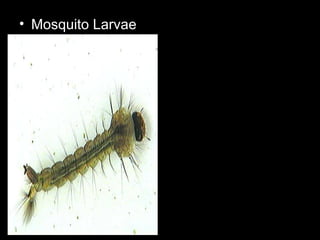
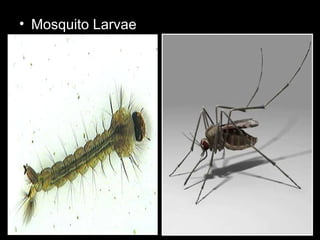
• Mosquito Larvae
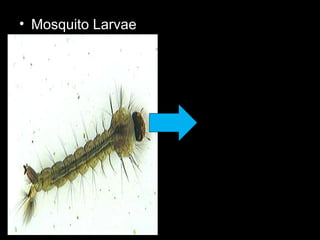
• Mosquito Larvae
• Mosquito Larvae
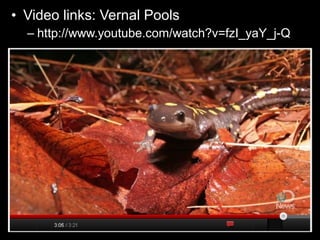
• Video links: Vernal Pools
– http://www.youtube.com/watch?v=fzI_yaY_j-Q
• Please trace three circles in your journal
with a Petri-dish.
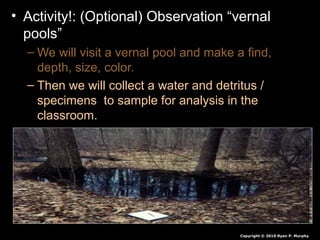
• Activity!: (Optional) Observation “vernal
pools”
– We will visit a vernal pool and make a find,
depth, size, color.
– Then we will collect a water and detritus /
specimens to sample for analysis in the
classroom.
Copyright © 2010 Ryan P. Murphy
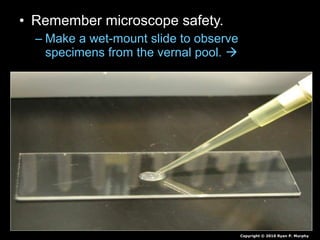
• Remember microscope safety.
– Make a wet-mount slide to observe
specimens from the vernal pool. 
Copyright © 2010 Ryan P. Murphy
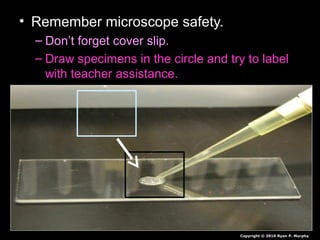
• Remember microscope safety.
– Don’t forget cover slip.
– Draw specimens in the circle and try to label
with teacher assistance.
Copyright © 2010 Ryan P. Murphy
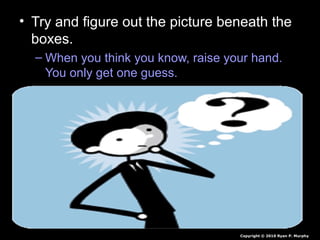
• Try and figure out the picture beneath the
boxes.
– When you think you know, raise your hand.
You only get one guess.
Copyright © 2010 Ryan P. Murphy
• Try and figure out the picture beneath the
boxes.
– When you think you know, raise your hand.
You only get one guess.
Copyright © 2010 Ryan P. Murphy
“That’s a
stretch at
best.”
• Try and figure out the picture beneath the
boxes.
– When you think you know, raise your hand.
You only get one guess.
Copyright © 2010 Ryan P. Murphy
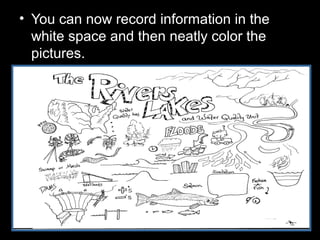
• You can now record information in the
white space and then neatly color the
pictures.
1
1
2
3
1
1
2
3
1
1
2
3
1
1
2
3
1
1
2
3
1
1
2
3
1
1
2
3
1
1
2
3
1
1
2
3
1
1
2
3
1
1
2
3
1
1
2
3
1
1
2
3
1
1
2
3
1
1
2
3
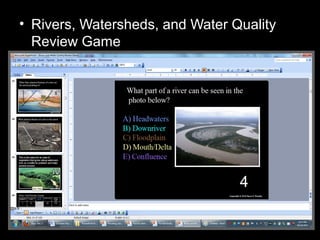
• Rivers, Watersheds, and Water Quality
Review Game
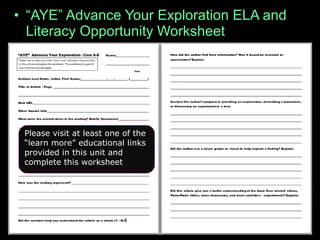
• “AYE” Advance Your Exploration ELA and
Literacy Opportunity Worksheet
– Visit some of the many provided links or..
– Articles can be found at (w/ membership to
NABT and NSTA)
• http://www.nabt.org/websites/institution/index.php?
p=1
• http://learningcenter.nsta.org/browse_journals.aspx?
journal=tstPlease visit at least one of the
“learn more” educational links
provided in this unit and
complete this worksheet
• “AYE” Advance Your Exploration ELA and
Literacy Opportunity Worksheet
– Visit some of the many provided links or..
– Articles can be found at (w/ membership to and
NSTA)
• http://www.sciencedaily.com/
• http://www.sciencemag.org/
• http://learningcenter.nsta.org/browse_journals.aspx?
journal=tst
• http://sciencepowerpoint.com/
• This PowerPoint is only small part of my Rivers,
Lakes, and Water Quality Unit.
– This unit includes a four part 2,150 slide PowerPoint
roadmap.
– 13 page bundled homework, modified version, 8
pages of lesson notes, built-in visual quizzes, review
game, 23 video links, hands-on activities with
instructions and questions, crossword, rubrics,
projects, answer keys, readings, materials list,
curriculum guide, and much more.
– http://sciencepowerpoint.com/River_and_Water_Quali
ty_Unit.htm
Areas of Focus within The Rivers and Water Quality Unit:
Watersheds, Rivers of the United States, Sections of a River, Parts of
River (Vocabulary), Stream Order, Erosion and Deposition, Water
Quality, Chemical Properties of Water, Bio-Indicators of Water Quality
(EPT richness), Physical Properties of Water Quality, Rivers and
Flooding, Factors that Control Flooding, Types of Flooding, Tsunami’s,
Wetlands, Flood Prevention, Levees, Dams and Ecosystem, Importance
of Dams, Impacts of Dams, Hydropower, Parts of Dam, Salmon (Life
Cycle), Systems of Help Salmon, Fish (General), Layering in a Lake,
Lake Turnover, Nutrients and Lakes.
Full Unit can be found at…
http://sciencepowerpoint.com/River_and_Water_Quality_Unit.h
tm
http://www.teacherspay
teachers.com/Product/P
hysical-Science-
Curriculum-596485
http://www.teachersp
ayteachers.com/Produ
ct/Life-Science-
Curriculum-601267
http://www.teachersp
ayteachers.com/Produ
ct/Earth-Science-
Curriculum-590950
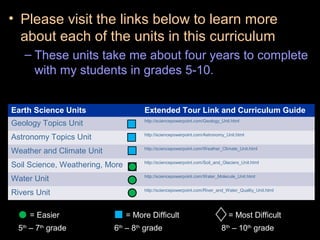
• Please visit the links below to learn more
about each of the units in this curriculum
– These units take me about four years to complete
with my students in grades 5-10.
Earth Science Units Extended Tour Link and Curriculum Guide
Geology Topics Unit http://sciencepowerpoint.com/Geology_Unit.html
Astronomy Topics Unit http://sciencepowerpoint.com/Astronomy_Unit.html
Weather and Climate Unit http://sciencepowerpoint.com/Weather_Climate_Unit.html
Soil Science, Weathering, More http://sciencepowerpoint.com/Soil_and_Glaciers_Unit.html
Water Unit http://sciencepowerpoint.com/Water_Molecule_Unit.html
Rivers Unit http://sciencepowerpoint.com/River_and_Water_Quality_Unit.html
= Easier = More Difficult = Most Difficult
5th
– 7th
grade 6th
– 8th
grade 8th
– 10th
grade
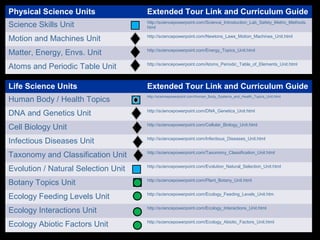
Physical Science Units Extended Tour Link and Curriculum Guide
Science Skills Unit http://sciencepowerpoint.com/Science_Introduction_Lab_Safety_Metric_Methods.
html
Motion and Machines Unit http://sciencepowerpoint.com/Newtons_Laws_Motion_Machines_Unit.html
Matter, Energy, Envs. Unit http://sciencepowerpoint.com/Energy_Topics_Unit.html
Atoms and Periodic Table Unit http://sciencepowerpoint.com/Atoms_Periodic_Table_of_Elements_Unit.html
Life Science Units Extended Tour Link and Curriculum Guide
Human Body / Health Topics
http://sciencepowerpoint.com/Human_Body_Systems_and_Health_Topics_Unit.html
DNA and Genetics Unit http://sciencepowerpoint.com/DNA_Genetics_Unit.html
Cell Biology Unit http://sciencepowerpoint.com/Cellular_Biology_Unit.html
Infectious Diseases Unit http://sciencepowerpoint.com/Infectious_Diseases_Unit.html
Taxonomy and Classification Unit http://sciencepowerpoint.com/Taxonomy_Classification_Unit.html
Evolution / Natural Selection Unit http://sciencepowerpoint.com/Evolution_Natural_Selection_Unit.html
Botany Topics Unit http://sciencepowerpoint.com/Plant_Botany_Unit.html
Ecology Feeding Levels Unit http://sciencepowerpoint.com/Ecology_Feeding_Levels_Unit.htm
Ecology Interactions Unit http://sciencepowerpoint.com/Ecology_Interactions_Unit.html
Ecology Abiotic Factors Unit http://sciencepowerpoint.com/Ecology_Abiotic_Factors_Unit.html
• The entire four year curriculum can be found
at... http://sciencepowerpoint.com/ Please feel
free to contact me with any questions you may
have. Thank you for your interest in this
curriculum.
Sincerely,
Ryan Murphy M.Ed
• http://sciencepowerpoint.com/

Benthic Macroinvertebrates Lesson PowerPoint, Water Quality, Insects

  • 1.
    • E- Ephemoptera(Mayfly) – Has 3 caudal filaments Copyright © 2010 Ryan P. Murphy
  • 3.
    • RED SLIDE:These are notes that are very important and should be recorded in your science journal. Copyright © 2010 Ryan P. Murphy
  • 4.
    -Nice neat notesthat are legible and use indentations when appropriate. -Example of indent. -Skip a line between topics -Don’t skip pages -Make visuals clear and well drawn.
  • 5.
  • 6.
    • RED SLIDE:These are notes that are very important and should be recorded in your science journal. • BLACK SLIDE: Pay attention, follow directions, complete projects as described and answer required questions neatly. Copyright © 2010 Ryan P. Murphy
  • 8.
  • 9.
  • 10.
  • 11.
  • 12.
  • 13.
    • Benthic Macroinvertebrates. Benthic:Living on the bottom Macro: Large
  • 14.
    • Benthic Macroinvertebrates. Benthic:Living on the bottom Macro: Large
  • 15.
    • Benthic Macroinvertebrates. Benthic:Living on the bottom Macro: Large Micro-Small
  • 16.
    • Benthic Macroinvertebrates. Benthic:Living on the bottom Macro: Large
  • 17.
    • Benthic Macroinvertebrates. Benthic:Living on the bottom Macro: Large Invertebrates: Without a backbone
  • 18.
    • Benthic Macroinvertebrates. Benthic:Living on the bottom Macro: Large Invertebrates: Without a backbone
  • 19.
    • Benthic Macroinvertebrates. Benthic:Living on the bottom Macro: Large Vertebrates: With a backbone
  • 20.
    • Activity! PTI,The Pollution Tolerance Index. Copyright © 2010 Ryan P. Murphy
  • 21.
    • Most ofthe insects that we see actually live most of their life in the water. – They emerge from the water to complete their life cycle. Copyright © 2010 Ryan P. Murphy
  • 22.
    • Biological: Thefollowing live only in unpolluted waters with high levels of dissolved oxygen – E- Ephemoptera (Mayfly) – P- Plecoptera (Stonefly) – T- Tricoptera (Caddisfly) – Megaloptera (Hellgrammite) – Coleoptera (Waterpenny) – Gilled Snail Copyright © 2010 Ryan P. Murphy
  • 23.
    • Biological: Thefollowing live only in unpolluted waters with high levels of dissolved oxygen – E- Ephemoptera (Mayfly) – P- Plecoptera (Stonefly) – T- Tricoptera (Caddisfly) – Megaloptera (Hellgrammite) – Coleoptera (Waterpenny) – Gilled Snail Copyright © 2010 Ryan P. Murphy
  • 24.
    • Biological: Thefollowing live only in unpolluted waters with high levels of dissolved oxygen – E- Ephemoptera (Mayfly) – P- Plecoptera (Stonefly) – T- Tricoptera (Caddisfly) – Megaloptera (Hellgrammite) – Coleoptera (Waterpenny) – Gilled Snail Copyright © 2010 Ryan P. Murphy
  • 25.
    • Biological: Thefollowing live only in unpolluted waters with high levels of dissolved oxygen – E- Ephemoptera (Mayfly) – P- Plecoptera (Stonefly) – T- Tricoptera (Caddisfly) – Megaloptera (Hellgrammite) – Coleoptera (Waterpenny) – Gilled Snail Copyright © 2010 Ryan P. Murphy
  • 26.
    • Biological: Thefollowing live only in unpolluted waters with high levels of dissolved oxygen – E- Ephemoptera (Mayfly) – P- Plecoptera (Stonefly) – T- Tricoptera (Caddisfly) – Megaloptera (Hellgrammite) – Coleoptera (Waterpenny) – Gilled Snail Copyright © 2010 Ryan P. Murphy Learn more about benthic macro-invertebrates at… http://www.dep.wv.gov/WWE/getinvolved/sos/Pages/Benthics.asp x
  • 43.
    • E- Ephemoptera(Mayfly) – Has 3 caudal filaments Copyright © 2010 Ryan P. Murphy
  • 44.
    • E- Ephemoptera(Mayfly) – Has 3 caudal filaments Copyright © 2010 Ryan P. Murphy
  • 45.
    • E- Ephemoptera(Mayfly) – Has 3 caudal filaments Copyright © 2010 Ryan P. Murphy
  • 46.
    • E- Ephemoptera(Mayfly) – Has 3 caudal filaments Copyright © 2010 Ryan P. Murphy
  • 47.
    • E- Ephemoptera(Mayfly) – Has 3 caudal filaments Copyright © 2010 Ryan P. Murphy
  • 48.
    • E- Ephemoptera(Mayfly) – Has 3 caudal filaments Copyright © 2010 Ryan P. Murphy
  • 53.
    – P- Plecoptera(Stonefly) • Two caudal filaments.
  • 54.
    – P- Plecoptera(Stonefly) • Two caudal filaments.
  • 59.
    • Video Link!Seeing some Benthic Macro Invertebrates up close. – http://www.youtube.com/watch?v=F6RKxeREHLc
  • 60.
    • People whofly fish will use patterns that look like these aquatic invertebrates. Copyright © 2010 Ryan P. Murphy
  • 61.
    • People whofly fish will use patterns that look like these aquatic invertebrates. Copyright © 2010 Ryan P. Murphy
  • 62.
    • People whofly fish will use patterns that look like these aquatic invertebrates. Copyright © 2010 Ryan P. Murphy
  • 63.
    • Many macroinvertebratesare dorsoventrally flattened. – What is dorsoventrally flattened? Copyright © 2010 Ryan P. Murphy
  • 64.
    • Many macroinvertebratesare dorsoventrally flattened. – What is dorsoventrally flattened? Copyright © 2010 Ryan P. Murphy
  • 65.
    • Many macroinvertebratesare dorsoventrally flattened. – What is dorsoventrally flattened? Copyright © 2010 Ryan P. Murphy
  • 66.
    • Many macroinvertebratesare dorsoventrally flattened. – What is dorsoventrally flattened? Copyright © 2010 Ryan P. Murphy
  • 67.
    • Many macroinvertebratesare dorsoventrally flattened. – What is dorsoventrally flattened? Copyright © 2010 Ryan P. Murphy
  • 68.
    • Many macroinvertebratesare dorsoventrally flattened. – What is dorsoventrally flattened? Copyright © 2010 Ryan P. Murphy
  • 73.
    • T- Tricoptera(Caddisfly) – Sometimes builds shelter from local materials. Copyright © 2010 Ryan P. Murphy
  • 74.
    • T- Tricoptera(Caddisfly) – Sometimes builds shelter from local materials. Copyright © 2010 Ryan P. Murphy
  • 75.
    • T- Tricoptera(Caddisfly) – Sometimes builds shelter from local materials. Copyright © 2010 Ryan P. Murphy
  • 81.
    • Which isbuilt better, the caddisfly home or the medieval castle? Copyright © 2010 Ryan P. Murphy
  • 82.
    • Video Link!Caddisflies (Tricoptera) – http://www.youtube.com/watch? v=_V2_aWmjpow
  • 86.
    • Many macroinvertebratesare dorsoventrally flattened. – What is dorsoventrally flattened? Copyright © 2010 Ryan P. Murphy
  • 95.
    • Activity! Gettingto know your benthic macro invertebrates before the 50/50 quiz. – Use this sheet to study now, but you will have to put it away for the 50/challenge.
  • 96.
    • Class IBenthic Macro-invertebrates Activity! 50/50 Round I/III – If you get the question correct then you get to keep your cd. If you get it wrong then you lose it . – Everyone starts with on cd. – Your table gets one token in round II, and one more in round III. – At the end of Part III, your groups gets a treat based on how many cd’s you have. • No cd’s = no treat  • 1 cd = one treat each  • 2 cd’s = two treats each  • 3 cd’s = three treats each  etc. Copyright © 2010 Ryan P. Murphy
  • 97.
    • Answer thetrue false questions with your “Compact Disc / Coin” Writing side of cd = True Clear side = False
  • 98.
    • Which oneis true, and which is false?
  • 99.
    • Which oneis true, and which is false?
  • 100.
    • Which oneis true, and which is false?
  • 101.
    • Which oneis true, and which is false?
  • 102.
    • Which oneis true, and which is false?
  • 103.
    • Activity! Benthic50/50 Challenge – Easier = Pass out sheet – Harder = Try and memorize picture key before each round.
  • 104.
  • 105.
    Copyright © 2010Ryan P. Murphy
  • 107.
    • This isa picture of a stonefly (Plecoptera) Class I Benthic Macro-invertebrate Copyright © 2010 Ryan P. Murphy
  • 108.
    • This isa picture of a stonefly (Plecoptera) Class I Benthic Macro-invertebrate. • False! Mayfly (Ephemeroptera) Copyright © 2010 Ryan P. Murphy
  • 109.
    • This isa picture of a stonefly (Plecoptera) Class I Benthic Macro-invertebrate. • False! Mayfly (Ephemeroptera) Copyright © 2010 Ryan P. Murphy
  • 110.
    • This isa picture of a stonefly (Plecoptera) class I benthic macro-invertebrate. Copyright © 2010 Ryan P. Murphy
  • 111.
    • This isa picture of a stonefly (Plecoptera) class I benthic macro-invertebrate. Copyright © 2010 Ryan P. Murphy
  • 112.
    • This isa picture of a stonefly (Plecoptera) class I benthic macro-invertebrate. Copyright © 2010 Ryan P. Murphy
  • 113.
    • This isa picture of a stonefly (Plecoptera) class I benthic macro-invertebrate. Copyright © 2010 Ryan P. Murphy “That’s bad grammar.”
  • 114.
    • This isa picture of a caddisfly (Tricoptera) Class I Benthic Macro-invertebrate. Copyright © 2010 Ryan P. Murphy
  • 115.
    • This isa picture of a caddisfly (Tricoptera) Class I Benthic Macro-invertebrate. • False! (Mayfly) Ephemeroptera class I Copyright © 2010 Ryan P. Murphy
  • 116.
    • This isa picture of a caddisfly (Tricoptera) Class I Benthic Macro-invertebrate. • False! (Mayfly) Ephemeroptera class I Copyright © 2010 Ryan P. Murphy
  • 117.
    • This isa caddisfly (Tricoptera) class I Benthic Macro-invertebrate. • True! Copyright © 2010 Ryan P. Murphy
  • 118.
    • This isa caddisfly (Tricoptera) class I Benthic Macro-invertebrate. • True! Copyright © 2010 Ryan P. Murphy
  • 119.
    • This isa caddisfly (Tricoptera) class I Benthic Macro-invertebrate. • True! Copyright © 2010 Ryan P. Murphy “Caddy.” “A 5 iron please.”
  • 120.
    • This isa caddisfly (Tricoptera) class I Benthic Macro-invertebrate. • True! Copyright © 2010 Ryan P. Murphy
  • 121.
    • This isa stonefly(Plecoptera) class I Benthic-Macroinvertebrate. • True! Copyright © 2010 Ryan P. Murphy
  • 122.
    • This isa stonefly(Plecoptera) class I Benthic-Macroinvertebrate. • True! Copyright © 2010 Ryan P. Murphy
  • 123.
    • This isa picture of a Caddisfly (Tricoptera) Class I. Copyright © 2010 Ryan P. Murphy
  • 124.
    • This isa picture of a Caddisfly (Tricoptera) Class I. Copyright © 2010 Ryan P. Murphy
  • 125.
    • This isa picture of a Caddisfly (Tricoptera) Class I. Copyright © 2010 Ryan P. Murphy
  • 126.
    This is astonefly (Plecoptera) class I. Copyright © 2010 Ryan P. Murphy
  • 127.
    This is astonefly (Plecoptera) class I. False! Mayfly (Ephemeroptera) Copyright © 2010 Ryan P. Murphy
  • 128.
    This is astonefly (Plecoptera) class I. False! Mayfly (Ephemeroptera) Copyright © 2010 Ryan P. Murphy
  • 129.
    • This isa Hellgramite / Dobsonfly (Megaloptera ) which is also a class I Benthic Macro-invertebrate. Copyright © 2010 Ryan P. Murphy
  • 130.
    • This isa Hellgramite / Dobsonfly (Megaloptera ) which is also a class I Benthic Macro-invertebrate. Copyright © 2010 Ryan P. Murphy
  • 131.
    • This isa Hellgramite / Dobsonfly (Megaloptera ) which is also a class I Benthic Macro-invertebrate. Copyright © 2010 Ryan P. Murphy “Just to let you know, I may fight back if you pick me up.”
  • 133.
    • This isa Waterpenny (Coleoloptera) which is also a class I Benthic Macro-invertebrate. Copyright © 2010 Ryan P. Murphy
  • 134.
    • This isa Waterpenny (Coleoloptera) which is also a class I Benthic Macro-invertebrate. Copyright © 2010 Ryan P. Murphy
  • 136.
    • Which isa Water Penny is which is a Regular Penny? Copyright © 2010 Ryan P. Murphy
  • 137.
    • Which isa Water Penny is which is a Regular Penny? Copyright © 2010 Ryan P. Murphy
  • 138.
    • This isa picture of a caddisfly (Tricoptera) class I benthic Macro-invertebrate.
  • 139.
    • This isa picture of a caddisfly (Tricoptera) class I benthic Macro-invertebrate. • Mayfly (Ephemeroptera) False!
  • 141.
    • The followingorganisms Can tolerate moderately polluted water. Medium (DO) – Dragonfly larvae – Cranefly – Damselfy – Sowbug – Crayfish – Clams – Scud Copyright © 2010 Ryan P. Murphy
  • 142.
    • The followingorganisms Can tolerate moderately polluted water. Medium (DO) – Dragonfly larvae – Cranefly – Damselfy – Sowbug – Crayfish – Clams – Scud Copyright © 2010 Ryan P. Murphy
  • 149.
    • The followingorganisms Can tolerate moderately polluted water. Medium (DO) – Dragonfly larvae – Cranefly – Damselfy – Sowbug – Crayfish – Clams – Scud Copyright © 2010 Ryan P. Murphy
  • 150.
    • The followingorganisms Can tolerate moderately polluted water. Medium (DO) – Dragonfly larvae – Cranefly – Damselfy – Sowbug – Crayfish – Clams – Scud Copyright © 2010 Ryan P. Murphy
  • 153.
    • This damselhas long hair. – Damsel: Derives from the French demoiselle, meaning "young lady"
  • 154.
    • This damselhas long hair. – Damsel: Derives from the French demoiselle, meaning "young lady"
  • 156.
    • The followingorganisms Can tolerate moderately polluted water. Medium (DO) – Dragonfly larvae – Cranefly – Damselfy – Sowbug – Crayfish – Clams – Scud Copyright © 2010 Ryan P. Murphy
  • 157.
    • The followingorganisms Can tolerate moderately polluted water. Medium (DO) – Dragonfly larvae – Cranefly – Damselfy – Sowbug – Crayfish – Clams – Scud Copyright © 2010 Ryan P. Murphy
  • 161.
    • The followingorganisms Can tolerate moderately polluted water. Medium (DO) – Dragonfly larvae – Cranefly – Damselfy – Sowbug – Crayfish – Clams – Scud Copyright © 2010 Ryan P. Murphy
  • 162.
    • The followingorganisms Can tolerate moderately polluted water. Medium (DO) – Dragonfly larvae – Cranefly – Damselfy – Sowbug – Crayfish – Clams – Scud Copyright © 2010 Ryan P. Murphy
  • 166.
    Copyright © 2010Ryan P. Murphy
  • 167.
    Copyright © 2010Ryan P. Murphy
  • 168.
    Copyright © 2010Ryan P. Murphy
  • 169.
    Copyright © 2010Ryan P. Murphy
  • 170.
    Copyright © 2010Ryan P. Murphy
  • 171.
    Copyright © 2010Ryan P. Murphy
  • 172.
    Copyright © 2010Ryan P. Murphy
  • 173.
    Copyright © 2010Ryan P. Murphy
  • 174.
    Copyright © 2010Ryan P. Murphy
  • 175.
    Copyright © 2010Ryan P. Murphy
  • 176.
    Copyright © 2010Ryan P. Murphy
  • 177.
    Copyright © 2010Ryan P. Murphy
  • 178.
    Copyright © 2010Ryan P. Murphy
  • 179.
    Copyright © 2010Ryan P. Murphy
  • 180.
    • Answer thetrue false questions with your “Compact Disc / Coin” Writing side of cd = True Clear side = False
  • 181.
    • Which oneis true, and which is false?
  • 182.
    • Which oneis true, and which is false?
  • 183.
    • Which oneis true, and which is false?
  • 184.
    • Which oneis true, and which is false?
  • 185.
    • Which oneis true, and which is false?
  • 187.
    • This isa picture of a Dragonfly larvae (Odonata) Class II Benthic Macro-invertebrate. Copyright © 2010 Ryan P. Murphy
  • 188.
    • This isa picture of a Dragonfly larvae (Odonata) Class II Benthic Macro-invertebrate. Copyright © 2010 Ryan P. Murphy
  • 189.
    • Dragonflies arevicious predators
  • 190.
    • Dragonflies arevicious predators
  • 191.
    Copyright © 2010Ryan P. Murphy
  • 192.
    • This isa picture of a Stonefly (Plecoptera) Class I. Copyright © 2010 Ryan P. Murphy
  • 193.
    • This isa picture of a Stonefly (Plecoptera) Class I. – False! (Damselfly) Zygoptera Class II Copyright © 2010 Ryan P. Murphy
  • 194.
    • Which isa picture of an adult damselfy? Zygoptera Copyright © 2010 Ryan P. Murphy
  • 195.
    • Which isa picture of an adult damselfy? Zygoptera Copyright © 2010 Ryan P. Murphy
  • 196.
  • 197.
    • This isa picture of a Mayfly (Ephemeroptera) class II. Copyright © 2010 Ryan P. Murphy
  • 198.
    • This isa picture of a Mayfly (Ephemeroptera) class II. False! Aquatic Sowbug (Isopoda) Copyright © 2010 Ryan P. Murphy
  • 199.
    • This isa picture of a Mayfly (Ephemeroptera) class II. False! Aquatic Sowbug (Isopoda) Copyright © 2010 Ryan P. Murphy
  • 200.
    • Which isa terrestrial sow bug?
  • 201.
    • Which isa terrestrial sow bug?
  • 202.
    • Which isa terrestrial sow bug? – Both are Isopods
  • 203.
    • This isa picture of a Class II, Crayfish (Crustacean) Decapoda. Copyright © 2010 Ryan P. Murphy
  • 204.
    • This isa picture of a Class II, Crayfish (Crustacean) Decapoda. Copyright © 2010 Ryan P. Murphy
  • 205.
    • This isa picture of Class II Scuds (Crustacea) Malacostraca. Copyright © 2010 Ryan P. Murphy
  • 206.
    • This isa picture of Class II Scuds (Crustacea) Malacostraca. Copyright © 2010 Ryan P. Murphy
  • 207.
    • This isa picture of a cranefly larvae (Diptera) Copyright © 2010 Ryan P. Murphy
  • 208.
    • This isa picture of a cranefly larvae (Diptera) Copyright © 2010 Ryan P. Murphy
  • 209.
    • This isa picture of a cranefly larvae (Diptera) Damselfly (Zygoptera) Copyright © 2010 Ryan P. Murphy
  • 210.
    • This isa picture of a Damselfly larvae / Class II Benthic Macro-Invertbrate.
  • 211.
    • This isa picture of a Damselfly larvae / Class II Benthic Macro-Invertbrate. • False! A Dragonfly larvae (Odonata)
  • 212.
    • This isa picture of a Damselfly larvae (Zygooptera) Copyright © 2010 Ryan P. Murphy
  • 213.
    • This isa picture of a Damselfly larvae (Zygooptera) Copyright © 2010 Ryan P. Murphy
  • 214.
    • This isa picture of a scud. Copyright © 2010 Ryan P. Murphy
  • 215.
    • This isa picture of a scud. – This is a picture of an aquatic Sowbug (Isopoda) Copyright © 2010 Ryan P. Murphy
  • 216.
    • This isa picture of a scud.
  • 217.
    • This isa picture of a scud.
  • 218.
    • This isa picture of a class II Benthic Macro-invertebrate. Copyright © 2010 Ryan P. Murphy
  • 219.
    • This isa picture of a class II Benthic Macro-invertebrate. • False – Class I (Dobsonfly / Megaloptera) Copyright © 2010 Ryan P. Murphy
  • 220.
    • This isa picture of a class II Benthic Macro-invertebrate. Copyright © 2010 Ryan P. Murphy
  • 221.
    • This isa picture of a class II Benthic Macro-invertebrate. True! (Dragonlfy) Copyright © 2010 Ryan P. Murphy
  • 222.
    • This isa picture of a class II Benthic Macro-invertebrate. True! (Dragonlfy) Copyright © 2010 Ryan P. Murphy
  • 223.
    • This isa picture of a class II Benthic Macro-invertebrate. True! (Dragonlfy) Copyright © 2010 Ryan P. Murphy
  • 224.
    • This isa picture of a Class II Benthic Macro-invertebrate. Copyright © 2010 Ryan P. Murphy
  • 225.
    • This isa picture of a Class II Benthic Macro-invertebrate. True! (Crayfish) Copyright © 2010 Ryan P. Murphy
  • 226.
    • This isa picture of a Class II Benthic Macro-invertebrate. True! (Crayfish) Copyright © 2010 Ryan P. Murphy
  • 227.
    • This isa picture of a class II Benthic Macro-invertebrate? Copyright © 2010 Ryan P. Murphy
  • 228.
    • This isa picture of a class II Benthic Macro-invertebrate? • False! Class I (Waterpenny) (Coleoptera) Copyright © 2010 Ryan P. Murphy
  • 229.
    • This isa picture of a class II Benthic Macro- invertebrate (Damselfly)
  • 230.
    • This isa picture of a class II Benthic Macro- invertebrate (Damselfly) – False! Mayfly (Ephemeroptera) Class I
  • 231.
    • This isa picture of a Damselfly (Zygoptera) Class II. Copyright © 2010 Ryan P. Murphy
  • 232.
    • This isa picture of a Damselfly (Zygoptera) Class II. Copyright © 2010 Ryan P. Murphy
  • 234.
    • The followingcan tolerate polluted waters and low dissolved oxygen content. (Class III). – Worms – Pouch Snails – Leeches – Midge Larvae – Cranefly Larvae – Black fly Larvae Copyright © 2010 Ryan P. Murphy
  • 235.
    • The followingcan tolerate polluted waters and low dissolved oxygen content. (Class III). – Worms – Pouch Snails – Leeches – Midge Larvae – Cranefly Larvae – Black fly Larvae Copyright © 2010 Ryan P. Murphy
  • 236.
    • The followingcan tolerate polluted waters and low dissolved oxygen content. (Class III). – Worms – Pouch Snails – Leeches – Midge Larvae – Cranefly Larvae – Black fly Larvae Copyright © 2010 Ryan P. Murphy
  • 241.
    • The followingcan tolerate polluted waters and low dissolved oxygen content. (Class III). – Worms – Pouch Snails – Leeches – Midge Larvae – Cranefly Larvae – Black fly Larvae Copyright © 2010 Ryan P. Murphy
  • 242.
    • The followingcan tolerate polluted waters and low dissolved oxygen content. (Class III). – Worms – Pouch Snails – Leeches – Midge Larvae – Cranefly Larvae – Black fly Larvae Copyright © 2010 Ryan P. Murphy
  • 243.
    • The followingcan tolerate polluted waters and low dissolved oxygen content. (Class III). – Worms – Pouch Snails – Leeches – Midge Larvae – Cranefly Larvae – Black fly Larvae Copyright © 2010 Ryan P. Murphy
  • 245.
    • Video Link!Midge Life Cycle – http://www.youtube.com/watch? v=NGQEPZqNZU8
  • 246.
    • The followingcan tolerate polluted waters and low dissolved oxygen content. (Class III). – Worms – Pouch Snails – Leeches – Midge Larvae – Cranefly Larvae – Black fly Larvae Copyright © 2010 Ryan P. Murphy
  • 247.
    • The followingcan tolerate polluted waters and low dissolved oxygen content. (Class III). – Worms – Pouch Snails – Leeches – Midge Larvae – Cranefly Larvae – Black fly Larvae Copyright © 2010 Ryan P. Murphy
  • 251.
    • The followingcan tolerate polluted waters and low dissolved oxygen content. (Class III). – Worms – Pouch Snails – Leeches – Midge Larvae – Cranefly Larvae – Black fly Larvae Copyright © 2010 Ryan P. Murphy
  • 252.
    • The followingcan tolerate polluted waters and low dissolved oxygen content. (Class III). – Worms – Pouch Snails – Leeches – Midge Larvae – Cranefly Larvae – Black fly Larvae Copyright © 2010 Ryan P. Murphy
  • 257.
    • The followingcan tolerate polluted waters and low dissolved oxygen content. (Class III). – Worms – Pouch Snails – Leeches – Midge Larvae – Cranefly Larvae – Black fly Larvae Copyright © 2010 Ryan P. Murphy
  • 258.
    • The followingcan tolerate polluted waters and low dissolved oxygen content. (Class III). – Worms – Pouch Snails – Leeches – Midge Larvae – Cranefly Larvae – Black fly Larvae Copyright © 2010 Ryan P. Murphy
  • 260.
    • The followingcan tolerate polluted waters and low dissolved oxygen content. (Class III). – Worms – Pouch Snails – Leeches – Midge Larvae – Cranefly Larvae – Black fly Larvae Copyright © 2010 Ryan P. Murphy
  • 261.
    • The followingcan tolerate polluted waters and low dissolved oxygen content. (Class III). – Worms – Pouch Snails – Leeches – Midge Larvae – Cranefly Larvae – Black fly Larvae Copyright © 2010 Ryan P. Murphy
  • 265.
    Copyright © 2010Ryan P. Murphy
  • 266.
    Copyright © 2010Ryan P. Murphy
  • 267.
    Copyright © 2010Ryan P. Murphy
  • 268.
    Copyright © 2010Ryan P. Murphy
  • 269.
    Copyright © 2010Ryan P. Murphy
  • 270.
    Copyright © 2010Ryan P. Murphy
  • 271.
    Copyright © 2010Ryan P. Murphy
  • 272.
    Copyright © 2010Ryan P. Murphy
  • 273.
    Copyright © 2010Ryan P. Murphy
  • 274.
    Copyright © 2010Ryan P. Murphy
  • 275.
    Copyright © 2010Ryan P. Murphy
  • 276.
    Copyright © 2010Ryan P. Murphy
  • 277.
    Copyright © 2010Ryan P. Murphy
  • 278.
    Copyright © 2010Ryan P. Murphy
  • 279.
    • Answer thetrue false questions with your “Compact Disc / Coin” Writing side of cd = True Clear side = False
  • 280.
    • Which oneis true, and which is false?
  • 281.
    • Which oneis true, and which is false?
  • 282.
    • Which oneis true, and which is false?
  • 283.
    • Which oneis true, and which is false?
  • 284.
    • Which oneis true, and which is false?
  • 286.
    • This isa picture of a cranefly larvae. Copyright © 2010 Ryan P. Murphy
  • 287.
    • This isa picture of a cranefly larvae. Copyright © 2010 Ryan P. Murphy
  • 288.
    • Which isa cranefly adult? Copyright © 2010 Ryan P. Murphy
  • 289.
    • Which isa cranefly adult? Copyright © 2010 Ryan P. Murphy
  • 290.
    • Which isa cranefly adult? Copyright © 2010 Ryan P. Murphy
  • 291.
    • Which isa cranefly adult? Copyright © 2010 Ryan P. Murphy
  • 292.
    • Which isa cranefly adult? Copyright © 2010 Ryan P. Murphy
  • 293.
    • These areBloodworms, Class III
  • 294.
    • These areBloodworms, Class III
  • 297.
    • Which oneis an adult midge?
  • 298.
    • Which oneis an adult midge?
  • 299.
    • Which oneis an adult midge?
  • 300.
    • Which oneis an adult midge?
  • 301.
    • Which oneis an adult midge?
  • 302.
    • These aretubifex worms (Class III)
  • 303.
    • These aretubifex worms (Class III)
  • 304.
    • This isa midge / bloodworm.
  • 305.
    • This isa midge / bloodworm.
  • 306.
    • This isa picture of a Sludgeworm larvae.
  • 307.
    • This isa picture of a Sludgeworm larvae. • False! A Pouch Snail (Class III)
  • 308.
    • This isa picture of a Class III Leech.
  • 309.
    • This isa picture of a Class III Leech.
  • 312.
    • Video Link!The Leech – http://www.youtube.com/watch?v=cKUAroimQrk
  • 313.
    • This isa picture of a bloodworm Class II/III
  • 314.
    • This isa picture of a bloodworm Class II/III • False! Blackfly larvae (Diptera)
  • 315.
    • This isa picture of a bloodworm Class II/III • False! Blackfly larvae (Diptera)
  • 316.
    Copyright © 2010Ryan P. Murphy
  • 317.
    Copyright © 2010Ryan P. Murphy
  • 318.
    Copyright © 2010Ryan P. Murphy
  • 319.
    Copyright © 2010Ryan P. Murphy
  • 320.
    Copyright © 2010Ryan P. Murphy
  • 321.
    Copyright © 2010Ryan P. Murphy
  • 322.
    • These areSludgeworms. Class III Copyright © 2010 Ryan P. Murphy
  • 323.
    • These areSludgeworms. Class III • False! These are Mosquito Larvae (Class III) Copyright © 2010 Ryan P. Murphy
  • 324.
    • This isa picture of a Bloodworm / Midge Copyright © 2010 Ryan P. Murphy
  • 325.
    • This isa picture of a Bloodworm / Midge Copyright © 2010 Ryan P. Murphy
  • 326.
    Which benthic macro-invertebratewould you find in more polluted waters? Copyright © 2010 Ryan P. Murphy
  • 327.
    Which benthic macro-invertebratewould you find in more polluted waters? Copyright © 2010 Ryan P. Murphy
  • 328.
    Which benthic macro-invertebratewould you find in more polluted waters? Copyright © 2010 Ryan P. Murphy This Blackfly larvae (Class III) can survive polluted waters while the Stonefly cannot (Class I)
  • 329.
    • Is thisa Cranefly (Diptera) Class II Benthic Macro-Invertebrates. Copyright © 2010 Ryan P. Murphy
  • 330.
    • Is thisa Cranefly (Diptera) Class II Benthic Macro-Invertebrates. Copyright © 2010 Ryan P. Murphy
  • 331.
    • Does thisturn into this, or this? Copyright © 2010 Ryan P. Murphy
  • 332.
    • Does thisturn into this, or this? Copyright © 2010 Ryan P. Murphy
  • 333.
    Copyright © 2010Ryan P. Murphy
  • 334.
    • The wateris polluted if you find the following benthic macro-invertebrates? True or False. Copyright © 2010 Ryan P. Murphy
  • 335.
    • The wateris polluted if you find the following benthic macro-invertebrates? True or False. Copyright © 2010 Ryan P. Murphy
  • 336.
    • The wateris polluted if you find the following benthic macro-invertebrates? True or False. Copyright © 2010 Ryan P. Murphy
  • 338.
    • The wateris polluted / not very clean? Copyright © 2010 Ryan P. Murphy
  • 339.
    • The wateris polluted / not very clean? Copyright © 2010 Ryan P. Murphy
  • 340.
    • The wateris polluted / not very clean? Copyright © 2010 Ryan P. Murphy
  • 341.
    • Which groupsstill have a token after playing 50/50? Copyright © 2010 Ryan P. Murphy
  • 342.
    • No cd’s= no treat  • 1 cd = one treat each  • 2 cd’s = two treats each  • 3 cd’s = three treats each  etc. Copyright © 2010 Ryan P. Murphy
  • 343.
    • Quiz 1-20Name that Benthic Macro- Invertebrate. – Teacher to decide if you can use your sheet. Copyright © 2010 Ryan P. Murphy
  • 344.
  • 369.
    • Name thisactor playing in the movie A River Runs Through It (1992).
  • 370.
    • Answers Quiz1-20 Name that Benthic Macro-Invertebrate.
  • 415.
    • Name thisactor playing in the movie A River Runs Through It (1992).
  • 416.
    • Name thisactor playing in the movie A River Runs Through It (1992).
  • 417.
    • Name thisactor playing in the movie A River Runs Through It (1992).
  • 418.
    • For anextra treat, count the PTI for each answer and add up the total. – Example – Class I = 1, Class II = 2, Class III = 3
  • 419.
    • For anextra treat, count the PTI for each answer and add up the total. – Example – Class I = 1, Class II = 2, Class III = 3
  • 420.
    • For anextra treat, count the PTI for each answer and add up the total. – Example – Class I = 1, Class II = 2, Class III = 3
  • 430.
    • You cannow complete this question
  • 431.
    • Teacher willprovide you a tray filled with a bit of water and some aquatic life. – Use your sheet to identify the different benthic macro-invertebrates. – Use you hands to pick them up gently if necessary. – How many different species can you identify. Be prepared to do this in the field.
  • 432.
    • Activity! (Optional)Benthic Macro-invertebrates. – Visit a river / stream and have teacher / students kick net for specimens. • Bring specimens to trays on shore for data collection. – Fill out sheet to determine the TOTAL NUMBER of each type of Benthic-Macro-invertebrates by recording a check next to each specimen. • Example on next slide. – Record final numbers in your journal with species name according to class. – Visit website: http://www.cod.edu/people/faculty/chenpe/RiverWatc h/MBI_calculator.html Copyright © 2010 Ryan P. Murphy
  • 433.
    • Other goodwebsites about PTI Index and benthic macroinvertebrates. – PTI Index Sheet – PTI index Alternative – Bioindicators – Info about PTI species – Benthic Macro Invertebrates
  • 434.
  • 435.
  • 436.
    Vernal Pool: Seasonalwetland area that isVernal Pool: Seasonal wetland area that is dry and largely uninhabited for much of thedry and largely uninhabited for much of the year, until rains arrive and fill it with water; ityear, until rains arrive and fill it with water; it teems with life again.teems with life again. Copyright © 2010 Ryan P. Murphy
  • 438.
    • Obligate VernalPool Species: Species that rely on vernal pools for all or portions of their lifecycle.
  • 439.
    • Obligate VernalPool Species: Species that rely on vernal pools for all or portions of their lifecycle.
  • 442.
    • Facultative VernalPool Species: Species that can use vernal pools for all or portions of their lifecycle, but are able to successfully complete their lifecycles in other water bodies.
  • 444.
    Vernal Pools. Learnmore at… http://water.epa.gov/type/wetlands/vernal.cfm
  • 445.
  • 446.
  • 447.
  • 448.
    • Video links:Vernal Pools – http://www.youtube.com/watch?v=fzI_yaY_j-Q
  • 449.
    • Please tracethree circles in your journal with a Petri-dish.
  • 450.
    • Activity!: (Optional)Observation “vernal pools” – We will visit a vernal pool and make a find, depth, size, color. – Then we will collect a water and detritus / specimens to sample for analysis in the classroom. Copyright © 2010 Ryan P. Murphy
  • 452.
    • Remember microscopesafety. – Make a wet-mount slide to observe specimens from the vernal pool.  Copyright © 2010 Ryan P. Murphy
  • 453.
    • Remember microscopesafety. – Don’t forget cover slip. – Draw specimens in the circle and try to label with teacher assistance. Copyright © 2010 Ryan P. Murphy
  • 454.
    • Try andfigure out the picture beneath the boxes. – When you think you know, raise your hand. You only get one guess. Copyright © 2010 Ryan P. Murphy
  • 467.
    • Try andfigure out the picture beneath the boxes. – When you think you know, raise your hand. You only get one guess. Copyright © 2010 Ryan P. Murphy
  • 479.
  • 480.
    • Try andfigure out the picture beneath the boxes. – When you think you know, raise your hand. You only get one guess. Copyright © 2010 Ryan P. Murphy
  • 481.
    Copyright © 2010Ryan P. Murphy
  • 482.
    Copyright © 2010Ryan P. Murphy
  • 483.
    Copyright © 2010Ryan P. Murphy
  • 484.
    Copyright © 2010Ryan P. Murphy
  • 485.
    Copyright © 2010Ryan P. Murphy
  • 486.
    Copyright © 2010Ryan P. Murphy
  • 487.
    Copyright © 2010Ryan P. Murphy
  • 488.
    Copyright © 2010Ryan P. Murphy
  • 489.
    Copyright © 2010Ryan P. Murphy
  • 490.
    Copyright © 2010Ryan P. Murphy
  • 491.
    Copyright © 2010Ryan P. Murphy
  • 492.
    Copyright © 2010Ryan P. Murphy
  • 493.
    Copyright © 2010Ryan P. Murphy
  • 494.
    Copyright © 2010Ryan P. Murphy
  • 495.
    Copyright © 2010Ryan P. Murphy
  • 496.
    Copyright © 2010Ryan P. Murphy
  • 497.
    Copyright © 2010Ryan P. Murphy
  • 498.
    Copyright © 2010Ryan P. Murphy
  • 499.
    Copyright © 2010Ryan P. Murphy
  • 500.
    Copyright © 2010Ryan P. Murphy
  • 501.
    Copyright © 2010Ryan P. Murphy
  • 502.
    • You cannow record information in the white space and then neatly color the pictures.
  • 503.
  • 504.
  • 505.
  • 506.
  • 507.
  • 508.
  • 509.
  • 510.
  • 511.
  • 512.
  • 513.
  • 514.
  • 515.
  • 516.
  • 517.
  • 518.
    • Rivers, Watersheds,and Water Quality Review Game
  • 519.
    • “AYE” AdvanceYour Exploration ELA and Literacy Opportunity Worksheet – Visit some of the many provided links or.. – Articles can be found at (w/ membership to NABT and NSTA) • http://www.nabt.org/websites/institution/index.php? p=1 • http://learningcenter.nsta.org/browse_journals.aspx? journal=tstPlease visit at least one of the “learn more” educational links provided in this unit and complete this worksheet
  • 520.
    • “AYE” AdvanceYour Exploration ELA and Literacy Opportunity Worksheet – Visit some of the many provided links or.. – Articles can be found at (w/ membership to and NSTA) • http://www.sciencedaily.com/ • http://www.sciencemag.org/ • http://learningcenter.nsta.org/browse_journals.aspx? journal=tst
  • 522.
  • 523.
    • This PowerPointis only small part of my Rivers, Lakes, and Water Quality Unit. – This unit includes a four part 2,150 slide PowerPoint roadmap. – 13 page bundled homework, modified version, 8 pages of lesson notes, built-in visual quizzes, review game, 23 video links, hands-on activities with instructions and questions, crossword, rubrics, projects, answer keys, readings, materials list, curriculum guide, and much more. – http://sciencepowerpoint.com/River_and_Water_Quali ty_Unit.htm
  • 525.
    Areas of Focuswithin The Rivers and Water Quality Unit: Watersheds, Rivers of the United States, Sections of a River, Parts of River (Vocabulary), Stream Order, Erosion and Deposition, Water Quality, Chemical Properties of Water, Bio-Indicators of Water Quality (EPT richness), Physical Properties of Water Quality, Rivers and Flooding, Factors that Control Flooding, Types of Flooding, Tsunami’s, Wetlands, Flood Prevention, Levees, Dams and Ecosystem, Importance of Dams, Impacts of Dams, Hydropower, Parts of Dam, Salmon (Life Cycle), Systems of Help Salmon, Fish (General), Layering in a Lake, Lake Turnover, Nutrients and Lakes. Full Unit can be found at… http://sciencepowerpoint.com/River_and_Water_Quality_Unit.h tm
  • 529.
  • 530.
    • Please visitthe links below to learn more about each of the units in this curriculum – These units take me about four years to complete with my students in grades 5-10. Earth Science Units Extended Tour Link and Curriculum Guide Geology Topics Unit http://sciencepowerpoint.com/Geology_Unit.html Astronomy Topics Unit http://sciencepowerpoint.com/Astronomy_Unit.html Weather and Climate Unit http://sciencepowerpoint.com/Weather_Climate_Unit.html Soil Science, Weathering, More http://sciencepowerpoint.com/Soil_and_Glaciers_Unit.html Water Unit http://sciencepowerpoint.com/Water_Molecule_Unit.html Rivers Unit http://sciencepowerpoint.com/River_and_Water_Quality_Unit.html = Easier = More Difficult = Most Difficult 5th – 7th grade 6th – 8th grade 8th – 10th grade
  • 531.
    Physical Science UnitsExtended Tour Link and Curriculum Guide Science Skills Unit http://sciencepowerpoint.com/Science_Introduction_Lab_Safety_Metric_Methods. html Motion and Machines Unit http://sciencepowerpoint.com/Newtons_Laws_Motion_Machines_Unit.html Matter, Energy, Envs. Unit http://sciencepowerpoint.com/Energy_Topics_Unit.html Atoms and Periodic Table Unit http://sciencepowerpoint.com/Atoms_Periodic_Table_of_Elements_Unit.html Life Science Units Extended Tour Link and Curriculum Guide Human Body / Health Topics http://sciencepowerpoint.com/Human_Body_Systems_and_Health_Topics_Unit.html DNA and Genetics Unit http://sciencepowerpoint.com/DNA_Genetics_Unit.html Cell Biology Unit http://sciencepowerpoint.com/Cellular_Biology_Unit.html Infectious Diseases Unit http://sciencepowerpoint.com/Infectious_Diseases_Unit.html Taxonomy and Classification Unit http://sciencepowerpoint.com/Taxonomy_Classification_Unit.html Evolution / Natural Selection Unit http://sciencepowerpoint.com/Evolution_Natural_Selection_Unit.html Botany Topics Unit http://sciencepowerpoint.com/Plant_Botany_Unit.html Ecology Feeding Levels Unit http://sciencepowerpoint.com/Ecology_Feeding_Levels_Unit.htm Ecology Interactions Unit http://sciencepowerpoint.com/Ecology_Interactions_Unit.html Ecology Abiotic Factors Unit http://sciencepowerpoint.com/Ecology_Abiotic_Factors_Unit.html
  • 532.
    • The entirefour year curriculum can be found at... http://sciencepowerpoint.com/ Please feel free to contact me with any questions you may have. Thank you for your interest in this curriculum. Sincerely, Ryan Murphy M.Ed
  • 533.