PEST – DEFINITION & CATEGORIES OF PEST
PEST - Derived from French word ‘Peste’ and Latin term ‘Pestis’ meaning plague
or contagious disease
 Pest is any animal which is noxious, destructive or troublesome to man or his
interests
A pest is an organism which harms man or his property significantly or is likely
to do so (Woods, 1976)
 Insects are pests when they are sufficiently numerous to cause economic
damage (Debacli, 1964)
PEST - Any organism that cause significant and economic damage to crops,
stored produced and animals”.
Pests are organisms which impose burdens on human population by causing -
 Injury to crop plants, forests and ornamentals
 Annoyance, injury and death to humans and domesticated animals
 Destruction or value depreciation of stored products.
Dr. Anita Sharma, Asstt. Prof. Entomology
CATEGORIES OF PESTS
I. Insect pests are classified as follows based on season and locality-
 Regular pests: Occur most frequently (regularly) in a crop and have close
association with that particular crop. Eg: Chilli Thrips Scirtothrips dorsalis , brinjal
shoot and fruit borer, Leucinodes orbonalis, Rice stem borer.
 Occasional pests: Here a close association with a particular crop is absent and
they occur infrequently. Eg: Rice case worm, Nymphula depunctalis castor slug
caterpillar, Parasa lepida , mango stem borer, Batocera rufamaculata
 Seasonal pests: Occur mostly during a particular part of the year, and usually
the incidence is governed by climatic conditions. Eg: Red hairy caterpillar on
groundnut-June - July, Rice grasshoppers –June-July
Persistent pests: Occur on a crop almost throughout the year. Eg. Thrips on
chillies.
 Sporadic pests: Pests, which occur in a few isolated localities Eg. Rice ear head
bug.
Dr. Anita Sharma, Asstt. Prof. Entomology
II. Based on level of infestation –
1. Pest epidemic: Sudden outbreak of a pest in a severe form in a region at a
particular time e.g. BPH in Tanjore, RHC in Madurai, Pollachi
2. Endemic pest: Occurrence of the pest in a low level in few pockets, regularly
and confined to particular area e.g. Rice gall midge in Madurai, Mango
hoppers in Periyakulam
III. Pests are classified as follows based on damage potential
 Key pests: These are the most severely damaging pests. The GEP is always
above the EIL. Human intervention may bring the population temporarily
below the EIL, but it rises back rapidly and repeated interventions (sprays) may
be required to minimize damage. These are persistent pests. The environment
must be changed to bring GEP below EIL. Ex.Cotton bollworm, Diamond
backmoth
 Major pests: These are pests with the population crosses EIL quite frequently.
Economic damage can be prevented by timely and repeated sprays e.g. Cotton
jassid, Rice stem borer
Dr. Anita Sharma, Asstt. Prof. Entomology
 Minor pests: These are pests with population rarely crosses EIL and
fluctuates around ETL. But these pests are easily amenable to available
control measures and a single application of insecticides is usually enough to
prevent economic damage (5-10% damage).
 Potential pests: These pests normally do not cause any economic damage.
Any change in the ecosystem may make them to cause economic damage .
 Sporadic pests : GEP generally below EIL The population of these pests is
usually negligible but in certain years under favorable environmental
conditions, they appear in a virtually epidemic form crossing many times
over DB and EIL. Under these conditions, the pest has to be controlled by
undertaking suitable management strategies. These pests are highly
sensitive to abiotic conditions and once the favorable season is over, only a
residual population survives. Ex: White grub, hairy caterpillars, cut worm,
grass hoppers
Dr. Anita Sharma, Asstt. Prof. Entomology
INTEGRATED PEST MANAGEMENT
History of Integrated Pest Management:
 - Michel bacher and Bacon (1952) coined the term “integrated control”
 - Stern et al. (1959) defined integrated control as “applied pest control which combines and
integrates biological and chemical control”
 - Geier (1966) coined the term “pest management”
 - Council on Environmental Quality (CEQ, 1972) gave the term “Integrated Pest
Management”
 - In 1989, IPM Task Force was established and in 1990. IPM Working Group (IPMWG) was
constituted to strengthen implementation of IPM at international level.
 - In 1997, Smith and Adkisson were awarded the World Food Prize for pioneering work on
implementation of IPM.
Definition IPM by Food and Agricultural Organization (FAO, 1967)
Integrated Pest Management (IPM) is a pest management system that, in the context of
associated environment and population dynamics of the pest species, utilizes all suitable
techniques and methods in as compatible a manner as possible and maintains pest
populations at levels below those causing economic injury.
Dr. Anita Sharma, Asstt. Prof. Entomology
Need for Pest Management (or) Why Pest Management
1. Development of resistance in insects against insecticides e.g. OP and synthetic
pyrethroid resistance in Helicoverpa armigera.
2. Out break of secondary pests e.g. Whiteflies emerged as major pest when
spraying insecticide against H. armigera.
3. Resurgence of target pests e.g. BPH of rice increased when some OP chemicals are
applied.
4. When number of application increases, profit decreases.
5. Environmental contamination and reduction in its quality.
6. Killing of non-target animals and natural enemies.
7. Human and animal health hazards.
Dr. Anita Sharma, Asstt. Prof. Entomology
Why Pest Management
1) Collapse of control system: During the massive use of pesticides, Rachel Carson, an
American biologist, warned the people about the side effects of the use of pesticides
through her book entitled, Silent Spring. Through her book, she raised a lot of
questions about the real benefits of the use of pesticides as well as the risks of
pesticides rendered in the environment and public health.
2) Phases of crop protection : Smith. R.F (1969) has classified World wide patterns of
crop protection in cotton agro ecosystem into the following phases which are also
applicable to other crop ecosystems-
A) Subsistence phase The crop is usually grown under non irrigated conditions. Crop
does not enter the world market and is consumed in the villages or bartered in the
market place. Crop yields are low. Crop protection is through natural control, hand
picking, host plant resistance, other cultural practices and rarely insecticides are used.
B) Exploitation phase The agricultural production increased from subsistence level to
higher so as to reach the market. Pest control solely depend on chemical pesticides.
These are used intensively, often at fixed intervals. Chemical control measures were
exploited to the maximum extent wherein new synthetic insecticides, new methods of
application, intensive use of pesticides resulted in higher yields.
Dr. Anita Sharma, Asstt. Prof. Entomology
C) Crisis phase : After few years in exploitation phase, more frequent applications of
pesticides and higher doses are needed to obtain effective control. Insect populations
often resurge rapidly after treatments and the pest population gradually becomes
tolerant to the pesticide. Another pesticide is substituted and pest population
becomes tolerant to it too. Occasional feeders become serious pests.
Excessive use of insecticides over a number of years led to serious problems like
i) Pest resurgence ii) Pest resistance to insecticides iii) Change of pest status
iv) Increase of production costs, etc
D) Disaster phase: As a result of all deleterious effects, the cost of cultivation got
increased and the crops were not grown profitably. There were frequent encounters of
crop failures and produce not acceptable at market (rejection of the produce due to
residues), and finally collapse of the existing pest control system.
E) Integrated control phase In this phase it is aimed to give the control measures to
the optimum and not to the maximum. Pest management concept is followed to avoid
crisis and disaster phases by a) Combination of the resources b) analysis of eco- factors
c) optimization of techniques d) recognizing or restoring the pest at manageable level
3) Environmental contamination Presence of residues in foods, feed and organisms
caused widespread concern about contamination of Environment
Dr. Anita Sharma, Asstt. Prof. Entomology
Concepts of IPM
Concepts of IPM Seeks to minimize the disadvantages of pesticide usage and maximizing socio-
economic and ecological advantages
1. Understanding the agricultural ecosystem
 Lesser diversity than natural ecosystem like forests.
 Only 1-4 major crop species and 6-10 major pest species.
 Intensively manipulated by man.
 Subjected to sudden alterations ( Ploughing , inter cultivation, Pesticide treatment)
2. Planning of agricultural ecosystem
 Anticipating pest problem
 Alternatives to the ways of control
 Integration of crop protection with crop production system Ex: Growing of susceptible
varieties should be avoided and related crops shouldn’t be grown Ground nut followed by
soybean increases incidence of the leaf miner
3. Cost benefit ratio
 By predicting the pest problem and defining economic threshold level
 Crop life table provide information analysis of pest damage as well as cost benefit ratio
 Benefit risk analysis includes impact of Pesticide usage on society as well as environment
relevant to its benefits.
Dr. Anita Sharma, Asstt. Prof. Entomology
4. Tolerance of pest damage
• Castor crop can tolerate upto 25 per cent defoliation
• Exceptions occur in case of plant disease transmission by vectors
• The relationship between density of pest population and profitability of control measures is
expressed through threshold values-
A) Economic Injury Level (EIL):
b) Economic Threshold Level(ETL):
c) General equilibrium position(GEP)
5. Leaving a pest residue
• Absence of their respective insect hosts and indiscriminate use of broad spectrum insecticides
eliminate natural enemies
• Leave a permanent pest residue below ETL, so that natural enemies will survive
6. Timing of treatments
• Pesticide spray should be need based
• Timely scheduled minimum number of sprays + Improved techniques of pest monitoring
E.g.: Use of pheromone traps for monitoring of pest population
7. Public understanding and acceptance
• Simple and effective communication to the people for better understanding and acceptance
• Should be economical and sustainable
Dr. Anita Sharma, Asstt. Prof. Entomology
Limitations of IPM
 Higher degree of management
 Labour intensive
 Accurate field scouting
 Weather dependant
Aims of IPM
 Reduce the use of synthetic organic pesticides
 Pest minimal risk of human health
 Re-useable return on investment
 Provide consumable safe food
Principles of IPM
• Identification of key pests and beneficial organisms
• Defining the management unit, the Agro-ecosystem
• Development of management strategy
• Establishment of Economic thresholds (loss & risks)
• Development of assessment techniques
• Evolving description of predictive pest models
Dr. Anita Sharma, Asstt. Prof. Entomology
ECONOMIC LEVELS FOR PESTS CATEGORIZATION
1. Economic injury level- The concept of economic injury level was
first defined by Stern et. al. (1959), who defined it as “ lowest
population density that will cause economic damage”.
cost of control=cost of damage
EIL is usually expressed as the number of insects per unit area
2. Economic thershold level- First defined by Stern et al. in 1959-
The pest population density at which control measures should be
applied to prevent an increasing pest population from reaching
the economic injury level.
ET is most important parameter in pest mgt decision making
also represent as “Action-threshold”
E.g.:- ETL value for BPH in rice is 25 insects/hill
Rice stem borer -5% dead hearts
Gall midge of rice-5% silver shoots
Dr. Anita Sharma, Asstt. Prof. Entomology
3. GEP- The general equilibrium position is the average population density of an
insect population over a long period of time & unaffected by the temporary
interventions of pest control.
Based on this insects can be grouped into 4 categories-
a) Negligible pest: Pop. density never increases high enough to cause economic
injury
b) Occasional pest: Occasionally their density reaches EIL due to unusual weather
conditions or the injudicious use of insecticides. At their peak population
density, some sort of intervention usually an insecticide is required to reduce
their numbers
c) Perennial pest: EIL’s are slightly above the GEP Intervention is necessary at
nearly every upward population fluctuation.
d) Severe pest: They have EIL below the GEP Regular and constant interventions
with insecticides are required to produce marketable crops
3. Damage boundary (DB)- The lowest level of damage which can be measured.
ETL is always less than EIL. Provides sufficient time for control measures.
Dr. Anita Sharma, Asstt. Prof. Entomology
Survey, Surveillance & Forecasting of
Insect Pests
Pest Monitoring-
Monitoring phytophagous insects and their natural enemies is a
fundamental tool in IPM - for taking management decision
Monitoring
- estimation of changes in insect distribution and abundance
- information about insects, life history
- influence of biotic and abiotic factors on pest population
Survey
Conducted to study the abundance of a pest species
‘An insect pest survey is ‘a detailed collection of insect
population information at a particular time in a given area’.
Dr. Anita Sharma, Asstt. Prof. Entomology
Two types of survey- Roving survey and fixed plot survey
1. Roving survey
 Assessment of pest population/damage from randomly selected spots
representing larger area
 Large area surveyed in short period
 Provides information on pest level over large area
2. Fixed plot survey
Assessment of pest population/damage from a fixed plot selected in a
field. The data on pest population/damage recorded periodic from sowing
till harvest-
• e.g. 1 sq.m. plots randomly selected from 5 spots in one acre of crop area
in case of rice. From each plot 10 plant selected at random. Total tillers
and tillers affected by stem borer in these 10 plants counted. Total leaves
and number affected by leaf folder observed. Damage expressed as per
cent damaged tillers or leaves. Population of BPH from all tillers in 10
plants observed and expressed as number/tiller.
• Qualitative survey - Useful for detection of pest
• Quantitative survey - Useful for enumeration of pest
Dr. Anita Sharma, Asstt. Prof. Entomology
Pest Surveillance
 Pest Surveillance Refers to the constant watch on the population dynamics of
pests, its incidence and damage on each crop at fixed intervals to forewarn the
farmers to take up timely crop protection measures.
 The word surveillance comes from the French word for "watching over".
 Pest surveillance is nothing but ‘periodical assessment of pests populations and
their damage’ or ‘watch kept on a pest for the purpose of decision making in pest
management’.
Three basic components of pest surveillance Determination of-
a. the level of incidence of the pest species
b. the loss caused by the incidence
c. the economic benefits, the control will provide
Objectives of Pest Surveillance
 to know existing and new pest species
 to assess pest population and damage at different growth stage of crop
 to study the influence of weather parameters on pest
 to study changing pest status (Minor to major)
 to assess natural enemies and their influence on pests
 effect of new cropping pattern and varieties on pest
Advantages of pest surveillance
 One can know how a pest is multiplying in an area and
when it is expected.
 Minimize the cost of plant protection by reducing the
amount of pesticides used and in turn reduce
environmental pollution.
 Pest control measures can be initiated in time due to
advance forecasting.
 Useful for pest forecasting.
 To find out natural enemy population
 To study the influence of weather parameters on pests
 Mark endemic areas
 Maintain the stability of the agro ecosystem
Dr. Anita Sharma, Asstt. Prof. Entomology
Sampling
• It is ‘a representative part of the total population and base our estimate on that
part’.
Sampling techniques:
• Surveillance requires suitable sampling techniques. A sampling technique is
‘the method used to collect information for a single sample’.
• The sampling techniques include direct counts (insitu counts), knock down,
netting, trapping, (use of light trap, pheromone trap, sticky trap), extraction
from soil etc
Sampling programme:
• It is ‘the procedure for employing the sampling techniques in time and space’.
Sampling programme describes when sampling is to begin, location of samples,
number of samples and how often samples should be taken.
Sampling Techniques
 Absolute sampling - To count all the pests occurring in a plot
 Relative sampling - To measure pest in terms of some values which can be
compared over time and space e.g. Light trap catch, Pheromone
Dr. Anita Sharma, Asstt. Prof. Entomology
Methods of sampling
A. In situ counts - Visual observation on number of insects on plant canopy (either
entire plot or randomly selected plot)
B. Knock down - Collecting insects from an area by removing from crop and (Sudden
trap) counting (Jarring)
C. Netting - Use of sweep net for hoppers, odonates, grasshopper
D. Norcotised collection - Quick moving insects anaesthesised and counter
E. Trapping - Light trap - Phototropic insects, Pheromone trap - Species specific,
Sticky trap - Sucking insects, Bait trap, Fishmeal trap - Sorghum shootfly,
Emergence trap - For soil insects
F. Crop samples: Plant parts removed and pest counted e.g. Bollworms
Decision-making:
is the key stone in insect pest management programmes. It indicates the course of
action to be taken in any pest situation.
- Population or damage assessed from the crop
- Compared with ETL and EIL
- When pest level crosses ETL, control measure has to be taken to prevent pest from
reducing EIL.
Dr. Anita Sharma, Asstt. Prof. Entomology
TOOLS OR COMPONENTS OF INTEGRATED PEST MANAGEMENT
i. Cultural method or use of agronomic practices
ii. Host plant resistance - Antixenosis, antibiosis, tolerance
iii. Mechanical methods of pest control
1. Hand destruction
2. Exclusion by screens, barriers
3. Trapping, suction devices, collecting machine
4. Crushing and grinding
iv. Physical methods
1. Heat
2. Cold
3. Energy - light trap, irradiation, light regulation
4. Sound
v. Biological methods
1. Protection and encouragement of NE
2. Introduction, artificial increase and colonizing specific parasitoids and predators
3. Pathogens on insects like virus, bacteria, fungi and protozoa
4. Use of botanicals like neem, pongam, etc.
FORECASTING
• It is ‘an advance knowledge of probable pest infestations (out
breaks) in a crop for planning the cropping pattern in such a way
as to minimize the damage but also to get the best advantage of
the pest control measures’ or ‘forewarning of the forthcoming
infestations of pests’.
• Forecasts are being done based on population's studies, studies on
the pest's life history and field studies of the effect of climatic
factors on the pest and its environment.
Forecasting service serves-
a) To predict the forthcoming infestation level of the pest, which
knowledge in essential in justifying the use of control measures
b) To find out the critical stage at which the applications of
insecticides would afford maximum protection.
c) The pest surveillance programmes are highly useful in forecasting
of the pests. Dr. Anita Sharma, Asstt. Prof. Entomology
vi. Chemical methods
1. Attractants
2. Repellents
3. Insecticides - OC, OP, carbamates, pyrethroids, etc.
4. Insect growth inhibitors
5. Chemosterilants
vii. Behavioural methods
1. Pheromones
2. Allelochemics
viii. Genetic/biotechnology method - Release of genetically incompatible/sterile pests -
Transgenic plant
ix. Regulatory/legal method - Plant/animal quarantine - Eradication and suppression
programme
Cultural method of Pest Management
Cultural practices include all the crop production and management techniques which are
utilized by the farmers to maximize their crop productivity and/or farm income.
The manipulation of these practices for reducing or avoiding pest damage to crops is known as
cultural control. Cultural practice which do not allow the favorable conditions for life cycle,
growth and breeding of the pests.
• It includes decisions on crops/varieties to be grown, time and fertilizers and irrigation,
harvesting times and procedures, and even off-season operations in fallow/cropped fields.
•The first reference on the use of cultural control practices in India is found in the book “The
Agricultural Pests of India and of Eastern and Southern Asia” by Balfour in 1887.
•Maxwell-Lefroy in his book “The Indian Insect Pests” published in 1906, suggested some other
practices like mixed cropping, use of trap crop, hoeing etc.
•Ayyar(1938) in his book “Handbook of Economic Entomology for South India” gave the pride
of place to various cultural control practices.
Cultural practices
1)Tillage or proper preparatory cultivation: Several insects which live or hide in the soil get
exposed to sun as well as predators like birds etc due to proper preparatory
cultivation/ploughing. Eg. Red hairy caterpillar, white grubs, cut worms etc. Raking and hoeing of
the soil around melon plants, mango and other fruit trees serve to destroy pupae of fruit flies.
2) Growing resistant varieties: It is well known that some crops are less attacked by pests
because they have more natural resistance than others. They have some special characteristic
like acidity or tasteless of cell sap, early maturity, hard bark etc., which helps in building their
resistance. Certain varieties resist pest attack. Eg: IR 36, IR 64 and MTU–5249 resistance to
paddy BPH, IR 36, Phalguna,Shakti, Surekha variety to gall midge, TKM -6, Ratna, IR 26 for stem
borer.
3) Seed rate: Adoption of appropriate seed rate ensures proper stand, spacing and crop canopy
that helps in adaptation of proper spray technology and checks the unwanted growth of crop.
Use of high seed rate is recommended in those crops where removal of infested plants is helpful
in minimizing the incidence of insect pests, viz. maize borer in maize, and sorghum shoot fly in
sorghum.
4) Planting time: The manipulation of planting time help to minimize pest damage by producing
asynchrony between host plant and the pest. Early planting has been found to reduce gall midge
and leaf folder damage in rice, shoot fly and head bug damage in sorghum and millet, white
grub damage in groundnut and mustard aphid damage in mustard. Timely and synchronous
planting has been found to reduce bollworm damage in cotton and stem borer damage in
sugarcane.
5) Plant spacing:
Plant spacing may influence the population and damage of many insect pests by modifying the
micro-environment of the crop or affecting health, vigour and strength of the crop plants.
Closer spacing has been reported to increase the incidence of plant hoppers, BPH, WBPH and
leaf folder etc. The closer spacing in cotton results in increase the relative humidity that favour
higher incidence of sucking pets and bollworm. Closer spacing in groundnut lowered the
incidence of thrips, jassids and leafminers and also increased parasitism in the later.
 6) Fertility Management:
High levels of nitrogen fertilizers significantly increase the incidence of most of the insect pests
including yellow stem borer, leaf folder, gall midge, BPH, WBPH, Hispa , Whorl maggot etc. in
rice crop. In cotton also it result in greater attack of leaf folder, white fly and bollworms.
Reduction in the incidence of GLH, BPH and WBPH in rice, aphids and thrips in chilies has been
reported by the application of potash. Potassium increase the silica content in the leaf due to
which cell-wall of parenchyma and tissues become hard and unfavorable for pest attack.
7) Water management: Flooding the field: Flooding of fields is recommended for reducing the
attack of cutworms, army worms, termites, root grubs etc.
 The incidence of gall midge was less in continuous flooding.
 For cutworms like paddy swarming caterpillar (Spodoptera mauritinana and S. exiqua) and
ragi cutworm, by flooding the fields the caterpillars float and leave the plants.
 The irrigation in sugarcane and wheat crop protects from white ants. Draining the fields: In
case of paddy case worm, Nymphula depunctalis which travel from plant to plant via water can
be eliminated by draining or drying the field.
 Alternate drying and wetting at 10 days interval starting from 35 DAT reduces the BPH and
WBPH.
8) Sanitation Clean cultivation/ weed management: Removal of weeds which act as alternate
hosts reduce insect pests.
 Paddy gall fly Orseolia oryzae breeds on grasses such as Panicum sp., Cynodon etc.
Fruit sucking moth spend their life on alternate host before attacking on main host crops.
 Mealy bug infestation in cotton is reduce by removal of weed which is alternate host for
mealy bugs
Removal of sugarcane shoots affected by borers, Cutting and removal of infested parts of
brinjal attacked by Leucinodes orbonalis
 Prunning of dried branches of citrus eliminates scales and stem borer.
 Clipping of tips of rice seedlings before transplanting eliminate the egg masses of stem borer.
 Clipping of leaf lets in coconut reduces the black headed caterpillar
9). Trap cropping:
Growing of susceptible or preferred plants by important pests near a major crop to act as a
trap and later it is destroyed or treated with insecticides. Trap crop may also attract natural
enemies thus enhancing natural control. The trap crop can be from the same or different family
group, than that of the main crop, as long as it is more attractive to the pest.
 There are two types of planting the trap crops, border trap cropping and row intercropping.
Boarder trap cropping is the planting of trap crop completely surrounding the main cash crop. It
prevents a pest attack that comes from all sides of the field. Row intercropping is the planting of
the trap crop in alternating rows within the main crop. E.g. Marigold as a trap crop around
tomato for fruit borer control.
10). Intercropping:
Tomato intercropped with cabbage has been reported to inhibit or reduce egg laying by
Dimondback moth.
The intercrop of cowpea, maize etc in cotton helped in the colonization of coccinellids and
also enhanced the parasitism of spotted bollworm. Okra intercrop with cotton increased the
population build up of jassids, whitefly, spotted bollworms and Americal bollworm.
 Intercropping of groundnut with pearlmillet reduced the incidence of thrips, jassids and
leafminer where as the same with sunflower and castor increased the incidence of thrips and
jassids, respectively.
11) Changes in the system of cultivation:
• Change of banana from perennial to annual crop reduced the infestation of banana rhizome
weevil Cosmopolitus sordidus in addition to giving increased yields.
•Avoiding ratoon redgram crop during offseason helps in reducing the carry over of pod fly
Melangromyza obtusa and eriophyid mite Aceria cajani
12) Crop rotation: Crop provides food for insect-pests and if the food is abundant all round the
year, such pests flourish and multiply rapidly. Lady’s finger followed by cotton will suffer from
increased infestation of pests. Hence if a non-host crop is grown after a host crop, it reduces the
pest population. The pest problem of monoculture can be control by adopting crop-rotation
cultivation.
Ex.
• Cereals followed by pulses reduce pest incidence.
• Cotton should be rotated with non hosts like ragi, maize, rice to minimize the incidence of
insect pests.
•Groundnut with non leguminous crops is recommended for minimizing the leaf miner
incidence.
13) Harvesting practices involving crop maturity, time of harvest or cutting practices, selective
harvesting and strip harvesting can be of considerable assistance in suppressing a variety of
insect pests and/or conserving their natural enemies.
2. Mechanical control
A. Mechanical destruction- Life stages are killed by manual (or) mechanical force.
Manual Force
1. Hand picking the caterpillars
2. Beating : Swatting housefly and mosquito
3. Sieving and winnowing : Red flour beetle (sieving) rice weevil (winnowing)
4. Shaking the plants : Passing rope across rice field to dislodge caseworm and shaking neem
tree to dislodge June beetles
5. Hooking : Iron hook is used against adult rhinoceros beetle
6. Crushing : Bed bugs and lice
7. Combing : Delousing method for Head louse
8. Brushing : Woolen fabrics for clothes moth, carper beetle.
Mechanical force
1. Entoleter : Centrifugal force - breaks infested kernels - kill insect
2. Hopper dozer : Kill nymphs of locusts by hording into trenches and filled with soil
3. Tillage implements : Soil borne insects, red hairy caterpillar.
4. Mechnical traps : Rat traps of various shapes like box trap, back break trap, wonder trap,
B. Mechanical exclusion Mechanical barriers prevent access of pests to hosts.
1. Wrapping the fruits : Covering with polythene bag against pomegrante fruit borer, Fruit
sucking moth in citrus.
2. Banding : Banding with grease or polythene sheets - Mango mealybug.
3. Netting : Mosquitoes, vector control in green house.
4. Trenching : Trapping marching larvae of red hairy catepiller.
5. Sand barrier : Protecting stored grains with a layer of sand on the top.
6. Water barrier : Ant pans for ant control.
7. Tin barrier : Coconut trees protected with tin band to prevent rat damage.
8. Electric fencing : Low voltage electric fences against rats.
Advantage of mechanical control Disadvantages
1. Home labour utilization 1. Limited application 2. Low equipment cost 2. Rarely highly effective
3. Ecologically safe 3. Labour intensive 4. High technical skill not required in adopting.
PHYSICAL CONTROL
Modification of physical factors in the environment to minimise (or) prevent pest problems. Use
of physical forces like temperature, moisture, etc. in managing the insect pests
A. Manipulation of temperature
1. Sun drying the seeds to kill the eggs of stored product pests.
2. Hot water treatment (50 - 55oC for 15 min) against rice white tip nematode.
3. Flame throwers against locusts.
4. Burning torch against hairy caterpillars.
5. Cold storage of fruits and vegetables to kill fruit flies (1 – 2O C for 12 - 20 days).
B. Manipulation of moisture
1. Alternate drying and wetting rice fields against BPH.
2. Drying seeds (below 10% moisture level) affects insect development.
3. Flooding the field for the control of cutworms.
C. Manipulation of light
1. Treating the grains for storage using IR light to kill all stages of insects (eg.) Infra-red seed
treatment unit.
2. Providing light in storage go downs as the lighting reduces the fertility of Indian meal moth,
Plodia.
3. Light trapping.
D. Manipulation of air
1. Increasing the CO2 concentration in controlled atmosphere of stored grains to cause
asphyxiation in stored product pests.
E. Use of irradiation
Gamma irradiation from Co 60 is used to sterilize the insects in laboratory which compete with
the fertile males for mating when released in natural condition. (eg.) cattle screw worm fly,
Cochliomyia hominivorax control in Curacao Island by E.F.Knipling.
F. Use of greasing material
Treating the stored grains particularly pulses with vegetable oils to prevent the oviposition and
the egg hatching. eg., bruchid adults.
G. Use of visible radiation :
Yellow colour preferred by aphids, cotton whitefly : yellow sticky traps.
H. Use of Abrasive dusts
1. Red earth treatment to red gram : Injury to the insect wax layer.
2. Activated clay : Injury to the wax layer resulting in loss of moisture leading to death. It is used
against stored product pests.
3. Drie-Die : This is a porous finely divided silica gel used against storage insects.
Botanical control
The insecticides of plant origin extracted from seeds, flowers, leaves, stem and roots, are
termed as botanical insecticides. Insecticides of plant origin unlike synthetic organic
insecticides are safer to use but since they are expensive and lack residual toxicity, their use
has been limited in the country. In nature more than, 2400 plant species are reported to have
pesticidal properties.
1. Neem (Azadirachta indica) (Meliaceae) Posses medicinal, insecticidal, insect repellent,
antifeedant, growth regulatory, nematicidal and antifungal properties. Contains a number
of components such as Azadirachtin, salannin, nimbin, epinimbin and nimbidin. Gives
insecticidal, insect repellent, ovicidal, Antifeedant and growth regulator characters.
Azadiractitin disrupts moulting by antagonizing the insect hormone ecdysone.
Azadiractitin Acute oral LD50 for rat is 5000mg/kg, Acute dermal for rabbit is >2000mg/kg
Preparation of Neem Seed Kernel Extract (NSKE 5%):
1. Take 50 g of powdered neem seed kernels, soak it in one litre of water for 8 hours and stir
the contents often.
2. Squeeze the soaked material repeatedly for better extraction of the azadirachtin in the
aqueous suspension.
3. Filter the contents through muslin cloth.
4. Make the filtrate to one litre. 5. Add 1ml teepol or triton or sandovit or soap water (2%)
and spray
Insecticidal Activity
• Dried powder of neem leaves are used against stored grain insect pests.
• Leaf extracts showed insecticidal property against Lepidopteran pests.
• Desert locust Schistocerca gregaria avoids feeding on neem leaves.
• Neem leaves are found as attractants to white grub Holotrichia adults.
• Neem seed/ kernel extract showed insecticidal properties against a number of sucking pest.
• Neem oil can be used against storage insect pests @ 1 to 2% and field insects @ (0.2 -0.4%, 1
to 2% 5% or 10% neem oil)
• Neem products are safer to honey bees, parasitoids, predators.
• Commercial formulations of neem are available in 1000 ppm, 1500 ppm and 300 ppm in the
market.
• Some of the neem formulations are Margosan, Neemark, Neemrich, Achook, Nimbicidine
etc
Nicotine (Solanaceae)
Found in the leaves of Nicotiana tabacum and N. rustica from 2% to 14%. Nicotine
sulphate- contact insecticide with marked fumigant action in the control of sucking
insects. More stable and less volatile and is a nerve poison. Highly toxic when
absorbed through the cuticle, trachea or injestion.
Affects the ganglion blocking conduction at higher levels. Contains 40% alkaloid, is
safer and is more convenient to use. Free alkaloid is liberated by the addition of soap
lime or ammonium hydroxide to the spray solution. Dust formulation of nicotine
sulphate releases nicotine in the presence of moisture.
Tobacco decoction:
1. Useful for controlling aphids, thrips etc.
2. Prepared by boiling 1kg of tobacco waste in 10lts of water for 30 minutes or steep it
in cold water for a day.
3. Make it up to 30 litres and add about 90gm of soap.
4. Addition of soap improves wetting, spreading and killing properties.
5. Does not leave any harmful residue on treated surface.
6. LD50for rat oral- 50-60 mg/kg.
2. Rotenone (Fabaceae)
1. From the roots of derris plant which many contain 4 to 11% rotenone
2. Principal commercial sources are Derris elliptica and Lonchocarupus utilis.
3. Rotenone occurs in Derris roots (4-9%), Lonchocarpus (8-11%)
4. Oxidizes to non-insecticidal compound in the presence of light and air
5. Hence rotenone residues are difficult to find after 5 to 10 days in normal sunlight
6. Insects show a steady decline in oxygen consumption followed by paralysis and deaths
7. Highly toxic to fishes and to most insect species but almost harmless to warm blooded
animals except pigs.
8. Dust or spray containing 0.5 to 1.0 per cent and 0.001 to 0.002 per cent rotenone are used
commercially
3. Pyrethrum:
From dried flower heads of Chrysanthemum cinerariaefolium (Asteraceae) The actual chemical
ingredients having insecticidal action are identified as five esters They are:
Pyrethrin I, Pyrethrin II, Cinerins-I and Cinerin-II and Jasmoline Predominately found in
achenes of flowers from 0.7 to 3 % .
1. Two acids – Chrysanthemic acid and Pyrethric acid
2. Three alcohols – Pyretholone, Cinerolone and Jasmolone Active principles/Esters
Pyrethrin I = Pyrethrolone + Chrysanthemc acid
Pyrethrin II = Pyrethrolone + Pyrethric acid
Cinerin I = Cynerolone + Chrysanthemc acid
Cinerin II = Cynerolone + Pyrethric acid
Jasmolin II = Jasmolone + Pyrethric acid
• Prepared by grinding the flowers • The powder mixed with a diluent such as talc or
clay is known as pyrethrum dust • It is prepared just before use as it gets
deteriorated rapidly • Also used as emulsions, solutions, and aerosols • Unstable to
light, air moisture and alkali • Residues deteriorate very rapidly after application •
Powerful contact insecticides but appear to be poor stomach poisons • A
characteristic action of pyrethroid is the rapid paralysis or ‘knock down’ effect and
substantial recovery that follow it • This recovery is due to rapid enzymatic
detoxification in the insect • To bring about mortality equivalent to knock down
effect three times increase in dosage may be required
Properties
1. Highly unstable in light, moisture and air
2. Have no residual effect
3. Paralyse by more contact
4. Gains entry through spiracle and cuticle
5. Act on central nervous system
6. Having rapid knock down effect
7. Practically no mammalian toxicity
8. Good insecticides against household and cattle pests
Sabadilla:
• It is a alkaloid found in seeds of tropical lily Schoenocaulon officinale (fam: Liliaceae)
• The alkaloid mainly, Cevadine and Veratridine act as nerve poisions
• It is harmful to pollinator, honey bees
Ryanodine:
• It is a alkaloid derived from woody stems of South American shrub, Ryania speciosa (Fam;
Flacourtaceae)
• Activity: It acts as muscular poison by blocking the conversion of ADP to ATP in muscle.
• It acts as slow acting stomach poision and causes insects to stop feeding after they eat it.
• It is reportedly effective against thrips and worms
. • It is used as dust (20-40%)
Petroleum Oil:
Oils with UR (Unreacted residue) value 50-90% are dormant oils. (Phytotoxic) Oils with UR value
90-96% are summer oils. (Safer)
Biological control
successful management of a pest (including insects, mites, weeds and plant diseases) by means
of another living organism (parasitoids, predators and pathogens) that is encouraged and
disseminated by man is called biological control.
It relies on predation, parasitism, herbivory, or other natural mechanisms, but typically also
involves an active human management role.
Classical biological control: a form of inoculative biological control in which specific natural
enemies are imported from the native home of the pest and released in small numbers in order
to establish a permanent population.
Techniques in biological control:
1. Introduction :
• Deliberate introduction and establishment of natural enemies to a new locality where they
did not occur/originate
• If successfully established, they continues to control the pest population
2. Augmentation:
• Rearing and releasing of natural enemies to supplement the numbers of naturally occurring
natural enemies
There are two approaches to augmentation-
A. Inoculative releases:
• Large number of natural enemies are released only once during the season
• Expected to reproduce and increase its population for that growing season
• Control is expected from the progeny and subsequent generations
b. Inundative releases:
• Mass multiplication and periodic release of natural enemies when pest populations approach
damaging levels
• Natural enemies are not expected to reproduce and increase in numbers
• Control is achieved through the released individuals
3. Conservation:
• To protect natural enemies that are already present in an area
• Actions to preserve and release of natural enemies by environmental manipulations or alter
production practices
• Not use of those pest control measures that destroy natural enemies
Parasite:
• An organism which is usually much smaller than its host and a single individual usually doesn’t
kill the host
• Parasite may complete their entire life cycle (eg. Lice) or may involve several host species
• Which attaches itself to the body of the other living organism either externally or internally
and gets nourishment and shelter at least for a shorter period if not for the entire life cycle
• The organism, which is attacked by the parasites, is called hosts
Parasitism: Is the phenomena of obtaining nourishment at the expense of the host to which the
parasite is attached
Parasitoid:
An insect parasite of an arthopod, parasitic only in immature stages, destroys its host in the
processof development and free living as an adult Eg: Braconid wasps
Some successful examples Control of cottony cushion scale, Icerya purchasi on fruit trees –
• Predatory vedalia beetle, Rodolia cardinalis in Nilgiris in 1888
• Imported from California in 1929 and from Egypt in 1930
• Multiplied in the laboratory and Released
• Within one year the pest was effectively checked
Biological Control of Water Hyacinth, Eichhornia crassipes
• by three exotic natural enemies were introduced in India
• hydrophilic weevils – Neochetina bruchi and N. eichhorniae ( Argentina)
• galumnid mite Orthogalumna terebrantis (SouthAmerica)
• Apple woolly aphis, Eriosoma lanigerum in Coonor area by Aphelinus mali (parasitoid)
imported from USA in 1937.
• Control of shoot borers of sugarcane, cotton bollworms, stem borers of paddy and sorghum
with the egg parasitoid, Trichogramma australicum 50,000/ha/week for 4-5 weeks from one
month afterplanting
Kinds of Parasitism
1. Simple parasitism : Irrespective of number of eggs laid only one parasitoid attacks
the host Eg. Apanteles taragamae on the larvae of Opisina arenosella, Goniozus
nephantids
2.Super parasitism : parasitisation of a single host by more larvae of single species
that can mature in the host Eg. Apanteles glomeratus on Pieris brassica, Trichospilus
pupivora on Opisina arenosella
3.Multiple parasitism : simultaneous parasitization of host individual by two or more
different species of primary parasites at the same time Eg:Trichogramma, Telenomous
and Tetrastichus attack eggs of paddy stem borer Scirpophaga incertulas Super
parasitism and multiple parasitism are regarded as undesirable situations as much
reproductive capacity is wasted
4. Hyper parasitism: When a parasite itself is parasitized by another parasite Eg.
Goniozus nephantidis is parasitized by Tetrastichus israeli, Most of the Bethylids and
Braconids are hyper parasites
Predators and Predatism
A predator is one which catches and devours smaller or more helpless creatures by killing
them in getting a single meal
• It is a free living organism through out its life
• normally larger than prey
• requires more than one prey to develop
Insect predator qualities
1. generally feeds on many different species of prey - polyphagousnature
2. relatively large compared to its prey , which it seizes and devours quickly
3. consumes large number of prey in its life time Eg: coccinellid predator larva consume
100s of aphids
4. kill and consume their prey quickly , usually via extra oral digestion
5. very efficient in search of their prey and capacity for swift movements
6. develop separately from their prey and may live in the same habitat or adjacent habitats
7. Structural adaptation with well developed sense organs to locate the prey
8. carnivorous in both its immature and adult stages
9. May have cryptic colourations and deceptive markings Eg. Preying mantids and Robber
flies
1. Entirely predatory, Eg. lace wings, tiger beetles, lady bird beetles
except Henosepilachna genus
2. Mainly predator but occasionally harmful Eg. Odonata and
mantids occasionally attack honey bees
3. Mainly harmful but partly predatory Eg. Cockroach feeds on
termites
4. Mainly scavenging and partly predatory Eg. Earwigs feed on dead
decaying organic matter and also feed on fly maggots
5. Variable feeding habits of predator, eg: Tettigonidae: omnivorous
and carnivorous but damage crop by lying eggs
6. Stinging predator Eg. Spider wasps
CHEMICAL CONTROL
• Control of insects with chemicals is known is chemical control.
• The term pesticide is used to those chemicals which kill pests and these pests may
include insects, animals, mites, diseases or even weeds.
Rodenticides - Chemicals used to kill rats. Eg. Zinc phosphide
Insecticides - Chemicals used to kill insects. Eg. Malathion
Acaricides - Chemicals used to kill mites. Eg. Dicofol
Avicides - Chemicals used to kill birds. Eg. Anthroquinone
Molluscicides - Chemicals used to kill snails and slugs. Eg. Metaldehyde
Nematicides - Chemicals used to kill nematodes. Eg. Ethylene di bromide
Fungicides - Chemicals used to kill plant diseases. Eg. Thiram
Herbicides - Chemicals used to kill weeds. Eg. 2,4 – D
Properties of an ideal insecticide or pesticide:
• Freely available under different formulations
• Toxic and kill the pest required • It should not be phytotoxic
• Non toxic to non target species • Should not leave residues in crops like vegetables
• Have wide range of compatibility • Not be toxic to bees and fish and other beneficial
organisms • Stable on application
• Should be cheaper
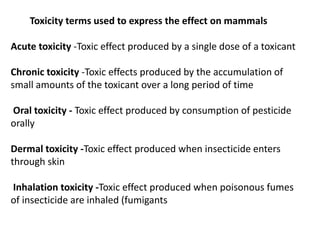
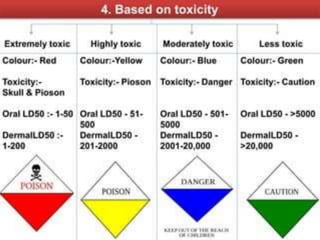
Toxicity terms used to express the effect on mammals
Acute toxicity -Toxic effect produced by a single dose of a toxicant
Chronic toxicity -Toxic effects produced by the accumulation of
small amounts of the toxicant over a long period of time
Oral toxicity - Toxic effect produced by consumption of pesticide
orally
Dermal toxicity -Toxic effect produced when insecticide enters
through skin
Inhalation toxicity -Toxic effect produced when poisonous fumes
of insecticide are inhaled (fumigants
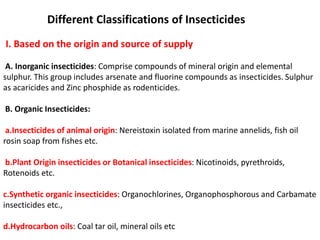
Different Classifications of Insecticides
I. Based on the origin and source of supply
A. Inorganic insecticides: Comprise compounds of mineral origin and elemental
sulphur. This group includes arsenate and fluorine compounds as insecticides. Sulphur
as acaricides and Zinc phosphide as rodenticides.
B. Organic Insecticides:
a.Insecticides of animal origin: Nereistoxin isolated from marine annelids, fish oil
rosin soap from fishes etc.
b.Plant Origin insecticides or Botanical insecticides: Nicotinoids, pyrethroids,
Rotenoids etc.
c.Synthetic organic insecticides: Organochlorines, Organophosphorous and Carbamate
insecticides etc.,
d.Hydrocarbon oils: Coal tar oil, mineral oils etc
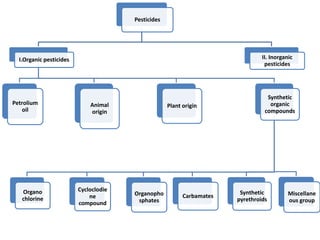
Pesticides
I.Organic pesticides
Petrolium
oil
Animal
origin
Plant origin
Synthetic
organic
compounds
Organo
chlorine
Cycloclodie
ne
compound
Organopho
sphates
Carbamates
Synthetic
pyrethroids
Miscellane
ous group
II. Inorganic
pesticides
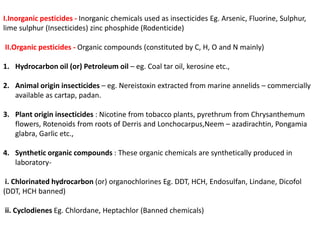
I.Inorganic pesticides - Inorganic chemicals used as insecticides Eg. Arsenic, Fluorine, Sulphur,
lime sulphur (Insecticides) zinc phosphide (Rodenticide)
II.Organic pesticides - Organic compounds (constituted by C, H, O and N mainly)
1. Hydrocarbon oil (or) Petroleum oil – eg. Coal tar oil, kerosine etc.,
2. Animal origin insecticides – eg. Nereistoxin extracted from marine annelids – commercially
available as cartap, padan.
3. Plant origin insecticides : Nicotine from tobacco plants, pyrethrum from Chrysanthemum
flowers, Rotenoids from roots of Derris and Lonchocarpus,Neem – azadirachtin, Pongamia
glabra, Garlic etc.,
4. Synthetic organic compounds : These organic chemicals are synthetically produced in
laboratory-
i. Chlorinated hydrocarbon (or) organochlorines Eg. DDT, HCH, Endosulfan, Lindane, Dicofol
(DDT, HCH banned)
ii. Cyclodienes Eg. Chlordane, Heptachlor (Banned chemicals)
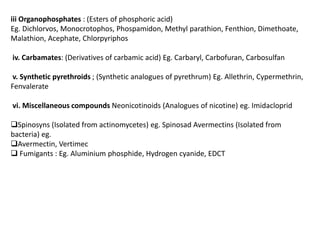
iii Organophosphates : (Esters of phosphoric acid)
Eg. Dichlorvos, Monocrotophos, Phospamidon, Methyl parathion, Fenthion, Dimethoate,
Malathion, Acephate, Chlorpyriphos
iv. Carbamates: (Derivatives of carbamic acid) Eg. Carbaryl, Carbofuran, Carbosulfan
v. Synthetic pyrethroids ; (Synthetic analogues of pyrethrum) Eg. Allethrin, Cypermethrin,
Fenvalerate
vi. Miscellaneous compounds Neonicotinoids (Analogues of nicotine) eg. Imidacloprid
Spinosyns (Isolated from actinomycetes) eg. Spinosad Avermectins (Isolated from
bacteria) eg.
Avermectin, Vertimec
 Fumigants : Eg. Aluminium phosphide, Hydrogen cyanide, EDCT
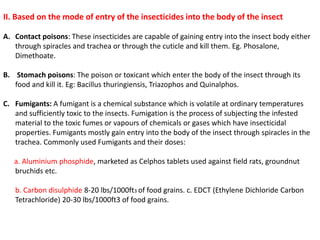
II. Based on the mode of entry of the insecticides into the body of the insect
A. Contact poisons: These insecticides are capable of gaining entry into the insect body either
through spiracles and trachea or through the cuticle and kill them. Eg. Phosalone,
Dimethoate.
B. Stomach poisons: The poison or toxicant which enter the body of the insect through its
food and kill it. Eg: Bacillus thuringiensis, Triazophos and Quinalphos.
C. Fumigants: A fumigant is a chemical substance which is volatile at ordinary temperatures
and sufficiently toxic to the insects. Fumigation is the process of subjecting the infested
material to the toxic fumes or vapours of chemicals or gases which have insecticidal
properties. Fumigants mostly gain entry into the body of the insect through spiracles in the
trachea. Commonly used Fumigants and their doses:
a. Aluminium phosphide, marketed as Celphos tablets used against field rats, groundnut
bruchids etc.
b. Carbon disulphide 8-20 lbs/1000ft3 of food grains. c. EDCT (Ethylene Dichloride Carbon
Tetrachloride) 20-30 lbs/1000ft3 of food grains.
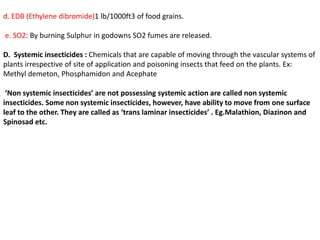
d. EDB (Ethylene dibromide)1 lb/1000ft3 of food grains.
e. SO2: By burning Sulphur in godowns SO2 fumes are released.
D. Systemic insecticides : Chemicals that are capable of moving through the vascular systems of
plants irrespective of site of application and poisoning insects that feed on the plants. Ex:
Methyl demeton, Phosphamidon and Acephate
‘Non systemic insecticides’ are not possessing systemic action are called non systemic
insecticides. Some non systemic insecticides, however, have ability to move from one surface
leaf to the other. They are called as ‘trans laminar insecticides’ . Eg.Malathion, Diazinon and
Spinosad etc.
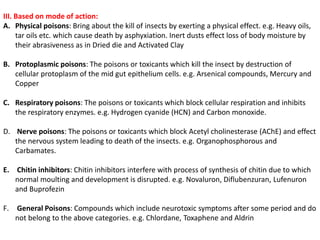
III. Based on mode of action:
A. Physical poisons: Bring about the kill of insects by exerting a physical effect. e.g. Heavy oils,
tar oils etc. which cause death by asphyxiation. Inert dusts effect loss of body moisture by
their abrasiveness as in Dried die and Activated Clay
B. Protoplasmic poisons: The poisons or toxicants which kill the insect by destruction of
cellular protoplasm of the mid gut epithelium cells. e.g. Arsenical compounds, Mercury and
Copper
C. Respiratory poisons: The poisons or toxicants which block cellular respiration and inhibits
the respiratory enzymes. e.g. Hydrogen cyanide (HCN) and Carbon monoxide.
D. Nerve poisons: The poisons or toxicants which block Acetyl cholinesterase (AChE) and effect
the nervous system leading to death of the insects. e.g. Organophosphorous and
Carbamates.
E. Chitin inhibitors: Chitin inhibitors interfere with process of synthesis of chitin due to which
normal moulting and development is disrupted. e.g. Novaluron, Diflubenzuran, Lufenuron
and Buprofezin
F. General Poisons: Compounds which include neurotoxic symptoms after some period and do
not belong to the above categories. e.g. Chlordane, Toxaphene and Aldrin
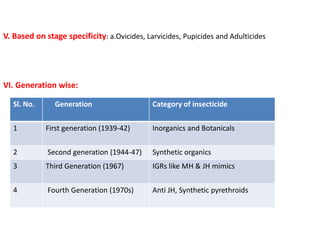
V. Based on stage specificity: a.Ovicides, Larvicides, Pupicides and Adulticides
VI. Generation wise:
Sl. No. Generation Category of insecticide
1 First generation (1939-42) Inorganics and Botanicals
2 Second generation (1944-47) Synthetic organics
3 Third Generation (1967) IGRs like MH & JH mimics
4 Fourth Generation (1970s) Anti JH, Synthetic pyrethroids
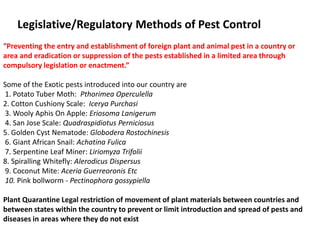
Legislative/Regulatory Methods of Pest Control
“Preventing the entry and establishment of foreign plant and animal pest in a country or
area and eradication or suppression of the pests established in a limited area through
compulsory legislation or enactment.”
Some of the Exotic pests introduced into our country are
1. Potato Tuber Moth: Pthorimea Operculella
2. Cotton Cushiony Scale: Icerya Purchasi
3. Wooly Aphis On Apple: Eriosoma Lanigerum
4. San Jose Scale: Quadraspidiotus Perniciosus
5. Golden Cyst Nematode: Globodera Rostochinesis
6. Giant African Snail: Achatina Fulica
7. Serpentine Leaf Miner: Liriomyza Trifolii
8. Spiralling Whitefly: Alerodicus Dispersus
9. Coconut Mite: Aceria Guerreoronis Etc
10. Pink bollworm - Pectinophora gossypiella
Plant Quarantine Legal restriction of movement of plant materials between countries and
between states within the country to prevent or limit introduction and spread of pests and
diseases in areas where they do not exist
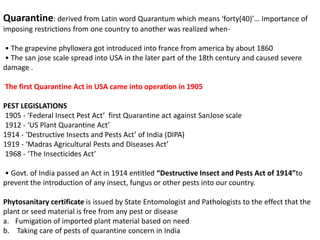
Quarantine: derived from Latin word Quarantum which means ‘forty(40)’… Importance of
imposing restrictions from one country to another was realized when-
• The grapevine phylloxera got introduced into france from america by about 1860
• The san jose scale spread into USA in the later part of the 18th century and caused severe
damage .
The first Quarantine Act in USA came into operation in 1905
PEST LEGISLATIONS
1905 - ‘Federal Insect Pest Act’ first Quarantine act against SanJose scale
1912 - ‘US Plant Quarantine Act’
1914 - ‘Destructive Insects and Pests Act’ of India (DIPA)
1919 - ‘Madras Agricultural Pests and Diseases Act’
1968 - ‘The Insecticides Act’
• Govt. of India passed an Act in 1914 entitled “Destructive Insect and Pests Act of 1914”to
prevent the introduction of any insect, fungus or other pests into our country.
Phytosanitary certificate is issued by State Entomologist and Pathologists to the effect that the
plant or seed material is free from any pest or disease
a. Fumigation of imported plant material based on need
b. Taking care of pests of quarantine concern in India
The legislative measures in force now in different countries can be grouped into five classes
1) Legislation to prevent the introduction of foreign pests:
To prevent entry of foreign pests all countries have restrictions
 Directorate of Plant Protection Quarantine and Storage (DPPQ&S) was established in
Faridababd in 1946
 From 1949, DPPQS deals with commercial import of grains, plants and plant products
 It has a network of 35 Plant Quarantine Stations spread across the countryincluding seaports,
airports and land frontiers
 Operate under the provisions made under the “Destructive Insect and Pests Act of1914”
 Government of India has approved NBPGR, New Delhi for quarantine processing of all
germplasm including transgenic planting material under exchange for researchpurposes
 Forest Research Institute(FRI), Dehradun for forestplants
 Botanical Survey of India (BSI), Kolkatta for ornamental plants to enforce quarantine laws
Restriction imposed on the importation of
i. Sugarcane setts - to prevent West Indies sugar weevil
ii. Coffee seeds - to prevent coffee berry borer
iii.Cotton seeds - to prevent cotton boll weevil
2) Legislation to prevent the spread of already established pests:
 The DIPA, 1914, have empowered the states to enact such laws as are necessary to prevent
the spread of dangerous insects within their jurisdiction
 The Madras Government enacted the Madras Agricultural Pests and Diseases act in 1919 and
was the first state to enact such laws in our country
 To prevent the spread of pests or diseases or weeds form one part of the state to another
 Cottony cushiony scale when localized in Nilgiris and Kodiakanal none of the alternate host
plants were permitted to get transported from these areas.
3) Legislation to enforce the application of effective control measures to prevent the damage
by established pests
 Under the state pests act, the farmers were asked to remove and destroy coconut leaf lets
infested with black headed caterpillar Opisina arenosella around Mangalore in 1923 and in 1927
in Krishna and Guntur districts
4) Legislation to regulate the activities of men engaged in pest control operations:
 They have to take certain precautionary measures to avoid pesticide poisoning and undergo
regular medical checkup.
5) Legislation to prevent the adulteration and misbranding of the insecticides
 To avoid malpractices and supply of substandard chemicals, the pesticide products are to be
standardized through the Indian Standards Institute
 Such products carry ISI mark and are expected to confirm the level of a.i (Active ingredient)
 The Insecticide Act, 1968 has been enforced on 2nd September, 1968 by the Government of
India to regulate the import, manufacture, sale, transport and distribution and use of
insecticides
The government of India also constituted the Central Insecticide Board (CIB) to advise the
state and central governments as per this act
The insecticide rules of 1971 framed under the Insecticides Act 1968 had come in to force in
1971 Invasive Alien Species (IAS): is a species outside of its native range whose introduction and
or spread threatens biodiversity
The insecticide act was passed on 2 Sept., 1968 and Implemented in August 1, 1971
(Insecticides Rule, Oct. 30, 1971)
 Safety oriented legislation - Regulates import, manufacture, storage, transport, sale,
distribution and use of insecticides with a view to prevent risk to human beings and animals
 Regulatory provision - compulsory registration, licensing, inspection, drawal and analysis of
samples, detention, seizure and confiscation of stocks, suspension and cancellation of licences,
etc. - Enforcement of the act is joint responsibility of central and state governments.
Recent methods of pest control
includes following agents
A. Anti-feedants
B. Insect Attractants
C. Insect Repellants
D. Genetic Control/Autocidal Control
E. Insect Growth Regulators
A. ANTIFEEDANTS
• These are the chemical substances that inhibit
feeding of insects when applied on the foliage
without impairing their appetite and gustatory
receptors or driving them away from the food.
• They are also called Gustatory repellants/
Feeding deterrents / Rejectants.
• Since insects do not feed on treated surface,
they die due to starvation.
MODE OF ACTION
• They inhibit gustatory (taste)
receptors of the mouth parts
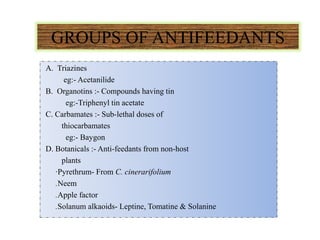
GROUPS OF ANTIFEEDANTS
A. Triazines
eg:- Acetanilide
B. Organotins :- Compounds having tin
eg:-Triphenyl tin acetate
C. Carbamates :- Sub-lethal doses of
thiocarbamates
eg:- Baygon
D. Botanicals :- Anti-feedants from non-host
plants
∙Pyrethrum- From C. cinerarifolium
.Neem
.Apple factor
.Solanum alkaoids- Leptine, Tomatine & Solanine
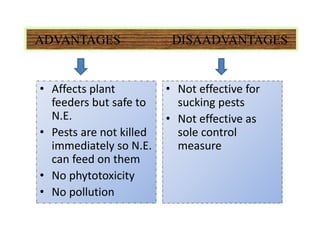
ADVANTAGES DISAADVANTAGES
• Affects plant
feeders but safe to
N.E.
• Pests are not killed
immediately so N.E.
can feed on them
• No phytotoxicity
• No pollution
• Not effective for
sucking pests
• Not effective as
sole control
measure
B. INSECTS REPELLENTS
• Chemicals which cause insects to move
away from their source are referred to as
repellents (or) Chemically that prevent
insect damage to plants (or) animals by
rendering them unattractive, unpalatable
(or) offensive are called repellents.
• Mode of Action:- Influences both
gustatory & olfactory receptors.
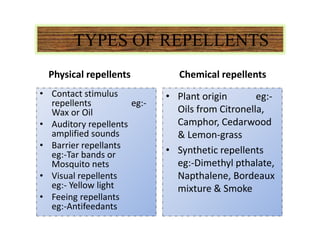
TYPES OF REPELLENTS
Physical repellents
• Contact stimulus
repellents eg:-
Wax or Oil
• Auditory repellents
amplified sounds
• Barrier repellants
eg:-Tar bands or
Mosquito nets
• Visual repellents
eg:- Yellow light
• Feeing repellants
eg:-Antifeedants
Chemical repellents
• Plant origin eg:-
Oils from Citronella,
Camphor, Cedarwood
& Lemon-grass
• Synthetic repellents
eg:-Dimethyl pthalate,
Napthalene, Bordeaux
mixture & Smoke
C. INSECTS
ATTARACTANTS
• Chemicals that cause insects to make
oriented movements towards their
source are called insect attractants.
• Mode of Action:- It influences both
gustatory and olfactory receptors
TYPES OF ATTARACTANTS
1. Pheromones:-Chemical that is secreted into the external
environment by an animal and that elicits a specific response
in a receiving individual of the same species.
2. Food Lures:-These are Chemicals present in plant and animal
hosts that attract (lure) insects for feeding. They stimulate
olfactory receptors.
3. Oviposition Lures:-These are chemicals that govern the
selection of suitable sites for oviposition by the adult female
eg:-Corn attaractants for H. armigera
4. Poison Baits:-Poison baits are a mixture of food lures and
insecticides. The effort is made to make the bait more
attractive to insects than their natural food and also a smaller
quantity should be able to attract the largest number of
insects.
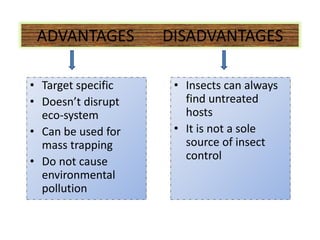
ADVANTAGES DISADVANTAGES
• Target specific
• Doesn’t disrupt
eco-system
• Can be used for
mass trapping
• Do not cause
environmental
pollution
• Insects can always
find untreated
hosts
• It is not a sole
source of insect
control
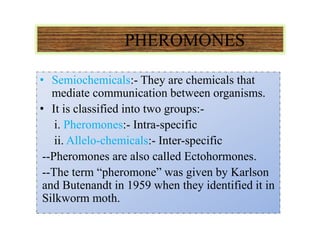
PHEROMONES
• Semiochemicals:- They are chemicals that
mediate communication between organisms.
• It is classified into two groups:-
i. Pheromones:- Intra-specific
ii. Allelo-chemicals:- Inter-specific
--Pheromones are also called Ectohormones.
--The term “pheromone” was given by Karlson
and Butenandt in 1959 when they identified it in
Silkworm moth.
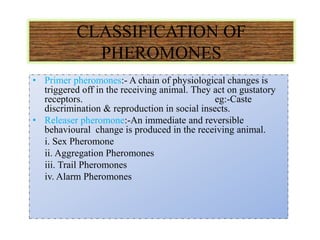
CLASSIFICATION OF
PHEROMONES
• Primer pheromones:- A chain of physiological changes is
triggered off in the receiving animal. They act on gustatory
receptors. eg:-Caste
discrimination & reproduction in social insects.
• Releaser pheromone:-An immediate and reversible
behavioural change is produced in the receiving animal.
i. Sex Pheromone
ii. Aggregation Pheromones
iii. Trail Pheromones
iv. Alarm Pheromones
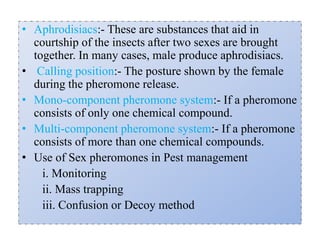
• Aphrodisiacs:- These are substances that aid in
courtship of the insects after two sexes are brought
together. In many cases, male produce aphrodisiacs.
• Calling position:- The posture shown by the female
during the pheromone release.
• Mono-component pheromone system:- If a pheromone
consists of only one chemical compound.
• Multi-component pheromone system:- If a pheromone
consists of more than one chemical compounds.
• Use of Sex pheromones in Pest management
i. Monitoring
ii. Mass trapping
iii. Confusion or Decoy method
D. GENETIC INSECT
CONTROL/AUTOCIDAL
CONTROL
A) Induced Sterility
i) Sterile male release technique: When a sterile male mates with
normal female there will be no progeny.
-This theory of Male Sterile Technique was conceived by
E.F. Knipling as early as 1937.
ii) Aspermia: Inactivation of sperms.
iii) Infecundity: Sterile eggs by dominant lethal mutation.
B) Cytoplasmic Incompatiblity: Sterility is due to a cytoplasmic
factor transmitted through the egg, which kills the sperm of
incompatible male after its entry into the egg.
C) Hybrid Sterility: In some insect cross-types or races
which
produce fertile females but sterile males among
progeny.
D) Population replacement: The ability of disease
transmission
of vectors i.e. replacement of specific vector populations
can
as well be changed by genetic methods.
E) Autosterilization: Sterilization of native insects in their
natural environment by using chemosterilants along
with
the species specific attatractants / lures/ bait traps.
-Bonus effect: The sterile males mates with the normal
females thus reduces reproductivity.
METHODS OF
STERILIZATION
A. Chemosterilants
i. Alkalyting agents: They inhibit nucleic acid
synthesis, inhibits gonad development &
produce
mutagenic effects.
Eg:- TEPA, Chloro ethylamine etc.
ii. Antimetabolites: Chemicals with structural
similarity with biological substances.
Eg:- 5-Fluororacil, Amethopterin etc.
B. Irradiations: It is done by exposing the insects to
X-
rays or neutrons emitted from Cobalt.
E. INSECT GROWTH
REGULATORS
• IGRs are compounds which interfares with the
growth, development and metamorphosis of
insects.
TYPES
1.Ecdysone or Moulting Hormone (MH):Synthetic
analogues of ecdysones are called ecdysoids
- It causes defective cuticle formation.
2. Juvenoids: The possibility that JH analogs may
have
potential as insect control was first recognized by
Williams & Slama (1966). The compounds
showing JH
activity, ‘Juvenoids’.
-They found it in paper made of Balsam fir tree.
3.Anti JH or Precocenes: Precocenes are the compounds
which would antagonize the JH activity and de-arrange the
insect development. These compounds induce the
precocious metamorphosis of immature insects.
Precocenes affect insect diapause, reproduction and
behaviour. These compounds first extracted from the plant
Ageratum houstonium.
4.Chitin synthesis inhibitors: Chitin synthesis inhibitors disrupt
molting by blocking the formation of chitin, the building block
of insect exoskeleton. Without the ability to synthesize chitin,
molting is incomplete, resulting in malformed insects that soon
die. It suppresses egg-laying and causes egg sterility in treated
adults through secondary hormonal activity
Eg:-Diflubenzuron, Flufenoxuron etc.

insect ecology and integrated pest management

  • 1.
    PEST – DEFINITION& CATEGORIES OF PEST PEST - Derived from French word ‘Peste’ and Latin term ‘Pestis’ meaning plague or contagious disease  Pest is any animal which is noxious, destructive or troublesome to man or his interests A pest is an organism which harms man or his property significantly or is likely to do so (Woods, 1976)  Insects are pests when they are sufficiently numerous to cause economic damage (Debacli, 1964) PEST - Any organism that cause significant and economic damage to crops, stored produced and animals”. Pests are organisms which impose burdens on human population by causing -  Injury to crop plants, forests and ornamentals  Annoyance, injury and death to humans and domesticated animals  Destruction or value depreciation of stored products. Dr. Anita Sharma, Asstt. Prof. Entomology
  • 2.
    CATEGORIES OF PESTS I.Insect pests are classified as follows based on season and locality-  Regular pests: Occur most frequently (regularly) in a crop and have close association with that particular crop. Eg: Chilli Thrips Scirtothrips dorsalis , brinjal shoot and fruit borer, Leucinodes orbonalis, Rice stem borer.  Occasional pests: Here a close association with a particular crop is absent and they occur infrequently. Eg: Rice case worm, Nymphula depunctalis castor slug caterpillar, Parasa lepida , mango stem borer, Batocera rufamaculata  Seasonal pests: Occur mostly during a particular part of the year, and usually the incidence is governed by climatic conditions. Eg: Red hairy caterpillar on groundnut-June - July, Rice grasshoppers –June-July Persistent pests: Occur on a crop almost throughout the year. Eg. Thrips on chillies.  Sporadic pests: Pests, which occur in a few isolated localities Eg. Rice ear head bug. Dr. Anita Sharma, Asstt. Prof. Entomology
  • 3.
    II. Based onlevel of infestation – 1. Pest epidemic: Sudden outbreak of a pest in a severe form in a region at a particular time e.g. BPH in Tanjore, RHC in Madurai, Pollachi 2. Endemic pest: Occurrence of the pest in a low level in few pockets, regularly and confined to particular area e.g. Rice gall midge in Madurai, Mango hoppers in Periyakulam III. Pests are classified as follows based on damage potential  Key pests: These are the most severely damaging pests. The GEP is always above the EIL. Human intervention may bring the population temporarily below the EIL, but it rises back rapidly and repeated interventions (sprays) may be required to minimize damage. These are persistent pests. The environment must be changed to bring GEP below EIL. Ex.Cotton bollworm, Diamond backmoth  Major pests: These are pests with the population crosses EIL quite frequently. Economic damage can be prevented by timely and repeated sprays e.g. Cotton jassid, Rice stem borer Dr. Anita Sharma, Asstt. Prof. Entomology
  • 4.
     Minor pests:These are pests with population rarely crosses EIL and fluctuates around ETL. But these pests are easily amenable to available control measures and a single application of insecticides is usually enough to prevent economic damage (5-10% damage).  Potential pests: These pests normally do not cause any economic damage. Any change in the ecosystem may make them to cause economic damage .  Sporadic pests : GEP generally below EIL The population of these pests is usually negligible but in certain years under favorable environmental conditions, they appear in a virtually epidemic form crossing many times over DB and EIL. Under these conditions, the pest has to be controlled by undertaking suitable management strategies. These pests are highly sensitive to abiotic conditions and once the favorable season is over, only a residual population survives. Ex: White grub, hairy caterpillars, cut worm, grass hoppers Dr. Anita Sharma, Asstt. Prof. Entomology
  • 5.
    INTEGRATED PEST MANAGEMENT Historyof Integrated Pest Management:  - Michel bacher and Bacon (1952) coined the term “integrated control”  - Stern et al. (1959) defined integrated control as “applied pest control which combines and integrates biological and chemical control”  - Geier (1966) coined the term “pest management”  - Council on Environmental Quality (CEQ, 1972) gave the term “Integrated Pest Management”  - In 1989, IPM Task Force was established and in 1990. IPM Working Group (IPMWG) was constituted to strengthen implementation of IPM at international level.  - In 1997, Smith and Adkisson were awarded the World Food Prize for pioneering work on implementation of IPM. Definition IPM by Food and Agricultural Organization (FAO, 1967) Integrated Pest Management (IPM) is a pest management system that, in the context of associated environment and population dynamics of the pest species, utilizes all suitable techniques and methods in as compatible a manner as possible and maintains pest populations at levels below those causing economic injury. Dr. Anita Sharma, Asstt. Prof. Entomology
  • 6.
    Need for PestManagement (or) Why Pest Management 1. Development of resistance in insects against insecticides e.g. OP and synthetic pyrethroid resistance in Helicoverpa armigera. 2. Out break of secondary pests e.g. Whiteflies emerged as major pest when spraying insecticide against H. armigera. 3. Resurgence of target pests e.g. BPH of rice increased when some OP chemicals are applied. 4. When number of application increases, profit decreases. 5. Environmental contamination and reduction in its quality. 6. Killing of non-target animals and natural enemies. 7. Human and animal health hazards. Dr. Anita Sharma, Asstt. Prof. Entomology
  • 7.
    Why Pest Management 1)Collapse of control system: During the massive use of pesticides, Rachel Carson, an American biologist, warned the people about the side effects of the use of pesticides through her book entitled, Silent Spring. Through her book, she raised a lot of questions about the real benefits of the use of pesticides as well as the risks of pesticides rendered in the environment and public health. 2) Phases of crop protection : Smith. R.F (1969) has classified World wide patterns of crop protection in cotton agro ecosystem into the following phases which are also applicable to other crop ecosystems- A) Subsistence phase The crop is usually grown under non irrigated conditions. Crop does not enter the world market and is consumed in the villages or bartered in the market place. Crop yields are low. Crop protection is through natural control, hand picking, host plant resistance, other cultural practices and rarely insecticides are used. B) Exploitation phase The agricultural production increased from subsistence level to higher so as to reach the market. Pest control solely depend on chemical pesticides. These are used intensively, often at fixed intervals. Chemical control measures were exploited to the maximum extent wherein new synthetic insecticides, new methods of application, intensive use of pesticides resulted in higher yields. Dr. Anita Sharma, Asstt. Prof. Entomology
  • 8.
    C) Crisis phase: After few years in exploitation phase, more frequent applications of pesticides and higher doses are needed to obtain effective control. Insect populations often resurge rapidly after treatments and the pest population gradually becomes tolerant to the pesticide. Another pesticide is substituted and pest population becomes tolerant to it too. Occasional feeders become serious pests. Excessive use of insecticides over a number of years led to serious problems like i) Pest resurgence ii) Pest resistance to insecticides iii) Change of pest status iv) Increase of production costs, etc D) Disaster phase: As a result of all deleterious effects, the cost of cultivation got increased and the crops were not grown profitably. There were frequent encounters of crop failures and produce not acceptable at market (rejection of the produce due to residues), and finally collapse of the existing pest control system. E) Integrated control phase In this phase it is aimed to give the control measures to the optimum and not to the maximum. Pest management concept is followed to avoid crisis and disaster phases by a) Combination of the resources b) analysis of eco- factors c) optimization of techniques d) recognizing or restoring the pest at manageable level 3) Environmental contamination Presence of residues in foods, feed and organisms caused widespread concern about contamination of Environment Dr. Anita Sharma, Asstt. Prof. Entomology
  • 9.
    Concepts of IPM Conceptsof IPM Seeks to minimize the disadvantages of pesticide usage and maximizing socio- economic and ecological advantages 1. Understanding the agricultural ecosystem  Lesser diversity than natural ecosystem like forests.  Only 1-4 major crop species and 6-10 major pest species.  Intensively manipulated by man.  Subjected to sudden alterations ( Ploughing , inter cultivation, Pesticide treatment) 2. Planning of agricultural ecosystem  Anticipating pest problem  Alternatives to the ways of control  Integration of crop protection with crop production system Ex: Growing of susceptible varieties should be avoided and related crops shouldn’t be grown Ground nut followed by soybean increases incidence of the leaf miner 3. Cost benefit ratio  By predicting the pest problem and defining economic threshold level  Crop life table provide information analysis of pest damage as well as cost benefit ratio  Benefit risk analysis includes impact of Pesticide usage on society as well as environment relevant to its benefits. Dr. Anita Sharma, Asstt. Prof. Entomology
  • 10.
    4. Tolerance ofpest damage • Castor crop can tolerate upto 25 per cent defoliation • Exceptions occur in case of plant disease transmission by vectors • The relationship between density of pest population and profitability of control measures is expressed through threshold values- A) Economic Injury Level (EIL): b) Economic Threshold Level(ETL): c) General equilibrium position(GEP) 5. Leaving a pest residue • Absence of their respective insect hosts and indiscriminate use of broad spectrum insecticides eliminate natural enemies • Leave a permanent pest residue below ETL, so that natural enemies will survive 6. Timing of treatments • Pesticide spray should be need based • Timely scheduled minimum number of sprays + Improved techniques of pest monitoring E.g.: Use of pheromone traps for monitoring of pest population 7. Public understanding and acceptance • Simple and effective communication to the people for better understanding and acceptance • Should be economical and sustainable Dr. Anita Sharma, Asstt. Prof. Entomology
  • 11.
    Limitations of IPM Higher degree of management  Labour intensive  Accurate field scouting  Weather dependant Aims of IPM  Reduce the use of synthetic organic pesticides  Pest minimal risk of human health  Re-useable return on investment  Provide consumable safe food Principles of IPM • Identification of key pests and beneficial organisms • Defining the management unit, the Agro-ecosystem • Development of management strategy • Establishment of Economic thresholds (loss & risks) • Development of assessment techniques • Evolving description of predictive pest models Dr. Anita Sharma, Asstt. Prof. Entomology
  • 12.
    ECONOMIC LEVELS FORPESTS CATEGORIZATION 1. Economic injury level- The concept of economic injury level was first defined by Stern et. al. (1959), who defined it as “ lowest population density that will cause economic damage”. cost of control=cost of damage EIL is usually expressed as the number of insects per unit area 2. Economic thershold level- First defined by Stern et al. in 1959- The pest population density at which control measures should be applied to prevent an increasing pest population from reaching the economic injury level. ET is most important parameter in pest mgt decision making also represent as “Action-threshold” E.g.:- ETL value for BPH in rice is 25 insects/hill Rice stem borer -5% dead hearts Gall midge of rice-5% silver shoots Dr. Anita Sharma, Asstt. Prof. Entomology
  • 13.
    3. GEP- Thegeneral equilibrium position is the average population density of an insect population over a long period of time & unaffected by the temporary interventions of pest control. Based on this insects can be grouped into 4 categories- a) Negligible pest: Pop. density never increases high enough to cause economic injury b) Occasional pest: Occasionally their density reaches EIL due to unusual weather conditions or the injudicious use of insecticides. At their peak population density, some sort of intervention usually an insecticide is required to reduce their numbers c) Perennial pest: EIL’s are slightly above the GEP Intervention is necessary at nearly every upward population fluctuation. d) Severe pest: They have EIL below the GEP Regular and constant interventions with insecticides are required to produce marketable crops 3. Damage boundary (DB)- The lowest level of damage which can be measured. ETL is always less than EIL. Provides sufficient time for control measures. Dr. Anita Sharma, Asstt. Prof. Entomology
  • 14.
    Survey, Surveillance &Forecasting of Insect Pests Pest Monitoring- Monitoring phytophagous insects and their natural enemies is a fundamental tool in IPM - for taking management decision Monitoring - estimation of changes in insect distribution and abundance - information about insects, life history - influence of biotic and abiotic factors on pest population Survey Conducted to study the abundance of a pest species ‘An insect pest survey is ‘a detailed collection of insect population information at a particular time in a given area’. Dr. Anita Sharma, Asstt. Prof. Entomology
  • 15.
    Two types ofsurvey- Roving survey and fixed plot survey 1. Roving survey  Assessment of pest population/damage from randomly selected spots representing larger area  Large area surveyed in short period  Provides information on pest level over large area 2. Fixed plot survey Assessment of pest population/damage from a fixed plot selected in a field. The data on pest population/damage recorded periodic from sowing till harvest- • e.g. 1 sq.m. plots randomly selected from 5 spots in one acre of crop area in case of rice. From each plot 10 plant selected at random. Total tillers and tillers affected by stem borer in these 10 plants counted. Total leaves and number affected by leaf folder observed. Damage expressed as per cent damaged tillers or leaves. Population of BPH from all tillers in 10 plants observed and expressed as number/tiller. • Qualitative survey - Useful for detection of pest • Quantitative survey - Useful for enumeration of pest Dr. Anita Sharma, Asstt. Prof. Entomology
  • 16.
    Pest Surveillance  PestSurveillance Refers to the constant watch on the population dynamics of pests, its incidence and damage on each crop at fixed intervals to forewarn the farmers to take up timely crop protection measures.  The word surveillance comes from the French word for "watching over".  Pest surveillance is nothing but ‘periodical assessment of pests populations and their damage’ or ‘watch kept on a pest for the purpose of decision making in pest management’. Three basic components of pest surveillance Determination of- a. the level of incidence of the pest species b. the loss caused by the incidence c. the economic benefits, the control will provide Objectives of Pest Surveillance  to know existing and new pest species  to assess pest population and damage at different growth stage of crop  to study the influence of weather parameters on pest  to study changing pest status (Minor to major)  to assess natural enemies and their influence on pests  effect of new cropping pattern and varieties on pest
  • 17.
    Advantages of pestsurveillance  One can know how a pest is multiplying in an area and when it is expected.  Minimize the cost of plant protection by reducing the amount of pesticides used and in turn reduce environmental pollution.  Pest control measures can be initiated in time due to advance forecasting.  Useful for pest forecasting.  To find out natural enemy population  To study the influence of weather parameters on pests  Mark endemic areas  Maintain the stability of the agro ecosystem Dr. Anita Sharma, Asstt. Prof. Entomology
  • 18.
    Sampling • It is‘a representative part of the total population and base our estimate on that part’. Sampling techniques: • Surveillance requires suitable sampling techniques. A sampling technique is ‘the method used to collect information for a single sample’. • The sampling techniques include direct counts (insitu counts), knock down, netting, trapping, (use of light trap, pheromone trap, sticky trap), extraction from soil etc Sampling programme: • It is ‘the procedure for employing the sampling techniques in time and space’. Sampling programme describes when sampling is to begin, location of samples, number of samples and how often samples should be taken. Sampling Techniques  Absolute sampling - To count all the pests occurring in a plot  Relative sampling - To measure pest in terms of some values which can be compared over time and space e.g. Light trap catch, Pheromone Dr. Anita Sharma, Asstt. Prof. Entomology
  • 19.
    Methods of sampling A.In situ counts - Visual observation on number of insects on plant canopy (either entire plot or randomly selected plot) B. Knock down - Collecting insects from an area by removing from crop and (Sudden trap) counting (Jarring) C. Netting - Use of sweep net for hoppers, odonates, grasshopper D. Norcotised collection - Quick moving insects anaesthesised and counter E. Trapping - Light trap - Phototropic insects, Pheromone trap - Species specific, Sticky trap - Sucking insects, Bait trap, Fishmeal trap - Sorghum shootfly, Emergence trap - For soil insects F. Crop samples: Plant parts removed and pest counted e.g. Bollworms Decision-making: is the key stone in insect pest management programmes. It indicates the course of action to be taken in any pest situation. - Population or damage assessed from the crop - Compared with ETL and EIL - When pest level crosses ETL, control measure has to be taken to prevent pest from reducing EIL. Dr. Anita Sharma, Asstt. Prof. Entomology
  • 20.
    TOOLS OR COMPONENTSOF INTEGRATED PEST MANAGEMENT i. Cultural method or use of agronomic practices ii. Host plant resistance - Antixenosis, antibiosis, tolerance iii. Mechanical methods of pest control 1. Hand destruction 2. Exclusion by screens, barriers 3. Trapping, suction devices, collecting machine 4. Crushing and grinding iv. Physical methods 1. Heat 2. Cold 3. Energy - light trap, irradiation, light regulation 4. Sound v. Biological methods 1. Protection and encouragement of NE 2. Introduction, artificial increase and colonizing specific parasitoids and predators 3. Pathogens on insects like virus, bacteria, fungi and protozoa 4. Use of botanicals like neem, pongam, etc.
  • 21.
    FORECASTING • It is‘an advance knowledge of probable pest infestations (out breaks) in a crop for planning the cropping pattern in such a way as to minimize the damage but also to get the best advantage of the pest control measures’ or ‘forewarning of the forthcoming infestations of pests’. • Forecasts are being done based on population's studies, studies on the pest's life history and field studies of the effect of climatic factors on the pest and its environment. Forecasting service serves- a) To predict the forthcoming infestation level of the pest, which knowledge in essential in justifying the use of control measures b) To find out the critical stage at which the applications of insecticides would afford maximum protection. c) The pest surveillance programmes are highly useful in forecasting of the pests. Dr. Anita Sharma, Asstt. Prof. Entomology
  • 22.
    vi. Chemical methods 1.Attractants 2. Repellents 3. Insecticides - OC, OP, carbamates, pyrethroids, etc. 4. Insect growth inhibitors 5. Chemosterilants vii. Behavioural methods 1. Pheromones 2. Allelochemics viii. Genetic/biotechnology method - Release of genetically incompatible/sterile pests - Transgenic plant ix. Regulatory/legal method - Plant/animal quarantine - Eradication and suppression programme
  • 23.
    Cultural method ofPest Management Cultural practices include all the crop production and management techniques which are utilized by the farmers to maximize their crop productivity and/or farm income. The manipulation of these practices for reducing or avoiding pest damage to crops is known as cultural control. Cultural practice which do not allow the favorable conditions for life cycle, growth and breeding of the pests. • It includes decisions on crops/varieties to be grown, time and fertilizers and irrigation, harvesting times and procedures, and even off-season operations in fallow/cropped fields. •The first reference on the use of cultural control practices in India is found in the book “The Agricultural Pests of India and of Eastern and Southern Asia” by Balfour in 1887. •Maxwell-Lefroy in his book “The Indian Insect Pests” published in 1906, suggested some other practices like mixed cropping, use of trap crop, hoeing etc. •Ayyar(1938) in his book “Handbook of Economic Entomology for South India” gave the pride of place to various cultural control practices.
  • 24.
    Cultural practices 1)Tillage orproper preparatory cultivation: Several insects which live or hide in the soil get exposed to sun as well as predators like birds etc due to proper preparatory cultivation/ploughing. Eg. Red hairy caterpillar, white grubs, cut worms etc. Raking and hoeing of the soil around melon plants, mango and other fruit trees serve to destroy pupae of fruit flies. 2) Growing resistant varieties: It is well known that some crops are less attacked by pests because they have more natural resistance than others. They have some special characteristic like acidity or tasteless of cell sap, early maturity, hard bark etc., which helps in building their resistance. Certain varieties resist pest attack. Eg: IR 36, IR 64 and MTU–5249 resistance to paddy BPH, IR 36, Phalguna,Shakti, Surekha variety to gall midge, TKM -6, Ratna, IR 26 for stem borer. 3) Seed rate: Adoption of appropriate seed rate ensures proper stand, spacing and crop canopy that helps in adaptation of proper spray technology and checks the unwanted growth of crop. Use of high seed rate is recommended in those crops where removal of infested plants is helpful in minimizing the incidence of insect pests, viz. maize borer in maize, and sorghum shoot fly in sorghum.
  • 25.
    4) Planting time:The manipulation of planting time help to minimize pest damage by producing asynchrony between host plant and the pest. Early planting has been found to reduce gall midge and leaf folder damage in rice, shoot fly and head bug damage in sorghum and millet, white grub damage in groundnut and mustard aphid damage in mustard. Timely and synchronous planting has been found to reduce bollworm damage in cotton and stem borer damage in sugarcane. 5) Plant spacing: Plant spacing may influence the population and damage of many insect pests by modifying the micro-environment of the crop or affecting health, vigour and strength of the crop plants. Closer spacing has been reported to increase the incidence of plant hoppers, BPH, WBPH and leaf folder etc. The closer spacing in cotton results in increase the relative humidity that favour higher incidence of sucking pets and bollworm. Closer spacing in groundnut lowered the incidence of thrips, jassids and leafminers and also increased parasitism in the later.  6) Fertility Management: High levels of nitrogen fertilizers significantly increase the incidence of most of the insect pests including yellow stem borer, leaf folder, gall midge, BPH, WBPH, Hispa , Whorl maggot etc. in rice crop. In cotton also it result in greater attack of leaf folder, white fly and bollworms. Reduction in the incidence of GLH, BPH and WBPH in rice, aphids and thrips in chilies has been reported by the application of potash. Potassium increase the silica content in the leaf due to which cell-wall of parenchyma and tissues become hard and unfavorable for pest attack.
  • 26.
    7) Water management:Flooding the field: Flooding of fields is recommended for reducing the attack of cutworms, army worms, termites, root grubs etc.  The incidence of gall midge was less in continuous flooding.  For cutworms like paddy swarming caterpillar (Spodoptera mauritinana and S. exiqua) and ragi cutworm, by flooding the fields the caterpillars float and leave the plants.  The irrigation in sugarcane and wheat crop protects from white ants. Draining the fields: In case of paddy case worm, Nymphula depunctalis which travel from plant to plant via water can be eliminated by draining or drying the field.  Alternate drying and wetting at 10 days interval starting from 35 DAT reduces the BPH and WBPH. 8) Sanitation Clean cultivation/ weed management: Removal of weeds which act as alternate hosts reduce insect pests.  Paddy gall fly Orseolia oryzae breeds on grasses such as Panicum sp., Cynodon etc. Fruit sucking moth spend their life on alternate host before attacking on main host crops.  Mealy bug infestation in cotton is reduce by removal of weed which is alternate host for mealy bugs Removal of sugarcane shoots affected by borers, Cutting and removal of infested parts of brinjal attacked by Leucinodes orbonalis  Prunning of dried branches of citrus eliminates scales and stem borer.  Clipping of tips of rice seedlings before transplanting eliminate the egg masses of stem borer.  Clipping of leaf lets in coconut reduces the black headed caterpillar
  • 27.
    9). Trap cropping: Growingof susceptible or preferred plants by important pests near a major crop to act as a trap and later it is destroyed or treated with insecticides. Trap crop may also attract natural enemies thus enhancing natural control. The trap crop can be from the same or different family group, than that of the main crop, as long as it is more attractive to the pest.  There are two types of planting the trap crops, border trap cropping and row intercropping. Boarder trap cropping is the planting of trap crop completely surrounding the main cash crop. It prevents a pest attack that comes from all sides of the field. Row intercropping is the planting of the trap crop in alternating rows within the main crop. E.g. Marigold as a trap crop around tomato for fruit borer control. 10). Intercropping: Tomato intercropped with cabbage has been reported to inhibit or reduce egg laying by Dimondback moth. The intercrop of cowpea, maize etc in cotton helped in the colonization of coccinellids and also enhanced the parasitism of spotted bollworm. Okra intercrop with cotton increased the population build up of jassids, whitefly, spotted bollworms and Americal bollworm.  Intercropping of groundnut with pearlmillet reduced the incidence of thrips, jassids and leafminer where as the same with sunflower and castor increased the incidence of thrips and jassids, respectively.
  • 28.
    11) Changes inthe system of cultivation: • Change of banana from perennial to annual crop reduced the infestation of banana rhizome weevil Cosmopolitus sordidus in addition to giving increased yields. •Avoiding ratoon redgram crop during offseason helps in reducing the carry over of pod fly Melangromyza obtusa and eriophyid mite Aceria cajani 12) Crop rotation: Crop provides food for insect-pests and if the food is abundant all round the year, such pests flourish and multiply rapidly. Lady’s finger followed by cotton will suffer from increased infestation of pests. Hence if a non-host crop is grown after a host crop, it reduces the pest population. The pest problem of monoculture can be control by adopting crop-rotation cultivation. Ex. • Cereals followed by pulses reduce pest incidence. • Cotton should be rotated with non hosts like ragi, maize, rice to minimize the incidence of insect pests. •Groundnut with non leguminous crops is recommended for minimizing the leaf miner incidence. 13) Harvesting practices involving crop maturity, time of harvest or cutting practices, selective harvesting and strip harvesting can be of considerable assistance in suppressing a variety of insect pests and/or conserving their natural enemies.
  • 29.
    2. Mechanical control A.Mechanical destruction- Life stages are killed by manual (or) mechanical force. Manual Force 1. Hand picking the caterpillars 2. Beating : Swatting housefly and mosquito 3. Sieving and winnowing : Red flour beetle (sieving) rice weevil (winnowing) 4. Shaking the plants : Passing rope across rice field to dislodge caseworm and shaking neem tree to dislodge June beetles 5. Hooking : Iron hook is used against adult rhinoceros beetle 6. Crushing : Bed bugs and lice 7. Combing : Delousing method for Head louse 8. Brushing : Woolen fabrics for clothes moth, carper beetle. Mechanical force 1. Entoleter : Centrifugal force - breaks infested kernels - kill insect 2. Hopper dozer : Kill nymphs of locusts by hording into trenches and filled with soil 3. Tillage implements : Soil borne insects, red hairy caterpillar. 4. Mechnical traps : Rat traps of various shapes like box trap, back break trap, wonder trap,
  • 30.
    B. Mechanical exclusionMechanical barriers prevent access of pests to hosts. 1. Wrapping the fruits : Covering with polythene bag against pomegrante fruit borer, Fruit sucking moth in citrus. 2. Banding : Banding with grease or polythene sheets - Mango mealybug. 3. Netting : Mosquitoes, vector control in green house. 4. Trenching : Trapping marching larvae of red hairy catepiller. 5. Sand barrier : Protecting stored grains with a layer of sand on the top. 6. Water barrier : Ant pans for ant control. 7. Tin barrier : Coconut trees protected with tin band to prevent rat damage. 8. Electric fencing : Low voltage electric fences against rats. Advantage of mechanical control Disadvantages 1. Home labour utilization 1. Limited application 2. Low equipment cost 2. Rarely highly effective 3. Ecologically safe 3. Labour intensive 4. High technical skill not required in adopting.
  • 31.
    PHYSICAL CONTROL Modification ofphysical factors in the environment to minimise (or) prevent pest problems. Use of physical forces like temperature, moisture, etc. in managing the insect pests A. Manipulation of temperature 1. Sun drying the seeds to kill the eggs of stored product pests. 2. Hot water treatment (50 - 55oC for 15 min) against rice white tip nematode. 3. Flame throwers against locusts. 4. Burning torch against hairy caterpillars. 5. Cold storage of fruits and vegetables to kill fruit flies (1 – 2O C for 12 - 20 days). B. Manipulation of moisture 1. Alternate drying and wetting rice fields against BPH. 2. Drying seeds (below 10% moisture level) affects insect development. 3. Flooding the field for the control of cutworms. C. Manipulation of light 1. Treating the grains for storage using IR light to kill all stages of insects (eg.) Infra-red seed treatment unit. 2. Providing light in storage go downs as the lighting reduces the fertility of Indian meal moth, Plodia. 3. Light trapping.
  • 32.
    D. Manipulation ofair 1. Increasing the CO2 concentration in controlled atmosphere of stored grains to cause asphyxiation in stored product pests. E. Use of irradiation Gamma irradiation from Co 60 is used to sterilize the insects in laboratory which compete with the fertile males for mating when released in natural condition. (eg.) cattle screw worm fly, Cochliomyia hominivorax control in Curacao Island by E.F.Knipling. F. Use of greasing material Treating the stored grains particularly pulses with vegetable oils to prevent the oviposition and the egg hatching. eg., bruchid adults. G. Use of visible radiation : Yellow colour preferred by aphids, cotton whitefly : yellow sticky traps. H. Use of Abrasive dusts 1. Red earth treatment to red gram : Injury to the insect wax layer. 2. Activated clay : Injury to the wax layer resulting in loss of moisture leading to death. It is used against stored product pests. 3. Drie-Die : This is a porous finely divided silica gel used against storage insects.
  • 33.
    Botanical control The insecticidesof plant origin extracted from seeds, flowers, leaves, stem and roots, are termed as botanical insecticides. Insecticides of plant origin unlike synthetic organic insecticides are safer to use but since they are expensive and lack residual toxicity, their use has been limited in the country. In nature more than, 2400 plant species are reported to have pesticidal properties. 1. Neem (Azadirachta indica) (Meliaceae) Posses medicinal, insecticidal, insect repellent, antifeedant, growth regulatory, nematicidal and antifungal properties. Contains a number of components such as Azadirachtin, salannin, nimbin, epinimbin and nimbidin. Gives insecticidal, insect repellent, ovicidal, Antifeedant and growth regulator characters. Azadiractitin disrupts moulting by antagonizing the insect hormone ecdysone. Azadiractitin Acute oral LD50 for rat is 5000mg/kg, Acute dermal for rabbit is >2000mg/kg Preparation of Neem Seed Kernel Extract (NSKE 5%): 1. Take 50 g of powdered neem seed kernels, soak it in one litre of water for 8 hours and stir the contents often. 2. Squeeze the soaked material repeatedly for better extraction of the azadirachtin in the aqueous suspension. 3. Filter the contents through muslin cloth. 4. Make the filtrate to one litre. 5. Add 1ml teepol or triton or sandovit or soap water (2%) and spray
  • 34.
    Insecticidal Activity • Driedpowder of neem leaves are used against stored grain insect pests. • Leaf extracts showed insecticidal property against Lepidopteran pests. • Desert locust Schistocerca gregaria avoids feeding on neem leaves. • Neem leaves are found as attractants to white grub Holotrichia adults. • Neem seed/ kernel extract showed insecticidal properties against a number of sucking pest. • Neem oil can be used against storage insect pests @ 1 to 2% and field insects @ (0.2 -0.4%, 1 to 2% 5% or 10% neem oil) • Neem products are safer to honey bees, parasitoids, predators. • Commercial formulations of neem are available in 1000 ppm, 1500 ppm and 300 ppm in the market. • Some of the neem formulations are Margosan, Neemark, Neemrich, Achook, Nimbicidine etc
  • 35.
    Nicotine (Solanaceae) Found inthe leaves of Nicotiana tabacum and N. rustica from 2% to 14%. Nicotine sulphate- contact insecticide with marked fumigant action in the control of sucking insects. More stable and less volatile and is a nerve poison. Highly toxic when absorbed through the cuticle, trachea or injestion. Affects the ganglion blocking conduction at higher levels. Contains 40% alkaloid, is safer and is more convenient to use. Free alkaloid is liberated by the addition of soap lime or ammonium hydroxide to the spray solution. Dust formulation of nicotine sulphate releases nicotine in the presence of moisture. Tobacco decoction: 1. Useful for controlling aphids, thrips etc. 2. Prepared by boiling 1kg of tobacco waste in 10lts of water for 30 minutes or steep it in cold water for a day. 3. Make it up to 30 litres and add about 90gm of soap. 4. Addition of soap improves wetting, spreading and killing properties. 5. Does not leave any harmful residue on treated surface. 6. LD50for rat oral- 50-60 mg/kg.
  • 36.
    2. Rotenone (Fabaceae) 1.From the roots of derris plant which many contain 4 to 11% rotenone 2. Principal commercial sources are Derris elliptica and Lonchocarupus utilis. 3. Rotenone occurs in Derris roots (4-9%), Lonchocarpus (8-11%) 4. Oxidizes to non-insecticidal compound in the presence of light and air 5. Hence rotenone residues are difficult to find after 5 to 10 days in normal sunlight 6. Insects show a steady decline in oxygen consumption followed by paralysis and deaths 7. Highly toxic to fishes and to most insect species but almost harmless to warm blooded animals except pigs. 8. Dust or spray containing 0.5 to 1.0 per cent and 0.001 to 0.002 per cent rotenone are used commercially 3. Pyrethrum: From dried flower heads of Chrysanthemum cinerariaefolium (Asteraceae) The actual chemical ingredients having insecticidal action are identified as five esters They are: Pyrethrin I, Pyrethrin II, Cinerins-I and Cinerin-II and Jasmoline Predominately found in achenes of flowers from 0.7 to 3 % . 1. Two acids – Chrysanthemic acid and Pyrethric acid 2. Three alcohols – Pyretholone, Cinerolone and Jasmolone Active principles/Esters Pyrethrin I = Pyrethrolone + Chrysanthemc acid Pyrethrin II = Pyrethrolone + Pyrethric acid Cinerin I = Cynerolone + Chrysanthemc acid Cinerin II = Cynerolone + Pyrethric acid Jasmolin II = Jasmolone + Pyrethric acid
  • 37.
    • Prepared bygrinding the flowers • The powder mixed with a diluent such as talc or clay is known as pyrethrum dust • It is prepared just before use as it gets deteriorated rapidly • Also used as emulsions, solutions, and aerosols • Unstable to light, air moisture and alkali • Residues deteriorate very rapidly after application • Powerful contact insecticides but appear to be poor stomach poisons • A characteristic action of pyrethroid is the rapid paralysis or ‘knock down’ effect and substantial recovery that follow it • This recovery is due to rapid enzymatic detoxification in the insect • To bring about mortality equivalent to knock down effect three times increase in dosage may be required Properties 1. Highly unstable in light, moisture and air 2. Have no residual effect 3. Paralyse by more contact 4. Gains entry through spiracle and cuticle 5. Act on central nervous system 6. Having rapid knock down effect 7. Practically no mammalian toxicity 8. Good insecticides against household and cattle pests
  • 38.
    Sabadilla: • It isa alkaloid found in seeds of tropical lily Schoenocaulon officinale (fam: Liliaceae) • The alkaloid mainly, Cevadine and Veratridine act as nerve poisions • It is harmful to pollinator, honey bees Ryanodine: • It is a alkaloid derived from woody stems of South American shrub, Ryania speciosa (Fam; Flacourtaceae) • Activity: It acts as muscular poison by blocking the conversion of ADP to ATP in muscle. • It acts as slow acting stomach poision and causes insects to stop feeding after they eat it. • It is reportedly effective against thrips and worms . • It is used as dust (20-40%) Petroleum Oil: Oils with UR (Unreacted residue) value 50-90% are dormant oils. (Phytotoxic) Oils with UR value 90-96% are summer oils. (Safer)
  • 39.
    Biological control successful managementof a pest (including insects, mites, weeds and plant diseases) by means of another living organism (parasitoids, predators and pathogens) that is encouraged and disseminated by man is called biological control. It relies on predation, parasitism, herbivory, or other natural mechanisms, but typically also involves an active human management role. Classical biological control: a form of inoculative biological control in which specific natural enemies are imported from the native home of the pest and released in small numbers in order to establish a permanent population. Techniques in biological control: 1. Introduction : • Deliberate introduction and establishment of natural enemies to a new locality where they did not occur/originate • If successfully established, they continues to control the pest population
  • 40.
    2. Augmentation: • Rearingand releasing of natural enemies to supplement the numbers of naturally occurring natural enemies There are two approaches to augmentation- A. Inoculative releases: • Large number of natural enemies are released only once during the season • Expected to reproduce and increase its population for that growing season • Control is expected from the progeny and subsequent generations b. Inundative releases: • Mass multiplication and periodic release of natural enemies when pest populations approach damaging levels • Natural enemies are not expected to reproduce and increase in numbers • Control is achieved through the released individuals 3. Conservation: • To protect natural enemies that are already present in an area • Actions to preserve and release of natural enemies by environmental manipulations or alter production practices • Not use of those pest control measures that destroy natural enemies
  • 41.
    Parasite: • An organismwhich is usually much smaller than its host and a single individual usually doesn’t kill the host • Parasite may complete their entire life cycle (eg. Lice) or may involve several host species • Which attaches itself to the body of the other living organism either externally or internally and gets nourishment and shelter at least for a shorter period if not for the entire life cycle • The organism, which is attacked by the parasites, is called hosts Parasitism: Is the phenomena of obtaining nourishment at the expense of the host to which the parasite is attached Parasitoid: An insect parasite of an arthopod, parasitic only in immature stages, destroys its host in the processof development and free living as an adult Eg: Braconid wasps Some successful examples Control of cottony cushion scale, Icerya purchasi on fruit trees – • Predatory vedalia beetle, Rodolia cardinalis in Nilgiris in 1888 • Imported from California in 1929 and from Egypt in 1930 • Multiplied in the laboratory and Released • Within one year the pest was effectively checked
  • 42.
    Biological Control ofWater Hyacinth, Eichhornia crassipes • by three exotic natural enemies were introduced in India • hydrophilic weevils – Neochetina bruchi and N. eichhorniae ( Argentina) • galumnid mite Orthogalumna terebrantis (SouthAmerica) • Apple woolly aphis, Eriosoma lanigerum in Coonor area by Aphelinus mali (parasitoid) imported from USA in 1937. • Control of shoot borers of sugarcane, cotton bollworms, stem borers of paddy and sorghum with the egg parasitoid, Trichogramma australicum 50,000/ha/week for 4-5 weeks from one month afterplanting
  • 43.
    Kinds of Parasitism 1.Simple parasitism : Irrespective of number of eggs laid only one parasitoid attacks the host Eg. Apanteles taragamae on the larvae of Opisina arenosella, Goniozus nephantids 2.Super parasitism : parasitisation of a single host by more larvae of single species that can mature in the host Eg. Apanteles glomeratus on Pieris brassica, Trichospilus pupivora on Opisina arenosella 3.Multiple parasitism : simultaneous parasitization of host individual by two or more different species of primary parasites at the same time Eg:Trichogramma, Telenomous and Tetrastichus attack eggs of paddy stem borer Scirpophaga incertulas Super parasitism and multiple parasitism are regarded as undesirable situations as much reproductive capacity is wasted 4. Hyper parasitism: When a parasite itself is parasitized by another parasite Eg. Goniozus nephantidis is parasitized by Tetrastichus israeli, Most of the Bethylids and Braconids are hyper parasites
  • 44.
    Predators and Predatism Apredator is one which catches and devours smaller or more helpless creatures by killing them in getting a single meal • It is a free living organism through out its life • normally larger than prey • requires more than one prey to develop Insect predator qualities 1. generally feeds on many different species of prey - polyphagousnature 2. relatively large compared to its prey , which it seizes and devours quickly 3. consumes large number of prey in its life time Eg: coccinellid predator larva consume 100s of aphids 4. kill and consume their prey quickly , usually via extra oral digestion 5. very efficient in search of their prey and capacity for swift movements 6. develop separately from their prey and may live in the same habitat or adjacent habitats 7. Structural adaptation with well developed sense organs to locate the prey 8. carnivorous in both its immature and adult stages 9. May have cryptic colourations and deceptive markings Eg. Preying mantids and Robber flies
  • 45.
    1. Entirely predatory,Eg. lace wings, tiger beetles, lady bird beetles except Henosepilachna genus 2. Mainly predator but occasionally harmful Eg. Odonata and mantids occasionally attack honey bees 3. Mainly harmful but partly predatory Eg. Cockroach feeds on termites 4. Mainly scavenging and partly predatory Eg. Earwigs feed on dead decaying organic matter and also feed on fly maggots 5. Variable feeding habits of predator, eg: Tettigonidae: omnivorous and carnivorous but damage crop by lying eggs 6. Stinging predator Eg. Spider wasps
  • 46.
    CHEMICAL CONTROL • Controlof insects with chemicals is known is chemical control. • The term pesticide is used to those chemicals which kill pests and these pests may include insects, animals, mites, diseases or even weeds. Rodenticides - Chemicals used to kill rats. Eg. Zinc phosphide Insecticides - Chemicals used to kill insects. Eg. Malathion Acaricides - Chemicals used to kill mites. Eg. Dicofol Avicides - Chemicals used to kill birds. Eg. Anthroquinone Molluscicides - Chemicals used to kill snails and slugs. Eg. Metaldehyde Nematicides - Chemicals used to kill nematodes. Eg. Ethylene di bromide Fungicides - Chemicals used to kill plant diseases. Eg. Thiram Herbicides - Chemicals used to kill weeds. Eg. 2,4 – D Properties of an ideal insecticide or pesticide: • Freely available under different formulations • Toxic and kill the pest required • It should not be phytotoxic • Non toxic to non target species • Should not leave residues in crops like vegetables • Have wide range of compatibility • Not be toxic to bees and fish and other beneficial organisms • Stable on application • Should be cheaper
  • 47.
    Toxicity terms usedto express the effect on mammals Acute toxicity -Toxic effect produced by a single dose of a toxicant Chronic toxicity -Toxic effects produced by the accumulation of small amounts of the toxicant over a long period of time Oral toxicity - Toxic effect produced by consumption of pesticide orally Dermal toxicity -Toxic effect produced when insecticide enters through skin Inhalation toxicity -Toxic effect produced when poisonous fumes of insecticide are inhaled (fumigants
  • 48.
    Different Classifications ofInsecticides I. Based on the origin and source of supply A. Inorganic insecticides: Comprise compounds of mineral origin and elemental sulphur. This group includes arsenate and fluorine compounds as insecticides. Sulphur as acaricides and Zinc phosphide as rodenticides. B. Organic Insecticides: a.Insecticides of animal origin: Nereistoxin isolated from marine annelids, fish oil rosin soap from fishes etc. b.Plant Origin insecticides or Botanical insecticides: Nicotinoids, pyrethroids, Rotenoids etc. c.Synthetic organic insecticides: Organochlorines, Organophosphorous and Carbamate insecticides etc., d.Hydrocarbon oils: Coal tar oil, mineral oils etc
  • 49.
  • 50.
    I.Inorganic pesticides -Inorganic chemicals used as insecticides Eg. Arsenic, Fluorine, Sulphur, lime sulphur (Insecticides) zinc phosphide (Rodenticide) II.Organic pesticides - Organic compounds (constituted by C, H, O and N mainly) 1. Hydrocarbon oil (or) Petroleum oil – eg. Coal tar oil, kerosine etc., 2. Animal origin insecticides – eg. Nereistoxin extracted from marine annelids – commercially available as cartap, padan. 3. Plant origin insecticides : Nicotine from tobacco plants, pyrethrum from Chrysanthemum flowers, Rotenoids from roots of Derris and Lonchocarpus,Neem – azadirachtin, Pongamia glabra, Garlic etc., 4. Synthetic organic compounds : These organic chemicals are synthetically produced in laboratory- i. Chlorinated hydrocarbon (or) organochlorines Eg. DDT, HCH, Endosulfan, Lindane, Dicofol (DDT, HCH banned) ii. Cyclodienes Eg. Chlordane, Heptachlor (Banned chemicals)
  • 51.
    iii Organophosphates :(Esters of phosphoric acid) Eg. Dichlorvos, Monocrotophos, Phospamidon, Methyl parathion, Fenthion, Dimethoate, Malathion, Acephate, Chlorpyriphos iv. Carbamates: (Derivatives of carbamic acid) Eg. Carbaryl, Carbofuran, Carbosulfan v. Synthetic pyrethroids ; (Synthetic analogues of pyrethrum) Eg. Allethrin, Cypermethrin, Fenvalerate vi. Miscellaneous compounds Neonicotinoids (Analogues of nicotine) eg. Imidacloprid Spinosyns (Isolated from actinomycetes) eg. Spinosad Avermectins (Isolated from bacteria) eg. Avermectin, Vertimec  Fumigants : Eg. Aluminium phosphide, Hydrogen cyanide, EDCT
  • 52.
    II. Based onthe mode of entry of the insecticides into the body of the insect A. Contact poisons: These insecticides are capable of gaining entry into the insect body either through spiracles and trachea or through the cuticle and kill them. Eg. Phosalone, Dimethoate. B. Stomach poisons: The poison or toxicant which enter the body of the insect through its food and kill it. Eg: Bacillus thuringiensis, Triazophos and Quinalphos. C. Fumigants: A fumigant is a chemical substance which is volatile at ordinary temperatures and sufficiently toxic to the insects. Fumigation is the process of subjecting the infested material to the toxic fumes or vapours of chemicals or gases which have insecticidal properties. Fumigants mostly gain entry into the body of the insect through spiracles in the trachea. Commonly used Fumigants and their doses: a. Aluminium phosphide, marketed as Celphos tablets used against field rats, groundnut bruchids etc. b. Carbon disulphide 8-20 lbs/1000ft3 of food grains. c. EDCT (Ethylene Dichloride Carbon Tetrachloride) 20-30 lbs/1000ft3 of food grains.
  • 53.
    d. EDB (Ethylenedibromide)1 lb/1000ft3 of food grains. e. SO2: By burning Sulphur in godowns SO2 fumes are released. D. Systemic insecticides : Chemicals that are capable of moving through the vascular systems of plants irrespective of site of application and poisoning insects that feed on the plants. Ex: Methyl demeton, Phosphamidon and Acephate ‘Non systemic insecticides’ are not possessing systemic action are called non systemic insecticides. Some non systemic insecticides, however, have ability to move from one surface leaf to the other. They are called as ‘trans laminar insecticides’ . Eg.Malathion, Diazinon and Spinosad etc.
  • 54.
    III. Based onmode of action: A. Physical poisons: Bring about the kill of insects by exerting a physical effect. e.g. Heavy oils, tar oils etc. which cause death by asphyxiation. Inert dusts effect loss of body moisture by their abrasiveness as in Dried die and Activated Clay B. Protoplasmic poisons: The poisons or toxicants which kill the insect by destruction of cellular protoplasm of the mid gut epithelium cells. e.g. Arsenical compounds, Mercury and Copper C. Respiratory poisons: The poisons or toxicants which block cellular respiration and inhibits the respiratory enzymes. e.g. Hydrogen cyanide (HCN) and Carbon monoxide. D. Nerve poisons: The poisons or toxicants which block Acetyl cholinesterase (AChE) and effect the nervous system leading to death of the insects. e.g. Organophosphorous and Carbamates. E. Chitin inhibitors: Chitin inhibitors interfere with process of synthesis of chitin due to which normal moulting and development is disrupted. e.g. Novaluron, Diflubenzuran, Lufenuron and Buprofezin F. General Poisons: Compounds which include neurotoxic symptoms after some period and do not belong to the above categories. e.g. Chlordane, Toxaphene and Aldrin
  • 56.
    V. Based onstage specificity: a.Ovicides, Larvicides, Pupicides and Adulticides VI. Generation wise: Sl. No. Generation Category of insecticide 1 First generation (1939-42) Inorganics and Botanicals 2 Second generation (1944-47) Synthetic organics 3 Third Generation (1967) IGRs like MH & JH mimics 4 Fourth Generation (1970s) Anti JH, Synthetic pyrethroids
  • 57.
    Legislative/Regulatory Methods ofPest Control “Preventing the entry and establishment of foreign plant and animal pest in a country or area and eradication or suppression of the pests established in a limited area through compulsory legislation or enactment.” Some of the Exotic pests introduced into our country are 1. Potato Tuber Moth: Pthorimea Operculella 2. Cotton Cushiony Scale: Icerya Purchasi 3. Wooly Aphis On Apple: Eriosoma Lanigerum 4. San Jose Scale: Quadraspidiotus Perniciosus 5. Golden Cyst Nematode: Globodera Rostochinesis 6. Giant African Snail: Achatina Fulica 7. Serpentine Leaf Miner: Liriomyza Trifolii 8. Spiralling Whitefly: Alerodicus Dispersus 9. Coconut Mite: Aceria Guerreoronis Etc 10. Pink bollworm - Pectinophora gossypiella Plant Quarantine Legal restriction of movement of plant materials between countries and between states within the country to prevent or limit introduction and spread of pests and diseases in areas where they do not exist
  • 58.
    Quarantine: derived fromLatin word Quarantum which means ‘forty(40)’… Importance of imposing restrictions from one country to another was realized when- • The grapevine phylloxera got introduced into france from america by about 1860 • The san jose scale spread into USA in the later part of the 18th century and caused severe damage . The first Quarantine Act in USA came into operation in 1905 PEST LEGISLATIONS 1905 - ‘Federal Insect Pest Act’ first Quarantine act against SanJose scale 1912 - ‘US Plant Quarantine Act’ 1914 - ‘Destructive Insects and Pests Act’ of India (DIPA) 1919 - ‘Madras Agricultural Pests and Diseases Act’ 1968 - ‘The Insecticides Act’ • Govt. of India passed an Act in 1914 entitled “Destructive Insect and Pests Act of 1914”to prevent the introduction of any insect, fungus or other pests into our country. Phytosanitary certificate is issued by State Entomologist and Pathologists to the effect that the plant or seed material is free from any pest or disease a. Fumigation of imported plant material based on need b. Taking care of pests of quarantine concern in India
  • 59.
    The legislative measuresin force now in different countries can be grouped into five classes 1) Legislation to prevent the introduction of foreign pests: To prevent entry of foreign pests all countries have restrictions  Directorate of Plant Protection Quarantine and Storage (DPPQ&S) was established in Faridababd in 1946  From 1949, DPPQS deals with commercial import of grains, plants and plant products  It has a network of 35 Plant Quarantine Stations spread across the countryincluding seaports, airports and land frontiers  Operate under the provisions made under the “Destructive Insect and Pests Act of1914”  Government of India has approved NBPGR, New Delhi for quarantine processing of all germplasm including transgenic planting material under exchange for researchpurposes  Forest Research Institute(FRI), Dehradun for forestplants  Botanical Survey of India (BSI), Kolkatta for ornamental plants to enforce quarantine laws Restriction imposed on the importation of i. Sugarcane setts - to prevent West Indies sugar weevil ii. Coffee seeds - to prevent coffee berry borer iii.Cotton seeds - to prevent cotton boll weevil
  • 60.
    2) Legislation toprevent the spread of already established pests:  The DIPA, 1914, have empowered the states to enact such laws as are necessary to prevent the spread of dangerous insects within their jurisdiction  The Madras Government enacted the Madras Agricultural Pests and Diseases act in 1919 and was the first state to enact such laws in our country  To prevent the spread of pests or diseases or weeds form one part of the state to another  Cottony cushiony scale when localized in Nilgiris and Kodiakanal none of the alternate host plants were permitted to get transported from these areas. 3) Legislation to enforce the application of effective control measures to prevent the damage by established pests  Under the state pests act, the farmers were asked to remove and destroy coconut leaf lets infested with black headed caterpillar Opisina arenosella around Mangalore in 1923 and in 1927 in Krishna and Guntur districts 4) Legislation to regulate the activities of men engaged in pest control operations:  They have to take certain precautionary measures to avoid pesticide poisoning and undergo regular medical checkup.
  • 61.
    5) Legislation toprevent the adulteration and misbranding of the insecticides  To avoid malpractices and supply of substandard chemicals, the pesticide products are to be standardized through the Indian Standards Institute  Such products carry ISI mark and are expected to confirm the level of a.i (Active ingredient)  The Insecticide Act, 1968 has been enforced on 2nd September, 1968 by the Government of India to regulate the import, manufacture, sale, transport and distribution and use of insecticides The government of India also constituted the Central Insecticide Board (CIB) to advise the state and central governments as per this act The insecticide rules of 1971 framed under the Insecticides Act 1968 had come in to force in 1971 Invasive Alien Species (IAS): is a species outside of its native range whose introduction and or spread threatens biodiversity The insecticide act was passed on 2 Sept., 1968 and Implemented in August 1, 1971 (Insecticides Rule, Oct. 30, 1971)  Safety oriented legislation - Regulates import, manufacture, storage, transport, sale, distribution and use of insecticides with a view to prevent risk to human beings and animals  Regulatory provision - compulsory registration, licensing, inspection, drawal and analysis of samples, detention, seizure and confiscation of stocks, suspension and cancellation of licences, etc. - Enforcement of the act is joint responsibility of central and state governments.
  • 62.
    Recent methods ofpest control includes following agents A. Anti-feedants B. Insect Attractants C. Insect Repellants D. Genetic Control/Autocidal Control E. Insect Growth Regulators
  • 63.
    A. ANTIFEEDANTS • Theseare the chemical substances that inhibit feeding of insects when applied on the foliage without impairing their appetite and gustatory receptors or driving them away from the food. • They are also called Gustatory repellants/ Feeding deterrents / Rejectants. • Since insects do not feed on treated surface, they die due to starvation.
  • 64.
    MODE OF ACTION •They inhibit gustatory (taste) receptors of the mouth parts
  • 65.
    GROUPS OF ANTIFEEDANTS A.Triazines eg:- Acetanilide B. Organotins :- Compounds having tin eg:-Triphenyl tin acetate C. Carbamates :- Sub-lethal doses of thiocarbamates eg:- Baygon D. Botanicals :- Anti-feedants from non-host plants ∙Pyrethrum- From C. cinerarifolium .Neem .Apple factor .Solanum alkaoids- Leptine, Tomatine & Solanine
  • 66.
    ADVANTAGES DISAADVANTAGES • Affectsplant feeders but safe to N.E. • Pests are not killed immediately so N.E. can feed on them • No phytotoxicity • No pollution • Not effective for sucking pests • Not effective as sole control measure
  • 67.
    B. INSECTS REPELLENTS •Chemicals which cause insects to move away from their source are referred to as repellents (or) Chemically that prevent insect damage to plants (or) animals by rendering them unattractive, unpalatable (or) offensive are called repellents. • Mode of Action:- Influences both gustatory & olfactory receptors.
  • 68.
    TYPES OF REPELLENTS Physicalrepellents • Contact stimulus repellents eg:- Wax or Oil • Auditory repellents amplified sounds • Barrier repellants eg:-Tar bands or Mosquito nets • Visual repellents eg:- Yellow light • Feeing repellants eg:-Antifeedants Chemical repellents • Plant origin eg:- Oils from Citronella, Camphor, Cedarwood & Lemon-grass • Synthetic repellents eg:-Dimethyl pthalate, Napthalene, Bordeaux mixture & Smoke
  • 69.
    C. INSECTS ATTARACTANTS • Chemicalsthat cause insects to make oriented movements towards their source are called insect attractants. • Mode of Action:- It influences both gustatory and olfactory receptors
  • 70.
    TYPES OF ATTARACTANTS 1.Pheromones:-Chemical that is secreted into the external environment by an animal and that elicits a specific response in a receiving individual of the same species. 2. Food Lures:-These are Chemicals present in plant and animal hosts that attract (lure) insects for feeding. They stimulate olfactory receptors. 3. Oviposition Lures:-These are chemicals that govern the selection of suitable sites for oviposition by the adult female eg:-Corn attaractants for H. armigera 4. Poison Baits:-Poison baits are a mixture of food lures and insecticides. The effort is made to make the bait more attractive to insects than their natural food and also a smaller quantity should be able to attract the largest number of insects.
  • 71.
    ADVANTAGES DISADVANTAGES • Targetspecific • Doesn’t disrupt eco-system • Can be used for mass trapping • Do not cause environmental pollution • Insects can always find untreated hosts • It is not a sole source of insect control
  • 72.
    PHEROMONES • Semiochemicals:- Theyare chemicals that mediate communication between organisms. • It is classified into two groups:- i. Pheromones:- Intra-specific ii. Allelo-chemicals:- Inter-specific --Pheromones are also called Ectohormones. --The term “pheromone” was given by Karlson and Butenandt in 1959 when they identified it in Silkworm moth.
  • 73.
    CLASSIFICATION OF PHEROMONES • Primerpheromones:- A chain of physiological changes is triggered off in the receiving animal. They act on gustatory receptors. eg:-Caste discrimination & reproduction in social insects. • Releaser pheromone:-An immediate and reversible behavioural change is produced in the receiving animal. i. Sex Pheromone ii. Aggregation Pheromones iii. Trail Pheromones iv. Alarm Pheromones
  • 74.
    • Aphrodisiacs:- Theseare substances that aid in courtship of the insects after two sexes are brought together. In many cases, male produce aphrodisiacs. • Calling position:- The posture shown by the female during the pheromone release. • Mono-component pheromone system:- If a pheromone consists of only one chemical compound. • Multi-component pheromone system:- If a pheromone consists of more than one chemical compounds. • Use of Sex pheromones in Pest management i. Monitoring ii. Mass trapping iii. Confusion or Decoy method
  • 75.
    D. GENETIC INSECT CONTROL/AUTOCIDAL CONTROL A)Induced Sterility i) Sterile male release technique: When a sterile male mates with normal female there will be no progeny. -This theory of Male Sterile Technique was conceived by E.F. Knipling as early as 1937. ii) Aspermia: Inactivation of sperms. iii) Infecundity: Sterile eggs by dominant lethal mutation. B) Cytoplasmic Incompatiblity: Sterility is due to a cytoplasmic factor transmitted through the egg, which kills the sperm of incompatible male after its entry into the egg.
  • 76.
    C) Hybrid Sterility:In some insect cross-types or races which produce fertile females but sterile males among progeny. D) Population replacement: The ability of disease transmission of vectors i.e. replacement of specific vector populations can as well be changed by genetic methods. E) Autosterilization: Sterilization of native insects in their natural environment by using chemosterilants along with the species specific attatractants / lures/ bait traps. -Bonus effect: The sterile males mates with the normal females thus reduces reproductivity.
  • 77.
    METHODS OF STERILIZATION A. Chemosterilants i.Alkalyting agents: They inhibit nucleic acid synthesis, inhibits gonad development & produce mutagenic effects. Eg:- TEPA, Chloro ethylamine etc. ii. Antimetabolites: Chemicals with structural similarity with biological substances. Eg:- 5-Fluororacil, Amethopterin etc. B. Irradiations: It is done by exposing the insects to X- rays or neutrons emitted from Cobalt.
  • 78.
    E. INSECT GROWTH REGULATORS •IGRs are compounds which interfares with the growth, development and metamorphosis of insects.
  • 79.
    TYPES 1.Ecdysone or MoultingHormone (MH):Synthetic analogues of ecdysones are called ecdysoids - It causes defective cuticle formation. 2. Juvenoids: The possibility that JH analogs may have potential as insect control was first recognized by Williams & Slama (1966). The compounds showing JH activity, ‘Juvenoids’. -They found it in paper made of Balsam fir tree.
  • 80.
    3.Anti JH orPrecocenes: Precocenes are the compounds which would antagonize the JH activity and de-arrange the insect development. These compounds induce the precocious metamorphosis of immature insects. Precocenes affect insect diapause, reproduction and behaviour. These compounds first extracted from the plant Ageratum houstonium. 4.Chitin synthesis inhibitors: Chitin synthesis inhibitors disrupt molting by blocking the formation of chitin, the building block of insect exoskeleton. Without the ability to synthesize chitin, molting is incomplete, resulting in malformed insects that soon die. It suppresses egg-laying and causes egg sterility in treated adults through secondary hormonal activity Eg:-Diflubenzuron, Flufenoxuron etc.