1
WELCOME TO ALL
Credit Seminar- 1
20-04-2018
2
INSECTS AS POLLUTION INDICATORS
BY,
L.N.NISHA
I-PhD-ENTOMOLOGY
What is pollution ???????
Pollution is the introduction of contaminants (solid,
liquid, gas and even light) into natural environment
that cause adverse change in environment
These effects are like degradation of natural
resources and nature
Effects of pollution are slow and gradual but last long
3
4
Types of pollution
Water Pollution
5
Air Pollution
6
Soil/ Land/ Terrestrial Pollution
7
Light Pollution
Noise/ Sound Pollution
8
What is an Indicator species???
A species whose presence, absence (or) abundance
reflects a specific environmental condition, habitat
(or) community. Indicator species may
Provide information on the overall health of an
ecosystem
When the species is present, it indicates the
presence of certain environmental parameters
9
Why use indicator species???
10
Indicator species can provide an early warning of
environmental changes
They can be used to assess the health of an environment
(or) ecosystem- they are often termed as “ Bio-indicators”
They can be a useful management tool
Characteristics of a good Bio-indicator
Abundance, wide distribution
Simple procedure of identification and sampling
High tolerance for the pollutants analyzed
Quick response towards the change in their environment
Taxonomically well documented and stable
Easy and cheap to survey
(Peck et al., 1998)
11
Pollution indicator groups of Insects
Dragonflies and Damselflies
Mayflies
Caddisflies
Stoneflies
Bugs
Beetles
12
Honey bees
Collembolans
Butterflies and Moths
Midges
Ants
Syrphid flies
13
14
Aquatic insects as Water Pollution Indicators
Insects which live completely (or) carry a major part of
their life cycle in water can tell directly about water
pollution
Larvae of Mosquitoes, Odonates and Neuropterans can
live only in fresh water. Absence of these larvae indicate
towards presence of Arsenic and Lead concentrations in
water
(Kaur et al., 2010)
Several aquatic insect groups can be used as aquatic
environment bioindicators, which are as follows:
15
Dragonflies and Damselflies
Dragonflies and damselflies are an important group
in biological water quality monitoring, as they are
particularly sensitive to pollution
16
Mayfly- Ephemeroptera
Mayfly larvae are recognized worldwide for their
sensitivity to oxygen depletion in running water and
are therefore commonly used as bioindicators in water
pollution
Mayfly larva are sensitive to dissolved oxygen levels
in water
17
Caddisflies
Caddisflies (Trichoptera) are the group of insects,
whose larvae occur in all types of fresh water
Particular species are sensitive to water pollution and
that’s why they are used as bioindicators of water
purity
18
Stoneflies
Stonefly (Plecoptera) larvae can live only in clear
water and these stoneflies prefer well oxygenated
water to survive
(Voshell et al., 2002)
19
Bugs- Hemiptera
Bugs of many families like Corixidae, Nepidae,
Notonectidae, Belestomatidae and Gerridae are also
acts as bio-indicator to determine the quality of water.
20
Water
boatman
Nepidae
Back
swimmer
Water
strider
Giant water bug
Polluted Water Indicators
21
Sludge worm
Chiranomid larva
Rat-tailed maggot
The tolerance of aquatic organisms to heavy metals
has been explained by the Metallothionins (MTs)
formation in many aquatic organisms
If the presence of MTs is a measure of metal tolerance,
the measurement of MTs could provide clues about the
tolerance in this organisms and possible toxic agents
responsible for environment stress
(Bisthoven et al., 1998)
Although species of the genus Halobates (Gerridae)
are suitable for bioindication of Cadmium & Mercury
(Nummelin et al., 2007)
22
Macro-invertebrates as bioindicators
23
Lives in Healthy ecosystem
24
Lives in Polluted water ecosystem
25
26
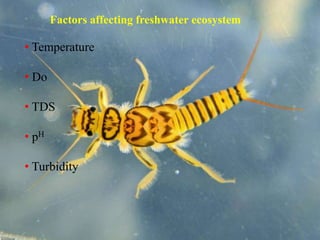
Factors affecting freshwater ecosystem
• Temperature
• Do
• TDS
• pH
• Turbidity
27
Insects as Terrestrial Pollution indicator
Land insects are good bioindicators in various types of
environmental change
Traditionally soil invertebrates are used to indicate soil
fertility and pollutant level
Occurrence of excess acidic (or) alkaline content, fertilizers
(or) industrial waste kills larvae, grubs, nymphs and adults
of these insects
Polluted land areas are not fit for insects to lay eggs
Several insect groups can be used as terrestrial
environment bioindicator, which are as follows
28
Coleoptera
Beetles from order Coleoptera- Family Carabidae
are important predators
They participate in biological monitoring of
pollution from oil, sulfur, herbicides, Co2 , insecticides
and radioactive phosphorus
29
Collembola
Primitive insects that influence soil fertility through
microbial activity stimulation, the fungi spore distribution
& inhibit fungal and bacterial action causing diseases in
plants
They are very sensitive to changes in soil & diversity
reduction can show us pollution by heavy metals, pesticide
in agricultural soils and soil water acidification by organic
pollutants and wastes
(Rusek, 2000)
30
Ants
31
Ants are used as soil quality bioindicators and have a
key role in the recovery of degraded and reforested
areas and are very sensitive to human impact
Some ant groups have the potential as biological
indicators of soil conditions, crop management and
assessment systems for plantations in agro-ecosystem
(Peck et al., 1998)
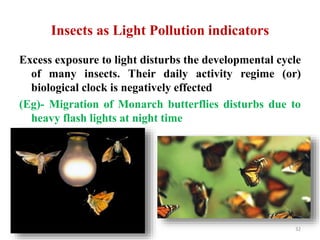
Insects as Light Pollution indicators
Excess exposure to light disturbs the developmental cycle
of many insects. Their daily activity regime (or)
biological clock is negatively effected
(Eg)- Migration of Monarch butterflies disturbs due to
heavy flash lights at night time
32
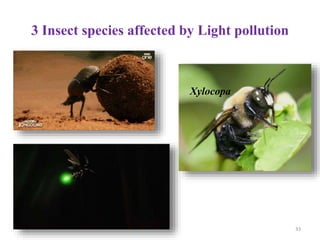
3 Insect species affected by Light pollution
33
Xylocopa
Insects as Sound Pollution indicators
34
Decreases
(Kawahara, 2017)
Wolf spider
Leafhopper
Insect species affected by Sound Pollution
• Sounds are an important part of social insects life
history. Generally males produce advertisement calls
to attract females (or) to drive out competitive males
out of their territory
• Negative effect of vehicular horns, noise of moving
vehicles and other sources suppress the advertisement
call of male insects
35
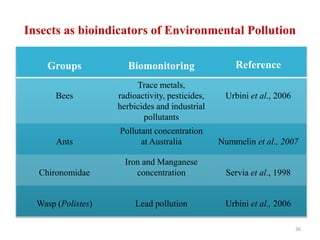
Insects as bioindicators of Environmental Pollution
Groups Biomonitoring Reference
Bees
Trace metals,
radioactivity, pesticides,
herbicides and industrial
pollutants
Urbini et al., 2006
Ants
Pollutant concentration
at Australia Nummelin et al., 2007
Chironomidae
Iron and Manganese
concentration Servia et al., 1998
Wasp (Polistes) Lead pollution Urbini et al., 2006
36
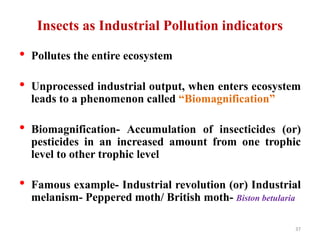
Insects as Industrial Pollution indicators
• Pollutes the entire ecosystem
• Unprocessed industrial output, when enters ecosystem
leads to a phenomenon called “Biomagnification”
• Biomagnification- Accumulation of insecticides (or)
pesticides in an increased amount from one trophic
level to other trophic level
• Famous example- Industrial revolution (or) Industrial
melanism- Peppered moth/ British moth- Biston betularia
37
38
39
40
Insects as Air pollution indicators
Air pollution blocks trachea/ spiracle openings of
insects
Orientation cues of insects to search host plant, mate or
ovipositional sites are damaged
Several inscet groups can be used as air pollution
indicators which are as follows :
Honeybee- Hymenoptera
The pollinator strength and its population size are
generally considered the most important features for
plant reproduction, especially to the agricultural crops
Pollinators, especially honeybees are considered as the
reliable biological indicators
(Ghini , 2004)
41
Recent news- Mass dying out of honeybee in United
states of America because of fertilizers has brought
honeybees to the list of endangered species
42
Lepidoptera- Moths & Butterflies
• The members of this group can be used as pollution
indicators via., heavy metals & carbon dioxide in localities
near the industrial and within urban areas
• Pupae of various species of Geometridae, Noctuidae and
Eriocraniidae are accountable for studying manifestation
and concerns of Copper, Iron, Nickel, Cadmium, Sulfuric
acid ions and other substances in fertilizers
43
Other bioindicator insect groups
• Termites- Increases soil infiltration capacity which leads to
water retention & soil productivity (Eggleton et al., 1994)
• Forest- Organic soil decomposition & incorporation
• In agricultural, pasture and reforestation areas they are
not always perceived because its nests are underground
and their presence is only noticed by the damage they
cause to the plants
44
Aphids are also pollutant indicators because they
show an increase in their population density when
feeding on hosts exposed to the environments with
high carbon dioxide concentrations
(Cannon, 1998)
45
46
Case Study
“Assessment of river water quality using macro
invertebrate organisms as pollution indicators of
Thamirabarani River Basin, Tamilnadu, India”
Manonmaniam Sundaranar University (2014)- Alwarkuruchi
47
The main objective of this study was to assess the current
pollution status of the river Thamirabarani using benthic
macro-invertebrate organisms as pollution indicators, since
the river receives plenty of organic constituents all along the
flow by means of sewage, agricultural run-off, industrial
wastes discharges.
12 sampling points
• Pabanasam
• V. K. Puram
• Ambasamudram
• Thiruppudaimarudhur
• Mukkudal
• Cheranmahadevi
• Kurukkuthurai
• Kokkirakulam
• Vannarapettai
• Seevalaperi
• Srivaigundam
• Aattur
48
List of observed macroinvertebrate organisms at various
locations of river Thamirabarani
1) Ephemeroptera
2) Plecoptera
3) Trichoptera
4) Diptera
5) Crustacea
6) Odonata
7) Hemiptera
8) Megaloptera ( Sialidae)
9) Coleoptera
49
Result
Presence of higher order families like Trichoptera, Ephemeroptera,
Plecoptera in reference locations is almost absent in the stations like
(Kurukkuthurai and Kokkirakulam) which represent the higher pollutant
level and the organisms are more vulnerable to the pollutant stress whereas
their presence is recorded in (Vannarapettai and Aathur)
Conclusion
This study showed that by using macroinvertebrates in water quality
assessment provides positive and promising results because they show
noticeable sensitivity to environmental changes. Hence the study concludes
that the macroinvertebrate organisms were good biological indicators of
pollution
50
CONCLUSION
• Essential for environmental monitoring
• Class Insecta has many potential representatives
that can be used as environmental bioindicators
• Some organisms are very sensitive to changes in
the environment and can be used to measure the
impact of human activities
“They might be small, but they are the dominant
species on the planet in terms of numbers. What
happens to them affects whole ecosystems”
51
THANK YOU

Insects as pollution indicators

  • 1.
    1 WELCOME TO ALL CreditSeminar- 1 20-04-2018
  • 2.
    2 INSECTS AS POLLUTIONINDICATORS BY, L.N.NISHA I-PhD-ENTOMOLOGY
  • 3.
    What is pollution??????? Pollution is the introduction of contaminants (solid, liquid, gas and even light) into natural environment that cause adverse change in environment These effects are like degradation of natural resources and nature Effects of pollution are slow and gradual but last long 3
  • 4.
  • 5.
  • 6.
  • 7.
  • 8.
  • 9.
    What is anIndicator species??? A species whose presence, absence (or) abundance reflects a specific environmental condition, habitat (or) community. Indicator species may Provide information on the overall health of an ecosystem When the species is present, it indicates the presence of certain environmental parameters 9
  • 10.
    Why use indicatorspecies??? 10 Indicator species can provide an early warning of environmental changes They can be used to assess the health of an environment (or) ecosystem- they are often termed as “ Bio-indicators” They can be a useful management tool
  • 11.
    Characteristics of agood Bio-indicator Abundance, wide distribution Simple procedure of identification and sampling High tolerance for the pollutants analyzed Quick response towards the change in their environment Taxonomically well documented and stable Easy and cheap to survey (Peck et al., 1998) 11
  • 12.
    Pollution indicator groupsof Insects Dragonflies and Damselflies Mayflies Caddisflies Stoneflies Bugs Beetles 12
  • 13.
    Honey bees Collembolans Butterflies andMoths Midges Ants Syrphid flies 13
  • 14.
  • 15.
    Aquatic insects asWater Pollution Indicators Insects which live completely (or) carry a major part of their life cycle in water can tell directly about water pollution Larvae of Mosquitoes, Odonates and Neuropterans can live only in fresh water. Absence of these larvae indicate towards presence of Arsenic and Lead concentrations in water (Kaur et al., 2010) Several aquatic insect groups can be used as aquatic environment bioindicators, which are as follows: 15
  • 16.
    Dragonflies and Damselflies Dragonfliesand damselflies are an important group in biological water quality monitoring, as they are particularly sensitive to pollution 16
  • 17.
    Mayfly- Ephemeroptera Mayfly larvaeare recognized worldwide for their sensitivity to oxygen depletion in running water and are therefore commonly used as bioindicators in water pollution Mayfly larva are sensitive to dissolved oxygen levels in water 17
  • 18.
    Caddisflies Caddisflies (Trichoptera) arethe group of insects, whose larvae occur in all types of fresh water Particular species are sensitive to water pollution and that’s why they are used as bioindicators of water purity 18
  • 19.
    Stoneflies Stonefly (Plecoptera) larvaecan live only in clear water and these stoneflies prefer well oxygenated water to survive (Voshell et al., 2002) 19
  • 20.
    Bugs- Hemiptera Bugs ofmany families like Corixidae, Nepidae, Notonectidae, Belestomatidae and Gerridae are also acts as bio-indicator to determine the quality of water. 20 Water boatman Nepidae Back swimmer Water strider Giant water bug
  • 21.
    Polluted Water Indicators 21 Sludgeworm Chiranomid larva Rat-tailed maggot
  • 22.
    The tolerance ofaquatic organisms to heavy metals has been explained by the Metallothionins (MTs) formation in many aquatic organisms If the presence of MTs is a measure of metal tolerance, the measurement of MTs could provide clues about the tolerance in this organisms and possible toxic agents responsible for environment stress (Bisthoven et al., 1998) Although species of the genus Halobates (Gerridae) are suitable for bioindication of Cadmium & Mercury (Nummelin et al., 2007) 22
  • 23.
  • 24.
    Lives in Healthyecosystem 24
  • 25.
    Lives in Pollutedwater ecosystem 25
  • 26.
    26 Factors affecting freshwaterecosystem • Temperature • Do • TDS • pH • Turbidity
  • 27.
  • 28.
    Insects as TerrestrialPollution indicator Land insects are good bioindicators in various types of environmental change Traditionally soil invertebrates are used to indicate soil fertility and pollutant level Occurrence of excess acidic (or) alkaline content, fertilizers (or) industrial waste kills larvae, grubs, nymphs and adults of these insects Polluted land areas are not fit for insects to lay eggs Several insect groups can be used as terrestrial environment bioindicator, which are as follows 28
  • 29.
    Coleoptera Beetles from orderColeoptera- Family Carabidae are important predators They participate in biological monitoring of pollution from oil, sulfur, herbicides, Co2 , insecticides and radioactive phosphorus 29
  • 30.
    Collembola Primitive insects thatinfluence soil fertility through microbial activity stimulation, the fungi spore distribution & inhibit fungal and bacterial action causing diseases in plants They are very sensitive to changes in soil & diversity reduction can show us pollution by heavy metals, pesticide in agricultural soils and soil water acidification by organic pollutants and wastes (Rusek, 2000) 30
  • 31.
    Ants 31 Ants are usedas soil quality bioindicators and have a key role in the recovery of degraded and reforested areas and are very sensitive to human impact Some ant groups have the potential as biological indicators of soil conditions, crop management and assessment systems for plantations in agro-ecosystem (Peck et al., 1998)
  • 32.
    Insects as LightPollution indicators Excess exposure to light disturbs the developmental cycle of many insects. Their daily activity regime (or) biological clock is negatively effected (Eg)- Migration of Monarch butterflies disturbs due to heavy flash lights at night time 32
  • 33.
    3 Insect speciesaffected by Light pollution 33 Xylocopa
  • 34.
    Insects as SoundPollution indicators 34 Decreases (Kawahara, 2017) Wolf spider Leafhopper
  • 35.
    Insect species affectedby Sound Pollution • Sounds are an important part of social insects life history. Generally males produce advertisement calls to attract females (or) to drive out competitive males out of their territory • Negative effect of vehicular horns, noise of moving vehicles and other sources suppress the advertisement call of male insects 35
  • 36.
    Insects as bioindicatorsof Environmental Pollution Groups Biomonitoring Reference Bees Trace metals, radioactivity, pesticides, herbicides and industrial pollutants Urbini et al., 2006 Ants Pollutant concentration at Australia Nummelin et al., 2007 Chironomidae Iron and Manganese concentration Servia et al., 1998 Wasp (Polistes) Lead pollution Urbini et al., 2006 36
  • 37.
    Insects as IndustrialPollution indicators • Pollutes the entire ecosystem • Unprocessed industrial output, when enters ecosystem leads to a phenomenon called “Biomagnification” • Biomagnification- Accumulation of insecticides (or) pesticides in an increased amount from one trophic level to other trophic level • Famous example- Industrial revolution (or) Industrial melanism- Peppered moth/ British moth- Biston betularia 37
  • 38.
  • 39.
  • 40.
    40 Insects as Airpollution indicators Air pollution blocks trachea/ spiracle openings of insects Orientation cues of insects to search host plant, mate or ovipositional sites are damaged Several inscet groups can be used as air pollution indicators which are as follows :
  • 41.
    Honeybee- Hymenoptera The pollinatorstrength and its population size are generally considered the most important features for plant reproduction, especially to the agricultural crops Pollinators, especially honeybees are considered as the reliable biological indicators (Ghini , 2004) 41
  • 42.
    Recent news- Massdying out of honeybee in United states of America because of fertilizers has brought honeybees to the list of endangered species 42
  • 43.
    Lepidoptera- Moths &Butterflies • The members of this group can be used as pollution indicators via., heavy metals & carbon dioxide in localities near the industrial and within urban areas • Pupae of various species of Geometridae, Noctuidae and Eriocraniidae are accountable for studying manifestation and concerns of Copper, Iron, Nickel, Cadmium, Sulfuric acid ions and other substances in fertilizers 43
  • 44.
    Other bioindicator insectgroups • Termites- Increases soil infiltration capacity which leads to water retention & soil productivity (Eggleton et al., 1994) • Forest- Organic soil decomposition & incorporation • In agricultural, pasture and reforestation areas they are not always perceived because its nests are underground and their presence is only noticed by the damage they cause to the plants 44
  • 45.
    Aphids are alsopollutant indicators because they show an increase in their population density when feeding on hosts exposed to the environments with high carbon dioxide concentrations (Cannon, 1998) 45
  • 46.
    46 Case Study “Assessment ofriver water quality using macro invertebrate organisms as pollution indicators of Thamirabarani River Basin, Tamilnadu, India” Manonmaniam Sundaranar University (2014)- Alwarkuruchi
  • 47.
    47 The main objectiveof this study was to assess the current pollution status of the river Thamirabarani using benthic macro-invertebrate organisms as pollution indicators, since the river receives plenty of organic constituents all along the flow by means of sewage, agricultural run-off, industrial wastes discharges. 12 sampling points • Pabanasam • V. K. Puram • Ambasamudram • Thiruppudaimarudhur • Mukkudal • Cheranmahadevi • Kurukkuthurai • Kokkirakulam • Vannarapettai • Seevalaperi • Srivaigundam • Aattur
  • 48.
    48 List of observedmacroinvertebrate organisms at various locations of river Thamirabarani 1) Ephemeroptera 2) Plecoptera 3) Trichoptera 4) Diptera 5) Crustacea 6) Odonata 7) Hemiptera 8) Megaloptera ( Sialidae) 9) Coleoptera
  • 49.
    49 Result Presence of higherorder families like Trichoptera, Ephemeroptera, Plecoptera in reference locations is almost absent in the stations like (Kurukkuthurai and Kokkirakulam) which represent the higher pollutant level and the organisms are more vulnerable to the pollutant stress whereas their presence is recorded in (Vannarapettai and Aathur) Conclusion This study showed that by using macroinvertebrates in water quality assessment provides positive and promising results because they show noticeable sensitivity to environmental changes. Hence the study concludes that the macroinvertebrate organisms were good biological indicators of pollution
  • 50.
    50 CONCLUSION • Essential forenvironmental monitoring • Class Insecta has many potential representatives that can be used as environmental bioindicators • Some organisms are very sensitive to changes in the environment and can be used to measure the impact of human activities “They might be small, but they are the dominant species on the planet in terms of numbers. What happens to them affects whole ecosystems”
  • 51.