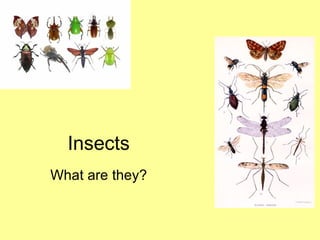
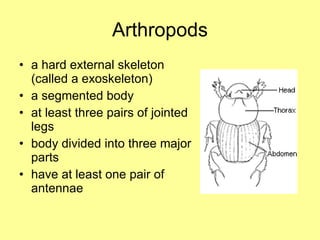
Insects What are they?
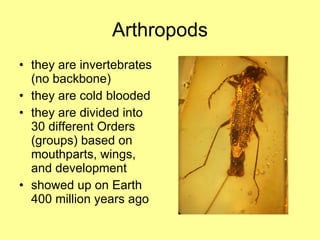
Arthropods a hard external skeleton (called a exoskeleton)  a segmented body  at least three pairs of jointed legs  body divided into three major parts have at least one pair of antennae
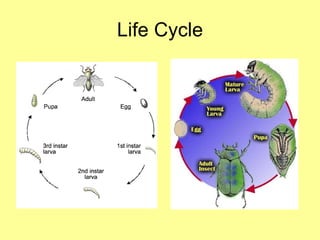
Arthropods they are invertebrates (no backbone) they are cold blooded they are divided into 30 different Orders (groups) based on mouthparts, wings, and development showed up on Earth 400 million years ago
Life Cycle
Ant Life Cycle The life cycle of the ant consists of four stages: egg, larva, pupa, and adult. Fertilized eggs produce female ants (queens, workers, or soldiers); unfertilized eggs produce male ants.  Egg : Ant eggs are oval shaped and tiny (they are on the order of 1 mm long, but the queen's egg is many times larger).  Larva : The worm-like larvae have no eyes and no legs; they eat food regurgitated by adult ants. The larvae  molt (shed their skin)  many times as they increase in size.  Pupa : After reaching a certain size, the larva spins a silk-like cocoon around itself (against a solid object, like the wall of the chamber) and pupates. During this time the body  metamorphoses (changes)  into its adult form.  Adult : The pupa emerges as an adult. The entire life cycle usually lasts from 6 to 10 weeks. Some queens can live over 15 years, and some workers can live for up to 7 years.
Adaptations Mouthparts – Structure and Function Chewing Sucking Sponging Lapping
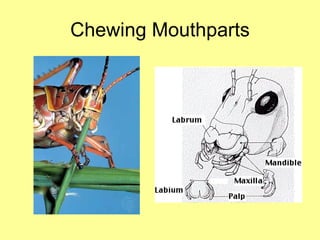
Chewing Mouthparts
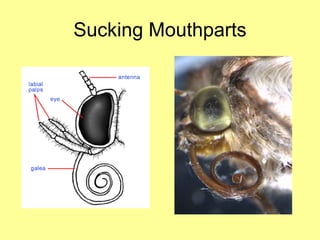
Sucking Mouthparts
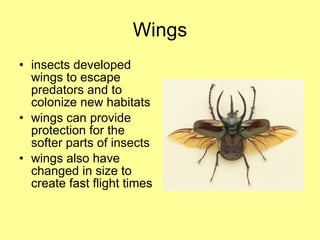
Wings insects developed wings to escape predators and to colonize new habitats wings can provide protection for the softer parts of insects wings also have changed in size to create fast flight times
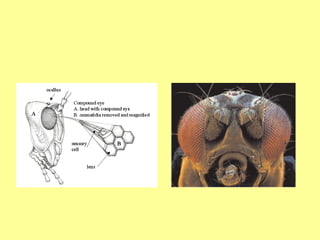
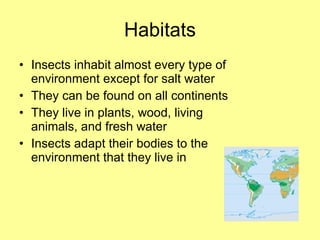
Insect Senses Insects taste using their mouthparts and their FEET-some use their antennae Insects smell using their antennae Insects touch using small hairs found on their bodies (they can feel wind) Insects hear using smalls hairs, usually found on their legs Insects have two compound eyes (for movement, color, and images) Insects can have up to three simple eyes (see light and dark)
 
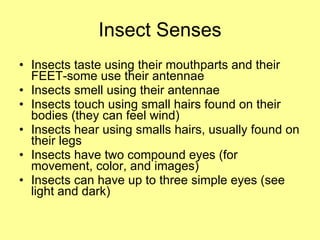
Habitats Insects inhabit almost every type of environment except for salt water They can be found on all continents They live in plants, wood, living animals, and fresh water Insects adapt their bodies to the environment that they live in
Insect Behavior It is mostly instinctive – instincts are determined by genes before it hatches from an egg They are programmed to eat certain foods, to defend against attack Insects do have the ability to learn – identify locations by sight Insects also learn by trial and error
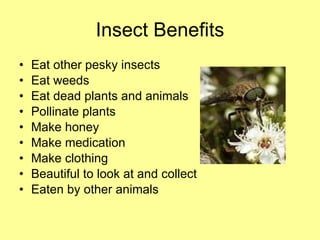
Insect Benefits Eat other pesky insects Eat weeds Eat dead plants and animals Pollinate plants Make honey Make medication Make clothing Beautiful to look at and collect Eaten by other animals
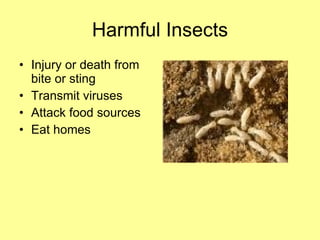
Harmful Insects Injury or death from bite or sting Transmit viruses Attack food sources Eat homes

Insects

  • 1.
  • 2.
    Arthropods a hardexternal skeleton (called a exoskeleton) a segmented body at least three pairs of jointed legs body divided into three major parts have at least one pair of antennae
  • 3.
    Arthropods they areinvertebrates (no backbone) they are cold blooded they are divided into 30 different Orders (groups) based on mouthparts, wings, and development showed up on Earth 400 million years ago
  • 4.
  • 5.
    Ant Life CycleThe life cycle of the ant consists of four stages: egg, larva, pupa, and adult. Fertilized eggs produce female ants (queens, workers, or soldiers); unfertilized eggs produce male ants. Egg : Ant eggs are oval shaped and tiny (they are on the order of 1 mm long, but the queen's egg is many times larger). Larva : The worm-like larvae have no eyes and no legs; they eat food regurgitated by adult ants. The larvae molt (shed their skin) many times as they increase in size. Pupa : After reaching a certain size, the larva spins a silk-like cocoon around itself (against a solid object, like the wall of the chamber) and pupates. During this time the body metamorphoses (changes) into its adult form. Adult : The pupa emerges as an adult. The entire life cycle usually lasts from 6 to 10 weeks. Some queens can live over 15 years, and some workers can live for up to 7 years.
  • 6.
    Adaptations Mouthparts –Structure and Function Chewing Sucking Sponging Lapping
  • 7.
  • 8.
  • 9.
    Wings insects developedwings to escape predators and to colonize new habitats wings can provide protection for the softer parts of insects wings also have changed in size to create fast flight times
  • 10.
    Insect Senses Insectstaste using their mouthparts and their FEET-some use their antennae Insects smell using their antennae Insects touch using small hairs found on their bodies (they can feel wind) Insects hear using smalls hairs, usually found on their legs Insects have two compound eyes (for movement, color, and images) Insects can have up to three simple eyes (see light and dark)
  • 11.
  • 12.
    Habitats Insects inhabitalmost every type of environment except for salt water They can be found on all continents They live in plants, wood, living animals, and fresh water Insects adapt their bodies to the environment that they live in
  • 13.
    Insect Behavior Itis mostly instinctive – instincts are determined by genes before it hatches from an egg They are programmed to eat certain foods, to defend against attack Insects do have the ability to learn – identify locations by sight Insects also learn by trial and error
  • 14.
    Insect Benefits Eatother pesky insects Eat weeds Eat dead plants and animals Pollinate plants Make honey Make medication Make clothing Beautiful to look at and collect Eaten by other animals
  • 15.
    Harmful Insects Injuryor death from bite or sting Transmit viruses Attack food sources Eat homes