BIOINDICATORS
ENVIRONMENTAL TOXICOLOGY
INTRODUCTION
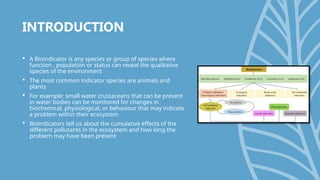
 A Bioindicator is any species or group of species where
function , population or status can reveal the qualitative
species of the environment
 The most common indicator species are animals and
plants
 For example: small water crustaceans that can be present
in water bodies can be monitored for changes in
biochemical, physiological, or behaviour that may indicate
a problem within their ecosystem
 Bioindicators tell us about the cumulative effects of the
different pollutants in the ecosystem and how long the
problem may have been present
CRITERIA FOR SELECTING BIOINDICATORS
• A. The indicator should be consistently and exclusively associated with the source of the
pathogens.
• B. It must be present in sufficient numbers to provide an accurate density estimate
whenever the level of each of the pathogens is such that the risk of illness is
unacceptable.
• C. It should approach the resistance to disinfectants and environmental stress,
including toxic materials deposited therein, of the most resistant pathogen potentially
present at significant levels in the sources.
• D. It should be quantifiable in recreational waters by reasonably facile and inexpensive
methods and with considerable accuracy, precision, and specificity. These requirements
provide a basis to compare available indicators for water quality monitoring.
TYPES OF BIOINDICATOR
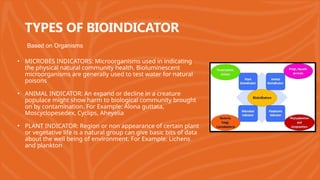
• MICROBES INDICATORS: Microorganisms used in indicating
the physical natural community health. Bioluminescent
microorganisms are generally used to test water for natural
poisons
• ANIMAL INDICATOR: An expand or decline in a creature
populace might show harm to biological community brought
on by contamination. For Example: Alona guttata,
Moscyclopesedex, Cyclips, Aheyelia
• PLANT INDICATOR: Region or non appearance of certain plant
or vegetative life is a natural group can give basic bits of data
about the well being of environment. For Example: Lichens
and plankton
Based on Organisms
TYPES OF INDICATOR
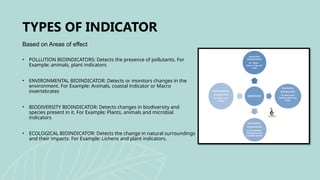
• POLLUTION BIOINDICATORS: Detects the presence of pollutants. For
Example: animals, plant indicators
• ENVIRONMENTAL BIOINDICATOR: Detects or monitors changes in the
environment. For Example: Animals, coastal indicator or Macro
invertebrates
• BIODIVERSITY BIOINDICATOR: Detects changes in biodiversity and
species present in it. For Example: Plants, animals and microbial
indicators
• ECOLOGICAL BIOINDICATOR: Detects the change in natural surroundings
and their impacts. For Example: Lichens and plant indicators.
Based on Areas of effect
LICHENS
• Lichens are mostly an indicator of air pollution and widely
used to assess the air pollution.
• Lichens serve as effective bioindicators of air quality
because they have no roots, no cuticle and acquire all
nutrients from direct exposure to the atmosphere
• The disappearance of lichens in a forest may indicate
environmental stresses such as high levels of sulphur
dioxide, sulphur- based pollutants and nitrogen oxides
• Not all lichens are equally sensitivity to all pollutants, to
different lichen species show different levels of sensitivity to
specific atmospheric pollutants
• Frogs and toads are increasingly used as bioindicators
of contaminant accumulation is pollution studies.
• These absorb toxic chemicals through their skin and
their lower gill membrane and are sensitive to
alterations in their environment.
• They have a poor ability to detoxify pesticides that are
absorbed, inhaled or ingested by eating contaminated
food.
• This allows residues like organochlorine pesticides to
accumalate in their systems.
• Also have permeable skin that can easily absorb toxic
chemicals, making them a model organism for
assessing the effects of environmental factors that
may cause the decline of the amphibian population.
FROGS AND TOADS
• Euglena gracilis is a motile, freshwater, photosynthetic flagellate.
• Although Euglena is rather tolerant to acidity, it responds rapidly and
sensitive to environmental stresses such as heavy metals or organic
and inorganic compounds
• Typical responses are inhibition of movement and a change of
orientation parameters.
• Moreover, this organisms is very easy to handle and grow, making it
very useful tool for eco- toxicological assessment.
EUGLENA
MACRO INVERTEBRATES
• Macro invertebrates are useful and convenient indicators of
ecological health of water bodies and terrestrial ecosystems.
• They are almost always present and are easy to sample and
identify.
• Benthic macro invertebrates such as aquatic insects,
crustaceans, worms and mollusks live in the vegetation and
stream beds of rivers
• Benthic indicators are often used to measure the biological
components of fresh water streams and rivers
A. Biological impacts can be determined.
B. To monitor synergetic and antagonistic impacts of various pollutants on a creature.
C. Early stage diagnosis as well as harmful effects of toxins to plants, as well as human
beings, can be monitored.
D. Can be easily counted, due to their prevalence.
E. Economically viable alternative when compared with other specialized measuring
systems.
ADVANTAGES
LIMITATIONS
1. Bioindicators are limited in their ability to assess the health of an ecosystem.
2. They can only provide a snapshot of the environment and cannot provide detailed
information about the effects of pollution, climate change, and other human
activities.
3. Bioindicators are also limited in their ability to detect changes in an environment over
time.
4. They can provide information about the current state of an ecosystem, but cannot
provide information about how the environment has changed over time.
THANK YOU

Bioindicators and its types with examples.pptx

  • 1.
  • 2.
    INTRODUCTION  A Bioindicatoris any species or group of species where function , population or status can reveal the qualitative species of the environment  The most common indicator species are animals and plants  For example: small water crustaceans that can be present in water bodies can be monitored for changes in biochemical, physiological, or behaviour that may indicate a problem within their ecosystem  Bioindicators tell us about the cumulative effects of the different pollutants in the ecosystem and how long the problem may have been present
  • 3.
    CRITERIA FOR SELECTINGBIOINDICATORS • A. The indicator should be consistently and exclusively associated with the source of the pathogens. • B. It must be present in sufficient numbers to provide an accurate density estimate whenever the level of each of the pathogens is such that the risk of illness is unacceptable. • C. It should approach the resistance to disinfectants and environmental stress, including toxic materials deposited therein, of the most resistant pathogen potentially present at significant levels in the sources. • D. It should be quantifiable in recreational waters by reasonably facile and inexpensive methods and with considerable accuracy, precision, and specificity. These requirements provide a basis to compare available indicators for water quality monitoring.
  • 4.
    TYPES OF BIOINDICATOR •MICROBES INDICATORS: Microorganisms used in indicating the physical natural community health. Bioluminescent microorganisms are generally used to test water for natural poisons • ANIMAL INDICATOR: An expand or decline in a creature populace might show harm to biological community brought on by contamination. For Example: Alona guttata, Moscyclopesedex, Cyclips, Aheyelia • PLANT INDICATOR: Region or non appearance of certain plant or vegetative life is a natural group can give basic bits of data about the well being of environment. For Example: Lichens and plankton Based on Organisms
  • 5.
    TYPES OF INDICATOR •POLLUTION BIOINDICATORS: Detects the presence of pollutants. For Example: animals, plant indicators • ENVIRONMENTAL BIOINDICATOR: Detects or monitors changes in the environment. For Example: Animals, coastal indicator or Macro invertebrates • BIODIVERSITY BIOINDICATOR: Detects changes in biodiversity and species present in it. For Example: Plants, animals and microbial indicators • ECOLOGICAL BIOINDICATOR: Detects the change in natural surroundings and their impacts. For Example: Lichens and plant indicators. Based on Areas of effect
  • 6.
    LICHENS • Lichens aremostly an indicator of air pollution and widely used to assess the air pollution. • Lichens serve as effective bioindicators of air quality because they have no roots, no cuticle and acquire all nutrients from direct exposure to the atmosphere • The disappearance of lichens in a forest may indicate environmental stresses such as high levels of sulphur dioxide, sulphur- based pollutants and nitrogen oxides • Not all lichens are equally sensitivity to all pollutants, to different lichen species show different levels of sensitivity to specific atmospheric pollutants
  • 7.
    • Frogs andtoads are increasingly used as bioindicators of contaminant accumulation is pollution studies. • These absorb toxic chemicals through their skin and their lower gill membrane and are sensitive to alterations in their environment. • They have a poor ability to detoxify pesticides that are absorbed, inhaled or ingested by eating contaminated food. • This allows residues like organochlorine pesticides to accumalate in their systems. • Also have permeable skin that can easily absorb toxic chemicals, making them a model organism for assessing the effects of environmental factors that may cause the decline of the amphibian population. FROGS AND TOADS
  • 8.
    • Euglena gracilisis a motile, freshwater, photosynthetic flagellate. • Although Euglena is rather tolerant to acidity, it responds rapidly and sensitive to environmental stresses such as heavy metals or organic and inorganic compounds • Typical responses are inhibition of movement and a change of orientation parameters. • Moreover, this organisms is very easy to handle and grow, making it very useful tool for eco- toxicological assessment. EUGLENA
  • 9.
    MACRO INVERTEBRATES • Macroinvertebrates are useful and convenient indicators of ecological health of water bodies and terrestrial ecosystems. • They are almost always present and are easy to sample and identify. • Benthic macro invertebrates such as aquatic insects, crustaceans, worms and mollusks live in the vegetation and stream beds of rivers • Benthic indicators are often used to measure the biological components of fresh water streams and rivers
  • 10.
    A. Biological impactscan be determined. B. To monitor synergetic and antagonistic impacts of various pollutants on a creature. C. Early stage diagnosis as well as harmful effects of toxins to plants, as well as human beings, can be monitored. D. Can be easily counted, due to their prevalence. E. Economically viable alternative when compared with other specialized measuring systems. ADVANTAGES
  • 11.
    LIMITATIONS 1. Bioindicators arelimited in their ability to assess the health of an ecosystem. 2. They can only provide a snapshot of the environment and cannot provide detailed information about the effects of pollution, climate change, and other human activities. 3. Bioindicators are also limited in their ability to detect changes in an environment over time. 4. They can provide information about the current state of an ecosystem, but cannot provide information about how the environment has changed over time.
  • 12.