© 2014, Neteler et al. - http://gis.cri.fmach.it/ 
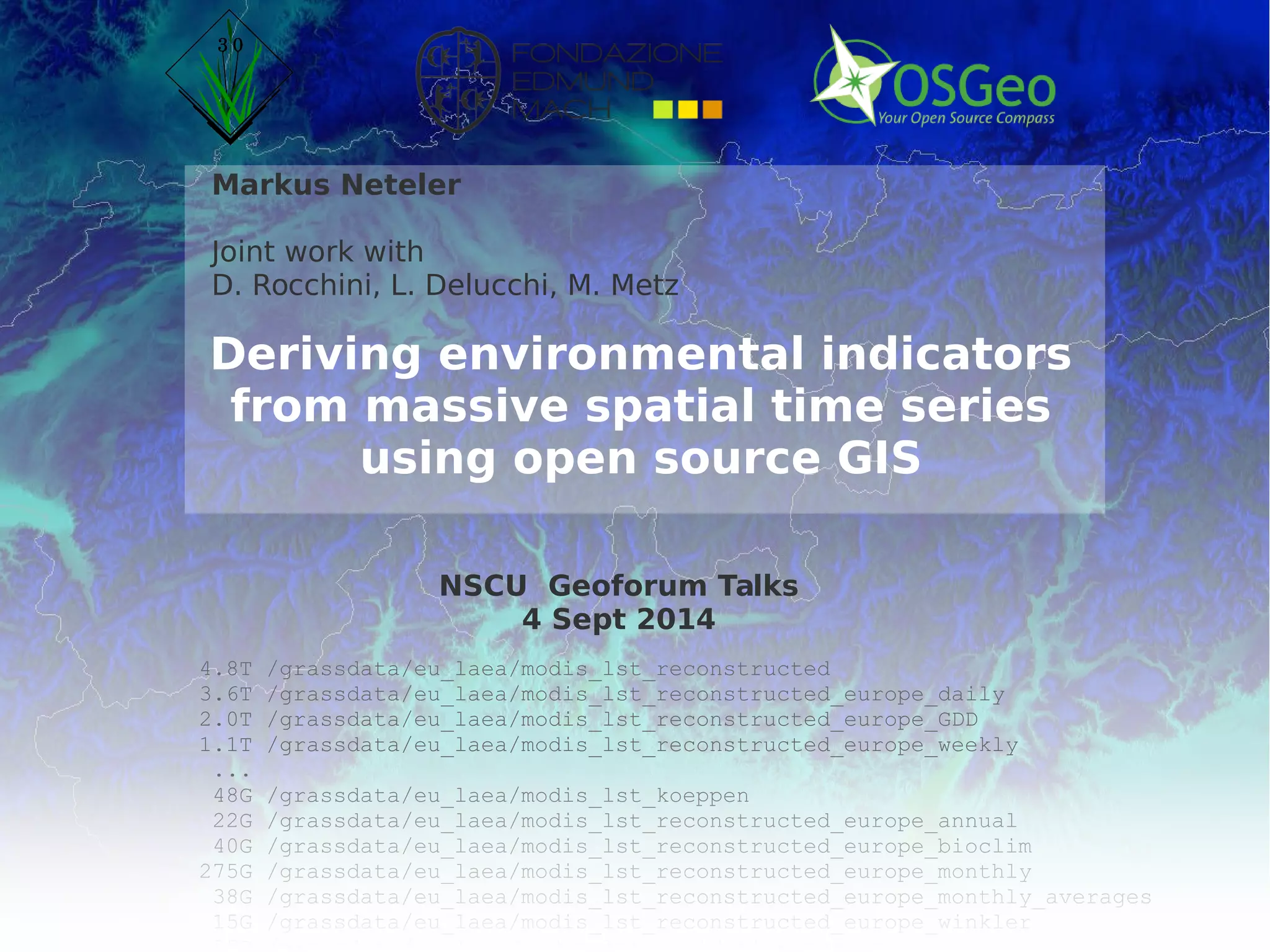
Markus Neteler 
Joint work with 
D. Rocchini, L. Delucchi, M. Metz 
Deriving environmental indicators 
from massive spatial time series 
using open source GIS 
NSCU Geoforum Talks 
4 Sept 2014 
4.8T /grassdata/eu_laea/modis_lst_reconstructed 
3.6T /grassdata/eu_laea/modis_lst_reconstructed_europe_daily 
2.0T /grassdata/eu_laea/modis_lst_reconstructed_europe_GDD 
1.1T /grassdata/eu_laea/modis_lst_reconstructed_europe_weekly 
... 
48G /grassdata/eu_laea/modis_lst_koeppen 
22G /grassdata/eu_laea/modis_lst_reconstructed_europe_annual 
40G /grassdata/eu_laea/modis_lst_reconstructed_europe_bioclim 
275G /grassdata/eu_laea/modis_lst_reconstructed_europe_monthly 
38G /grassdata/eu_laea/modis_lst_reconstructed_europe_monthly_averages 
15G /grassdata/eu_laea/modis_lst_reconstructed_europe_winkler 
55G /grassdata/eu_laea/modis_lst_validation_europe
© 2014, Neteler et al. - http://gis.cri.fmach.it/ 
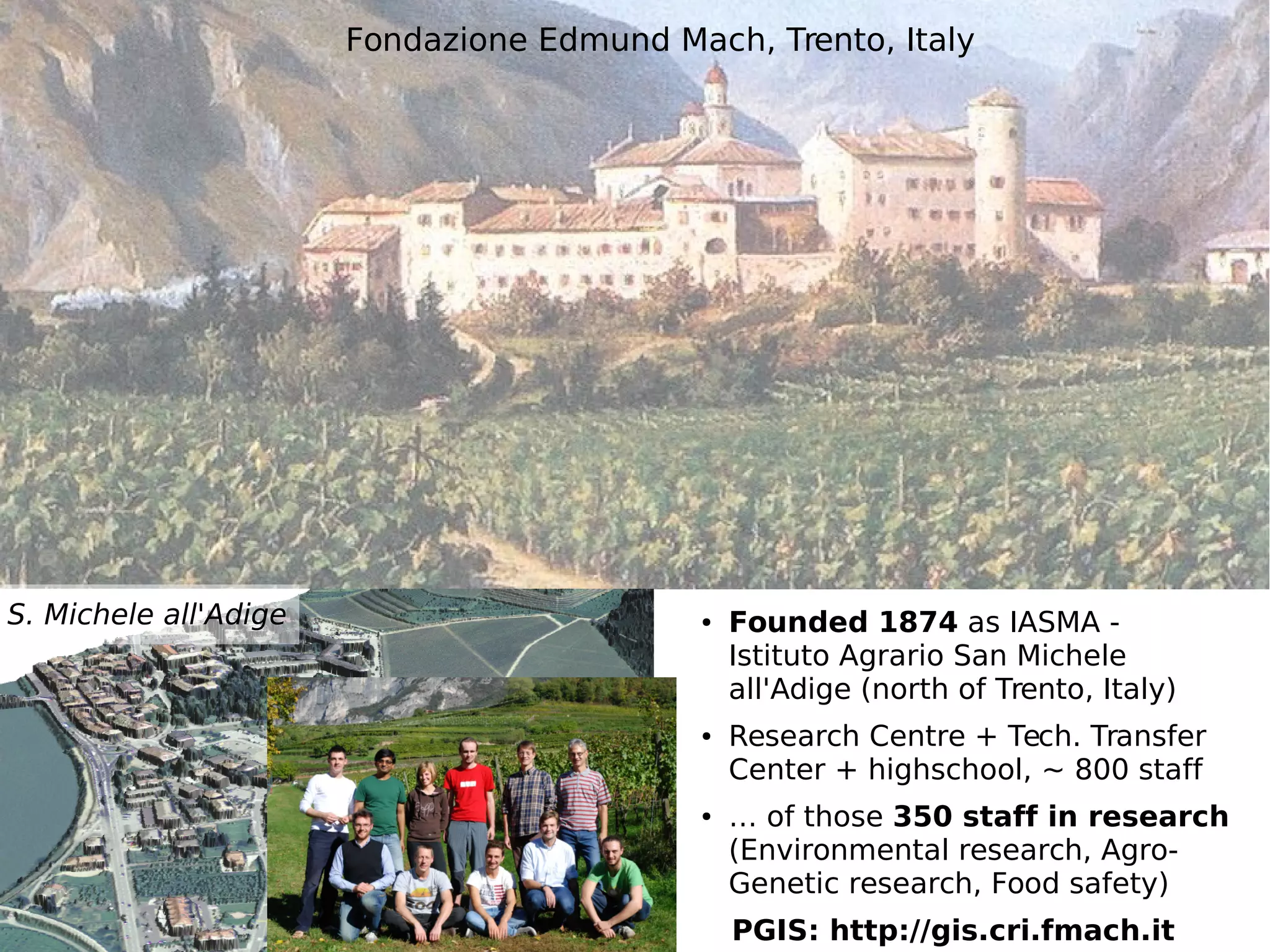
Fondazione Edmund Mach, Trento, Italy 
● Founded 1874 as IASMA - 
Istituto Agrario San Michele 
all'Adige (north of Trento, Italy) 
● Research Centre + Tech. Transfer 
Center + highschool, ~ 800 staff 
● … of those 350 staff in research 
(Environmental research, Agro- 
Genetic research, Food safety) 
PGIS: http://gis.cri.fmach.it 
S. Michele all'Adige
© 2014, Neteler et al. - http://gis.cri.fmach.it/ 
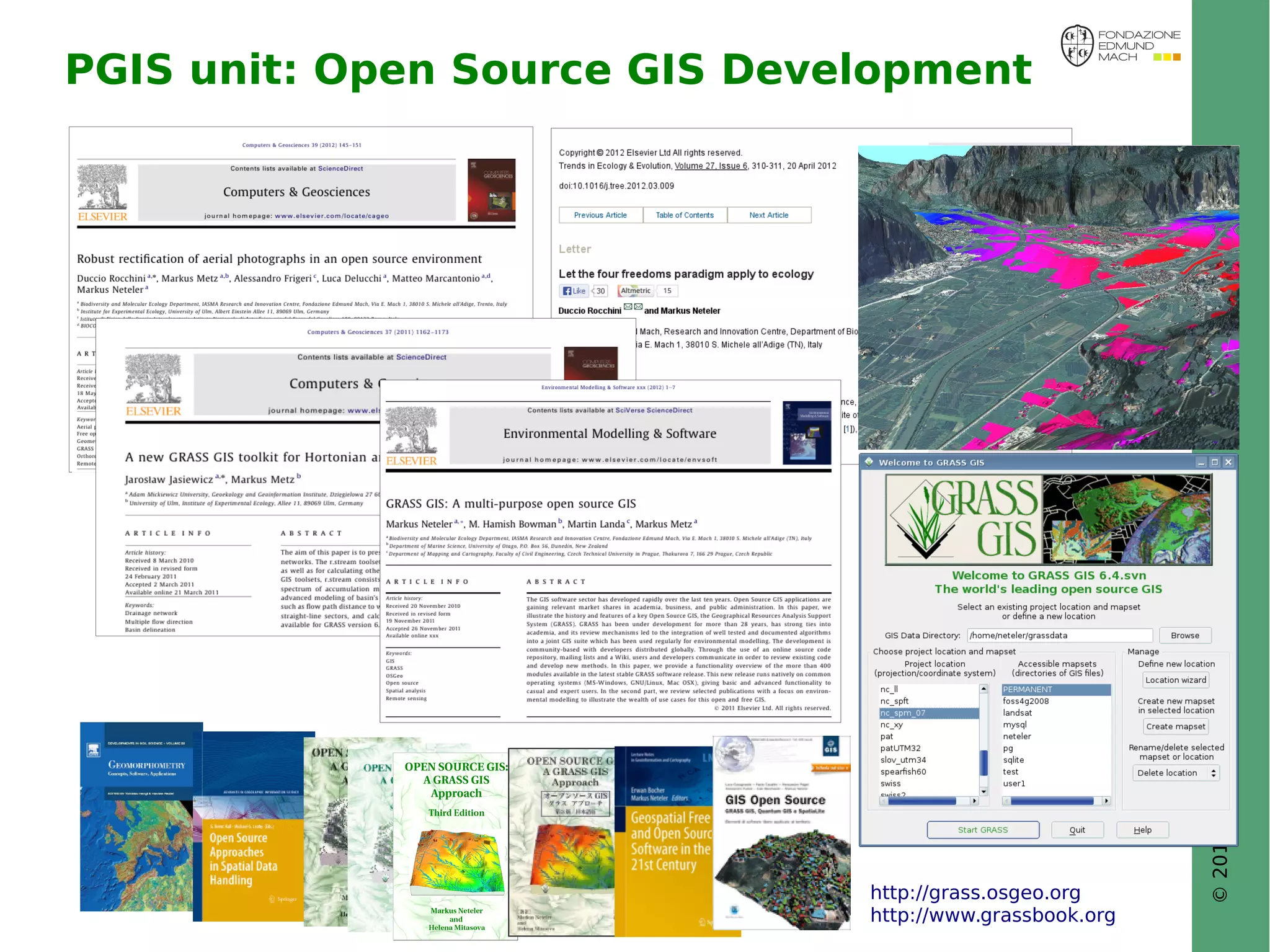
PGIS unit: Open Source GIS Development 
http://grass.osgeo.org 
http://www.grassbook.org
© 2014, Neteler et al. - http://gis.cri.fmach.it/ 
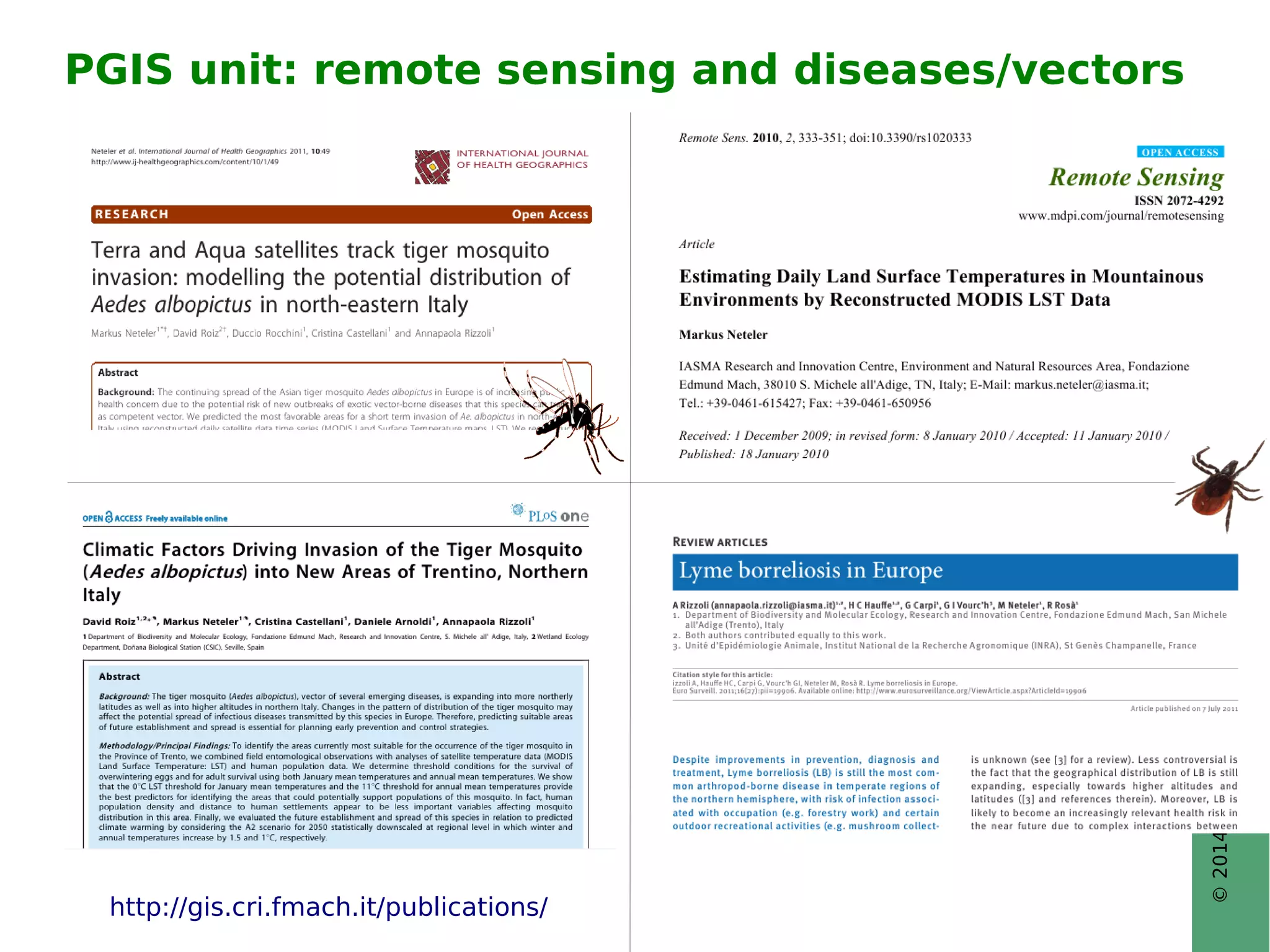
PGIS unit: remote sensing and diseases/vectors 
http://gis.cri.fmach.it/publications/
© 2014, Neteler et al. - http://gis.cri.fmach.it/ 
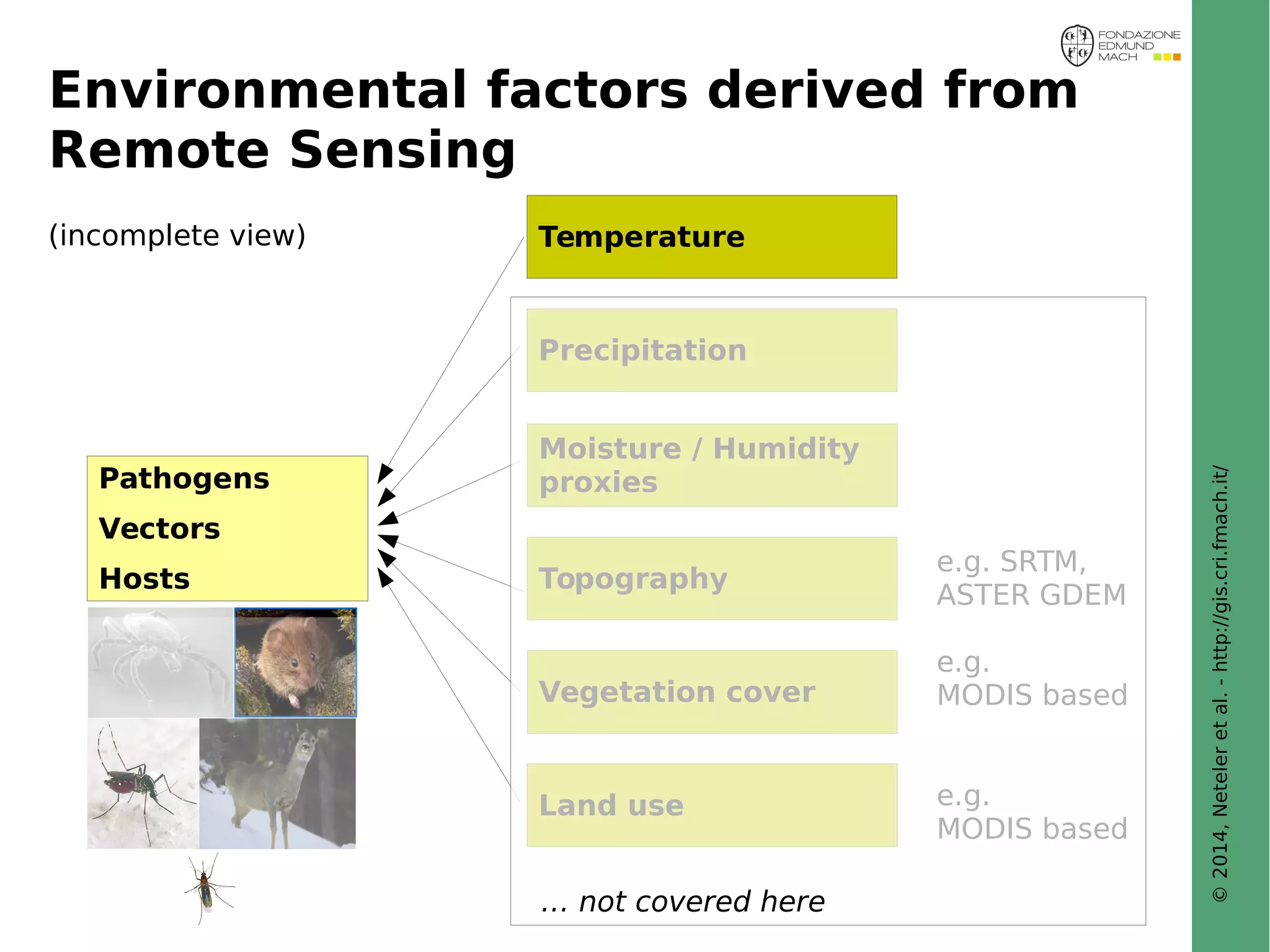
Environmental factors derived from 
Remote Sensing 
Pathogens 
Vectors 
Hosts 
Temperature 
Precipitation 
Moisture / Humidity 
proxies 
Topography 
Vegetation cover 
Land use 
(incomplete view) 
e.g. SRTM, 
ASTER GDEM 
e.g. 
MODIS based 
e.g. 
MODIS based 
… not covered here
© 2014, Neteler et al. - http://gis.cri.fmach.it/ 
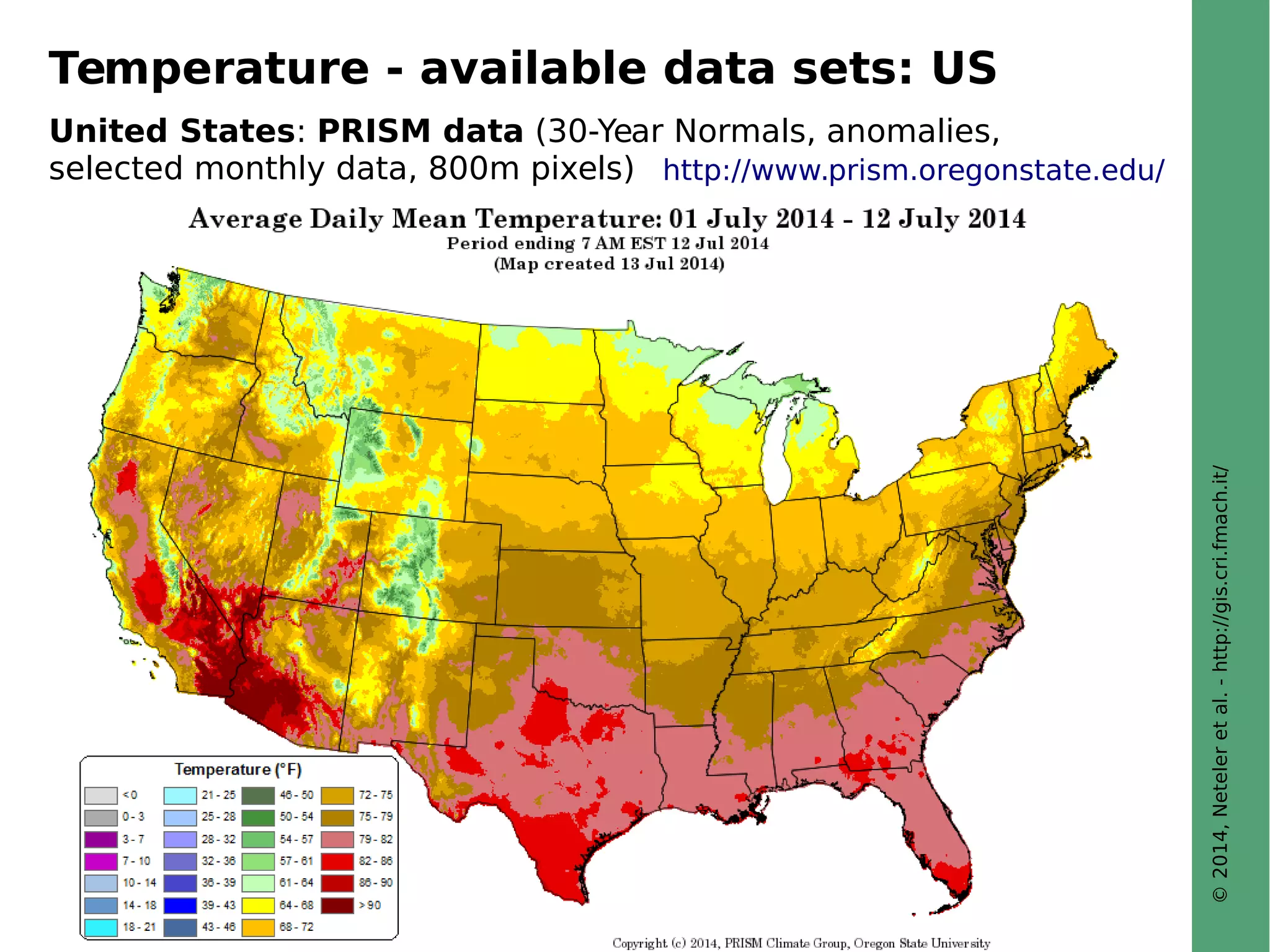
Temperature - available data sets: US 
United States: PRISM data (30-Year Normals, anomalies, 
selected monthly data, 800m pixels) http://www.prism.oregonstate.edu/
© 2014, Neteler et al. - http://gis.cri.fmach.it/ 
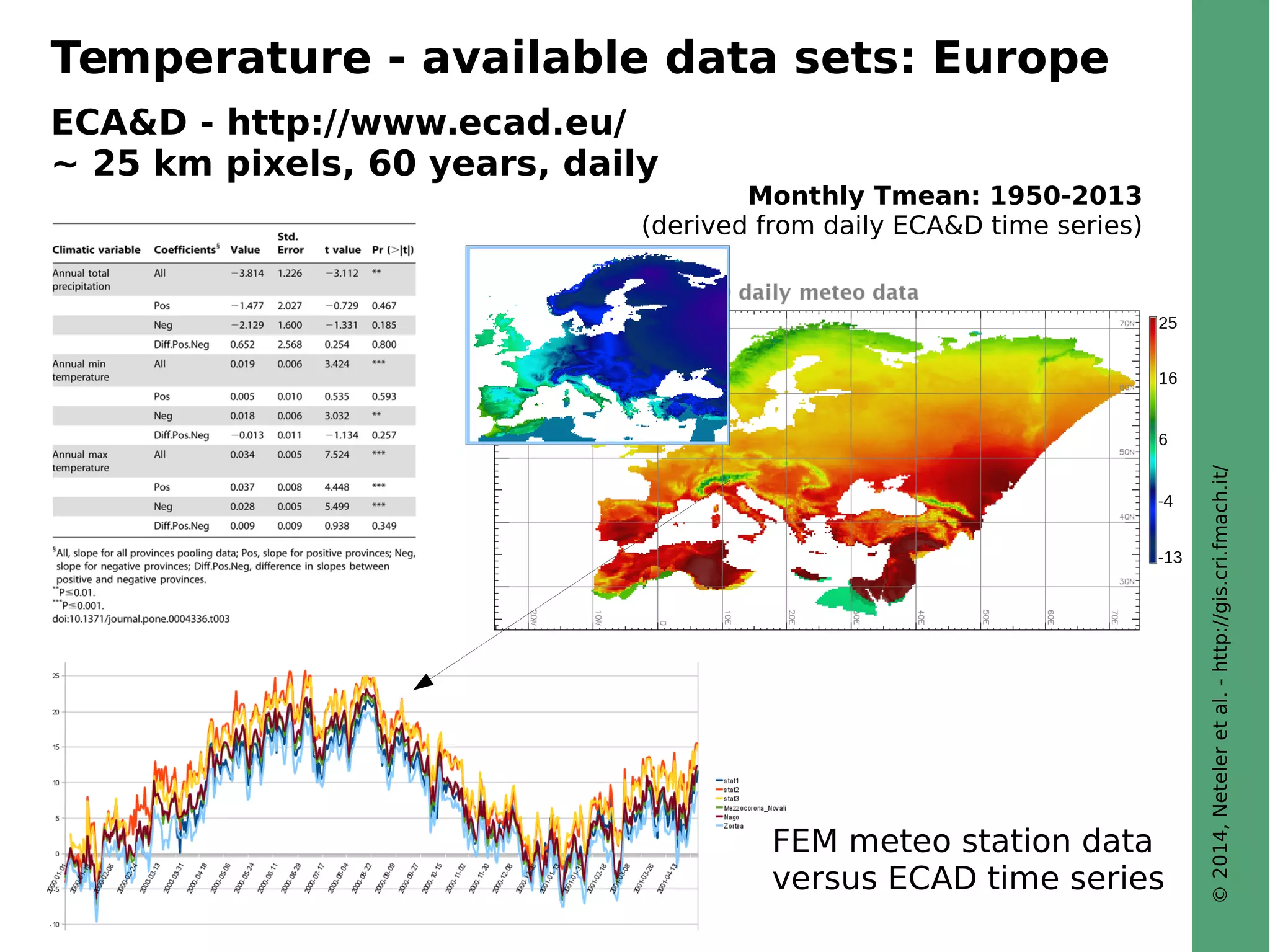
Temperature - available data sets: Europe 
ECA&D - http://www.ecad.eu/ 
~ 25 km pixels, 60 years, daily 
Monthly Tmean: 1950-2013 
(derived from daily ECA&D time series) 
FEM meteo station data 
versus ECAD time series
© 2014, Neteler et al. - http://gis.cri.fmach.it/ 
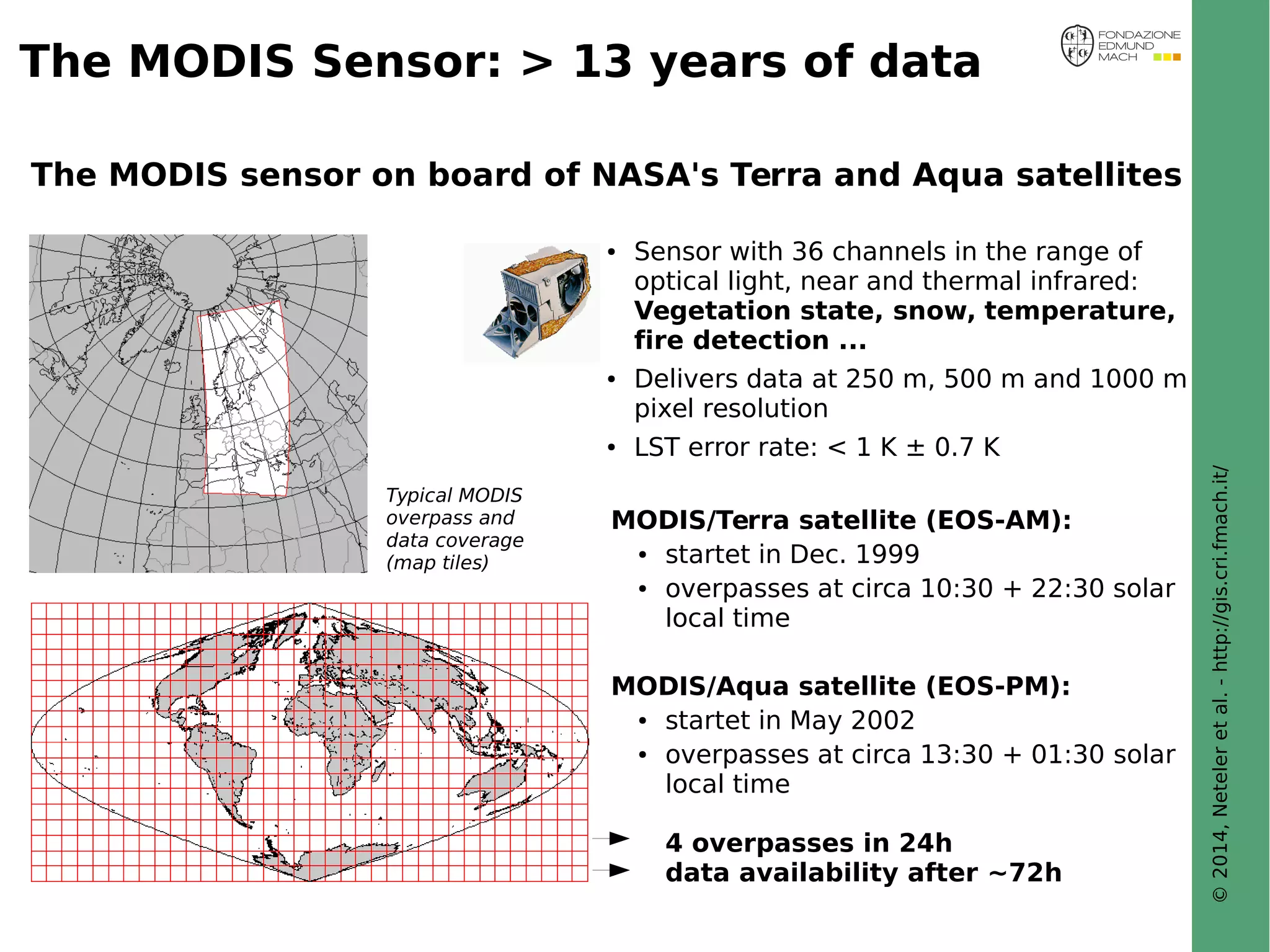
The MODIS Sensor: > 13 years of data 
The MODIS sensor on board of NASA's Terra and Aqua satellites 
● Sensor with 36 channels in the range of 
optical light, near and thermal infrared: 
Vegetation state, snow, temperature, 
fire detection ... 
● Delivers data at 250 m, 500 m and 1000 m 
pixel resolution 
● LST error rate: < 1 K ± 0.7 K 
MODIS/Terra satellite (EOS-AM): 
● startet in Dec. 1999 
● overpasses at circa 10:30 + 22:30 solar 
local time 
MODIS/Aqua satellite (EOS-PM): 
● startet in May 2002 
● overpasses at circa 13:30 + 01:30 solar 
local time 
4 overpasses in 24h 
data availability after ~72h 
Typical MODIS 
overpass and 
data coverage 
(map tiles)
© 2014, Neteler et al. - http://gis.cri.fmach.it/ 
EuroLST: MODIS LST daily time series 
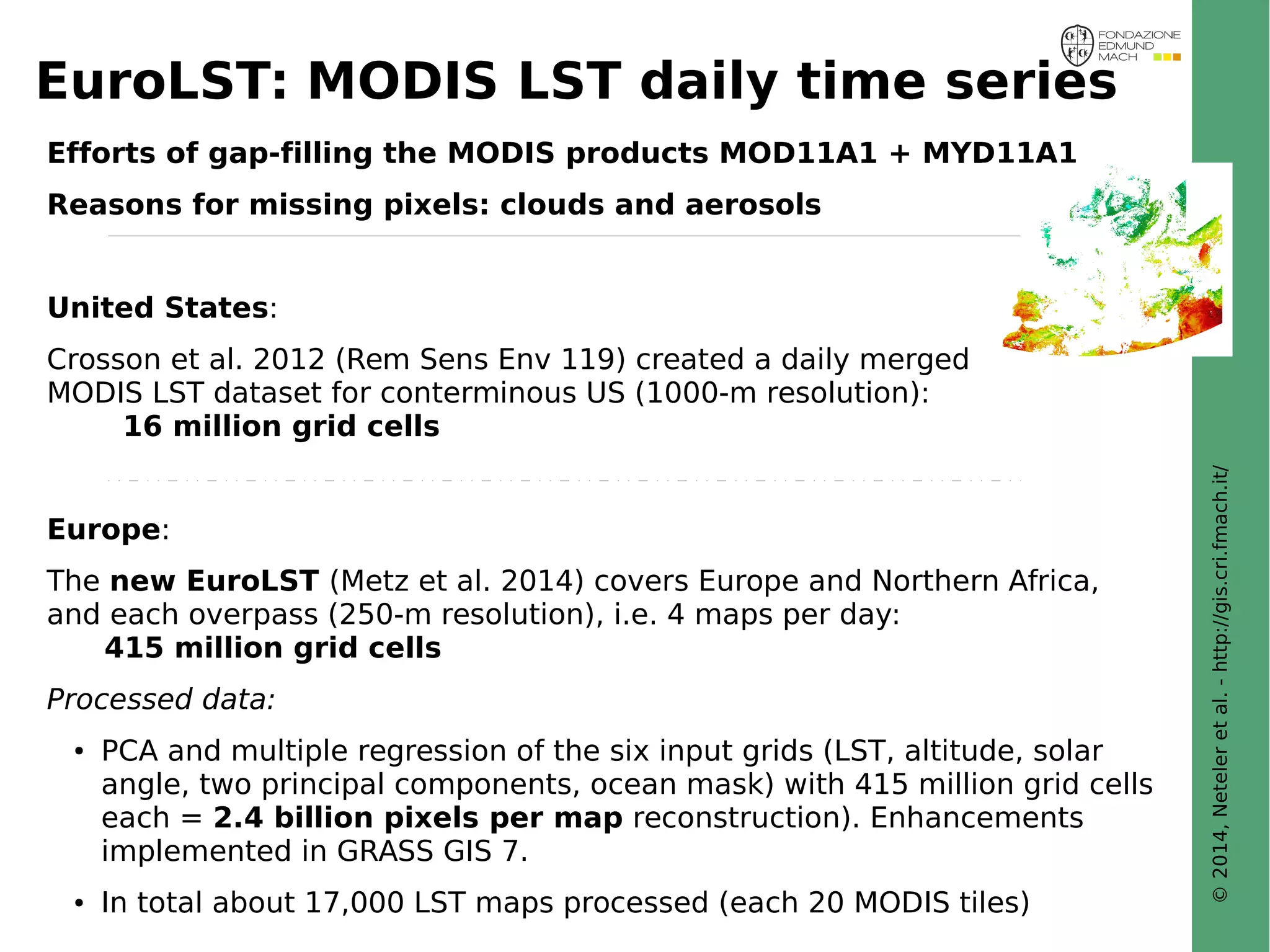
Efforts of gap-filling the MODIS products MOD11A1 + MYD11A1 
Reasons for missing pixels: clouds and aerosols 
United States: 
Crosson et al. 2012 (Rem Sens Env 119) created a daily merged 
MODIS LST dataset for conterminous US (1000-m resolution): 
16 million grid cells 
Europe: 
The new EuroLST (Metz et al. 2014) covers Europe and Northern Africa, 
and each overpass (250-m resolution), i.e. 4 maps per day: 
415 million grid cells 
Processed data: 
● PCA and multiple regression of the six input grids (LST, altitude, solar 
angle, two principal components, ocean mask) with 415 million grid cells 
each = 2.4 billion pixels per map reconstruction). Enhancements 
implemented in GRASS GIS 7. 
● In total about 17,000 LST maps processed (each 20 MODIS tiles)
© 2014, Neteler et al. - http://gis.cri.fmach.it/ 
EuroLST: MODIS LST daily time series 
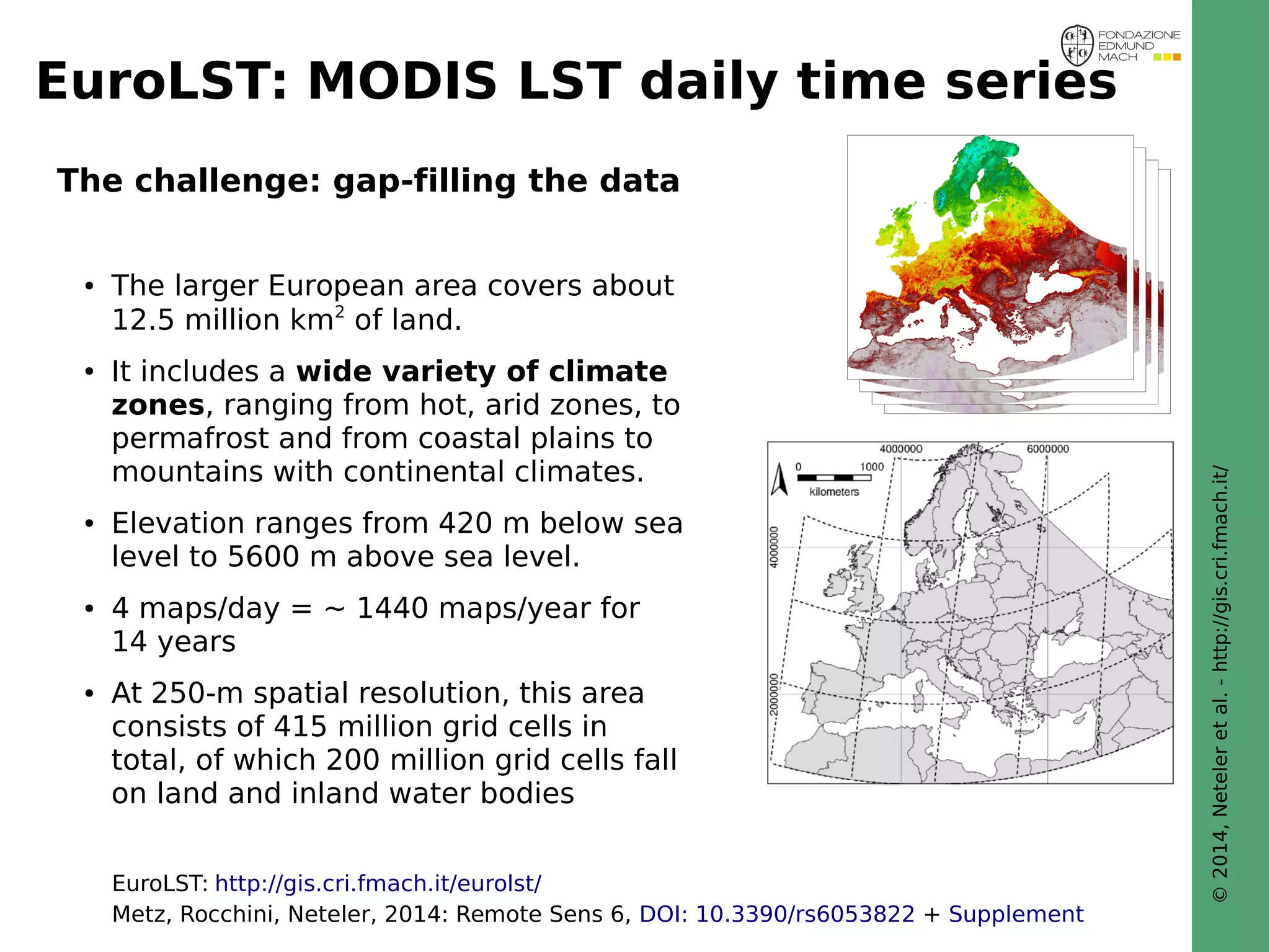
The challenge: gap-filling the data 
● The larger European area covers about 
12.5 million km2 of land. 
● It includes a wide variety of climate 
zones, ranging from hot, arid zones, to 
permafrost and from coastal plains to 
mountains with continental climates. 
● Elevation ranges from 420 m below sea 
level to 5600 m above sea level. 
● 4 maps/day = ~ 1440 maps/year for 
14 years 
● At 250-m spatial resolution, this area 
consists of 415 million grid cells in 
total, of which 200 million grid cells fall 
on land and inland water bodies 
EuroLST: http://gis.cri.fmach.it/eurolst/ 
Metz, Rocchini, Neteler, 2014: Remote Sens 6, DOI: 10.3390/rs6053822 + Supplement
© 2014, Neteler et al. - http://gis.cri.fmach.it/ 
EuroLST: MODIS LST daily time series 
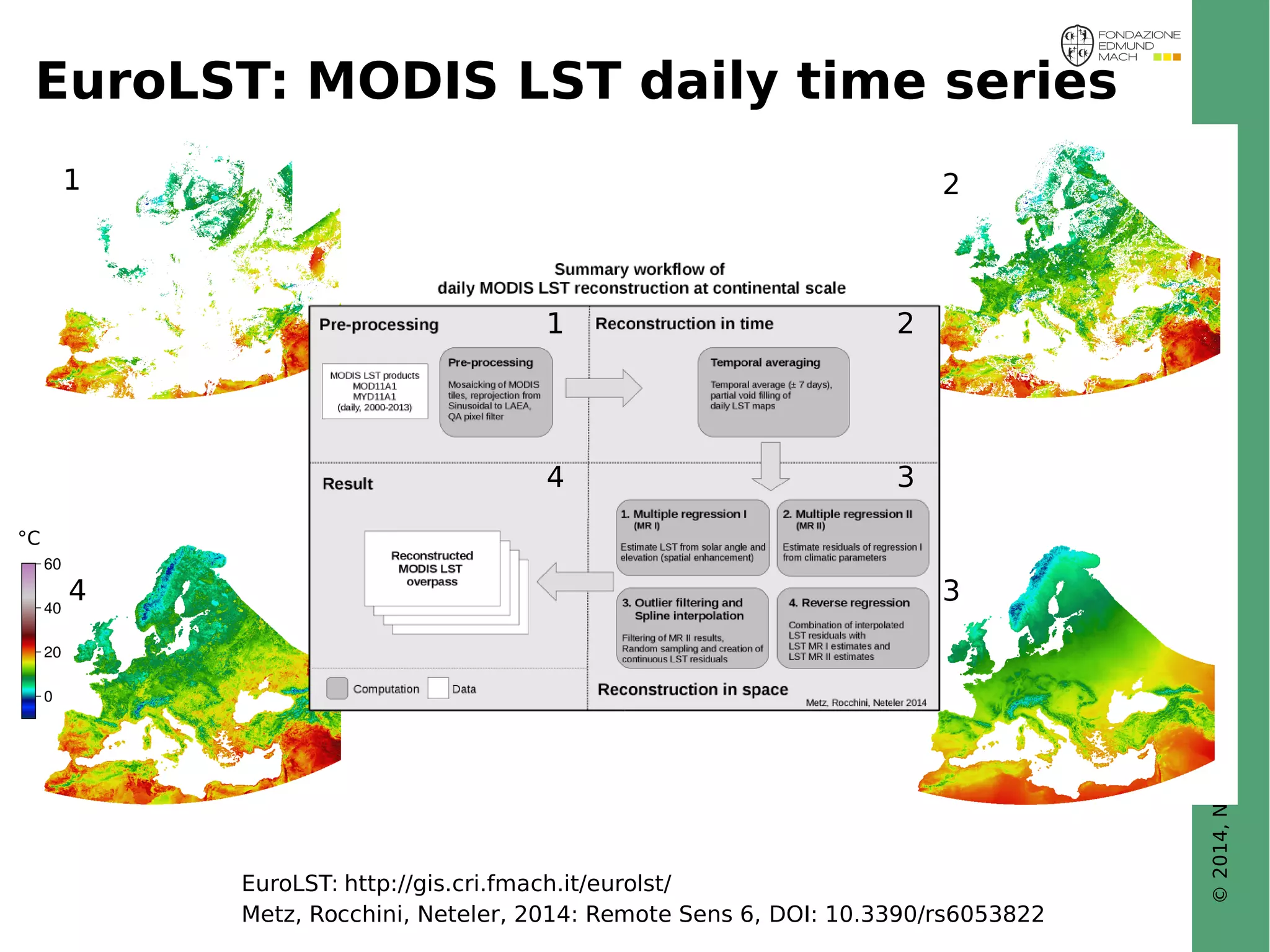
1 2 
4 3 
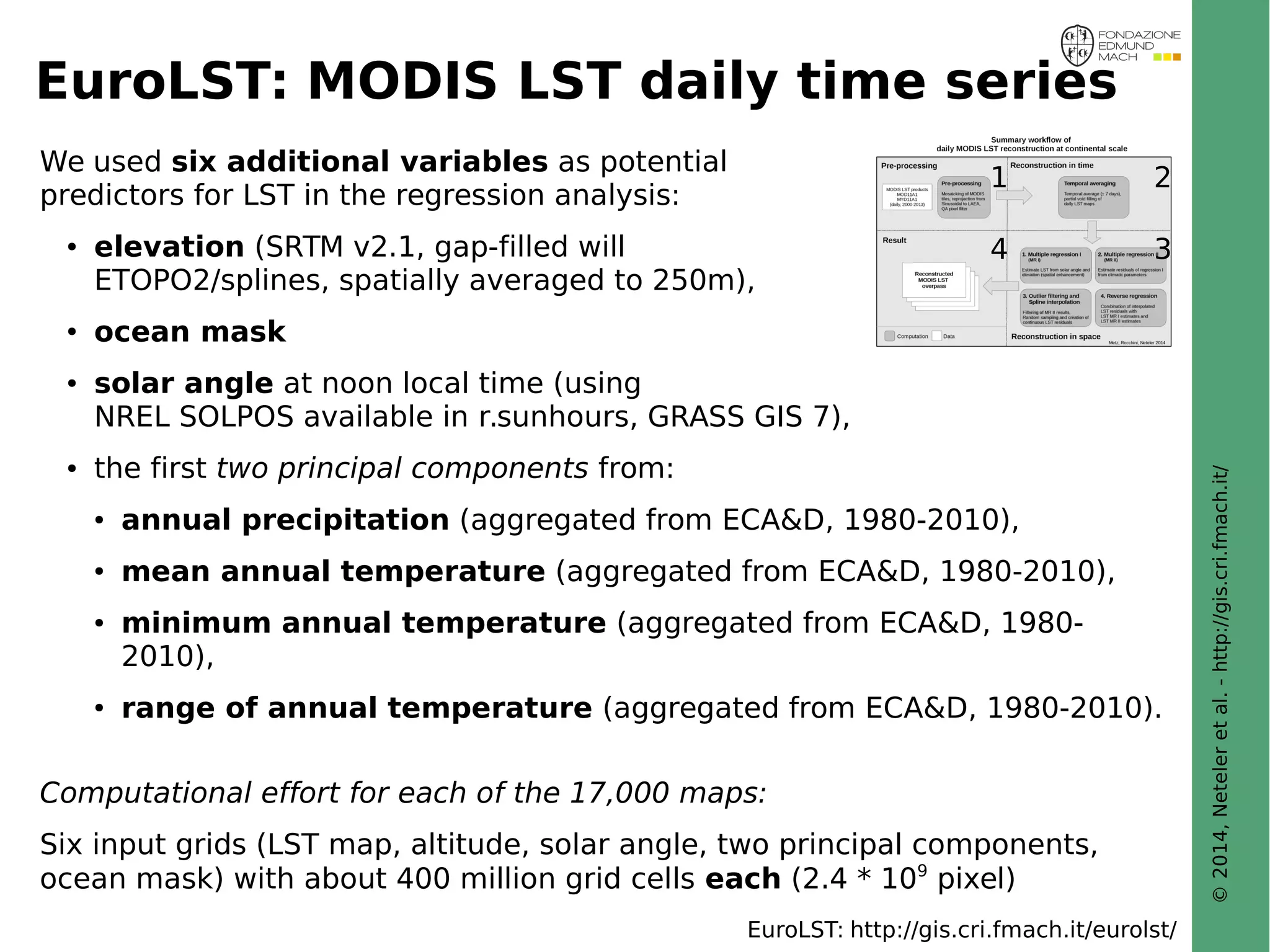
We used six additional variables as potential 
predictors for LST in the regression analysis: 
● elevation (SRTM v2.1, gap-filled will 
ETOPO2/splines, spatially averaged to 250m), 
● ocean mask 
● solar angle at noon local time (using 
NREL SOLPOS available in r.sunhours, GRASS GIS 7), 
● the first two principal components from: 
● annual precipitation (aggregated from ECA&D, 1980-2010), 
● mean annual temperature (aggregated from ECA&D, 1980-2010), 
● minimum annual temperature (aggregated from ECA&D, 1980- 
2010), 
● range of annual temperature (aggregated from ECA&D, 1980-2010). 
Computational effort for each of the 17,000 maps: 
Six input grids (LST map, altitude, solar angle, two principal components, 
ocean mask) with about 400 million grid cells each (2.4 * 109 pixel) 
EuroLST: http://gis.cri.fmach.it/eurolst/
© 2014, Neteler et al. - http://gis.cri.fmach.it/ 
EuroLST: MODIS LST daily time series 
1 2 
1 2 
4 3 
4 3 
EuroLST: http://gis.cri.fmach.it/eurolst/ 
Metz, Rocchini, Neteler, 2014: Remote Sens 6, DOI: 10.3390/rs6053822 
°C
© 2014, Neteler et al. - http://gis.cri.fmach.it/ 
EuroLST: MODIS LST daily time series 
Software used for LST reconstruction 
[ MODIS Reprojection Tool (MRT 4.1) ] 
GDAL 1.x 
PROJ.4 
GRASS GIS 7 
Grid Engine 
(gdalwarp V1.11/VRT is much faster than MRT) [1] 
Scientific Linux 6.x 
PostGISomics 
[1] Mosaiking of 20 MODIS LST tiles 
* 17,000 overpasses reduced from 
1 week to 1 day
© 2014, Neteler et al. - http://gis.cri.fmach.it/ 
EuroLST: MODIS LST daily time series 
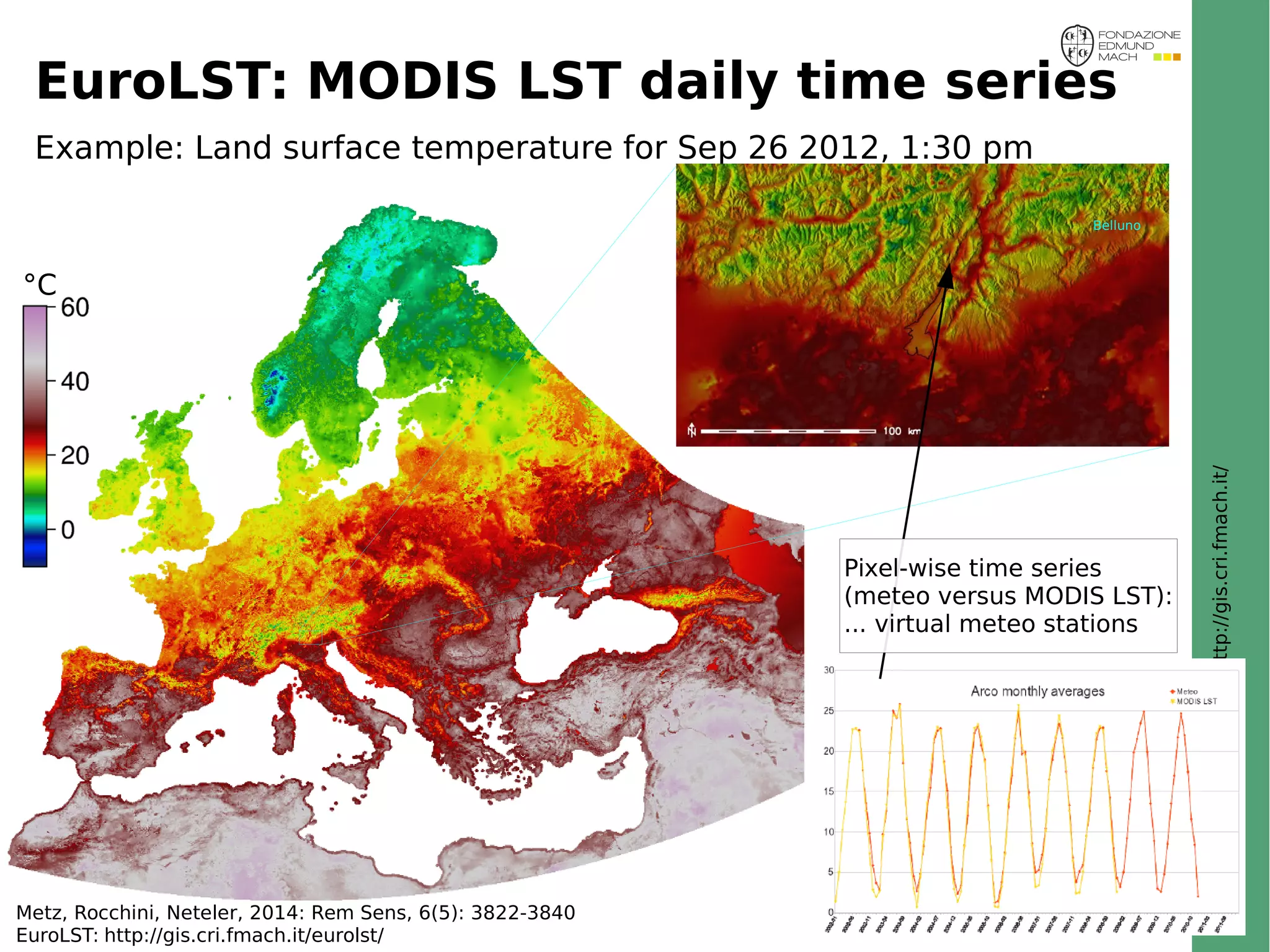
Example: Land surface temperature for Sep 26 2012, 1:30 pm 
Metz, Rocchini, Neteler, 2014: Rem Sens, 6(5): 3822-3840 
EuroLST: http://gis.cri.fmach.it/eurolst/ 
Belluno 
Pixel-wise time series 
(meteo versus MODIS LST): 
... virtual meteo stations 
°C
© 2014, Neteler et al. - http://gis.cri.fmach.it/ 
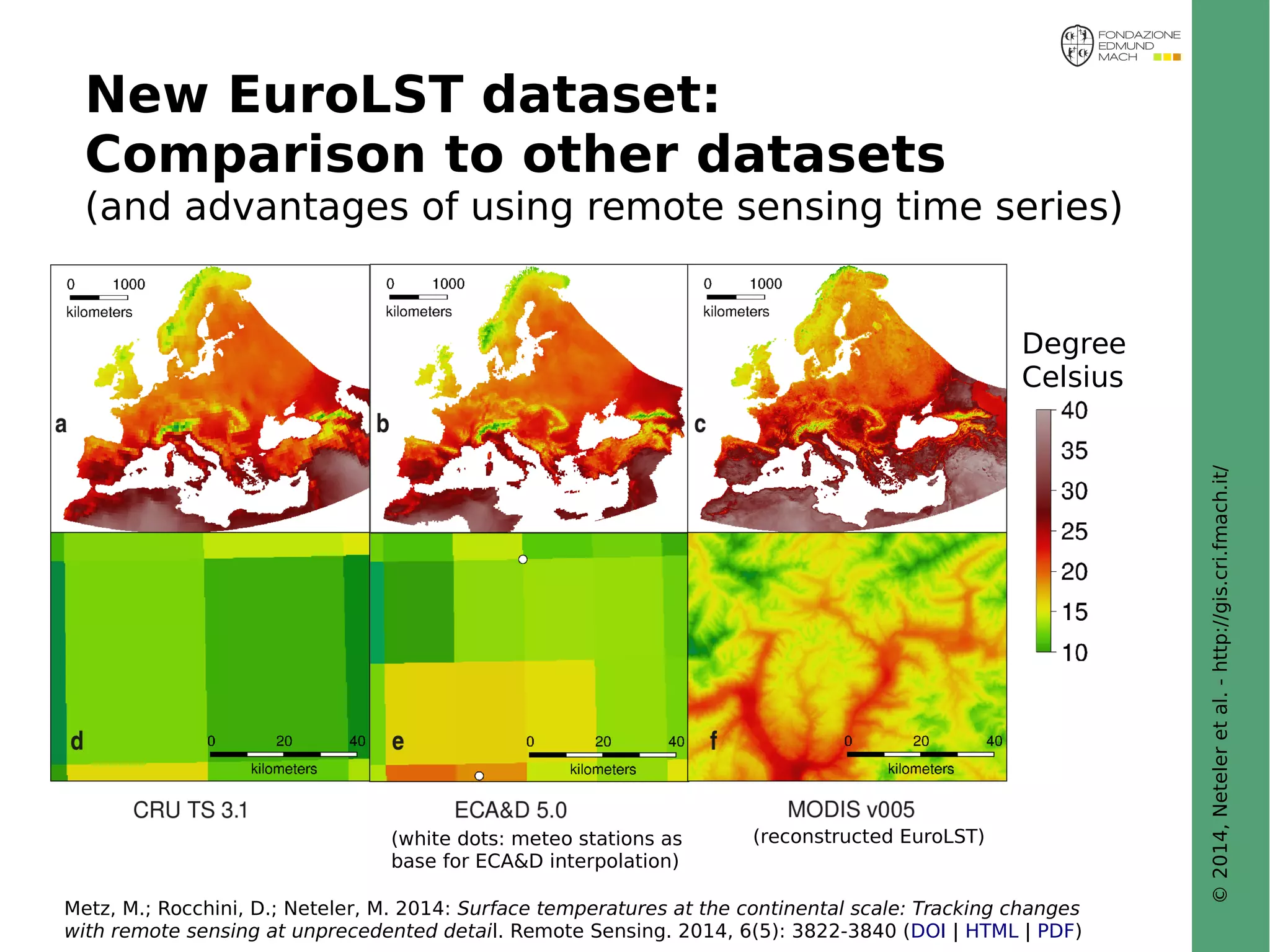
New EuroLST dataset: 
Comparison to other datasets 
(and advantages of using remote sensing time series) 
Degree 
Celsius 
(reconstructed EuroLST) 
(white dots: meteo stations as 
base for ECA&D interpolation) 
Metz, M.; Rocchini, D.; Neteler, M. 2014: Surface temperatures at the continental scale: Tracking changes 
with remote sensing at unprecedented detail. Remote Sensing. 2014, 6(5): 3822-3840 (DOI | HTML | PDF)
© 2014, Neteler et al. - http://gis.cri.fmach.it/ 
MODIS Land Surface Temperature 
Examples: 
“Hot” year 2003 
and effects in 
January 2004 
January 2004: Lake Garda still “warm” after hot 2003 summer 
--> local heating effect = insect overwintering facilitated 
Neteler et al. (2013). PLoS ONE, 8(12): e82090 [DOI]
© 2014, Neteler et al. - http://gis.cri.fmach.it/ 
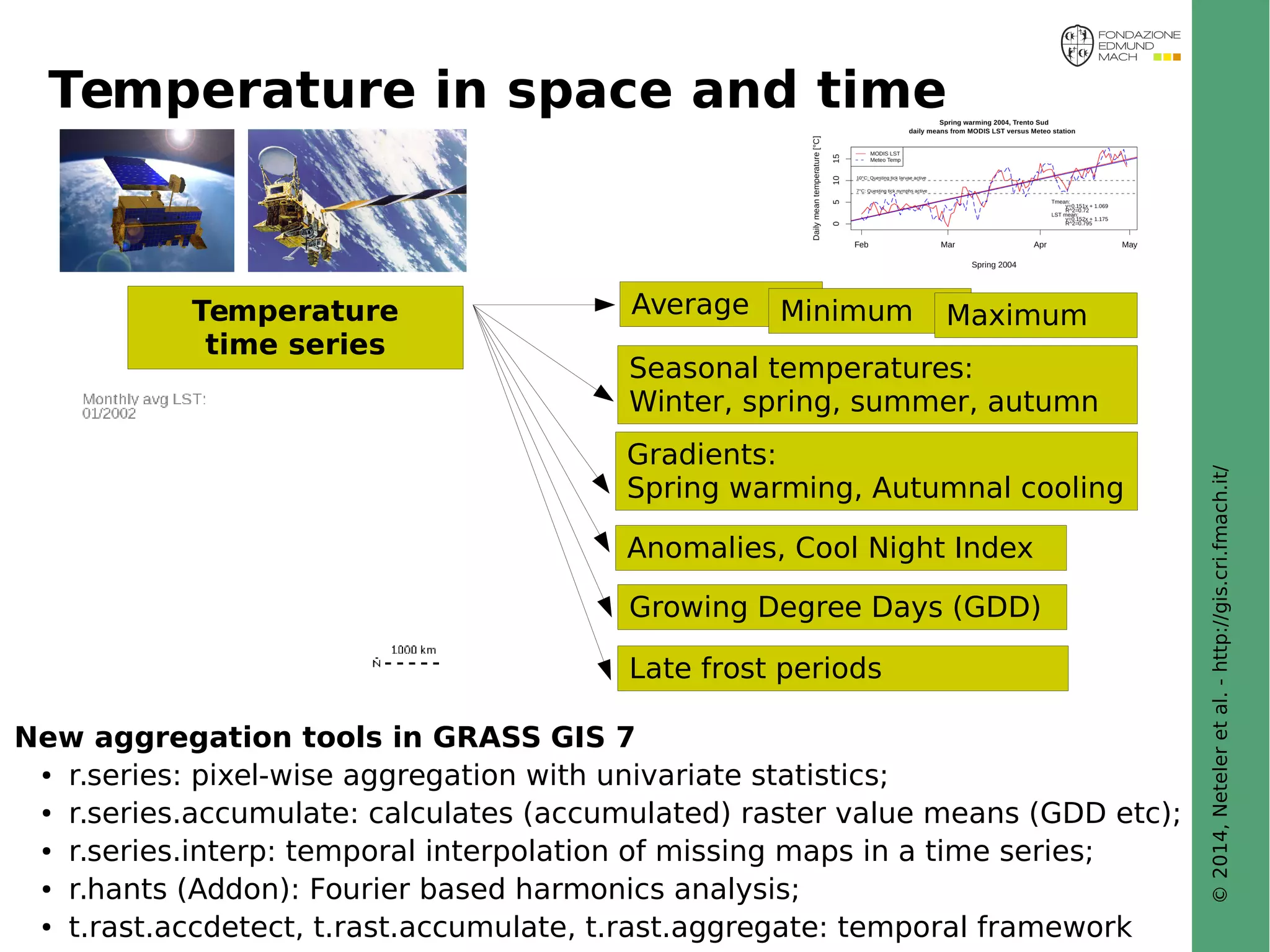
Temperature in space and time 
Temperature 
time series 
Average Minimum Maximum 
Seasonal temperatures: 
Winter, spring, summer, autumn 
Gradients: 
Spring warming, Autumnal cooling 
Anomalies, Cool Night Index 
Growing Degree Days (GDD) 
Late frost periods 
New aggregation tools in GRASS GIS 7 
● r.series: pixel-wise aggregation with univariate statistics; 
● r.series.accumulate: calculates (accumulated) raster value means (GDD etc); 
● r.series.interp: temporal interpolation of missing maps in a time series; 
● r.hants (Addon): Fourier based harmonics analysis; 
● t.rast.accdetect, t.rast.accumulate, t.rast.aggregate: temporal framework
© 2014, Neteler et al. - http://gis.cri.fmach.it/ 
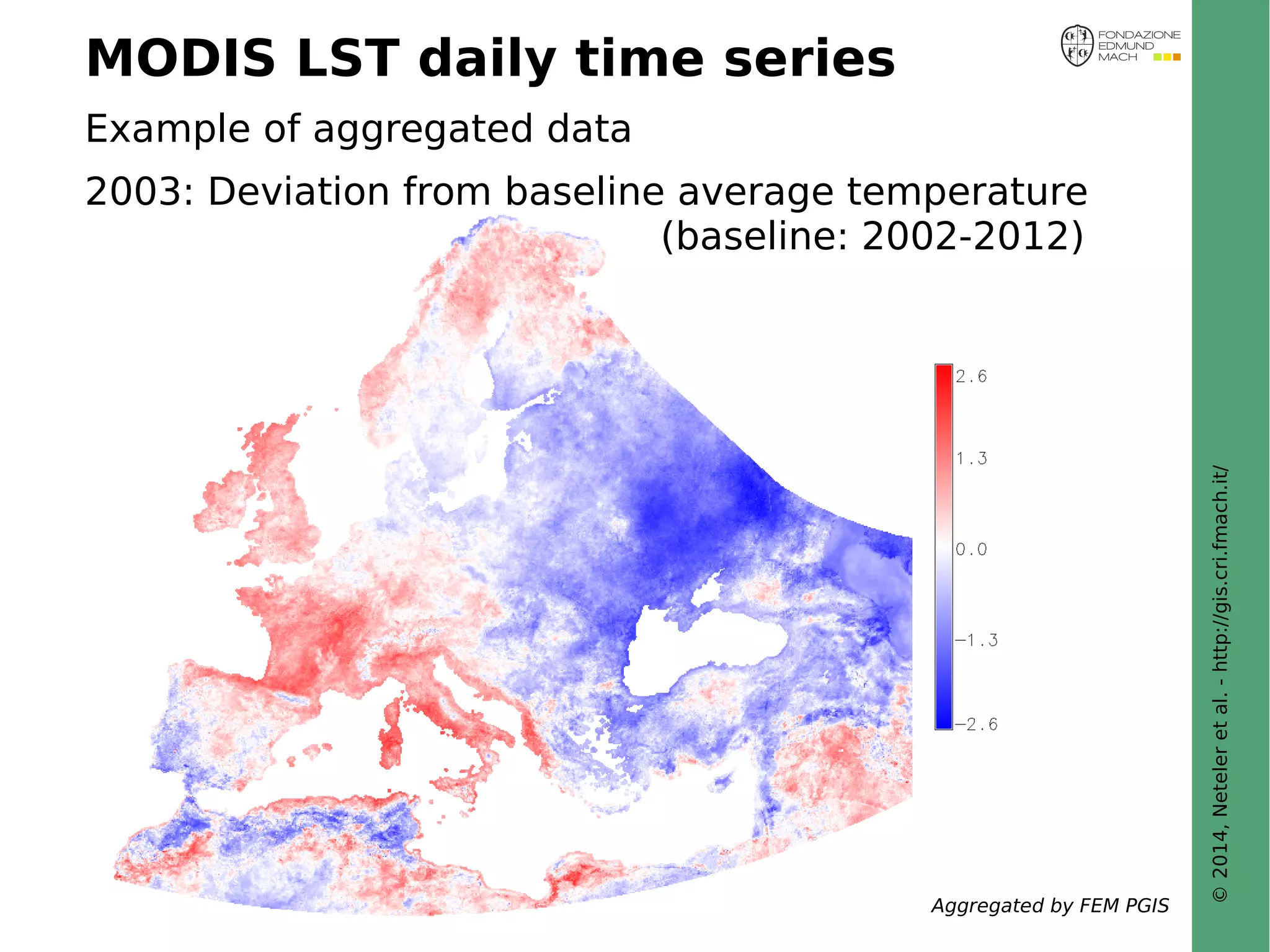
MODIS LST daily time series 
Example of aggregated data 
2003: Deviation from baseline average temperature 
(baseline: 2002-2012) 
Aggregated by FEM PGIS
© 2014, Neteler et al. - http://gis.cri.fmach.it/ 
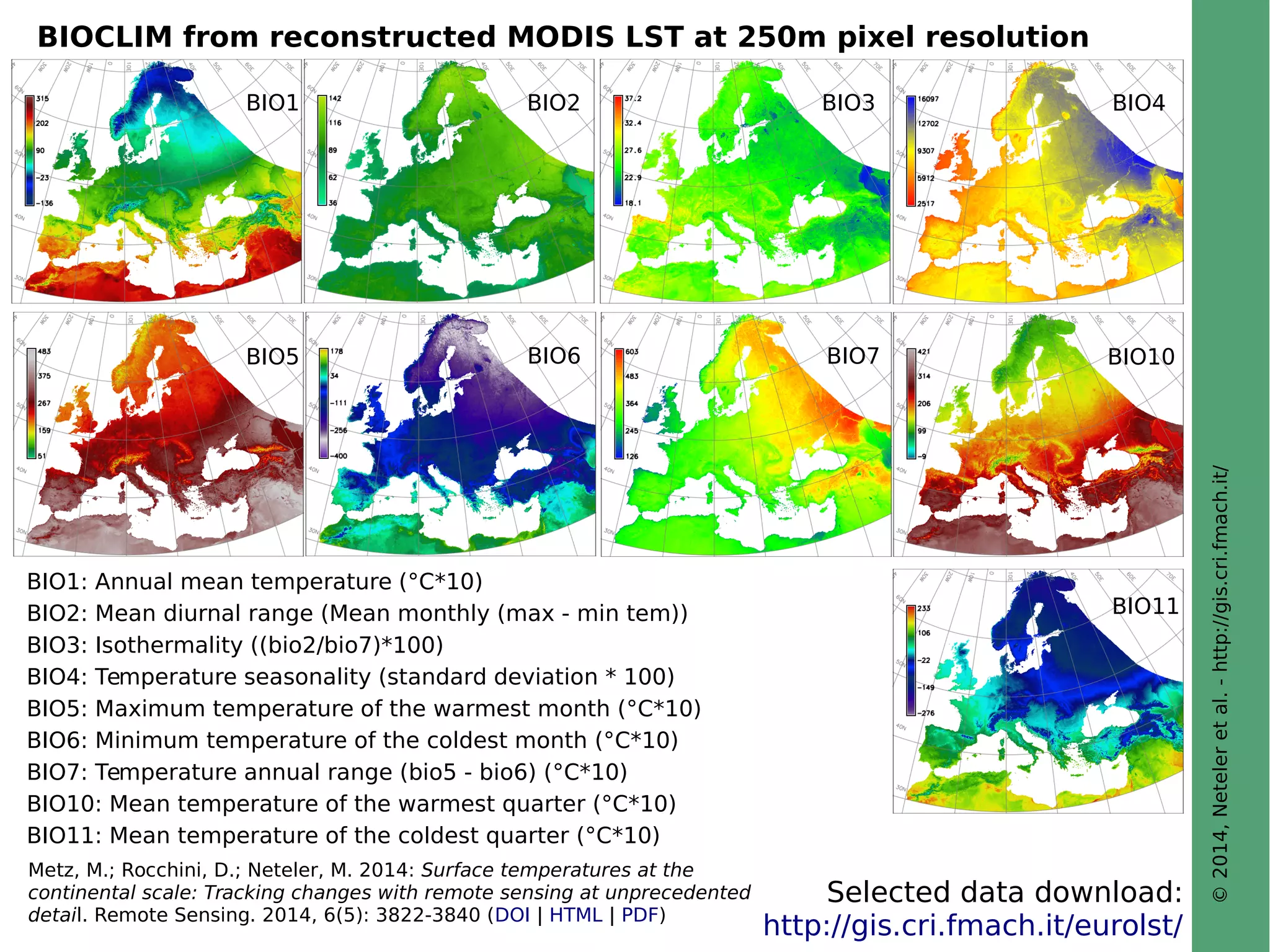
BIOCLIM from reconstructed MODIS LST at 250m pixel resolution 
BIO1 BIO2 BIO3 BIO4 
BIO5 BIO6 BIO7 BIO10 
BIO1: Annual mean temperature (°C*10) 
BIO2: Mean diurnal range (Mean monthly (max - min tem)) 
BIO3: Isothermality ((bio2/bio7)*100) 
BIO4: Temperature seasonality (standard deviation * 100) 
BIO5: Maximum temperature of the warmest month (°C*10) 
BIO6: Minimum temperature of the coldest month (°C*10) 
BIO7: Temperature annual range (bio5 - bio6) (°C*10) 
BIO10: Mean temperature of the warmest quarter (°C*10) 
BIO11: Mean temperature of the coldest quarter (°C*10) 
Metz, M.; Rocchini, D.; Neteler, M. 2014: Surface temperatures at the 
continental scale: Tracking changes with remote sensing at unprecedented 
detail. Remote Sensing. 2014, 6(5): 3822-3840 (DOI | HTML | PDF) 
BIO11 
Selected data download: 
http://gis.cri.fmach.it/eurolst/
© 2014, Neteler et al. - http://gis.cri.fmach.it/ 
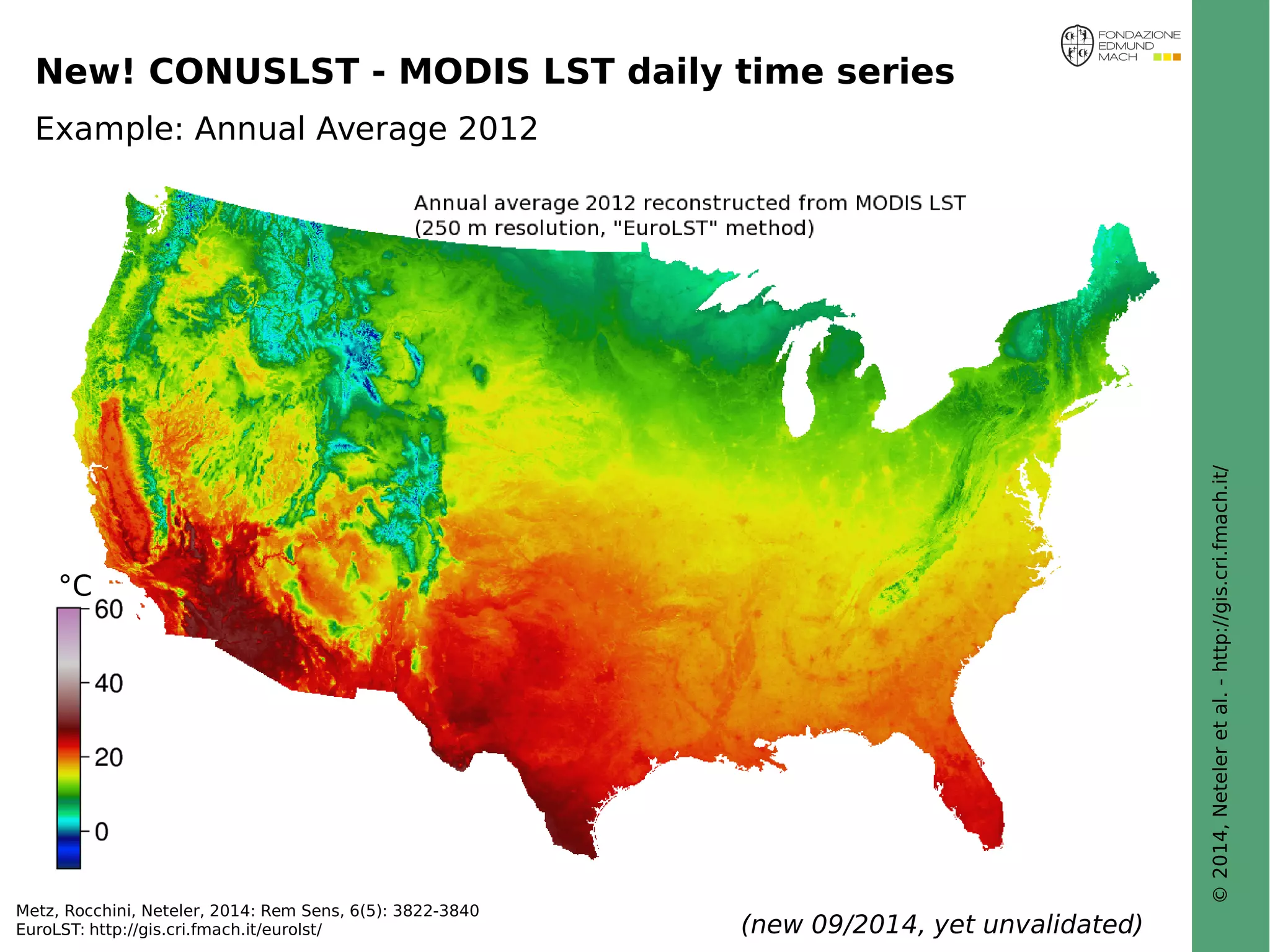
New! CONUSLST - MODIS LST daily time series 
Example: Annual Average 2012 
°C 
Metz, Rocchini, Neteler, 2014: Rem Sens, 6(5): 3822-3840 
EuroLST: http://gis.cri.fmach.it/eurolst/ (new 09/2014, yet unvalidated)
© 2014, Neteler et al. - http://gis.cri.fmach.it/ 
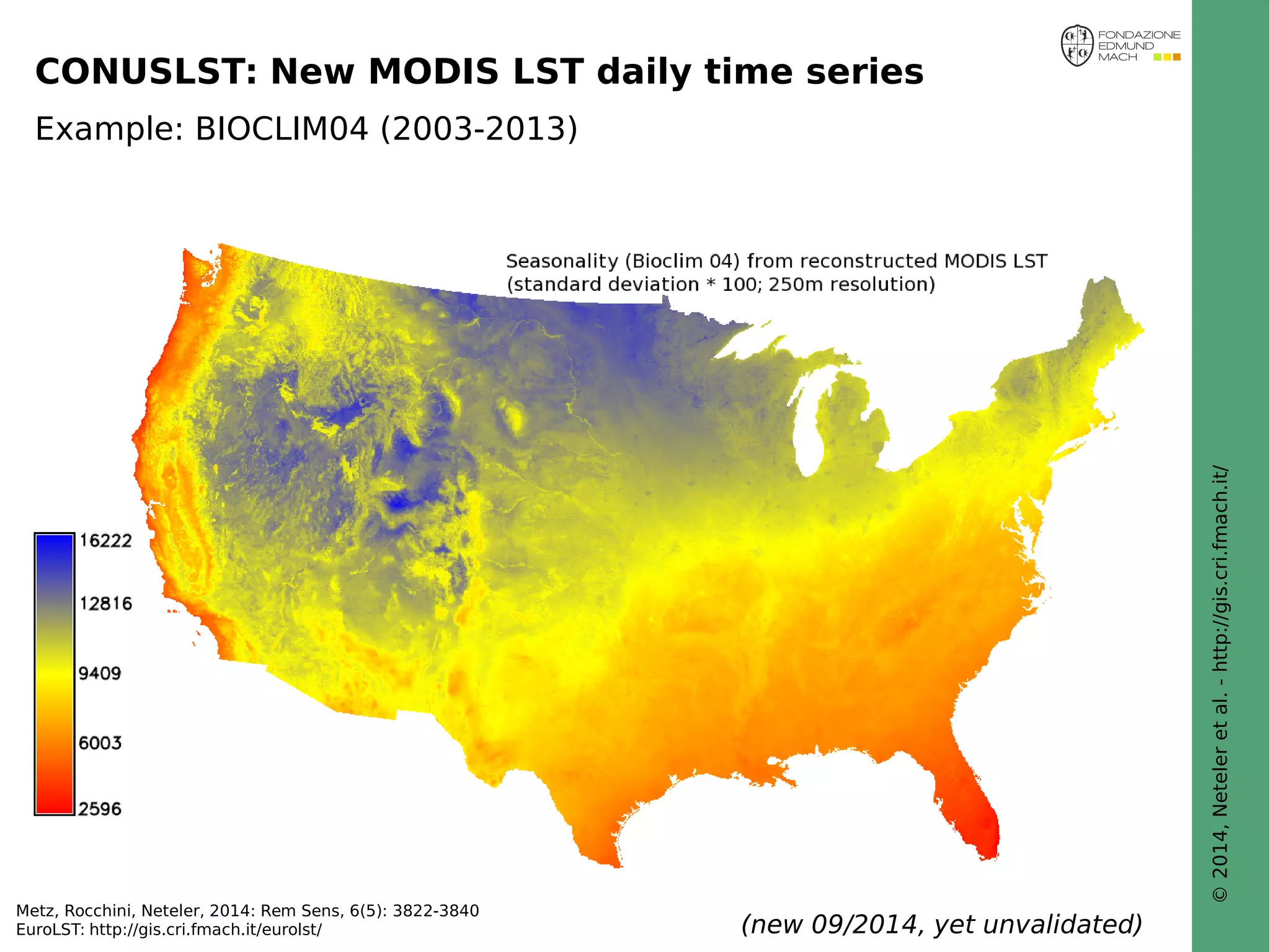
CONUSLST: New MODIS LST daily time series 
Example: BIOCLIM04 (2003-2013) 
Metz, Rocchini, Neteler, 2014: Rem Sens, 6(5): 3822-3840 
EuroLST: http://gis.cri.fmach.it/eurolst/ (new 09/2014, yet unvalidated)
© 2014, Neteler et al. - http://gis.cri.fmach.it/ 
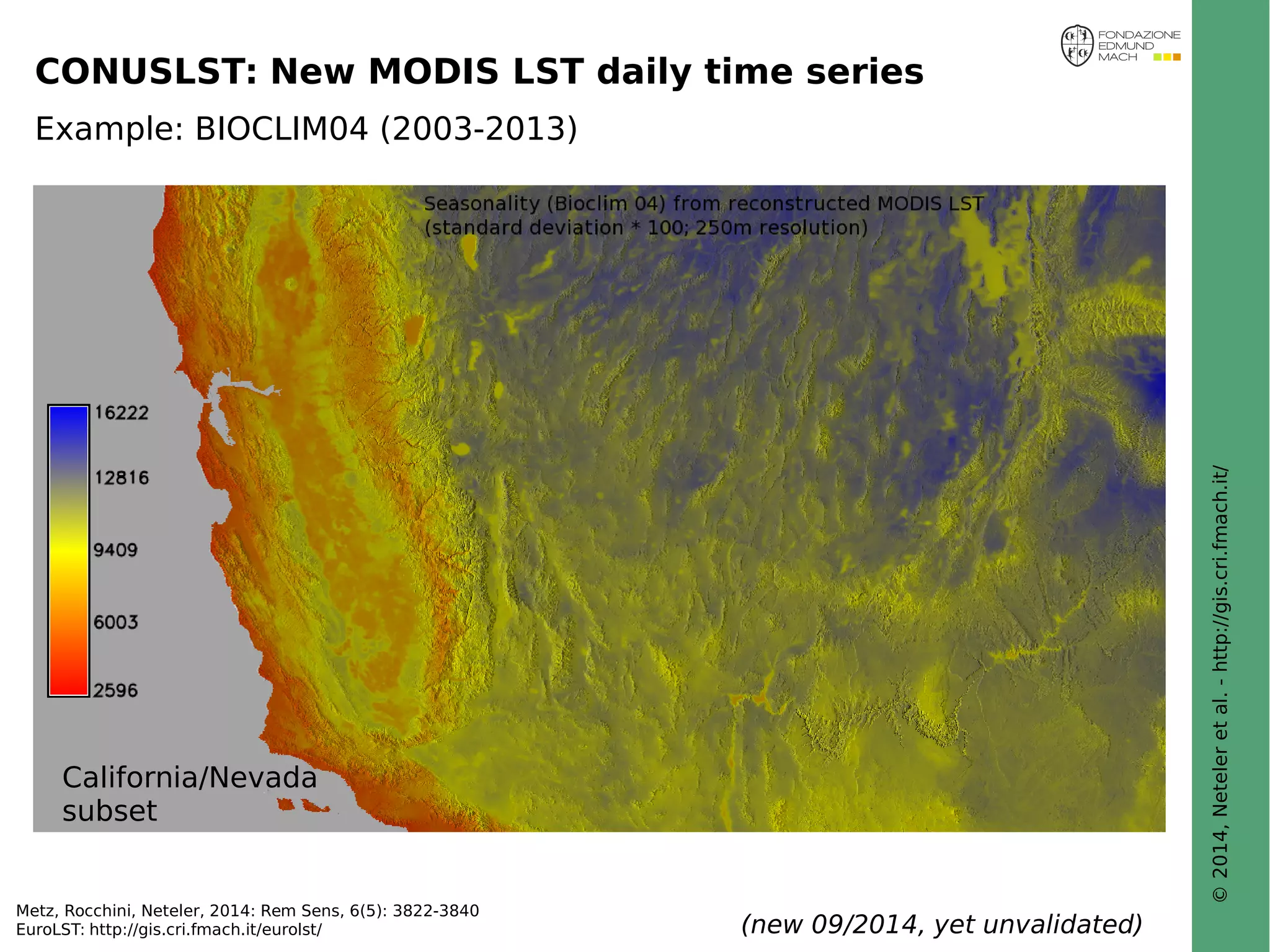
CONUSLST: New MODIS LST daily time series 
Example: BIOCLIM04 (2003-2013) 
California/Nevada 
subset 
Metz, Rocchini, Neteler, 2014: Rem Sens, 6(5): 3822-3840 
EuroLST: http://gis.cri.fmach.it/eurolst/ (new 09/2014, yet unvalidated)
© 2014, Neteler et al. - http://gis.cri.fmach.it/ 
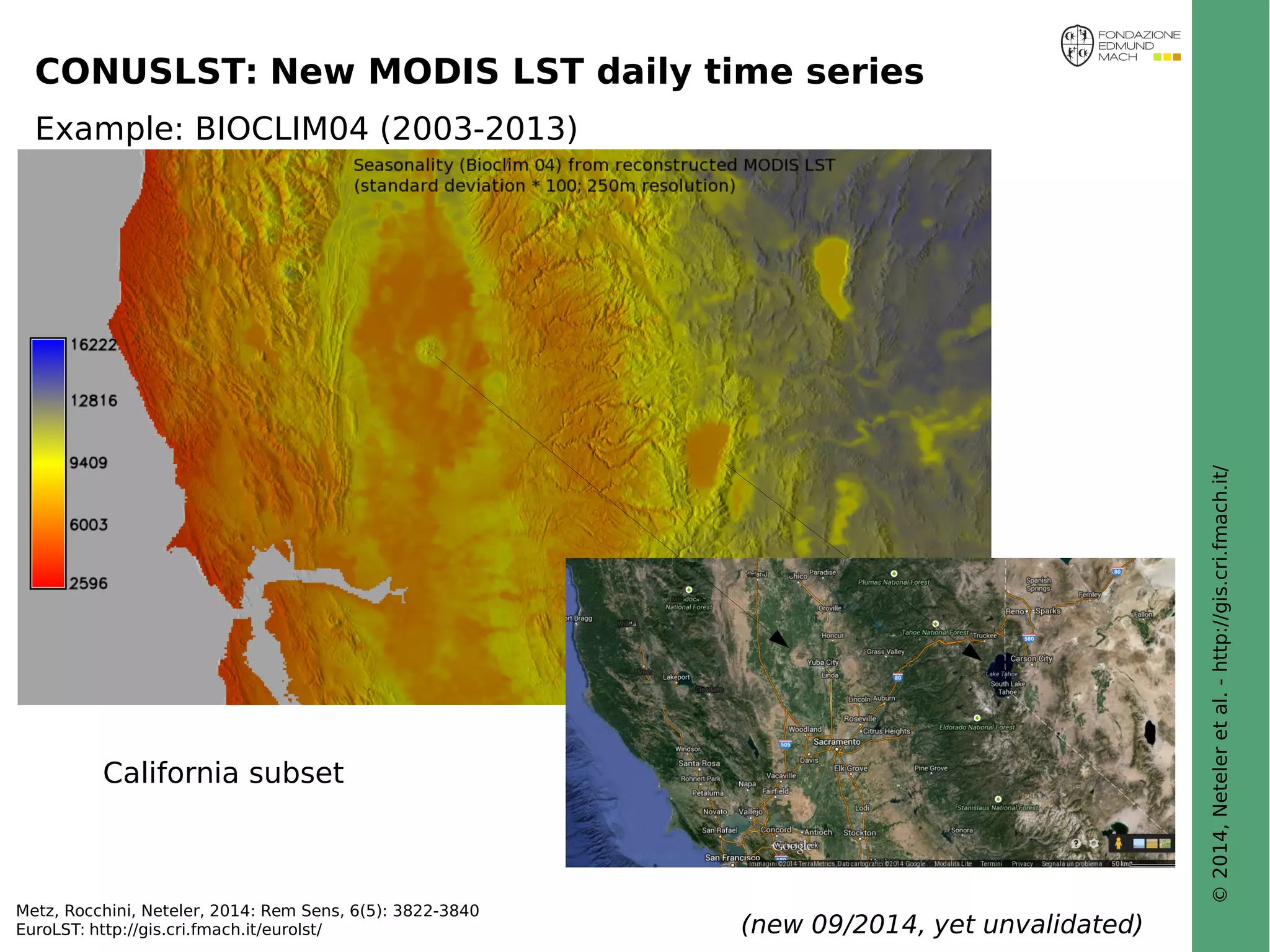
CONUSLST: New MODIS LST daily time series 
Example: BIOCLIM04 (2003-2013) 
California subset 
Metz, Rocchini, Neteler, 2014: Rem Sens, 6(5): 3822-3840 
EuroLST: http://gis.cri.fmach.it/eurolst/ (new 09/2014, yet unvalidated)
© 2014, Neteler et al. - http://gis.cri.fmach.it/ 
MODIS LST daily time series 
Nice to have... now what?
© 2014, Neteler et al. - http://gis.cri.fmach.it/ 
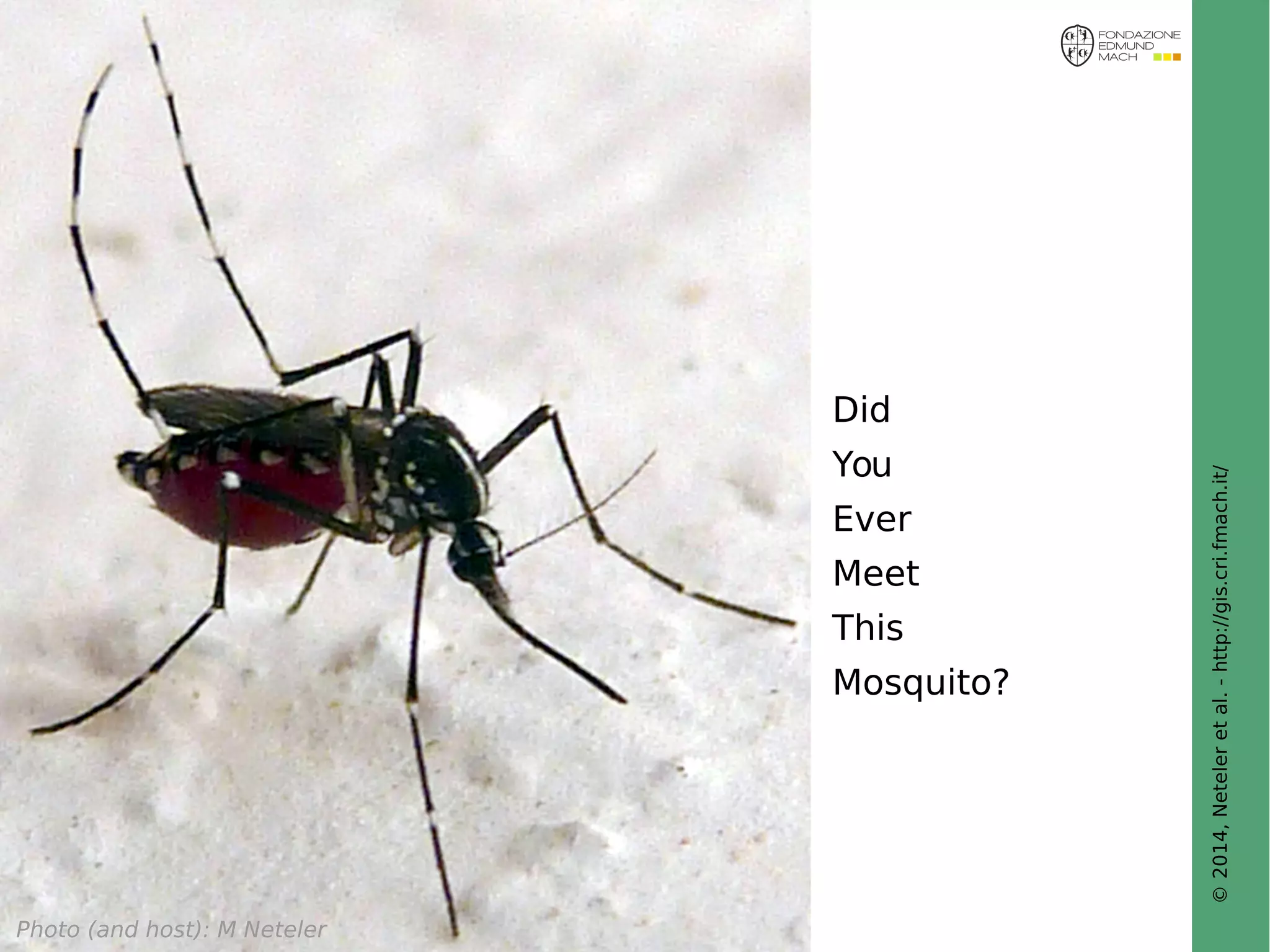
Did 
You 
Ever 
Meet 
This 
Mosquito? 
Photo (and host): M Neteler
© 2014, Neteler et al. - http://gis.cri.fmach.it/ 
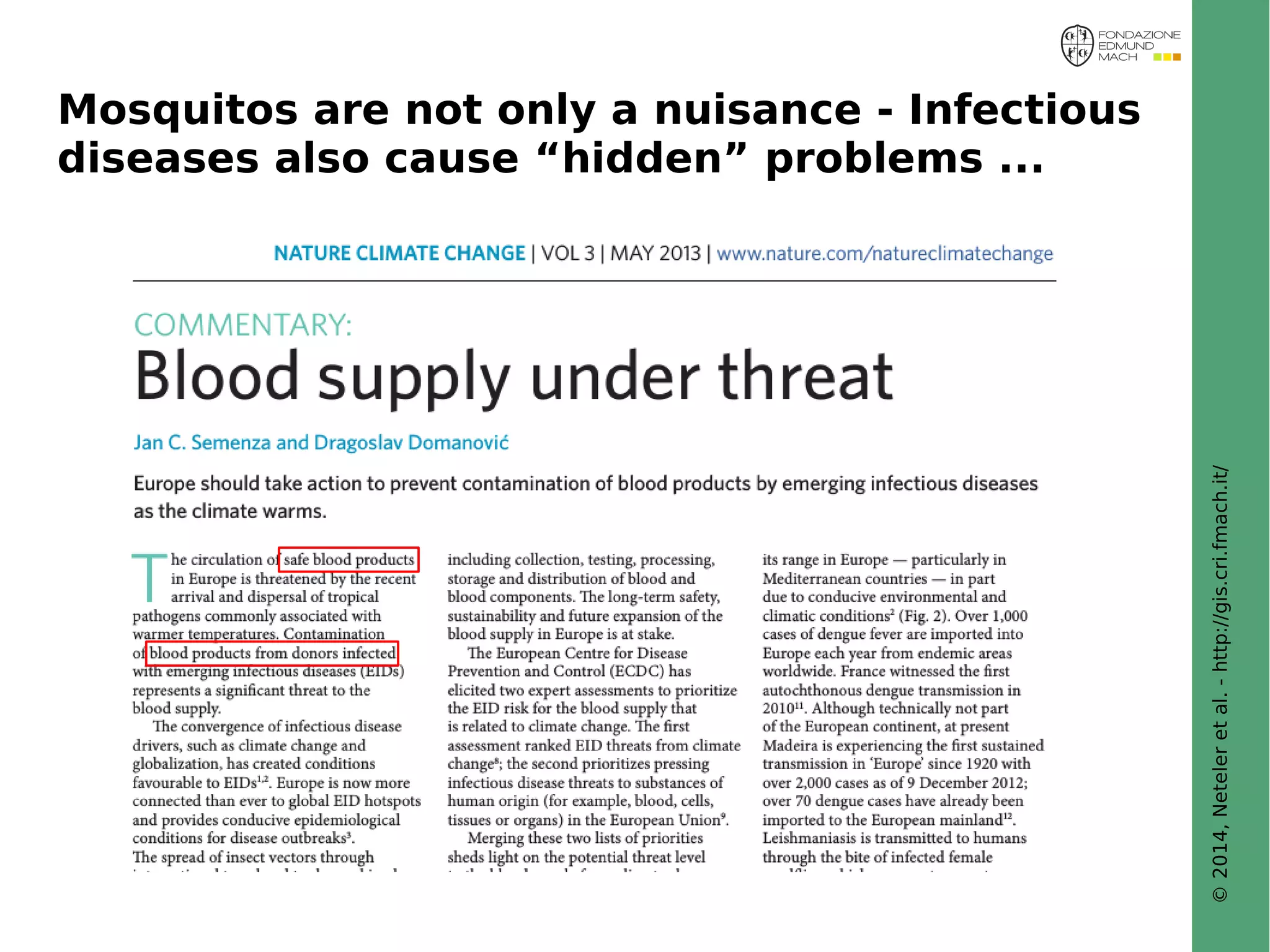
Mosquitos are not only a nuisance - Infectious 
diseases also cause “hidden” problems ...
© 2014, Neteler et al. - http://gis.cri.fmach.it/ 
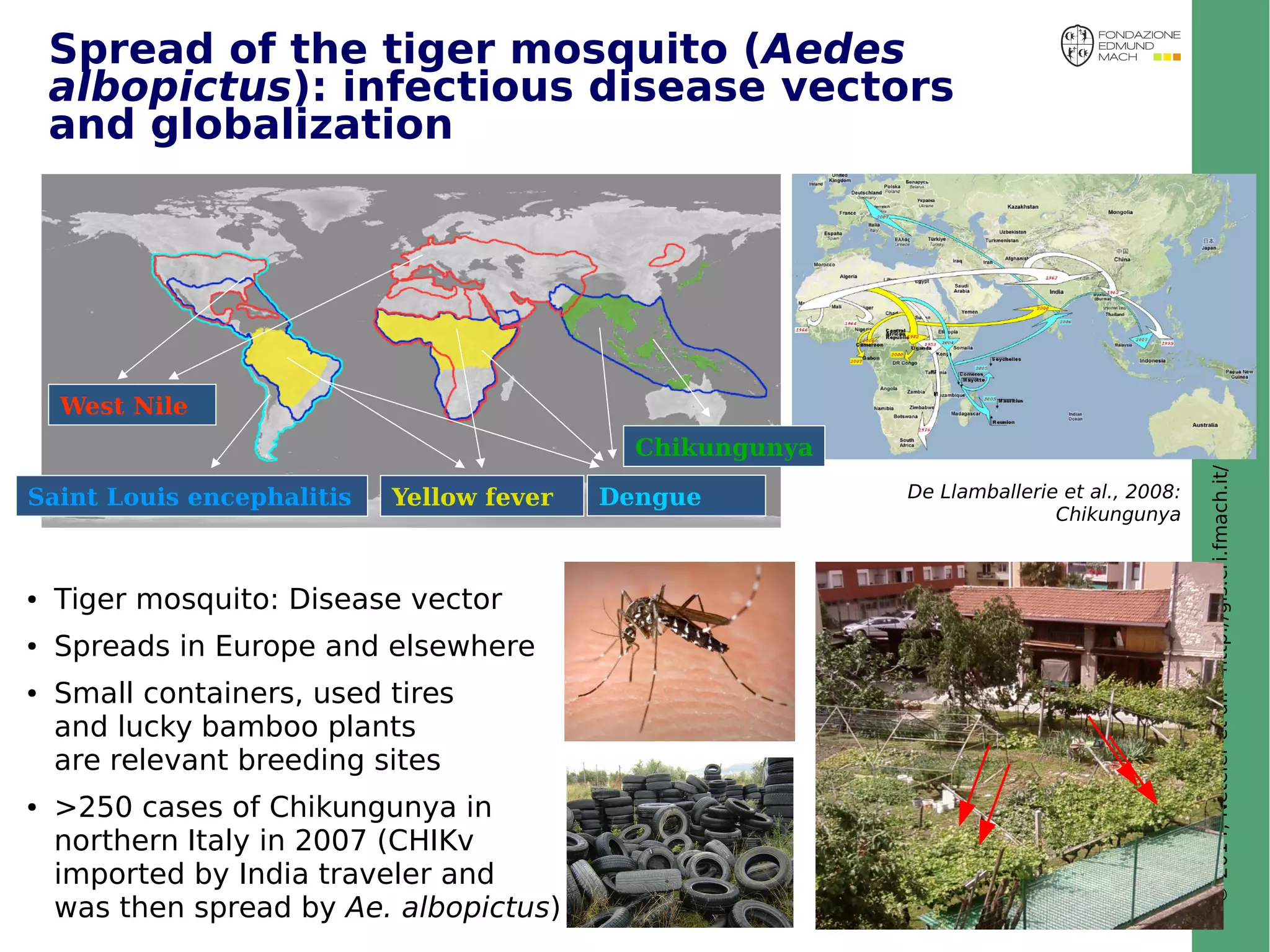
Spread of the tiger mosquito (Aedes 
albopictus): infectious disease vectors 
and globalization 
Yellow fever Dengue 
West Nile 
Saint Louis encephalitis 
Chikungunya 
De Llamballerie et al., 2008: 
Chikungunya 
● Tiger mosquito: Disease vector 
● Spreads in Europe and elsewhere 
● Small containers, used tires 
and lucky bamboo plants 
are relevant breeding sites 
● >250 cases of Chikungunya in 
northern Italy in 2007 (CHIKv 
imported by India traveler and 
was then spread by Ae. albopictus)
© 2014, Neteler et al. - http://gis.cri.fmach.it/ 
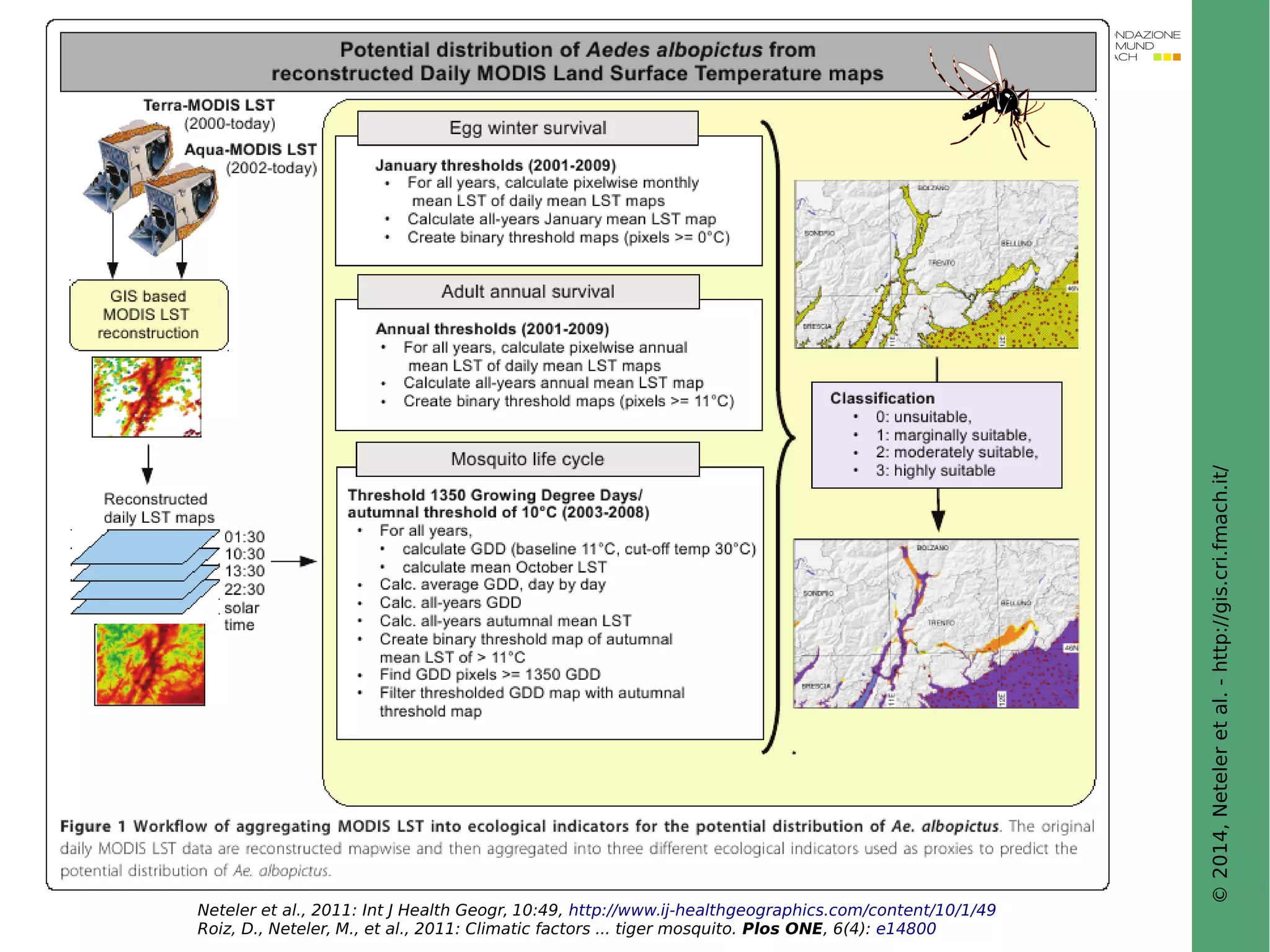
Neteler et al., 2011: Int J Health Geogr, 10:49, http://www.ij-healthgeographics.com/content/10/1/49 
Roiz, D., Neteler, M., et al., 2011: Climatic factors ... tiger mosquito. Plos ONE, 6(4): e14800
© 2014, Neteler et al. - http://gis.cri.fmach.it/ 
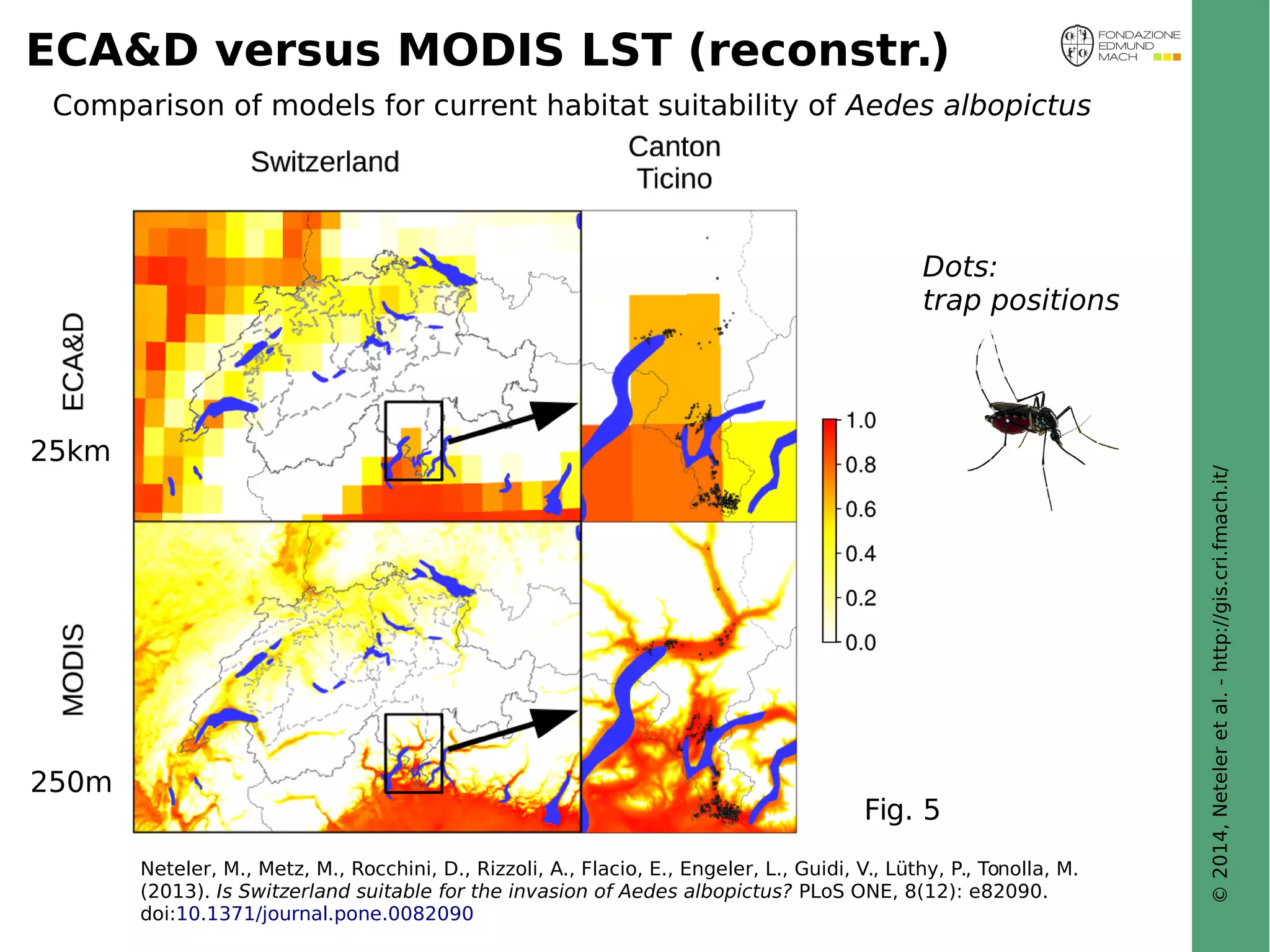
ECA&D versus MODIS LST (reconstr.) 
Comparison of models for current habitat suitability of Aedes albopictus 
Dots: 
trap positions 
Fig. 5 
Neteler, M., Metz, M., Rocchini, D., Rizzoli, A., Flacio, E., Engeler, L., Guidi, V., Lüthy, P., Tonolla, M. 
(2013). Is Switzerland suitable for the invasion of Aedes albopictus? PLoS ONE, 8(12): e82090. 
doi:10.1371/journal.pone.0082090 
25km 
250m
© 2014, Neteler et al. - http://gis.cri.fmach.it/ 
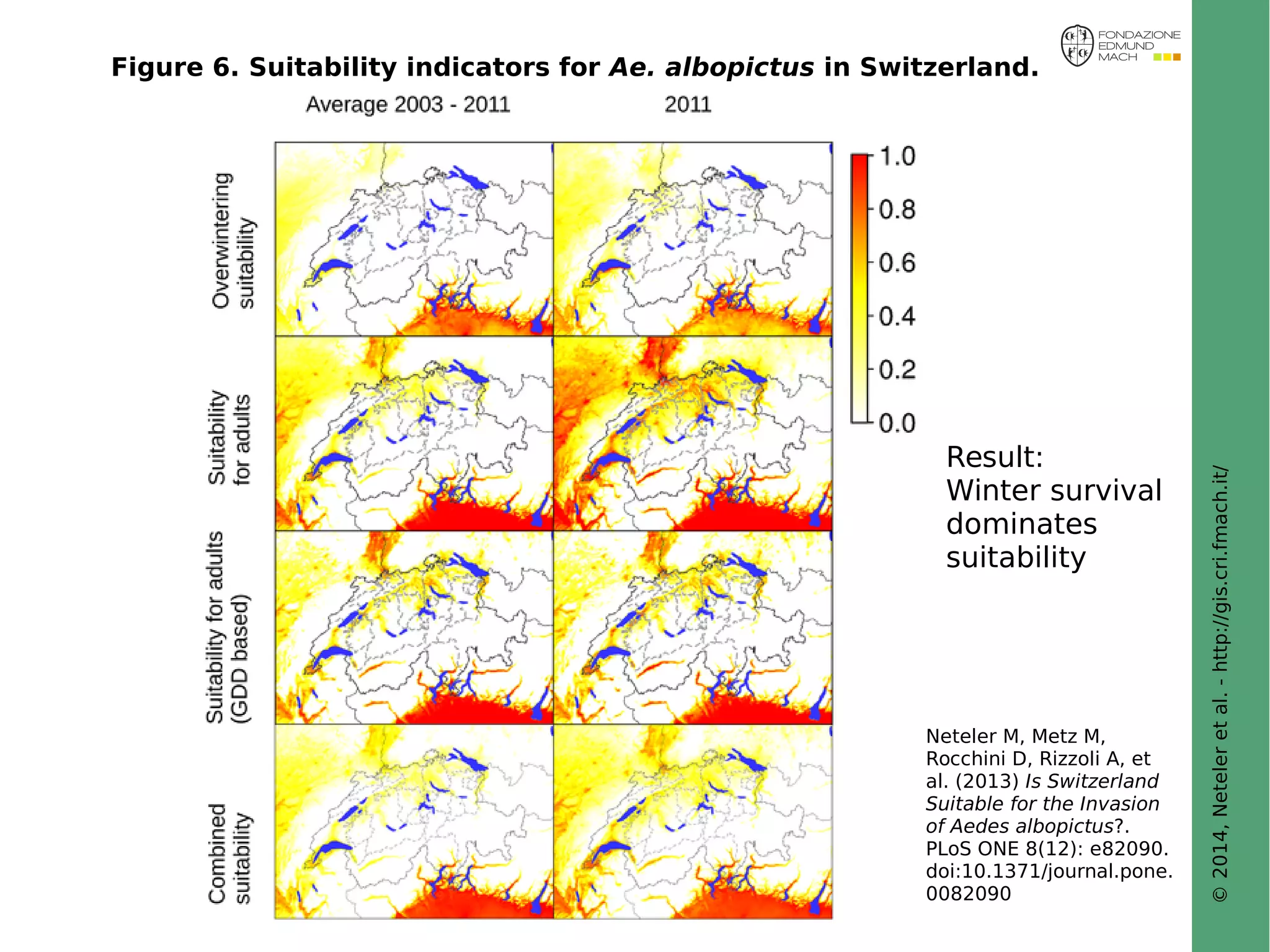
Figure 6. Suitability indicators for Ae. albopictus in Switzerland. 
Result: 
Winter survival 
dominates 
suitability 
Neteler M, Metz M, 
Rocchini D, Rizzoli A, et 
al. (2013) Is Switzerland 
Suitable for the Invasion 
of Aedes albopictus?. 
PLoS ONE 8(12): e82090. 
doi:10.1371/journal.pone. 
0082090
© 2014, Neteler et al. - http://gis.cri.fmach.it/ 
Assessing urban heat islands 
The example of Milan city, Italy in 2003 
Number of combined hot days (>35 °C) 
and warm nights (>20 °C) 
ECA&D data set EuroLST (MODIS LST) 
~ 25km resolution 250m resolution 
SRS EPSG: 3035 
Refs: 
● EEA, http://www.eea.europa.eu/data-and-maps/explore-interactive-maps/heat-wave-risk-of-european-cities-1 
● Metz, Rocchini, Neteler, 2014: Rem Sens, 6(5): 3822-3840 [DOI]
© 2014, Neteler et al. - http://gis.cri.fmach.it/ 
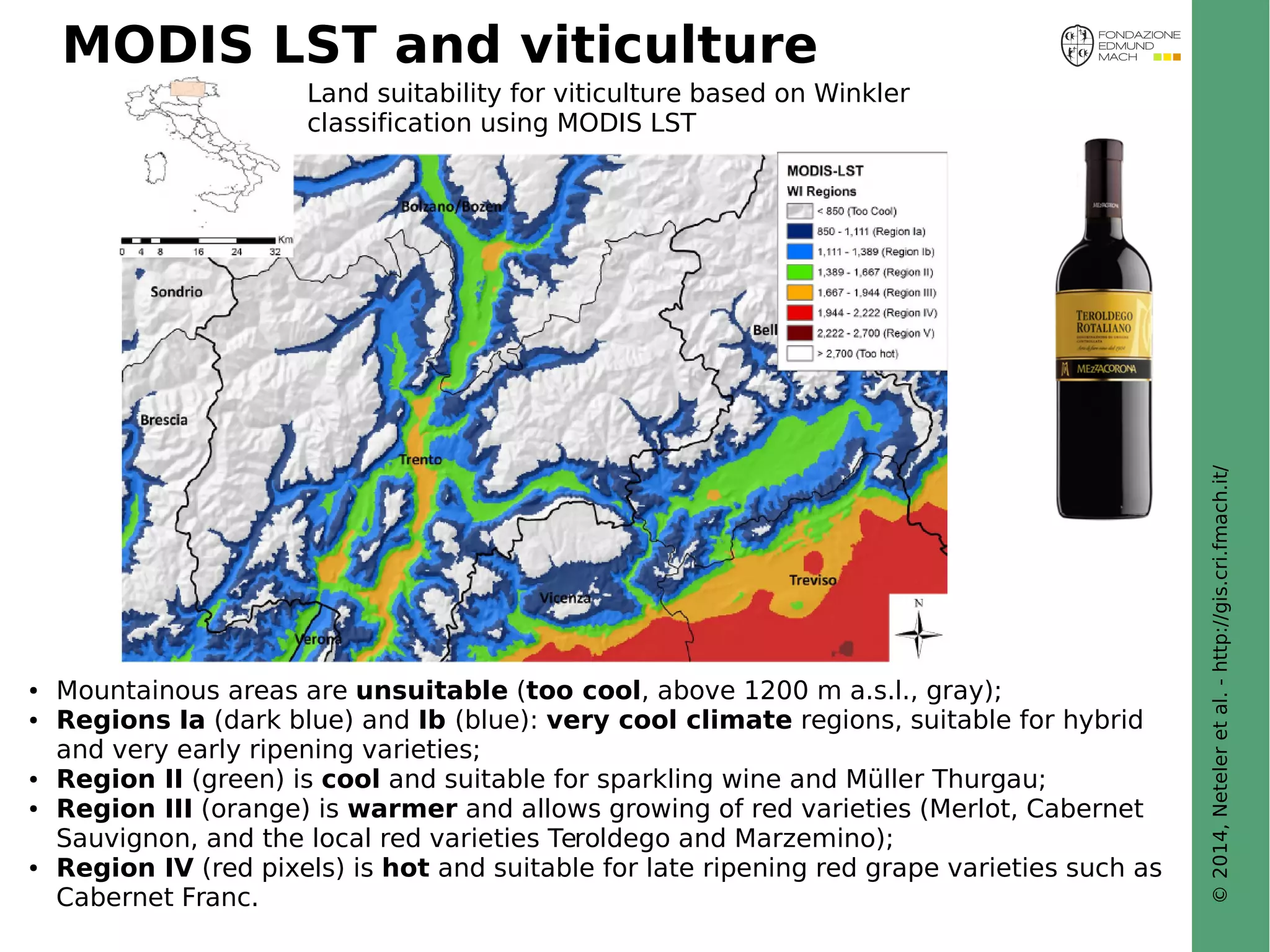
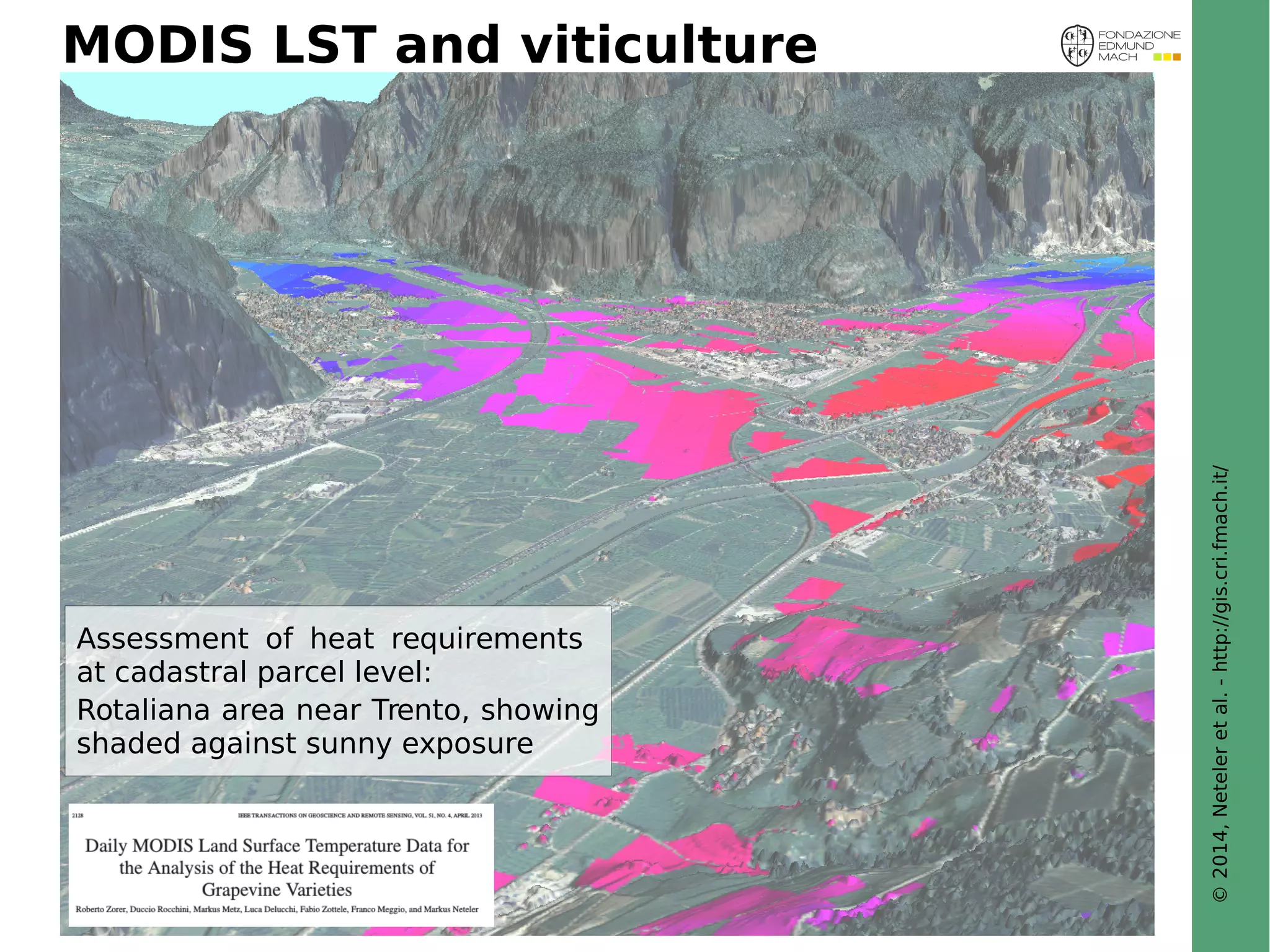
MODIS LST and viticulture 
Land suitability for viticulture based on Winkler 
classification using MODIS LST 
● Mountainous areas are unsuitable (too cool, above 1200 m a.s.l., gray); 
● Regions Ia (dark blue) and Ib (blue): very cool climate regions, suitable for hybrid 
and very early ripening varieties; 
● Region II (green) is cool and suitable for sparkling wine and Müller Thurgau; 
● Region III (orange) is warmer and allows growing of red varieties (Merlot, Cabernet 
Sauvignon, and the local red varieties Teroldego and Marzemino); 
● Region IV (red pixels) is hot and suitable for late ripening red grape varieties such as 
Cabernet Franc.
© 2014, Neteler et al. - http://gis.cri.fmach.it/ 
MODIS LST and viticulture 
Assessment of heat requirements 
at cadastral parcel level: 
Rotaliana area near Trento, showing 
shaded against sunny exposure
© 2014, Neteler et al. - http://gis.cri.fmach.it/ 
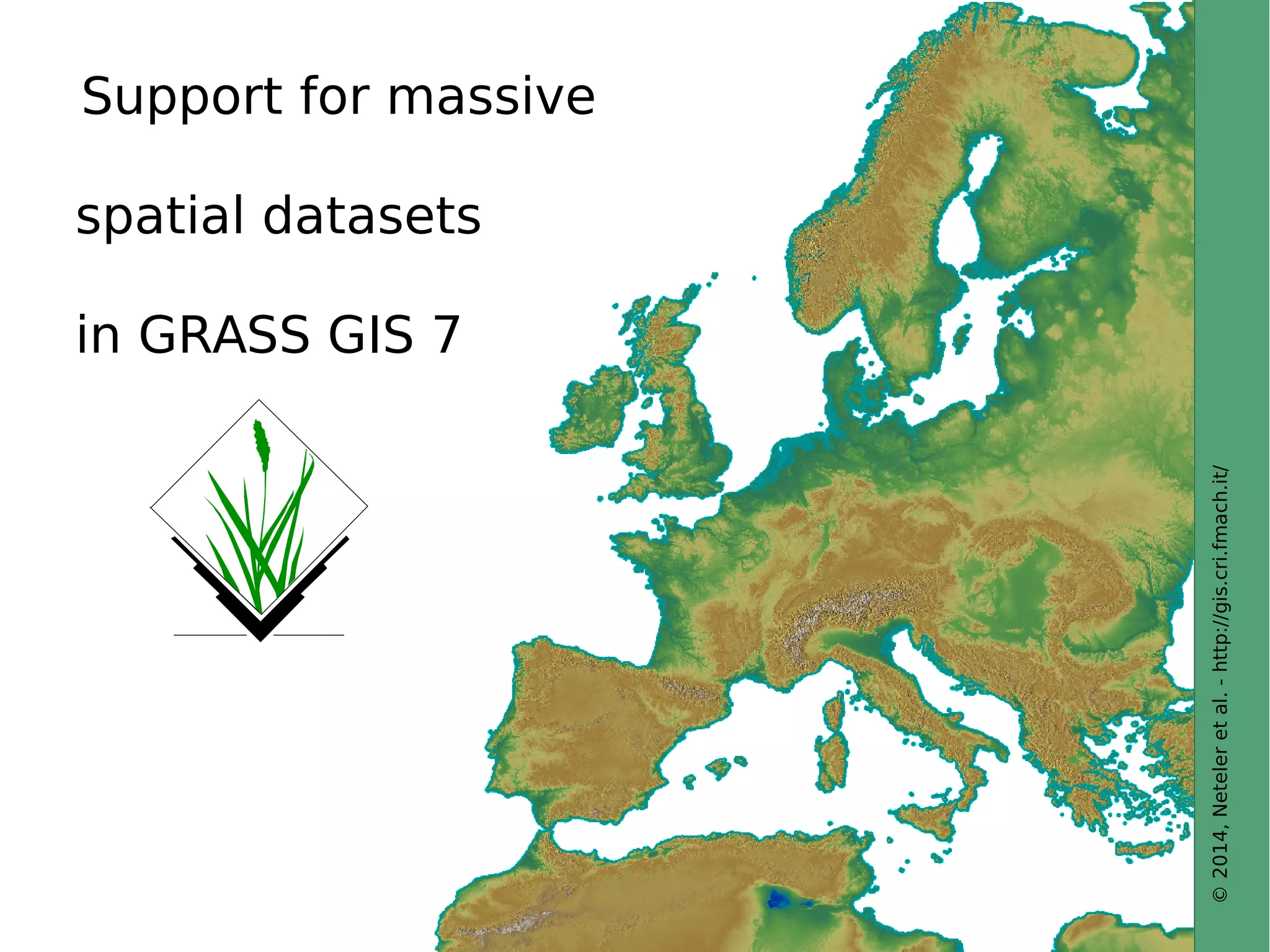
Support for massive 
spatial datasets 
in GRASS GIS 7
© 2014, Neteler et al. - http://gis.cri.fmach.it/ 
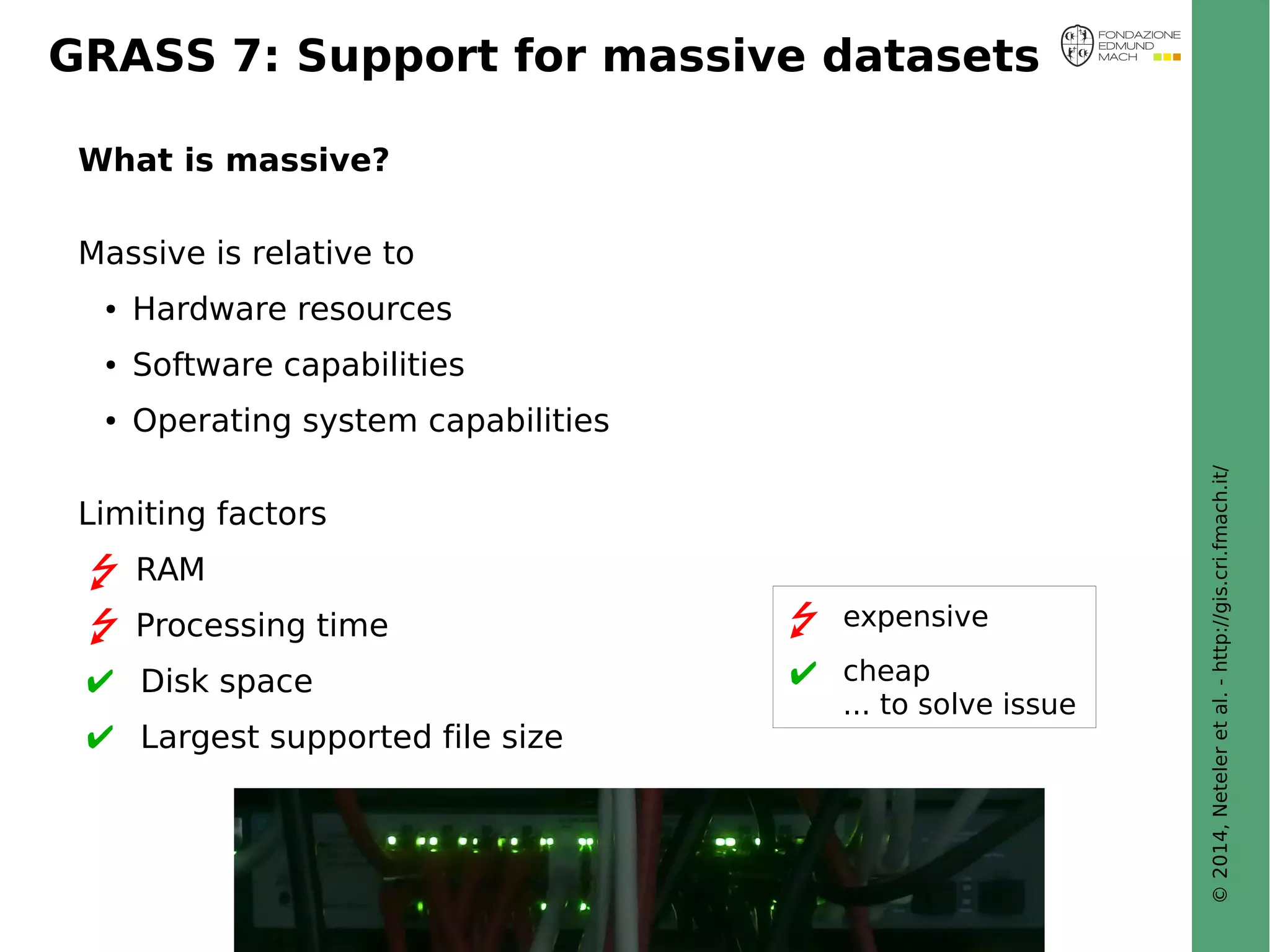
GRASS 7: Support for massive datasets 
What is massive? 
Massive is relative to 
● Hardware resources 
● Software capabilities 
● Operating system capabilities 
Limiting factors 
RAM 
Processing time 
Disk space 
Largest supported file size 
expensive 
cheap 
... to solve issue 

© 2014, Neteler et al. - http://gis.cri.fmach.it/ 
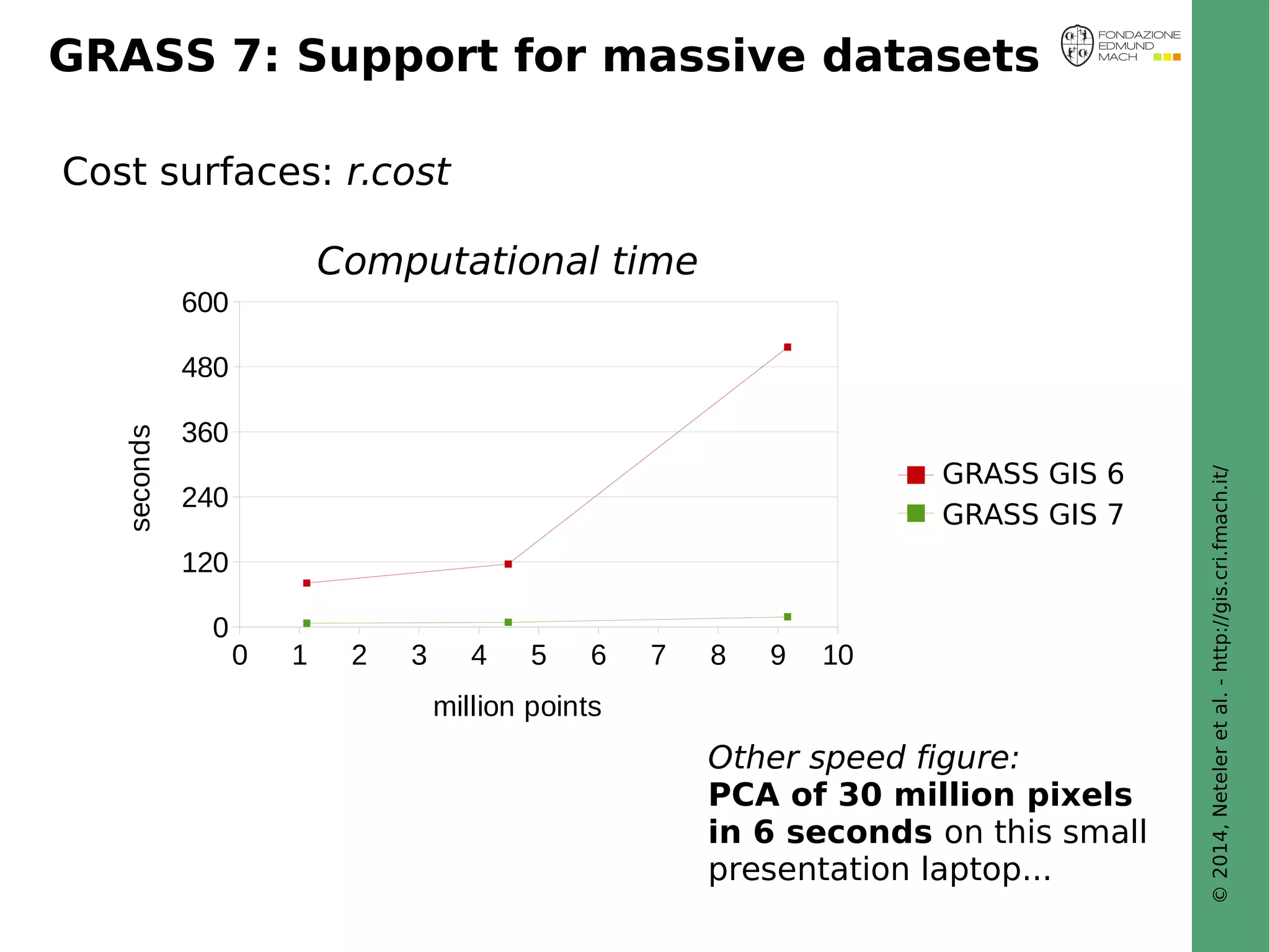
GRASS 7: Support for massive datasets 
0 1 2 3 4 5 6 7 8 9 10 
600 
480 
360 
240 
120 
0 
million points 
seconds 
GRASS GIS 6 
GRASS GIS 7 
Other speed figure: 
PCA of 30 million pixels 
in 6 seconds on this small 
presentation laptop... 
Cost surfaces: r.cost 
Computational time
© 2014, Neteler et al. - http://gis.cri.fmach.it/ 
MODIS Land Surface Temperature 
LST reconstruction 
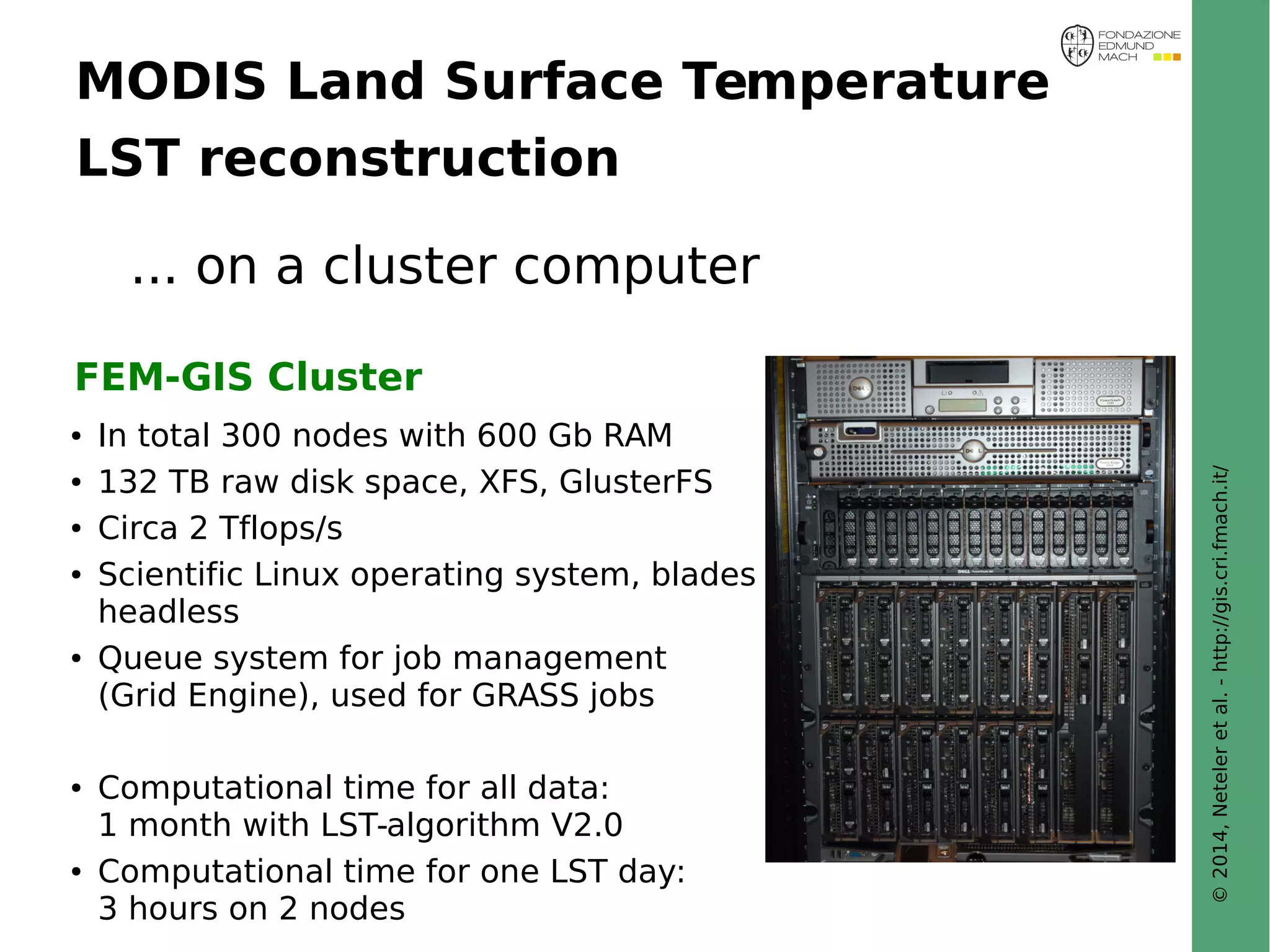
... on a cluster computer 
FEM-GIS Cluster 
● In total 300 nodes with 600 Gb RAM 
● 132 TB raw disk space, XFS, GlusterFS 
● Circa 2 Tflops/s 
● Scientific Linux operating system, blades 
headless 
● Queue system for job management 
(Grid Engine), used for GRASS jobs 
● Computational time for all data: 
1 month with LST-algorithm V2.0 
● Computational time for one LST day: 
3 hours on 2 nodes
© 2014, Neteler et al. - http://gis.cri.fmach.it/ 
“Big data” challenges on a cluster 
GRASS GIS – LST data processing “evolution”: 
● 2008: internal 10Gb network connection way to slow... 
Solution: TCP jumbo frames enabled (MTU > 8000) to 
speed up the internal NFS transfer 
 
● 2009: hitting an ext3 filesystem limitation (not more than 
32k subdirectories but more files in cell_misc/ – each raster 
maps consists of multiple files) 
Solution: adopting XFS filesystem [err, reformat everything] 
 
● 2012: Free inodes on XFS exceeded 
Solution: Update XFS version [err, reformat everything again] 
 
● 2013: I/O saturation in NFS connection between chassis and 
blades 
Solution: reduction to one job per blade (queue management), 
21 blades * 2.5 billion input pixels + 415 million output pixels 
 
● GlusterFS saturation 
Solution: New 48 port switch, 8-channel trunking (= 8 Gb/s) 

© 2014, Neteler et al. - http://gis.cri.fmach.it/ 
Conclusions & Thanks 
● Massive data processing in GRASS GIS 7: 
most “homework” has been done 
● Large file support for raster and vector data 
● Temporal data processing framework available 
● New Python API integrated (PyGRASS) 
● New reconstructed MODIS LST dataset available 
● Next steps: 
● Add new big data interfaces to analyse data remotely 
(rasdaman, sciDB interfaces?) 
Markus Neteler 
Fondazione E. Mach (FEM) 
Centro Ricerca e Innovazione 
GIS and Remote Sensing Unit 
38010 S. Michele all'Adige (Trento), Italy 
http://gis.cri.fmach.it 
http://www.osgeo.org 
Thanks to NASA Land Processes Distributed Active Archive 
Center (LP DAAC) for making the MODIS LST data available.

Deriving environmental indicators from massive spatial time series using open source GIS

  • 1.
    © 2014, Neteleret al. - http://gis.cri.fmach.it/ Markus Neteler Joint work with D. Rocchini, L. Delucchi, M. Metz Deriving environmental indicators from massive spatial time series using open source GIS NSCU Geoforum Talks 4 Sept 2014 4.8T /grassdata/eu_laea/modis_lst_reconstructed 3.6T /grassdata/eu_laea/modis_lst_reconstructed_europe_daily 2.0T /grassdata/eu_laea/modis_lst_reconstructed_europe_GDD 1.1T /grassdata/eu_laea/modis_lst_reconstructed_europe_weekly ... 48G /grassdata/eu_laea/modis_lst_koeppen 22G /grassdata/eu_laea/modis_lst_reconstructed_europe_annual 40G /grassdata/eu_laea/modis_lst_reconstructed_europe_bioclim 275G /grassdata/eu_laea/modis_lst_reconstructed_europe_monthly 38G /grassdata/eu_laea/modis_lst_reconstructed_europe_monthly_averages 15G /grassdata/eu_laea/modis_lst_reconstructed_europe_winkler 55G /grassdata/eu_laea/modis_lst_validation_europe
  • 2.
    © 2014, Neteleret al. - http://gis.cri.fmach.it/ Fondazione Edmund Mach, Trento, Italy ● Founded 1874 as IASMA - Istituto Agrario San Michele all'Adige (north of Trento, Italy) ● Research Centre + Tech. Transfer Center + highschool, ~ 800 staff ● … of those 350 staff in research (Environmental research, Agro- Genetic research, Food safety) PGIS: http://gis.cri.fmach.it S. Michele all'Adige
  • 3.
    © 2014, Neteleret al. - http://gis.cri.fmach.it/ PGIS unit: Open Source GIS Development http://grass.osgeo.org http://www.grassbook.org
  • 4.
    © 2014, Neteleret al. - http://gis.cri.fmach.it/ PGIS unit: remote sensing and diseases/vectors http://gis.cri.fmach.it/publications/
  • 5.
    © 2014, Neteleret al. - http://gis.cri.fmach.it/ Environmental factors derived from Remote Sensing Pathogens Vectors Hosts Temperature Precipitation Moisture / Humidity proxies Topography Vegetation cover Land use (incomplete view) e.g. SRTM, ASTER GDEM e.g. MODIS based e.g. MODIS based … not covered here
  • 6.
    © 2014, Neteleret al. - http://gis.cri.fmach.it/ Temperature - available data sets: US United States: PRISM data (30-Year Normals, anomalies, selected monthly data, 800m pixels) http://www.prism.oregonstate.edu/
  • 7.
    © 2014, Neteleret al. - http://gis.cri.fmach.it/ Temperature - available data sets: Europe ECA&D - http://www.ecad.eu/ ~ 25 km pixels, 60 years, daily Monthly Tmean: 1950-2013 (derived from daily ECA&D time series) FEM meteo station data versus ECAD time series
  • 8.
    © 2014, Neteleret al. - http://gis.cri.fmach.it/ The MODIS Sensor: > 13 years of data The MODIS sensor on board of NASA's Terra and Aqua satellites ● Sensor with 36 channels in the range of optical light, near and thermal infrared: Vegetation state, snow, temperature, fire detection ... ● Delivers data at 250 m, 500 m and 1000 m pixel resolution ● LST error rate: < 1 K ± 0.7 K MODIS/Terra satellite (EOS-AM): ● startet in Dec. 1999 ● overpasses at circa 10:30 + 22:30 solar local time MODIS/Aqua satellite (EOS-PM): ● startet in May 2002 ● overpasses at circa 13:30 + 01:30 solar local time 4 overpasses in 24h data availability after ~72h Typical MODIS overpass and data coverage (map tiles)
  • 9.
    © 2014, Neteleret al. - http://gis.cri.fmach.it/ EuroLST: MODIS LST daily time series Efforts of gap-filling the MODIS products MOD11A1 + MYD11A1 Reasons for missing pixels: clouds and aerosols United States: Crosson et al. 2012 (Rem Sens Env 119) created a daily merged MODIS LST dataset for conterminous US (1000-m resolution): 16 million grid cells Europe: The new EuroLST (Metz et al. 2014) covers Europe and Northern Africa, and each overpass (250-m resolution), i.e. 4 maps per day: 415 million grid cells Processed data: ● PCA and multiple regression of the six input grids (LST, altitude, solar angle, two principal components, ocean mask) with 415 million grid cells each = 2.4 billion pixels per map reconstruction). Enhancements implemented in GRASS GIS 7. ● In total about 17,000 LST maps processed (each 20 MODIS tiles)
  • 10.
    © 2014, Neteleret al. - http://gis.cri.fmach.it/ EuroLST: MODIS LST daily time series The challenge: gap-filling the data ● The larger European area covers about 12.5 million km2 of land. ● It includes a wide variety of climate zones, ranging from hot, arid zones, to permafrost and from coastal plains to mountains with continental climates. ● Elevation ranges from 420 m below sea level to 5600 m above sea level. ● 4 maps/day = ~ 1440 maps/year for 14 years ● At 250-m spatial resolution, this area consists of 415 million grid cells in total, of which 200 million grid cells fall on land and inland water bodies EuroLST: http://gis.cri.fmach.it/eurolst/ Metz, Rocchini, Neteler, 2014: Remote Sens 6, DOI: 10.3390/rs6053822 + Supplement
  • 11.
    © 2014, Neteleret al. - http://gis.cri.fmach.it/ EuroLST: MODIS LST daily time series 1 2 4 3 We used six additional variables as potential predictors for LST in the regression analysis: ● elevation (SRTM v2.1, gap-filled will ETOPO2/splines, spatially averaged to 250m), ● ocean mask ● solar angle at noon local time (using NREL SOLPOS available in r.sunhours, GRASS GIS 7), ● the first two principal components from: ● annual precipitation (aggregated from ECA&D, 1980-2010), ● mean annual temperature (aggregated from ECA&D, 1980-2010), ● minimum annual temperature (aggregated from ECA&D, 1980- 2010), ● range of annual temperature (aggregated from ECA&D, 1980-2010). Computational effort for each of the 17,000 maps: Six input grids (LST map, altitude, solar angle, two principal components, ocean mask) with about 400 million grid cells each (2.4 * 109 pixel) EuroLST: http://gis.cri.fmach.it/eurolst/
  • 12.
    © 2014, Neteleret al. - http://gis.cri.fmach.it/ EuroLST: MODIS LST daily time series 1 2 1 2 4 3 4 3 EuroLST: http://gis.cri.fmach.it/eurolst/ Metz, Rocchini, Neteler, 2014: Remote Sens 6, DOI: 10.3390/rs6053822 °C
  • 13.
    © 2014, Neteleret al. - http://gis.cri.fmach.it/ EuroLST: MODIS LST daily time series Software used for LST reconstruction [ MODIS Reprojection Tool (MRT 4.1) ] GDAL 1.x PROJ.4 GRASS GIS 7 Grid Engine (gdalwarp V1.11/VRT is much faster than MRT) [1] Scientific Linux 6.x PostGISomics [1] Mosaiking of 20 MODIS LST tiles * 17,000 overpasses reduced from 1 week to 1 day
  • 14.
    © 2014, Neteleret al. - http://gis.cri.fmach.it/ EuroLST: MODIS LST daily time series Example: Land surface temperature for Sep 26 2012, 1:30 pm Metz, Rocchini, Neteler, 2014: Rem Sens, 6(5): 3822-3840 EuroLST: http://gis.cri.fmach.it/eurolst/ Belluno Pixel-wise time series (meteo versus MODIS LST): ... virtual meteo stations °C
  • 15.
    © 2014, Neteleret al. - http://gis.cri.fmach.it/ New EuroLST dataset: Comparison to other datasets (and advantages of using remote sensing time series) Degree Celsius (reconstructed EuroLST) (white dots: meteo stations as base for ECA&D interpolation) Metz, M.; Rocchini, D.; Neteler, M. 2014: Surface temperatures at the continental scale: Tracking changes with remote sensing at unprecedented detail. Remote Sensing. 2014, 6(5): 3822-3840 (DOI | HTML | PDF)
  • 16.
    © 2014, Neteleret al. - http://gis.cri.fmach.it/ MODIS Land Surface Temperature Examples: “Hot” year 2003 and effects in January 2004 January 2004: Lake Garda still “warm” after hot 2003 summer --> local heating effect = insect overwintering facilitated Neteler et al. (2013). PLoS ONE, 8(12): e82090 [DOI]
  • 17.
    © 2014, Neteleret al. - http://gis.cri.fmach.it/ Temperature in space and time Temperature time series Average Minimum Maximum Seasonal temperatures: Winter, spring, summer, autumn Gradients: Spring warming, Autumnal cooling Anomalies, Cool Night Index Growing Degree Days (GDD) Late frost periods New aggregation tools in GRASS GIS 7 ● r.series: pixel-wise aggregation with univariate statistics; ● r.series.accumulate: calculates (accumulated) raster value means (GDD etc); ● r.series.interp: temporal interpolation of missing maps in a time series; ● r.hants (Addon): Fourier based harmonics analysis; ● t.rast.accdetect, t.rast.accumulate, t.rast.aggregate: temporal framework
  • 18.
    © 2014, Neteleret al. - http://gis.cri.fmach.it/ MODIS LST daily time series Example of aggregated data 2003: Deviation from baseline average temperature (baseline: 2002-2012) Aggregated by FEM PGIS
  • 19.
    © 2014, Neteleret al. - http://gis.cri.fmach.it/ BIOCLIM from reconstructed MODIS LST at 250m pixel resolution BIO1 BIO2 BIO3 BIO4 BIO5 BIO6 BIO7 BIO10 BIO1: Annual mean temperature (°C*10) BIO2: Mean diurnal range (Mean monthly (max - min tem)) BIO3: Isothermality ((bio2/bio7)*100) BIO4: Temperature seasonality (standard deviation * 100) BIO5: Maximum temperature of the warmest month (°C*10) BIO6: Minimum temperature of the coldest month (°C*10) BIO7: Temperature annual range (bio5 - bio6) (°C*10) BIO10: Mean temperature of the warmest quarter (°C*10) BIO11: Mean temperature of the coldest quarter (°C*10) Metz, M.; Rocchini, D.; Neteler, M. 2014: Surface temperatures at the continental scale: Tracking changes with remote sensing at unprecedented detail. Remote Sensing. 2014, 6(5): 3822-3840 (DOI | HTML | PDF) BIO11 Selected data download: http://gis.cri.fmach.it/eurolst/
  • 20.
    © 2014, Neteleret al. - http://gis.cri.fmach.it/ New! CONUSLST - MODIS LST daily time series Example: Annual Average 2012 °C Metz, Rocchini, Neteler, 2014: Rem Sens, 6(5): 3822-3840 EuroLST: http://gis.cri.fmach.it/eurolst/ (new 09/2014, yet unvalidated)
  • 21.
    © 2014, Neteleret al. - http://gis.cri.fmach.it/ CONUSLST: New MODIS LST daily time series Example: BIOCLIM04 (2003-2013) Metz, Rocchini, Neteler, 2014: Rem Sens, 6(5): 3822-3840 EuroLST: http://gis.cri.fmach.it/eurolst/ (new 09/2014, yet unvalidated)
  • 22.
    © 2014, Neteleret al. - http://gis.cri.fmach.it/ CONUSLST: New MODIS LST daily time series Example: BIOCLIM04 (2003-2013) California/Nevada subset Metz, Rocchini, Neteler, 2014: Rem Sens, 6(5): 3822-3840 EuroLST: http://gis.cri.fmach.it/eurolst/ (new 09/2014, yet unvalidated)
  • 23.
    © 2014, Neteleret al. - http://gis.cri.fmach.it/ CONUSLST: New MODIS LST daily time series Example: BIOCLIM04 (2003-2013) California subset Metz, Rocchini, Neteler, 2014: Rem Sens, 6(5): 3822-3840 EuroLST: http://gis.cri.fmach.it/eurolst/ (new 09/2014, yet unvalidated)
  • 24.
    © 2014, Neteleret al. - http://gis.cri.fmach.it/ MODIS LST daily time series Nice to have... now what?
  • 25.
    © 2014, Neteleret al. - http://gis.cri.fmach.it/ Did You Ever Meet This Mosquito? Photo (and host): M Neteler
  • 26.
    © 2014, Neteleret al. - http://gis.cri.fmach.it/ Mosquitos are not only a nuisance - Infectious diseases also cause “hidden” problems ...
  • 27.
    © 2014, Neteleret al. - http://gis.cri.fmach.it/ Spread of the tiger mosquito (Aedes albopictus): infectious disease vectors and globalization Yellow fever Dengue West Nile Saint Louis encephalitis Chikungunya De Llamballerie et al., 2008: Chikungunya ● Tiger mosquito: Disease vector ● Spreads in Europe and elsewhere ● Small containers, used tires and lucky bamboo plants are relevant breeding sites ● >250 cases of Chikungunya in northern Italy in 2007 (CHIKv imported by India traveler and was then spread by Ae. albopictus)
  • 28.
    © 2014, Neteleret al. - http://gis.cri.fmach.it/ Neteler et al., 2011: Int J Health Geogr, 10:49, http://www.ij-healthgeographics.com/content/10/1/49 Roiz, D., Neteler, M., et al., 2011: Climatic factors ... tiger mosquito. Plos ONE, 6(4): e14800
  • 29.
    © 2014, Neteleret al. - http://gis.cri.fmach.it/ ECA&D versus MODIS LST (reconstr.) Comparison of models for current habitat suitability of Aedes albopictus Dots: trap positions Fig. 5 Neteler, M., Metz, M., Rocchini, D., Rizzoli, A., Flacio, E., Engeler, L., Guidi, V., Lüthy, P., Tonolla, M. (2013). Is Switzerland suitable for the invasion of Aedes albopictus? PLoS ONE, 8(12): e82090. doi:10.1371/journal.pone.0082090 25km 250m
  • 30.
    © 2014, Neteleret al. - http://gis.cri.fmach.it/ Figure 6. Suitability indicators for Ae. albopictus in Switzerland. Result: Winter survival dominates suitability Neteler M, Metz M, Rocchini D, Rizzoli A, et al. (2013) Is Switzerland Suitable for the Invasion of Aedes albopictus?. PLoS ONE 8(12): e82090. doi:10.1371/journal.pone. 0082090
  • 31.
    © 2014, Neteleret al. - http://gis.cri.fmach.it/ Assessing urban heat islands The example of Milan city, Italy in 2003 Number of combined hot days (>35 °C) and warm nights (>20 °C) ECA&D data set EuroLST (MODIS LST) ~ 25km resolution 250m resolution SRS EPSG: 3035 Refs: ● EEA, http://www.eea.europa.eu/data-and-maps/explore-interactive-maps/heat-wave-risk-of-european-cities-1 ● Metz, Rocchini, Neteler, 2014: Rem Sens, 6(5): 3822-3840 [DOI]
  • 32.
    © 2014, Neteleret al. - http://gis.cri.fmach.it/ MODIS LST and viticulture Land suitability for viticulture based on Winkler classification using MODIS LST ● Mountainous areas are unsuitable (too cool, above 1200 m a.s.l., gray); ● Regions Ia (dark blue) and Ib (blue): very cool climate regions, suitable for hybrid and very early ripening varieties; ● Region II (green) is cool and suitable for sparkling wine and Müller Thurgau; ● Region III (orange) is warmer and allows growing of red varieties (Merlot, Cabernet Sauvignon, and the local red varieties Teroldego and Marzemino); ● Region IV (red pixels) is hot and suitable for late ripening red grape varieties such as Cabernet Franc.
  • 33.
    © 2014, Neteleret al. - http://gis.cri.fmach.it/ MODIS LST and viticulture Assessment of heat requirements at cadastral parcel level: Rotaliana area near Trento, showing shaded against sunny exposure
  • 34.
    © 2014, Neteleret al. - http://gis.cri.fmach.it/ Support for massive spatial datasets in GRASS GIS 7
  • 35.
    © 2014, Neteleret al. - http://gis.cri.fmach.it/ GRASS 7: Support for massive datasets What is massive? Massive is relative to ● Hardware resources ● Software capabilities ● Operating system capabilities Limiting factors RAM Processing time Disk space Largest supported file size expensive cheap ... to solve issue 
  • 36.
    © 2014, Neteleret al. - http://gis.cri.fmach.it/ GRASS 7: Support for massive datasets 0 1 2 3 4 5 6 7 8 9 10 600 480 360 240 120 0 million points seconds GRASS GIS 6 GRASS GIS 7 Other speed figure: PCA of 30 million pixels in 6 seconds on this small presentation laptop... Cost surfaces: r.cost Computational time
  • 37.
    © 2014, Neteleret al. - http://gis.cri.fmach.it/ MODIS Land Surface Temperature LST reconstruction ... on a cluster computer FEM-GIS Cluster ● In total 300 nodes with 600 Gb RAM ● 132 TB raw disk space, XFS, GlusterFS ● Circa 2 Tflops/s ● Scientific Linux operating system, blades headless ● Queue system for job management (Grid Engine), used for GRASS jobs ● Computational time for all data: 1 month with LST-algorithm V2.0 ● Computational time for one LST day: 3 hours on 2 nodes
  • 38.
    © 2014, Neteleret al. - http://gis.cri.fmach.it/ “Big data” challenges on a cluster GRASS GIS – LST data processing “evolution”: ● 2008: internal 10Gb network connection way to slow... Solution: TCP jumbo frames enabled (MTU > 8000) to speed up the internal NFS transfer  ● 2009: hitting an ext3 filesystem limitation (not more than 32k subdirectories but more files in cell_misc/ – each raster maps consists of multiple files) Solution: adopting XFS filesystem [err, reformat everything]  ● 2012: Free inodes on XFS exceeded Solution: Update XFS version [err, reformat everything again]  ● 2013: I/O saturation in NFS connection between chassis and blades Solution: reduction to one job per blade (queue management), 21 blades * 2.5 billion input pixels + 415 million output pixels  ● GlusterFS saturation Solution: New 48 port switch, 8-channel trunking (= 8 Gb/s) 
  • 39.
    © 2014, Neteleret al. - http://gis.cri.fmach.it/ Conclusions & Thanks ● Massive data processing in GRASS GIS 7: most “homework” has been done ● Large file support for raster and vector data ● Temporal data processing framework available ● New Python API integrated (PyGRASS) ● New reconstructed MODIS LST dataset available ● Next steps: ● Add new big data interfaces to analyse data remotely (rasdaman, sciDB interfaces?) Markus Neteler Fondazione E. Mach (FEM) Centro Ricerca e Innovazione GIS and Remote Sensing Unit 38010 S. Michele all'Adige (Trento), Italy http://gis.cri.fmach.it http://www.osgeo.org Thanks to NASA Land Processes Distributed Active Archive Center (LP DAAC) for making the MODIS LST data available.